A Preliminary Study of Disputation Behavior in Online Debating Forum
Zhongyu Wei1,2, Yandi Xia1, Chen Li1, Yang Liu1 Zachary Stallbohm1,Yi Li1andYang Jin1
1Computer Science Department, The University of Texas at Dallas Richardson, Texas 75080, USA
2School of Data Science, Fudan University, Shanghai, P.R.China
{zywei,yandixia,chenli,yangl,stallbohm,yili,yangjin}@hlt.utdallas.edu
Abstract
In this paper, we propose a task for qual-ity evaluation of disputing argument. In order to understand the disputation behav-ior, we propose three sub-tasks, detecting disagreement hierarchy, refutation method and argumentation strategy respectively. We first manually labeled a real dataset collected from an online debating forum. The dataset includes 45 disputing argu-ment pairs. The annotation scheme is developed by three NLP researchers via annotating all the argument pairs in the dataset. Two under-graduate students are then trained to annotate the same dataset. We report annotation results from both groups. Then, another larger dataset was annotated and we show analysis of the cor-relation between disputing quality and dif-ferent disputation behaviors.
1 Introduction
With the popularity of the online debating forum such as idebate1, convinceme2 and createdebate3,
researchers have been paying increasing attention to analyze debating content, including identifica-tion of arguing expressions in online debate (Tra-belsi and Zaıane, 2014), recognition of stance in ideological online debates (Somasundaran and Wiebe, 2010; Hasan and Ng, 2014; Ranade et al., 2013b), and debate summarization (Ranade et al., 2013a). However, there is still little research about quality evaluation of debating content.
Tan et al. (2016) and Wei and Liu (2016) stud-ied the persuasiveness of comments in sub-reddit
change my view of Reddit.com. They evaluated
1http://idebate.org/ 2http://convinceme.net
[image:1.595.308.524.222.358.2]3http://www.createdebate.com/
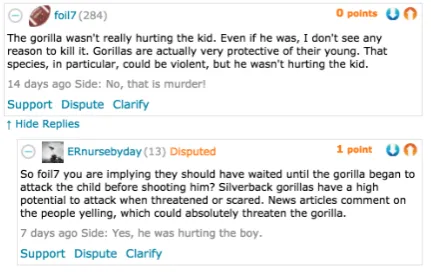
Figure 1: A disputation example from createdde-bate.com (The debating topic is “Should the Go-rilla have died?”)
the effectiveness of different features for the pre-diction of highly voted comments in terms of delta score and karma score respectively. Although they considered some sorts of argumentation related features, such features are merely based on lexi-cal similarity, without modeling persuasion behav-iors.
In this paper, we focus on a particular action in the online debating forum, i.e., disputation. Within debate, disputation happens when a user disagrees with a specific comment. Figure 1 gives a disputation example from the online debating forum createdebate. It presents an original ar-gument and an arar-gument disputing it. Our study aims to evaluate the quality of a disputing com-ment given its original argucom-ment and the discussed topic. In order to have a deep understanding of disputation, we analyze disputation behavior via three sub-tasks, including disagreement hierarchy identification, refutation method identification and argumentation strategy identification.
We first manually labeled a small amount of data collected from createdebate.com. It includes 8 debate threads related to different topics. We
extracted all the 45 disputing pairs from these threads. Each pair contains two arguments and the second one disputes the first one. Three NLP re-searchers (the first three authors of the paper) first developed a rough version of annotation scheme and they annotated all the argument pairs. Based on the annotation feedback and discussioins, they modified the scheme. Two native English speak-ers are then trained to annotate the same dataset. Further, we asked one annotator with better perfor-mance in previous step to annotate a larger set of data. We then analyze the correlation between dis-puting quality and different disputation behaviors. We will introduce annotation schema in Section 2 and then report the annotation result in Section 3. We conclude the paper in Section 4.
2 Annotation Schema
Our annotation is performed on a pair of argu-ments from opposite sides of a specific topic. In each pair, the second argument disputes the first one. Any of them can hold the “supportive” stance to the discussed topic. We define four annota-tion tasks: disagreement hierarchy (DH), refuta-tion method (RM), argumentarefuta-tion strategy (AS) and disputing quality (DQ). The first three are pro-posed to understand the disputation behavior. In the disputing comment, DH indicates how the dis-agreement is expressed, RM describes which part of the original argument is attacked, and AS shows how the argument is formed.
2.1 Disagreement Hierarchy
In order to identify how users express their dis-agreement to the opposite argument, we borrowed the disagreement hierarchy from Paul Graham4.
We modified the original version of the theory by combining some similar categories and proposed a four-level hierarchy. The definition of different types of DH is shown below. Examples of disput-ing comments with different disagreement hierar-chies are shown in Table 1.
a) DH-LV1: Irrelevance. The disagreement barely considers the content of the original ar-gument.
b) DH-LV2: Contradiction. The disagreement simply states the opposing case, with little or no supporting evidence.
4http://paulgraham.com/disagree.html
Table 1: Examples for disagreement hierarchy
original argument
I strongly feel age for smoking and drinking should not be lowered down as it can disturb the hormonal balance of the body!
disputing argument
DH-LV1: Irrelevance
Wat???? You are an idiot! I would definitely give you a down vote! DH-LV2: Contradiction
I do not think this correct, it is impossible to be accepted. DH-LV3: Target Losing Argument
So this age 21 thing is really stupid cause like i said minors still get hold to alcoholic beverages. (Age limit is non-sense because teen-age can always have alcohol.)
DH-LV4: Refutation
Getting involved in a war will also hurt your body as drinking and smok-ing, but the age limit is 18 instead of 21.
c) DH-LV3: Target Losing Argument. The disagreement is contradiction plus reasoning and/or evidence. However, it aims at some-thing slightly different from the original argu-ment.
d) DH-LV4: Refutation. Refutation is a counter-argument quoting content from the original ar-gument. The quoting can be either explicit or implicit.
2.2 Refutation Method
When a disputing comment is labeled as refuta-tion, we will further identify its refutation method. This sub-task is proposed to indicate what aspect of the original argument is attacked by the disput-ing one. Three categories are given for this sub-task according to the theory ofrefutation methods
proposed by Freeley and Steinberg (2013). Exam-ples for disputing comments using different refu-tation methods are shown in Table 2.
a) RM-F: refute fallacy. Refutation is performed by attacking the fallacy of the original argu-ment. This usually happens when the target of the attack is the correctness of the claim itself in the original argument.
b) RM-R: refute reasoning. Refutation is per-formed by attacking the reasoning process demonstrated in the original argument.
c) RM-E: refute evidence. Refutation is per-formed by attacking the correctness of the evi-dence given in the original argument.
2.3 Argumentation Strategy
Table 2: Examples for refutation methods (OA: original argument; DA: disputing argument)
RM-F: refute fallacy
OA: Humans are not animal’s and dont say that we evolved from mon-keys because we did not
DA: dont say that we evolved from monkeys because we did not http://en.wikipedia.org/wiki/Human evolution And there’s a long list of references and further reading down there.
RM-R: refute reasoning
OA: There is supposed to be equal protection under the law. If we give some couples benefits for being together we need to give it to the rest. DA: Talking about the 14th Amendment’s Equal Protection Clause? That was talking about slavery.
RM-E: refute evidence
OA: Dont say that we evolved from monkeys because we did not http://en.wikipedia.org/wiki/Human evolution And there’s a long list of references and further reading down there.
DA: Evolution is fake God made you retard learn it. Also Wikipedia is sooooooooo wrong random people put stuff in there and the creator does not even care Yah Fools
of Argumentation5 and the work of Walton et
al. (2008). In our research, we employ the classi-fication version from Toulmin because it is much simpler. Six categories are used to indicate the ar-gumentation strategy used in the disputing argu-ment. Note that this label should be given based on user’s intention instead of the quality of the ar-gument. For example, users might choose inap-propriate evidence to support the disputing claim. We will still treat it asgeneralization. Examples of arguments with different argumentation strategies are shown in Table 3.
a) Generalization. Argument by generalization assumes that a number of examples can be ap-plied more generally.
b) Analogy. Argument by analogy examines al-ternative examples in order to prove that what is true in one case is true in the other.
c) Sign. Argument by sign asserts that two or more things are so closely related that the pres-ence or abspres-ence of one indicates the prespres-ence or absence of the other.
d) Cause. Argument by cause attempts to estab-lish a cause and effect relationship between two events.
e) Authority. Argument by authority relies on the testimony and reasoning of a credible source. f) Principle. Argument by principle locates a
principle that is widely regarded as valid and shows that a situation exists in which this prin-ciple applies.
g) Other. When no above-mentioned argumenta-tion strategy is identified, we label it as other.
5http://www-rohan.sdsu.edu/˜digger/ 305/toulmin_model.htm
Table 3: Examples for argumentation strategy
Generalization
Look at alan turing; government data collection on him and his homo-sexual tendencies led to his suicide.
Analogy
What has worked for drug decriminalization in the Netherlands should work in the United States.
Sign
Where there’s fire, there’s smoke. Cause
Beer causes drunkenness, or that drunkenness can be caused by beer. Authority
As stated by Wikipedia: human is evolved from animal. Principle
As it says, ”there is a will, there is a way”.
2.4 Debating quality evaluation
We are also interested in the general quality of the disputing comment. We use three categories: bad debate,reasonable debateandgood debate. The label should be assigned based on the content of the disputing argument instead of annotators’ per-sonal preference to the topic.
a) Bad debate. The disagreement is irrelevant or simply states its attitude without any support; the support or reasoning or fallacy is not rea-sonable.
b) Reasonable debate. The disagreement is com-plete including contradiction and related sup-portive evidence or reasoning. However, the argument might be attacked easily.
c) Good debate. The disagreement contains con-tradiction and related supportive evidence or reasoning. Besides, this argument is good and persuasive to some extent.
3 Annotation Result
The annotation is performed on the variantA dataset6 provided by the 3rd workshop on
ar-gumentation mining collected from createde-bate.com. In such forum, each debating thread is about a particular topic and users can initialize a comment with a specific stance. Besides starting a comment, users can also reply to a comment with an intention of supporting, disputing or clarifying. We first work on one subset of the data, namely
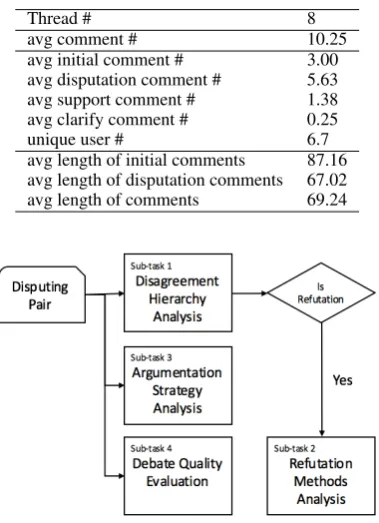
devto develop our annotation scheme and analyze the annotation performance of two laymen annota-tors. The statistics of the originaldevset are given in Table 4. As we can see, more than half of the comments are disputing ones. We extract all dis-puting comments together with their original com-ment to form argucom-ment pairs as the first batch of
Table 4: Statistics of the dev dataset in VariantA from createdebate.com
Thread # 8
avg comment # 10.25
avg initial comment # 3.00
avg disputation comment # 5.63
avg support comment # 1.38
avg clarify comment # 0.25
unique user # 6.7
avg length of initial comments 87.16 avg length of disputation comments 67.02
avg length of comments 69.24
Figure 2: Workflow of the annotation task
our experiment dataset batch-1, 8 threads and 45 pairs of arguments in total.
We also analyze the relationship between dif-ferent disputation behaviors and the quality of the disputing argument. To make this correlation anal-ysis more convincible and also to motivate follow-up research for disputation analysis in the online forum, we collected another batch of annotation on the larger dataset batch-2 from another two sub-sets of variantA (i.e., test and crowdsourc-ing). This batch contains 20 new topics including 93 pairs of disputing arguments. The correlation analysis is then performed on the combination of
batch-1andbatch-2.
3.1 Annotation Result of Expert and Layman on Batch-1
Three NLP researchers work together to define the annotation scheme via annotating all the argument pairs inbatch-1. Two undergraduate students are then hired to annotate the same set of data given two days to finish all the annotation task. A half an hour training session is used for introducing the annotation scheme and demonstrating the annota-tion process via two samples. The work flow of the annotation is shown in Figure 2. Annotators are given the entire thread of the debating to have a
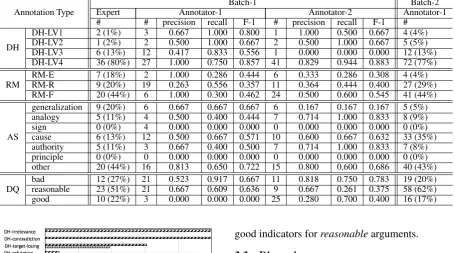
background of the discussion related to this topic. We first look at the label distribution on all the four annotation tasks based on experts’ opinion on batch-1. The annotation scheme changes dur-ing the annotation process via discussion, we thus are not able to provide agreement between ex-perts. For the three disputation behavior annota-tion tasks, experts finalize the label after discus-sion. For the disputing quality evaluation, experts agree on the label forbad debatebut had different opinions about good and reasonable ones, since these are subjective. Therefore, for general qual-ity annotation we take the majorqual-ity. Table 5 shows the detail of the annotation results. For disagree-ment hierarchy, 36 out 45 (80%) disputation are
refutation. For refutation method, 20 (44%) dis-puting comments refute fallacy directly, while 7 (18%) and 9 (20%) refute evidence and reason-ing respectively. For argumentation strategy, 20 (44%) disputing comments do not use any speci-fied methods. Generalizationis the most popular one while nosignandprincipleare found. For the disputing quality, more than half of the comments are labeled as reasonable. Only 10 (22%) are la-beled as good.
We then analyze the annotation result for two laymen annotators using experts’ opinion as ground truth onbatch-1. Generally speaking, the disputation behavior annotation is difficult for lay-men. With only half an hour training, the perfor-mance of both annotators is not very good for la-beling the four tasks. For disagreement hierarchy, annotators seem to have problems to distinguish
target losing argumentandrefutation. Annotator-1 mis-labels too many instances asttarget losing argumentwhile annotator-2 gives only 1 such an-notation. The lowest accuracy comes from refu-tation method identification. This is because the task requires deep understanding and analysis of argument. For disputing quality evaluation, it is easier for annotators to identify thebadargument. Distinguishing good and reasonable disputing is much more difficult. This is because the differ-ence between them is very subjective.
3.2 Correlation of Disputation Behavior and Disputing Quality
With the same strategy, we further construct and annotate the second batch of experiment dataset
Table 5: Annotation results
Annotation Type Expert Annotator-1 Batch-1 Annotator-2 Annotator-1Batch-2
# # precision recall F-1 # precision recall F-1 #
DH
DH-LV1 2 (1%) 3 0.667 1.000 0.800 1 1.000 0.500 0.667 4 (4%)
DH-LV2 1 (2%) 2 0.500 1.000 0.667 2 0.500 1.000 0.667 5 (5%)
DH-LV3 6 (13%) 12 0.417 0.833 0.556 1 0.000 0.000 0.000 12 (13%)
DH-LV4 36 (80%) 27 1.000 0.750 0.857 41 0.829 0.944 0.883 72 (77%)
RM RM-ERM-R 7 (18%)9 (20%) 192 1.0000.263 0.5560.286 0.3570.444 116 0.3640.333 0.4440.286 0.4000.308 4 (4%)27 (29%)
RM-F 20 (44%) 6 1.000 0.300 0.462 24 0.500 0.600 0.545 41 (44%)
AS
generalization 9 (20%) 6 0.667 0.667 0.667 6 0.167 0.167 0.167 5 (5%)
analogy 5 (11%) 4 0.500 0.400 0.444 7 0.714 1.000 0.833 8 (9%)
sign 0 (0%) 4 0.000 0.000 0.000 0 0.000 0.000 0.000 0 (0%)
cause 6 (13%) 12 0.500 0.667 0.571 10 0.600 0.667 0.632 33 (35%)
authority 5 (11%) 3 0.667 0.400 0.500 7 0.714 1.000 0.833 7 (8%)
principle 0 (0%) 0 0.000 0.000 0.000 0 0.000 0.000 0.000 0 (0%)
other 20 (44%) 16 0.813 0.650 0.722 15 0.800 0.600 0.686 40 (43%)
DQ badreasonable 12 (27%)23 (51%) 2121 0.5230.667 0.6090.917 0.6360.667 119 0.6670.818 0.2610.750 0.3750.783 19 (20%)58 (62%)
good 10 (22%) 3 0.000 0.000 0.000 25 0.280 0.700 0.400 16 (17%)
Figure 3: The correlation between disputation be-haviors and disputing quality (binary setting) on
batch-1+batch-2.
with the annotator to enhance his understanding about the annotation task. The annotation result ofbatch-2can be seen in Table 5. We then report the correlation result between disputation behav-iors and disputing quality of the arguments on the combination ofbatch-1andbatch-2.
For the correlation analysis, we report the label distribution in terms of disputing quality for argu-ments with different disputation labels. Consid-ering the difference between a “good disputing” and a “reasonable disputing” is hard to decide, we treat both reasonable and good as reasonable to form a binary setting. Figure 3 shows the correla-tion between disputacorrela-tion behaviors and disputing quality. As we can see, all the arguments labeled asDH-irrelevanceandDH-contradictionarebad
ones, and 91.7% of DH-refutationarguments are
reasonable. For argumentation strategy, analogy
(100%),cause(89.7%) andauthority(91.7%) are
good indicators forreasonablearguments.
3.3 Discussion
We identified two major reasons for annotation er-rors after result analysis on batch-1. First, some categories within sub-tasks are difficult to distin-guish in nature (e.g. target losing argument and refutation). Second, some disputing comments contain multiple claims and premises. This makes it difficult to identify the essential claim of the dis-putation. We believe we can improve the annota-tion performance in future work by: a) extend the time for training session and pick some representa-tive samples for demonstration; b) modify the an-notation scheme to avoid the ambiguity between categories; c) preprocess the disputing comment to identify the essential argument for better anno-tation.
4 Conclusion
In this paper, we analyzed the disputation action in the online debate. Four sub-tasks were pro-posed including disagreement hierarchy identifi-cation, refutation method identifiidentifi-cation, argumen-tation strategy identification and disputing quality evaluation. We labeled a set of disputing argument pairs extracted from a real dataset collected in cre-ateddebate.com and showed annotation results.
Acknowledgments
References
Austin Freeley and David Steinberg. 2013.
Argumen-tation and debate. Cengage Learning.
Kazi Saidul Hasan and Vincent Ng. 2014. Why are you taking this stance? identifying and classifying
reasons in ideological debates. InEMNLP, pages
751–762.
Sarvesh Ranade, Jayant Gupta, Vasudeva Varma, and Radhika Mamidi. 2013a. Online debate summa-rization using topic directed sentiment analysis. In Proceedings of the Second International Workshop on Issues of Sentiment Discovery and Opinion
Min-ing. ACM.
Sarvesh Ranade, Rajeev Sangal, and Radhika Mamidi. 2013b. Stance classification in online debates by
recognizing users? Intentions. In SigDial, pages
61–69.
Swapna Somasundaran and Janyce Wiebe. 2010. Rec-ognizing stances in ideological on-line debates. In Proceedings of the NAACL HLT 2010 Workshop on Computational Approaches to Analysis and Genera-tion of EmoGenera-tion in Text, pages 116–124. Association for Computational Linguistics.
Chenhao Tan, Vlad Niculae, Cristian Danescu-Niculescu-Mizil, and Lillian Lee. 2016. Winning arguments: Interaction dynamics and persuasion
strategies in good-faith online discussions. arXiv
preprint arXiv:1602.01103.
Amine Trabelsi and Osmar R Zaıane. 2014. Finding arguing expressions of divergent viewpoints in
on-line debates. InProceedings of the 5th Workshop
on Language Analysis for Social Media (LASM)@
EACL, pages 35–43.
Douglas Walton, Christopher Reed, and Fabrizio
Macagno. 2008. Argumentation schemes.
Cam-bridge University Press.