Towards Temporal Segmentation of Patient History
in Discharge Letters
Galia Angelova
Institute of Information and Commu-nication Technologies, Bulgarian Academy of Sciences (IICT-BAS)
Sofia, Bulgaria [email protected]
Svetla Boytcheva IICT-BAS and
University of Library Studies and In-formation Technologies
Sofia, Bulgaria
Abstract
This paper reports about ongoing work in au-tomatic identification of temporal markers and segmentation of patient histories into episodes. We discuss the discourse structure of the
Anamnesesin Bulgarian hospital discharge
let-ters and present experiments with a corpus of 1,375 anonymised discharge letters of patients with endocrine and metabolic diseases. Our IE prototype discovers 32,445 key terms in the corpus, among them more that 7,000 rences of drug names and about 7,500 occur-rences of diagnoses. The temporal markers oc-cur 8,248 times usually paired with tokens pointing the direction of time “forward” or “backwards”. Temporal markers are identified with precision 84%, recall 57% and f-measure 67.9%.
1 Introduction
Medical informatics has made little progress in the temporal representation and reasoning tasks [1]. This is partly due to the complexity of the free text descriptions in clinical narratives where temporal information is presented. On the other hand, there is no agreement about the essence of clinical temporal models and the concepts and relationships that have to be taken into account. Research on temporal information interpretation is still in its embryonic stage according to [2]. The progress requires theoretic models as well as large training corpora of annotated medical texts which are expensive to construct.
This paper summarises work in progress on discharge letters structuring and experiments in automatic extraction of temporal markers. We deal with discharge letters in Electronic Health Records (EHR) in Bulgarian language. These letters contain predefined sections due to the general practice of structuring clinical notes into sections which dates back to the 60's and 70's of
the last century as a result of centralised regula-tions1. Our present IE system, which analyses discharge letter texts, automatically identifies the Anamnesis (Patient history). This section con-tains a sketchy abstract, manually prepared by medical experts, who summarise the patient his-tory in order to communicate it to another doctor. Explicit temporal markers designate the main phases in disease development, the main inter-ventions and their effects. The unified text for-mat is a motivation for its inclusion in methods for automatic episode recognition. Our main idea is to select a discourse structure theory and to try extracting pieces of information that have mean-ings as discourse units. The paper presents our first results in this direction.
Section 2 overviews related approaches. Sec-tion 3 considers the context of our work: the dis-course structure of discharge letters and existing prototypes for section splitting and information extraction. Section 4 presents the evaluation of the current component for automatic extraction of temporal markers as well as our research agenda for building timelines of clinical events. Section 5 contains the conclusion.
2 Related Work
Research on temporal information processing is a relatively recent activity in biomedical NLP. Savova et al. [4] presents an annotation schema with temporal relations based on TimeML [5] and analyses the potential of TimeML tags as annotation tool for clinical narratives. The gener-al objective is to build a temporgener-al relation dis-covery component and a reasoner to create time-lines of clinically relevant concepts. The authors consider five Event classes including Occurence (events that happened) and State(a condition or
1The list of sections in Bulgarian hospital discharge letters
state, e.g. symptoms, descriptors and chronic conditions). The paper explicates important fine-grained characteristics of events and temporal relations in clinical texts which are related to lin-guistic units.
Five tags for marking up temporal informa-tion are suggested in [6]: reference point, direc-tion, number, time unit, and pattern. The authors identified 254 temporal expressions in 50 dis-charge summaries and represented them using the suggested scheme. The inter-rater agreement was 75% which shows the complexity of tem-poral annotations even when simple tags are used.
Harkema et al. [7] presents an algorithm called ConText which identifies clinical condi-tions that are described in clinical reports: they can be negated, hypothetical, historical, or expe-rienced by someoneother than the patient. Con-Text infers the status of a condition with regard to these properties from simple lexical clues oc-curring in the context of the condition. The study deals with 4,654 annotations from 240 clinical reports: 2,377 annotated conditions in the devel-opment set and 2,277 annotated conditions in the test set. The evaluation summarises results ob-tained in a six-token window (stw) and end-of-sentence (eos) contexts. For “historical” condi-tion, ConText achieves stw precision 78% and recall 70% as well as eosprecision 77% and re-call 79% across all report types that contain such conditions.
Hripcsak et al. model temporal information as contraint satisfaction problem [8]. Medical events from 231 discharge summaries are represented as intervals, and assertions about events are represented as constraints. Up to 151 medical events and 388 temporal assertions were identified per complete discharge summary. Non-definitional assertions were explicit (36%) or implicit (64%) and absolute (17%), qualitative (72%), or metric (11%). Implicit assertions were based on domain knowledge and assumptions, e.g., the section of the report determined the or-dering of events. The source texts contained no instances of discontinuous temporal disjunction. The authors conclude that a simple temporal constraint satisfaction problem appears sufficient to represent most temporal assertions in dis-charge summaries and may be useful for encod-ing electronic medical records.
In our present work, we are mostly influenced by [6], which is attractive because of its relative simplicity, and [8].
3 Project context
The general objectives of our project are: (i) to develop a system for knowledge extraction from discharge letter texts and (ii) to design algo-rithms for searching conceptual patterns in the extracted clinical facts. Recognising the events and ordering them in timelines is an essential part of the project research agenda.
3.1 Materials
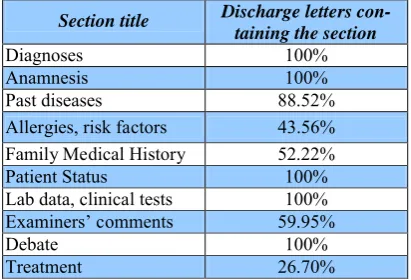
The discharge letters in our corpus contain sec-tions which can be automatically recognised with accuracy 99.99% using their headers. Sometimes the structure is not strictly kept due to section merging, changing the section headers, skipping (empty) sections and replacing the default sec-tion sequence. Table 1 shows the percentage of discharge letters with available standard sections in the corpus of 1,375 EHRs.
Section title Discharge letters con-taining the section
Diagnoses 100%
Anamnesis 100%
Past diseases 88.52%
Allergies, risk factors 43.56%
Family Medical History 52.22%
Patient Status 100%
Lab data, clinical tests 100%
Examiners’ comments 59.95%
Debate 100%
[image:2.595.304.510.334.474.2]Treatment 26.70%
Table 1. Formatting discharge letters according to centralised state regulations
Having the potential to identify automatically the Anamnesis section, which contains the pa-tient history, we can plan further research tasks related to its temporal segmentation.
3.2 Methods
We have developed extractors of ICD-10 codes (the International Classification of Diseases, v. 102) and ATC codes (the Anatomical Therapeu-tic Chemical Classification System3) from dis-charge letter texts [9, 10, 11]. The tool for diag-nosis extraction assigns ICD-10 codes to Bulga-rian nominal phrases designating disease names with 84.5% precision [9]. The drug extractor as-signs ATC codes to Bulgarian drug names with measure 98.42% and achieves 93.85%
measure for the dosage recognition [10]. Auto-matic extraction of “current treatment” is possi-ble with highest accuracy for the drugs discussed in the Anamnesis(precision 88%, recall 92.45%, f-measure 90.17%, overgeneration 6%) [11].
Figure 1 shows the connections between the text (pre-)processing components that have been developed so far in our projects. The anonymised input discharge letter is split into section; after tokenisation and sentence splitting, the temporal
[image:3.595.144.453.217.458.2]markers are identified and episodes are tagged. Within the episodes, diseases and drugs are rec-ognised by the existing tools. Other entities to be recognised in the episodes are conditions (symp-toms, complains and status) and treatment out-come. The system works on a resource bank of medical nomenclatures, terminologies and lin-guistic resources. The output consists of anno-tated anamneses whit tagged episodes.
Figure 1. Text pre-processing components and extractors of diseases, drug names, and temporal markers
4 Extraction of temporal markers and ideas for structuring episodes
4.1 Evaluation results
We have performed experimental tests with 1,375 discharge letters where our IE prototype discovers 32,445 key terms or markers in the Anamneses (in average 23.59 per discharge let-ter). The distribution of these terminologies and temporal markers is presented in Table 2.
Temporal
Marker Occurrences EHRs Avg
drug names 7,108 1,213 5.86
diagnoses 7,565 1,292 5.86
complains 1,274 841 1.51
temporal 8,248 1,373 6.01
direction 8,249 1,374 6.01
Total 32,445 1,375 23.59
Table 2. Recognised entities in 1,375 discharge letters
[image:3.595.318.495.579.697.2]Not surprisingly the temporal and direction markers occur as pairs, because direction mark-ers point “forward” or “backward” from the time marker. The share of temporal and direction markers is significant (51% in total, see Fig. 2). These figures explicate the importance of tempo-ral information for the case history description.
The present recall in the recognition of the temporal markers in about 57% and the precision is 84% (f-measure 67.9%).
4.2 Segmentation into episodes
In medicine, an episode comprises all activities that are performed between the diagnosis of a disease and its cure (or stabilisation in case of chronic diseases). Studying various approaches to determine and annotate the granularity of tem-poral intervals, we view the patient history epi-sodes as sets of events defined via the explicit temporal markers stated by the physicians who examine and treat the patients.
Most discharge letters in our corpus concern patients with endocrine and metabolic diseases diagnosed decades ago. In general only the major illness phases are discussed in the Anamnesis together with the treatment and medication changes. We consider below an example of a case history written in 2010:
Example 1. Diabetes Mellitus diagnosed 5-6 years ago, manifested by most symptoms. At the beginning started treatment with Maninil only, after-wards in combination with Siofor. After few months the Maninil was re-placed by Diaprel. Since October 2005 treated with Insulin Novomix 30 – 32E in the morning, 26E in the evening with diagnosed diabetic retinopathy. Complains of strong pains in the feet mostly at night.
We believe that human experts declare ex-plicitly the most important temporal markers which are sufficient (in their view) to adequately and unambiguously communicate the case histo-ry to another medical doctor. Therefore, we con-sider these markers as intentional signals for dis-course segmentation. Our temporal model is framed using three tags suggested in [6]:
reference point, direction, and temporal expression
plus additional tags needed for our project: diagnoses or disorders,
complains or symptoms,
drugs/treatment appliedas well as treatment outcome.
There could be several diagnoses or symp-toms enumerated in one episode as well as more than one drug correspondingly prescribed to the patient.
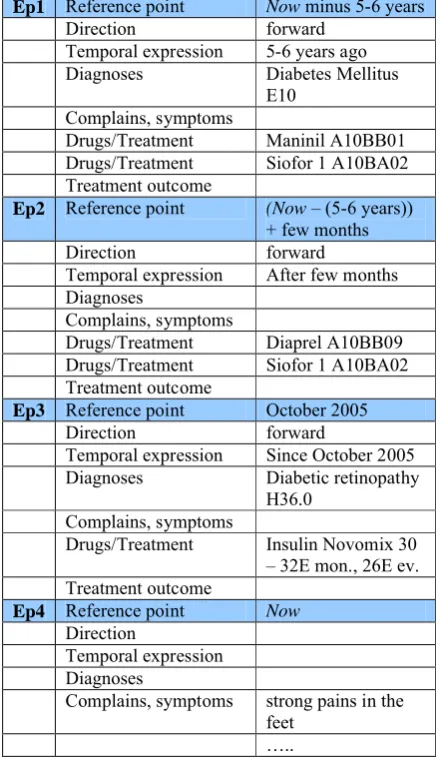
Let us consider the episodes in Example 1 which are defined by the explicit temporal ex-pressions. Interpreting the text and ordering the
temporal markers in a time progression scale ac-cording to the concrete moments, we construct the representation shown in Table 3. The conven-tional literal ′now′ denotes the speech/writing moment, in this case the moment of hospitalisa-tion in 2010. Table 3 integrates the results of two extractors that were referred to in Section 3.2.
Ep1 Reference point Nowminus 5-6 years
Direction forward
Temporal expression 5-6 years ago
Diagnoses Diabetes Mellitus
E10 Complains, symptoms
Drugs/Treatment Maninil A10BB01
Drugs/Treatment Siofor 1 A10BA02
Treatment outcome
Ep2 Reference point (Now– (5-6 years))
+ few months
Direction forward
Temporal expression After few months Diagnoses
Complains, symptoms
Drugs/Treatment Diaprel A10BB09
Drugs/Treatment Siofor 1 A10BA02
Treatment outcome
Ep3 Reference point October 2005
Direction forward
Temporal expression Since October 2005
Diagnoses Diabetic retinopathy
H36.0 Complains, symptoms
Drugs/Treatment Insulin Novomix 30
– 32E mon., 26E ev. Treatment outcome
Ep4 Reference point Now
Direction
Temporal expression Diagnoses
Complains, symptoms strong pains in the feet
[image:4.595.304.525.184.564.2]…..
Table 3. Temporal segmentation with integration of automatic diagnoses and drugs extraction
Studying manually the discharge letters in our corpus, we think that the episodes resemble dis-course segments as introduced in [12]. It seems reasonable to consider every temporal marker as a cue phrase signaling a new episode, because cue phrases express the intention of the writer to emphasize on major disease phases. In Example 1 and Table 3 we can also follow the topical fo-cus shifts[13]: an episode might
the previous episode. For instance, episode 2 which was uttered immediately after episode 1 refers to the entity Maninil introduced in episode 1;
shift the topic and start discussion of another entity like e.g. episode 3.
Practical guidance of how to recognise segments is given in [14] where a discourse segment is viewed as a sequence of clauses that display lo-cal coherence. The following properties are listed as features that should hold within a segment:
(i) Resolution of references should be possi-ble by techniques based on recency; (ii) The time is fixed or there is a simple
pro-gression;
(iii)A fixed set of background assumptions is relevant to all clauses in the segment; (iv)From intentional perspective, all the
sen-tences in the segment contribute to a com-mon discourse purpose, i.e. the same communicative goal motivates the writer to utter all clauses in the segment;
(v) From informational perspective, all the sentences in the segment are related to each other by some temporal, causal or rhetoric relations, i.e. all sentences and phrases combine together to describe a co-herent event or situation.
Following these five properties, we might view the elementaryepisode 1and episode 2as a sin-gle segment because they discuss the progression of the diabetes, while episode 3is focused on the diabetes complication Diabetic retinopathy diag-nosed in 2005. We also note that the clauses in episode 1 and episode 2 form a focus space where the diabetes progress in considered; in computational linguistics the focus spaces are organised in hierarchies and the preferred option is to open each topic only once.
These structural features are seen in most discharge letters that we have studied manually but we are far from final generalisation of our empirical observations. At the end we note that most temporal markers contain explicit refer-ences to time which help to construct the “ele-mentary episodes”. Only 0.014% of the temporal markers contain vague statements like “ long-term diabetes” and only 0.01% use expressions like “since several years/weeks/days”. The rela-tive temporal markers are oriented in two direc-tions:
To the time marker of the immediately pre-ceding previous episode, e.g. since then, be-fore that, after that,etc. and
To the moment Nowwhen the discharge let-ter is written: like e.g. few months ago. Such episodes might elaborate a past event or pe-riod no matter that they are oriented accord-ing to the present moment.
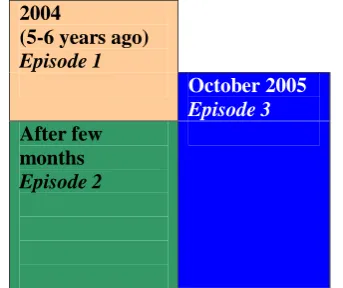
The next task in our research agenda is to de-velop heuristics enabling to automatically posi-tion the temporal markers on a linear time scale with respect to the actual date of hospitalisation which is known in the Hospital Information Sys-tem. In this way the episodes might be ordered in a sequence using a simple procedure which tries to calculate the actual date and constructs a list of linearly-ordered reference points. Moreover, applying the discourse coherence considerations, we could aim at semantic coupling of episodes which discuss the same topic (like episode 1and episode 2that are adjacent and display local co-herence). This seems to be a challenge but one can aim to achieve it because adjacent episodes should be uttered in consecutive sentences deal-ing with the same entities. Figure 3 is obtained in this way. At present we only extract temporal markers and build “elementary” episodes of pa-tient history phases.
2004
(5-6 years ago) Episode 1
October 2005
Episode 3
[image:5.595.326.498.394.538.2]After few months Episode 2
Figure 3. Grouping episodes into segments with local coherence for an Anamnesiswritten in 2010
related to diabetes. Therefore, it is easy to find informational signals that episode 2 belongs to the local context of episode 1.
5 Conclusion
This paper presents work in progress aiming at the automatic segmentation of episodes in the patient history (usually events or periods) as de-scribed in discharge letters.
So far, we have found no case of temporal ambiguity which prohibits the manual annotation (although it is based on human interpretation of the text semantics). Further research needs to be done for designing a heuristic strategy of how to “glue” adjacent groups of clauses together be-cause they display local coherence properties. To solve such a task our system needs to understand which episode elaborates the previous one. The present paper reports first findings in this respect.
Acknowledgments
The research work presented here is supported by grant DO 02-292 "Effective search of conceptual information with applications in medical informatics", funded by the Bulgarian National Science Fund in 2009-2012.
The authors are grateful to the paper review-ers for the useful comments and numerous sug-gestions.
References
1. Zhou L., C. Friedman, S. Parsons, and G. Hripcsak. System architecture for temporal in-formation extraction, representation and rea-soning in clinical narrative reports. In Proc. AMIA Ann. Symp. 2005, pp. 869–873.
2. Zhou L. and G. Hripcsak. Temporal reasoning with medical data - a review with emphasis on medical natural language processing. J. Biom. Informatics 2007, 40(2), pp. 183-202.
3. National Framework Contract between the National Health Insurance Fund, the Bulgarian Medical Association and the Bulgarian Dental Association, Official State Gazette №106 (2005), updates №68(2006)and №101(2006), Sofia, Bulgaria, http://dv.parliament.bg/. 4. Savova, G., S. Bethard, W. Styler, J. Martin,
M. Palmer, J. Masanz, and W. Ward. Towards Temporal Relation Discovery from the Clini-cal Narrative. In Proc. AMIA Annual Sympo-sium 2009, pp. 568–572.
5. Sauri R., J. Littman, B. Knippen, R. Gai-zauskas, A. Setzer and J. Pustejovky. TimeML annotation guidelines, Version 1.2.1, 31
Janu-ary 2006. Available online at
http://www.timeml.org/site/publications/time
MLdocs/annguide_1.2.1.pdf.
6. Hyun S., S. Bakken and S.B. Johnson. Markup of temporal information in electronic health records. In Stud. Health Technologies and In-formatics Vol. 122, 2006, pp. 907-908.
7. Harkema, H., J. Dowling, T. Thornblade, and W. Chapman. Context: An Algorithm for De-termining Negation, Experiencer, and Tem-poral Status from Clinical Reports. J Biomed Inform. 2009 42(5): 839–851.
8. Hripcsak G., L. Zhou, S. Parsons, A. K. Das, and S.B. Johnson. Modeling electronic dis-charge summaries as a simple temporal con-straint satisfaction problem. JAMIA 2005, 12(1), pp. 55-63.
9. Tcharaktchiev, D., G. Angelova, S. Boytche-va, Z. Angelov, and S. Zacharieva. Comple-tion of Structured Patient DescripComple-tions by Se-mantic Mining. In: Koutkias et al. (Eds.), Pa-tient Safety Informatics - Adverse Drug Events, Human Factors and IT Tools for Pa-tient Medication Safety, Stud. Health Techn. Inform. 166, 2011, pp. 260-269.
10. Boytcheva, S. Shallow Medication Extraction from Hospital Patient Records. In: Koutkias Koutkias et al. (Eds.),Patient Safety Informa-tics – Adverse Drug Events, Human Factors and IT Tools for Patient Medication Safety, Stud. Health Techn. Inform. 166, 2011, pp. 119-128.
11. Boytcheva, S., D. Tcharaktchiev and G. An-gelova. Contextualization in automatic extrac-tion of drugs from Hospital Patient Records. In A. Moen et al. (Eds.) User Centred Net-worked Health Case, Proc. of MIE-2011, the 23th Int. Conf. of the European Federation of Medical Informatics, Stud. Health Techn. In-form. 169, 2011, pp. 527-531.
12. Grosz, B. and C. Sidner. Attention, Intention and the Structure of Discourse. Computational Linguistics 1986, 12(3), Reprinted in RNLP. 13. Grosz, B. The representation and use of
fo-cus in a system for understanding dialogues. IJCAI 1977, pp. 67-76, Reprinted in RNLP. 14. Allen, J. Natural Language Understanding,