A Note on Sequential Rule-Based POS Tagging
Sylvain Schmitz
LSV, ENS Cachan & CNRS, Cachan, France
Abstract
Brill’s part-of-speech tagger is defined through a cascade of leftmost rewrite rules. We revisit the compilation of such rules into a single sequential transducer given by Roche and Schabes (Comput. Ling. 1995) and provide a direct construction of the minimal sequential transducer for each individual rule.
Keywords. Brill Tagger; Sequential Trans-ducer; POS Tagging
1 Introduction
Part-of-speech (POS) tagging consists in assigning the appropriate POS tag to a word in the context of its sentence. The program that performs this task, the POS tagger, can be learned from an annotated corpus in case of supervised learning, typically us-ing hidden Markov model-based or rule-based tech-niques. The most famous rule-based POS tagging technique is due to Brill (1992). He introduced a three-parts technique comprising:
1. alexical tagger, which associates a unique POS tag to each word from an annotated training corpus. This lexical tagger simply associates to each known word its most probable tag ac-cording to the training corpus annotation, i.e. a unigram maximum likelihood estimation; 2. anunknown word tagger, which attempts to tag
unknown words based on suffix or capitaliza-tion features. It works like the contextual tag-ger, using the presence of a capital letter and bounded sized suffixes in its rules: for instance in English, a-ablesuffix usually denotes an ad-jective;
3. acontextual tagger, on which we focus in this paper. It consists of a cascade of string rewrite rules, calledcontextual rules, which correct tag assignments based on some surrounding con-texts.
In this note, we revisit the proof that contextual rules can be translated into sequential transducers1 proposed by Roche and Schabes (1995): whereas Roche and Schabes give a separate proof of sequen-tiality and exercise it to show that their constructed non-sequential transducer can be determinized (at the expense of a worst-case exponential blow-up), we give a direct translation of a contextual rule into the minimal normalized sequential transducer, by adapting Simon (1994)’s string matching automa-ton to the transducer case. Our resulting sequential transducers are of linear size (before their composi-tion). A similar construction can be found in (Mi-hov and Schultz, 2007), but no claim of minimality is made there.
2 Contextual Rules
We start with an example by Roche and Schabes (1995): Let us suppose the following sentences were tagged by the lexical tagger (using the Penn Tree-bank tagset):
∗Chapman/NNP killed/VBN John/NNP Lennon/NNP ∗John/NNP Lennon/NNP was/VBD shot/VBD by/IN
Chapman/NNP
He/PRP witnessed/VBD Lennon/NNP killed/VBN by/IN Chapman/NNP
1Historically, what we call here “sequential” used to be called “subsequential” (Sch¨utzenberger, 1977), but we follow the more recent practice initiated by Sakarovitch (2009).
There are mistakes in the first two sentences: killed
should be tagged as a past tense form “VBD”, and
shotas a past participle form “VBN”.
The contextual tagger learns contextual rules over some tagsetΣof formuav→ubv(ora→b / u v using phonological rule notations (Kaplan and Kay, 1994)), meaning that the tag arewrites to b in the context of u v, where the context is of length
|uv| bounded by some fixed k + 1; in practice, k = 2ork = 3(Brill (1992) and Roche and Sch-abes (1995) use slightly differenttemplatesthan the one parametrized by k we present here). For in-stance, a first contextual rule could be “nnp vbn→
nnp vbd” resulting in a new tagging
Chapman/NNP killed/VBD John/NNP Lennon/NNP ∗John/NNP Lennon/NNP was/VBD shot/VBD by/IN
Chapman/NNP
∗He/PRP witnessed/VBD Lennon/NNP killed/VBD by/IN Chapman/NNP
A second contextual rule could be “vbd in →
vbn in” resulting in the correct tagging
Chapman/NNP killed/VBD John/NNP Lennon/NNP John/NNP Lennon/NNP was/VBD shot/VBN by/IN
Chapman/NNP
He/PRP witnessed/VBD Lennon/NNP killed/VBN by/IN Chapman/NNP
As stated before, our goal is to compile the entire sequence of contextual rules learned from a corpus into a single sequential function.
Let us first formalize the semantics we will em-ploy in this note for Brill’s contextual rules.2 Let
C=r1r2· · ·rnbe a finite sequence of string rewrite rules inΣ∗×Σ∗ withΣa POS tagset offixed size.
In practice the rules constructed in Brill’s contextual tagger arelength-preservingand1-change-bounded, i.e. they modify a single letter, but this is not a useful consideration for our transducer construction. Each ruleri ri =ui →videfines aleftmost rewrite relation
=⇒
lm defined by
w=ri⇒
lm w
0 iff∃x, y∈Σ∗, w=xu
iy∧w0 =xviy
∧ ∀z, z0∈Σ∗, w6=zu
iz0∨x≤pref z 2This is not exactly the semantics assumed by either Brill nor Roche and Schabes, who used iterated-application seman-tics, resp. contextual and non contextual, instead of the single-application semantics we use here. This has little practical con-sequence.
wherex≤pref zdenotes thatxis a prefix ofz. Note that the domain of=ri⇒
lm isΣ
∗·ui·Σ∗. Thebehavior
of a single rule is then the relationJriKincluded in
Σ∗×Σ∗ defined byJr
iK = =lmri⇒ ∪ IdΣ∗\(Σ∗·ui·Σ∗),
i.e. it applies=ri⇒
lm onΣ
∗·ui·Σ∗ and the identity on
its complementΣ∗\(Σ∗·ui·Σ∗). The behavior of
C is then the composition JCK = Jr1K # Jr2K #· · ·#
JrnK. Note that this behavior doesnot employ the transitive closure of the rewriting rules.
A naive implementation ofCwould try to match each ui at every position of the input string w in
Σ∗, resulting in an overall complexity of O(|w| ·
P
i|ui|). One often faces the problem of tag-ging asetof sentences{w1, . . . , wm}, which yields O((Pi|ui|)·(Pj|wj|)). As shown in Roche and Schabes’ experiments, compilingCinto a single se-quential transducerT results in practice in huge sav-ings, with overall complexities inO(|w|+|T |)and O(|T |+Pj|wj|)respectively.
EachJriKis a rational function, being the union of two rational functions over disjoint domains. Let|ri| be the length|uivi| ≤k. Roche and Schabes (1995, Sec. 8.2) provide a construction of an exponential-sized transducer Tri for each JriK, and compute their compositionTC of size|TC| = O(Qni=12|ri|).
As they show that each JriK is actually a sequen-tial function, their composition JCKis also sequen-tial, and TC can be determinized to yield a
se-quential transducer T of size doubly exponential inPni=1|ri| ≤ nk (see Roche and Schabes, 1995, Sec. 9.3). By contrast, our construction directly yields linear-sized minimal sequential transducers for each JriK, resulting in a final sequential trans-ducer of sizeO(Qni=1|ri|) =O(2nlogk).
3 Sequential Transducer of a Rule
Intuitively, the sequential transducer for JriKis re-lated to the string matching automaton (Simon, 1994; Crochemore and Hancart, 1997) for ui, i.e. the automaton for the languageΣ∗u
i. This insight yields adirectconstruction of the minimal sequen-tial transducer of a contextual rule, with at most
3.1 Preliminaries
Overlaps, Borders (see e.g. Crochemore and Hancart, 1997, Sec. 6.2). The overlap ov(u, v) of two wordsuandvis the longest suffix ofuwhich is simultaneously a prefix ofv. A worduis aborder
of a wordvif it is both a prefix and a suffix ofv, i.e. if there existv1,v2inΣ∗ such thatv =uv1 =v2u. Forv 6= ε, the longest border ofvdifferent fromv itself is denotedbord(v).
Fact 1. For allu, vinΣ∗ andainΣ,ov(ua, v) = ov(u, v)·aifov(u, v)·a≤pref vandov(ua, v) =
bord(ov(u, v)·a)otherwise.
Sequential Transducers (see e.g. Sakarovitch, 2009, Sec.V.1.2). Formally, a sequential transducer fromΣto∆is a tupleT = hQ,Σ,∆, q0, δ, η, ι, ρi
whereδ :Q×Σ→Qis a partial transition function, η:Q×Σ→∆∗a partial transition output function
with the same domain asδ, i.e.dom(δ) = dom(η), ι ∈ ∆∗ is an initial output, and ρ : Q → ∆∗
is a partial final output function. T defines a par-tial sequential function JTK : Σ∗ → ∆∗ with
JTK(w) =ι·η(q0, w)·ρ(δ(q0, w))for allwinΣ∗for which δ(q0, w) andρ(δ(q0, w))are defined, where η(q, ε) = εandη(q, wa) = η(q, w)·η(δ(q, w), a)
for allwinΣ∗andainΣ.
Let us noteT(q)for the sequential transducer with qfor initial state. We writeu∧vfor the longest com-mon prefix of stringsu andv; the longest common prefix of all the outputs from state q can be writ-ten formally asVv∈Σ∗JT(q)K(v). A sequential
trans-ducer is normalizedif this value isεfor allq ∈ Q such that dom(JT(q)K) 6= ∅, i.e. if the transducer outputs symbols as soon as possible; any sequen-tial transducer can be normalized. The translation
of a sequential function f by a word w in Σ∗ is
the sequential function w−1f withdom(w−1f) = w−1dom(f) and w−1f(u) = (V
v∈Σ∗f(wv))−1 ·
f(wu) for all u in dom(w−1f). As in the finite automata case where minimal automata are isomor-phic with residual automata, the minimal sequen-tial transducer for a sequensequen-tial functionf is defined as thetranslation transducerhQ,Σ,∆, q0, δ, η, ι, ρi, where Q = {w−1f | w ∈ Σ∗} (which is finite),
q0 =ε−1f,ι=Vv∈Σ∗f(v)ifdom(f)6=∅andι=
εotherwise,δ(w−1f, a) = (wa)−1f,η(w−1f, a) = V
v∈Σ∗(w−1f)(av) if dom((wa)−1f) 6= ∅ and η(w−1f, a) = ε otherwise, and ρ(w−1f) =
(w−1f)(ε)ifε∈dom(w−1f), and is otherwise un-defined.
3.2 Main Construction
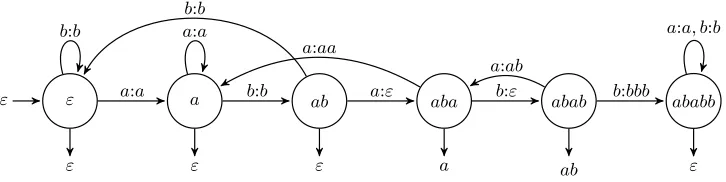
Here is the definition of our transducer for a contex-tual rule (see Fig.1):
Definition 2(Transducer of a Contextual Rule). The sequential transducer Tr associated with a contex-tual rule r = u → v with u 6= ε is defined as
Tr=hpref(u),Σ,Σ, ε, δ, η, ε, ρiwith the set of pre-fixes of u as state set, ε as initial state and initial output, and for allainΣandwinpref(u),
δ(w, a)=
wa ifwa≤prefu
w ifw=u
bord(wa) otherwise
ρ(w)=
ε ifw≤pref (u∧v)
(u∧v)−1w if(u∧v)<pref w <pref u ε otherwise, i.e. ifw=u
η(w, a)=
a ifwa≤pref (u∧v) ε if(u∧v)<prefwa<pref u
(u∧v)−1v ifwa=u
a ifw=u
ρ(w)a·ρ(bord(wa))−1 otherwise.
It remains to show that this sequential transducer is indeed the minimal normalized sequential trans-ducer forJrK.
Proposition 3(Correctness). Letr = u → v with
u6=ε. ThenJTrK=JrK.
Proof. Let us first consider the case of input words inΣ∗\(Σ∗·u·Σ∗):
Claim3.1. For allwinΣ∗\(Σ∗·u·Σ∗),δ(ε, w) = ov(w, u)andη(ε, w) =w·ρ(ov(w, u))−1.
By induction onw: sinceu 6= ε, the base case is w = εwithδ(ε, ε) = ε = ov(ε, u) andη(ε, ε) =
ε ε
ε
a
ε
ab
ε
aba
a
abab
ab
ababb
ε b:b
a:a a:a
b:b b:b
a:ε a:aa
b:ε b:bbb a:ab
[image:4.612.126.489.59.150.2]a:a, b:b
Figure 1: The sequential transducer constructed forababb→abbbb.
andainΣ:
δ(ε, wa) =δ(δ(ε, w), a)i.h.= δ(ov(w, u), a)
Fact 1= ov(wa, u)
η(ε, wa) =η(ε, w)·η(δ(ε, w), a)
i.h.= w·ρ(δ(ε, w))−1·η(δ(ε, w), a)
=w·ρ(w0)−1·η(w0, a) ;
(by settingw0 =δ(ε, w))
we need to do a case analysis for this last equation:
Casew0a6≤
pref u Then η(w0, a) = ρ(w0) · a ·
ρ(border(w0a))−1, which yields η(ε, wa) = w·ρ(w0)−1·ρ(w0)·a·ρ(δ(ε, wa))−1 =wa· ρ(δ(ε, wa))−1.
Casew0a <
pref u Then δ(ε, wa) = w0a, and
we need to further distinguish between several cases:
w0a≤
pref (u∧v) then ρ(w0) = ε,
η(w0, a) = a, and ρ(w0a) = ε,
thus η(ε, wa) = wa = wa · ε−1 = wa·ρ(w0a)−1,
w0 = (u∧v) thenρ(w0) = ε,η(w0, a) =ε,
and ρ(w0a) = (u ∧ v)−1 · w0a = a,
η(ε, wa) = w = wa · a−1 = wa · ρ(w0a)−1,
(u∧v) <pref w0 thenρ(w0) = (u∧v)−1 ·
w0, η(w0, a) = ε, and ρ(w0a) = (u ∧
v)−1·w0a, thusη(ε, wa) =w·((u∧v)−1· w0)−1 =wa·a−1·((u∧v)−1·w0)−1 = wa·ρ(w0a)−1.
The claim yields thatJTrKcoincides with JrKon words in Σ∗\(Σ∗ ·u·Σ∗), i.e. is the identity over Σ∗\(Σ∗ ·u ·Σ∗). Then, since u 6= ε, a word in Σ∗·u·Σ∗can be written aswaw0withwinΣ∗\(Σ∗·
u·Σ∗),ainΣwithwainΣ∗·u, andw0inΣ∗. Let
u = u0a; the claim implies that δ(ε, w) = u0 and
η(ε, w) = w·ρ(u0)−1. Thus, by definition ofT r, δ(ε, wa) =u0a= uand thusη(ε, wa) = η(ε, w)·
η(u0, a) =w·ρ(u0)−1·(u∧v)−1·v;
if(u∧v) <pref u0 η(ε, wa) = w·((u∧v)−1·
u0)−1·(u∧v)−1·v=w·u0−1·v=wa·u−1·v;
otherwise i.e. ifu0 = (u∧v):η(ε, wa) =w·u0−1· v=wa·u−1·v.
Thus in all casesJTrK(wa) =JrK(wa), and sinceTr starting in stateu(i.e.Tr(u)) implements the identity overΣ∗, we have more generallyJT
rK=JrK.
Lemma 4(Normality). Letr =u→ v. ThenTris
normalized.
Proof. Let w ∈ Prefix(u) be a state of Tr; let us show thatVJTr(w)K(Σ∗) =ε.
If(u∧v) <pref w <pref u let u0 =
w−1u ∈ Σ+, and consider the two out-putsJTr(w)K(u0) =η(w, u0)ρ(u) = (u∧v)−1v and JTr(w)K(ε) = ρ(w) = (u ∧ v)−1w. Since (u ∧ v) <pref u we can write u as
(u ∧v)au00u0, and either v = (u ∧v)bv0 or
v = u ∧v, for some a 6= b inΣ and u00, v0
inΣ∗; this yields w = (u ∧v)au00 and thus
JTr(w)K(u0)∧JT
r(w)K(ε) =ε.
otherwise ρ(w) =ε, which yields the lemma.
Proposition 5 (Minimality). Letr = u → v with
u6=εandu6=v. ThenTris the minimal sequential
transducer forJrK.
Proof. Let w <pref w0 be two different states in
Prefix(u); we proceed to prove that Jw−1T rK 6=
Jw0−1TrK, hence that no two states of Tr can be merged. By Thm. 4 it suffices to prove that
such thatJTr(w)K(x) =6 JTr(w0)K(x). We perform a
case analysis:
ifw0 ≤
pref (u∧v) then w <pref (u ∧ v) thus
JTr(w)K(x) = xfor all x 6∈ w−1·Σ∗·u·Σ∗;
considerJTr(w)K(w0−1u) =w0−1u6=w0−1v=
JTr(w0)K(w0−1u);
ifw≤pref (u∧v)andw0 =u then
JTr(w0)K(x) = x for all x and we
con-sider JTr(w)K(w−1u) = w−1v 6= w−1v =
JTr(w0)K(w−1u);
otherwise that is ifw≤pref (u∧v)and(u∧v)<pref w0 <pref u, or(u∧v)<pref w <pref w0 ≤pref
u, we have ρ(w) 6= ρ(w0) thus JT
r(w)K(ε) 6=
JTr(w0)K(ε).
4 Conclusion
The results of the previous section yield (the cases u=εandu=vare trivial):
Theorem 6. Given a contextual rule r = u → v, one can construct directly the minimal normalized sequential transducerTrof sizeO(|r|)forJrK.
The remaining question is whether we can ob-tain better upper bounds on the size of the sequen-tial transducer TC for a cascade C = r1· · ·rn than O(2nlogk). It turns out that there are cascades of length n for which no sequential transducer with a subexponential (inn) number of states can exist, thus our construction is close to optimal.
References
Eric Brill. 1992. A simple rule-based part of speech tag-ger. InANLP ’92, pages 152–155. ACL Press. Maxime Crochemore and Christophe Hancart. 1997.
Au-tomata for matching patterns. In Grzegorz Rozenberg and Arto Salomaa, editors,Handbook of Formal Lan-guages, volume 2. Linear Modeling: Background and Application, chapter 9, pages 399–462. Springer. Ronald M. Kaplan and Martin Kay. 1994. Regular
mod-els of phonological rule systems. Comput. Linguist., 20(3):331–378.
Stoyan Mihov and Klaus U. Schultz. 2007. Effi-cient dictionary-based text rewriting using subsequen-tial transducers.Nat. Lang. Eng., 13(4):353–381. Emmanuel Roche and Yves Schabes. 1995.
Determinis-tic part-of-speech tagging with finite-state transducers.
Comput. Linguist., 21(2):227–253.
Jacques Sakarovitch. 2009. Elements of Automata The-ory. Cambridge University Press.
Marcel-Paul Sch¨utzenberger. 1977. Sur une variante des fonctions s´equentielles. Theor. Comput. Sci., 4(1):47– 57.