Generating effective referring expressions using charts
Nikos Engonopoulos and Alexander Koller University of Potsdam, Germany
{engonopo|akoller}@uni-potsdam.de
Abstract
We present a novel approach for generat-ing effective referrgenerat-ing expressions (REs). We define a synchronous grammar formal-ism that relates surface strings with the sets of objects they describe through an ab-stract syntactic structure. The grammars may choose to require or not that REs are distinguishing. We then show how to com-pute a chart that represents, in finite space, the complete (possibly infinite) set of valid REs for a target object. Finally, we pro-pose a probability model that predicts how the listener will understand the RE, and show how to compute the most effective RE according to this model from the chart. 1 Introduction
The fundamental challenge in the generation of re-ferring expressions (REG) is to compute an RE which is effective, i.e. understood as intended by the listener. Throughout the history of REG, we have approximated this as the problem of generat-ingdistinguishingREs, i.e. REs that are only satis-fied by a unique individual in the domain. This has been an eminently successful approach, as doc-umented e.g. in the overview article of Krahmer and van Deemter (2012) and a variety of recent shared tasks involving RE generation (Gatt and Belz, 2010; Belz et al., 2008; Koller et al., 2010).
Nonetheless, reducing effectiveness to unique-ness is limiting in several ways. First, in complex, real-world scenes it may not be feasible to gener-ate fully distinguishing REs, or these may have to be exceedingly complicated. It is also not neces-sary to generate distinguishing REs in such situa-tions, because listeners are very capable of taking the discourse and task context into account to re-solve even ambiguous REs. Conversely, listeners can misunderstand even a distinguishing RE, so uniqueness is no guarantee for success. We pro-pose instead to define and train a probabilistic RE
resolution modelP(a|t), which directly captures the probability that the listener will resolve a given REtto some objectain the domain. An REtwill then be “good enough” ifP(a⇤|t)is very high for the intended target referenta⇤.
Second, in an interactive setting like the GIVE Challenge (Koller et al., 2010), the listener may behave in a way that offers further information on how they resolved the generated RE. Engonopou-los et al. (2013) showed how an initial estimate of the distributionP(a|t)can be continuously up-dated based on the listener’s behavior, and that this can improve a system’s ability to detect misunder-standings. It seems hard to achieve this in a prin-cipled way without an explicit model ofP(a|t).
In this paper, we present an algorithm that gen-erates the RE t that maximizes P(a⇤|t), i.e. the RE that has the highest chance to be understood correctly by the listener according to the proba-bilistic RE resolution model. This is a challeng-ing problem, since the algorithm must identify that RE from a potentially infinite set of valid alterna-tives. We achieve this by using achart-based al-gorithm, a standard approach in parsing and real-ization, which has (to our knowledge) never been used in REG.
We start by defining a synchronous grammar formalism that relates surface strings to their in-terpretations as sets of objects in a given domain (Section 3). This formalism integrates REG with surface realization, and allows us to specify in the grammar whether REs are required to be distin-guishing. We then show how to compute a chart for a given grammar and target referent in Sec-tion 4. SecSec-tion 5 defines a log-linear model for P(a|t), and presents a Viterbi-style algorithm for computing the REtfrom the chart that maximizes P(a⇤|t). Section 6 concludes by discussing how to apply our algorithm to the state-of-the-art ap-proaches of Krahmer et al. (2003) and Golland et al. (2010), and how to address a particular chal-lenge involving cycles that arises when dealing
with probabilistic listener models.
2 Related Work
RE generation is the task of generating a natural-language expression that identifies an object to the listener. Since the beginnings of modern REG (Appelt, 1985; Dale and Reiter, 1995), this prob-lem has been approximated as generating a dis-tinguishing description, i.e. one which fits only one object in the domain and not any of the oth-ers. This perspective has made it possible to apply search-based (Kelleher and Kruijff, 2006), logic-based (Areces et al., 2008) and graph-logic-based (Krah-mer et al., 2003) methods to the problem, and overall has been one of the success stories of NLG. However, in practice, human speakers fre-quentlyoverspecify, i.e. they include information in an RE beyond what is necessary to make it distinguishing (Wardlow Lane and Ferreira, 2008; Koolen et al., 2011). An NLG system, too, might include redundant information in an RE to make it easier to understand for the user. Conversely, an RE that is produced by a human can often be eas-ily resolved by the listener even if it is ambiguous. Here we present an NLG system that directly uses a probabilistic model of RE resolution, and is ca-pable of generating ambiguous REs if it predicts that the listener will understand them.
Most existing REG algorithms focus on gener-ating distinguishing REs, and then select the one that isbestaccording to some criterion, e.g. most human-like (Krahmer et al., 2003; FitzGerald et al., 2013) or most likely to be understood (Garoufi and Koller, 2013). By contrast, Mitchell et al. (2013) describe a stochastic algorithm that com-putes human-like, non-relational REs that may not be distinguishing. Golland et al. (2010) are close to our proposal in spirit, in that they use a log-linear probability model of RE resolution to com-pute a possibly non-distinguishing RE. However, they use a trivial REG algorithm which is limited to grammars that only permit a (small) finite set of REs for each referent. This is in contrast to gen-eral REG, where there is typically an infinite set of valid REs, especially when relational REs (“the buttonto the left of the plant”) are permitted.
Engonopoulos et al. (2013) describe how to up-date an estimate forP(a|t)based on a log-linear model based on observations of the listener’s be-havior. They use a shallow model based on a string tand not an RE derived from a grammar, and they do not discuss how to generate the bestt. The
al-gorithm we develop here fills this gap.
Our formalism for REG can be seen as a syn-chronous grammar formalism; it simultaneously derives strings and their interpretations, connect-ing the two by an abstract syntactic representa-tion. This allows performing REG and surface re-alization with a single algorithm, along the lines of SPUD (Stone et al., 2003) and its planning-based implementation, CRISP (Koller and Stone, 2007). Probabilistic synchronous grammars are widely used in statistical machine translation (Chi-ang, 2007; Graehl et al., 2008; Jones et al., 2012) and semantic parsing (Zettlemoyer and Collins, 2005; Wong and Mooney, 2007). Lu and Ng (2011) have applied such grammars to surface re-alization. Konstas and Lapata (2012) use related techniques for content selection and surface real-ization (with simple, non-recursive grammars).
Charts are standard tools for representing a large space of possible linguistic analyses com-pactly. Next to their use in parsing, they have also been applied to surface realization (Kay, 1996; Carroll et al., 1999; Kaplan and Wedekind, 2000). To our knowledge, ours is the first work using charts for REG. This is challenging because the input to REG is much less structured than in pars-ing or realization.
3 Grammars for RE generation
We define a new grammar formalism that we use for REG, which we call semantically intepreted grammar (SIG). SIG is a synchronous grammar formalism that relates natural language strings with the sets of objects in a given domain which they describe. It uses regular tree grammars (RTGs)to describe languages of derivation trees, which then project to strings and sets.
3.1 Derivation trees
We describe the abstract syntax of an RE by its derivation tree, which is a tree over some ranked signature ⌃ of symbols representing lexicon en-tries and grammatical constructions. A (ranked) signature is a finite set of symbols r 2 ⌃, each of which is assigned anarityar(r) 2 N0. A tree
over the signature⌃is a termr(t1, . . . , tn), where r 2⌃,n=ar(r), andt1, . . . , tnare trees over⌃.
We writeT⌃for the set of all trees over⌃. Fig. 1b shows an example derivation tree for the RE “the square button” over the signature ⌃ = {def|1,square|1,button|0}, where r|n
nota-(a) (b) (c)
{b2}
IR
def
square
button IS
!“the square button”
0 @
\1
square button
1
A 0
B B B @
•
the •
square button
1 C C C A
Figure 1: A SIG derivation tree (b) with its inter-pretations (a, c).
tion, it isdef(square(button)).
String interpretation. We interpret derivation trees simultaneously as strings and sets. First, let be a finite alphabet, and let ⇤ be the string
al-gebra over . We define a string interpretation
over as a functionIS that maps each r|n 2 ⌃
to a functionIS(r) : ( ⇤)n ! ⇤. For instance,
we can assign string interpretations to our exam-ple signature⌃as follows; we writew1 •w2 for
the concatenation of the stringsw1 andw2.
IS(def)(w1) = the•w1
IS(square)(w1) = square•w1
IS(button) = button
Since the arity of IS(r) is the same as the
ar-ity ofr for any r 2 ⌃, we can use IS to
recur-sively map derivation trees to strings. Starting at the leaves, we map the tree r(t1, . . . , tn) to the
stringIS(r)(IS(t1), . . . ,IS(tn)), whereIS(ti)is
the string that results from recursively applyingIS
to the subtreeti. In the example, the subtreebutton
is mapped to the string “button”. We then get the string for the subtreesquare(button) by con-catenating this with “square”, obtaining the string “square button” and so on, as shown in Fig. 1c.
Relational interpretation. We further define a
relational interpretation IR, which maps each
r|n 2 ⌃to a functionIR(r) : R(U)n ! R(U),
whereR(U)is a class ofrelations. We defineIR
over some first-ordermodelstructureM =hU, Li, whereU is a finiteuniverseU of individuals andL
interprets a finite set of predicate symbols as rela-tions overU. We letR(U)be the set of allk-place relations overU for all k 0. The subsets ofU
are the special case ofk = 1. We writek(R)for
the arity of a relationR2R(U).
For the purposes of this paper, we constructIR
by combining the following operations:
• The denotations of the atomic predicate
sym-bols ofM; see Fig. 2 for an example.
U ={b1, b2, b3} button={b1, b2, b3}
round={b1, b3} square={b2}
left of ={hb1, b2i,hb2, b3i}
right of ={hb2, b1i,hb3, b2i}
Figure 2: A simple model, illustrated as a graph.
• proji(R) = {ai | ha1, . . . , ak(R)i 2 R} is
the projection to thei-th component; if i > k(R), it evaluates to;.
• R1\i R2 ={ha1, . . . , ak(R1)i 2 R1 |ai 2
R2}is the intersection on thei-th component
ofR1; ifi > k(R1), it evaluates to;.
• For anya2U,uniqa(R)evaluates to{a}if
R={a}, and to;otherwise.
• For any a 2 U, membera(R) evaluates to
{a}ifa2R, and to;otherwise.
For the example, we assume that we want to generate REs over the scene shown in Fig. 2; it consists of the universeU ={b1, b2, b3}and
inter-prets the atomic predicate symbolsbutton,square, round, left of, and right of. Given this, we can
assign a relational interpretation to the derivation tree in Fig. 1b using the following mappings:
IR(def)(R1) = R1
IR(square)(R1) = square\1R1
IR(button) = button
We evaluate a derivation tree to a relation as we did for strings (cf. Fig. 1a). The subtree button
maps to the denotation of the symbolbutton, i.e.
{b1, b2, b3}. The subtreesquare(button)evaluates
to the intersection of this set with the set of square individuals, i.e.{b2}; this is also the relational
in-terpretation of the entire derivation tree. We thus see that “the square button” is an RE that describes the individualb2uniquely.
3.2 Semantically interpreted grammars Now we define grammars that describe relations between strings and relations overU. We achieve
this by combining aregular tree grammar (RTG, (G´ecseg and Steinby, 1997; Comon et al., 2007)), describing a language of derivation trees, with a string interpretation and a relational interpretation. An RTG G = (N,⌃, S, P) consists of a finite set N of nonterminal symbols, a ranked
A, B1, . . . , Bn 2 N and r|n 2 ⌃. We say that
a tree t2 2 T⌃ can be derived in one step from
t1 2 T⌃,t1 ) t2, if it can be obtained by
replac-ing an occurrence of B in t1 with t and P
con-tains the rule B ! t. A tree tn 2 T⌃ can be
derived fromt1, t1 )⇤ tn, if there is a sequence t1 ). . .)tnof lengthn 0. For any
nontermi-nalA, we writeLA(G)for the set of treest2T⌃
withA )⇤ t. We simply writeL(G)for L
S(G)
and call it thelanguageofG.
We define a semantically interpreted grammar
(SIG) as a tripleG = (G,IS,IR) of an RTG G
over some signature⌃, together with a string
inter-pretationISover some alphabet and a relational
interpretation IR over some universe U, both of
which interpret the symbols in⌃. We assume that
every terminal symbol r 2 ⌃ occurs in at most
one rule, and that the nonterminals ofGare pairs
Ab of a syntactic categoryAand asemantic index
b = ix(Ab). A semantic index indicates the
indi-vidual inU to which a given constituent is meant
to refer, see e.g. (Kay, 1996; Stone et al., 2003). Note that SIGs can be seen as specific Interpreted Regular Tree Grammars (Koller and Kuhlmann, 2011) with a set and a string interpretation.
We ignore the start symbol of G. Instead, we
say that given some individualb2Uand syntactic
categoryA, the set ofreferring expressionsforbis
REG(A, b) = {t 2 LAb(G) | IR(t) = {b}}, i.e.
we define an RE as a derivation tree that G can
derive fromAband whose relational interpretation
is{b}. Fromt, we can read off the stringIS(t).1
3.3 An example grammar
Consider the SIG G in Fig. 3 for example. The
grammar is written in template form. Each rule is instantiated for all semantic indices specified
in the line above; e.g. the symbolrounddenotes
the set {b1, b3}, therefore there are rules Nb1 !
roundb1(Nb1)andNb3 !roundb3(Nb3). The
val-ues of IR and IS for each symbol are specified
below the RTG rule for that symbol.
We can use Gto generate NPs that refer to the
target referentb2given the model shown in Fig. 2
by finding trees in LNPb2(G) that refer to {b2}.
One such tree is t1 = defb2(squareb2(buttonb2)),
a more detailed version of the tree in Fig. 1b.
It can be derived by NPb2 ) defb2(Nb2) )
defb2(squareb2(Nb2)) ) t1. Because IR(t1) =
{b2}, we see thatt1 2REG(NP, b2); it represents
1Below, we will often write the RE as a string when the derivation tree is clear.
for alla2U: NPa!defa(Na) IS(defa)(w1) =the•w1 IR(defa)(R1) =membera(R1) for alla2button:
Na!buttona IS(buttona) =button IR(buttona) =button for alla2round: Na!rounda(Na)
IS(rounda)(w1) =round•w1 IR(rounda)(R1) =round\1R1 for alla2square:
Na!squarea(Na)
IS(squarea)(w1) =square•w1 IR(squarea)(R1) =square\1R1 for alla, b2left of:
Na!leftofa,b(Na,NPb)
IS(leftofa,b)(w1, w2) =w1•to•the•left•of•w2 IR(leftofa,b)(R1, R2) =proj1((left of\1R1)\2R2) for alla, b2right of:
Na!rightofa,b(Na,NPb)
IS(rightofa,b)(w1, w2) =w1•to•the•right•of•w2 IR(rightofa,b)(R1, R2) =proj1((right of\1R1)\2R2)
Figure 3: An example SIG grammar.
the stringIS(t1) =“the square button”.
A second derivation tree for b2 is t2 =
defb2(squareb2(squareb2(buttonb2))),
correspond-ing toIS(t2) =“the square square button”. It
de-rives fromNPb2 in four steps, and has IR(t2) =
{b2}. Even the small grammarG licences an
infi-nite set of REs forb2, all of which are semantically
correct. Avoiding the generation of nonsensical REs like “the square square button” is a techni-cal challenge to which we will return in Section 6.
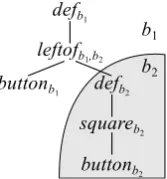
Gcan also derive relational REs; for instance, the
derivation tree in Fig. 6 for the string “the button
to the left of the square button” is inREG(NP, b1).
Finally,Gconsiders the non-distinguishingt3 =
defb2(buttonb2) (for “the button”) a valid RE for
b2. This is becausememberb2 will quietly project
the set {b1, b2, b3} (to which buttonb2 refers) to
{b2}. As discussed in previous sections, we want
to allow such non-unique REs and delegate the judgment about their quality to the probability model. It would still be straightforward, however, to impose a hard uniqueness constraint, by simply
changing IR(defa)(R1) to uniqa(R1) in Fig. 3.
This would yield IR(t3) = ;, i.e. t3 would no
longer be inREG(NP, b2).
4 Chart-based RE generation
Nb1/{b1, b2, b3}!buttonb1
Nb2/{b1, b2, b3}!buttonb2
Nb3/{b1, b2, b3}!buttonb3
Nb1/{b1, b3}!roundb1(Nb1/{b1, b2, b3})
Nb3/{b1, b3}!roundb3(Nb3/{b1, b2, b3})
Nb1/{b1, b3}!roundb1(Nb1/{b1, b3})
Nb3/{b1, b3}!roundb3(Nb3/{b1, b3})
Nb2/{b2}!squareb2(Nb2/{b1, b2, b3})
Nb2/{b2}!squareb2(Nb2/{b2})
NPb2/{b2}!defb2(Nb2/{b1, b2, b3})
NPb2/{b2}!defb2(Nb2/{b2})
Nb1/{b1}!leftofb1,b2(Nb1/{b1, b2, b3},NPb2/{b2})
Nb1/{b1}!leftofb1,b2(Nb1/{b1, b3},NPb2/{b2})
Nb1/{b1}!leftofb1,b2(Nb1/{b1},NPb2/{b2})
Nb1/{b1}!roundb1(Nb1/{b1})
NPb1/{b1}!defb1(Nb1/{b1, b2, b3})
NPb1/{b1}!defb1(Nb1/{b1, b3})
NPb1/{b1}!defb1(Nb1/{b1})
Nb3/{b3}!rightofb3,b2(Nb3/{b1, b2, b3},NPb2/{b2})
Nb3/{b3}!rightofb3,b2(Nb3/{b1, b3},NPb2/{b2})
Nb3/{b3}!rightofb3,b2(Nb3/{b3},NPb2/{b2})
Nb3/{b3}!roundb3(Nb3/{b3})
NPb3/{b3}!defb3(Nb3/{b1, b2, b3})
NPb3/{b3}!defb3(Nb3/{b1, b3})
NPb3/{b3}!defb3(Nb3/{b3})
Nb2/{b2}!leftofb2,b3(Nb2/{b1, b2, b3},NPb3/{b3})
Nb2/{b2}!rightofb2,b1(Nb2/{b1, b2, b3},NPb1/{b1})
Nb2/{b2}!leftofb2,b3(Nb2/{b2},NPb3/{b3})
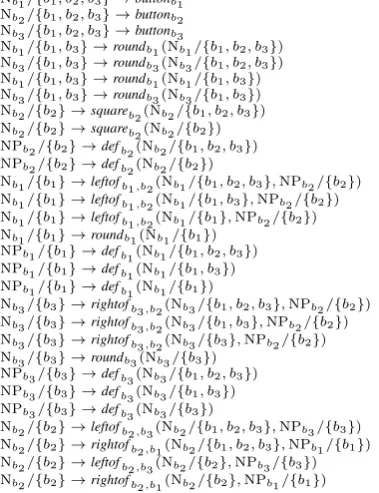
[image:5.595.78.268.67.314.2]Nb2/{b2}!rightofb2,b1(Nb2/{b2},NPb1/{b1})
Figure 4: The chart for the grammar in Fig. 3.
4.1 RE generation charts
Generally speaking, a chart is a packed data struc-ture which describes how larger syntactic repre-sentations can be recursively built from smaller ones. In applications such as parsing and sur-face realization, the creation of a chart is driven by the idea that we consume some input (words or semantic atoms) as we build up larger struc-tures. The parallel to this intuition in REG is that “larger” chart entries are more precise descriptions of the target, which is a weaker constraint than input consumption. Nonetheless, we can define REG charts whose entries are packed representa-tions for large sets of possible REs, and compute them in terms of these entries instead of RE sets.
Technically, we represent charts as RTGs over an extended set of nonterminals. A chart for gener-ating an RE of syntactic categoryAfor an
individ-ualb2 U is an RTGC = (N0,⌃, S0, P0), where N0 ✓ N ⇥R(U) andS0 = Ab/{b}. Intuitively, the nonterminal Ab/{a1, . . . , an} expresses that weintendto generate an RE forbfromA, but each
RE that we can derive from the nonterminal actu-allydenotes the referent set{a1, . . . , an}.
A chart for the grammar in Fig. 3 is shown in Fig. 4. To generate an NP for b2, we let
its start symbol be S0 = NPb2/{b2}. The rule Nb2/{b1, b2, b3}!buttonb2says that we can
gen-erate an REtwith IR(t) = {b1, b2, b3}from the
nonterminal symbolNb2 by expanding this symbol
with the grammar ruleNb2 !buttonb2. Similarly,
A!r(B1, ..., Bn)inG B0
1=B1/R1, ..., Bn0 =Bn/RninN0
AddA0=A/IR(r)(R1, ..., Rn)toN0
Add ruleA0!r(B0
1, ..., Bn0)toP0 Figure 5: The chart computation algorithm.
the rule Nb2/{b2} ! squareb2(Nb2/{b1, b2, b3})
expresses that we can generate an RE with
IR(t) ={b2}by expanding the nonterminal
sym-bolNb2 intosquareb2(t
0), wheret0 is any tree that
the chart can generate fromNb2/{b1, b2, b3}.
4.2 Computing a chart
Given a SIG G, a syntactic category A, and a
target referent b, we can compute a chart C for REG(A, b) using the parsing schema in Fig. 5. The schema assumes that we have a rule A !
r(B1, . . . , Bn) in G; in addition, for each 1
i n it assumes that we have already added
the nonterminal B0i = Bi/Ri to the chart, in-dicating that there is a tree ti with Bi )⇤ ti and IR(ti) = Ri. Then we know that t =
r(t1, . . . , tn)can be derived fromAand thatR0 =
IR(t) = IR(r)(R1, . . . , Rn). We can therefore add the nonterminalA0 = A/R0 and the
produc-tion rule A0 ! r(B10, . . . , Bn0) to the chart; this
rule can be used as the first step in a derivation oft
fromA0. We can optimize the algorithm by adding A0and the rule only ifR06=;.
The algorithm terminates when it can add no more rules to the chart. Because U is finite, this
always happens after a finite number of steps, even if there is an infinite set of REs. For instance, the chart in Fig. 4 describes an infinite language of REs, including “the square button”, “the button to the left of the round button”, “the button to the left of the button to the right of the square button”, etc. Thus it represents relational REs that are nested arbitrarily deeply through a finite number of rules. After termination, the chart contains all rules by which a nonterminal can be decomposed into other (productive) nonterminals. As a result,L(C)
con-tains exactly the REs forbof categoryA:
Theorem 1 IfCis a chart for the SIGG, the syn-tactic categoryA, and the target referent b, then L(C) =REG(A, b).
5 Computing best referring expressions The chart algorithm allows us to compactly rep-resent all REs for the target referent. We now show how to compute thebestRE from the chart. We present a novel probability modelP(b|t) for
Figure 6: The derivation tree for “the button to the left of the square button”.
one with the highest chance to be understood as intended. Next to the best RE itself, the algo-rithm also computes the entire distributionP(b|t), to support later updates in an interactive setting.
Nothing in our algorithm hinges on this par-ticular model; it can also be used with any other scoring model that satisfies a certain monotonicity condition which we spell out in Section 5.2.
5.1 A log-linear model for effective REs We model the probability P(b|t) that the listener will resolve the RE t to the object b using a
log-linear model with a set of feature functions
f(a, t, M), where ais an object, tis a derivation
tree, andM is the relational interpretation model.
We focus on features that only look at informa-tion that is local to a specific subtree of the RE, such as the label at the root. For instance, a feature
fround(a, t0, M)might return 1 if the root label of t0isroundaandais round inM, and 0 otherwise.
Another featurefdef(a, t0, M)might return1/kif t0 is of the formdefb(t00), R = IR(t00)has k
el-ements, and a 2 R; and 0 otherwise. This
fea-ture counterbalances the ability of the grammar in Fig. 3 to say “thew” even whenwis a non-unique
description by penalizing descriptions with many possible referents through lower feature values.
When generating a relational RE, the derivation tree naturally splits into separateregions, each of which is meant to identify a specific object. These regions are distinguished by the semantic indices in the nonterminals that derive them; e.g., in Fig. 6, the subtree for “the square button” is an attempt to refer tob2, whereas the RE as a whole is meant to
refer tob1. To find out how effective the RE is as
a description ofb1, we evaluate the features at all
nodes in the regiontop(t)containing the root oft.
Each feature function fi is associated with a
weightwi. We obtain ascore tuplesc(t0)for some
subtreet0 of an RE as follows:
sc(t0) =hs(a1, t0, M), . . . , s(am, t0, M)i,
t b1 b2 b3
“the button” 0.33 0.33 0.33
“the round button” 0.45 0.10 0.45
“the button to the left
of the square button” 0.74 0.14 0.12
Figure 7: Probability distributions for some REst.
where U = {a1, . . . , am} and s(a, t0, M) = Pn
i=1wi ·fi(a, t0, M). We then combine these
into a score tuple score(t) = Pu2top(t)sc(t.u) for the whole RE t, where t.u is the subtree of
t below the nodeu. Finally, given a score tuple s = hs1, . . . , smi for t, we define the usual
log-linear probability distribution as
P(ai|t) =prob(ai,s) = esi Pm
j=1esj .
ThebestRE for the target referentbis then
bestG(A, b) = arg max
t2REG(A,b)
prob(b,sc(t)).
For illustration, we consider a number of REs forb1 in our running example. We usefroundand fdef and letwround =wdef = 1. In this case, the
RE “the button” has a score tupleh1/3,1/3,1/3i, which is the sum of the tuple h0,0,0i for fround
(since the RE does not use the “round” rule) and the tupleh1/3,1/3,1/3iforfdef (since “button”
is three-way ambiguous inM). This yields a
uni-form probability distribution overU (see Fig. 7).
By contrast, “the round button” getsh3/2,0,3/2i, resulting in the distribution in the second line of Fig. 7. This RE is judged better than “the button” because it assigns a higher probability tob1.
Relational REs involve derivation trees with multiple regions, only the top one of which is di-rectly counted forP(b|t)(see Fig. 6). We incorpo-rate the quality of the other regions through appro-priate features. In the example, we use a feature
flef tof(a, t0, M) = Pb:ha,bi2left ofP(b|t00), where
t00 is the second subtree oft0. This feature
com-putes the probability that the referent to which the listener resolves t00 is actually to the right of a,
and will thus take a high value if t00 is a good
RE forb2. Assuming a probability distribution of P(b2|t0) = 0.78andP(b1|t0) = P(b3|t0) = 0.11
for t0 =“the square button”, we get the tuple
h0.78,0.11,0i for flef tof, yielding the third line
[image:6.595.140.224.62.152.2]5.2 Computing the best RE
We computebestG(A, b)from the chart by
adapt-ing the Viterbi algorithm. Our key data structure assigns a score tuple is(A0) to each nonterminal
A0 in the chart. Intuitively, if the semantic index ofA0 isb, thenis(A0) is the score tuplesc(t)for
the treet2LA0(C)which maximizesP(b|t). We also record this best tree asbt(A0). Thus the
al-gorithm is correct if, after running it, we obtain
bestG(A, b) =bt(Ab/{b}).
As is standard in chart algorithms, we limit our attention to features whose values can be com-puted bottom-up by local operations. Specifically, we assume that ifA0 !r(B10, . . . , Bn0)is a rule in
the chart andtiis the best RE forBi0for alli, then
the best RE forA0that can be built using this rule isr(t1, . . . , tn). This means that features must be monotonic, i.e. that the RE that seemed locally best forB0
ileads to the best RE overall.
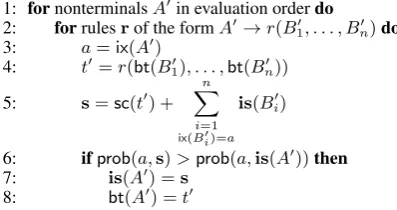
Under this assumption, we can computeis(A0)
andbt(A0)bottom-up as shown in Fig. 8. We
it-erate over all nonterminals A0 in the chart in a fixed linear order, which we call the evaluation order. Then we compute is(A0) and bt(A0) by
maximizing over the rules for A0. Assume that the best RE for A0 can be constructed using the
ruleA0 !r(B01, . . . , Bn0). Then if, at the time we evaluateA0, we have fully evaluated all theBi0 in the sense that bt(Bi0) is actually the best RE for
Bi0, the algorithm will assign the best RE for A0 tobt(A0), and its score tuple tois(A0). Thus, if
we call an evaluation orderexactif the nontermi-nals on the right-hand side of each rule in the chart come before the nonterminal on the left-hand side, we can inductively prove the following theorem:
Theorem 2 If the evaluation order is exact, then for every nonterminal A0 in the chart, we
ob-tain bt(A0) = arg maxt2L
A0(C)P(ix(A
0)|t) and
is(A0) =sc(bt(A0)).
In other words, the algorithm is correct if the evaluation order is exact. If it is not, we might compute a sub-optimal RE as bt(A0), which
un-derestimatesis(A0). The choice of evaluation
or-der is thus crucial.
6 Evaluating charts with cycles
It remains to show how we can determine an ex-act evaluation order for a given chart. One way to think about the problem is to consider the order-ing graphO(C)of the chart C(see Fig. 9 for an example). This is a directed graph whose nodes
1: fornonterminalsA0in evaluation orderdo 2: forrulesrof the formA0!r(B0
1, . . . , Bn0)do 3: a=ix(A0)
4: t0=r(bt(B10), . . . ,bt(B0n))
5: s=sc(t0) + n
X
i=1
ix(Bi0)=a is(B0i)
6: ifprob(a,s)>prob(a,is(A0))then
[image:7.595.312.511.63.168.2]7: is(A0) =s 8: bt(A0) =t0
Figure 8: Computing the best RE.
are the nonterminals of the chart; for each rule A0 ! r(B10, . . . , Bn0) in C, it has an edge from
Bi0 to A0 for each i. If this graph is acyclic, we can simply compute a topological sort of O(C)
to bring the nodes into a linear order in which each Bi0 precedes A0. This is enough to evalu-ate charts using certain simpler models. For in-stance, we can apply our REG algorithm to the log-linear model of Golland et al. (2010). Because they only generate REs with a bounded number of relations, their grammars effectively only describe finite languages. In such a case, our charts are al-ways acyclic, and therefore a topological sort of O(C)yields an exact evaluation order.
This simple approach will not work with gram-mars that allow arbitrary recursion, as they can lead to charts with cycles (indicating an infinite set of valid REs). E.g. the chart in Fig. 4 contains a rule Nb2/{b2} ! squareb2(Nb2/{b2}) (shown in Fig. 9), which can be used to construct the RE t0 =“the square square button” in addition to the
REt =“the square button”. Such cycles can be increasingwith respect to a log-linear probability model, i.e. the model considerst0a better RE than t. Indeed, t has a score tuple ofh0,2,0i, giving P(b2|t) = 0.78. By contrast,t0 has a score tuple ofh0,3,0i, thusP(b2|t0) = 0.91. This can be
con-tinued indefinitely, with each addition of “square” increasing the probability of being resolved tob2. Thus, there is no best RE forb2; every RE can be improved by adding another copy of “square”.
In such a situation, it is a challenge to even computeanyscore for every nonterminal without running into infinite loops. We can achieve this by decomposingO(C)into its strongly connected
components (SCCs), i.e. the maximal subgraphs in which each node is reachable from any other node. We then consider thecomponent graphO0(C); its
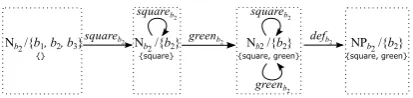
Figure 9: A fragment of the ordering graph for the chart in Fig. 4. Dotted boxes mark SCCs.
Figure 10: A fragment of a chart ordering graph for a grammar with enriched nonterminals.
sort and order all nonterminals from earlier SCCs before all nonterminals from later SCCs. Within each SCC, we order the nonterminals in the order in which they were discovered by the algorithm in Fig. 5. This yields a linear order on nonterminals, which at least ensures that by the time we evaluate a nonterminalA0, there is at least one rule forA0 whose right-hand nonterminals have all been eval-uated; sois(A0)gets at leastsomevalue.
In our example, we obtain the order
Nb2/{b1, b2, b3}, Nb2/{b2}, NPb2/{b2}. The
rule Nb2/{b2} ! squareb2(Nb2/{b2}) will thus
not be considered in the evaluation of Nb2/{b2},
and the algorithm returns “the square button”. The algorithm computes optimal REs for acyclic charts, and also for charts where all cycles are decreasing, i.e. using the rules in the cycle make the RE worse. This enables us, for instance, to encode the REG problem of Krahmer et al. (2003) into ours by using a feature that evaluates the rule for each attribute to its (negative) cost according to the Krahmer model. Krahmer et al. assume that every attribute has positive cost, and is only used if it is necessary to make the RE distinguishing. Thus all cycles in the chart are decreasing.
One limitation of the algorithm is that it does not overspecify. Suppose that we extend the ex-ample model in Fig. 2 with a color predicate green = {b2}. We might then want to prefer “the green square button” over “the square but-ton” because it is easier to understand. But since all square objects (i.e. {b2}) are also green, using “green” does not change the denotation of the RE, i.e. it is represented by a loop from Nb2/{b2} to
Nb2/{b2}, which is skipped by the algorithm. One
idea could be tobreaksuch cycles by the careful use of a richer set of nonterminals in the gram-mar; e.g., they might record the set of all attributes that were used in the RE. Our example rule would then become Nb2/{b2}/{square, green} !
greenb2(Nb2/{b2}/{square}), which the
algo-rithm can make use of (see Fig. 10).
7 Conclusion
We have shown how to generate REs using charts. Based on an algorithm for computing a chart of all valid REs, we showed how to compute the RE that maximizes the probability of being understood as the target referent. Our algorithm integrates REG with surface realization. It generates distinguish-ing REs if this is specified in the grammar; oth-erwise, it computes the best RE without regard to uniqueness, using features that prefer unambigu-ous REs as part of the probability model.
Our algorithm can be applied to earlier models of REG, and in these cases is guaranteed to com-pute optimal REs. The probability model we intro-duced here is more powerful, and may not admit “best” REs. We have shown how the algorithm can still do something reasonable in such cases, but this point deserves attention in future research, especially with respect to overspecification.
We evaluated the performance of our chart al-gorithm on a number of randomly sampled in-put scenes from the GIVE Challenge, which con-tained 24 objects on average. Our implementa-tion is based on the IRTG tool available atirtg. googlecode.com. While in the worst case the chart computation is exponential in the input size, in practice runtimes did not exceed 60 ms for the grammar shown in Fig. 3.
We have focused here on computing best REs given a probability model. We have left train-ingthe model and evaluating it on real-world data for future work. Because our probability model focuses on effectiveness for the listener, rather than human-likeness, our immediate next step is to train it on an interaction corpus which records the reactions of human listeners to system-generated REs. A further avenue of research is to deliber-ately generate succinct but ambiguous REs when the model predicts them to be easily understood. We will explore ways of achieving this by combin-ing the effectiveness model presented here with a language model that prefers succinct REs.
References
Douglas E. Appelt. 1985. Planning English sentences. Cambridge University Press.
Carlos Areces, Alexander Koller, and Kristina Strieg-nitz. 2008. Referring expressions as formulas of description logic. In Proceedings of the 5th Inter-national Natural Language Generation Conference (INLG).
Anja Belz, Eric Kow, Jette Viethen, and Albert Gatt. 2008. The GREC challenge 2008: Overview and evaluation results. InProceedings of the 5th Inter-national Conference on Natural Language Genera-tion (INLG).
John Carroll, Ann Copestake, Dan Flickinger, and Vic-tor Poznanski. 1999. An efficient chart generaVic-tor for (semi-)lexicalist grammars. In Proceedings of the 7th European Workshop on Natural Language Generation.
David Chiang. 2007. Hierarchical phrase-based trans-lation. Computational Linguistics, 33(2):201–228.
Hubert Comon, Max Dauchet, R´emi Gilleron, Christof L¨oding, Florent Jacquemard, Denis Lugiez, Sophie Tison, and Marc Tommasi. 2007. Tree automata techniques and applications. Available on http: //tata.gforge.inria.fr/.
Robert Dale and Ehud Reiter. 1995. Computational interpretations of the Gricean Maxims in the gener-ation of referring expressions. Cognitive Science, 19(2):233–263.
Nikos Engonopoulos, Martin Villalba, Ivan Titov, and Alexander Koller. 2013. Predicting the resolution of referring expressions from user behavior. In Pro-ceedings of the Conference on Empirical Methods in Natural Language Processing (EMNLP), Seattle.
Nicholas FitzGerald, Yoav Artzi, and Luke Zettle-moyer. 2013. Learning distributions over logical forms for referring expression generation. In Pro-ceedings of the Conference on Empirical Methods in Natural Language Processing.
Konstantina Garoufi and Alexander Koller. 2013. Generation of effective referring expressions in situ-ated context. Language and Cognitive Processes.
Albert Gatt and Anja Belz. 2010. Introducing shared task evaluation to NLG: The TUNA shared task evaluation challenges. In E. Krahmer and M. The-une, editors, Empirical Methods in Natural Lan-guage Generation, number 5790 in LNCS, pages 264–293. Springer.
Ferenc G´ecseg and Magnus Steinby. 1997. Tree lan-guages. In G. Rozenberg and A. Salomaa, editors,
Handbook of Formal Languages, volume 3, chap-ter 1, pages 1–68. Springer-Verlag.
Dave Golland, Percy Liang, and Dan Klein. 2010. A game-theoretic approach to generating spatial de-scriptions. InProceedings of the 2010 Conference on Empirical Methods in Natural Language Pro-cessing (EMNLP).
Jonathan Graehl, Kevin Knight, and Jonathan May. 2008. Training tree transducers. Computational Linguistics, 34(3).
B. Jones, J. Andreas, D. Bauer, K.-M. Hermann, and K. Knight. 2012. Semantics-based machine transla-tion with hyperedge replacement grammars. In Pro-ceedings of COLING.
Ron Kaplan and J¨urgen Wedekind. 2000. LFG gener-ation produces context-free languages. In Proceed-ings of the 18th COLING.
Martin Kay. 1996. Chart generation. InProceedings of the 34th ACL.
John Kelleher and Geert-Jan Kruijff. 2006. Incremen-tal generation of spatial referring expressions in situ-ated dialogue. InIn Proceedings of Coling-ACL ’06, Sydney Australia.
Alexander Koller and Marco Kuhlmann. 2011. A gen-eralized view on parsing and translation. In Pro-ceedings of the 12th International Conference on Parsing Technologies, pages 2–13. Association for Computational Linguistics.
Alexander Koller and Matthew Stone. 2007. Sentence generation as a planning problem. InProceedings of the 45th Annual Meeting of the Association of Com-putational Linguistics (ACL).
Alexander Koller, Kristina Striegnitz, Donna Byron, Justine Cassell, Robert Dale, Johanna Moore, and Jon Oberlander. 2010. The First Challenge on Generating Instructions in Virtual Environments. In E. Krahmer and M. Theune, editors, Empirical Methods in Natural Language Generation, number 5790 in LNAI, pages 337–361. Springer.
Yannis Konstas and Mirella Lapata. 2012. Concept-to-text generation via discriminative reranking. In
Proceedings of the 50th ACL.
Ruud Koolen, Albert Gatt, Martijn Goudbeek, and Emiel Krahmer. 2011. Factors causing overspec-ification in definite descriptions. Journal of Prag-matics, 43:3231–3250.
Emiel Krahmer and Kees van Deemter. 2012. Compu-tational generation of referring expressions: A sur-vey. Computational Linguistics, 38(1):173–218. Emiel Krahmer, Sebastiaan van Erk, and Andr´e Verleg.
2003. Graph-based generation of referring expres-sions. Computational Linguistics, 29(1):53–72. Wei Lu and Hwee Tou Ng. 2011. A probabilistic
Margaret Mitchell, Kees van Deemter, and Ehud Re-iter. 2013. Generating expressions that refer to vis-ible objects. InProceedings of NAACL-HLT, pages 1174–1184.
Matthew Stone, Christine Doran, Bonnie Webber, To-nia Bleam, and Martha Palmer. 2003. Microplan-ning with communicative intentions: The SPUD system. Computational Intelligence, 19(4):311– 381.
Liane Wardlow Lane and Victor Ferreira. 2008. Speaker-external versus speaker-internal forces on utterance form: Do cognitive demands override threats to referential success? Journal of Experi-mental Psychology: Learning, Memory, and Cogni-tion, 34:1466–1481.
Yuk Wah Wong and Raymond J. Mooney. 2007.
Learning synchronous grammars for semantic pars-ing with lambda calculus. InProceedings of the 45th ACL.