D S Sharma, R Sangal and J D Pawar. Proc. of the 11th Intl. Conference on Natural Language Processing, pages 101–106, Goa, India. December 2014. c2014 NLP Association of India (NLPAI)
LMSim : Computing Domain-specific Semantic Word
Similarities Using a Language Modeling Approach
Sachin Pawar1,2 Swapnil Hingmire1,3 Girish K. Palshikar1
{sachin7.p, swapnil.hingmire, gk.palshikar}@tcs.com 1Systems Research Lab, Tata Consultancy Services Ltd., Pune, India
2Department of CSE, IIT Bombay, Mumbai, India 3Department of CSE, IIT Madras, Chennai, India
Abstract
We propose a method to compute domain-specific semantic similarity be-tween words. Prior approaches for finding word similarity that use lin-guistic resources (like WordNet) are not suitable because words may have very specific and rare sense in some particular domain. For example, in customer support domain, the word escalation is used in the sense of “problem raised by a customer” and therefore in this domain, the words escalation and complaint are se-mantically related. In our approach, domain-specific word similarity is cap-tured through language modeling. We represent context of a word in the form of a set of word sequences containing the word in the domain corpus. We define a similarity function which com-putes weighted Jaccard similarity be-tween the set representations of two words and propose a dynamic program-ming based approach to compute it ef-ficiently. We demonstrate effectiveness of our approach on domain-specific cor-pora of Software Engineering and Agri-culture domains.
1 Introduction
In text clustering, we expect to cluster these two sentences together - Ricestar HT is a good product for sprangletop control. and Barnyardgrass can be controlled by usage of Clincher. We observe that though these two sentences do not share any content word, still they are semantically simi-lar to each other. The simisimi-larity between these two sentences will not be high unless the clus-tering algorithm takes into account that the
words within the pairs Ricestar-Clincher1 and sprangletop-Barnyardgrass2 are semantically similar. In addition to text clustering, discovering semantically similar words has rich applications in the fields of Information Retrieval, Question Answering, Machine Translation, Spelling correction, etc. We propose an algorithm which assigns high similarity for words, which are highly replace-able by each other in their context with-out affecting its syntax and “meaning”. In above example, the words sprangletop and Barnyardgrasscan be safely replaced by each other while preserving the syntax and “mean-ing” of the original sentences.
Approaches for computing similarity be-tween words can be broadly classified into two types - i) Approaches using linguistic resources like WordNet (Miller, 1995) or thesaurus (Bu-danitsky and Hirst, 2006) and ii) Approaches using statistical properties of words in a cor-pus (Blei et al., 2003; Halawi et al., 2012; Brown et al., 1992).
In this paper, our focus is to develop a word similarity algorithm which discovers sim-ilar words for a specific domain. We mainly focus on two domains - Software Engineering (SE) and Agriculture. Our motivation behind choosing these domains is that these are rel-atively unexplored and as per our knowledge they lack domain-specific lexical resources.
WordNet-based approaches are not suitable for some domains because words may have very specific and rare sense in those domains. Moreover, creating lexical resources like Word-Net for a certain domain is a quite challenging task as it requires extensive human efforts, ex-pertise, time and cost. In SE domain, we can say that the words Oracleand DB2 are
simi-1both are names of herbicides
lar because they both are Database Manage-ment Softwares. However, the wordDB2is not present in WordNet and the sense of the word Oracleas a “database management software” is not covered in WordNet.
Corpus-based approaches for finding word similarity using topic models (Blei et al., 2003) or Distributional Similarity (Lee, 1999) make use of word context to capture its meaning. Though these approaches use higher order word co-occurrence, they do not consider order of other words within the context of a word. Our hypothesis is that considering word order results in better word similarities and this is evident from our experimental results. Brown Word clustering algorithm (Brown et al., 1992) considers order of words and learns a language model based on word clusters. However, this algorithm is sensitive to number of clusters. In this paper, we use word-based Language Model to capture the context of words in the form of word sequences (preserving word or-der) and to assign weights for each of the word sequences by computing their probabil-ities. The major contributions of this paper are - i) a new algorithm (LMSim) to compute domain-specific word similarity and ii) an ef-ficient dynamic programming based algorithm for fast computation of LMSim.
2 Related Work
Various WordNet-based approaches are pro-posed for computing similarity between two words which are surveyed by Budanitsky and Hirst (2006). Pedersen et al. (2007) adapted WordNet-based word similarity measures to the biomedical domain using SNOMED-CT, which is an ontology of medical concepts.
In order to overcome several limitations of WordNet, Gabrilovich and Markovitch (2007) proposed Explicit Semantic Analysis (ESA), that represents and compares the meaning of texts in a high-dimensional space of concepts derived from Wikipedia.
Halawi et al. (2012) proposed an approach for learning word-word relatedness, where known pairs of related words can be provided as an input to impose constraints on the learn-ing process. For both the domains that we are focusing on - SE and Agriculture domain, we do not have any such prior knowledge about
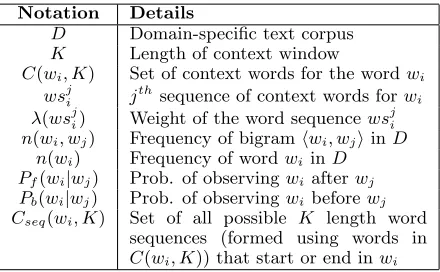
Notation Details
D Domain-specific text corpus
K Length of context window
C(wi, K) Set of context words for the wordwi wsji jthsequence of context words forw
i λ(wsji) Weight of the word sequencewsji n(wi, wj) Frequency of bigramhwi, wjiinD
n(wi) Frequency of wordwi inD Pf(wi|wj) Prob. of observingwiafterwj Pb(wi|wj) Prob. of observingwibeforewj Cseq(wi, K) Set of all possible K length word
sequences (formed using words in
[image:2.612.316.536.36.172.2]C(wi, K)) that start or end inwi
Table 1: Details of notations used in this paper
related word pairs.
3 Computing Word Similarity
We take help of astatistical language modelto represent the context of each of the words.
3.1 Language Model
A statistical language model (Jurafsky and Martin, 2000) assigns a probability to a se-quence of words using n-gram statistics es-timated from a text corpus. Using bigram statistics, the probability of the word sequence
w1, w2, w3, w4 is computed as follows,
P(w1, w2, w3, w4) =P(w1)P(w2|w1)P(w3|w2)P(w4|w3)
The main motivation behind using a Lan-guage Model is that it not only provides a way to capture the context information for words but also retains the word order information of context words. Moreover, using a Language Model, we can weigh each word sequence in the context of a particular word by computing its probability as explained above.
In our work, we have used a bigram (L0 = 2) Language Model along with Laplace smooth-ing. Our algorithm is currently designed for bigram model and in future we plan to extend it to higher order (L0 >2) models.
3.2 LMSim : Algorithm to Compute Language Model based Similarity For finding semantic similarity between two any words w1 and w2 (refer Table 1 for no-tations), sets of context words (C(w1, K) and
C(w2, K)) are created by collecting all the words falling in the window of±Kin the given text corpus. Let I be the set of words which appear in the context of both w1 and w2, i.e.
I =C(w1, K)∩C(w2, K).
Forw1 Forw2
Forward Backward Forward Backward
[image:3.612.316.544.37.131.2]w1, c1, c2 c1, c2, w1 w2, c1, c2 c1, c2, w2 w1, c1, c3 c1, c3, w1 w2, c1, c3 c1, c3, w2 w1, c2, c1 c2, c1, w1 w2, c2, c1 c2, c1, w2 w1, c2, c3 c2, c3, w1 w2, c2, c3 c2, c3, w2 w1, c3, c1 c3, c1, w1 w2, c3, c1 c3, c1, w2 w1, c3, c2 c3, c2, w1 w2, c3, c2 c3, c2, w2
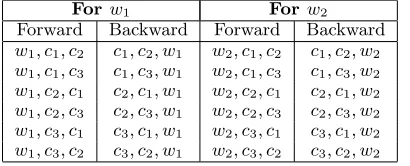
Table 2: Example word sequences considered
The context of w1 and w2 is then defined as set of word sequences of lengthK starting at or ending at either w1 or w2. The word sequences are formed by considering all pos-sible combinations of the words in the set I. If|I|=M, then MK word sequences starting atw1 orw2 are considered and MK word se-quences ending atw1 or w2 are considered. If
I ={c1, c2, c3} and K = 2, then the word se-quences created forw1 andw2are as shown in the table 2. Each word sequence is also asso-ciated with a weight which corresponds to its Language Model probability. For a forward sequencew1, c1, c2, its weight is set as follows,
λw1,c1,c2=Pf orward(c1, c2|w1) =Pf(c1|w1)Pf(c2|c1)
Pf(c1|w1) is computed by using the bigram statistics learnt from the text corpus, i.e. it is the ratio of number of times the word c1 succeeds w1 in the corpus to the number of timesw1 occurs in the corpus.
Pf(c1|w1) =
n(w1, c1)
n(w1)
Similarly, for a backward sequence c1, c2, w1, we set its weight as,
λc1,c2,w1 =Pbackward(c1, c2|w1) =Pb(c2|w1)Pb(c1|c2)
Pb(c2|w1) is computed as the ratio of number of times the wordc2precedesw1 in the corpus to the number of timesw1occurs in the corpus.
Pb(c2|w1) =
n(c2, w1)
n(w1)
The context of a word is a set of word sequences (ws’s) and their corresponding weights (λ’s) as follows,
Cseq(w1, K) ={hws11, λ(ws11)i,· · ·,hws1N, λ(ws1N)i}
Cseq(w2, K) ={hws21, λ(ws21)i,· · ·,hws2N, λ(ws2N)i}
It is to be noted that the word sequence
ws1i (in Cseq(w1, K)) corresponds to ws2i (in
Cseq(w2, K)) and they both are equal except that ws1
i starts or ends in w1 whereas ws2i starts or ends inw2.
Word pair simjaccard simcontext LMSim
client, 0.1545 0.754 0.1165
complaint
succession, 0.2019 0.9651 0.1949 plan
collaboration, 0.4259 0.2643 0.1126 realization
mapping, 0.4672 0.2951 0.1379
publication
Table 3: Word pairs having low LMSim
We define similarity based on Language Model between w1 and w2 as follows,
simjaccard(w1, w2) =
PN
i=1min(λ(ws 1
i), λ(ws2i))
PN
i=1max(λ(ws1i), λ(ws2i))
(1)
The similarity simJaccard between w1 and w2 is nothing but the weighted Jaccard similar-ity (Surgey, 2010) between Cseq(w1, K) and
Cseq(w2, K). Here, we treat ws1i and ws2i as equal while computing Jaccard similarity as noted earlier.
As we are constructing the word sequences by only using the words in the intersection of the contexts of the two words, we weigh down the similarity by multiplying it with the com-mon context factor,simcontext defined as,
simcontext(w1, w2) = max
|I| |C(w1, K)|,
|I| |C(w2, K)|
LMSim, the similarity between two wordsw1 and w2 is computed as,
LM Sim(w1, w2) =simjaccard(w1, w2)∗simcontext(w1, w2)
3.2.1 Why Are Both simjaccard and
simcontext Important?
Considering onlysimcontextcan be misleading, as many co-occurring word pairs will have a high simcontext. This is evident for the top 2 word pairs in Table 3 which have got high
simcontext even though they are not similar. As simjaccard for these pairs is very low, LM-Sim is reduced as desired.
On the other hand, due to smaller com-mon context, considering only simjaccard can be misleading. In Table 3, we can observe that the bottom 2 word pairs have relatively high
simjaccard, but due to their smaller common context, their simcontext is low which results in low LMSim as desired.
3.3 Efficient Computation of LMSim For computing simjaccard (Eq. 1), the sum of
N terms is required to be computed. Here,
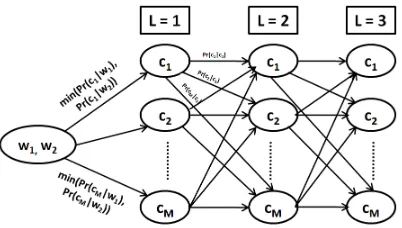
[image:3.612.88.293.38.121.2]Figure 1: All possible forward word sequences (intersection scenario)
N = 2·MK where K is the context window considered and M is the number of words in the context of both the words in consideration for computing similarity. Even for a moderate size corpus, the value ofMcan be in thousands and even for a small window of size 3, N will be 10003 which is a huge number. Hence, it is infeasible to actually enumerate all theN dis-tinct word sequences. We propose an efficient, dynamic programming based approach similar to Viterbi Algorithm (Forney, 1973) for fast computation of Language Model similarity.
Figure 1 shows all possible forward paths for words w1 and w2 formed using words in the setI ={c1, c2,· · ·cM}. It depicts the sce-nario where the numerator (intersection of two sets with weighted members) of Eq. 1 is being computed. All possible backward paths can be constructed in similar way.
At each level (Lin the figure 1 which varies from 1 toK), for each context word, we store sum of probabilities of all the word sequences ending in that particular word. This is similar to the Viterbi algorithm used for finding most probable state sequence for HMMs. The only difference is that, at each level for each state, Viterbi algorithm stores maximum of proba-bilities of all state sequences ending in that particular state whereas our algorithm stores the sum of probabilities of all word sequences ending in a particular word. This algorithm to compute simjaccard reduces the number of computations fromO(MK) to O(KM2).
4 Experimental Analysis
In this section, we describe details about ex-perimental evaluation of our algorithm.
4.1 Datasets
We use text corpora from following domains: 1. SE domain: A collection of 138159 task descriptions/expectations for various roles performed in Software services industry con-taining 1276514 words.
2. Agriculture domain: A set of 30533 doc-uments in English containing 999168 sentences and approximately 19 million words. It was collected using crawler4j3 by crawling various agriculture news sites.
There are no publicly available datasets of similar words for the SE and Agriculture do-mains. We selected some domain-specific word pairs for these domains and obtained human assigned similarity scores for these pairs. For the SE domain, we had 500 word pairs an-notated for similarity scores (0:No similarity, 1:Weak, 2:High) by 4 human annotators fa-miliar with the domain terminologies. The average of the similarity scores assigned by all the annotators is then considered as the gold-standard similarities for these word pairs. Similarly, we created a standard dataset4 of 200 word pairs in Agriculture domain.
4.2 Comparison with Other Approaches
1. Distributional Similarity (DistSim): For each word, a TF-IDF vector is constructed which encodes how the other words co-occur with that particular word. The similarity be-tween any two words is then computed as the cosine similarity between their corresponding TF-IDF vectors.
2. Latent Dirichlet Allocation (LDA): LDA (Blei et al., 2003) is a probabilistic gen-erative model that can be used to uncover the underlying semantic structure of a document collection. LDA gives per-word per-document topic assignments that can be used to find a likely set of topics and represent each docu-ment in the collection in the form of topic pro-portions. We find probability distribution of a word over topics using the number of times the word is assigned to a topic. We com-pute similarity between words wi and wj as the Jensen-Shannon (JS) divergence between their respective probability distributions over
3code.google.com/p/crawler4j/
topics. We experimented with different num-ber of topics and reported the results of best performing number of topics.
3. WordNet and Wikipedia based sim-ilarities: We used WordNet-based approach “Lin similarity” (Lin, 1998) for computing word similarities. We used its NLTK imple-mentation5 with Brown corpus for IC statis-tics. This algorithm computes similarity be-tween two synsets (senses). As we are not disambiguating sense of the words in a given word pair, we compute Lin similarity between all possible combinations of senses of the two words and consider the maximum of these sim-ilarities as overall similarity between words. We consider that the words not present in WordNet have similarity score of 0 with any other word. We also compare LMSim with Wikipedia based ESA6.
4. Brown Word Clustering: We used the Brown word clustering implementation7 by Percy Liang. Each word cluster is rep-resented by a binary (0/1) string indicating the path taken from the root to the word in consideration in the hierarchical word cluster-ing output. The algorithm does not explic-itly compute the word similarities, hence for any two wordsw1 andw2having binary string cluster representationss1 ands2, we compute similarity as,
simbrown(w1, w2) = |
CommonP ref ix(s1, s2)|
Average(|s1|,|s2|)
Here, |si| indicates the length of the binary string si. The only parameter required for Brown word clustering algorithm is the num-ber of clusters to form. We got the best results with 1000 clusters for SE domain and 500 clus-ters for Agriculture domain.
4.3 Results
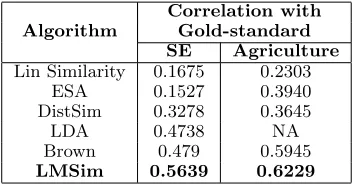
We use each algorithm discussed above to assign similarity scores to each word pair in our gold-standard dataset. Performance of each algorithm (see Table 4) is judged by computing correlation between an algo-rithm assigned word similarities with the gold-standard word similarities. We could not compare LMSim with LDA for Agriculture
5www.nltk.org
6http://treo.deri.ie/easyesa/
7http://github.com/percyliang/brown-cluster
Algorithm
Correlation with Gold-standard SE Agriculture
Lin Similarity 0.1675 0.2303
ESA 0.1527 0.3940
DistSim 0.3278 0.3645
LDA 0.4738 NA
Brown 0.479 0.5945
[image:5.612.335.512.37.129.2]LMSim 0.5639 0.6229
Table 4: Relative performance of algorithms
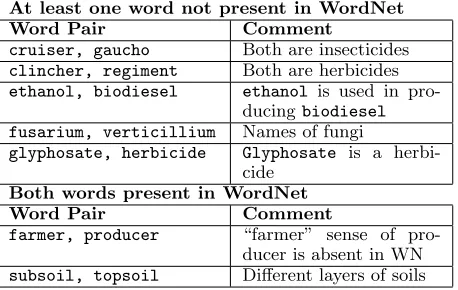
dataset due to large size of the corpus. We can observe here that for both the datasets, LMSim performs better than WordNet and Wikipedia based approaches because of ab-sence of many domain-specific words/senses in these resources. At the same time, LMSim performs better than DistSim, LDA and Brown word clustering algorithm, so we can say that LMSim encodes the context infor-mation in better way through forward and backward context word sequences. Table 5 and Table 6 show some of the highly similar word pairs discovered for both the domains. Following are some key observations of the experimental results.
1. Importance of Word Order : LM-Sim scores over other context based word similarity approaches like DistSim and LDA because it encodes word order of the context words using Language Model. For example, a word pair asset - wiki incorrectly assigned high similarity scores by both DistSim and LDA, because these two words co-occur quite frequently. Some example text fragments in which they usually co-occur are as follows:
-Number of Assets to be logged into wiki ... -No. of assets created in team Wiki..
At least one word not present in WordNet Word Pair Comment
clarity, epm Clarity is a tool for EPM (En-terprise Project Management)
sit ,uat SIT:System Integration Testing, UAT:User Acceptance Testing
solution, POCs POC : “Proof of concept”
.Net, Java Types of softwares
Both words present in WordNet Word Pair Comment
people, resource “person” sense ofresource not present in WN
complaint, escalation
“complaint” sense of
escalationabsent in WN
[image:5.612.316.544.556.713.2]test, regression Regression is a kind of testing
Table 5: Examples from SE domain
At least one word not present in WordNet Word Pair Comment
cruiser, gaucho Both are insecticides
clincher, regiment Both are herbicides
ethanol, biodiesel ethanol is used in pro-ducingbiodiesel fusarium, verticillium Names of fungi
glyphosate, herbicide Glyphosate is a herbi-cide
Both words present in WordNet Word Pair Comment
farmer, producer “farmer” sense of pro-ducer is absent in WN
[image:6.612.82.311.38.183.2]subsoil, topsoil Different layers of soils
Table 6: Examples from Agriculture domain
-Number of assets posted to Wiki..
For this word pair, LMSim assigns a low similarity score as they do not tend to share similar context word sequences.
2. Limitations of LMSim: We ob-served that LMSim assigns high similarity for synonyms (client-customer), antonyms (dry-wet) and siblings (spring-summer, .Net-Java), but for some hypernymy rela-tions (like consultant-associate) it assigns a low similarity score because of strict replace-ability constraint. In future, we will revise our algorithm to overcome this limitation.
5 Conclusions and Future Work
We proposed a new algorithm LMSim using a Language Modeling approach for computing domain-specific word similarities. We demon-strated the performance of LMSim on two dif-ferent domains - Software Engineering (SE) domain and Agriculture domain. To the best of our knowledge this is the first attempt for discovering similar words in these domains.
The important advantages of LMSim over previous approaches are - i) it does not require any linguistic resources (like WordNet) hence it saves cost, time and human efforts involved in creating such resources, ii) LMSim incorpo-rates the word order information within con-text of a word resulting in better estimates of word similarity compared to other corpus-based approaches that ignore word order. We proposed an efficient dynamic programming based algorithm for computing LMSim. Our experiments show that LMSim better corre-lates with human assigned word similarities as compared to other approaches.
In future, we plan to revise LMSim by ex-tending it to higher order language models, trying better smoothing techniques and us-ing other information like POS tags for hav-ing better estimates of word probabilities. We also plan to extend our algorithm to work for Indian languages as lexical resources for these languages are not widely available. We would like to experiment with other domains like Me-chanical Engineering, Legal domain etc. We believe that our algorithm can facilitate con-struction of domain-specific ontologies.
References
D. M. Blei, A. Y. Ng, and M. I. Jordan. Latent Dirichlet Allocation. The Journal of Machine Learning Research, 3:993–1022, March 2003.
A. Budanitsky and G. Hirst. Evaluating wordnet-based measures of lexical semantic relatedness.
Computational Linguistics, 32(1):13–47, 2006.
G. D. Forney Jr. The viterbi algorithm. Proceed-ings of the IEEE, 61(3):268–278, 1973.
E. Gabrilovich and S. Markovitch. Computing semantic relatedness using wikipedia-based ex-plicit semantic analysis. In IJCAI, volume 7, pages 1606–1611, 2007.
G. Halawi, G. Dror, E. Gabrilovich, and Y. Ko-ren. Large-scale learning of word relatedness with constraints. InSIGKDD, pages 1406–1414. ACM, 2012.
S. Ioffe. Improved consistent sampling, weighted minhash and l1 sketching. Data Mining (ICDM), 2010 IEEE 10th International Confer-ence on. IEEE, 2010, pages 246–255, 2010.
D. Jurafsky and J. H. Martin. Speech & Language Processing. Pearson Education India, 2000.
L. Lee. Measures of distributional similarity. In
ACL1999, pages 25–32.
D. Lin. An information-theoretic definition of sim-ilarity. InICML, vol. 98, pages 296–304, 1998.
G. A. Miller. Wordnet: a lexical database for en-glish. Communications of the ACM, 38(11):39– 41, 1995.
T. Pedersen, S.V. Pakhomov, S. Patwardhan and C.G. Chute. Measures of semantic similarity and relatedness in the biomedical domain. Jour-nal of biomedical informatics, 40(3):288–299, 2007.
Brown, P. F., Desouza, P. V., Mercer, R. L., Pietra, V. J. D., & Lai, J. C. Class-based n-gram mod-els of natural language. In Computational lin-guistics, 18(4), pages 467–479.