N-best Reranking by Multitask Learning
Kevin Duh Katsuhito Sudoh Hajime Tsukada Hideki Isozaki Masaaki Nagata
NTT Communication Science Laboratories
2-4 Hikaridai, Seika-cho, Soraku-gun, Kyoto, 619-0237, Japan
{kevinduh,sudoh,tsukada,isozaki}@cslab.kecl.ntt.co.jp [email protected]
Abstract
We propose a new framework for N-best reranking on sparse feature sets. The idea is to reformulate the reranking problem as a Multitask Learning problem, where each N-best list corresponds to a distinct task.
This is motivated by the observation that N-best lists often show significant differ-ences in feature distributions. Training a single reranker directly on this heteroge-nous data can be difficult.
Our proposed meta-algorithm solves this challenge by using multitask learning (such as ℓ1/ℓ2 regularization) to discover common feature representations across N-best lists. This meta-algorithm is simple to implement, and its modular approach al-lows one to plug-in different learning algo-rithms from existing literature. As a proof of concept, we show statistically signifi-cant improvements on a machine transla-tion system involving millions of features.
1 Introduction
Many natural language processing applications, such as machine translation (MT), parsing, and language modeling, benefit from the N-best reranking framework (Shen et al., 2004; Collins and Koo, 2005; Roark et al., 2007). The advan-tage of N-best reranking is that it abstracts away the complexities of first-pass decoding, allowing the researcher to try new features and learning al-gorithms with fast experimental turnover.
In the N-best reranking scenario, the training data consists of sets of hypotheses (i.e. N-best lists) generated by a first-pass system, along with their labels. Given a new N-best list, the goal is to rerank it such that the best hypothesis appears near the top of the list. Existing research have fo-cused on training a single reranker directly on the
entire data. This approach is reasonable if the data is homogenous, but it fails when features vary sig-nificantly across different N-best lists. In partic-ular, when one employs sparse feature sets, one seldom finds features that are simultaneously ac-tive on multiple N-best lists.
In this case, we believe it is more advantageous to view the N-best reranking problem as a
multi-task learning problem, where each N-best list
cor-responds to a distinct task. Multitask learning, a subfield of machine learning, focuses on how to effectively train on a set of different but related datasets (tasks). Our heterogenous N-best list data fits nicely with this assumption.
The contribution of this work is three-fold:
1. We introduce the idea of viewing N-best reranking as a multitask learning problem. This view is particularly apt to any general reranking problem with sparse feature sets.
2. We propose a simple meta-algorithm that first discovers common feature representa-tions across N-bests (via multitask learning) before training a conventional reranker. Thus it is easily applicable to existing systems.
3. We demonstrate that our proposed method outperforms the conventional reranking ap-proach on a English-Japanese biomedical machine translation task involving millions of features.
The paper is organized as follows: Section 2 de-scribes the feature sparsity problem and Section 3 presents our multitask solution. The effectiveness of our proposed approach is validated by experi-ments demonstrated in Section 4. Finally, Sections 5 and 6 discuss related work and conclusions.
2 The Problem of Sparse Feature Sets
For concreteness, we will describe N-best rerank-ing in terms of machine translation (MT), though
our approach is agnostic to the application. In MT reranking, the goal is to translate a foreign lan-guage sentence f into an English sentence e by picking from a set of likely translations. A stan-dard approach is to use a linear model:
ˆ
e= arg max
e∈N(f)
wT ·h(e, f) (1)
where h(e, f) is aD-dimensional feature vector, wis the weight vector to be trained, and N(f)is the set of likely translations off, i.e. the N-best list. The feature h(e, f) can be any quantity de-fined in terms of the sentence pair, such as transla-tion model and language model probabilities.
Here we are interested in situations where the feature definitions can be quite sparse. A com-mon methodology in reranking is to first design
feature templates based on linguistic intuition and
domain knowledge. Then, numerous features are instantiated based on the training data seen. For example, the work of (Watanabe et al., 2007) de-fines feature templates based on bilingual word alignments, which lead to extraction of heavily-lexicalized features of the form:
h(e, f) =
1 if foreign word “Monsieur” and English word “Mr.” co-occur ine,f
0 otherwise
(2) One can imagine that such features are sparse because it may only fire for input sentences that contain the word “Monsieur”. For all other input sentences, it is an useless, inactive feature.
Another common feature involves word ngram templates, for example:
h(e, f) =
1 if English trigram
“Mr. Smith said” occurs ine
0 otherwise
(3) In this case, all possible trigrams seen in the N-best list are extracted as features. One can see that this kind of feature can be very sensitive to the first-pass decoder: if the decoder has loose re-ordering constraints, then we may extract expo-nentially many nonsense ngram features such as “Smith said Mr.” and “said Smith Mr.”. Granted, the reranker training algorithm may learn that these nonsense ngrams are indicative of poor hy-potheses, but it is unlikely that the exact same
non-sense ngrams will appear given a different test sen-tence.
In summary, the following issues compound to create extremely sparse feature sets:
1. Feature templates are heavily-lexicalized, which causes the number of features to grow unbounded as the the amount of data in-creases.
2. The input (f) has high variability (e.g. large vocabulary size), so that features for different inputs are rarely shared.
3. The N-best list output also exhibits high vari-ability (e.g. many different word reorder-ings). LargerN may improve reranking per-formance, but may also increase feature spar-sity.
When the number of features is too large, even popular reranking algorithms such as SVM (Shen et al., 2004) and MIRA (Watanabe et al., 2007; Chiang et al., 2009) may fail. Our goal here is to address this situation.
3 Proposed Reranking Framework
In the following, we first give an intuitive com-parison between single vs. multiple task learning (Section 3.1), before presenting the general meta-algorithm (Section 3.2) and particular instantia-tions (Section 3.3).
3.1 Single vs. Multiple Tasks
Given a set ofI input sentences{fi}, the training data for reranking consists of a set ofIN-best lists
{(Hi,yi)}i=1,...,I, where Hi are features and yi are labels.
To clarify the notation:1 for an input sentence
fi, there is a N-best listN(fi). For a N-best list
N(fi), there areN feature vectors corresponding to theNhypotheses, each with dimensionD. The collection of feature vectors for N(fi) is repre-sented by Hi, which can be seen as a D × N
matrix. Finally, the N-dimensional vector of la-belsyiindicates the translation quality of each hy-pothesis in N(fi). The purpose of the reranker training algorithm is to find good parameters from
{(Hi,yi)}.
1Generally we use bold fonthto represent a vector,
bold-capital fontHto represent a matrix. Scripthandh(·)may
The conventional method of training a single reranker (single task formulation) involves opti-mizing a generic objective such as:
arg min w
I
X
i=1
L(w,Hi,yi) +λΩ(w) (4)
wherew∈RD is the reranker trained on all lists, and L(·) is some loss function. Ω(w) is an op-tional regularizer, whose effect is traded-off by the constant λ. For example, the SVM reranker for MT (Shen et al., 2004) defines L(·) to be some function of sentence-level BLEU score, andΩ(w)
to be the large margin regularizer.2
On the other hand, multitask learning involves solving for multiple weights, w1,w2, . . . ,wI, one for each N-best list. One class of multitask learning algorithms, Joint Regularization, solves the following objective:
arg min w1,..,wI
I
X
i=1
L(wi,Hi,yi) +λΩ(w1, ..,wI)
(5) The loss decomposes by task but the joint regu-larizerΩ(w1, ..,wI)couples together the different weight parameters. The key is to note that multi-ple weights allow the algorithm to fit the heteroge-nous data better, compared to a single weight vec-tor. Yet these weights are still tied together so that some information can be shared across N-best lists (tasks).
One instantiation of Eq. 5 is ℓ1/ℓ2 regular-ization: Ω(w1, ..,wI) , ||W||1,2, where W =
[w1|w2|. . .|wI]T is a I-by-D matrix of stacked
weight vectors. The norm is computed by first tak-ing the 2-norm on columns of W, then taking a 1-norm on the resultingD-length vector. This en-courages the optimizer to choose a small subset of features that are useful across all tasks.
For example, suppose two different sets of weight vectors Wa and Wb for a 2 lists, 4
fea-tures reranking problem. The ℓ1/ℓ2 norm forWa
is 14; theℓ1/ℓ2 norm forWb is 12. If both have
the same loss L(·) in Eq. 5, the multitask opti-mizer would prefer Wb since more features are
shared:
Wa: »
4 0 0 3
0 4 3 0
–
Wb: »
4 3 0 0
0 4 3 0
–
4 4 3 3→14 4 5 3 0→12
2In MT, evaluation metrics like BLEU do not exactly
de-compose across sentences, so for some training algorithms this loss is an approximation.
3.2 Proposed Meta-algorithm
We are now ready to present our general reranking meta-algorithm (see Algorithm 1), termed Rerank-ing by Multitask LearnRerank-ing (RML).
Algorithm 1 Reranking by Multitask Learning Input: N-best data{(Hi,yi)}i=1,...,I
Output: Common feature representation hc(e, f) and weight vectorwc
1: [optional]RandomHashing({Hi})
2: W= MultitaskLearn({(Hi,yi)})
3: hc = ExtractCommonFeature(W)
4: {Hic}= RemapFeature({Hi}, hc)
5: wc= ConventionalReranker({(Hic,yi)})
The first step, random hashing, is optional. Ran-dom hashing is an effective trick for reducing the dimension of sparse feature sets without suffer-ing losses in fidelity (Weinberger et al., 2009; Ganchev and Dredze, 2008). It works by collaps-ing random subsets of features. This step can be performed to speed-up multitask learning later. In some cases, the original feature dimension may be so large that hashed representations may be neces-sary.
The next two steps are key. A multitask learn-ing algorithm is run on the N-best lists, and a com-mon feature space shared by all lists is extracted. For example, if one uses the multitask objective of Eq. 5, the result of step 2 is a set of weights W. ExtractCommonFeature(W) then returns the feature id’s (either from original or hashed repre-sentation) that receive nonzero weight in any of W.3 The new features hc(e, f) are expected to have lower dimension than the original features
h(e, f). Section 3.3 describes in detail different multitask methods that can be plugged-in to this step.
The final two steps involve a conventional reranker. In step 4, we remap the N-best list data according to the new feature representations
hc(e, f). In step 5, we train a conventional reranker on this common representation, which by now should have overcome sparsity issues. Us-ing a conventional reranker at the end allows us to exploit existing rerankers designed for specific NLP applications. In a sense, our meta-algorithm simply involves a change of representation for the conventional reranking scenario, where the
3For example inW
b, features 1-3 have nonzero weights
new representation is found by multitask methods which are well-suited to heterogenous data.
3.3 Multitask Objective Functions
Here, we describe various multitask methods that can be plugged in Step 2 of Algorithm 1. Our goal is to demonstrate that a wide range of existing methods from the multitask learning literature can be brought to our problem. We categorize multi-task methods into two major approaches:
1. Joint Regularization: Eq. 5 is an
exam-ple of joint regularization, withℓ1/ℓ2 norm being a particular regularizer. The idea is to use the reg-ularizer to ensure that the learned functions of re-lated tasks are close to each other. The popular
ℓ1/ℓ2objective can be optimized by various meth-ods, such as boosting (Obozinski et al., 2009) and convex programming (Argyriou et al., 2008). Yet another regularizer is theℓ1/ℓ∞norm (Quattoni et al., 2009), which replaces the 2-norm with a max. One could also define a regularizer to ensure that each task-specificwiis close to some average parameter, e.g. P
i||wi −wavg||2. If we inter-pretwavg as a prior, we begin to see links to
Hier-archical Bayesian methods for multitask learning
(Finkel and Manning, 2009; Daume, 2009).
2. Shared Subspace: This approach assumes
that there is an underlying feature subspace that is common to all tasks. Early works on multi-task learning implement this by neural networks, where different tasks have different output layers but share the same hidden layer (Caruana, 1997).
Another method is to write the weight vector as two parts w = [u;v]and let the task-specific function beuT ·h(e, f) +vT ·Θ·h(e, f)(Ando and Zhang, 2005).Θis aD′
×Dmatrix that maps the original features to a subspace common to all tasks. The new feature representation is computed by the projectionhc(e, f),Θ·h(e, f).
Multitask learning is a vast field and relates to areas like collaborative filtering (Yu and Tresp, 2005) and domain adaptation. Most methods as-sume some common representation and is thus ap-plicable to our framework. The reader is urged to refer to citations in, e.g. (Argyriou et al., 2008) for a survey.
4 Experiments and Results
As a proof of concept, we perform experiments on a MT system with millions of features. We use a hierarchical phrase-based system (Chiang,
100
101
102
103
104 10−7
10−6 10−5 10−4 10−3 10−2 10−1 100
P(feature occurs in x lists)
[image:4.595.331.489.66.194.2]x
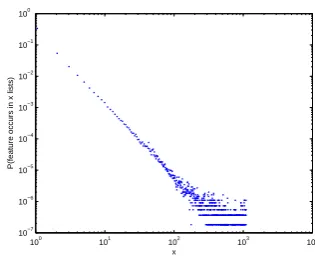
Figure 1: This log-log plot shows that there are many rare features and few common features. The probability that a feature occurs inxnumber of N-best lists behaves according to the power-lawx−α, whereα= 2.28.
2007) to generate N-best lists (N=100). Sparse features used in reranking are extracted according to (Watanabe et al., 2007). Specifically, the major-ity are lexical features involving joint occurrences of words within the N-best lists and source sen-tences.
It is worth noting that the fact that the first pass system is a hierarchical system is not essential to the feature extraction step; similar features can be extracted with other systems as first-pass, e.g. a phrase-based system. That said, the extent of the feature sparsity problem may depend on the per-formance of the first-pass system.
We experiment with medical domain MT, where large numbers of technical vocabulary cause spar-sity challenges. Our corpora consists of English abstracts from PubMed4with their Japanese trans-lations. The first-pass system is built on hierarchi-cal phrases extracted from 17k sentence pairs and target (Japanese) language models trained on 800k medical-domain sentences. For our reranking ex-periments, we used 500 lists as the training set5, 500 lists as held-out, and another 500 for test.
4.1 Data Characteristics
We present some statistics to illustrate the feature sparsity problem: From 500 N-best lists, we ex-tracted a total of 2.4 million distinct features. By type, 75% of these features occur in only one N-best list in the dataset. Less than 3% of features
4A database of the U.S. National Library of Medicine.
5In MT, training data for reranking is sometimes referred
occur in ten or more lists. The distribution of fea-ture occurrence is clearly Zipfian, as seen in the power-law plot in Figure 1.
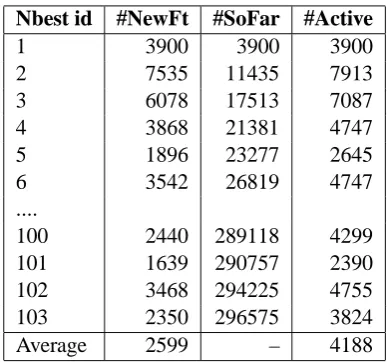
We can also observe the feature growth rate (Ta-ble 1). This is the number of new features intro-duced when an additional N-best list is seen. It is important to note that on average, 2599 new fea-tures are added everytime a new N-best list is seen. This is as much as2599/4188 = 62%of the ac-tive features. Imagine an online training algorithm (e.g. MIRA or perceptron) on this kind of data: whenever a loss occurs and we update the weight vector, less than half of the weight vector update applies to data we have seen thus far. Herein lies the potential for overfitting.
From observing the feature grow rate, one may hypothesize that adding large numbers of N-best lists to the training set (500 in the experiments here) may not necessarily improve results. While adding data potentially improves the estimation process, it also increases the feature space dramat-ically. Thus we see the need for a feature extrac-tion procedure.
(Watanabe et al., 2007) also reports the possibil-ity of overfitting in their dataset (Arabic-English newswire translation), especially when domain differences are present. Here we observe this ten-dency already on the same domain, which is likely due to the highly-specialized vocabulary and the complex sentence structures common in research paper abstracts.
4.2 MT Results
Our goal is to compare different feature represen-tations in reranking: The baseline reranker uses the original sparse feature representation. This is compared to feature representations discovered by three different multitask learning methods:
• Joint Regularization (Obozinski et al., 2009)
• Shared Subspace (Ando and Zhang, 2005)
• Unsupervised Multitask Feature Selection (Abernethy et al., 2007).6
We use existing implementations of the above methods.7 The conventional reranker (Step 5,
Al-6This is not a standard multitask algorithm since most
multitask algorithms are supervised. We include it to see if unsupervised or semi-supervised multitask algorithms is promising. Intuitively, the method tries to select subsets of features that are correlated across multiple tasks using ran-dom sampling (MCMC). Features that co-occur in different tasks form a high probability path.
7
Available at http://multitask.cs.berkeley.edu
Nbest id #NewFt #SoFar #Active
1 3900 3900 3900
2 7535 11435 7913
3 6078 17513 7087
4 3868 21381 4747
5 1896 23277 2645
6 3542 26819 4747
....
100 2440 289118 4299
101 1639 290757 2390
102 3468 294225 4755
103 2350 296575 3824
[image:5.595.319.513.60.241.2]Average 2599 – 4188
Table 1: Feature growth rate: For N-best list iin the table, we have (#NewFt = number of new fea-tures introduced since N-best i−1) ; (#SoFar = Total number of features defined so far); and (#Ac-tive = number of ac(#Ac-tive features for N-besti). E.g., we extracted 7535 new features from N-best 2; combined with the 3900 from N-best 1, the total features so far is 11435.
gorithm 1) used in all cases is SVMrank.8 Our initial experiments show that the SVM baseline performance is comparable to MIRA training, so we use SVM throughout. The labels for the SVM are derived as in (Shen et al., 2004), where top 10% of hypotheses by smoothed sentence-BLEU is ranked before the bottom 90%. All multitask learning methods work on hashed features of di-mension 4000 (Step 1, Algorithm 1). This speeds up the training process.
All hyperparameters of the multitask method are tuned on the held-out set. In particular, the most important is the number of common features to extract, which we pick from{250,500,1000}.
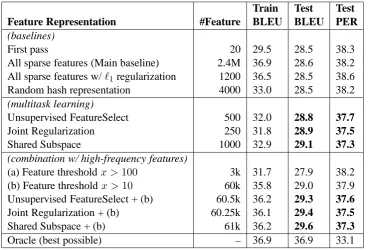
Table 2 shows the results by BLEU (Papineni et al., 2002) and PER. The Oracle results are ob-tained by choosing the best hypothesis per N-best list by sentence-level BLEU, which achieved 36.9 BLEU in both Train and Test. A summary of our observations is:
1. The baseline (All sparse features) overfits. It achieves the oracle BLEU score on the train set (36.9) but performs poorly on the test (28.6).
2. Similar overfitting occurs when traditional ℓ1 regularization is used to select features on
8
the sparse feature representation9. ℓ
1 reg-ularization is a good method of handling sparse features for classification problems, but in reranking the lack of tying between lists makes this regularizer inappropriate. A small set of around 1200 features are chosen: they perform well independently on each task in the training data, but there is little sharing with the test data.
3. All three multitask methods obtained features that outperformed the baseline. The BLEU scores are 28.8, 28.9, 29.1 for Unsupervised Feature Selection, Joint Regularization, and Shared Subspace, respectively, which all out-perform the 28.6 baseline. All improvements are statistically significant by bootstrap sam-pling test (1000 samples, p < 0.05) (Zhang et al., 2004).
4. Shared Subspace performed the best. We conjecture this is because its feature projec-tion can create new feature combinaprojec-tions that is more expressive than the feature selection used by the two other methods.
5. PER results are qualitatively similar to BLEU results.
6. As a further analysis, we are interested in see-ing whether multitask learnsee-ing extracts novel features, especially those that have low fre-quency. Thus, we tried an additional feature representation (feature threshold) which only keeps features that occur in more than x N-bests, and concatenate these high-frequency features to the multitask features. The fea-ture threshold alone achieves nice BLEU re-sults (29.0 forx > 10), but the combination outperforms it by statistically significant mar-gins (29.3-29.6). This implies that multitask learning is extracting features that comple-ment well with high frequency features.
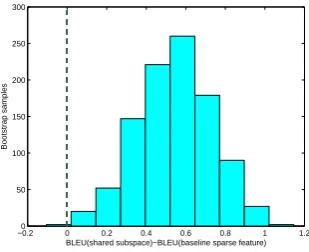
For the multitask features, improvements of 0.2 to 1.0 BLEU are modest but consistent. Figure 2 shows the BLEU of bootstrap samples obtained as part of the statistical significance test. We see that multitask almost never underperform
base-line in any random sampling of the data. This
im-plies that the proposed meta-algorithm is very
sta-9Optimized by the Vowpal Wabbit toolkit:
http://hunch.net/vw/
ble, i.e. it is not a method that sometimes improves and sometimes degrades.
Finally, a potential question to ask is: what kinds of features are being selected by the multitask learning algorithms? We found that that two kinds of features are usually selected: one is general features that are not lexicalized, such as “count of phrases”, “count of dele-tions/insertions”, “number of punctuation marks”. The other kind is lexicalized features, such as those in Equations 2 and 3, but involving functions words (like the Japanese characters “wa”, “ga”, “ni”, “de”) or special characters (such as numeral symbol and punctuation). These are features that can be expected to be widely applicable, and it is promising that multitask learning is able to recover these from the millions of potential features. 10
−0.20 0 0.2 0.4 0.6 0.8 1 1.2 50
100 150 200 250 300
BLEU(shared subspace)−BLEU(baseline sparse feature)
[image:6.595.335.490.312.438.2]Bootstrap samples
Figure 2: BLEU difference of 1000 bootstrap sam-ples. 95% confidence interval is [.15, .90] The proposed approach therefore seems to be a stable method.
5 Related Work in NLP
Previous reranking work in NLP can be classified into two different research focuses:
1. Engineering better features: In MT, (Och
and others, 2004) investigates features extracted from a wide variety of syntactic representations, such as parse tree probability on the outputs. Al-though their results show that the proposed syntac-tic features gave little improvements, they point to some potential reasons, such as domain mismatch for the parser and overfitting by the reranking
10
Train Test Test Feature Representation #Feature BLEU BLEU PER
(baselines)
First pass 20 29.5 28.5 38.3
All sparse features (Main baseline) 2.4M 36.9 28.6 38.2 All sparse features w/ℓ1regularization 1200 36.5 28.5 38.6
Random hash representation 4000 33.0 28.5 38.2
(multitask learning)
Unsupervised FeatureSelect 500 32.0 28.8 37.7
Joint Regularization 250 31.8 28.9 37.5
Shared Subspace 1000 32.9 29.1 37.3
(combination w/ high-frequency features)
(a) Feature thresholdx >100 3k 31.7 27.9 38.2
(b) Feature thresholdx >10 60k 35.8 29.0 37.9
Unsupervised FeatureSelect + (b) 60.5k 36.2 29.3 37.6
Joint Regularization + (b) 60.25k 36.1 29.4 37.5
Shared Subspace + (b) 61k 36.2 29.6 37.3
[image:7.595.116.486.61.311.2]Oracle (best possible) – 36.9 36.9 33.1
Table 2: Results for different feature sets, with corresponding feature size and train/test BLEU/PER. All multitask features give statistically significant improvements over the baselines (boldfaced), e.g. Shared Subspace: 29.1 BLEU vs Baseline: 28.6 BLEU. Combinations of multitask features with high frequency features also give significant improvements over the high frequency features alone.
method. Recent work by (Chiang et al., 2009) de-scribes new features for hierarchical phrase-based MT, while (Collins and Koo, 2005) describes features for parsing. Evaluation campaigns like WMT (Callison-Burch et al., 2009) and IWSLT (Paul, 2009) also contains a wealth of information for feature engineering in various MT tasks.
2. Designing better training algorithms:
N-best reranking can be seen as a subproblem of structured prediction, so many general structured prediction algorithms (c.f. (Bakir et al., 2007)) can be applied. In fact, some structured predic-tion algorithms, such as the MIRA algorithm used in dependency parsing (McDonald et al., 2005) and MT (Watanabe et al., 2007) uses iterative sets of N-best lists in its training process. Other training algorithms include perceptron-style algo-rithms (Liang et al., 2006), MaxEnt (Charniak and Johnson, 2005), and boosting variants (Kudo et al., 2005).
The division into two research focuses is conve-nient, but may be suboptimal if the training algo-rithm and features do not match well together. Our work can be seen as re-connecting the two focuses, where the training algorithm is explicitly used to help discover better features.
Multitask learning is currently an active subfield
within machine learning. There has already been some applications in NLP: For example, (Col-lobert and Weston, 2008) uses a deep neural net-work architecture for multitask learning on part-of-speech tagging, chunking, semantic role label-ing, etc. They showed that jointly learning these related tasks lead to overall improvements. (De-selaers et al., 2009) applies similar methods for machine transliteration. In information extraction, learning different relation types can be naturally cast as a multitask problem (Jiang, 2009; Carlson et al., 2009). Our work can be seen as following the same philosophy, but applied to N-best lists.
In other areas, (Reichart et al., 2008) introduced an active learning strategy for annotating multitask linguistic data. (Blitzer et al., 2006) applies the multitask algorithm of (Ando and Zhang, 2005) to domain adaptation problems in NLP. We expect that more novel applications of multitask learning will appear in NLP as the techniques become scal-able and standard.
6 Discussion and Conclusion
learning data. Our MT experiments show consis-tent statistically significant improvements.
From the Bayesian view, multitask formulation of best lists is actually very natural: Each N-best is generated by a different data-generating distribution since the input sentences are different, i.e. p(e|f1) 6= p(e|f2). Yet these N-bests are re-lated since the generalp(e|f)distribution depends on the same first-pass models.
The multitask learning perspective opens up interesting new possibilities for future work, e.g.:
• Different ways to partition data into tasks, e.g. clustering lists by document structure, or hierarchical clustering of data
• Multitask learning on lattices or N-best lists with larger N. It is possible that a larger hy-pothesis space may improve the estimation of task-specific weights.
• Comparing multitask learning to sparse on-line learning of batch data, e.g. (Tsuruoka et al., 2009).
• Modifying the multitask objective to incorpo-rate application-specific loss/decoding, such as Minimum Bayes Risk (Kumar and Byrne, 2004)
• Using multitask learning to aid large-scale feature engineering and visualization.
Acknowledgments
We have received numerous helpful comments throughout the course of this work. In partic-ular, we would like to thank Albert Au Yeung, Jun Suzuki, Shinji Watanabe, and the three anony-mous reviewers for their valuable suggestions.
References
Jacob Abernethy, Peter Bartlett, and Alexander Rakhlin. 2007. Multitask learning with expert ad-vice. In COLT.
Rie Ando and Tong Zhang. 2005. A framework for learning predictive structures from multiple tasks and unlabeled data. JMLR.
Andreas Argyriou, Theodoros Evgeniou, and Massim-iliano Pontil. 2008. Convex multitask feature learn-ing. Machine Learning, 73(3).
G. Bakir, T. Hofmann, B. Scholkopf, A. Smola, B. Taskar, and S. V. N. Vishwanathan, editors. 2007. Predicting structured data. MIT Press.
J. Blitzer, R. McDonald, and F. Pereira. 2006. Domain adaptation with structural correspondence learning. In EMNLP.
Chris Callison-Burch, Philipp Koehn, Christof Monz, and Josh Schroeder. 2009. Findings of the 2009 workshop on statistical machine translation. In WMT.
Andrew Carlson, Justin Betteridge, Estevam Hruschka, and Tom Mitchell. 2009. Coupling semi-supervised learning of categories and relations. In NAACL Workshop on Semi-supervised learning for NLP (SSLNLP).
Rich Caruana. 1997. Multitask learning. Machine Learning, 28.
Eugene Charniak and Mark Johnson. 2005. Coarse-to-fine n-best parsing and maxent discriminative reranking. In ACL.
David Chiang, Wei Wang, and Kevin Knight. 2009. 11,001 new features for statistical machine transla-tion. In NAACL.
David Chiang. 2007. Hierarchical phrase-based trans-lation. Computational Linguistics, 33(2).
Michael Collins and Terry Koo. 2005. Discriminative reranking for natural langauge parsing. Computa-tional Linguistics, 31(1).
Ronan Collobert and Jason Weston. 2008. A unified architecture for natural language processing: deep neural networks with multitask learning. In ICML.
Hal Daume. 2009. Bayesian multitask learning with latent hierarchies. In UAI.
Thomas Deselaers, Sasa Hasan, Oliver Bender, and Hermann Ney. 2009. A deep learning approach to machine transliteration. In WMT.
Jenny Rose Finkel and Chris Manning. 2009. Hier-archical Bayesian domain adaptation. In NAACL-HLT.
Kuzman Ganchev and Mark Dredze. 2008. Small sta-tistical models by random feature mixing. In ACL-2008 Workshop on Mobile Language Processing.
Jing Jiang. 2009. Multitask transfer learning for weakly-supervised relation extraction. In ACL.
Taku Kudo, Jun Suzuki, and Hideki Isozaki. 2005. Boosting-based parse reranking with subtree fea-tures. In ACL.
Shankar Kumar and William Byrne. 2004. Minimum bayes-risk decoding for statistical machine transla-tion. In HLT-NAACL.
J. Liu, S. Ji, and J. Ye. 2009. Multi-task feature learn-ing via efficient l2,1-norm minimization. In UAI.
Ryan McDonald, Koby Crammer, and Fernando Pereira. 2005. Online large margin training of de-pendency parsers. In ACL.
Guillaume Obozinski, Ben Taskar, and Michael Jor-dan. 2009. Joint covariate selection and joint sub-space selection for multiple classification problems. Statistics and Computing.
F.J. Och et al. 2004. A smorgasbord of features for statistical machine translation. In HLT/NAACL.
Kishore Papineni, Salim Roukos, Todd Ward, and Wei-Jing Zhu. 2002. BLEU: A method for automatic evaluation of machine translation. In ACL.
Michael Paul. 2009. Overview of the iwslt 2009 eval-uation campaign. In IWSLT.
Ariadna Quattoni, Xavier Carreras, Michael Collins, and Trevor Darrell. 2009. An efficient projection for L1-Linfinity regularization. In ICML.
Roi Reichart, Katrin Tomanek, Udo Hahn, and Ari Rappoport. 2008. Multi-task active learning for lin-guistic annotations. In ACL.
Brian Roark, Murat Saraclar, and Michael Collins. 2007. Discriminative n-gram language modeling. Computer Speech and Language, 21(2).
Libin Shen, Anoop Sarkar, and Franz Och. 2004. Dis-criminative reranking for machine translation. In HLT-NAACL.
Yoshimasa Tsuruoka, Jun’ichi Tsujii, and Sophia Ana-niadou. 2009. Stochastic gradient descent training for l1-regularized log-linear models with cumulative penalty. In ACL-IJCNLP.
Taro Watanabe, Jun Suzuki, Hajime Tsukada, and Hideki Isozaki. 2007. Online large-margin train-ing for statistical machine translation. In EMNLP-CoNLL.
Kilian Weinberger, Anirban Dasgupta, John Langford, Alex Smola, and Josh Attenberg. 2009. Feature hashing for large scale multitask learning. In ICML.
Kai Yu and Volker Tresp. 2005. Learning to learn and collaborative filtering. In NIPS-2005 Workshop on Inductive Transfer.