An integrated tool for annotating historical corpora
Pablo Picasso Feliciano de Faria∗ University of Campinas
Campinas, Brazil [email protected]
Fabio Natanael Kepler† University of Sao Paulo
Sao Paulo, Brazil [email protected]
Maria Clara Paixão de Sousa University of Sao Paulo
Sao Paulo, Brazil [email protected]
Abstract
E-Dictor is a tool for encoding, applying levels of editions, and assigning part-of-speech tags to ancient texts. In short, it works as a WYSIWYG interface to en-code text in XML format. It comes from the experience during the building of the Tycho Brahe Parsed Corpus of Historical Portuguese and from consortium activities with other research groups. Preliminary results show a decrease of at least50%on the overall time taken on the editing pro-cess.
1 Introduction
The Tycho Brahe Parsed Corpus of Historical Por-tuguese (CTB) (Cor, 2010) consists of PorPor-tuguese texts written by authors born between 1380 and 1845. Been one of the forefront works among projects dedicated to investigate the history of Por-tuguese language, it contributed to the renovation of the theoretical relevance of studies about the linguistic change in different frameworks (Mat-tos e Silva, 1988; Kato and Roberts, 1993; de Castilho, 1998).
This resulted in crescent work with ancient texts in the country (Megale and Cambraia, 1999), and, by the end of the 1990s, the work on Corpus Lin-guistics has given rise to a confluence between philology and computer science, a relationship not so ease to equate.
1.1 Philological and computational needs
In studies based on ancient texts, above all, one has to guarantees fidelity to the original forms of the texts. Starting with a fac-simile, a first op-tion would be the automatic systems of character
∗
Thanks to FAPESP, n. 2008/04312-9, for funding part of the development of E-Dictor.
†
Thanks to CAPES for the scholarship granted during the initial part of this work.
recognition (OCR). For the older texts, however, the current recognition technologies have proven inefficient and quite inadequate for handwritten documents (Paixão de Sousa, 2009). Anyway one cannot totally avoid manual transcription.
There are different degrees of fidelity between the transcription and the original text. In prac-tice, one often prepares a “semi-diplomatic” edi-tion, in which a slightly greater degree of interfer-ence is considered acceptable – eg., typographical or graphematic modernization. A central goal of the philological edition is to make the text accessi-ble to the specialist reader, with maximum preser-vation of its original features.
However, it needs to be integrated with compu-tational and linguistic requirements: the need for quantity, agility and automation in the statistical work of selecting data. The original spelling and graphematic characteristics of older texts, for ex-ample, may hinder the subsequent automatic pro-cessing, such as morphological annotation. Thus, the original text needs to be prepared, or edited, with a degree of interference higher than that ac-ceptable for a semi-diplomatic edition and that is where the conflict emerges.
1.2 Background
The modernization of spellings and standardiza-tion of graphematic aspects, during the first years of CTB, made texts suitable for automated pro-cessing, but caused the loss of important features from the original text for the historical study of language. This tension has led to the project “Memories of the Text” (Paixão de Sousa, 2004), which sought to restructure the Corpus, based on the development of XML annotations (W3C, 2009), and to take advantage of the core features of this type of encoding, for example, XSLT (W3C, 1999) processing.
A annotation system was conceived and applied to 48 Portuguese texts (2,279,455words), which
allowed keeping philological informations while making the texts capable of being computationally treated in large-scale. Since 2006, the system has been being tested by other research groups, no-tably the Program for the History of Portuguese Language(PROHPOR-UFBA). The system, then, met its initial objectives, but it had serious issues with respect to reliability and, especially, ease of use.
We noted that manual text markup in XML was challenging to some and laborious for every-one. The basic edition process was: transcription in a text editor, application of the XML markup (tags plus philological edition), generation of a standardized plain text version to submit to auto-matic part-of-speech tagging, revision of both files (XML and tagged). All in this process, except for text tagging, been manually done, was too subject to failures and demanded constant and extensive revision of the encoding. The need for an alter-native, to make the task more friendly, reliable, and productive, became clear. In short, two things were needed: a friendly interface (WYSIWYG), to prevent the user from dealing with XML code, and a way to tighten the whole process (transcrip-tion, encode/edi(transcrip-tion, POS tagging and revision).
1.3 Available tools
A search for available options in the market (free and non-free) led to some very interesting tools, which may be worth trying:
• Multext1: a series of projects for corpora en-coding as well as developing tools and lin-guistic resources. Not all tools seem to have been finished, and the projects seems to be outdated and no longer being maintained.
• CLaRK2: a system for corpora development based on XML and implemented in Java. It does not provide a WYSIWYG interface.
• Xopus3: an XML editor, which offers a WYSIWYG interface. Some of its funcional-ities can be extended (customized) throught a Javascript API.
• <oXygen/> XML Editor4: a complete XML development platform with support for all
1http://aune.lpl.univ-aix.fr/projects/
multext/.
2http://www.bultreebank.org/clark
.
3
http://xopus.com/.
4http://www.oxygenxml.com/.
major XML related standards. An XML file can be edited in the following perspec-tives: XML text editor, WYSIWYG-like edi-tor, XML grid ediedi-tor, tree editor.
Unfortunately, all the cited tools lack the ca-pability of dealing proper with levels of edition
for tokens (words and punctuations) and an inte-grated environment for the whole process of edi-tion. Thus, in spite of their amazing features, none of them was sufficiently suitable, specially con-cerning spelling modernization and normalization of graphematic aspects. In fact, this is expected for the tools are intended to broader purposes.
1.4 Solution
Conception and development of a tool, E-Dictor, where the need for a WYSIWYG interface joined a second goal, ie., integrating the tasks of the whole process, which would then be performed inside the same environment, with any necessary external tools being called by the system, trans-parently.
2 Integrated annotation tool
2.1 General features
E-Dictor has been developed in Python5 and, to-day, has versions for both Linux and Windows (XP/Vista/7) platforms. A version for MacOS is planned for the future. It is currently at 1.0beta
version (not stable).
2.2 General interface features
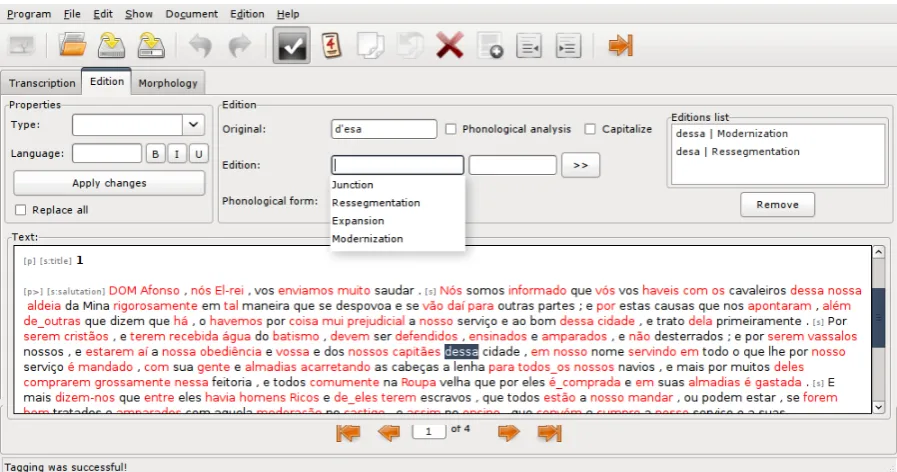
As shown in Figure 1, the main interface has an application menu, a toolbar, a content area (di-vided into tabs: Transcription, Edition, and Mor-phology), and buttons to navigate throught pages. The tabs are in accordance with the flow of the en-coding process. Many aspects of the functioning described in what follows are determined by the application preferences.
In the ‘Transcription’ tab, the original text is transcribed “as is” (the user can view the fac-simile image, while transcribing the text). Throught a menu option, E-Dictor will automat-ically apply an XML structure to the text, “guess-ing” its internal structure as best as it can. Then, in the ‘Edition’ tab, the user can edit any token or
5Available on internet at http://www.python.
Figure 1: E-Dictor GUI.
structural element (eg., paragraph). Finally, in the ‘Morphology’ tab, tokens and part-of-speech tags are displayed in token/TAG format, so they can be revised6.
2.3 The XML structure
The XML structure specified meets two main goals: (i) be as neutral as possible (in relation to the textual content encoded) and (ii) suit philolog-ical and linguistic needs, i.e., edition must be sim-ple and efficient without losing information rele-vant to philological studies. In the context of CTB, it was initially established a structure to encode the following information:
• Metadata: information about the source text, e.g., author information, state of processing, etc.
• Delimitation of sections, pages, paragraphs, sentences, headers and footers, and tokens.
• Class of tokens (part-of-speech tags) and phonological form for some tokens.
• Types (levels) of edition for each token.
• Comments of the editor.
• Subtypes for some text elements, like sec-tions, paragraphs, sentences and tokens (eg., a section of type “prologue”).
6The current version of E-Dictor comes with a POS
tag-ger, developed by Fabio Kepler, accessed by a menu option.
2.4 Encoding flexibility
A key goal of E-Dictor is to be flexible enough so as to be useful in other contexts of corpora build-ing. To achieve this, the user can customize the “preferences” of the application. The most promi-nent options are thelevels of editionfor tokens; the subtypes for the elements ‘section’, ‘paragraph’, ‘sentence’, and ‘token’; and the list of POS tags to be used in the morphological analysis. Finally, in the ’Metadata’ tab, the user can create the suitable metadata fields needed by his/her project.
2.5 Features
Throught its menu, E-Dictor provides some com-mon options (eg., Save As, Search & Replace, Copy & Paste, and many others) as well as those particular options intended for the encoding pro-cess (XML structure generation, POS automatic tagging, etc.). E-Dictor provides also an option for exporting the encoded text and the lexicon of editions7 in two different formats (HTML and TXT/CSV).
2.6 Edition
To conclude this section, a brief comment about token (words and punctuation) edition, which is the main feature of E-Dictor. The respective in-terface is shown in Figure2. When a token is
se-7The actual editions applied to words and punctuations of
Figure 2: Details of the token edition interface.
lected, the user can: (i) in the “Properties” panel, specify thetypeof the token (according to the sub-types defined by the preferences), its foreign lan-guage, and format (bold, italic, and underlined); (ii) in the “Edition” panel, specify some other properties (eg., phonological form) of the token and includeedition levels(according to the levels defined by the preferences).
To each token, the user must click on “Apply changes” to effectivate (all) the editions made to it. The option “Replace all” tells E-Dictor to repeat the operation over all identical tokens in the re-maining of the text (a similar functionality is avail-able for POS tags revision).
3 Discussion
The dificulties of encoding ancient texts in XML, using common text editors, had shown that a tool was necessary to make the process efficient and friendly. This led to the development of E-Dictor, which, since its earlier usage, has shown promis-ing results. Now, the user does not even have to know that the underlying encoding is XML. It is only necessary for him/her to know the (philolog-ical and linguistics) aspects of text edition.
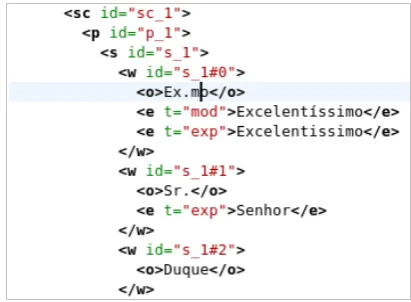
E-Dictor led to a decrease of about 50%in the time required for encoding and editing texts. The improvement may be even higher if we consider the revision time. One of the factors for this im-provement is the better legibility the tool provides. The XML code is hidden, allowing one to prac-tically read the text without any encoding. To il-lustrate the opposite, Figure3shows the common edition “interface”, before E-Dictor. Note that the content being edited is just “Ex.mo Sr. Duque”.
Finally, the integration of the whole process into one and only environment is a second factor for the overall improvement, for it allows the user to move freely and quickly between “representations” and
Figure 3: Example of XML textual encoding.
to access external tools transparently.
3.1 Improvements
E-Dictor is always under development, as we dis-cuss its characteristics and receive feedback from users. There is already a list of future improve-ments that are being developed, such as extending the exporting routines, for example. A bigger goal is to incorporate an edition lexicon, which would be used by the tool for making suggestions during the edition process, or even to develop an “auto-matic token edition” system for later revision by the user.
3.2 Perspectives
[image:4.595.312.518.227.378.2]References
[BBD2010] BBD. 2010. Biblioteca Brasiliana Digital.
[Bird et al.2009] Steven Bird, E. Klein, and E. Loper. 2009. Natural Language Processing with Python. O’Reilly.
[Cor2010] IEL-UNICAMP and IME-USP, 2010. Cór-pus Histórico do Português Anotado Tycho Brahe.
[de Castilho1998] Ataliba Teixeira de Castilho. 1998.
Para a história do português brasileiro, volume Vol I: Primeiras idéias. Humanitas, São Paulo.
[Kato and Roberts1993] Mary A. Kato and Ian Roberts. 1993. Português brasileiro: uma viagem Di-acrônica. Editora da Unicamp, Campinas.
[Mattos e Silva1988] Rosa Virgínia Mattos e Silva. 1988. Fluxo e refluxo: uma retrospectiva da lingüís-tica histórica no brasil. D.E.L.T.A., 4(1):85–113.
[Megale and Cambraia1999] Heitor Megale and César Cambraia. 1999. Filologia portuguesa no brasil.
D.E.L.T.A., 15(1:22).
[Paixão de Sousa2004] Maria Clara Paixão de Sousa. 2004. Memórias do texto: Aspectos tecnológicos na construção de um corpus histórico do português. Projeto de pós-doutorado – fapesp, Unicamp.
[Paixão de Sousa2009] Maria Clara Paixão de Sousa. 2009. Desafios do processamento de textos anti-gos: primeiros experimentos na brasiliana digital. In
I Workshop de Linguística Computacional da USP, São Paulo, 11.
[W3C1999] W3C. 1999. Extensible stylesheet lan-guage transformation.