Capturing Nonlinear Structure in Word Spaces through Dimensionality
Reduction
David Jurgens
University of California, Los Angeles, 4732 Boelter Hall
Los Angeles, CA 90095 [email protected]
Keith Stevens
University of California, Los Angeles, 4732 Boelter Hall
Los Angeles, CA 90095 [email protected]
Abstract
Dimensionality reduction has been shown to improve processing and information ex-traction from high dimensional data. Word space algorithms typically employ lin-ear reduction techniques that assume the space is Euclidean. We investigate the ef-fects of extracting nonlinear structure in the word space using Locality Preserv-ing Projections, a reduction algorithm that performs manifold learning. We apply this reduction to two common word space models and show improved performance over the original models on benchmarks.
1 Introduction
Vector space models of semantics frequently em-ploy some form of dimensionality reduction for improvement in representations or computational overhead. Many of the dimensionality reduc-tion algorithms assume that the unreduced word space is linear. However, word similarities have been shown to exhibit many non-metric proper-ties: asymmetry, e.g North Korea is more sim-ilar to Red China than Red China is to North Korea, and non-transitivity, e.g. Cuba is similar the former USSR, Jamaica is similar to Cuba, but Jamaica is not similar to the USSR (Tversky, 1977). We hypothesize that a non-linear word space model might more accurately preserve these non-metric relationships.
To test our hypothesis, we capture the non-linear structure with dimensionality reduction by using Locality Preserving Projection (LPP) (He and Niyogi, 2003), an efficient, linear approxi-mation of Eigenmaps (Belkin and Niyogi, 2002). With this reduction, the word space vectors are as-sumed to exist on a nonlinear manifold that LPP learns in order to project the vectors into a Eu-clidean space. We measure the effects of us-ing LPP on two basic word space models: the
Vector Space Model and a Word Co-occurrence model. We begin with a brief overview of these word spaces and common dimensionality reduc-tion techniques. We then formally introduce LPP. Following, we use two experiments to demonstrate LPP’s capacity to accurately dimensionally reduce word spaces.
2 Word Spaces and Reductions
We consider two common word space models that have been used with dimensionality reduc-tion. The first is the Vector Space Model (VSM) (Salton et al., 1975). Words are represented as vectors where each dimension corresponds to a document in the corpus and the dimension’s value is the number of times the word occurred in the document. We label the second model the Word Co-occurrence (WC) model: each dimension cor-respond to a unique word, with the dimension’s value indicating the number of times that dimen-sion’s word co-occurred.
Dimensionality reduction has been applied to both models for three kinds of benefits: to im-prove computational efficiency, to capture higher order relationships between words, and to reduce noise by smoothing or eliminating noisy features. We consider three of the most popular reduction techniques and the general word space models to which they have been applied: linear projections, feature elimination and random approximations.
The most frequently applied linear projection technique is the Singular Value Decomposition (SVD). The SVD factors a matrixA, which rep-resents a word space, into three matrices UΣV⊤
such that Σ is a diagonal matrix containing the singular values ofA, ordered descending based on their effect on the variance in the values ofA. The original matrix can be approximated by using only the top k singular values, setting all others to 0. The approximation matrix,Aˆ = UkΣkVk⊤, is the least squares best-fit rank-kapproximation ofA.
The SVD has been used with great success on both models. Latent Semantic Analysis (LSA) (Landauer et al., 1998) extends the (VSM) by de-composing the space using the SVD and mak-ing the word space the left smak-ingular vectors, Uk. WC models have also utilized the SVD to improve performance (Sch¨utze, 1992; Bullinaria and Levy, 2007; Baroni and Lenci, 2008).
Feature elimination reduces the dimensional-ity by removing those with low information con-tent. This approach has been successfully applied to WC models such as HAL (Lund and Burgess, 1996) by dropping those with low entropy. This technique effectively removes the feature dimen-sions of high frequency words, which provide lit-tle discriminatory content.
Randomized projections have also been suc-cessfully applied to VSM models, e.g. (Kanerva et al., 2000) and WC models, e.g. (Sahlgren et al., 2008). This reduction statistically approximates the original space in a much lower dimensional space. The projection does not take into account the structure of data, which provides only a com-putational benefit from fewer dimensions, unlike the previous two reductions.
3 Locality Preserving Projection
For a set of vectors, x1, x2, . . . , xn ∈ Rm, LPP preserves the distance in thek-dimensional space, wherek≪m, by solving the following minimiza-tion problem,
min w
X
ij
(w⊤xi−w⊤xj)2Sij (1)
wherewis a transformation vector that projectsx into the lower dimensional space, and S is a ma-trix that represents the local structure of the origi-nal space. Minimizing this equation is equivalent to finding the transformation vector that best pre-serves the local distances in the original space ac-cording toS. LPP assumes that the data pointsxi exist on a manifold. This is in contrast to the SVD, which assumes that the space is Euclidean and per-forms a global, rather than local, minimization. In treating the space as a manifold, LPP is able to dis-cover some of the nonlinear structure of the data from its local structure.
To solve the minimization problem in Equation 1, LPP uses a linear approximation of the Lapla-cian Eigenmaps procedure (Belkin and Niyogi, 2002) as follows:
1. LetXbe a matrix wherexiis theithrow vec-tor. Construct an adjacency matrix,S, which represents the local structure of the original vector space, by making an edge between pointsxiandxj ifxj is locally proximate to xi. Two variations are available for determin-ing proximity: either thek-nearest neighbors, or all the data points with similarity> ǫ. 2. Weight the edges in S proportional to the
closeness of the data points. Four main op-tions are available: a Gaussian kernel, a poly-nomial kernel, cosine similarity, or binary. 3. Construct the diagonal matrixDwhere entry
Dii =PjSij. LetL =D−S. Then solve the generalized eigenvector problem:
XLX⊤w=λXDX⊤w. (2)
He and Niyogi (2003) show that solving this problem is equivalent to solving Equation 1. 4. LetWk=[w1, . . . ,wk]denote the matrix of
transformation vectors, sorted in descending order according to their eigenvalues λ. The original space is projected intokdimensions byWk⊤X→Xk.
For many applications of LPP, such as doc-ument clustering (He et al., 2004), the original data matrix X is transformed by first perform-ing Principle Component Analysis and discardperform-ing the smallest principle components, which requires computing the full SVD. However, for large data sets such as those frequently used in word space algorithms, performing the full SVD is computa-tionally infeasible.
To overcome this limitation, Cai et al. (2007a) show how Spectral Regression may be used as an alternative for solving the same minimization equation through an iterative process. The princi-ple idea is that Equation 2 may be recast as
Sy=λDy (3)
where y = X⊤w, which ensures y will be an eigenvector with the same eigenvalue for the prob-lem in Equation 2. Finding the transformation matrix Wk, used in step 4, is done in two steps. First, Equation 3 is solved to produce eigenvectors [y0, . . . ,yk], sorted in decreasing order according to their eigenvalues λ. Second, the set of trans-formation vectors composing Wk, [w1, . . . ,wk], is found by a least-squares regression:
wj = argmin
w
n
X
i=1
where yji denotes the value of the jth dimension of yi. The α parameter penalizes solutions pro-portionally to their magnitude, which Cai et al. (2007b) note ensures the stability of was an ap-proximate eigenproblem solution.
4 Experiments
Two experiments measures the effects of nonlin-ear dimensionality reduction for word spaces. For both, we apply LPP to two basic word space mod-els, the VSM and WC. In the first experiment, we measure the word spaces’ abilities to model semantic relations, as determined by priming ex-periments. In the second experiment, we evaluate the representation capabilities of the LPP-reduced models on standard word space benchmarks.
4.1 Setup
For the VSM-based word space, we consider three different weighting schemes: no weighting, TF-IDF and the log-entropy (LE) used in (Landauer et al., 1998). For the WC-based word space, we use a 5 word sliding window. Due to the large pa-rameter space for LPP models, we performed only a limited configuration search. An initial analysis using the 20 nearest neighbors and cosine simi-larity did not show significant performance differ-ences when the number of dimensions was varied between 50 and 1000. We therefore selected 300 dimensions for all tests. Further work is needed to identify the impact of different parameters. Stop words were removed only for the WC+LPP model. We compare the LPP-based spaces to three mod-els: VSM, HAL, and LSA.
Two corpora are used to train the models in both experiments. The first corpus, TASA, is a collec-tion of 44,486 essays that are representative of the reading a student might see upon entering college, introduced by (Landauer et al., 1998). The cor-pus consists of 98,420 unique words; no filtering is done when processing this corpus. The second corpus, WIKI, is a 387,082 article subset of a De-cember 2009 Wikipedia snapshot consisting of all the articles with more than 1,000 tokens. The cor-pus is filtered to retain the top 100,000 most fre-quent tokens in addition to all the tokens used in each experiment’s data set.
4.2 Experiment 1
Semantic priming measures word association based on human responses to a provided cue.
Priming studies have been used to evaluate word spaces by equating vector similarity with an in-creased priming response. We use data from two types of priming experiments to measure whether LPP models better correlate with human perfor-mance than non-LPP word spaces.
Normed Priming Nelson et al. (1998) collected
free association responses to 5,019 prime words. An average of 149 participants responded to each prime with the first word that came to mind.
Based on this dataset, we introduce a new benchmark that correlates word space similarity with the associative strength of semantic priming pairs. We use three measures for modeling prime-target strength, which were inspired by Steyvers et al. (2004). LetWabbe the percentage of partici-pants who responded to primeawith targetb. The three measures of associative strength are
S1
ab =Wab S2
ab =Wab+Wba S3
ab =S
2
ab+
P
cS
2
acS
2
cb
These measure three different levels of semantic relatedness between wordsaandb. S1
ab measures the relationship from ato b, which is frequently asymmetric due to ordering, e.g. “orange” duces “juice” more frequently than “juice” pro-duces “orange.”S2
abmeasures the symmetric asso-ciation betweenaandb; Steyvers et al. (2004) note that this may better model the associative strength by including weaker associates that may have been a suitable second response. S3ab further increases the association by including the indirect associa-tions betweenaandbfrom all cued primes.
For each measure, we rank a prime’s targets according to their strength and then compute the Spearman rank correlation with the prime-target similarities in the word space. The rank compari-son measures how well word space similarity cor-responds to the priming association. We report the average rank correlation of associational strengths over all primes.
Priming Effect The priming study by Hodgson
Antonymy Conceptual Coordinates
Algorithm Rb U E R U E R U E
VSM+LPP+LE 0.103 0.018 0.085 0.197 0.050 0.147 0.071 0.027 0.044 VSM+LPP+TF-IDF 0.348 0.321 0.027 0.408 0.414 -0.005 0.323 0.294 0.029 VSM+LPP 0.247 0.122 0.124 0.312 0.120 0.193 0.230 0.111 0.119 VSM+LPPa 0.298 0.070 0.228 0.284 0.033 0.252 0.321 0.037 0.284
WC+LPP 0.255 0.071 0.185 0.413 0.110 0.303 0.431 0.134 0.298
HAL 0.813 0.716 0.096 0.845 0.814 0.031 0.861 0.809 0.052 HALa 0.915 0.879 0.037 0.867 0.846 0.021 0.913 0.861 0.052
LSA 0.235 0.023 0.213 0.392 0.028 0.364 0.199 0.014 0.185 LSAa 0.287 0.061 0.226 0.362 0.041 0.321 0.316 0.037 0.278
VSM 0.051 0.011 0.040 0.111 0.012 0.099 0.032 0.008 0.024
Phrasal Ordinates Synonymy
Algorithm R U E R U E R U E
VSM+LPP+LE 0.147 0.039 0.108 0.225 0.032 0.193 0.081 0.027 0.053 VSM+LPP+TF-IDF 0.438 0.425 0.013 0.277 0.290 -0.013 0.344 0.328 0.017 VSM+LPP 0.234 0.107 0.127 0.273 0.115 0.158 0.237 0.157 0.080 VSM+LPPa 0.202 0.031 0.171 0.270 0.032 0.238 0.299 0.069 0.230 WC+LPP 0.274 0.087 0.186 0.324 0.076 0.248 0.345 0.111 0.233 HAL 0.805 0.776 0.029 0.825 0.789 0.036 0.757 0.681 0.076 HALa 0.866 0.856 0.010 0.881 0.857 0.024 0.898 0.879 0.019 LSA 0.280 0.021 0.258 0.258 0.018 0.240 0.197 0.019 0.178 LSAa 0.269 0.030 0.238 0.326 0.032 0.294 0.327 0.052 0.275
VSM 0.104 0.013 0.091 0.061 0.008 0.053 0.052 0.009 0.043
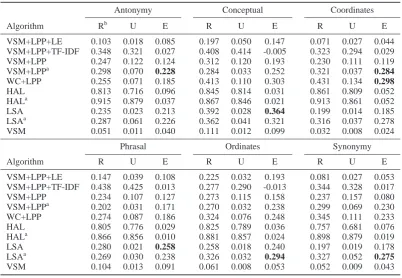
a Processed using the WIKI corpus b
[image:4.595.98.501.61.339.2]R are related primes, U are unrelated primes, E is the priming effect
Table 1: Experiment 1 priming results for the six relation categories from Hodgson (1991)
Word Choice Word Association
Algorithm Corpus TOEFL ESL RDWP F. et al. R.&G. Deese
VSM+LPP+le TASA 24.000 50.000 45.313 0.296 0.092 0.034 VSM+LPP+tf-idf TASA 22.667 25.000 37.209 0.023 0.086 0.001 VSM+LPP TASA 41.333 54.167 39.063 0.219 0.136 0.045 VSM+LPP Wiki 33.898 48.780 43.434 0.530 0.503 0.108 WC+LPP TASA 46.032 40.000 45.783 0.423 0.414 0.126 HAL TASA 44.00 20.83 50.00 0.173 0.180 0.318 HAL Wiki 50.00 31.11 43.44 0.261 0.195 0.042 LSA TASA 56.000 50.000 55.814 0.516 0.651 0.349
LSA Wiki 60.759 54.167 59.200 0.614 0.681 0.206 VSM TASA 61.333 52.083 84.884 0.396 0.496 0.200
Table 2: Results from Experiment 2 on six word space benchmarks
of 23 word pairs. Hodgson’s results showed that priming effects were exhibited by the prime-target pairs in all six categories.
We use the same methodology as Pad´o and La-pata (2007) for this data set; the prime-target (Re-lated Primes) cosine similarity is compared with the average cosine similarity between the prime and all other targets (Unrelated Primes) within the semantic category. The priming effect is the dif-ference between the two similarity values.
4.3 Experiment 2
We use six standard word space benchmarks to test our hypothesis that LPP can accurately capture
general semantic knowledge and association based relations. The benchmarks come in two forms: word association and word choice tests.
[image:4.595.118.482.392.528.2]Algorithm Corpus S1 S2 S3
VSM+LPP+LE TASA 0.457 0.413 0.255 VSM+LPP+TF-IDF TASA 0.464 0.390 0.207 VSM+LPP TASA 0.457 0.427 0.275 VSM+LPP Wiki 0.472 0.440 0.333 WC+LPP TASA 0.469 0.437 0.315 HAL TASA 0.485 0.434 0.310 HAL Wiki 0.462 0.406 0.266 LSA TASA 0.494 0.481 0.414
LSA Wiki 0.489 0.472 0.398 VSM TASA 0.484 0.460 0.407
Table 3: Experiment 1 results for normed priming.
Word association tests measure the semantic re-latedness of two words by comparing their simi-larity in the word space with human judgements. These tests are more precise than word choice tests because they take into account the specific value of the word similarity. Three word association benchmarks are used: the word similarity data set of Rubenstein and Goodenough (1965), the word-relatedness data set of Finkelstein et al. (2002), and the antonymy data set of Deese (1964), which measures the degree to which high similarity cap-tures the antonymy relationship. The Finkelstein et al. test is notable in that the human judges were free to score based on any word relationship.
5 Results and Discussion
The LPP-based models show mixed performance in comparison to existing models on normed prim-ing tasks, shown in Table 3. Adding LPP to the VSM decreased performance; however, when WIKI was used instead of TASA, the VSM+LPP model increased .15 on all correlations, whereas LSA’s performance decreased. This suggests that LPP needs more data than LSA to properly model the word space manifold. WC+LPP performs comparably to HAL, which indicates that LPP is effective in retaining the original WC space’s structure in significantly fewer dimensions.
For the categorical priming tests shown in Ta-ble 1, LPP-based models show competitive results. VSM+LPP with the WIKI corpus performs much better than other VSM+LPP configurations. Un-like in the previous priming experiment, adding LPP to the base models resulted in a significant performance improvement. We also note that both HAL models and the VSM+LPP+TF-IDF model have high similarity ratings for unrelated primes. We posit that these models’ feature weighting re-sults in poor differentiation between words in the
same semantic category, which causes their de-creased performance.
For experiment 2, LPP-based spaces showed mixed results on word choice benchmarks, while showing notable improvement on the more pre-cise word association benchmarks. Table 2 lists the results. Notably, LPP-based spaces performed well on the ESL synonym benchmark but poorly on the TOEFL synonym benchmark, even when the larger WIKI corpus was used. This suggests that LPP was not effective in retaining the re-lationship between certain classes of synonyms. Given that performance did not improve with the WIKI corpus, further analysis is needed to iden-tify whether a different representation of the local structure would improve results or if the poor per-formance is due to another factor. While LSA and VSM model performed best on all benchmarks, LPP-based spaces performed competitively on the word association tests. In all but two tests, the WC+LPP model outperformed HAL.
The results from both experiments indicate that LPP is capable of accurately representing distri-butional information in a much lower dimensional space. However, in many cases, applications using the SVD-reduced representations performed bet-ter. In addition, application of standard weight-ing schemes worsened LPP-models’ performance, which suggests that the local neighborhood is ad-versely distorted. Nevertheless, we view these re-sults as a promising starting point for further eval-uation of nonlinear dimensionality reduction.
6 Conclusions and Future Work
References
Marco Baroni and Alessandro Lenci. 2008. Con-cepts and properties in word spaces. From context to
meaning: Distributional models of the lexicon in lin-guistics and cognitive science (Special issue of the Italian Journal of Linguistics), 1(20):55–88.
Mikhail Belkin and Partha Niyogi. 2002. Laplacian Eigenmaps and Spectral Techniques for Embedding and Clustering. In Advances in Neural Information
Processing Systems, number 14.
John A. Bullinaria and Joseph P. Levy. 2007. Ex-tracting semantic representations from word co-occurrence statistics: a computational study.
Behav-ior Research Methods, 39:510–526.
Deng Cai, Xiaofei He, and Jiawei Han. 2007a. Spec-tral regression for efficient regularized subspace learning. In IEEE International Conference on
Computer Vision (ICCV’07).
Deng Cai, Xiaofei He, Wei Vivian Zhang, , and Jiawei Han. 2007b. Regularized Locality Preserving In-dexing via Spectral Regression. In Proceedings of
the 2007 ACM International Conference on Infor-mation and Knowledge Management (CIKM’07).
James Deese. 1964. The associative structure of some common english adjectives. Journal of Verbal
Learning and Verbal Behavior, 3(5):347–357.
Lev Finkelstein, Evgeniy Gabrilovich, Yossi Matias, Ehud Rivlin, Zach Solan, Gadi Woflman, and Ey-tan Ruppin. 2002. Placing search in context: The concept revisited. ACM Transactions of Information
Systems, 20(1):116–131.
Xiaofei He and Partha Niyogi. 2003. Locality preserv-ing projections. In Advances in Neural Information
Processing Systems 16 (NIPS).
Xiaofei He, Deng Cai, Haifeng Liu, and Wei-Ying Ma. 2004. Locality preserving indexing for doc-ument representation. In SIGIR ’04: Proceedings
of the 27th annual international ACM SIGIR confer-ence on Research and development in information retrieval, pages 96–103.
James M. Hodgson. 1991. Informational constraints on pre-lexical priming. Language and Cognitive Processes, 6:169–205.
Mario Jarmasz and Stan Szpakowicz. 2003. Roget’s thesaurus and semantic similarity. In Conference on
Recent Advances in Natural Language Processing,
pages 212–219.
David Jurgens and Keith Stevens. 2010. The S-Space Package: An Open Source Package for Word Space Models. In Proceedings of the ACL 2010 System
Demonstrations.
Pentti Kanerva, Jan Kristoferson, and Anders Holst. 2000. Random indexing of text samples for latent semantic analysis. In L. R. Gleitman and A. K. Josh, editors, Proceedings of the 22nd Annual Conference
of the Cognitive Science Society, page 1036.
Thomas K. Landauer, Peter W. Foltz, and Darrell La-ham. 1998. Introduction to Latent Semantic Analy-sis. Discourse Processes, (25):259–284.
Benoˆıt Lemaire, , and Guy Henhi´ere. 2006. Effects of High-Order Co-occurrences on Word Semantic Similarities. Current Psychology Letters, 1(18).
Kevin Lund and Curt Burgess. 1996. Producing high-dimensional semantic spaces from lexical co-occrrence. Behavoir Research Methods, Instru-ments & Computers, 28(2):203–208.
Douglas L. Nelson, Cathy L. McEvoy, and Thomas A. Schreiber. 1998. The Uni-versity of South Florida word association, rhyme, and word fragment norms. http:
//www.usf.edu/FreeAssociation/.
Sebastian Pad´o and Mirella Lapata. 2007. Dependency-Based Construction of Seman-tic Space Models. Computational Linguistics,
33(2):161–199.
Herbert Rubenstein and John B. Goodenough. 1965. Contextual correlates of synonymy. Communica-tions of the ACM, 8:627–633.
Magnus Sahlgren, Anders Holst, and Pentti Kanerva. 2008. Permutations as a means to encode or-der in word space. In Proceedings of the 30th
Annual Meeting of the Cognitive Science Society (CogSci’08).
Gerard Salton, A. Wong, and C. S. Yang. 1975. A vector space model for automatic indexing.
Com-munications of the ACM, 18(11):613–620.
Hinrich Sch¨utze. 1992. Dimensions of meaning. In Proceedings of Supercomputing ’92, pages 787– 796.
Mark Steyvers, Richard M. Shiffrin, and Douglas L. Nelson, 2004. Word association spaces for
predict-ing semantic similarity effects in episodic memory.
American Psychological Assocation.
Joshua B. Tenenbaum, Vin de Silva, and John C. Langford. 2000. A global geometric framework for nonlinear dimensionality reduction. Science,
290(5500):2319–2323.
Peter D. Turney. 2001. Mining the Web for synonyms: PMI-IR versus LSA on TOEFL. In Proceedings
of the Twelfth European Conference on Machine Learning (ECML-2001), pages 491–502.
Amos Tversky. 1977. Features of similarity.