Connotation in Translation
Marine Carpuat
Department of Computer Science University of Maryland College Park, MD, USA
Abstract
We present a pilot study analyzing the con-notative language found in a bilingual cor-pus of French and English headlines. We find that (1) manual annotation of conno-tation at the word-level is more reliable than using segment-level judgments, (2) connotation polarity is often, but not al-ways, preserved in reference translations produced by humans, (3) machine trans-lated text does not preserve the connota-tive language identified by an English con-notation lexicon. These lessons will helps us build new resources to learn better mod-els of connotation and translation.
1 Introduction
Subtle shades of meaning beyond surface meaning are receiving increasing attention in Natural Lan-guage Processing. Recognizing that even words that are objective on the surface can reveal senti-ment of the writer or evoke emotions in readers, Feng et al. (2013) show that the connotation of words can be induced from corpora in an unsu-pervised fashion, and that the learned connotation polarity of words is useful for sentiment analysis tasks. While such connotation resources only exist for English at the moment, sentiment and subjec-tivity analysis (Pang and Lee, 2008) increasingly addresses other languages (Banea et al., 2011).
This leads us to ask whether connotation can also be studied in the cross-lingual and multilin-gual setting. Modeling and detecting differences of connotation across languages would have many applications, e.g., enabling comparison of social media discussions in different languages. But since connotation is a more subtle form of mean-ing, with cultural and emotional associations, it is not clear to what extend we can expect it to be preserved in translation. On the one hand, we ex-pect correct translations to preserve the meaning
of the source: this is the key assumption under-lying alignment algorithms in statistical machine translation (Brown et al., 1990), as well as the use of translations to capture the meaning of words in lexical semantics (Resnik and Yarowsky, 1999; Callison-Burch, 2007; Apidianaki, 2009; Carpuat, 2013, among others). On the other hand, cross-lingual structural divergences (Dorr, 1994) might introduce subtle but unavoidable shifts in meaning as part of the translation process.
In this short paper, we report on a pilot study on connotation and translation, using human and machine translated text, and manual as well as au-tomatic tagging of connotative language. We will see that connotation is often, but not always, pre-served in translation. This suggests that new mod-els will be needed to represent, predict and use word connotation in more than one language.
2 Defining connotation
We adopt the notion of word connotation defined, and used, by Feng et al. (2013). Connotation refers to “an idea or feeling that a word invokes in addi-tion to its literal or primary meaning [or denota-tion].” Words with positive connotation describe “physical objects or abstract concepts that peo-ple generally value, cherish or care about”, while words with negative connotation “describe physi-cal objects or abstract concepts that people gener-ally disvalue or avoid”.
As a result, connotation can be evoked by words that do not express sentiment (either explicitly or implicitly), and that would be considered neutral in a sentiment analysis or opinion mining task. For instance, the nouns “life” and “home” are anno-tated as objective in SentiWordNet (Baccianella et al., 2010), while they carry a positive connotation according to the definition above.
3 Study conditions
Languages:We choose French and English as
get languages, as these are resource-rich languages and machine translation between them can be achieved with reasonably high quality (Callison-Burch et al., 2009; Bojar et al., 2013).
Domain:We collect text from the Global Voices1
website Unlike more traditional news sources, Global Voices content is produced by a commu-nity of volunteers who curate, verify and trans-late trending news emerging from social media or blogs. We crawled Global Voices to collect arti-cles that are translations of each other. This study focuses on headlines from these articles: we antic-ipate that headlines are good candidates for study-ing connotative language since they aim to provide a concise summary of a news story, and are often written to capture the attention of readers.
Size:We work with a sample of 245 parallel head-lines, and study the connotation in each language using both automatic and manual analysis.
4 Does machine translation preserve connotative language?
We start our analysis of connotation using fully automatic means: machine translation and an automatically induced connotation lexicon. We use the lexicon to tag connotative words in both human-produced English, and machine-translated English. If machine translation preserves conno-tation, we expect to find a high overlap between connotative words in machine translated text and the human-produced reference, and we expect the connotation polarity to remain the same.
4.1 Marking connotative language
We use the English connotation lexicon2 to tag
connotative language. We run the Stanford part-of-speech tagger on all our English examples (Toutanova et al., 2003), and tag word and part-of-speech pairs that are found in the lexicon with their polarity (i.e. negative, positive or neutral).3
For instance, in the example “Guinea-Bissau: Citizen Frustration and Defiance in Face of Turmoil”, the connotation lexicon detects one word with positive connotation (“citizen NN”) and three words with negative connotation ( “frus-tration NN”, “defiance NN” and “turmoil NN”).
1https://globalvoicesonline.org/about/ 2http://www3.cs.stonybrook.edu/˜ychoi/
connotation/data/connotation_lexicon_a. 0.1.csv
3Words that are out of the vocabulary of the connotation lexicon are considered neutral in this experiment.
This broad-coverage lexicon was automatically induced from raw text, based on the intuition that connotation can be propagated to the entire vocab-ulary based on co-occurrences with a small set of seed connotative predicates of known polarity. For instance, the arguments of “enjoy” are typically positive, while those of “suffer” are typically nega-tive. Follow-up work showed that connotation can be associated with fine-grained word senses(Kang et al., 2014), but we limit our analysis of connota-tion at the word level at this stage.
4.2 Machine translation systems
We produce automatic translations of the French headlines into English using two different machine translation systems.
First, we use Google Translate, since this free online system is known to achieve good transla-tion quality in a variety of domains for French to English translation. Second, we build a system using publicly available resources, to complement the black-box Google Translate system. We use the hierarchical phrase-based machine translation model (Chiang, 2005) from the open-source cdec toolkit (Dyer et al., 2010), and datasets from the Workshop on Machine Translation.4
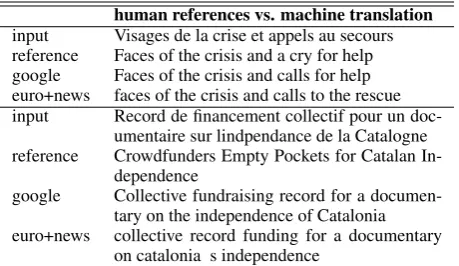
Google Translate achieves an uncased BLEU score (Papineni et al., 2002) of 20.13, and the cdec-based system 14.60. The lower score of the cdec system reflects the nature of its training data which is primarily drawn from parliament pro-ceedings rather than news, as well as the difficulty of translating headlines. The translation quality is nevertheless reasonable, as illustrated by the ran-domly selected examples in Table 1.
4.3 Connotative words in human vs. machine-translated text
First, we note that connotative language is found in 89% of the original English examples and 92% of the machine-translated examples. This confirms our intuition that Global Voices headlines are a good source of connotative language.
Second, we compare the connotative language found in machine translated text to the connota-tive language found in the reference translations
human references vs. machine translation input Visages de la crise et appels au secours reference Faces of the crisis and a cry for help google Faces of the crisis and calls for help euro+news faces of the crisis and calls to the rescue input Record de financement collectif pour un
doc-umentaire sur lindpendance de la Catalogne reference Crowdfunders Empty Pockets for Catalan
In-dependence
google Collective fundraising record for a documen-tary on the independence of Catalonia euro+news collective record funding for a documentary
[image:3.595.72.302.63.196.2]on catalonia s independence
Table 1: Machine translation output for two sys-tems: (1) Google Translate (Google), and (2) a hi-erarchical phrase-based system trained on WMT data (euro+news).
Translation System Google euro+news Do positive words overlap with references?
Precision 42.35 56.13
Recall 30.03 53.87
Do negative words overlap with references?
Precision 50.75 52.60
Recall 46.69 50.53
Do content words overlap with references?
Precision 37.35 49.70
Recall 41.56 58.52
Table 2: Are connotative words in machine trans-lation output found in reference transtrans-lations?
produced by humans. We use Precision and Re-call metrics to represent the overlap.
Table 2 shows that precision and recall are in the 40-50 range for connotative words, indicating that they are often not found in the reference. How-ever, this happens less frequently for connotative words than for content words in general: precision with respect to the reference words is higher for connotative words (positive or negative) than for all content words.
Surprisingly, the translations obtained using our in-house system achieves a higher overlap with references despite having a lower translation qual-ity according to BLEU. This might be explained by the nature of its training data which is presum-ably smaller and more homogeneous, resulting in translations that might be more literal at the cost of fluency, resulting in more matches for content words, and fewer matches for the higher ordern -grams taken into account in BLEU.
4.4 Segment-level connotation analysis Lastly, we use the polarity of the words to compute the dominant polarity of the
entire headline. Following the senti-ment analysis experisenti-ments of (Feng et al., 2013), the dominant polarity is defined as pol(E) = argmaxpol=pos,negPe∈EpolwEpol(e)
wherewEpol(e) = 2ife ∈ Epol andeis a verb
or an adjective;wEpol(e) = 1ife ∈A andehas
another part-of-speech. Based on this statistic, the dominant connotation of the reference English vs. machine translated English headlines only agree in 60% of the examples considered.
Translation System Google euro+news Comparing MT to positive references
Precision 54.34 54.34
Recall 30.86 28.73
Comparing MT to negative references
Precision 62.40 50.40
[image:3.595.92.271.275.379.2]Recall 75.72 76.82
Table 3: Comparing the dominant connotation of the entire machine translated segment to that of the reference for our two systems.
Taken together, these results suggest that ma-chine translation does not preserve connotative language accurately, even for an “easy” language pair such as as French-English. This differs from prior work on sentiment analysis which suggests that even imperfect machine translation can be good enough to port systems from e.g., English to Arabic dialects (Salameh et al., 2015), or to project labels of subjectivity from English into Ro-manian and Spanish (Banea et al., 2008).
However, our study of connotation differs from prior work in two important ways: (1) as defined in Section 2, connotation refers to meaning that is evoked or associated with a word, while sen-timent or subjectivity tends to be more explicit. So we expect connotation shifts to be more sub-tle. (2) our study focuses on word connotation, while prior cross-lingual analyses have focused on sentiment/subjectivity at thesegmentlevel, and are therefore expected to be more tolerant of machine translation errors.
5 Human connotation judgments on human-translated examples
We now turn to manual evaluation of connotation expressed in French and English using manually translated data.
5.1 Defining an annotation scheme
whether the language used in the headline im-plies (1) something positive, (b) something nega-tive, (c) both, or (d) neither (neutral), according to the definition of connotation and its polarity from Section 2. Annotations were produced by native speakers independently for each language, using two different schemes and sets of instructions.
Segment-level 3-way annotation At first, an-notators were asked to mark whether the domi-nant connotation of each segment (i.e. the com-plete headline) is positive, negative, or neutral. This task was inspired by prior segment-level an-notation schemes used for annotating more overt emotion and its polarity in news headlines (Strap-parava and Mihalcea, 2007). The inter-annotator agreement (Cohen, 1960) was poor between the two versions of the English annotations, and even worse between annotations of French and English text (see Table 4).
Kappa en 3a en 3b fr 3a en 3a 100 67.20 55.20 en 3b 67.20 100 55.31
Table 4: Inter-annotator agreement for segment-level 3-way annotation of connotation (positive vs. negative vs. neutral)
Bag-of-words 4-way annotation We then re-defined the annotation scheme to discriminate be-tween language that is neutral and language that contains both positive and negative connotations. This yields a set of four labels. We call this an-notation “bag-of-words” because it simply indi-cates whether there exists words in the segment with negative or positive connotation, instead of attempting to assign a single dominant connota-tion label to the entire segment. This schemes re-sults in higher agreement as measured by Kappa score (Cohen, 1960), both within and across lan-guages (see Table 5).
[image:4.595.310.522.60.217.2]Kappa en 4a en 4b fr 4a fr 4b en 4a 100 73.79 71.08 70.35 en 4b 73.79 100 73.54 72.28 fr 4a 70.35 72.28 100 80.07
Table 5: Inter-annotator agreement for bag-of-word 4-way annotation of connotation (positive vs. negative vs. both vs. neutral)
The “both” category allows annotators to avoid difficult decisions for the confusing examples where positive and negative words are observed in
Label Example
neu Russia: Online Cooperation as an Alternative for Government?
pos Russie : la collaboration en ligne comme nou-velle forme de gouvernance ?
neg China: Wiping Sweat Gate
neu Chine : le commissaire politique essuie la sueur du front des policiers
pos China: The Most Awesome Train Door neu Chine : M´etro de P´ekin, attention `a la
ferme-ture des portes !
neu Nicaragua: Opposition Youth Affected by Hacktivism
neg Nicaragua : Les jeunes de lopposition vic-times de piratage informatique
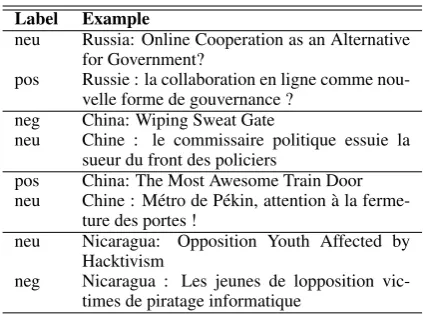
Table 6: Agreement within and Disagreement across languages: negative (neg); positive (pos); both (both); neutral (neu)
the same examples (see Table 7). The agreement within languages remains higher across languages.
5.2 Agreement within and across languages While we expect the annotation task to be difficult, we found that agreements are more frequent than disagreements both within and across languages.
In fact, all four annotations are identical for 71% of examples, which suggests that the majority of the headlines are not ambiguous. Such exam-ples of agreement can be found in Table 7. English annotations disagree for 16.8% of examples; while French annotations disagree only for 12.30%.
[image:4.595.311.520.517.641.2]5.3 Disagreement within and across languages
Figure 1: Disagreement in pairwise comparison of annotations: the x axis represents disagreement for each label pair (-1 = negative; 1 = positive; 2 = both; 0 = neutral), the y axis represents the number of observed examples.
[image:4.595.94.266.619.661.2]Label Example
neg Uganda: Government Quiet as Famine Takes Toll
neg Ouganda : Le gouvernement garde le silence sur la famine
pos Mexico: Indigenous Long-Distance Runner Wins International Race
pos Mexique : Une femme de la tribu Tarahumara remporte une course internationale
both Spain: 12M, a Ray of Sun in the Midst of the Crisis
both Espagne : Le premier anniversaire des In-dign´es, un rayon de soleil en pleine crise neu China: Graduate thesis or practical training? neu Chine : Vaut-il mieux avoir une th`ese ou une
[image:5.595.75.288.61.225.2]formation pratique ?
Table 7: Agreement within and across languages.
well as across languages. We observe that there are fewer disagreements between monolingual an-notations than across languages. The most fre-quent confusion is between “positive” or “both” in monolingual, while confusions between “neutral” and “positive” as well as “neutral” and “negative” increase in cross-lingual comparisons.
For a small number of examples (4.5%), French and English annotations are internally consistent within each language but disagree across lan-guages. This happens when one example is deemed neutral or considered to have both neg-ative and positive polarity in one language, but is considered only positive or negative in the other. A sample of such examples is given in Table 6. The differences are due to a number of factors. In the most extreme case, we have an idiomatic expres-sions with a strong connotation polarity, such as the English suffix “Gate” used to denote a political scandal (derived from “Watergate”). This suffix does not have a direct equivalent in French, and the translation loses the strong negative connotation present in the English. More frequently, key words that convey connotation are translated with words that have a weaker connotation (e.g. the strongly negative “victimes” becomes the more neutral “af-fected”, the positive sounding “serendipity” is dropped from the French version of the headline.)
6 Automatic predictions vs. human labels
Finally, we compare the automatic predictions based on the connotation lexicon from Section 4 to the manual annotation of connotation collected in Section 5. To focus on the most reliable annota-tions, we only use the subset of examples where
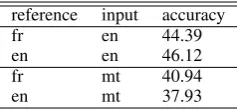
reference input accuracy
fr en 44.39
en en 46.12
fr mt 40.94
en mt 37.93
Table 8: Connotation lexicon predictions on En-glish headlines
intra-language annotations are consistent, which yields a smaller subset of 232 examples out of the initial 244. Furthermore, for each example, we compare the positive vs. negative connotation strengths from Section 4, so as to predict one of the four classes for each example.
A baseline predicting the most frequent class (“negative”) would get an accuracy of 55%. So the main lesson of this comparison is that using the lexicon out of the box is not sufficient to repli-cate the decisions of human annotators. Neverthe-less, it is reassuring that predictions based on the English headlines agree more with English anno-tations, while predictions based on machine trans-lation of French agree more with manual annota-tions of the original French.
7 Discussion
We have studied the connotation of French and English headlines using both manual and auto-matic annotations and translations.
The manual annotation revealed that transla-tions can diverge in connotation, even in manu-ally translated parallel texts in closely related lan-guages. This suggests that further cross-lingual studies should not use parallel corpora to project annotations blindly. Perhaps more importantly, we found that annotating connotation reliably requires working with a set of four categories (“positive”, “negative”, “both” or “neutral”) to achieve bet-ter inbet-ter-annotator agreement. We will use these lessons to collect and annotate larger datasets with more annotators, and more languages.
[image:5.595.357.476.62.117.2]References
Marianna Apidianaki. 2009. Data-driven semantic analysis for multilingual WSD and lexical selection in translation. In Proceedings of the 12th Confer-ence of the European Chapter of the ACL (EACL 2009), pages 77–85, Athens, Greece, March. Stefano Baccianella, Andrea Esuli, and Fabrizio
Sebas-tiani. 2010. SENTIWORDNET 3.0: An enhanced lexical resource for sentiment analysis and opinion mining. InProceedings of the seventh international conference on Language Resources and Evaluation (LREC).
Carmen Banea, Rada Mihalcea, Janyce Wiebe, and Samer Hassan. 2008. Multilingual subjectivity analysis using machine translation. InProceedings of the Conference on Empirical Methods in Natural Language Processing, EMNLP ’08, pages 127–135, Stroudsburg, PA, USA.
Carmen Banea, Rada Mihalcea, and Janyce Wiebe. 2011. Multilingual sentiment and subjectivity. Mul-tilingual Natural Language Processing.
Ondˇrej Bojar, Christian Buck, Chris Callison-Burch, Christian Federmann, Barry Haddow, Philipp Koehn, Christof Monz, Matt Post, Radu Soricut, and Lucia Specia. 2013. Findings of the 2013 Work-shop on Statistical Machine Translation. In Pro-ceedings of the Eighth Workshop on Statistical Ma-chine Translation, pages 1–44, Sofia, Bulgaria, Au-gust.
Peter Brown, John Cocke, Stephen Della Pietra, Vin-cent Della Pietra, Frederik Jelinek, John Lafferty, Robert Mercer, and Paul Rossin. 1990. A statisti-cal approach to machine translation. Computational Linguistics, 16:79–85.
Chris Callison-Burch, Philipp Koehn, Christof Monz, and Josh Schroeder. 2009. Findings of the 2009 Workshop on Statistical Machine Translation. In Proceedings of the Fourth Workshop on Statistical Machine Translation, pages 1–28, Athens, Greece, March.
Chris Callison-Burch. 2007. Paraphrasing and Trans-lation. Ph.D. thesis, University of Edinburgh. Marine Carpuat. 2013. A semantic evaluation of
ma-chine translation lexical choice. In Proceedings of the 7th Workshop on Syntax, Semantics and Struc-ture in Statistical Translation, Atlanta, USA, May.
David Chiang. 2005. A hierarchical phrase-based model for statistical machine translation. In Pro-ceedings of the 43rd Annual Meeting of the Associa-tion for ComputaAssocia-tional Linguistics, pages 263–270, Ann Arbor, Michigan.
Jacob Cohen. 1960. A coefficient of agreement for nominal scales. Educational and Psychological Measurement, 20 (1):37–46.
Bonnie J. Dorr. 1994. Machine translation diver-gences: A formal description and proposed solution. Computational Linguistics, 20(4):597–633.
Chris Dyer, Adam Lopez, Juri Ganitkevitch, Johnathan Weese, Ferhan Ture, Phil Blunsom, Hendra Seti-awan, Vladimir Eidelman, and Philip Resnik. 2010. cdec: A decoder, alignment, and learning framework for finite-state and context-free translation models. InProceedings of the Association for Computational Linguistics (ACL).
Song Feng, Jun Seok Kang, Polina Kuznetsova, and Yejin Choi. 2013. Connotation lexicon: A dash of sentiment beneath the surface meaning. In Proceed-ings of the 51st Annual Meeting of the Association for Computational Linguistics (Volume 1: Long Pa-pers), pages 1774–1784, Sofia, Bulgaria, August. Stephan Greene and Philip Resnik. 2009. More than
words: Syntactic packaging and implicit sentiment. In Proceedings of Human Language Technologies: The 2009 Annual Conference of the North American Chapter of the Association for Computational Lin-guistics, NAACL ’09, pages 503–511, Stroudsburg, PA, USA.
Jun Seok Kang, Song Feng, Leman Akoglu, and Yejin Choi. 2014. ConnotationWordNet: Learning con-notation over the Word+Sense network. In Proceed-ings of the 52nd Annual Meeting of the Association for Computational Linguistics (Volume 1: Long Pa-pers), pages 1544–1554, Baltimore, Maryland, June. Bo Pang and Lillian Lee. 2008. Opinion mining and sentiment analysis. Found. Trends Inf. Retr., 2(1-2):1–135, January.
Kishore Papineni, Salim Roukos, Todd Ward, and Wei-Jing Zhu. 2002. BLEU: a method for automatic evaluation of machine translation. In Proceedings of the 40th Annual Meeting of the Association for Computational Linguistics, Philadelphia, PA, July. Philip Resnik and David Yarowsky. 1999.
Distinguis-ing systems and distDistinguis-inguishDistinguis-ing senses: New evalua-tion methods for word sense disambiguaevalua-tion. Natu-ral Language Engineering, 5(2):113–133.
Mohammad Salameh, Saif Mohammad, and Svetlana Kiritchenko. 2015. Sentiment after translation: A case-study on arabic social media posts. In Pro-ceedings of the 2015 Conference of the North Amer-ican Chapter of the Association for Computational Linguistics: Human Language Technologies, pages 767–777, Denver, Colorado, May–June.
Carlo Strapparava and Rada Mihalcea. 2007. SemEval-2007 task 14: Affective text. In Proceed-ings of the 4th International Workshop on Semantic Evaluations, SemEval ’07, pages 70–74.