Verb-centered Sentiment Inference with Description Logics
Manfred Klenner
Computational Linguistics University of Zurich
Switzerland
Abstract
We introduce description logics as a means to carry out sentiment inferences triggered by some verbs on their seman-tic roles. Verbs might impose polar ef-fects on some roles, but also have polar expectations on other roles. For instance, an entity inherits a positive polarity just by being actor of some verb (“she suc-ceeds”). More complicated scenarios arise if we take subclause embeddings, negation and polarity conflicts into consideration. Polarity propagation and effect inversion need to be coped with, then. We have im-plemented a prototype in OWL covering a substantial subset of our verb lexicon cov-ering about 140 German verbs.
1 Introduction
Verbs and their role in sentiment analysis have raised some interest only recently, cf. Neviarouskaya et al. (2009), Reschke and Anand (2011), Maks and Vossen (2012), Hollenstein et al. (2014), Deng and Wiebe (2014). More or less common to these approaches is the notion of sen-timent inferences triggered by verbs. For instance, given the sentence “Greece blames EU and IMF for ’obstacles’ in talks”, we expect that the PP (“for”) must be something negative and we un-derstand that the direct object (“EU”) receives a negative effect and that the subject (”Greece”) is the source of this. The aforementioned approaches differ much in the details, but they all strive to cope with this kind of implicit information.
More complicated cases such as “U.N. Refugee Chief criticizes Europe for not rescueing mi-grants” raise the need to cope with subclause em-bedding and negation. Even polarity conflicts might arise as in “Palestinian students admire ter-rorist Dalal Mughrabi” where a negative direct ob-ject seems to produce an odd scenario. However,
what about “I hugely admire refugees” where we have a negative direct object as well (“refugee” is negative in the way “ill” is), but where no po-larity clash seems to be arising. We argue that fine-grained distinctions are needed to distinguish these cases, namely to distinguish factual from emotional and moral polarities. In this article, we simplify matters and introduce a concept called
sympathy entitywhich covers factual negative en-tities such as refugee etc.
In order to draw sentiment inferences, rules are needed and their application must not inter-fere with each other nor should the set of rules be inconsistent (which is a problem for complex rule-based systems). We believe description log-ics (Baader, 2009) is well suited as a framework to model such an inference task. The big advantage is that we do not need to care about the order in which rules are applied; also consistency checks are part of the machinery. Our model is a com-petence model that - at least in principle - should be able to properly cope with arbitrarily complex embeddings and negation.
2 Related Work
We only discuss the most prominent approaches. A rule-based approach based on semantic verb classes was introduced by Neviarouskaya et al. (2009). Also fine-grained polarity labels are used there, namely the one from Appraisal Theory (Martin and White, 2005); positive or negative po-larities are either related to appreciation (object in-herent properties like “beautiful”), affect or judge-ment (the moral side, say “cheating”). Each verb instantiation is described from an internal and an external perspective. For example, “to admire a mafia leader” is classified as affective positive (the subjects attitude) given the internal perspective while it is judgement negative externally. The au-thors do not give any details about how they carry out rule application. Also, compared to our
work, they are not able to tell “admire refugees” from “admire a mafia leader” as discussed above.
Reschke and Anand (2011) capture the polarity of a verb frame instantiation as a function of the polarity of the verb’s roles. For instance, if a ter-rorist loses something positive, then this is positive as a whole. No rules are specified, just evaluativ-ity classes are defined. It is hard to see how less drastic cases are to be treated (e.g. ”the thief who loses all his friends” - is this positive?).
Recently, Deng and Wiebe (2014) have intro-duced an ambitious conceptual framework for in-ferring (sentiment) implications. Here, the private state of the author of a sentence is in question, what his attitudes towards various targets in the sentence are (and also what he believes the pri-vate states of the agents of the sentence would be). Rules within a graph-based model are used, propa-gation continues until no rules can be applied any-more. The model builds (in part) on the ideas de-scribed in Reschke and Anand (2011) (to commit a crime is good for the crime since it comes into ex-istence), in contrast to Neviarouskaya et al. (2009) no external perspective is envisaged. “to admire” is a good-for situation, it is unclear how this influ-ences the critical cases: “admire refugees” com-pared to “admire a mafia leader. Does the last ex-ample produces a polarity conflict? We would say that it should and that the subject receives a nega-tive effect as a consequence.
3 Verb Polarity Frames
Some verbs do impose polar restrictions and cast polar perspectives on their complements, see Klenner et al. (2014a) and Klenner et al. (2014b). Take “to blame someone for something”. As a consequence of the instantiation of “to blame” the direct object receives a negative effect and we expect the PP to realize something negative (or something neutral that contextually is perceived as being negative). We distinguishverb role expec-tationsfrom verb role effects. Effects are propa-gated as the result of the verb frame instantiation (given a concrete sentence), whileexpectationsare a kind of presuppositional aspects of the meaning of a verb - they are constant under negation: “not to blame for X” and “to blame for X”, both pre-suppose that X is negative.
Verb polarity frames are used to capture this kind of information: “to blame” is a “direct ob-ject negative effect verb” and it also is a “PP
com-plement negative expectation verb”. Our German verb model comprises about 140 verbs (about 300 verb polarity frames) and their effects and expec-tations. Although there are cases, where a particu-lar syntactic frame of a verb allows for more than one verb sense, this is not the rule. Often sortal re-strictions might help in these cases (“sorgen f¨ur” in German might denote “care for”, if a person is involved and “to organize”, if e.g. a non-animate object takes the role: “sorgen f¨ur Verpflegung”, “to organize food”). Word sense disambiguation (of verbs) is thus not so much a problem and we ignore the rare cases, where we would need it.
We are not interested in the private state of the author of a text, but in the polar conceptualization the text imposes on potential targets. Our goal is a target-specific sentiment analysis, which means that we focus on positive and negative contexts the target is in. Verb polarity frames capture the un-marked condition of verb usage. That is, devia-tions (e.g. expectation violadevia-tions) are possible, but they lead to sanctions. For instance, if someone criticizes something positive or if someone sup-ports something negative then he receives a nega-tive effect (stemming from - what we call - a polar-ity clash between verb polarpolar-ity frame and the po-larity of the actual filler object). Apolarity clash
or violation arises, if a polar expectation or a po-lar effect casted from the verb meets an inverse entity polarity that comes either from the polarity lexicon or from noun phrase composition (“sick colleague”).
Our polarity lexicon comprises about 6,700 nouns and adjectives (see Clematide and Klenner (2010)). Nouns that denote factual negative con-cepts form a new class of objects, namely those that deserve (or have) our sympathy (refugee, vic-tim, hostage, depressed and poor people etc.). This helps to overcome problems with sentiment com-position: “to admire something negative” is nega-tive, except if we talk about negative entities that have our sympathy: “to admire a sick colleague” (no polarity clash) compared to “to admire a cheat-ing colleague” (polarity clash).
4 A Case Study
In order to clarify the kind of sentiment inferences we envisage, we work through the sentence: “Die ganze Welt kritisiert Europa daf¨ur, dass es den Fl¨uchtlingen nicht hilft.” A translation which pre-serves the German subclause construction is given in example 1. Examples 2-4 are variants of it re-garding negation, i.e. ”not” or ”refuse to” (POS = positive):
1) criticize that NOT POS: The whole world criticizes Europe for the fact that it does not help the migrants.
→In our verb model, “to criticize” imposes a neg-ative effect on both, the direct object and the sub-clause. “to help” has a positive effect on the indi-rect object, which gives a positive situation, while the “criticize” frame is negative. Here, no (posi-tive) effect is propagated to “migrants” since the subclause is negated, an “ordinary” negative ef-fect is given to “Europe” (stemming from “crit-icize”). Moreover, “not to help someone who needs our help” is an odd situation (we call it a
Neg Clash Situation)and the subject of such a sit-uation (Europe) is penalized (it is per definitionem aNeg Clash Entity).
2) criticize that POS: Russia has criticized Eu-rope for the fact that it helps the Ukraine.
→ “Ukraine” receives a positive effect; since a violation (“to criticize”: a negative effect meets a positive sentence) is encountered, “Russia”, as the actor of such a situation clash, is a Neg Clash Entity, while “Europe” receives a neg-ative effect from being criticized (but since “criti-cize” is here a Neg Clash Situation, this might be regarded as irrelevant or neutralized - not yet im-plemented).
3) NOT (refuse to) criticize that NOT POS: China has refused to criticize Europe for the fact that it does not help the migrants.
→ “Europe” and “China” are of class
Neg Clash Entity
4) NOT (refuse to) criticize that POS: USA has refused to criticize Europe for the fact that it helps the Ukraine.→“Ukraine” gets a positive effect
Deeper embeddings are possible, e.g.: “The USA forces the UN not to criticize Europe for the fact that it helps the Ukraine.” Eventually, our model should be able to handle this (and all per-mutations of “not” among the clauses) as well.
5 A Prototype Implementation
We use the description logic OWL (Horrocks and Patel-Schneider, 2011) to represent the verb model, the effect propagation, the polarity clash classes, and we let the reasoner carry out all in-ferences coupled with sentiment propagation. Our model is meant to be a competence mode: we model cases even if they hardly are to be found in real texts. We are interested in the underlying principles (the correct predictions), not so much in the empirical impact (in terms of recall) given a sentiment analysis application.
Description logics (DL) were first introduced in the 1980s – so called KL-ONE languages. The big advantage of this (subset of predicate) logic is that the consistency of a knowledge base and also decidability are guaranteed. The reasoner can be used to relate instances from the so-called A-Box (assertions) to the concept hierachy, the termino-logical part (the T-Box). The system cares for the proper (truth) maintenance of derived facts, ie. if an assertion is ceased, any inferences made on the basis of it are ceased as well. We use the Prot´eg´e1
editor for engineering and HermiT (Glimm et al., 2014) as an inference machinery. The following OWL specifications are given in Manchester Syn-tax (Horridge et al., 2006).
5.1 A-Box Representation
In order to carry out inferences, individuals (class instantiations) need to be specified (then reason-ing or realization, the DL term, might be trig-gered). Verbs are referred to by a constant rep-resenting a verb event instantiation. Technically, their base form followed by a digit is used (e.g. blame-1 is an instance of a blame event). Binary relations link the participants to their event. We stick with grammatical functions (subject, etc.) for readability, but they are meant to represent argu-ments (AO, A1, etc.). The labels subj, obja (direct object), objd (indirect object) and objc (comple-ment clause) are modelled as OWL properties, we also define a property class “participant” that cov-ers subj, obja and objd and we define invcov-erse prop-erties, e.g. subj-of.
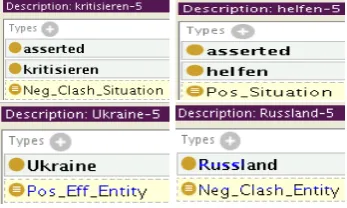
So “Russland kritisiert, dass Europa der Ukraine hilft” (take the translation given in sec-tion 4, example 2) would be represented as given in Fig. 1. The class “asserted” is used to indicate
that the verb instance is not negated (non asserted, otherwise).
Figure 1: Instance Representation
5.2 Concepts for Sentiment Inference
Verbs have effects and expectations (see section 3 for their definition). Effects are directly ap-plied if a verb polarity frame instantiation is fea-sible without any violation (e.g. of expectations). A target then is classified as a Pos Eff Entity or Neg Eff Entity depending on the polarity frame. If everything is as expected, the instantiation as a whole is classified as a Pos Situation or a Neg Situation according to the verb class. A vi-olation occurs if a polar effect or polar expec-tation is not met. Then a Neg Clash Situation is found. Effects might get inverted or canceled and the subject of the situation is classified as a Neg Clash Entity. A situation that embeds a Neg Clash Situation is also a Neg Clash Situation and its subject then becomes a Neg Clash Entity and so on.
5.3 T-Box Representation
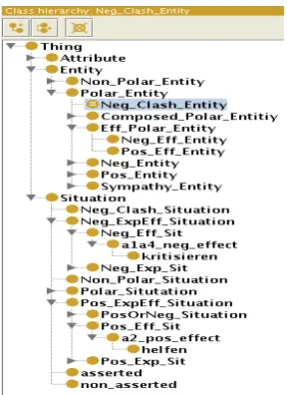
Fig. 2 shows a simplified version of the taxon-omy. We distinguish attributes (Attribute, po-lar and non-popo-lar adjectives) from entities (En-tity) and situations (Situation). Entities comprise non-polar entities (e.g. nations) and polar enti-ties, which divide into Neg Entity and Pos Entity (the polarity lexicon entries) and Eff Polar Entity (meant to capture the inferred verb effects), Neg Clash Entity (expectation violation entities) and Composed Polar Entity – the class that real-izes noun phrase composition (e.g. that “cheat-ing colleague” is negative). Sympathy Entity is meant to capture entities that have our sympathy (e.g. “refugee”).
[image:4.595.74.246.100.215.2]Situations are divided into polar situations (Po-lar Situation) which capture positive and negative clause level denotations and Neg Clash Situations
Figure 2: OWL Classes (partial)
(violation of subclause expectations or effects, e.g. “criticizes something positive”) and the various verb classes.
Verb classes are represented as primitive (unde-fined) concepts, their class name indicates effect and expectation patterns. For instance, “helfen” (“to help”) is, among others, a a2 pos effect verb, since the indirect object receives a positive effect. We use the following shortcuts: a0, a1, a2, a3, a4 for subj, direct object, indirect object, PP comple-ment, clausal complecomple-ment, respectively. A primi-tive definition prevents the reasoner from automat-ically determining class membership. There is no need to let the reasoner classify verbs, since the parse tree provides all information needed in or-der to identify the verb class (the verb lemma, its grammatical roles).
The class a2 pos effect is a subclass of Pos Eff Situation. In order to assign the ef-fect that comes with the verb classes, the concept Pos Eff Entity is defined as a non-primitive subclass (equivalence class in Prot´eg´e) of Eff Polar Entity2:
objd-of some (a2 pos effect and asserted)
That is, the indirect object (objd) of a a2 pos effect verb that is not negated (i.e. asserted) is automatically classified as a Pos Eff Entity (i.e. it gets a positive effect). The equivalent in terms of predicate logic is:
∀x: (∃y: objd−of(x, y)∧a2 pos effect(y)
∧asserted(y))→Pos Eff Entity(x)
A situation (denoted by the verb and its
tiated roles) is positive situation (a subclass of Po-lar Situation from Fig. 2), if (among others):
a2 pos effect and asserted and (objd some (Sympa-thy Entity or Comp Neut Entity or Comp Pos Entity))
That is: the verb is a a2 pos effect and asserted (not negated) and the indirect object of that verb is an entity that has our sympathy or is a composed positive or neutral entity (nouns without further modification like “Ukraine” are treated as simply composed, neutral entities).
The verb “to criticize” is a a1a4 neg effect verb, the direct object as well as the subclause inherit a negative effect. For our example (“Russia has criticized Europe for the fact that it helps the Ukraine”) we get (see Fig. 3): “helfen-5” is a pos-itive situation3, thus, a polarity clash occurs
[image:5.595.72.246.305.409.2](“crit-icize something positive”).
Figure 3: Sentiment Inferences
The class Neg Clash Situation captures this (cf. Fig. 4). The first line states that a situation with a participant (a property class that subsumes subj, obja and objd) that is a M Neg Comp Entity and is at the same time a Pos Effect Entity, is a Neg Clash Situation. That is, any situation, where a (morally) negative entity has received a positive effect, is a situation clash.
Figure 4: Neg Clash Situation
According to line 2 (and 3), a non-negated a1a4 neg effect verb that embeds a Pos Situation (or, to capture recursive cases, a Neg Clash Situation) is classified as a Neg Clash Situation. “kritisieren-5” is clas-sified accordingly (see Fig. 3) and the next step
3Lines marked in yellow are inferred by the reasoner.
is to propagate this situation polarity clash to the subject. We define a Neg Clash Entity to be the subject of a Neg Clash Situation: (subj-of some Neg Clash Situation). In our case, this holds for “Russland-5”. Russia thus is penalized for criticizing a positive situation.
5.4 The Current State of the Model
A dependency parse of a sentence is easily con-verted into the input format of our model. One just has to take the verb from the tree, take the lemma as its class, create a verb instance, find its grammatical roles and create constants in order to provide individual referents. If the verb is negated, its OWL instance is set to non asserted.
We have created an interface to a dependency parser (Sennrich et al., 2009), but just worked with hand-crafted sample sentences (that are inspired by real sentences, anyway). We expect that an em-pirical evaluation will reveal gaps in the model and parts that need to be refined. It is already clear that we need to deal more explicitly with implica-tion signatures of verbs in the sense of Nairn et al. (2006). For instance, German “zwingen” turns out to be a one-way implicative (which is in line with its English translation “to force”). Thus, negated “zwingen” does not entail anything regarding the factuality (truth) of its complement clause.
Currently, we have 12 verb classes in the model, covering about 80 different verbs.
6 Conclusions
This paper introduces description logics as a framework for verb-centered sentiment inferences. We have sketched a model and implemented a pro-totype of it in order to demonstrate the power of such an approach. Subclause embedding, nega-tion and polarity conflicts can be handled in such a framework in a very concise way. We have not yet fully explored the various model variants that appear to be interesting. Further experiments and an empirical evaluation are needed.
References
Franz Baader. 2009. Description logics. In Franconi-E. Eiter Th. Gutierrez C. Handschuh S. Rousset
M.-C. Schmidt R. Tessaris, S., editor, Reasoning
Web: Semantic Technologies for Information Sys-tems, pages 1–39. Springer.
Simon Clematide and Manfred Klenner. 2010. Eval-uation and extension of a polarity lexicon for
Ger-man. InProceedings of the First Workshop on
Com-putational Approaches to Subjectivity and Sentiment Analysis (WASSA), pages 7–13.
Lingjia Deng and Janyce Wiebe. 2014. Sentiment propagation via implicature constraints. Meeting of the European Chapter of the Association for Com-putational Linguistics (EACL-2014).
Birte Glimm, Ian Horrocks, Boris Motik, Giorgos Stoi-los, and Zhe Wang. 2014. HermiT: An OWL 2
rea-soner. Journal of Automated Reasoning, 53(3):245–
269.
Nora Hollenstein, Michael Amsler, Martina Bach-mann, and Manfred Klenner. 2014. Sa-uzh:
Verb-based sentiment analysis. In Proceed. of the 8th
Intern. Workshop on Semantic Evaluation (SemEval 2014), pages 503–507.
Matthew Horridge, Nick Drummond, John Goodwin, Alan Rector, Robert Stevens, and Hai H Wang.
2006. The Manchester OWL syntax. InOWL:
Ex-periences and Directions (OWLED).
Ian Horrocks and Peter F. Patel-Schneider. 2011. KR and reasoning on the Semantic Web: OWL. In John Domingue, Dieter Fensel, and James A. Hendler,
editors, Handbook of Semantic Web Technologies,
chapter 9, pages 365–398. Springer.
Manfred Klenner, Michael Amsler, and Nora Hollen-stein. 2014a. Verb polarity frames: a new resource and its application in target-specific polarity
classi-fication. InProceedings of KONVENS 2014, pages
106–115.
Manfred Klenner, Susanna Tron, Michael Amsler, and Nora Hollenstein. 2014b. The detection and anal-ysis of bi-polar phrases and polarity conflicts. In
Proceedings of 11th International Workshop on Nat-ural Language Processing and Cognitive Science.
Venice, Italy.
Isa Maks and Piek Vossen. 2012. A lexicon model for deep sentiment analysis and opinion mining applica-tions. Decision Support Systems, 53(4):680–688.
J. R. Martin and P. R. R. White. 2005. Appraisal in
English. Palgrave, London.
Rowan Nairn, Cleo Condoravdi, and Lauri Karttunen. 2006. Computing relative polarity for textual infer-ence. InProceed. of Inference in Computational Se-mantics (ICoS 5), Buxton, England, pages 67–75.
Alena Neviarouskaya, Helmut Prendinger, and Mitsuru Ishizuka. 2009. Semantically distinct verb classes involved in sentiment analysis. In Hans Weghorn and Pedro T. Isa´ıas, editors, IADIS AC (1), pages 27–35. IADIS Press.
Kevin Reschke and Pranav Anand. 2011. Extracting contextual evaluativity. InProceedings of the Ninth International Conference on Computational Seman-tics, pages 370–374.
Rico Sennrich, Gerold Schneider, Martin Volk, and Martin Warin. 2009. A new hybrid dependency
parser for German. InProc. of the German Society