Privacy-Aware Incentivisation for
Participatory Sensing
Martin Connolly
A thesis submitted to the University of Dublin, Trinity College in fulllment of the requirements for the degree of Doctor of Philosophy
Declaration
I declare that this thesis has not been submitted as an exercise for a degree at this or any other university and it is entirely my own work. I agree to deposit this thesis in the University's open access institutional repository or allow the library to do so on my behalf, subject to Irish Copyright Legislation and Trinity College Library conditions of use and acknowledgement. I consent to the examiners retaining a copy of the thesis beyond the examining period, should they so wish (EU GDPR May 2018).
Martin Connolly
Permission to lend or copy
I, the undersigned, agree that the Trinity College Library may lend or copy this thesis upon request.
Martin Connolly
Acknowledgements
Firstly, I would like to thank my supervisor Dr. Mélanie Bouroche. Her knowledge, patience and attention to detail have been of enormous help to me over the past ve years. Mélanie's supervision has been an education not just in Computer Science but in the nature of academic research and scientic writing. I am also indebted to Dr. Ivana Dusparic, who acted as my supervisor while Mélanie was on leave. Her valuable ideas and thoughts on my research were of great assistance in honing my ideas into the work that is presented here. I must also acknowledge Dr. Georgios Iosidis, Ussher Assistant Professor in Future Networks at Trinity, whose advice on applying statistical methods to incentivi-sation deepened my understanding of the area and played a fundamental role in shaping a key contribution of this work.
My employers, Cork Institute of Technology, made this PhD possible. In particular, I wish to thank the registrar's oce for their nancial support and the Department of Accounting and Information Systems for allocating a substantial proportion of my teaching hours towards my research activity. In addition, I would like to thank Professor Noel Barry, former head of Academic Aairs at CIT, for his positive encouragement throughout the process and wish him a happy and healthy retirement. I am also grateful to Dr. J.B. McCarthy of the Department of Mathematics in CIT for the insightful questions he posed regarding initial drafts of my paper on incentivisation. These were of great assistance in the renement of my ideas.
I am also grateful to my family and friends who were a constant positive support through this journey. In particular, I would like to thank my very good friends Phil Corcoran and Cathal Hoare who were ever willing sounding boards for my ideas and were a willing and candid audience when practicing my confer-ence presentation skills. Thank you to my family, my Dad, Terry, for being my constant and willing companion on my trips to Dublin and my sister Joanne for her unwavering support, advice and encouragement. Finally, my nieces Freya and Lauren Healy never fail to make life more joyous. I hope in the years to come that they will appreciate the value of education and learning. I dedicate this thesis to them.
Abstract
Participatory sensing is a paradigm through which mobile device users (or par-ticipants) collect and share data about their environments. The data captured by participants is typically submitted to an intermediary (the service provider) who will build a service based upon this data.
For a participatory sensing system to attract the data submissions it requires, its users often need to be incentivised. Such an incentivisation mechanism typ-ically requires users to at least partially disclose their identity to be able to reward them, and to ensure that they are only rewarded for truthful submis-sions (called incentive compatibility). This, however, might deter privacy con-scious users from participating. Therefore, an incentivisation mechanism needs to support anonymous and unlinkable data submission and untraceable and unlinkable rewarding while also ensuring data truthfulness (An incentivisation scheme is not in and of itself incentive compatible but should be able to facilitate incentive compatibility). Furthermore, as an environment can quickly and sud-denly change (for example, an accident causing elevated pollution levels and a buildup of trac), the value of a given data item to the service provider is likely to change signicantly over time, and therefore an incentivisation scheme must be able to adapt the rewards it oers in real-time to match the environmental conditions and current participation rates, thereby optimising the consumption of the service provider's budget.
There are numerous approaches in the state of the art in the areas of iden-tity privacy and incentivisation for participatory sensing. For example, one approach proposes a digital currency to enable participants to make data sub-missions without disclosing their privacy, while another approach devises tokens to exchange data and rewards in a privacy-preserving fashion. However, while basic identity privacy may be preserved in these approaches, other forms of iden-tity privacy such as behavioural habits and frequent trajectories can be inferred from the submitted data, with some proposed solutions actually increasing the threat of such inference attacks occurring. Furthermore, none of the approaches in the state of the art support adapting the reward to match the environmental conditions.
modi-cation and extension of the concept of decentralised trading for cryptocurrencies to make payments (i.e. rewards) sent to a recipient (i.e. the participant) un-traceable. Furthermore, the use of the Die-Hellman Exchange Protocol is modied to enable participants to create their own untraceable reward currency in the form of tokens to which the service provider can then assign value. Fi-nally, the Lyapunov Optimisation method is used to create an adaptive reward allocation model that optimises the consumption of the service provider's bud-get.
The principal contributions of PAI are:
1. A platform for anonymous and unlinkable data submission and untraceable and unlinkable rewarding that is robust to inference attacks from semi-honest service providers and other potential attackers.
2. A privacy-aware adaptive incentive-compatible incentivisation scheme.
Publications Related to this PhD
Martin Connolly, Ivana Dusparic, Georgios Iosidis and Mélanie Bouroche, Privacy-Aware Incentivization for Participatory Sensing, In MDPI Sen-sors, 2019.
Martin Connolly, Ivana Dusparic, Georgios Iosidis and Mélanie Bouroche, An Identity Privacy Preserving Incentivization Scheme for Participatory Sensing, In IEEE 11th International Conference on Mobile Computing and Ubiquitous Networking (ICMU), Auckland, New Zealand, October 2018.
Contents
1 Introduction 1
1.1 Background . . . 1
1.1.1 Participatory Sensing . . . 1
1.1.2 Participatory Sensing & Privacy . . . 2
1.2 Motivation . . . 3
1.3 Context & Related Work . . . 5
1.4 Challenges . . . 7
1.5 The Approach . . . 8
1.6 Goals & Contribution . . . 10
1.7 Assumptions & Scope . . . 11
1.8 Roadmap . . . 12
1.9 Summary . . . 13
2 Problem Denition 14 2.1 System Model . . . 14
2.1.1 Incentivisation Scheme for Participatory Sensing . . . 14
2.1.2 Assumptions . . . 16
2.2 Participatory Sensing Threat Model . . . 17
2.2.1 External Attacks . . . 18
2.2.2 Internal Attacks . . . 18
2.3 Threat Model Addressed . . . 20
2.4 Requirements . . . 21
2.5 Summary . . . 24
3 Related Work 25 3.1 Incentivisation . . . 25
3.1.1.1 Auctions . . . 26
3.1.1.2 Contract Theory . . . 29
3.1.1.3 Game Theory . . . 30
3.1.1.4 Other Microeconomic Concepts . . . 32
3.1.2 Statistical & Machine Learning Approaches to Incentivi-sation . . . 33
3.1.2.1 Optimisation . . . 33
3.1.2.2 Other Statistical & Machine Learning Methods . 35 3.1.3 Incentivisation: Summary . . . 37
3.2 Privacy Preservation . . . 38
3.2.1 Privacy Preserving Methods for Incentivisation . . . 39
3.2.1.1 Privacy Preservation using Pseudonyms . . . 39
3.2.1.2 Use of Third Party Components . . . 40
3.2.1.3 Anonymisation . . . 41
3.2.1.4 Encryption & Statistics . . . 42
3.2.1.5 Methods for Privacy Preservation: Summary . . 42
3.2.2 Medium for Reward Allocation . . . 43
3.2.2.1 Cryptocurrencies . . . 43
3.2.2.2 Reward Tokens . . . 44
3.2.2.3 Medium for Reward Allocation: Summary . . . 46
3.3 Incentive Compatibility . . . 46
3.3.1 Trust & Reputation Management . . . 46
3.3.2 Data Truthfulness . . . 48
3.3.3 Incentive Compatibility: Summary . . . 49
3.4 Summary . . . 50
4 Design 52 4.1 Privacy Preservation for the PAI Platform . . . 54
4.1.1 Meeting the Privacy Requirements . . . 54
4.1.2 Anonymous, Unlinkable & Protected Data Submission (R1) 58 4.1.3 Untraceable & Unlinkable Reward Allocation (R2) . . . . 59
4.1.4 Untraceable & Unlinkable Reward Spending (R3) . . . 62
4.2 Incentive Compatibility (R4) . . . 63
4.2.1 Choosing an Approach for Estimating Data Truthfulness 65 4.2.2 Adapting an Approach for Estimating Data Truthfulness 67 4.3 Adaptive & Tunable Reward Allocation (R5) . . . 69
4.3.1.1 Estimating the Number of Responses . . . 74
4.3.1.2 Modeling the Environment for Reward Determi-nation . . . 78
4.3.1.3 Modeling the Environment for Budget Optimi-sation . . . 79
4.3.2 Formulating the Oine Problem . . . 81
4.3.2.1 Complete Future Information . . . 81
4.3.2.2 Stochastic Future Information . . . 83
4.3.2.3 Analysing the Benchmarks . . . 83
4.3.3 Online Budget Consumption Optimisation Problem . . . 84
4.3.4 Designing the Reward Algorithm . . . 84
4.3.5 Incorporating Data Utility . . . 87
4.4 Summary . . . 88
5 Evaluation 92 5.1 Implementation . . . 93
5.1.1 Implementing Privacy Preservation (R1, R2 & R3) . . . . 94
5.1.2 Implementing Incentive Compatibility (R4) . . . 96
5.1.3 Implementing Adaptive & Tunable Reward Allocation (R5) 97 5.1.4 Implementing a Simulated Environment for Participatory Sensing . . . 98
5.2 Analysis & Validation . . . 99
5.2.1 Anonymous, Unlinkable & Protected Data Submission (R1) . . . 99
5.2.2 Untraceable & Unlinkable Reward Allocation (R2) . . . . 101
5.2.3 Untraceable & Unlinkable Reward Spending (R3) . . . . 102
5.2.4 Incentive Compatibility (R4) . . . 102
5.2.5 Adaptive & Tunable Reward Allocation (R5) . . . 103
5.2.5.1 Experimental Setup . . . 103
5.2.5.2 Adaptiveness & Utility . . . 106
5.2.5.3 Budget Consumption . . . 113
5.2.5.4 Summary . . . 114
5.3 Performance Evaluation . . . 116
5.3.1 Cryptographic Primitives used for Privacy Preserving Re-quirements R1, R2 & R3 . . . 119
5.3.2 Computational Complexity . . . 121
List of Figures
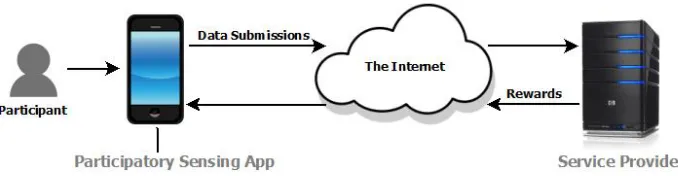
2.1 A Typical Participatory Sensing System . . . 16
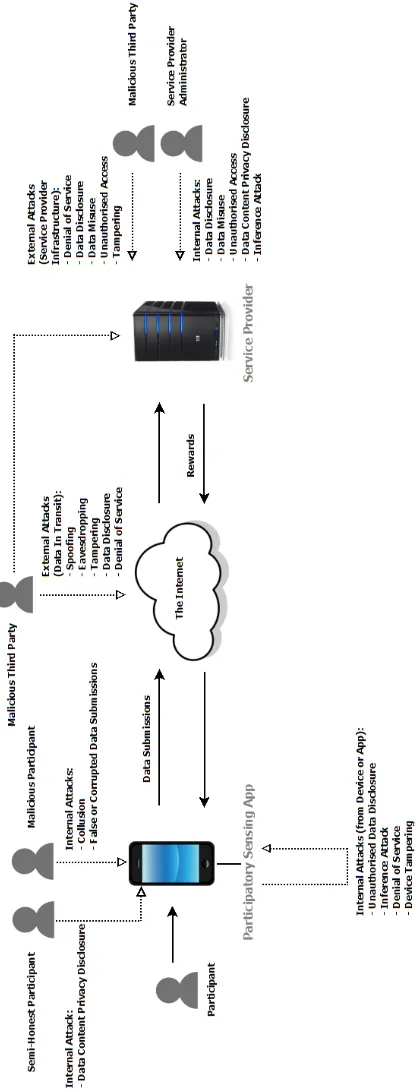
2.2 Threats to Participatory Sensing Systems . . . 19
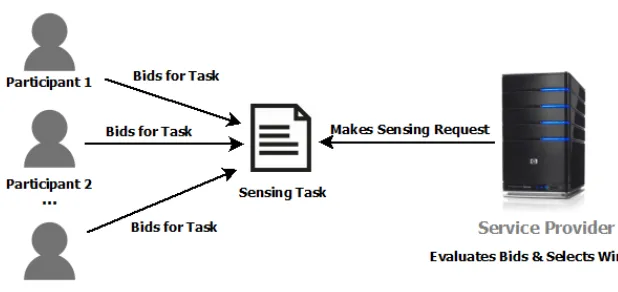
3.1 Auction in Participatory Sensing . . . 27
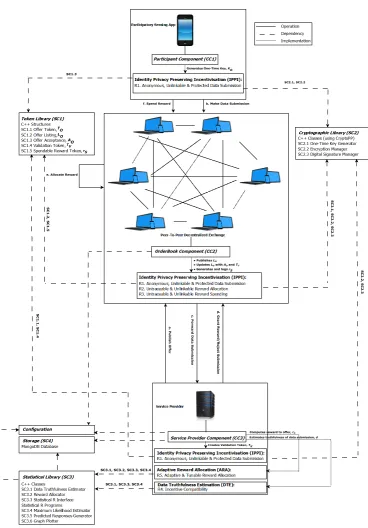
4.1 The PAI Platform . . . 53
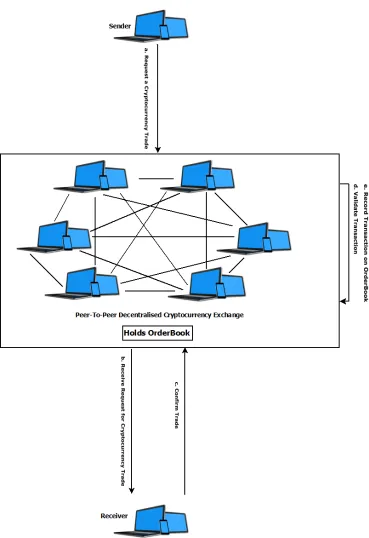
4.2 Operation of a Typical Decentralised Cryptocurrency Exchange . . . 57
4.3 Privacy Preservation in the IPPI Platform . . . 60
4.4 The Data Truthfulness Estimation Approach . . . 70
4.5 ARA Operation . . . 75
5.1 Implementation of the PAI Approach . . . 95
5.2 Adapting the Reward to the Response Rate . . . 108
5.3 ARA Adaptiveness (High Response Environment, Rolling Regression Window=100, No. Simulations=1) . . . 109
5.4 ARA Adaptiveness (High Response Environment, Rolling Regression Window=100, No. Simulations=10) . . . 109
5.5 ARA Adaptiveness (Low Response Environment) . . . 110
5.6 ARA Adaptiveness (Low Response Environment, V = 1000) . . . 110
5.7 STOC-PISCES Adaptiveness (High Response Environ-ment) . . . 111
5.8 STOC-PISCES Adaptiveness (Low Response Environ-ment) . . . 111
5.10 ARA Adaptiveness (High Response Environment, Rolling
Regression Window=50, No. Simulations=10) . . . 112
5.11 Average Reward . . . 115
5.12 Total No. Responses . . . 116
5.13 Total No. Oers . . . 117
5.14 Rate of Budget Consumption (High Response Environ-ment) . . . 118
List of Tables
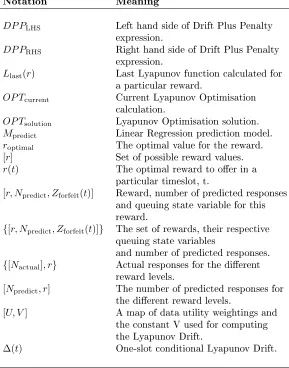
4.1 Additional Notations for Reward Computation Algorithm 90
List of Algorithms
1 Allocating the Reward . . . 64
2 Spending the Reward . . . 65
3 Estimating Data Truthfulness . . . 71
Chapter 1
Introduction
This chapter introduces the eld of research for this thesis. The background to the thesis, specically, the concept of participatory sensing, is introduced in Sec-tion 1.1. The motivaSec-tion for the research undertaken in this thesis is presented in Section 1.2 while Section 1.3 discusses its context and briey presents related work in the area. The challenges to be addressed are discussed in Section 1.4 while Section 1.5 introduces the proposed approach to be taken. The goals of the research and the principal contributions made by the approach are explored in Section 1.6. Section 1.7 outlines the assumptions made as well as the scope of the threat model while a roadmap for the rest of this thesis is presented in Section 1.8. Section 1.9 summarises this chapter.
1.1 Background
This section provides background information in the area of participatory sens-ing, the domain for which the research in this thesis is being undertaken. Section 1.1.1 explores the concept of participatory sensing while Section 1.1.2 discusses the importance of privacy for participatory sensing campaigns.
1.1.1 Participatory Sensing
and storage capacity of such devices gives them the potential to act as sensor nodes and location-aware data collection instruments. As a result, smartphones are becoming very powerful mobile sensor platforms and location-aware data collection instruments that accompany users during their daily lives (Predic et al., 2013). The potential of these devices to enable users to gather, analyse and share data is known as participatory sensing (Burke et al., 2006), a form of crowdsourcing whereby individuals and communities submit scalar and/or multimedia data from mobile devices such as personal smart phones. The sub-mitted data can be GPS coordinates revealing location or trajectory, a sensed data measurement or multimedia content such as photos, sound clips or video. A typical participatory sensing application (or app) consists of a client on the participatory sensing device (for example, a SmartPhone) which connects to a server that resides in the Cloud (the participatory sensing app service). Participants can submit data (i.e. act as data submitters) and/or consume information derived by the service provider from submitted data (i.e. act as data consumers). One of the goals for a service provider is to ensure that as many participants as possible are data submitters as well as data consumers.
The wide range of data that can be captured by participatory sensing is reected in the diversity of its potential applications including, among others, smart cities (Szabo et al., 2013), air pollution exposure (Predic et al., 2013), noise pollution (Coulson et al., 2018), health (Clarke and Steele, 2014b), crime reporting (Cilliers and Flowerday, 2014) and agriculture (Mohite et al., 2015). Participatory sensing campaigns are currently being undertaken across the world in, for example, Amsterdam1where sensed data is shared among people living in
a particular neighbourhood as well as with the police authorities. Participatory sensing campaigns for health monitoring are also common. For example, the city of Louisville, Kentucky2used participatory sensing for its (now completed)
asthma hotspot monitoring project.
1.1.2 Participatory Sensing & Privacy
Privacy is a key consideration for participatory sensing systems given their re-liance upon mobile devices, in particular, their use of a mobile application. Moreover, the privacy consciousness of mobile users has the potential to di-rectly impact upon the use of participatory sensing applications. For example,
the surveys carried out by Boyles et al. [2012] and Brandtzaeg et al. [2018] both found that more than half of surveyed users were deterred from using a mobile app because they did not want to share their information while Hutton et al. [2014] and Almuhimedi et al. [2015] point out user concerns when location access is sought by mobile applications. These ndings are of concern to participatory sensing given that the essence of the paradigm is the sharing of readings that may reveal condential data pertaining to, for example, participant location or behaviour. Some potential participants may thus be deterred by this possibility of their privacy being compromised. and, indeed, privacy concerns have been found to hinder the eectiveness of some participatory sensing campaigns. For example, Ogie [2016] cites the example of a ood reporting participatory sensing service for Jakarta where potential participants living in temporary waterfront dwellings are deterred by fears that they will be traced by the government and punished for living in what are illegal settlements.
Privacy concerns with respect to mobile applications have been found to be particularly acute in the case of participatory sensing. For instance, the survey carried out by Christin et al. [2013a] found that potential users of participatory sensing applications rated the importance of privacy very highly. These ndings are borne out by the work undertaken by Shilton and Martin [2013] which highlights the selling of data to an exchange (which is what submitting data to a participatory sensing service provider actually is) as having a negative eect on the privacy perceptions of mobile users. The authors also point out that mobile users expect more privacy from a third party data collector. This nding is particularly pertinent to participatory sensing applications as their operation typically comprises of submissions of data such as location and images to a third party service provider. However, despite these ndings, participant privacy is frequently not taken into account in participatory sensing campaigns (Kounadi and Resch, 2018). Furthermore, the issue of privacy, which can be crucial to potential participants, needs to reconciled with that of data accuracy which is identied by potential data collectors and service providers as being of critical importance (Jiang et al., 2018).
1.2 Motivation
require-ments. To achieve this, the service provider must attract a sucient number of participants. In the majority of participatory sensing campaigns, participants may be willing to make data submissions but will, in general, expect some form of tangible (monetary or non-monetary) reward in return (Christin et al., 2013a, Christin et al., 2014, Mohite et al., 2015, Zaman et al., 2015, Arakawa and Matsuda, 2016, Restuccia et al., 2016 and Khoi et al., 2018). Moreover, participants expect to be compensated for costs such as battery consumption (Jin et al., 2015). By identifying a number of participatory sensing applications that have failed to attract sucient participation rates, Xu et al. [2018] high-light the need for an eective incentivisation and reward allocation scheme that enables the service provider to attain a meaningful dataset.
In addition to its role in attracting participants, the issue of incentivisation also has direct implications for the quality of a service provider's dataset. In the case of participatory sensing and other similar data sharing environments, it has been found that proper incentive allocation improves data quality. For example, Wang et al. [2012] point out that content from data sharing is suboptimal with-out proper incentives, a claim that has its basis in economic theory while Gao et al. [2015a] highlight the scope that exists to improve data quality through proper incentive allocation. It should also be noted that incentivisation plays a key role in ensuring data submissions are timely as well as being of sucient quality as users who are paid for assigned tasks complete them signicantly more quickly than volunteer users (Mao et al., 2013).
While incentivisation schemes are critical to the success of participatory sensing campaigns, they face a number of challenges to ensure that the service provider's dataset is relevant and timely. In particular, the conditions in a participatory sensing environment can suddenly change, for example, a bridge connecting two areas of a city being closed due to high winds would result in a buildup of trac. As a result of such sudden changes, the utility value of a particular type of data submission to the service provider can also change signicantly over time. Moreover, as participation rates will vary over time, the service provider needs the ability to adapt the level of reward it oers to match the current response rate. At the same time, a service provider will have a nite budget and will want to optimise its consumption of this budget. This is not only of benet to the service provider but also to those participants who want to consume the data and will therefore want it to be as relevant and timely as possible.
par-ticular, the allocation of rewards, is a point of privacy violation as participants then need to disclose their identity to receive this reward, thus potentially deter-ring privacy conscious users from participating (as discussed in Section 1.1.2). At the same time, privacy preservation should not prevent the service provider from allocating the rewards it needs to oer to attract and incentivise users. Moreover, the service provider must be able to evaluate whether the data sub-mission is a truthful and accurate one, a concept known as incentive compatibil-ity3 (Koutsopoulos, 2013). Both reward allocation and incentive compatibility
are very challenging tasks if the service provider has no access to participant identity. Thus, the principal focus of this thesis is to investigate whether it is possible to provide an incentivisation scheme for participatory sensing cam-paigns that can allocate rewards in a way that protects participant identity privacy.
1.3 Context & Related Work
As attracting a sucient level of participation is key to the success of a par-ticipatory sensing campaign, incentivisation for parpar-ticipatory sensing has been considered extensively in the state of the art. Incentivisation schemes for ipatory sensing are, however, sometimes implemented without regard for partic-ipant privacy. For example, the bidding process used in auctions requires access to participant information. In addition, certain approaches require participant information such as past bidding history and geographic location (for example, Li et al., 2018). Other microeconomic-based incentivisation approaches (for ex-ample, Game Theory) are also vulnerable to privacy leakage through the use of traceable credit tokens and third party components. Statistical-based methods are also subject to privacy vulnerabilities. For example, access to participants' private information is fundamental to the task assignment mechanism used by CrowdMind (Xiong et al., 2017). Other statistical approaches display short-comings in considering all facets of an incentivisation scheme. For instance, the approach taken by Yang et al. [2015] does not consider budget consumption
3Incentive compatibility, an economic concept that addresses how players in an economic
optimisation.
Like incentivisation, privacy preservation for participatory sensing is widely addressed in the state of the art. However, this is sometimes achieved in a way that negatively impacts other aspects pertinent to participatory sensing. Specif-ically, privacy preservation methods such as perturbation provide participant privacy at the expense of the quality of the service provider's dataset. More-over, anonymisation methods such as k-Anonymity and Dierential Privacy are vulnerable to inference attacks (for example, To et al., 2014). Other methods, for example, the coarsening of the participant's location (Wiesner et al., 2014) also reduce the quality of the data for the service provider.
Other privacy-preserving approaches provide direct identity privacy (i.e. they prevent access to a participant's true identity) without impacting data quality but do not provide full participant privacy. Specically, they are prone to inference attacks that enable the service provider or a third party to track a participant's behaviours and activities. This tracking can be facilitated by, for example, the use of a third party component that is itself a point of privacy vulnerability (for example, De Cristofaro and Soriente, 2013) or pseudonyms (for example, Zhang et al. [2012b]). Those approaches that seek to provide anonymous reward allocation are also prone to such attacks. For example, the credit token system proposed by Li and Cao [2016] incorporates a direct link to a participant's ID while the approach proposed by Niu et al. [2014] also has the potential to be used to trace participants. Other approaches do address privacy preservation when allocating rewards but do not address the potential for reward spending to be tracked, for example, Liu et al., 2018 and Dimitriou, 2018a. Cryptocurrencies such as Bitcoin (Nakamoto, 2008) are not an alterna-tive to address this issue as, despite oering anonymity, they do not prevent the tracking of users.
par-ticipant privacy into account with those that do being vulnerable to inference attacks (for example, Tanas et al., 2015 and Wang et al., 2018c)
1.4 Challenges
The key question to be addressed when designing a privacy-preserving incen-tivisation scheme is resolving how the need to link participant submissions so as to reward them and the need to break this link to ensure privacy preserva-tion can be reconciled (Li et al., 2018). This results in a number of challenges that need to be addressed with respect to privacy preservation as the use of an incentivisation scheme in itself leads to a number of potential points of privacy vulnerability.
The rst point of potential privacy vulnerability occurs when participants are making data submissions. To ensure identity privacy for participants, it is necessary to hide their real identity by considering the means by which partic-ipants can submit data anonymously. However, while this prevents disclosure of a participant's identity, anonymity in itself is insucient in preventing the service provider or a third party from carrying out an inference attack to gain further private information about participants such as their habitual behaviour, location and trajectory. For this reason, the pseudonymous monitoring of par-ticipant activities must be prevented by ensuring that no links can be made between multiple data submissions made by the same participant. In addi-tion, the service provider must have the ability to reward participants without knowing who they are.
Another potential point of privacy leakage that must be addressed occurs when a participant receives a reward. When seeking to prevent an inference attack from occurring, a signicant challenge is how to design an approach that ensures that the service provider cannot identify a participant, cannot link the allocated reward to the participant's data submission, cannot trace participant activity and behaviour and cannot infer further information about that partic-ipant from the allocation of a reward. This protection for the particpartic-ipant must also hold when the reward is being spent.
should therefore ensure that data submissions received by the service provider are evaluated to determine whether they are truthful ones. Moreover, this has to be achieved without impinging upon the participant's privacy through, for ex-ample, linking the participant's data submissions to a reputation score. The dy-namic environments in which participatory sensing campaigns may potentially operate should also be taken into account. Specically, the rewards oered by the service provider must be set at a level that matches current environmental conditions and current participation rates. It is also critical that such a scheme seeks to optimise the consumption of the service provider's budget and gives the service provider the exibility to tune the importance and utility of the data being sought.
1.5 The Approach
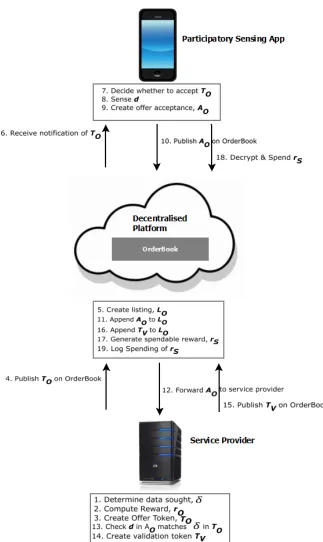
This thesis presents Privacy-Aware Incentivisation (PAI), a privacy-preserving approach to participatory sensing incentivisation and reward allocation. PAI provides a means of allocating untraceable and unlinkable rewards to attract data submissions that reect the dynamic changes occurring in the participatory sensing environment; preserves the identity privacy of participants; prevents the inference of participant activity such as behavioural habits and frequently vis-ited locations and ensures incentive compatibility for the service provider. The core of the approach is a peer-to-peer decentralised exchange platform that enables participants to anonymously make unlinkable data submissions in ex-change for an untraceable and unlinkable reward from the service provider. Oers to which participants can respond are published on the modied equiv-alent of a cryptocurrency OrderBook which lists all oers made by the service provider. Participants who elect to make data submissions in response to these oers publish their acceptance on the OrderBook. As the OrderBook is hosted on multiple peer devices, the platform does not necessitate the use of a Trusted Third Party or other potential means of tracking participant activity and be-haviour. As a result, the approach is robust to inference attacks.
once in response to a particular oer, the service provider or other third party cannot trace participants using the public key component. In addition, the data included in the oer acceptance is encrypted using the service provider's public key to ensure that the service provider has sole access to the data for which it has paid.
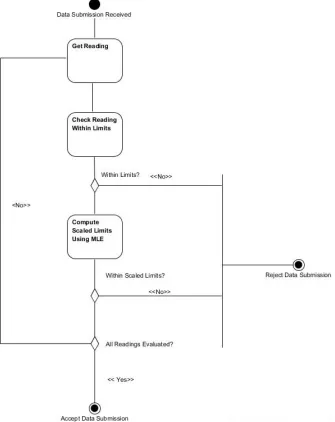
Once the service provider decrypts the data submission, it evaluates it to see if it meets the terms of the oer. To address the potential of rewards being allocated to non-truthful data submissions, the Maximum Likelihood Estima-tion method is used to provide incentive compatibility. The service provider then indicates whether the participant should receive a reward by publishing an update to this eect on the OrderBook. The OrderBook generates an encrypted spendable reward if the service provider has deemed the data submission to be valid. The participant has sole access to this reward using the private part of the One-Time Key. Rewards are not only untraceable when they are allocated but also when they are spent as the OrderBook holds an identity certicate for the service provider. This ensures that the service provider cannot change its signature to track spendable rewards.
To enable the computation of rewards that reect changing environmental conditions and participation rates, the incentive mechanism is modeled using the stochastic Lyapunov Optimisation technique. Through the ongoing com-putation of the reward level, the incentive mechanism can adapt to changes in the sensed environment and participants' response rates by adjusting the reward level whilst balancing budget consumption with the importance of the data being sought.
and computational complexity of the overall approach using the most relevant approaches in the state of the art in privacy preserving reward allocation as baselines.
1.6 Goals & Contribution
As highlighted by research undertaken by authors such as Christin et al. [2013a], an incentivisation scheme whose means of reward allocation ensures privacy for potential participants increases the probability of the service provider attaining a critical mass of participants given that privacy conscious users are more likely to participate. At the same time, participant privacy must not be at the expense of the service provider who will want to have sole access to the data submis-sions being paid for. In addition, current conditions and activities in the sensing environment need to be taken into account. Specically, the response rate to previous requests made by the service provider and the utility of the data being submitted need to be considered when computing the reward oered to partic-ipants for data submissions. Incentive compatibility must also be considered so that participants are motivated to make truthful data submissions.
The goal of this thesis, therefore, is to investigate whether a participatory sensing service provider can oer incentive-compatible untraceable and unlink-able rewards to encourage anonymous, unlinkunlink-able and protected data submis-sions that reect relevant changes in the environment, whilst ensuring iden-tity privacy for participants and in particular, preserving behavioural privacy through the prevention of inference attacks.
The principal contributions of this thesis are:
1. A decentralised platform that provides a data submission mechanism for participatory sensing that meets the privacy requirements of the partici-pant by ensuring that data is submitted anonymously and cannot be linked to any data submissions previously made by the same participant. This mechanism also meets the privacy requirements of the service provider by ensuring that the submitted data can only be accessed by this party.
robustness to inference attacks from service providers and other potential attackers.
3. A privacy preserving reward computation mechanism and incentivisation scheme that adapts to participation rates and environmental conditions, seeks to optimise budget consumption and enables the service provider to tune the scheme so as to balance data capture and budget consumption.
4. The incorporation of a mechanism that assesses the truthfulness of data submissions made without violating participant privacy, thereby demon-strating that the approach facilitates incentive compatibility.
Proofs and experiments are used to evaluate these contributions. Proofs are used to demonstrate that the integrated approach provides anonymous and unlink-able data submission, untraceunlink-able and unlinkunlink-able reward allocation and spend-ing and privacy preservspend-ing incentive compatibility. A simulated participatory sensing environment is also provided to compare the eectiveness of the reward computation mechanism with the state of the art in adapting to changes in the participatory sensing environment and balancing budget consumption with data capture. In addition, a simulation is provided to evaluate the energy consump-tion and computaconsump-tional complexity of the integrated approach in comparison with the most relevant approaches in the state of the art.
1.7 Assumptions & Scope
Participatory sensing systems have two principal actors, the service provider and the participant. The goal of the service provider is to attract data to build a dataset that it will, for example, disseminate to other users or analyse to learn about the environment being monitored. Participants will capture and submit this data using mobile devices such as smart phones, typically in expectation of a reward. PAI assumes that higher rewards attract a larger number of responses with participants only receiving these rewards when a sensing task has been completed in full. Furthermore, the budget for rewarding the sensing activity is assumed to be nite.
provider i.e. one who will seek sensed data in return for genuine rewards but will seek to use that data and the allocation and spending of rewards to violate participant privacy by attempting to obtain further information about partici-pant behaviour and activity without that person's consent. For this reason, the Semi-Honest Threat Model is the principal privacy model that must be ad-dressed so as to prevent the tracking of participant activity and behaviour. To ensure that increased participant privacy is not achieved at the expense of the service provider's budget consumption through the rewarding of false or spuri-ous data, the potential for False Data Injection Attacks is also addressed by PAI.
1.8 Roadmap
The remainder of this thesis is organised as follows:
Chapter 2 discusses the problem to be addressed by PAI in terms of the system and threat models to be used and denes the requirements that need to be fullled.
Chapter 3 considers related work in the areas of incentivisation, privacy preservation and incentive compatibility with research gaps in these areas being identied.
Chapter 4 introduces PAI, the main contribution of this thesis. It de-scribes the design of the decentralised platform used to allocate incentive compatible, untraceable and unlinkable rewards in return for anonymous and unlinkable data submissions. The design of a reward computation mechanism that facilitates adaptive reward allocation is also considered in this chapter.
Chapter 5 describes the implementation of PAI. The evaluation of PAI is also discussed in terms of how well the approach addresses the require-ments. The performance, computational complexity, privacy robustness and data truthfulness of the approach is also analysed.
1.9 Summary
Chapter 2
Problem Denition
This chapter denes the problem to be addressed in this thesis and outlines its scope. Section 2.1 describes the participatory sensing system model used. The participatory sensing threat model is described in Section 2.2 while the threat model to be addressed by the approach is discussed in Section 2.3. The require-ments to be fullled are then discussed in Section 2.4. Section 2.5 summarises this chapter.
2.1 System Model
This section considers the participatory sensing system model. Section 2.1.1 describes the incentivisation scheme to be used while the assumptions made for the participatory sensing system model are discussed and justied in Section 2.1.2.
2.1.1 Incentivisation Scheme for Participatory Sensing
and the corresponding reward that participants will receive for making data submissions matching the criteria outlined in the oer.
Participants will typically use mobile devices such as smart phones, tablet computers, wearable devices or smart vehicles which have embedded sensors to capture data. The data captured by these smart devices can be scalar (e.g. temperature, air quality levels or GPS coordinates) or multimedia (e.g. photos or video). Once captured, data is submitted to the service provider in antici-pation of a reward. In addition to submitting data, participants may also be consumers of the data captured by a service provider.
Once the service provider issues an oer, participants can then elect whether or not to respond to it. As participants are assumed to incur costs (for example, battery consumption, mobile data consumption) when making data submissions, many participants cannot be expected to respond without incentivisation. Par-ticipants are thus modeled as having a reward threshold beyond which they will consider making a data submission. If the reward is greater than or equal to this threshold value, the participant will decide whether to make a data submission in response to this oer having taken issues such as battery consumption into account.
The fundamental problem being addressed by a participatory sensing incen-tivisation scheme can be considered to be a time average cost minimisation one as the service provider is seeking to set the oered reward and corresponding budget consumption at the minimum level that will attract an acceptable level of relevant and timely responses from participants that meet the quality criteria set by the service provider. To model this problem, it is assumed that the ser-vice provider operates in discrete time over slotst∈1,2... with the reward level
being reviewed at the start of each time slot. This review is necessary as the dynamic nature of participatory sensing environments means that participation rates and the data being sought by service providers changes over time. Once the reward level is computed for a particular time slot,t, the service provider
Figure 2.1: A Typical Participatory Sensing System
2.1.2 Assumptions
A number of assumptions are made for the participatory sensing system con-sidered in this thesis. These are listed as follows:
When considering the issue of reward allocation, it is assumed that par-ticipants are rational i.e. the higher the reward oered for a particular type of data, the larger the number of responses (assuming other factors such as privacy perceptions remain constant).
The incentivisation budget held by the service provider for allocating these rewards is assumed to be nite with this budget either being a monetary one or consisting of tangible rewards (for example, Wi-Fi access).
The service provider is also assumed to be rational and will not undertake actions that would adversely aect the success of its participatory sensing campaigns.
Other assumptions made pertain to the scalability and scope of the participatory sensing system and do not diminish the core contributions described in this thesis:
It is assumed that there is only one service provider. This is done so as to simplify implementation and evaluation. Any evaluation results would still hold even if multiple service providers are incorporated.
Other assumptions dene the scope of the participatory sensing system in terms of functionality:
It is assumed that parameters such as the number of responses to reward are congurable. This can be considered to be reasonable as the service provider may wish to do such conguration itself on the basis of its knowl-edge of the domain for which it is seeking sensed data. While it would be possible to automate the adaptive reward allocation mechanism to set these parameters on an ongoing basis, this is regarded to be outside the scope of this thesis.
Only scalar data submissions are considered as the allocation of untrace-able and unlinkuntrace-able rewards would be carried out in the same fashion for multimedia data submissions.
The potential to illegitimately use privacy-disclosing attributes (such as location or journey trajectory) in the data content of a single data sub-mission to derive further information about a participant is outside the scope of this thesis as there are several approaches in the state of the art to address this issue through the use of, for example, obfuscation (Bettini and Riboni, 2015).
While the participatory sensing paradigm relies upon the use of distributed computer networks, the addressing of networking issues such as reliability and communication failures is not considered as this would not be a core contribution in meeting the goals of this thesis.
2.2 Participatory Sensing Threat Model
hand, a semi-honest adversary will be one of the parties within the system and follows the protocol specication exactly. However, it may try to learn more in-formation than intended by examining data that it receives. Figure 2.2 presents the threats faced by a typical participatory sensing system. It can be seen from the diagram that threats in participatory sensing can be external or internal to the system.
It should be noted that this diagram format is used as existing formal methods for modeling threats on computer systems (for example, Attack Trees [Schneier, 1999] and STRIDE [Shostack, 2014]) would not reect the multiple points of vulnerability at which a number of threats exist. For example, the unauthorised disclosure of data could be an internal or external attack that takes place within the participatory sensing app, while the data is in transit or within the service provider's infrastructure.
2.2.1 External Attacks
External attacks by malicious adversaries can take place when submitted data is in transit over an external network to the service provider, when the partic-ipatory sensing app is compromised or when attempts are made to gain access to or disrupt the service provider's infrastructure. The many attacks that can be carried out by external third parties include eavesdropping, data disclosure, unauthorized access, data misuse, tampering, spoong and denial of service (Chang et al., 2013, De Cristofaro and Soriente, 2013 and Qiu et al., 2013). While such attacks can have serious consequences, there are a number of solu-tions available to prevent them such as end-to-end encryption (see, for example, Li and Cao, 2015) and host hardening (see, for example, Shimeall and Spring, 2013).
2.2.2 Internal Attacks
could tamper or damage the device by, for example, encrypting all its data thus denying access to the device owner or could deny service access to the device.
It can be seen from Figure 2.2 that there are many potential internal threats from the service provider. The service provider can potentially misuse data without the participant's consent or could deliberately or accidentally disclose or grant access to that data to an unauthorized third party inside or outside its organisation. When carrying out such actions, the service provider falls under the denition of a malicious adversary. There is also potential for the service provider to carry out an inference attack that analyses the dataset to illegitimately gain further knowledge about the participant without that party's consent. The service provider acts as a semi-honest adversary in this scenario. Similarly, a semi-honest service provider or participant could also use potentially privacy disclosing attributes from the data submission content to illegitimately gain further knowledge about a particular participant.
2.3 Threat Model Addressed
Section 2.2 describes the wide range of threats within a participatory sensing environment. This section identies those threats that would directly impact upon the issue of privacy preserving incentivisation and denes the threat model to be addressed in this thesis.
The denition of identity privacy used in this thesis is based upon the legal principles of Personally Identiable Information (PII). PII is any information which relates to an identied or identiable person. The concept is enshrined in privacy law legislation in many jurisdictions, for example, the European Com-mission's General Data Protection Regulation1. In the context of participatory
sensing, PII requires that participants must be protected not only from disclo-sure of their identity but also attacks that use their participation in the system to discover or infer information about them (i.e. an inference attack). Using the concept of PII, identity privacy in this thesis is therefore dened as any data that can disclose who a person is, where that person is located and what that person is doing in terms of their behaviour, activities and habits.
Meeting this denition of identity privacy requires that participant data is secured from unauthorized intrusions by the service provider, a challenge that is more demanding than preventing external attacks (Qiu et al., 2013).
1See http://ec.europa.eu/justice/data-protection/reform/files/regulation_oj_en.
Specically, the fact that the service provider has full access to participants' sensing records means that it can potentially infer or obtain private data such as location, trajectory or identity. The focus of this thesis is therefore on preventing the service provider from potentially using participants' data submissions or allocated rewards to carry out an inference attack to obtain further information which the participant does not wish to disclose, for example, the frequency of sensing activity in a particular location.
The potential for the service provider to act in a semi-honest fashion by using data submissions and rewards to gain unauthorised private information is the key threat to be addressed when considering privacy preserving reward allocation. The Semi-Honest Service Provider Threat Model is therefore the privacy model that must be addressed in order to fulll the goals of this thesis, specically, to prevent inference attacks tracking participants' activity and behaviour through their data submissions, reward allocations and reward spending. Other threats such as malicious apps and collusion attacks, while serious, can be addressed independently of privacy preserving incentivisation2.
For this reason, such attacks are not considered to be within the scope of this thesis. In addition, as outlined in Section 1.7, the potential of the content in the data submission to be a point of privacy vulnerability is not within the scope of this thesis.
While the Semi-Honest Service Provider Threat Model addresses participant privacy, it also increases the potential for malicious participants to deceive the service provider and gain unearned rewards by submitting false or spurious data without penalty. This also aects participants who consume the service provider's dataset as its overall quality is degraded. The Semi-Honest Service Provider Threat Model must therefore be addressed in a way that does not open up the possibility of the quality of the service provider's dataset being diminished. For this reason, False Data Injection Attacks also fall within the threat model addressed in this thesis.
2.4 Requirements
This section considers the requirements that must be met to fulll the goals of this thesis. These requirements are organised around the need to address the
2For example, the potential for malicious apps to conduct attacks has been addressed in
Semi-Honest Service Provider Threat Model, False Data Injection Attacks and the dynamic nature of the participatory sensing environment. The requirements outlined in this section stem from the motivation for this thesis as outlined in Section 1.2 as well as the the threat model discussed in Section 2.3 i.e. to provide a privacy preserving incentive compatible incentivisation scheme that addresses the potential for both inference attacks and the submission of false or corrupted data.
To ensure privacy preservation, several potential points of privacy vulner-ability must be addressed. The rst point of vulnervulner-ability under the Semi-Honest Service Provider Threat Model occurs when the participant is making a data submission. Participants must therefore be able to make data submissions anonymously without any scope for the service provider to infer further informa-tion about that participant by, for example, linking multiple data submissions from the same participant. At the same time, the data submission should not be devalued for the service provider by making it potentially accessible to other parties. This leads to the rst requirement to be addressed in this thesis:
Anonymous, Unlinkable & Protected Data Submission (R1)
Participants must be able to make anonymous, unlinkable and protected data submissions to the service provider that preserve identity privacy. Specically: The service provider cannot identify participants from the data
submis-sions they make.
The service provider cannot link multiple data submissions made by the same participant.
The data submission should only be accessible by the service provider.
Untraceable & Unlinkable Reward Allocation (R2)
Participants must receive untraceable and unlinkable rewards that preserve their identity privacy. In addition, the service provider or a third party should not be able to conduct an inference attack to gain further private information about participants such as their habitual behaviour, location and trajectory. Specically:
The service provider cannot identify a participant through the allocation of a reward.
The service provider cannot trace participant activity and behaviour, or infer further information about that participant, from the allocation of a reward.
The privacy standard identied for reward allocation must also hold when the reward is being spent i.e. the service provider should not be able to identify participants or trace their activities when they spend the rewards they have been given. This leads to the next requirement to be addressed in this thesis:
Untraceable & Unlinkable Reward Spending (R3)
The service provider or a third party should not be able to conduct an inference attack when a reward is being spent.
As the potential for False Data Injection Attacks falls within the scope of the threat model dened in Section 2.3, the potential for participants to make non-truthful data submissions must also be addressed:
Incentive Compatibility (R4)
For the participatory sensing system model and threat model identied in Section 2.1 and Section 2.3, incentive compatibility must ensure that:
only data submissions that are truthful and accurate receive rewards from the service provider.
the requirement for Untraceable and Unlinkable Reward Allocation (R2). is not violated.
en-sure the timely capture of the most relevant data, therefore, the service provider needs a mechanism that periodically recomputes the level of reward to oer. This is considered in the nal requirement to be addressed in this thesis:
Adaptive & Tunable Reward Allocation (R5)
The incentivisation scheme used to motivate participation must:
be able to adapt the rewards it oers in real-time to match current envi-ronmental conditions and current participation rates, thereby optimising the consumption of the service provider's budget.
be tunable to enable the service provider to balance data capture with budget consumption optimisation and vice versa.
adhere to the requirement for Untraceable and Unlinkable Reward Allo-cation (R2).
not impair the service provider's quality requirementsa.
aWhile methods from the state of the art that are used to preserve participant privacy
with respect to the content of a single data submission may diminish the quality of this data, the approach in this thesis will not.
2.5 Summary
Chapter 3
Related Work
Having dened the scope of the problem to be addressed in this thesis, Chap-ter 2 identied the need to fulll requirements for Anonymous, Unlinkable and Protected Data Submission (R1), Untraceable and Unlinkable Reward Allocation (R2), Untraceable and Unlinkable Reward Spending (R3), Incentive Compatibil-ity (R4) and Adaptive and Tunable Reward Allocation (R5). This chapter eval-uates approaches in the state of the art that address incentivisation, privacy preservation and incentive compatibility, the areas most pertinent to the work undertaken in this thesis, in light of these requirements. The incentivisation schemes for participatory sensing that are proposed for the state of the art are discussed in Section 3.1 while the issue of privacy preservation is explored in Section 3.2. Approaches to incentive compatibility are outlined in Section 3.3. Section 3.4 summarises this chapter.
3.1 Incentivisation
The goal of incentivisation is to motivate a sucient number of participants to make data submissions that meet the service provider's requirements. Balancing the needs of privacy preservation and incentivisation is a challenge as, in some cases, the means of incentivisation is itself a point of privacy leakage. At the same time, any eort to preserve participant privacy must not occur at the expense of pertinent issues such as data utility, response rate and participation rate.
the academic discipline used as the basis for their design and implementation, specically, microeconomics, statistics or a combination of both. For this rea-son, participatory sensing incentivisation schemes are categorised into economic and statistical approaches and are discussed in Section 3.1.1 and Section 3.1.2 respectively.
3.1.1 Economic Approaches to Incentivisation
This section considers approaches to incentivisation that are based upon mi-croeconomic concepts. Section 3.1.1.1 considers those approaches that are based upon auctions, where an auctioneer sells some goods to a group of bidders who place bids to buy these goods. Incentivisation approaches based upon the mi-croeconomic concept of Contract Theory, the study of how economic actors make contractual arrangements in the presence of asymmetrical information where one party has access to more information than the other, are then ex-plored in Section 3.1.1.2. The use of Game Theory, a microeconomic concept dened as a bargaining game concerned with how to divide surpluses between two players (Luo et al., 2017), is discussed in Section 3.1.1.3 while the use of other microeconomic concepts to design participatory sensing incentivisation schemes is considered in Section 3.1.1.4.
3.1.1.1 Auctions
Figure 3.1: Auction in Participatory Sensing
Tunable Reward Allocation (R5), which seeks to ensure that the service provider attracts data that meets its desired quality standards. It should be noted that this is a potential problem for several auction-based approaches in the state of the art which assume that participants will not engage in collusion attacks prior to bidding, for example, the approach proposed by Liu et al. [2019].
Some approaches do claim privacy protection for their auction-based scheme, for example, the approaches proposed by Jin et al. [2016a] and Wang et al. [2016b]. However, in both cases, the privacy protection is intended to enable privacy between participants and, indeed, access to private information such as participants' bid activity is required. In addition, there are a number of auction-based approaches to incentivisation that claim privacy preservation but actually facilitate the trading of privacy and do not address the potential for further private information to be accessed, for example, the approaches taken by Holzbauer and Bulut [2012], Jin et al. [2016b] and Wang et al. [2018c]. Other approaches do seek to provide privacy preservation between the participant and service provider but nevertheless do not meet the requirement for Anonymous, Unlinkable and Protected Data Submission (R1). For example, the approach taken by Sun and Ma [2014], a rst price sealed bid auction1that uses oblivious
transfer to preserve privacy, does not address the potential for inference attacks and further exacerbates privacy vulnerabilities by the use of a bulletin board displaying all bids in the auction. Similarly, while Jin and Zhang [2018] claim privacy preservation for their approach, their reverse auction has no privacy preserving attributes that could prevent the tracking of participant activity.
Other auction-based approaches seek to preserve privacy through the use of a third party component (for example, Dimitriou and Krontiris, 2017). How-ever, such a component could itself be a point of privacy violation through, for example, attacks, database leaks or seizure by governments (Ziegeldorf et al., 2017), given the condential nature of the data that is often stored. For in-stance, the approach proposed by Li et al. [2017b], who explicitly state that the third party component used in their approach is semi-honest, incorporates a cryptographic key generator that has access to participants' IDs, a potential point of privacy leakage.
There are a number of auction-based approaches that would partially ad-dress the requirement for Anonymous, Unlinkable and Protected Data
Submis-1Easley and Kleinberg [2010] dene a rst-price sealed-bid auction, also known as a blind
sion (R1). For example, the use of dierent pseudonyms in dierent auctions for the approach proposed by Dimitriou and Krontiris [2017] ensures that bids made by the same participant in multiple auctions cannot be tracked. However, this method still oers scope to monitor participant activity as it is possible to track multiple bids made by a participant during a single auction. As a result, this approach does not fully meet requirement R1 and, in addition, would not meet the requirement for Untraceable and Unlinkable Reward Allocation (R2).
To conclude, while there are many auction-based incentivisation schemes in the state of the art, the bidding process means that such schemes cannot meet requirement R1. This also applies to those auction-based schemes that claim privacy preservation as, in general, such approaches do not address the fundamental privacy vulnerabilities presented by the bidding process.
3.1.1.2 Contract Theory
Contract theory denes two players who take very dierent roles (Luo et al., 2017). For participatory sensing, the principal, the player who has all the bargaining power and spells out the terms of the contract, corresponds to the service provider. The agent, who can only accept or reject the contract and cannot make a counter-oer, corresponds to the participant.
There are two main contract models. In the adverse selection model, the agent has certain hidden information that the principal tries to elicit. In partic-ipatory sensing, this corresponds to the service provider attempting to obtain sensed data (i.e. the hidden information) from the participant. In the moral hazard model, the agent could exert some hidden eort that is of economic value to the principal while the principal tries to induce a desired eort level at a minimal cost. For participatory sensing, the moral hazard model introduces the concept of value for data submissions. In this case, the service provider attempts to obtain the data at the minimal reward level possible.
Con-tract Theory is used by Zhang et al. [2018a] to devise an incentivisation approach that focuses on data quality by ensuring that participants are rewarded through the evaluation of their task completion performance from multiple perspectives (or dimensions). However, while linking the participant's reward to task per-formance has merit in attracting better quality data submissions, the approach gives the service provider direct access to the participant's behaviour and activ-ities. The moral hazard model-based approach proposed by Zhao et al. [2017] also exhibits privacy vulnerabilities as its linking of a contract issued to the participant with a data submission results in the participant being vulnerable to inference attacks. The incentive compatible approach outlined by Chen et al. [2017b] is more robust from a privacy preservation perspective in that it could be extended to incorporate anonymous data submission with some modication of the core algorithm. However, data submissions made by the same participant would be linkable.
The user matching mechanism for the Broker-less Participatory Sensing Scheme proposed by Oide et al. [2016], which uses a Contract Theory-based approach to match consumers and providers of sensing information, is more ro-bust from a privacy preservation perspective as it uses a peer-to-peer approach that removes the need for a central server and thus avoids many of the pitfalls of privacy leakage to the service provider. However, this approach would not fulll the requirement for Anonymous, Unlinkable and Protected Data Submis-sion (R1) as the sensed data cannot be stored by the service provider. While the authors assert that sensed data does not need to be stored anywhere, this will not be the case for many service providers and would not meet the needs of the participatory sensing model presented in Section 2.1.
Other approaches that consider privacy preservation do so from the perspec-tive of privacy trade-os. For example, the contracts issued between participant and service provider by REAP (Zhang et al., 2018b), while seeking to compen-sate participants for loss of privacy, gives the service provider the potential to conduct inference attacks by monitoring the nature and frequency of these contracts.
3.1.1.3 Game Theory
approach by modeling the bargaining procedure as a sequential game, in which the two players alternately propose oers until one accepts the oer proposed by the other while the Nash bargaining model focuses on deriving an outcome that satises certain mathematical conditions (or axioms).
Like Contract Theory-based approaches, the Game Theory-based incentivi-sation mechanisms outlined in the state of the art for participatory sensing have inherent attributes that make them vulnerable to unauthorised privacy disclo-sure. For example, the authors of the QUOIN incentivisation scheme (Ota et al., 2018), which uses the Stackelberg Game Theory model to maximise the util-ity of the data a service provider collects from participants, point out that their method is prone to privacy leakages while Theseus (Jin et al., 2017a), which uses Game Theory for its payment mechanism, retains details tracking the quality of participants' data submissions.
Incentivisation schemes that combine Game Theory with other methods ex-hibit similar vulnerabilities to privacy leakage. For instance, Stable-GRS (Az-zam et al., 2018), which uses both genetic algorithms and Game Theory to recruit and incentivise participants respectively, requires signicant access to participants' private information, specically GPS locations and mobility pat-terns. Similarly, the Nash bargaining model-based approach outlined by Zhan et al. [2018b], which envisages the use of credits that can be later used by the participant to claim a reward, is vulnerable to inference attacks and, specif-ically does not meet the requirement for Untraceable and Unlinkable Reward Allocation (R2) as allocated rewards can be used to track participants.
incentive mechanism proposed by Koh et al. [2018]. However, this is in terms of privacy trade-os as participant rewards are determined on the basis of the location granularity of their data submission.
3.1.1.4 Other Microeconomic Concepts
A wide diversity of other microeconomic concepts are used to design incentivi-sation schemes with the core tenet of supply and demand being used in many approaches. Unfortunately, like incentivisation schemes based upon auctions, Contract Theory and Game Theory, some of these approaches exhibit privacy vulnerabilities that prevent them from meeting the requirement for Anonymous, Unlinkable and Protected Data Submission (R1). For example, the supply and demand-based approach outlined by He et al. [2017], which uses Walrasian Equi-librium to devise a vector of rewards, selects and recruits individual participants rather than making a general oer that could be responded to anonymously. Moreover, the privacy preservation claims of the approach proposed by Zhan et al. [2018a], which seeks to maximise social welfare2, are undermined by the
fact that participants must register an ID and their location with the service provider who can also track participant activity through reputational quality scores. Similarly, Pournaras et al. [2016], who use supply and demand to build a market mechanism for participatory sensing, acknowledge that the poten-tial for inference attacks is an open issue for their approach. SEQTGREEDY (Singla and Krause, 2013b), which uses marginal utility to maximise the ser-vice provider's marginal gain, also considers privacy preservation. However, the authors assume that, regardless of their privacy concerns, participants are will-ing to share what they term certain non-sensitive private information (which is not dened). It should also be noted that the use of obfuscation and random perturbation by this approach to devise what is called a 'privacy prole' is not robust against certain types of inference attacks such as distribution analysis3.
While many of the approaches in the state of the art that use microeconomic concepts exhibit privacy leakage, there is no reason why the use of these concepts should preclude meeting the privacy preserving requirements for Anonymous, Unlinkable and Protected Data Submission (R1), Untraceable and Unlinkable Reward Allocation (R2) and Untraceable and Unlinkable Reward Spending (R3).
2As previously noted, social welfare is an economic concept that, in the case of participatory
sensing, measures the benets accrued by both the participant and the service provider.
3A distribution analysis attack entails reconstructing the probability density function of a
For example, SenseUtil (Tsujimori et al., 2014 and Thepvilojanapong et al., 2013), which uses the principles of supply and demand in conjunction with marginal utility to determine the value of sensed data, does not consider privacy but could be integrated with a appropriate method of privacy preservation. It must be noted, however, that SenseUtil cannot be directly adapted for the work addressed in this thesis as it does not meet the requirement for Adaptive & Tunable Reward Allocation (R5). Specically, the approach does not attempt to optimise rewards to determine a level at which data submissions will be made below that value.
3.1.2 Statistical & Machine Learning Approaches to
In-centivisation
There are a wide variety of statistical-based incentivisation approaches in the state of the art for participatory sensing. Given the nature of incentivisation schemes, it is unsurprising that optimisation methods are used for computing the reward level in several schemes. These are considered in Section 3.1.2.1. In addition to optimisation, there are also a number of approaches that use a variety of techniques such as probability and machine learning. These are discussed in Section 3.1.2.2.
3.1.2.1 Optimisation
Optimisation is used to design incentive schemes in a wide range of domains in the state of the art (Huang et al., 2016). However, while these approaches have diverse goals such as optimising budget consumption or increasing partic-ipation rates, a number of these approaches would not meet the requirement for Anonymous, Unlinkable and Protected Data Submission (R1) as they seek to enhance data quality by ensuring the selection of those participants who are best placed to meet the service provider's data requirements and, in many cases, require additional participant information such as trajectories and expertise (for example, Karaliopoulos et al., 2016, Xiong et al., 2016, Back et al., 2017, Xiong et al., 2017 and Sun and Liu, 2018)4. Other approaches have goals that are not
consistent with those of requirement R1, for example, the trading of rather than the preservation of privacy (Alsheikh et al., 2017).
4See also the approaches taken by Han and Zhu [2014], Luo et al. [2014], Song et al. [2014],