09
PRIVATISATION: LESSONS
FROm THE Uk
DAVID PARkER
AbstRAct
0
12.1 Introduction
By the mid-970s it was common to label the UK ‘the sick man of Europe’. The growth of GDP between 950 and 97 averaged . per cent. This contrasted with growth rates of five per cent in Germany and four per cent in France (Crafts, 00: ). At the time the UK had a large state sector with nationalised industries accounting for around per cent per cent of GDP and eight per cent of employment. The returns on investment in the nationalised industries were depressingly low. Earnings before interest and tax are estimated to have ranged between –0. per cent and . per cent in the period 97-8 (Brittan, 98:8). In part this was because Governments interfered with the prices set by the nationalised industries in a futile attempt to hold down inflation. In 975 inflation in the UK peaked at around per cent. Accumulated government subsidies, capital write-offs and other payments to the nationalised industries from the mid-950s are said to have totalled nearly £8 billion. By 997 as a result of the privatisation programme the nationalised industries accounted for only around two per cent of GDP and public sector employment had fallen by over .5 million.
May 979 saw the Election of a Conservative Government under the leadership of Margaret Thatcher. Between 97 and 979 the previous Labour Government had extended state ownership with nationalisation of the aerospace and shipbuilding industries, the taking into state ownership of the country’s largest vehicles manufacturer British Leyland, the establishment of the British National Oil Corporation to control North Sea oil extraction, and an Industry Act in 975, which amongst other things set up the National Enterprise Board (NEB). The role of the NEB was to invest taxpayer funds in industrial enterprises. Both Rolls-Royce, taken into state ownership in 97 after going into receivership, and British Leyland similarly rescued from bankruptcy in 975, came under the supervision of the NEB.
Although the Conservatives’ 979 Election Manifesto made only modest promises on denationalisation, between May 979 and May 997, first under Margaret Thatcher and then under John Major, the UK experienced the world’s first large-scale privatisation experiment. Nor did the re-election of a Labour Government in 997 see it come to an end. Although Labour had opposed every one of the Conservatives’ privatisation measures, under Tony Blair as Prime Minister privatisation has been extended with the sale of organisations such as National Air Traffic System and Qinetiq, a defence research establishment, and the promotion of Public-Private Partnerships (PPPs). By April 00, 5 private-financing deals had been agreed with a capital value of £5 billion (Financial Times, 00).
This chapter looks at the UK’s experience of privatisation and points to some lessons that Ireland might learn from the experience.
12.2 Development of Privatisation as Policy
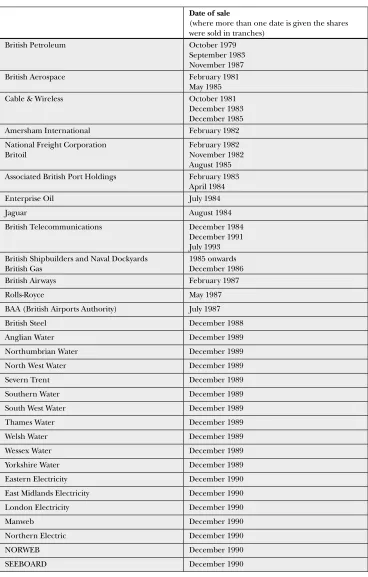
During the first Conservative Government, from May 979 to June 98, the Conservatives denationalised British Aerospace, the international telecommunications operator Cable and Wireless, Amersham International a specialist producer of radioactive chemicals, the country’s largest ports operator Associated British Ports, Britoil incorporating the oil and gas exploration and production activities of the British National Oil Corporation, and the National Freight Corporation. Shares in each of these industries were sold through the stock market, often in tranches with just over 50 per cent sold initially. An interesting exception was the National Freight Corporation, involved in road haulage and storage, which was transferred to the private sector in February 98 through a management and employee buyout. In all cases small shareholders were encouraged to buy shares, as part of the Government’s strategy to extend property ownership. In addition to this programme of privatisation, the Government also encouraged the nationalised industries to sell off subsidiary activities and the NEB was run down. These privatisations typically took the form of direct sales of businesses to other companies, usually referred to as ‘private sales’ or ‘trade sales’.
The election of the second Thatcher Government in June 98 saw privatisation step up a further gear. Between 98 and 987 receipts totalling £0. billion were raised from the sale of nationalised industries, the most important being British Telecom, British Gas, British Airways, Rolls-Royce, parts of British Leyland, the National Bus Company, and shipbuilding and ship repair yards. The 987-97 Conservative Governments went even further, privatising airports, the Scottish Transport Group, water, electricity, coal and most controversially, the railways.
Where outright privatisation was deemed not possible for the present time, Government developed a programme of competitive tendering for public services, such as refuse collection, cleaning and catering, in central and local government and the National Health Service (NHS). This was extended in the later 980s with the introduction of compulsory competitive tendering for a range of local government work and the transfer of the running of the Royal Dockyards to private contractors. However, privatisation of the welfare state remained almost entirely ‘out of bounds’. Suggestion in September 98 that the Government was contemplating privatisation of the NHS led to a speedy denial from Mrs Thatcher. Thatcher was well aware of the public’s fondness for the welfare state.
Table 12.1: The UK’s Major Privatisations, 979-987
Date of sale
(where more than one date is given the shares were sold in tranches)
British Petroleum October 979
September 98 November 987
British Aerospace February 98
May 985
Cable & Wireless October 98
December 98 December 985
Amersham International February 98
National Freight Corporation Britoil
February 98 November 98 August 985 Associated British Port Holdings February 98
April 98
Enterprise Oil July 98
Jaguar August 98
British Telecommunications December 98
December 99 July 99 British Shipbuilders and Naval Dockyards
British Gas
985 onwards December 98
British Airways February 987
Rolls-Royce May 987
BAA (British Airports Authority) July 987
British Steel December 988
Anglian Water December 989
Northumbrian Water December 989
North West Water December 989
Severn Trent December 989
Southern Water December 989
South West Water December 989
Thames Water December 989
Welsh Water December 989
Wessex Water December 989
Yorkshire Water December 989
Eastern Electricity December 990
East Midlands Electricity December 990
London Electricity December 990
Manweb December 990
Northern Electric December 990
NORWEB December 990
[image:4.482.58.426.70.647.2]
Date of sale
(where more than one date is given the shares were sold in tranches)
Southern Electric December 990
South Wales Electricity December 990
South Western Electricity December 990
Yorkshire Electricity December 990
National Power March 99
PowerGen March 99
Scottish Hydro-Electric June 99
Scottish Power June 99
Trust Ports 99-97 (various dates)
Northern Ireland Electricity June 99
British Coal December 99
Railtrack May 99
British Energy July 99
AEA Technology September 99
[image:5.482.64.426.355.569.2]Train Operating Companies Various dates in 99/7 National Air Traffic Services July 00
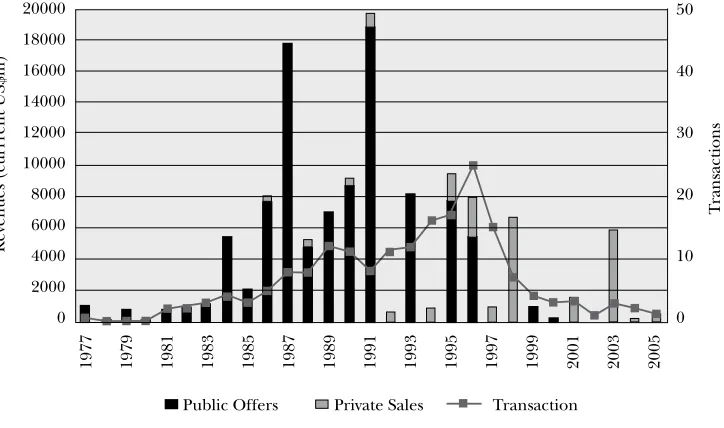
Figure 12.1: Total Privatisation Revenues and Transactions, UK, 977-005
Source: Available online at: www.privatizationbarometer.net. ä
Óäää {äää Èäää näää £ääää £Óäää £{äää £Èäää £näää Óääää
ä £ä Óä Îä {ä xä
*ÕLVÊ"vviÀà *ÀÛ>ÌiÊ->ià /À>Ã>VÌ
,iÛiÕiÃÊVÕÀ
ÀÀ
iÌÊ1-f®
/
À>Ã>VÌÃ
12.3 Privatisation and Uk Economic Performance
For an economist, the litmus test for privatisation is whether the industries performed much better than they would have done had they stayed under state ownership. This requires a consideration of the ‘counterfactual’ or what would have been their economic performance had they remained nationalised. This must ultimately be a matter of conjecture. However, it is the case that under Thatcher the nationalised sector as a whole performed much better in terms of productivity and profitability, in no small part because the management were mandated to improve efficiency rather than pursue political or social objectives. For example, the British Steel Corporation saw manning fall from 9,500 in 979 to 5,70 in 988, immediately before privatisation. Over the same period, labour productivity rose by almost 8 per cent per annum. In British Airways between 98 and privatisation in 987 employment fell by 0 per cent and labour productivity rose annually by around 8. per cent a year (Martin and Parker, 997).Perhaps these efficiency gains would not have occurred if the management had not been preparing for privatisation. In which case the gains can be credited to privatisation; but some industries that stayed in the state sector in the 980s, such as the Post Office and the National Coal Board, also saw efficiency improvements (Bishop and Kay, 988; Bishop and Thompson, 99). For example, Total Factor Productivity (TFP) in the Post Office rose by some .7 per cent per annum between 979 and 988 (Bishop and Kay, 988: 5). Perhaps the safest conclusion is that state industries can perform well when Government concentrates on managing them as commercial concerns and not as political poodles. Whether Governments can be relied on to do so for long, however, is quite another matter.
So the counterfactual is tricky. Less problematic is the record of performance in the privatised industries since their transfer to the private sector. A number of studies have been undertaken, some by this author, and they generally show efficiency gains. However, in some cases the gains were not markedly different to those achieved under nationalisation and, more unequivocally, the gains in the former monopoly public utilities (telecoms, gas and electricity) tend to be associated with the arrival of competition rather than privatisation per se.
Under nationalisation a number of the industries were given monopoly powers even though there was no sound economic rationale for not permitting competition, coal mining comes immediately to mind. Once privatised the Government had no particular reason to protect the industries from competition and even the so-called ‘natural monopolies’ were opened up to new competitors.
5
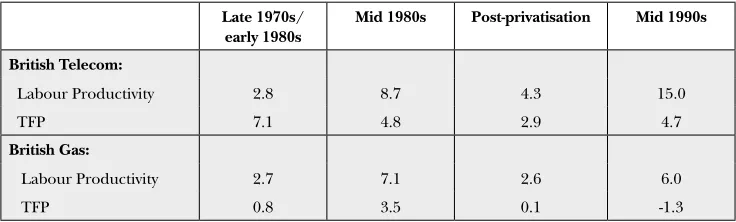
[image:7.482.57.425.261.372.2]The result of competition is evident especially in the labour productivity figures in Table .. In the cases of both British Telecom and British Gas the largest efficiency gains occurred in the 990s with the arrival of competition and regulatory tightening, discussed below (although there were also some impressive gains in the run up to privatisation too). It can also be seen from the figures in this table that the growth in TFP, which takes account of other inputs notably capital, is more modest. This suggests that the industries after privatisation undertook capital for labour substitution. They also contracted out a number of activities, taking the labour involved off their books. Both trends are consistent with the notion of over-manning when state owned, probably because of the stronger power of the trade unions. Since privatisation the power of the trade unions has been much diminished, and with it the UK’s previously depressing record of man-days lost through strikes.
Table 12.2: Productivity Growth in British Telecom and British Gas (annual
percentage change)
Late 1970s/ early 1980s
Mid 1980s Post-privatisation Mid 1990s
British Telecom:
Labour Productivity .8 8.7 . 5.0
TFP 7. .8 .9 .7
British Gas:
Labour Productivity .7 7. . .0
TFP 0.8 .5 0. -.
Note: The dates given are approximate; for more details of the dates and the methods of calculation, see Martin and Parker (997: ).
Where the quick development of competition proved difficult, the Government resorted to establishing a new regulatory structure. It was recognised that regulating prices and services from government departments, as had occurred under nationalisation, would leave the industries open to political manipulation and would be likely to frighten away private investors. In consequence, when the privatisation of the first of the monopoly industries, British Telecom, was planned, the decision was taken to set up a quasi-independent regulatory agency, the Office of Telecommunications (Oftel), headed by a Director General. Oftel’s responsibilities were set down in statute and a licensing system was introduced to regulate BT and new entrants into the industry. Amongst the licence terms was the regulation of pricing, which took the form of a price cap based on the retail price index minus an ‘X’ efficiency factor (RPI-X) (Littlechild, 98). Although it would have been possible for Ministers to have interfered in the regulation, in practice the regulatory offices were given a high degree of independence. This regulatory model was later extended to gas, water, airports, electricity and the railways.
industry fully competitive (Helm, 995; Parker, 998). Nevertheless, the new regulatory bodies in the UK quickly built up a reputation for effective intervention to protect consumers. At the same time, their skill in identifying the scope for efficiency gains grew and with it their pressure on management to achieve efficiency. The initial price caps at privatisation were set through negotiation between the corporations, government departments and their respective financial advisors, but always with an eye to achieving a successful sale. However, once the price caps came up for renewal, typically after five years (although sometimes less), each regulator acted to tighten the cap.
For example, at privatisation British Telecom’s price cap was set at RPI- per cent, which was raised to .5 per cent in 989, . per cent in 99 and then to 7.5 per cent in 99. The effect was to put increasing pressure on the management in these privatised industries to achieve efficiency improvements. In addition, over time new competition did develop, so that the privatised monopolies were eventually faced by a double squeeze involving competition
and regulation, until such time as regulation could be safely removed. Regulation of British Telecom’s prices was finally abolished in August 00. The regulation of electricity and gas retail prices had been removed a few years earlier.
With the arrival of competition, the privatised industries were subject to normal competition law in the UK, relating to market power, restrictive practices and mergers. This necessitated the Government revisiting competition policy to ensure that the competition authorities in the UK, the Office of Fair Trading and the Competition Commission, and the regulatory agencies such as Oftel (now Ofcom) could work seamlessly to promote and protect competition. The UK strengthened its competition laws in 998 and 00.
The figures in Table . above, showing labour and TFP growth in British Telecom and British Gas therefore reflect both the results of growing competition and more effective regulation during the 990s. Privatisation has not led to the withering away of the state in the UK, but rather to a reformulated role for government as a market regulator rather than a direct service provider (Cook, 998; Parker, 999).
Consumers have gained from the efficiency improvements. In most of the UK public utilities prices and tariffs have fallen since privatisation. For example, between 98 and 999 average real charges in telecommunications fell by around 8 per cent on average; although this change certainly resulted from technology and competition in addition to ownership change and regulation. Turning to gas, between 98 and 997 domestic gas bills fell by an average of . per cent a year, again in real terms. After 997 the gradual introduction of competition in domestic gas supplies led to further cuts of up to 0 per cent. Real industrial and commercial gas prices fell over the same period by about five per cent a year. In the electricity market the decline in charges for domestic consumers in England and Wales between 990 and 999 was around per cent in real terms for domestic consumers, while the reduction for industrial and commercial consumers was even larger, totalling between 5 per cent and per cent (Parker, 999; Littlechild, 000: -). The main exception to this impressive track record on charging occurred in the water and sewerage industry, where prices rose. Higher charges were levied to fund the modernisation of the water and sewerage system after years of under investment when in the state sector and to meet the requirements of new EU water quality directives.
7
tended to receive bigger reductions in charges than smaller, often poorer consumers, which are individually more costly to serve (NAO, 00). The result is that lower income groups have received smaller welfare gains from privatisation and in some cases may even have lost out.
Service quality changes since privatisation are particularly difficult to summarise. However, there is little evidence that price reductions following privatisation have been at the expense of service quality. The industry regulators police service quality and penalise quality reductions where competition is restricted and in competitive markets it will not be in the interests of firms to compromise on the quality that consumers expect. An exception may relate to long-term investment. It has been suggested that privatisation of electricity may have driven firms to reduce their capital investment programmes to reduce costs, leading to less reserve capacity to meet peak load demands or emergencies. Recent blackouts in London may be a result of such action. The black outs occurred when technical faults took capacity off-line and the electricity supplier had insufficient alternative supplies.
Economists distinguish between static efficiency gains and dynamic efficiency gains. Static gains involve the firm moving towards its efficiency frontier or achieving the level of productive efficiency that it should be able to attain given existing inputs, input prices and technology. Dynamic efficiency gains are more concerned with efficiency improvements associated with technological development and management changes, including changes to production processes and supply chains. In other words, it might be possible for an industry to register efficiency gains at the time of privatisation and immediately afterwards that simply reflect de-manning and the selling off of under-utilised land and buildings - and this did occur in the UK. But maintaining continuing efficiency gains, and therefore long-term international competitiveness, requires investment and management effort directed into improving products and production processes.
8
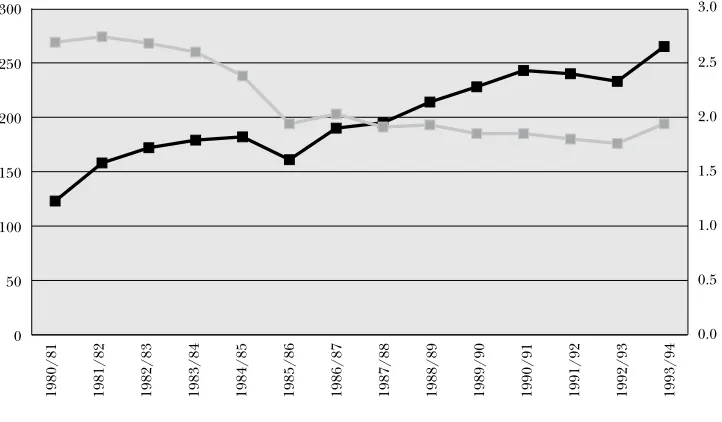
Figure 12.2: BT Expenditure on R&D, 979-80 to 99-9
Source: BT, Annual Report & Accounts, various; Parker (99).
More generally, anecdotal evidence suggests that in privatised companies R&D has been expected to achieve greater, shorter-term, commercial payoffs, leading to less spent on ‘blue sky’ research. But we cannot be sure and if it has occurred the long-term economic effects are difficult to gauge.
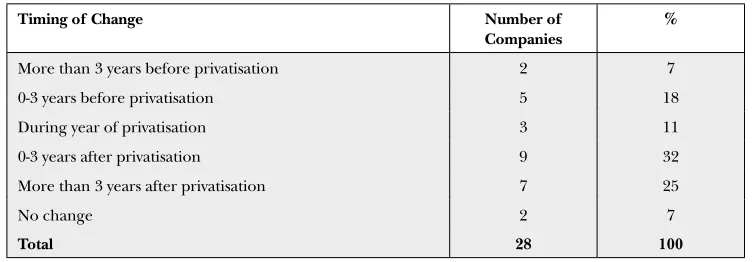
Another indicator is to look at processes within firms. In a piece of major research by this author and colleagues changes in the management of procurement were investigated (Harris, Parker and Cox, 998; Cox, Harris and Parker, 999). Twenty-eight privatised firms in the UK were included in the research and evidence was gathered that there had been substantial changes in the structure of procurement in most in the three years before or following privatisation (see Table .). In many there had been the introduction of a more professional approach to procuring goods and services including the introduction of ‘leading-edge’ procurement practices. Whereas under state ownership procurement had often been a ‘Cinderella’ activity, professional procurement managers had been recruited from the private sector to champion these new and more effective procurement methods. This had led to improved supplies and lower costs; although arguably in many cases there was an over emphasis on cost reduction rather than using procurement strategically to gain competitive advantage.
0 50 100 150 200 250 300
0.0 0.5 1.0 1.5 2.0 2.5 3.0
1980/81 1981/82 1982/83 1983/84 1984/85 1985/86 1986/87 1987/88 1988/89 1989/90 1990/91 1991/92 1992/93 1993/94
9
Table 12.3: Changes in the Structure of Procurement in UK Privatised Industries
Timing of Change Number of
Companies
%
More than years before privatisation 7
0- years before privatisation 5 8
During year of privatisation
0- years after privatisation 9
More than years after privatisation 7 5
No change 7
Total 28 100
Source: Cox, Harris and Parker (999:5).
Alongside this work on procurement, other studies of management in privatised companies have revealed a new attention to satisfying the consumer. Whereas previously the consumer may have had no choice but to buy from the nationalised industry, the introduction of competition necessitated the building of new competencies in consumer marketing. Other changes to improve responsiveness to the market included the installing of new accounting and IT systems (Parker, 995; Martin and Parker, 997; Cragg and Dyck, 999). In general, this evidence (albeit tentative) is consistent with management pursuing dynamic efficiency gains after privatisation. However, the failure of a number of privatised shipyards, mines and steel works, the collapse of Rover cars, the liquidation of Railtrack and the need for government financial support for British Energy to prevent its collapse in 00, are just some examples confirming that privatisation is not a panacea for economic failure. Moreover, most of the UK’s electricity industry, much of its water industry, and privatised companies such as Amersham International, Associated British Ports and most recently the British Airports Authority, have come under foreign control. This suggests that foreign managers have seen greater potential for efficiency gains than British managers. Privatisation alone does not reverse national failings in management competency.
12.4 Lessons for Ireland
Ireland has had its own privatisation programme since the late 980s (Barrett, 998). However, there are still some useful lessons that can be learned from the UK experience.
[image:11.482.54.430.75.206.2]0
Secondly, where effective competition is not possible, at least for some time, the Government must regulate to protect consumers. This requires the establishment of a new regulatory regime. The role of regulation should be two fold: first, to protect consumers from monopoly abuse and second, to promote competition wherever possible, perhaps even by tilting the playing field in the favour of new entrants into the industry. Once competition develops it needs to be protected because there is an incentive for producers to merge to reduce competition and raise their market power. This necessitates Government revisiting its competition laws to ensure that they are adequate to protect competition in the privatised utilities and to ensure that the regulatory regimes and competition authorities work consistently.
Thirdly, consumers in the UK have benefited from more competition and lower prices, especially for telephone calls and fuel. They have also benefited since privatisation from improved service quality. The UK’s experience confirms that private profit making is not incompatible with good public services. However, regulators have to act to ensure that the benefits of privatisation flow down to the poorest who can be the most expensive to serve. In private-sector markets businesses are interested in the most profitable consumers.
Finally, the longer-term economic benefits from privatisation will come from dynamic efficiency gains. While there is some evidence that since privatisation management has tackled some of the deficiencies under nationalisation in, for example procurement and marketing, the impact of privatisation on research and development and the country’s technological capability is much less clear. The possibility that privatised firms will be overly ‘short termist’ in their investment programmes because of pressures from the capital market for quick returns should not be dismissed.
12.5 Conclusions
In the UK, of the major nationalised industries in 979 only the Post Office escaped largely unscathed from the privatisation experience. It seems that Margaret Thatcher had nervousness about privatising the ‘Royal Mail’ and more pragmatically Conservative Governments were mindful that the rural constituencies from which most of their MPs came might well lose out from privatisation. Typically, urban post cross-subsidises more expensive mail collection and delivery in rural areas. Since 997 the trade unions have opposed any suggestion from the Labour Government that private capital should be introduced into the Post Office. Nevertheless, it is difficult to believe that the Post Office can remain an entirely state-owned organisation into the future. A lacklustre service and a lamentable record of industrial disputes is a reminder of what the public suffered from more widely in the 970s under nationalisation.
Notes
The Government also sold its majority shareholding in the company BP, starting in October 979. The final share sale occurred in November 987.
To this might be added the sums raised by state industries selling off subsidiaries and surplus land and buildings which were usually retained by the industries. However, the Government was then able to adjust the level of loan financing they obtained through Government. Similarly, local authorities gained receipts from the sale of council housing to the tenants under legislation introduced in 980 which gave tenants the right to buy on privileged terms.
Saal and Parker (000) study performance in the water and sewerage industry, where competition is strictly limited by the technology of provision, and find that tighter regulation is associated with efficiency gains.
References
Barrett, S. (998), “The Importance of State Enterprises in the Irish Economy and the Future for Privatisation”, in D. Parker (ed.) Privatisation in the European Union: Theory and Policy Perspectives, London: Routledge.
Bishop, M. and Kay, J. (988), Does Privatization Work? Lessons from the UK, London: London Business School.
Bishop, M. and Thompson, D. (99), “Regulatory Reform and Productivity Growth in the UK’s Public Utilities”, Applied Economics, Vol., 8-90.
Brittan, S. (98), “The Politics and Economics of Privatization”, Political Quarterly, Vol.55, 09-8.
Cook, P. (998), “Privatization in the UK”, in D.Parker (ed.) Privatisation in the European Union: Theory and Policy Perspectives, London: Routledge.
Cox, A., Harris, L. and Parker, D. (999), Privatisation and Supply Chain Management: On the Effective Alignment of Purchasing and Supply after Privatisation, London: Routledge.
Crafts, N. (00), Britain’s Relative Economic Performance 1870-899, London: Institute of Economic Affairs.
Cragg, M. and Dyck, I.J.A. (999), “Management Control and Privatization in the UK”, RAND Journal of Economics, Vol.0, No., 75-97.
Financial Times (00), “Big Expansion Planned in PFI Projects”, June, p..
Harris, L., Parker, D. and Cox, C. (998), “UK Privatisation: Its Impact on Procurement”, British Journal of Management, Vol.9, Special Issue, -.
University Press.
Littlechild, S.C. (98), Regulation of British Telecommunications’ Profitability, London: HMSO.
Littlechild, S.C. (000), Privatisation, Competition and Regulation, Occasional Paper 0, London: Institute of Economic Affairs.
Martin, S. and Parker, D. (997), The Impact of Privatisation: Ownership and Corporate Performance in the UK, London: Routledge.
.
NAO (00), Giving Domestic Customers a Choice of Electricity Supplier, Report by the Comptroller and Auditor General, HC 85 Session 000-00, London: Stationery Office.
Parker, D. (99), “A Decade of Privatisation: the Effect of Ownership Change and Competition on British Telecom”, British Review of Economic Issues, Vol., No.0, 87-.
Parker, D. (995), “Privatisation and Agency Status: Identifying the Critical Factors for Performance Improvement”, British Journal of Management, Vol., 9-.
Parker, D. (997), “Price Cap Regulation, Profitability and Returns to Investors in the UK Regulated Industries”, Utilities Policy, Vol., No., 0-5.
Parker, D. (999), “Regulating Public Utilities: Lessons from the UK”, International Review of Administrative Sciences, Vol.5, 7-.
Saal, D. and Parker, D. (000), “The Impact of Privatisation and Regulation on the Water and Sewerage Industry in England and Wales: A Translog Cost Function Model”,Managerial and Decision Economics, Vol., 5-8.
Waddams Price, C. and Hancock, R. (998), “Distributional Effects of Liberalising UK Residential Utility Markets”, Fiscal Studies, Vol.9, No., 95-9.