EUR 7921 EN
COMMISSION OF THE EUROPEAN COMMUNITIES
Multiannual Programme
of the Joint Research Centre
1980-1983
1981
Annual Status Report
Hydrogen production,
energy storage and transport
EUR 7921 EN
COMMISSION OFTHE EUROPEAN COMMUNITIES
Multiannual Programme
of the Joint Research Centre
1980-1983
1981
Annual Status Report
Hydrogen production,
Published by the
COMMISSION OF THE EUROPEAN COMMUNITIES Directorate-General
Scientific and Technical Information and Information Management Bâtiment Jean Monnet LUXEMBOURG
Reproduction in whole or in part of the contents of this publication is free, provided the source is acknowledged
© ECSC-EAEC, Brussels-Luxembourg, 1982 Printed in Italy
ISBN 92-825-2994-0
HYDROGEN PRODUCTION
ENERGY STORAGE AND TRANSPORT
1981
Research Staff:
Budget:
40 men-year
4.027.000 ECU
Projects:
1. Thermochemical Production of Hydrogen
2. Advanced Studies for Energy Carriers
3. Study of Technical Systems
Programme Manager:
G. BEGHI
Commission of the European Communities
Joint Research Centre
Ispra Establishment
1-21020 Ispra (Varese), Italy
1.
INTRODUCTION
In the development of new energy sources, a great deal of
at-tention has been devoted to the sources themselves and to
systems of conversion. Nevertheless, the storage and transport
of the energy produced are an essential requirement for the
economic utilization of the new systems, whether because of
the intermittent nature of the source, or because of the mode of
utilization (mobile applications), or because of the distance
between the centres of production and consumption.
The cost-effectiveness of these primary energies is closely
link-ed with the development of economic storage or transport
systems.
In these respects, hydrogen holds out attractive
prospects-hence the JRC's interest in the production of this energy
car-rier.
The experience acquired at Ispra in the previous «Hydrogen»
Programme provides a solid basis for the development of new
techniques (or for the verification of known but unproven
techniques) for the storage and transport of energy, especially
by thermo-chemical processes.
The present activities on hydrogen, which are going to a
con-clusion of the research phase, will progressively decrease in
favour of new activities on the more general aspects of energy
storage and transport.
The activities of the programme are subdivided in three
pro-jects, each one having a different evolution of their importance
in the time.
The first project is the
thermochemical production of
hydrogen.
The experimental realizations, as a results of the previous
grammes, will be terminated in the current multiannual
pro-gramme. The objective is to verify the technological feasibility
and the competitivity of the thermochemical hydrogen
produc-tion route on a industrial scale; a final report describing a pilot
plant will be produced, and the technical and economic studies
on thermochemical hydrogen production will be terminated.
The second project deals with
advanced studies for energy
car-riers.
The problem of storing and transporting energy can be solved
in different ways, according to the situation and the system; an
activity of exploratory nature is useful for the definition and
selection of various techniques to transport and store energy,
on which to concentrate later on the effort.
2. RESULTS
Project 1. Thermochemical Production of Hydrogen
The objective of the activity is the verification of the feasibility and competitivity of the thermochemical decomposition of water, as a possible new method for hydrogen production, us-ing high temperature heat as primary energy.
After the exploratory studies and the preliminary tests made in the past years, the research phase, concentrated on two of the cycles defined at Ispra, the Mark 11 and the Mark 13 cycles, is approaching to a conclusion.
At the level of the laboratory scale, the demostration of the feasibility of the method was made with the operation of a complete circuit for the cycle Mark 13 since May 1978. The analysis of the results of these experiments with the laboratory circuit, built in glass and quartz and working at at-mospheric pressure, was concluded, after the continuous run for 100 hr. The data obtained with these experiments confirm-ed the good operation and showconfirm-ed that the design data and criteria were correct.
The second level for the demonstration circuits is the
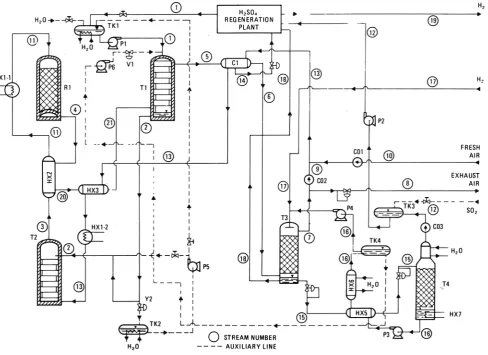
technological scale. The preparation of a technological circuit was continued for the verification of the H2S04 decomposition
under pressure and with metallic and ceramic material, on the basis of the new scheme CRISTINA, i.e. a flow sheet for the
decomposition of sulfuric acid when the heat transfer is obtain-ed by mixing the gas with hot air, instead of heating the gas throught heat exchangers. This new scheme simplifies the pro-blems of construction materials, decreasing the investment costs for the plant.
The most important effort of the Programme, also from the point of view of the budgest, is now concentrated on the con-struction of this technological experiment. The objective is (i) the demonstration of the feasibility of the improved scheme for the thermal decomposition of sulfuric acid, eliminating most of the metallic heat exchangers with the use of direct, hot air for the heat transfert, and (ii) the experimental definition of the most important technological parameters useful for the design of an industrial pilot plant and for more accurate techno-economic assessment of the process.
Thé design and the orders for all devices of the experiment were made, and the first components were already delivered: instruments for control and regulation, compressor, some mechanical parts.
In the design of the closed, complete circuit the chemical sec-tion for the thermal concentrasec-tion and decomposisec-tion of H2S04 has to be coupled, to close the circuit, with a section for
the regeneration of sulfuric acid and the hydrogen production. For this step, that is the synthesis of H2S04 from S02, it was
decided to use the electrochemical oxidation corresponding to the Mark 11 cycle. For this electrochemical step it will be used
~@1
W^~
Ί®
¡P6
ψψ-—
—
J
"o"
H,0
^
1_
·« T—4- ρ . |
STREAM NUMBER P3 C i Oj)
[image:6.595.53.542.393.748.2]AUXILIARY LINE
Fig. 2. Cracking tower
the cell which is studied, and in construction, in the frame of
the contracts of the Indirect Action, using the technique of the
three compartments cell developed at the level of laboratory by
KFAJülich, also within the R and D Programme of the In
direct Action.·
The nominal capacity of the facility is 10 Nm
3H
2/hr, with a
pressure of 25 bars, and a total electric input of about 100 KW,
The flowsheet calculations have been completed, with all
chemistry and thermodynamic data, and the evaluation of
mass and energy balance.
The chemical engineering and mechanical design of all the
equipment is complete; with the new concept for H
2S0
4decomposition it is possible the use of construction materials
actually available for conventional technology. In some cases,
difficulties were found for the mechanical design of the high
temperature apparati due to their small size: this is the case for
the installation of refractory bricks, even if this a well known
technique, largely used in industrial plants.
Particular attention was given to the instrumentation, for
measurements of temperature, pressure, gas and liquid flows,
chemical analysis (automatic and on line when possible). The
process control was also particularly studied, with a computer
assistance specially studied. A full dedicated mini computer
will give assistance to the operator with calculations, extrapola
tions, graphic representations, etc. Operators will be in an
isolated control room, and a sulphur products monitoring
system will give information on possible release of chemicals.
The engineering study of the circuit was devoted, during the
reporting period, to the design of the detailed layout of the
plant, for the parts internal and external to the explosion proof
building. On the basis of the general layout, all particulars of
the piping were designed; for each of the 64 lines of the flows, a
complete definition, and specification, was made for all the
necessary process components, as valves, filters, etc.
It was also prepared, for all the flow lines, an assonometric
sketch in such a way to allow the preconstruction of all parts in
the workshop. All these elements are considered for the com
plete evaluation of the cost, the delivery time, and the time for
construction. With the completion of these evaluations, at the
beginning of 1982 a decision will be taken for the sections of
the plant whose construction is compatible with the budgetary
and timing limitations.
It has be mentioned that the facility has been conceived with
some flexibility: the circuit, or part of it, could eventually be
used, or adapted, to test components (heat exchanger, cracking
tower) studied in other laboratories working in the same fields,
or active in similar problems. In fact, the infrastructure which
will be available is: an explosion proof building with two
separate zones, an electrical heating loop up to 150 K We work
ing at 950°C and 25 bars, a conventional and analytical in
strumentation mainly online type, a full dedicated computer
system with a 192 K byte CPU with memory management and
256 inputoutput channels, a control room, an auxiliar
chemical laboratory for monitoring. The facility is potentially
available for technological tests of several, different processes.
A parallel activity is in progress on the study of construction
materials, which are a critical and essential aspect in the
technoeconomic assessments. Tests are made in vapour phase
at high temperature (between 400 and 900°C) for S0
3cracking
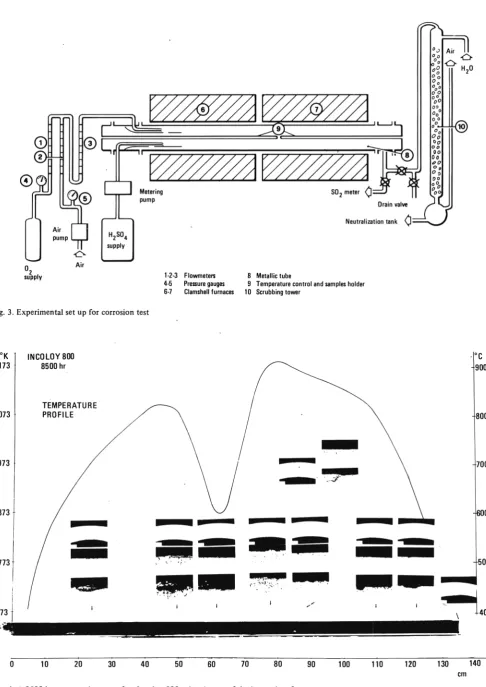
and heat exchangers. The experiment with a tube (40 mm φ) in
Incoloy 800 was stopped after 8500 hr, corresponding to about
1 year of continuous operation. The tube was cut and subdivid
ed in different sections, corresponding to the various flow
compositions and temperatures. The metallurgical analysis
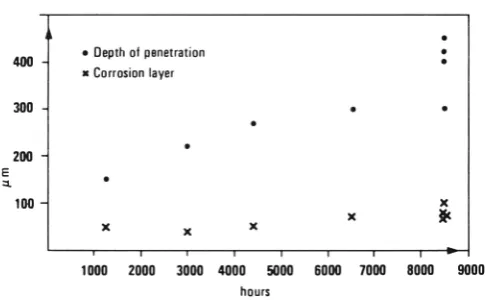
shows that, in the region corresponding to 800900°C there is
an internal corrosion with formation of oxides and sulphides.
It is interesting to note that the depth of penetration of the at
tack due to air (external surface of the tube) is not much dif
ferent from that which is observed with the addition of
sulphuric acid vapours (internal surface of the tube). From the
measurements made it appears that the sound metal loss and
consequently the corrosion allowance needed for equipment
design is about 0.5 mm/year at 900°C, and much lower for the
lower temperatures. This is therefore well acceptable for the
construction of the technological circuit, or for a pilot plant.
Air pump
° 2 ,
supply
IT
o
Air
H2S04
supply
Drain valve
Neutralization tank <Q:
1-2-3 Flowmeters 8 Metallic tube
4-5 Pressure gauges 9 Temperature control and samples holder 6-7 Clamshell furnaces 10 Scrubbing tower
Fig. 3. Experimental set up for corrosion test
[image:8.595.51.538.75.763.2]0 10 20 30 40 50 60 70 80 90
Fig. 4. A 8500 hours corrosion test of an Incoloy 800 tube. Aspect of the internal surface
100 110 120 130 140
• Depth of penetration
2 0 0
1 0 0
-x Corrosion layer
*
•
X
I I I I
χ
•
1 I 1
•
X•
•
X
1 — ■ —
1000 2000 3000 4000 5000 6000 7000 8000 9000
hours
Fig. 5. Long duration test. Data for Incoloy 800 at 800 C
1
400
-300
-200
-100
-I
• Depth of penetration
« Corrosion layer
•
•
* χ
1 1 1
•
X
1 1
•
X
1 1
•
•
•
•
X*
1 * ~ 1000 2000 3000 4000 5000 6000 7000 8000 9000
hours
Fig. 6. Long duration test. Data for Incoloy 800 at 900 °C
the 8500 hours, the metallic tube exposed to temperatures in the range from 550°C to 700°C was examined and analyzed. The corrosion remains within acceptable limits, the sound metal loss not exceeding 0.3 mm/year at the higher temperature of utilization (700°C).
In view of possible improvements for the metallic materials in the range 700900° C, tests are in progress with alloys similar to Incoloy 800 but with higher Silicon content: the positive in fluence of this element was put in evidence analyzing the behaviour of the already tested materials.
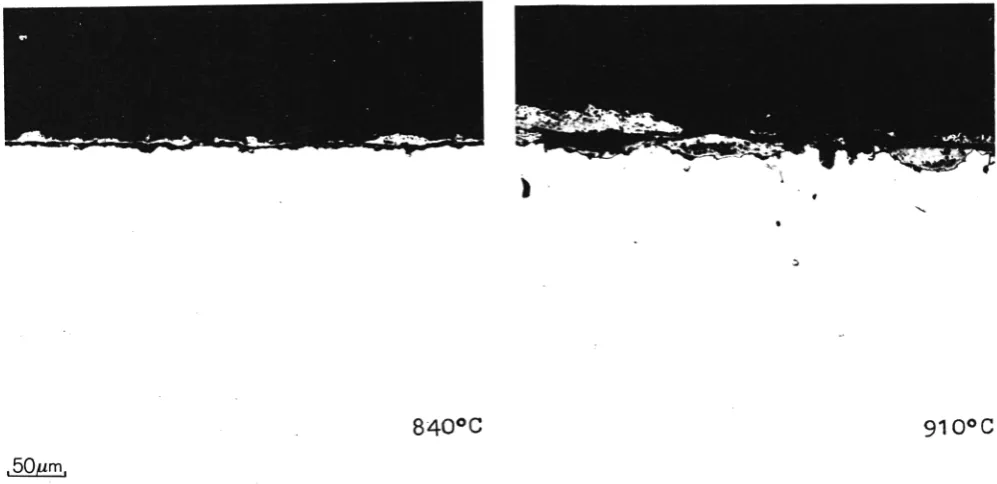
Two alloys were selected: Nieral C, produced by CreusotLoire (France) with 1.92% Si, and RA330, produced by Rolled Alloys (USA) with 1.15% Si.
Tests made with temperature up to 900°C reached 3500 hrs and 1500 hrs, respectively. The beneficial effect of the Si content on the corrosion resistance is confirmed, in the first period of ex posure to the corrosive environment, through the formation of a protective layer. This beneficial effect seems to decrease in the time: longer exposure should give an information on the stability of the protective layer. The objective of the future tests is to determine if there is an optimal concentration of the Si content in the alloys, for a better long term corrosion resistance.
Some tests were made also on the preparation of coated alloys. Among the various techniques for the formation on protective coating on various alloys, the plasma deposition process was adopted; different coatings were prepared, containing Silicon, Molibdenum, Chromium, or Titanium; the research is oriented to inprove the adherence and to decrease the porosity of the coatings obtained with plasma spray.
Other complementary activities in the field of thermochemical processes are those related to the electrochemical decomposi tion of HBr a step of the Mark 13 cycle. The cell tested in a first run, working in a monopolar mode, was inspected and all mechanical parts were found in perfect conditions. The cell was remounted with one more electrode of 248 cm2 and the
tests will continue to measure the performance with the cell working in bipolar mode.
The endurance tests on graphite anodes continued, on the four types of graphite produced by SIGRI (Germany), reaching in one case more than 14000 hours; so far these graphites are suf ficiently corrosion resistant.
Studies were also made on the possibility to improve the per formance of the HBr cell. The influence of depolarizing agents on the anode potentials was investigated.
Seven reagents were tested and the more promising results, with a decrease in the cell voltage, were obtained using Cu +
and Fe + + salts; tests will be continued particularly with Iron.
Another way which is investigated to improve the performance of the cell is the operation of the electrochemical decomposi tion of HBr at temperatures above 373 Κ and under pressure without adding other chemical elements. The preliminary results are encouraging but not yet sufficient to decide what is the best solution.
It has to be mentioned an important fallout of the research on thermochemical Hydrogen: two of the chemical reactions of Mark 13 cycle (reaction of bromine with S 02 and elec
trochemical decomposition of HBr) are well suitable as flue gas desulphurization process (patent pending).
This new process offers several advantages when compared to the current ones. It does not produce the huge amounts of valueless, disposable products, as are produced in the current throwaway processes, such as lime and limestone scrubbing. The sulphuric acid produced is of high concentration and is directly produced in one single reaction step.
No additional thermal regeneration steps are required. The internal regeneration of bromine by HBr electrolysis pro duces a considerable stream of pure hydrogen, which is a very valuable byproduct of the process.
No solid materials or slurries are required as reactants. Reaction rates are high and will probably only be diffusion controlled, so that reactors of relatively small dimensions can be utilized.
A small scale demonstration plant was installed for the power station of the Centre and will give information on the opera tion in real conditions.
Project 2. Advanced Studies on Energy Carriers
The project is dealing with studies in different directions and in exploratory ways, considering that the activities started only recently and we are in a transition phase, engaging at present a rather limited effort. The evolution of the research should put in evidence the fields which are more promising, and where there are more important needs. The various orientations of the studies are here reported.
[image:9.595.55.297.92.194.2] [image:9.595.56.299.249.399.2]840°C 910°C
[image:10.595.50.546.90.323.2],δΟμηι,
Fig. 7. Optical micrographs of cross sections of samples of Nieral C corroded for 3500 hours in H, S0
4decomposition products
840°C 910° C
.δΟμιτι.
Fig. 8. Optical micrographs of cross sections of samples of RA 330 corroded for 1500 hours in H, SO„ decomposition products
conia solid electrolyte was completed and the result presented
at a specialized, scientific international conference. Other ex
periments were made to try to replace platinum with less expen
sive cathodic materials. Interesting results were obtained with
10% Strontium doped Lanthanum Chromite.
Another activity, in the field of thermal energy storage, is the
study of chemical latent heat storage systems. In these systems
an endothermic reaction is used to load the store and the
reversed exothermic reaction is used to restituite the stored
energy when needed.
[image:10.595.45.544.378.620.2]Fig. 9. Flue gas desulphurization, lab-scale, Mark 13 A
Fig. 10. Section of the heat flow calorimeter for the determination of the heat storage capacity of reciprocal salt pairs
Decrease in the heat storage capacity was observed in some cases, a thoroughly mixing of the heat storage material during cyclying avoids this decrease. Confirmation will be given by measurements in a technical heat storage system; the prepara-tion of this technical system in collaboraprepara-tion with DFVLR' in Stuttgart was terminated, and the tests should be performed next year.
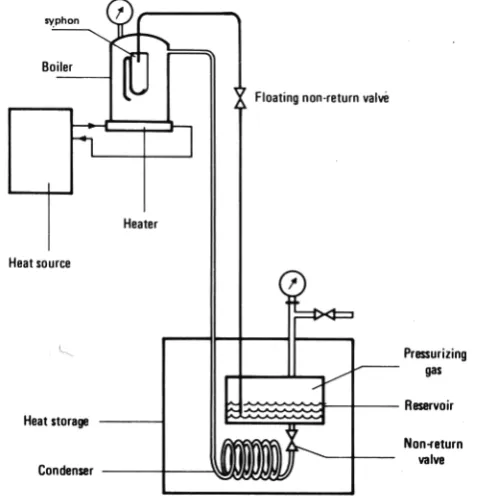
Another subject of research is the verification of the possibility of realization of a «heat transformer»,i.e. a device for chang-ing the temperature of heat in a nearly reversible way without receiving any other input that heat and without delivering anything else than heat. The basis is an idea already developed at Ispra, which makes use of gasdynamic effects and evapora-tion and condensaevapora-tion at the container walls.
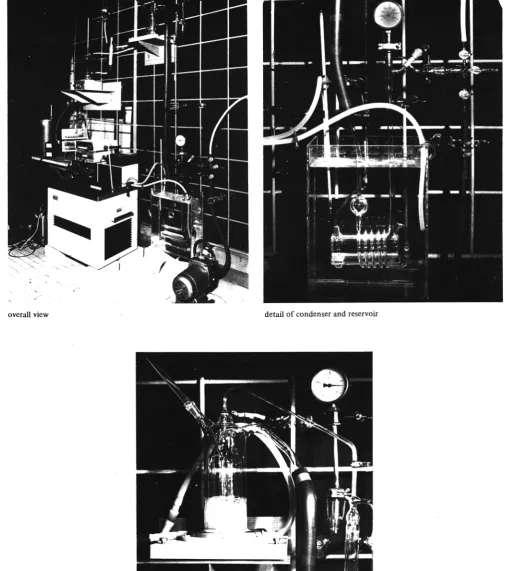
During the reporting period, an apparatus was built to measure the average radial heat transfer coefficient, an important parameter for the design of gasdynamic heat transformes. In the present design and performance codes the vapour is described by a two-phase equilibrium model, well known from classical heat pipe analysis. To avoid some inconveniences, work was started on the analysis of gasdynamic heat transformers describing the vapour by a perfect gas model·. A new idea has been found in the field of heat transfert; a system for «passive downward heat transport». This system has no moving parts, and consequently higher reliability in the operation and potentially lower cost because of the absence of certain components, as pumps and thermostats. Moreover it does not need external energy, mechanical or electric, and re-quires very reduced maintenance. The passive system can be used to heat water at a low level by the solar heat collected for instance at a roof; the collector in this case heats up only to the temperature of the storage medium and there is no back transport when the temperature of the collector is lower than that of the storage. This difference of temperature (collector-storage medium) can be as small as desired, reducing losses. The device developed at Ispra, and for which there is a patent application, is based on the following principle. Transport of heat as latent heat of vaporization, as in a heat pipe; return of the liquid obtained through the action of an energy ac-cumulator containing an inert gas and charged by the vapour itself during the transport of heat. The capability to win the difference in level is obtained with a difference of a few degrees centigrade between evaporator and condenser. A first
ex-syphon
Y Floating non-return valve
Pressurizing 9 * Heat storage
Condenser
[image:11.595.310.552.503.753.2]overall view detail of condenser and reservoir
perimental device was built and successfully operated; the dif-ference of level for this laboratory test was set at 1.7 m, the temperature range of the heat storage medium between 25 and 55°C, the fluid being methanol. The results obtained with the laboratory set-up were in complete agreement with the design conditions.
The work on this first laboratory device for the «passive downward heat transport» was presented to the IV Interna-tional Heat Pipe Conference in London (September 1981). Another unit working under pressure was designed, built and tested; first experiments were made using as working fluid Freon 11, and Helium as pressurizing gas. In these conditions it was possible to operate the device with the boiler (heat input) up to 358 K and having a difference of temperature between boiler and heat store of about 30°C, with a difference of level between boiler and heat store up to 10 m. Other fluids will be tested at higher pressure, in order to check the best achievable performances.
To avoid some possible inconveniencies, for instance the effect of small leakages in long time operation, a new system was defined (patent application 10 August 1981) and is tested: the heat is still transported as heat of evaporation/condensation but there is no more the pressurizing gas.
Other orientative studies were performed in the general field of energy storage, in order to have as much as possible informa-tion in this transiinforma-tion phase of the programme. Priorities and selections will be defined according to the evolution of the research, and of the needs in the energy systems.
Project 3. Study of Technical Systems
The activities concerning this project are in a first phase, and are limited to techno-economic assessments of technical systems for storage and transport of energy.
Various technical systems of conversion, storage and transport/transmission of energy, in the form of various «energy vectors», are studied and compared to evaluate their relative merits using two criteria. These criteria, which are bas-ed on delivery of one unit of usable energy at a given point of the economic systems are:
— cost, in «constant money» (i.e. $/GJ) and
— energy requirement (i.e. GJ/GJ).
The activity is progressing, at a limited level of effort, with the following objectiver:
(i) definition of different technical systems for supply-conversion-storage-transmission-distribution of energy (ii) preparation and test of methodologies for energy and cost
analysis
(iii) comparison of different systems.
The technical systems taken into consideration include: — as primary energy: natural gas, coal, solar, nuclear — as energy vectors: natural gas, coal, hydrogen, methanol
(ammonia)
The step «transport» of the energy (raw materials and energy vectors) is studied for all the possible forms (on-shore and
off-shore pipelines for liquids, gases and slurries, ships if liquid, solid or slurry, train, barges, etc.).
The main results are:
— the energy requirements calculated for each technical system considered;
— the comparison of technical systems; the relative merits of the systems for conventional and alternative energy vectors are put in evidence and quantified;
— identification of the steps of the technical systems, requir-ing technological improvement and for which energy sav-ings are possible;
— the recovery time of the invested energy for each technical system considered.
Concerning the computer codes, a code is under development for pipeline transmission of fuels, giving the transmission cost ($/GJ) and the net energy requirement (GJ/GJ) for optimized onshore and offshore pipelines, as a function of the annual throughput and of the transmission distance.
Another code is also under development, concerning seaborne transportation of fuels.
The codes, on a parametric basis, could be applied to any geographical situation for the technical system, allowing the study of specific european cases.
The methodologies already defined were applied to the study of technical systems for coal and for methanol. These two specific cases have to be considered as examples of application of the methodologies to systems where technologies are well known.
Concerning coal, a comparison was made for two technical systems, transmission of coal by slurry pipelines and coal transportation by trains. Results were presented at an interna-tional scientific Conference. The conditions for which one technique is more convenient than the other were calculated, both from the point of view of energy consumption and cost. Application of methodology and comparisons will be extended to many possible systems to transport energy, particularly for large quantities and over long distances. Methanol is at present considered, and the work in concentrated on the study of systems using methanol as energy carrier and natural gas, coal, biomass as primary energy.
Concerning the methanol production step, data related to the energy analysis are collected concerning three different produc-tion processes: methanol from coal, from natural gas, from coal and Non-Fossil-Derived Hydrogen.
These activities are performed in connection with many organizations and industries, due to the large amount of data which have to be collected.
In the frame of the study of technical systems another subject of study is an engineering analysis of specific thermochemical energy storage systems.
10
METHANOL from COAL ind
NFDHYDROGEN
Ü
_/J
COAL AUXILIARY STORAGE AIHSEPAR. & HANDLING PLANT
tr
^Tx
COAL PREPARATION
PLANT
^rv
METHANOL STORAGE
¿rv
^rv
^rv
(dimtntionil to illustrate not to tcalal
Fig. 13.
for the verification of the advantages and the possibility of the use of this evaluation procedure.
3. CONCLUSIONS
The evolution of the programme is following the orientation given for the multiannual 1980-83 programme, i.e. the shifting of the main effort of research from thermochemical produc-tion of hydrogen to other «energy carriers» in the general field of storage and transportation of energy. These studies could give useful contributions to the technologies related to energy storage and transport, which are becoming more and more im-portant for the valorization of new, renewable energies, and also for some aspects of energy conservation.
The first project, on thermochemical production of Hydrogen from water, is concentrated now in the design and the con-struction of a demonstration circuit representing the conclu-sion of the research phase. Within the limits of time and budget, some equipments and sections will be tested next year and a final dossier will be prepared.
The work performed at Ispra is a large part of the european research in this field and will be useful for the evaluation of the
potential of this possible new method for hydrogen produc-tion. In fact almost all activities on this research area in the EC are connected and oriented to the JRC final experiment par-ticularly the researches which are performed in the Energy R and D programme-Indirect Action (Hydrogen, Project A) managed by the Directorate General for Research and Science. Good connections and exchanges also exist with the similar, parallel cooperative action of the International Energy Agency, Energy R and D programme.
As a fall-out of the research a new process for flue gas desulphurisation was defined and tested, with good prospec-tives for applications.
11
The second project is in a first, preliminary period and
ex-ploratory researches, based on competences previously
developed at the JRC, would bring new ideas on some
advanc-ed studies concerning the energy storage and transportation.
Some main orientations are in phase of definition and are
generally in connection with similar activities in progress in
various laboratories.
The third project, study of technical systems, will give a
con-tribution to selections and decisions concerning different
systems for solving the problems of converting and
transpor-ting energy, in large quantities and over long distance, and of
storing thermal energy.
Salgs- og abonnementskontorer · Vertriebsbüros · Sales Offices
Bureaux de vente · Uffici di vendita · Verkoopkantoren
Belgique - België
Moniteur belge — Belgisch Staatsblad
Rue de Louvain 4 0 4 2 -Leuvensestraai 4 0 - 4 2
1 0 0 0 Bruxelles - 1 0 0 0 Brussel Tél. 5 1 2 0 0 2 6
CCP 0 0 0 - 2 0 0 5 5 0 2 - 2 7 Postrekening 0 0 0 - 2 0 0 5 5 0 2 - 2 7
Sousdépôts — Agentschappen:
Librairie européenne — Europese Boekhandel
Rue de la Loi 2 4 4 - Wetstraat 2 4 4 1 0 4 0 Bruxelles - 1 0 4 0 Brussel
F r a n c e
Service de vente en France des publica
tions des Communautés européennes
Journal officiel
2 6 , rue Desaix 7 5 7 3 2 Paris Cedex 15
Tél. (1) 5 7 8 6 1 3 9 - CCP Paris 2 3 - 9 6
Sousdépôt
D.E.P.P.
Maison de l'Europe 3 7 , rue des Francs-Bourgeois 7 5 0 0 4 Paris
Tél. 8 8 7 9 6 5 0
N e d e r l a n d
Staatsdrukkerij en uitgeversbedrijf
Christoffel Plantijnstraat. 's-Gravenhage Tel. (070) 62 4 5 5 1
Postgiro 42 5 3 0 0
U n i t e d K i n g d o m
HM. Stationery Office
P.O. Box 5 6 9 London SE1 9 N H
Tel. 101) 9 2 8 6 9 7 7 , ext. 3 6 5 National Giro Account 5 8 2 - 1 0 0 2
CREDOC
Rue de la M o n t a g n e 3 4 - Bte 1 1 Bergstraat 3 4 - Bus 11
1 0 0 0 Bruxelles - 1 0 0 0 Brussel
D a n m a r k
J.H. Schultz Boghandel
Møntergade 1 9 1 1 1 6 København K Tlf. (01) 14 11 9 5 Girokonto 2 0 0 1 1 9 5
Underagentur:
Europa Bøger G a m m e l Torv 6 Postbox 137 1 0 0 4 København K Tlf. 101) 14 5 4 3 2
B R D e u t s c h l a n d
Ver/ag Bundesanzeiger
Breite Straße - Postfach 10 8 0 0 6 5 0 0 0 Köln 1
Tel. 10221) 2 1 0 3 4 8 (Fernsc reiber: Anzeiger Bonn 8 8 8 2 5 9 5 )
Postscheckkonto 8 3 4 0 0 Köln
I r e l a n d
Government Publications
Sales Office G.P.O. Arcade Dublin 1
or by post f r o m
Stationer/ Office
Dublin 4 Tel. 7 8 9 6 4 4
Italia
Libreria dello Stato
Piazza G. Verdi 10
0 0 1 9 8 Roma - Tel. (6) 8 5 0 8 Telex 6 2 0 0 8
CCP 3 8 7 0 0 1
Agenzia
Via XX Settembre
(Palazzo Ministero del tesoro) 0 0 1 8 7 Roma
G r a n d - D u c h é d e L u x e m b o u r g
Office des publications officielles
des Communautés européennes
5. rue du Commerce
Boîte postale 1 0 0 3 - Luxembourg Tél. 4 9 0 0 8 1 - CCP 1 9 1 9 0 - 8 1 Compte courant bancaire: B1L 8 - 1 0 9 / 6 0 0 3 / 3 0 0
U n i t e d S t a t e s o f A m e r i c a
European Community Information
Service
2 1 0 0 M . S t r e e t . N.W. Suite 7 0 7
W a s h i n g t o n . D.C. 2 0 0 3 7 Tel. (202) 8 6 2 9 5 0 0
S c h w e i z - S u i s s e - S v i z z e r a
Librairie Payot
6, rue Grenus 1 2 1 1 Genève Tél. 3 1 8 9 5 0
CCP 1 2 - 2 3 6 Genève
S v e r i g e
Librairie CE. Fritze
2. Fredsgatan Stockholm 1 6
Postgiro 1 9 3 . Bankgiro 7 3 / 4 0 1 5
España
Libreria MundiPrensa
Castellò 3 7 M a d r i d 1 Tel. 2 7 5 4 6 5 5
A n d r e l a n d e · A n d e r e L ä n d e r · O t h e r c o u n t r i e s · A u t r e s p a y s · A l t r i p a e s i · A n d e r e l a n d e n
Kontoret for De europæiske Fællesskabers officielle Publikationer ■ Ami für amiliche Veröffentlichungen der Europäischen Gemeinschaften - Office for Official Publications of lhe European Communities ■ Office des publications officielles des Communautés européennes ■ Ufficio delle pubblicazion
ufficiali delle Comunità europee · Bureau voor officiële publikalies der Europese Gemeenschappen