http://dx.doi.org/10.4236/ojanes.2013.31007 Published Online January 2013 (http://www.scirp.org/journal/ojanes)
Thromboelastography: Current Applications, Future
Directions
Linda M. Trapani
The Brooklyn Hospital Center, Brooklyn, USA. Email: [email protected]
Received October 20th, 2012; revised November 25th, 2012; accepted December 20th, 2012
ABSTRACT
Analyzing coagulability often hinges on patient surveillance using prothrombin time (PT) or international normalized ratio (INR) and activated partial thromboplastin time (aPTT) to monitor the extrinsic and intrinsic coagulation pathways, respectively A more complete assessment, however, can often be obtained using thromboelastography (TEG), a coagula-tion assay that evaluates the efficiency of clot formacoagula-tion, as well as the viscoelastic properties of the clot. Developed by Dr. Helmut Hartert in 1948 at the University of Heidelberg, it provides information regarding hemostasis as a dynamic proc-ess [1,2]. Here, the TEG technique will be described, as well as its current applications and future directions for its use.
Keywords: Thromboelastography; Rotational Thromboelastometry; Cardiopulmonary Bypass; Coagulation Index; Adenosine Diphosphate; Prothrombin Time; Partial Thromboplastin Time; International Normalized Ratio
1. Introduction
The coagulation cascade is a highly regulated process relying on both the enzymatic activity of clotting factors as well as proper platelet structure and function. Several factors influence the function of platelets, including ade- nosine diphosphate (ADP), epinephrine, collagen and thrombin [2]. Routine coagulation assays, such as aPTT and PT, are not performed on whole blood; rather, these tests are performed only on plasma. Thus, the contribu-tion of platelets to clot strength and formacontribu-tion is not con-sidered. While PT and aPTT are often suitable tests for monitoring disorders of blood coagulation and medica-tions used to treat these disorders, they provide an overly- simplistic view of global coagulation characteristics, par-ticularly in critically ill patients. The impact of platelet function- or lack thereof-on clotting homeostasis can be crucial for intraoperative decision-making, especially re- garding the need to transfuse blood products and clotting factors.
2. Method
2.1. Performing the Technique
In classical TEG, a small cuvette of blood is slowly ro-tated through an arc of about 4.75 degrees, six times per minute, to imitate sluggish venous flow and activate co-agulation. A thin wire probe is immersed in the moving cuvette; a clot begins to form between the probe and the side of the cuvette. The strength of the clot, as well as a
variety of other parameters, are measured over time. In rotational thromboelastometry (ROTEM), the cuvette containing blood is stationary, and the wire probe oscil-lates; the clot impedes movement of the probe and per-mits measurement of several variables [2].
2.2. Variables Analyzed
Variables of interest in TEG or ROTEM include maxi-mum amplitude (MA, measured in mm), a reflection of clot strength; reaction time (R, measured in sec), the time until there is first evidence of clot; clot kinetics (K, measured in sec), or the time from R until the clot reaches 20 mm; , an angular measurement from a tan-gent line drawn to the curve of the TEG tracing starting from the point of clot reaction time; coagulation index (CI, measured in dynes/sec), a description of a patient’s global coagulable state derived from
CI 0.2454R0.0184K0.1655MA0.02415.0220[3].
Figure 1. Normal TEG tracing, depicting rate of formation and degradation of clot, as well as the MA, R, α and K.
coagulation factor production or qualitative dysfunction of coagulation factors, as well as the presence of heparin. Decreases in MA reflect platelet dysfunction or throm-bocytopenia, whereas an increased MA. Conversely, in-creases in MA, coupled with decreased R, are suggestive of a hypercoagulable state [2].
2.3. Sample Modifications
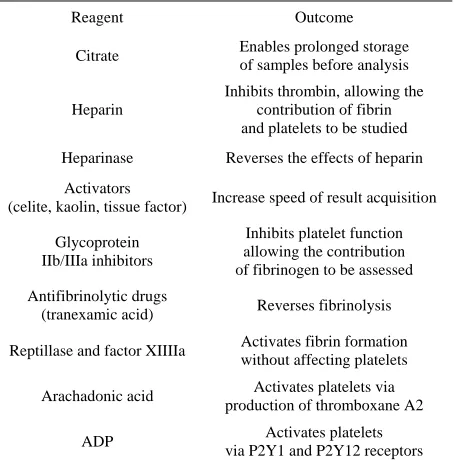
Recently, modifications to the TEG sample have im-proved ease of sample handling and removed the neces-sity of performing the test promptly after sample collec-tion. These modifications also allow specific areas of the TEG assessment to be parsed out while controlling other patient variables (Table 1). With these modifications to TEG, ex vivo analysis of various therapies can be PER-FORMED USING the patient’s blood to permit efficient titration to therapeutic levels. For example, by adding arach- adonic acid to a sample, one can focus on the pathway affected by aspirin, thereby analyzing the dose needed to observe inhibition of the pathway and benefit the patient. Isolation of the pathway by which clopidogrel exerts its therapeutic effect is achieved by adding ADP to the sam-ple [1].
Despite the impressive advances in TEG technology, there remain notable pitfalls to the widespread use of this test. Due to variability in the glycoprotein (GP) IIb/IIIa receptor number expressed by each person, platelet number and function, and fibrinogen concentration, a normal TEG value for one person may represent a de-rangement in another. Thus, a baseline TEG is an impor-tant first-step for any patient for whom TEG monitoring will be used [1]. This fact alone has enormously limited its practical use, as standardization and validation of a “normal” value has proven challenging [1,3,4].
While the advent of additive reagents and computer software implementation have greatly improved the standardization of samples before and during analysis, TEG remains a test best used to assess changes in global coagulative function over time in patients for whom a baseline is available [4].
Table 1. Modifications to TEG permit study of specific pa-tient variables (From A. R. Hobson, R. A. Agarwala, R. A. Swallow, K. D. Dawkins and N. P. Curzen, “Thrombelasto-graphy: Current Clinical Applications and Its Potential Role in Interventional Cardiology,” Platelets, Vol. 17, No. 8, 2006, pp. 509-518.)
Reagent Outcome
Citrate Enables prolonged storage of samples before analysis
Heparin
Inhibits thrombin, allowing the contribution of fibrin and platelets to be studied
Heparinase Reverses the effects of heparin
Activators
(celite, kaolin, tissue factor) Increase speed of result acquisition
Glycoprotein IIb/IIIa inhibitors
Inhibits platelet function allowing the contribution of fibrinogen to be assessed
Antifibrinolytic drugs
(tranexamic acid) Reverses fibrinolysis
Reptillase and factor XIIIIa Activates fibrin formation without affecting platelets
Arachadonic acid Activates platelets via production of thromboxane A2
ADP Activates platelets via P2Y1 and P2Y12 receptors
3. Current Applications
The application and development of this method of blood analysis has evolved based heavily on the needs of the modern anesthesiologist.
3.1. Liver Transplantation
The liver is the major site of clotting factor production and as such, acute and chronic liver failure can contribute to a hypocoagulable state. Thrombocytopenia, due to disseminated intravascular coagulation (DIC) or hyper-splenism, can compound this coagulation factor defi-ciency. Azotemia stemming from hepatorenal syndrome can further aggravate an existing platelet deficiency by causing qualitative platelet dysfunction [5].
[image:2.595.310.537.153.384.2]trans-planted liver resumes its synthetic capabilities [2,5]. Ultimately, the benefit of TEG in liver transplant is clear: it has been shown to reduce transfuse requirements, even in this population in which transfusion is a mainstay of intraoperative therapy, by quantifying the exact need of platelets and coagulation factors [6].
3.2. Cardio-Pulmonary Bypass Surgery
Extracorporeal circulation causes platelet dysfunction, coagulation factor activation and ultimately, coagulation factor depletion by passing blood through plastic or metal surfaces, permitting fibrinogen and von Willebrand Factor (vWF) adherence. Platelets can subsequently ad-here to these substances, activating the coagulation cas-cade and causing thrombus formation [1,2,7]. Further, the procedure itself can cause clotting derangement: dis-ruption of the endothelium exposes tissue factor, and activates the extrinsic coagulation cascade, while surgery itself induces inflammation, activating platelets [1]. As a result, cardiac surgery patients receive large doses of heparin during bypass to avoid thrombus formation [1]. The dose is so large that it exceeds the capability of aPTT to monitor coagulation in these patients; while many physicians monitor patients on cardio-pulmonary bypass (CPB) using activated clotting time (ACT), this assay provides only a fragment of the global coagulative function [1,2]. TEG permits assessment of coagulation both in the presence of heparin as well as in isolation of it, ultimately improving the specificity of blood products selected, reducing the amount of blood transfused—and even the number of patients receiving transfusion [1,2,8]. Moreover, TEG also provides temperature-specific in-formation, crucial in the setting of CPB, given that the patient’s temperature is substantially cooler than normal [8].
3.3. Obstetrics
Up to 8% of healthy pregnant women exhibit some de-gree of thrombocytopenia; given the extent of screening in this population, it is not surprising that even modest, asymptomatic thrombocytopenic states are detected [9]. Though often not a cause of a marked changes in coagu-lation, platelet counts remain a major factor in obstetric anesthesia decisions. TEG is being more-routinely used to predict the risk of morbidity following epidural place- ment [1]. It can also be used to differentiate the physiol- ogic hypercoagulable state often observed in pregnancy coagulation screening from pre-eclampsia and HELP syndrome [1]. TEG may play an important role in post- partum hemorrhage by helping clinicians rapidly identify and treat exactly the deficiency in question. This is im- portant not only from a patient care perspective, but also
as a means of preserving precious blood product re-sources [10].
4. Future Directions
4.1. Cardiology
The applications of TEG are ever expanding. In the area of cardiology, the use of TEG has expanded into moni-toring of patients on antithrombotic therapy, such as GP IIb/IIIa antagonists or aspirin [1,11]. Given the immense variability in ADP receptor expression through the spe-cies, TEG is particularly useful in patients who appear to be “non-responders” to anti-thrombotic therapy as it per- mits ex vivo optimization of treatment [11,12]. The platelet mapping assay, a modification of TEG using some of the reagents in Table 1, may be useful for pre-dicting blood loss in patients who underwent CPB [13]. This could help clinicians sooner activate massive trans-fusion protocols whilst helping to reduce blood product waste.
4.2. Neonatology and Pediatrics
CPB, fewer neonates required plasma transfusions intra-operatively [18], a significant finding considering the increased risk of acute lung injury associated with plasma transfusion in both adult and pediatric patients. Further, TEG monitoring appeared to permit early identi-fication of neonatal patients at-risk for post-operative mediastinal bleeding, guiding hemostatic management in this population that is particularly sensitive to volume overload [19].
4.3. Trauma
TEG may also have a unique role in trauma assessment. Acute traumatic coagulopathy (ATC) is a devastating consequence of traumatic injury stemming from tissue damage and systemic hypoperfusion [20,21]. Early, ag-gressive resuscitation with fresh frozen plasma and other blood products is paramount to these patients’ survival [22]. Given its unique ability to assess whole blood, TEG is ideal for rapidly identifying patients with ATC and subsequently activating massive transfusion protocols, providing these patients with the chance of a better out-come [20]. TEG has further been used to identify the mechanism of platelet dysfunction in traumatic brain injury (TBI) that of ADP receptor inhibition [21]. While the cause for this inhibition remains unknown, early identification of this state may contribute to successful treatment of coagulopathy associated with TBI in the future [21].
5. Conclusion
Though TEG has been in existence for over 60 years, its potential contributions to medicine are just beginning to be realized. Now a point of care test, this whole blood method of coagulation monitoring rapidly provides a wealth of information beyond traditional, plasma-based assays. As further data become available with regard to reference values and standardization, the use of TEG is certain to become more widespread.
REFERENCES
[1] A. R. Hobson, R. A. Agarwala, R. A. Swallow, K. D. Dawkins and N. P. Curzen, “Thrombelastography: Cur-rent Clinical Applications and Its Potential Role in Inter-ventional Cardiology,” Platelets, Vol. 17, No. 8, 2006, pp. 509-518. doi:10.1080/09537100600935259
[2] M. Kroll, “Thromboelastography: Theory and Practice in Measuring Hemostasis,” Clinical Laboratory News, Vol. 36, No. 12, 2010, pp. 8-10.
[3] R. M. Edwards, B. J. Naik-Mathuria, A. N. Gay, O. O. Olutoye and J. Teruya, “Parameters of Thromboelasto-graphy in Healthy Newborns,” American Journal of Cli- nical Pathology, Vol. 130, No. 1, 2008, pp. 99-102. doi:10.1309/LABNMY41RUD099J2
[4] Y. Dai, A. Lee, L. A. Critchley and P. F. White, “Does Thromboelastography Predict Postoperative Thromboem- bolic Events? A Systematic Review of the Literature,” Anesthesia & Analgesia, Vol. 108, No. 3, 2009, pp. 734- 742. doi:10.1213/ane.0b013e31818f8907
[5] C. G. Krenn and A. M. De Wolf, “Current Approach to Intraoperative Monitoring in Liver Transplantation,” Cur- rent Opinion in Organ Transplantation, Vol. 13, No. 3, 2008, pp. 285-290.
doi:10.1097/MOT.0b013e3283005832
[6] R. J. McCarthy, K. J. Tuman, B. Chen and A. D. Ivank-ovich, “Platelet Integrin Inhibition with c7E3 Enhances the Correlation between Platelet Aggregometryand Throm- belastograph®(TEG[®]) MA Values,” Anesthesia & An-algesia, Vol. 86, 1998, p. S219.
doi:10.1097/00000539-199802001-00217
[7] A. B. Gelb, R. I. Roth, J. Levin, M. J. London, R. A. Noall, W. W. Hauck, M. Cloutier, E. Verrier and D. T. Mangano, “Changes in Blood Coagulation during and Following Cardiopulmonary Bypass: Lack of Correlation with Clinical Bleeding,” Journal of Clinical Pathology, Vol. 106, No. 1, 1996, pp. 87-99.
[8] L. Shore-Lesserson, H. E. Manspeizer, M. DePerio, S. Francis, F. Vela-Cantos and M. A. Ergin, “Thromboelas-tography-Guided Transfusion Algorithm Reduces Trans-fusions in Complex Cardiac Surgery,” Anesthesia & An-algesia, Vol. 88, No. 2, 1999, pp. 312-319.
doi:10.1097/00000539-199902000-00016
[9] R. A. Kadir and C. McLintock, “Thrombocytopenia and Disorders of Platelet Function in Pregnancy,” Seminars in Thrombosis and Hemostasis, Vol. 37, No. 6, 2011, pp. 640-652. doi:10.1055/s-0031-1291374
[10] O. Onwuemene, D. Green and L. Keith, “Postpartum He- morrhage Management in 2012: Predicting the Future,” International Journal of Gynecology & Obstetrics, Vol. 119, No. 1, 2012, pp. 3-5. doi:10.1016/j.ijgo.2012.07.001 [11] J. H. Waters, D. G. Anthony, A. Gottlieb and J. Sprung,
“Bleeding in a Patient Receiving Platelet Aggregation In-hibitors,” Anesthesia & Analgesia, Vol. 93, No. 4, 2001, pp. 878-882. doi:10.1097/00000539-200110000-00015 [12] L. Bochsen, B. Wiinberg, M. Kjelgaard-Hansen, D. A.
Steinbrüchel and P. I. Johansson, “Evaluation of the TEG Platelet Mapping Assay in Blood Donors,” Thrombosis Journal, Vol. 5, 2007, p. 3. doi:10.1186/1477-9560-5-3 [13] N. S. Weitzel, L. B. Weitzel, L. E. Epperson, A.
Karim-pour-Ford, Z. V. Tran and T. Seres, “Platelet Mapping as Part of Modified Thromboelastography (TEG) in Patients Undergoing Cardiac Surgery and Cardiopulmonary By-pass,” Anesthesia & Pain Management, Vol. 67, No. 10, 2012, pp. 1158-1165.
doi:10.1111/j.1365-2044.2012.07231.x
[14] H. W. Grant and G. P. Hadley, “Prediction of Neonatal Sepsis by Thromboelastography,” Pediatric Surgery In-ternational, Vol. 12, No. 4, 1997, pp. 289-292.
doi:10.1007/BF01372152
British Journal of Anaesthesia, Vol. 105, No. 6, 2010, pp. 827-835. doi:10.1093/bja/aeq258
[16] T. Haas, N. Spielmann, J. Mauch, C. Madjdpour, O. Speer, M. Schmugge and M. Weiss, “Comparison of Thromboe-lastography (ROTEM®) with Standard Plasmatic Coagu-lation Testing in Paediatric Surgery,” British Journal of Anaesthesia, Vol. 108, No. 1, 2012, pp. 36-41.
doi:10.1093/bja/aer342
[17] M. Radicioni, D. Mezzetti, A. Del Vecchio and M. Motta, “Thromboelastography: Might Work in Neonatology Too?” Journal of Maternal-Fetal and Neonatal Medicine, Vol. 25, No. S4, 2012, pp. 10-13.
doi:10.3109/14767058.2012.714996
[18] B. S. Romlin, H. Wahlander, H. Berggren, M. Synnergren, F. Baghaei, K. Nilsson and A. Jeppsson, “Intraoperative Thromboelastography Is Associated with Reduced Trans- fusion Prevalence in Pediatric Cardiac Surgery,” Anesthe-sia & AnalgeAnesthe-sia, Vol. 112, No. 1, 2011, pp. 30-36. doi:10.1213/ANE.0b013e3181fe4674
[19] S. Moganasundram, B. J. Hunt, K. Sykes, F. Holton, K. Parmar, A. Durward, I. A. Murdoch, C. Austin, D.
Ander-son and S. M. Tibby, “The Relationship among Throm-boelastography, Hemostatic Variables, and Bleeding after Cardiopulmonary Bypass Surgery in Children,” Anesthe-sia & AnalgeAnesthe-sia, Vol. 110, No. 4, 2010, pp. 995-1002.
[20] R. Davenport and S. Khan, “Management of Major Trau- ma Haemorrhage: Treatment Priorities and Controversies,” British Journal of Anaesthesia, Vol. 155, No. 5, 2011, pp. 537-548. doi:10.1111/j.1365-2141.2011.08885.x
[21] P. K. Davis, H. Musunuru, M. Walsh, R. Cassady, R. Yount, A. Losiniecki, E. E. Moore, M. V. Wohlauer, J. Howard, V. A. Ploplis, F. J. Castellino and S. G. Thomas, “Platelet Dysfunction Is an Early Marker for Traumatic Brain Injury-Induced Coagulopathy,” Neurocritical Care, 2012. doi:10.1007/s12028-012-9745-6