Performance Enhancement of SOVA Based Decoder in
SCCC and PCCC Schemes
Ahmed A. Hamad
Department of Electrical Engineering, University of Babylon, Babel, Iraq. Email: [email protected]
Received October 13th, 2012; revised November 20th, 2012; accepted December 9th, 2012
ABSTRACT
This study proposes a simple scaling factor approach to improve the performance of parallel-concatenated convolu-tional code (PCCC) and serial concatenated convoluconvolu-tional code (SCCC) systems based on suboptimal soft-input soft-output (SISO) decoders. Fixed and adaptive scaling factors were estimated to mitigate both the optimistic nature of a posteriori information and the correlation between intrinsic and extrinsic information produced by soft-output Viterbi (SOVA) decoders. The scaling factors could be computed off-line to reduce processing time and implementation com-plexity. The simulation results show a significant improvement in terms of bit-error rate (BER) over additive white Gaussian noise and Rayleigh fading channel. The convergence properties of the suggested iterative scheme are assessed using the extrinsic information transfer (EXIT) chart analysis technique.
Keywords: Turbo Codes; SOVA; SCCC; Scaling Factor; EXIT
1. Introduction
Since the invention of turbo codes [1], a considerable interest had been devoted to reduce the complexity of the optimum MAP [2] decoding algorithm. This is to comply with the excessive need for low-power and low-cost de-coder chips that are used in wireless mobile devices that pervade in recent years. The log-MAP, max-log-MAP, and SOVA algorithms [3-5] are some of the examples proposed for this target. The reduction in complexity that is achieved by near optimum algorithms like SOVA is accompanied by degradation in performance in terms of bit error rate.
Several papers have looked into the reasons behind the degradation in performance of these practical turbo-de- coding algorithms, especially the one based on SOVA relative to the MAP algorithm [6-12]. A conviction has been created that the reason behind this degradation is the overestimation of reliability values generated by the SOVA decoder compared by those that would have been produced by the MAP decoder. It has been suggested in some of those papers that this optimistic extrinsic infor-mation may be due to the relatively high correlation be-tween the intrinsic and extrinsic information [6]. As a result, various approaches were suggested to improve the performance of SOVA. Fixed and adaptive scaling fac-tors are the more conventional approaches that are used to alleviate the distortion of the extrinsic information produced by SOVA [11].
This study proposes a simple approach for dealing with the exaggerated reliability values and the excessive correlation between the intrinsic and extrinsic informa-tion produced by the SOVA decoder. The suggested rem-edy is based on mathematical statistics, and it involves using two scaling factors, one is applied to the a-poste- riori soft-output information of the SOVA and another is applied to the extrinsic information before it passes to the other decoder component in the iterative decoding pro- cess.
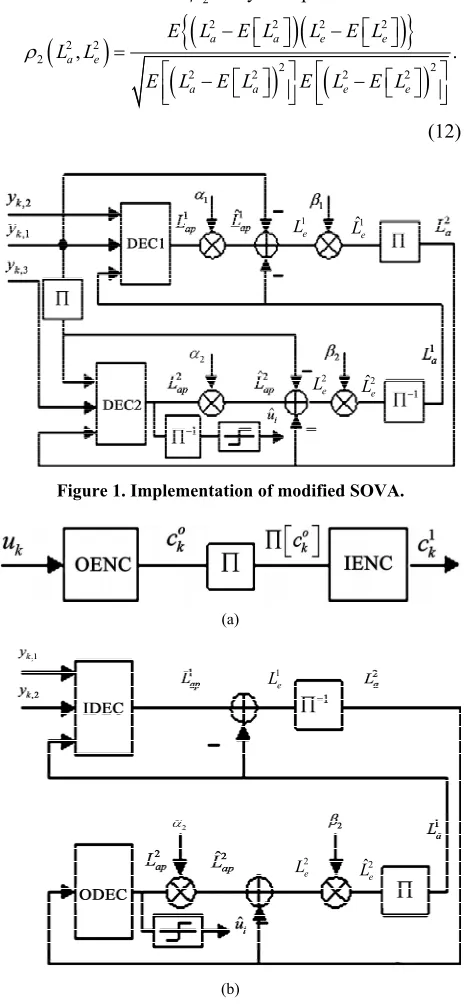
It is worth mentioning that the proposed approach could be applied to both SCCC and PCCC schemes based on MAP, log-MAP, max-log-MAP and SOVA decoders and it has almost the same complexity as that of the conven-tional schemes, which makes it quite attractive. The nu-merical results show that the turbo decoding algorithm based on SOVA that employs the proposed scaling fac-tors can achieve a better performance compared to the one that does not employ scaling factors.
2. Improved SOVA
2.1. PCCC Scheme
In this work, it has been suggested that the turbo code consists of two recursive systematic convolutional codes (RSC) joined by an interleaver.
Let u
u u1, , ,2 uk
where , is the binaryinformation sequence. The modulated symbols corre-
0,1
sponding to the coded bits are as follows
1,1, 1,2, 1,3, , k,1, k,2, k,3 c c c c c c c
,
where , assuming binary phase shift keying
modulation is applied. The noisy received sequence at the channel output is
1, 1c
1,1, 1,2, 1,3, , k,1, k,2, k,3 y y y y y y y
and it is given by;
, , , , 1, 2,3
k i k i k i k i
y d c i (1)
where dk i, is the fading magnitude, and k i, is
addi-tive noise modeled as Gaussian with zero mean and variance No 2 (the two-sided power spectral density of
the Gaussian channel). When the simulation is used over the additive white Gaussian channel (AWGN), k i, is 1,
while it is a Rayleigh random variable for the case of a Rayleigh flat-fading channel. It is assumed that coherent
detection with a perfect estimation of is present at
the receiver.
d
, k i
d
To avoid extra complexity when using the MAP algo-rithm, the SOVA decoder is proposed. Actually, SOVA has two essential modifications (over the conventional Viterbi Algorithm) which allows it to be used as a com-ponent decoder for turbo codes [4,13]. Firstly, the path metrics used are modified to take account of a-priori in-formation when selecting the maximum likelihood path through the trellis. Secondly, the algorithm is modified so that it provides a soft output in the form of the a-posteriori LLR ( ap) for each decoded bit. After each
iteration, the LLR for first decoder ( ) can be
repre-sented as [14]
L
ap
L
,1
ap c k a e
L L y L L (2) where L yc k,1 is the received systematic symbol scaled
by the reliability of the channel Lc ( c 4 b
o
E L dr
N
,
which can be set to 1 for SOVA [15]), where r is the rate
of the code, b is the energy per information bit, and
is the a priori information achieved by interleaving () or deinterleaving ( ) of the extrinsic information
e produced by the other decoder. For the first decoder
(DEC1), , whereas for second decoder
E
1 a
L a L L 1 2 e L 1 2 1
L L
(DEC2), a e .
To improve the reliability of ap for practical
decod-ers like SOVA, two scaling factor
L 1
and 2 are
pro-posed. The scaled Lap is given by
ˆj j 1, 2.
ap j ap
L L j (3) The values of 1 and 2 are derived based on the minimum mean-square error (MMSE) criterion [16] as follows.
The threshold value of , i.e., produced
by DEC1 is a growing estimate to the systematic coded
bits k,1 with each iteration. Statistically, their mean-
square difference (MSD)
1
ˆ
ap
L sgn
ˆ1 apL
c
1 2
1 E 1sgn Lap ck,1 ,
(4)
is a measure of how efficient the algorithm is with the proposed modification. E
denotes the expected value.In a similar sense, the MSD related to DEC2 is
2
2
2 E 2sgn Lap ck,1 . (5)
It is obvious that to get better suboptimal decoding, the
parameter j should be found to minimize the MSD
j , which means that d
j dj 0. From this equation, 1 and 2 are found to be
11 E sgn Lap ck ,
,1 (6)
and
22 E sgn Lap ck, ,
1 (7)
given that
sgn
j 2
1.ap
E L
We can describe the correlation between the received sequence and extrinsic information by their correlation coefficient [16]. Therefore, we have two correlation co-efficients as follows
1 1
,1 ,1 1
1 y,1 L
2
2 1 1
,1 ,1
, k k e e ,
k e
k k e e
y y L L
y y L L
E E E
E E E E
(8a)
2 2 ,1 2 2 ,1 ,12 2 2 2
,1 ,1
,
.
k e
k k e e
k k e e
y L
E y E y L E L
E y E y E L E L
(8b) To reduce the correlation between intrinsic and extrin-sic information, it is proposed that we scale j
e L by j ˆj j,
e j e
L L (9) where
1
j j .
(10)
The above method can be implemented as shown in
Figure1.
2.2. SCCC Scheme
modi-fied decoder is depicted in Figure 2. Simulation results show that better performance can be achieved by scaling the LLRs which are produced by outer decoder (ODEC) as shown in Figure2(b).
Following a similar procedure to PCCC, the LLR im-mediate produces by the ODEC scaled as:
22 sgn .
o ap k
E L c
(11)Whereas, the extrinsic information for the same de-coder is scaled by 2 given by Equation (10). Here, the
correlation coefficient 2 may be represented as
2 2 2 2
2 2 2
2
2 2 2 2
, a a e e
a e
a a e e
E L E L L E L
L L
E L E L E L E L
2.
(12)
1 e
L ˆ1
e L
2 e
L ˆ2
[image:3.595.57.291.220.724.2]e L
Figure 1. Implementation of modified SOVA.
(a)
1 e L
2 e
L ˆ2
e L
(b)
Figure 2. (a) SCCC encoder, (b) Modified SCCC decoder.
3. Numerical Results
This section presents the effectiveness of scaling factors on the performance of PCCC and SCCC schemes. The simulations were implemented over AWGN and flat fading Rayleigh channels. For the fading channel, the sampling time of the input signal is taken to be (1/50000) sec. and maximum Doppler shift of 100 Hz.
The 1/3 rate turbo code that is specified for high-speed downlink packet access (HSDPA) in UMTS [17] is con-sidered here which consists of two 1/2 rate component RSC codes of memory 3, with polynomials (Gr, Gf) = (1 + D2 + D3, 1 + D + D3). The two RSCs are joined by in-terleaver of sizes 1024 bits, which is constructed for the same standard [17]. In SCCC, the same constituent codes are used, and to obtain a total coding rate of 1/3, the coded bits have been puncture using the pattern [10,11]. To examine the effectiveness of the four scaling factors (j and ,j j1, 2), different combinations of these
factors are considered. Figures 3 and 4 show the BER
0.5 1 1.5 2
10‐7 10‐6 10‐5 10‐4 10‐3 10‐2 10‐1
Eb/No
BE
R
SOVA Original Lap1 L
ap 2 L
e 2
Lap1 L e 1 L
ap 2
Lap1 L e 2
Lap2 L e 2
Le1L e 2
[image:3.595.59.288.226.469.2]MAP Original
Figure 3. BER performance of modified PCCC systems over AWGN channel.
2 4 6 8 10 12 14
10‐6
10‐5
10‐4 10‐3
10‐2
10‐1
Eb/No
BE
R
Original Lap2 Le2
Figure 4. BER performance of modified system over Rayleigh fading channel.
2 2
ap e
[image:3.595.312.537.328.493.2] [image:3.595.313.535.535.699.2]results for the proposed PCCC systems after five itera-tions over AWGN and Rayleigh fading channels, respec- tively. To avoid congestion, each figure is restricted to a number of curves, which demonstrate better improve-ment. The proposed schemes are also compared with the performance of turbo decoder based on log-MAP algo-rithm simulated over AWGN channel. Each curve is la-beled with a group of symbols, which describe the
simu-lated system. The letters ap and e refer to the
scaled LLR and the numeral superscript indicates which decoder is belong (DEC1 or DEC2). The letters “O” and “I” refer to the outer (ODEC) and inner (IDEC) decoders respectively.
L L
The simulation presents the gain achieved (about 0.9 dB over AWGN and 1 dB over faded channel at BER of 10–5) by modified systems (with scaling) in comparison
with the original system (without scaling). The
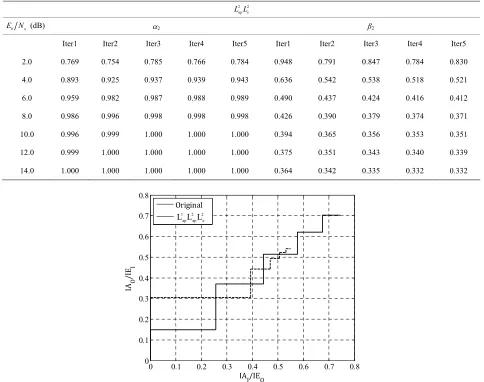
perform-ance of modified systems are become closer by about 0.35 dB (~0.75 dB for unmodified systems) to the per-formance of turbo code utilizes log-MAP decoder at BER of 10–4. Table1 presents the average scaling factors
(2 and β2) derived offline for five iterations to system
at different signal to noise ratios (
2 2 ap e
L L E Nb o) over
flat fading channels. Referring to Equation (6) and (7), the values of j should be estimated offline, because
the systematic coded bits ( k,1) are not available at the
decoder side, whereas the values of
c
j
can be obtained
online. Utilizing the simulation results taken from the “free-running” iterative decoder, the average trajectory of the extrinsic information transfer chart (EXIT) [18] for system ( ap ap e) is depicted in Figure 5 at
1 2 L L L2
b o
E N = 0.5 dB. In comparison to the trajectory of original system,
it is obvious from Figure 5 that the modified systems
[image:4.595.54.541.321.718.2]present better convergence in mutual information.
Table 1. Average scaling factors,2 and 2applied on system for different
2 2
ap e
L L E Nb o and 5 iterations assuming Rayleigh
fading channel.
2 2
ap e
L L
b o
E N (dB) 2 β2
Iter1 Iter2 Iter3 Iter4 Iter5 Iter1 Iter2 Iter3 Iter4 Iter5 2.0 0.769 0.754 0.785 0.766 0.784 0.948 0.791 0.847 0.784 0.830 4.0 0.893 0.925 0.937 0.939 0.943 0.636 0.542 0.538 0.518 0.521 6.0 0.959 0.982 0.987 0.988 0.989 0.490 0.437 0.424 0.416 0.412 8.0 0.986 0.996 0.998 0.998 0.998 0.426 0.390 0.379 0.374 0.371 10.0 0.996 0.999 1.000 1.000 1.000 0.394 0.365 0.356 0.353 0.351 12.0 0.999 1.000 1.000 1.000 1.000 0.375 0.351 0.343 0.340 0.339 14.0 1.000 1.000 1.000 1.000 1.000 0.364 0.342 0.335 0.332 0.332
0 0.1 0.2 0.3 0.4 0.5 0.6 0.7 0.8 0
0.1 0.2 0.3 0.4 0.5 0.6 0.7 0.8
IAI/IEO
IA O
/I
E I
Original La11La22Le22
ap ap e L L L
Figure 5. Average trajectory for system ( 1 2 2) at
ap ap e
[image:4.595.56.540.331.713.2]1 1.5 2 2.5 3 3.5 4 10‐4
10‐3 10‐2
10‐1
IAI/IEO
IAO
/I
EI
Original LapO LeO LapI LeI LeO
b 0 E /N
BE
[image:5.595.60.289.302.482.2]R
Figure 6. BER performance of modified SCCC systems over AWGN channel.
0 2 4 6 8 10
10‐4
10‐3
10‐2
10‐1
Eb/No
BE
R
[image:5.595.60.294.521.700.2]Original LeO LapO LeO
Figure 7. BER performance of modified SCCC systems over Rayleigh fading channel.
0 0.2 0.4 0.6 0.8 1
0 0.2 0.4 0.6 0.8 1
IAI/IEO IA O
/I
E I
Original LapO LeO
Figure 8. Average trajectory for system ( o o) at
ap e
L L E Nb o
= 2.25 dB in AWGN channel.
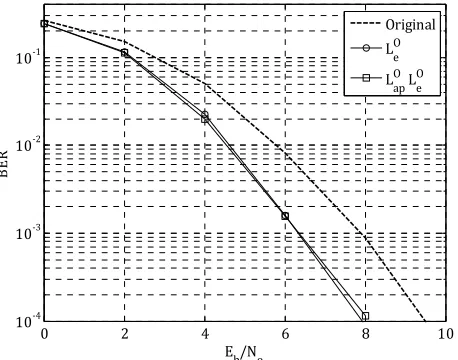
Figures6 and 7 show the BER performance of modi-fied SCCC schemes compared with the original SOVA over AWGN and flat fading channel respectively. The
simulation of scheme reveals similar
improve-ment of about 1.5 dB at BER 10–4 over the two channels. Figure8 shows a stall in the mutual information trajec- tory for conventional SOVA after two iterations, whereas
continue in converge.
o o ap e
L L
o o ap e
L L
4. Conclusion
This paper introduces simple modifications to the con-ventional SOVA to alleviate the effect of optimistic a posteriori information and the strong correlation between the input and output of the SOVA. A method for offline and online computation of scaling factors has also been described. It has shown that the proposed scheme is sig-nificantly improved the performance of PCCC and SCCC schemes that are based on suboptimal decoders. The si- mulation shows that better improvement could be achie- ved by adding two or three simple multipliers to the tra-ditional PCCC scheme, whereas two multipliers are suf-ficient to produce a modified SCCC scheme. The com-plexity resulting from incorporating scaling factors is almost the same as that of the traditional method without these factors. The convergence behavior of such deco- ders is investigated by using extrinsic information trans-fer (EXIT) charts.
REFERENCES
[1] C. Berrou, A. Glavieux and P. Thitimajshima, “Near Shan- non Limit Error-Correcting Coding and Decoding: Turbo Codes,” Proceedings of the International Conference on
Communications, Geneva, 23-26 May 1993, pp. 1064-
1070.
[2] J. Hagenauer and P. Robertson, “Iterative (“Turbo”) De- coding of Systematic Convolutional Codes with the MAP And SOVA Algorithm,” Proceedings of the ITG Tagung,
Codierung für Quelle, Kanal and Ubertragung,Frankfurt,
October 1994, pp. 21-29.
[3] P. Robertson, E. Villebrun and P. Höher, “A Compari- son of Optimal and Sub-Optimal MAP Decoding Algori- thms Operating in the Log Domain,” Proceedings of the
International Conference on Communications, Seattle,
18-22 June 1995, pp. 1009-1013.
[4] J. Hagenauer and P. Hoeher, “A Viterbi Algorithm with Soft-Decision Outputs and Its Applications,” Proceedings
of IEEE Global Telecommunications Conference,Dallas,
27-30November1989, pp. 1680-1686.
[5] C. Berrou, P. Adde, E. Angui and S. Faudeil, “A Low Complexity Soft-Output Viterbi Decoder Architecture,”
Proceedings of IEEE International Conference on Com-
munications, Geneva,Vol. 2, 23-26 May 1993, pp. 737-
740.
coding with the SOVA in a Parallel Concatenated (Tur- bo-Code) Scheme,” Proceedings of the IEEE Internatio-
nal Conference Communications (ICC), Dallas, 23-27
June 1996, pp. 102-106.
[7] C. H. Wang, W. T. Wang and C. C. Chao, “A Unified Structure of Trellis-Based Soft-Output Decoding Algo- rithms for Turbo Codes,” IEEE Transactions on Commu-
nications, Vol. 52, No. 8, 2004, pp. 1355-1366.
doi:10.1109/TCOMM.2004.833025
[8] G. Colavolpe, G. Ferrari and R. Raheli, “Extrinsic Infor- mation in Iterative Decoding: A Unified View,” IEEE
Transactions on Communications, Vol. 49, No. 12, 2001,
pp. 2088-2094. doi:10.1109/26.974255
[9] C. X. Huang and A. Ghrayeb, “A Simple Remedy for the Exaggerated Extrinsic Information Produced by SOVA Algorithm,” IEEE Transactions on Wireless Communica-
tions, Vol. 5, No. 5, 2006, pp. 996-1002.
doi:10.1109/TWC.2006.1633352
[10] S. Papaharalabos, P. Sweeney, B. G. Evans and P. T. Ma- thiopoulos, “Improved Performance SOVA Turbo Deco- der,” IEE Proceedings—Communications, Vol. 153, No. 5, 2006, pp. 586-590. doi:10.1049/ip-com:20050247 [11] C. X. Huang and A. Ghrayeb, “Improved SOVA and APP
Decoding Algorithms for Serial Concatenated Codes,”
IEEE Globecom, Dallas, 29 November-3 December 2004,
pp. 189-193.
[12] D.-W. Yue and H. H. Nguyen, “Unified Scaling Factor Approach for Turbo Decoding Algorithms,” IET Commu-
nications, Vol. 4, No. 8, 2010, pp. 905-914.
doi:10.1049/iet-com.2009.0125
[13] C. Berrou, P. Adde, E. Angui and S. Faudeil, “A Low Complexity Soft-Output Viterbi Decoder Architecture,”
Proceedings of ICC 1993, Geneva, May 1993, pp. 737-
740.
[14] J. Hagenauer, E. Offer and L. Papke, “Iterative Decoding of Binary Block and Convolutional Codes,” IEEE Trans-
actions on Information Theory, Vol. 42, No. 2, 1996, pp.
429-445. doi:10.1109/18.485714
[15] L. Lin and R. S. Cheng, “Improvements in SOVA-Based Decoding for Turbo Codes,” Proceedings of the IEEE
In-ternational Conference on Communications (ICC), Mon-
treal, Vol. 3, 8-12 June 1997, pp. 1473-1478.
[16] A. Papoulis, “Probability, Random Variables, and Stocha- stic Processes,” McGraw-Hill Inc., Montreal, 1991. [17] 3GPP, “Ts 25.212 v3.11.0 (2002-09),” Technical Specifi-
cation Group Radio Access Network, Multiplexing and Channel Coding (FDD), 1999.
[18] S. T. Brink, “Convergence Behavior of Iteratively Decod- ed Parallel Concatenated Codes,” IEEE Transactions on
Communications, Vol. 49, No. 10, 2001, pp. 1727-1737.