MorphoLogic’s submission for the WMT 2009 Shared Task
Attila Novák
MorphoLogic
Kardhegy utca 5, Budapest 1116, Hungary
Abstract
In this article, we describe the machine translation systems we used to create MorphoLogic’s submissions to the WMT09 shared Hungarian to English and English to Hungarian shared transla-tion tasks. We used our rule based MetaMorpho system to generate our pri-mary submission. In addition, we created a hybrid system where the Moses de-coder is used to rank translations or as-semble partial translations created by MetaMorpho. Our third system was a purely statistical morpheme based system for the Hungarian to English task.
1
Introduction
This year, MorphoLogic submitted translations for the WMT09 shared Hungarian to English and English to Hungarian translation tasks. Our pri-mary submissions were translated by MetaMor-pho, a purely rule based machine translation sys-tem (Prószéky and Tihanyi, 2002). Since last year’s workshop we improved the Hungarian to English grammar of MetaMorpho by making more efficient the handling of certain structural ambiguities and making the way the system han-dles long sentences more robust.
The way Metamorpho selects the translation to output is not optimal whether or not a full parse for the source sentence could be obtained by its parser.1 Thus we decided to experiment with a
hybrid system where translations and partial translations produced by MetaMorpho are ranked or assembled by the Moses decoder (Koehn et al., 2007) using a target language model.
1 In the first case, simply the first translation is output instead of considering all possible translations and selecting the best, while in the second case, the algo-rithm that combines the partial translations does not check how well the target language side of the pieces fit together.
In addition, we created a purely statistical morpheme based system (also using Moses) for the Hungarian to English task. However, results obtained with the latter setup have been clearly inferior in quality to those produced by the rule based system both in terms of BLEU score and subjective human judgment.
2
The MetaMorpho translation system
MetaMorpho is a rule based system the architec-ture of which differs from that of most well-known rule based systems: it does not contain a separate transfer component. Its grammar oper-ates with pairs of patterns (context-free rules en-riched with features) that consist of one source pattern used during bottom-up parsing and one or more target patterns that are applied during top-down generation of the translation. The architec-ture of the grammar is completely homogeneous: the same formalism is used to represent general rules of grammar, more-or-less idiomatic phrases and fully lexicalized items, these differ only in the degree of underspecification.
The translation of the parsed structures is al-ready determined during parsing the source lan-guage input. The actual generation of the target language representations does not involve any additional transfer operations: target language structures corresponding to substructures of the source language parse tree are combined and the leaves of the resulting tree are interpreted by a morphological generator.
MetaMorpho processes input by first segmenting it into sentences, then tokenizing them and per-forming morphological analysis on tokens, as-signing morphosyntactic attribute vectors to them. This is followed by parsing the network of ambiguous token sequences using the source side of the grammar. Features are used in the gram-mar to express constraints on the applicability of rules and to store morphosyntactic, valence and lexical information concerning the parsed input.
patterns constituting the source language parse tree. A source language rule may have more than one associated target rule. The selection of the target structure to apply relies on constraints on the actual values of features in the source rule.
Unlike in classical transfer-based systems, word order rearrangement is already determined during parsing the source language input by the applied rules and the values of the features. Dur-ing generation, the already determined rear-ranged structures are simply spelled out. The morphosyntactic feature vectors on the terminal level of the generated tree are interpreted by a morphological generator that synthesizes the cor-responding target language word forms.
Handling ambiguity is always a difficult problem in a rule based system. MetaMorpho gets rid of alternatives either by using high level heuristics or by specific rules explicitly overrid-ing some more general alternatives. Generally MetaMorpho only generates the first possible translation corresponding to the first parse it pro-duces. In the case of long sentences however, MetaMorpho still may run into the problem of generating too many hypotheses. The solution to this problem originally was simply to abort the parser when it had spent too much time on ana-lyzing a sentence. This resulted in a sequence of words at the end of the sentence remaining un-translated. We managed to alleviate this problem by introducing subsentential segmentation that partitions the input sentence into chunks at pre-sumably safe places (usually clause boundaries).
3
Using a target language model to
com-bine partial parses
During parsing, a hierarchy of partial structures is built by the parser. If the parser fails to pro-duce full parse of the sentence, MetaMorpho re-verts to using a heuristic process that constructs an output by combining the output of a selected set of these partial structures covering the whole sentence. These assembled translations are usu-ally suboptimal, because in the absence of a full parse some structural information such as agree-ment is often lost.
3.1 Pronoun dropping
In the case of Hungarian to English translation, pronoun dropping in Hungarian is a further prob-lem when trying to assemble a translation from partial structures. Since the number and person of the subject and the definiteness of the object (in the case of transitive verbs) is exactly
ex-pressed by Hungarian verbal agreement suffixes, explicit subject and object pronouns may be (and usually are) dropped (unless they are focused or otherwise stressed). The problem is that the same verb forms are used when the subject or object is a full NP. In these cases, however no pronoun is incorporated in the verbal suffix:
Hallja. He/she/it hears him/her/it.
Fred hallja a doktort. Fred hears the doctor.
For single verb forms the MetaMorpho parser only generates English phrases that contain sub-ject pronouns (and in the case of a transitive definite verb like hallja also an object pronoun:
he hears it), because the verb is only represented in the grammar by structures that inherently con-tain its possible argument structures. This results in extra pronouns appearing in the assembled output translation if there is in fact an overt sub-ject and/or obsub-ject in the sentence. The same thing applies to 3rd person singular possessive con-structions:
háza his house
Fred háza. Fred’s house.
3.2 Utilizing the Moses decoder
The original partial structure combination algo-rithm in MetaMorpho does not utilize a statistical model of the target language. In our experiments, we replaced the original phrase combination al-gorithm with a statistical model using the Moses decoder hoping that this would improve the translations produced in these cases. We created an interface to the parser that can output all par-tial parses generated during parsing the input sentence along with their translations.
in-stalled in our test machine was not enough for that.2
[image:3.595.306.528.202.396.2]We experimented with various parameter set-tings and ways of building the phrase table. While including partial translations in the phrase table for sentences that had a full parse definitely hurt performance, adding all alternative full translations (if the parser managed to parse the whole sentence) to the phrase table and letting the language model select the best one (instead of MetaMorpho defaulting to the first successful parse) improved performance as could be ex-pected. We needed to increase the maximum al-lowed phrase length parameter from the default to allow the decoder to use the full sentence translations (failing to do so resulted in a serious degradation of performance).
Adding alternative versions of phrases con-taining possibly spurious pronouns to the phrase table with the pronouns removed or properly modified also had a beneficial effect as this re-duced the frequency of extra inserted pronouns in the translations.
While our original phrase assembly algorithm never attempts to reorder the chunks it selects, we did experiment with different distortion pa-rameter settings in the statistical approach since reordering comes for free with the Moses de-coder. (Well, there is in fact a price to pay for distortion: a sharp fall in decoding speed.) We found that not penalizing word order changes by the decoder clearly had a detrimental effect on the accuracy of translations. The default distor-tion limit and penalty (distordistor-tion limit was of six words (d=6) in this setting; distortion penalty weight was identical with the language model weight) often resulted in translations with com-pletely out-of-place chunks at the end of the sen-tence. We got the best results (also in terms of BLEU score) when disallowing distortion alto-gether even though this results in somewhat dis-fluent output, especially if the target language is English and the original Hungarian sentence was verb final. Disallowing distortion also made de-coding more than ten times faster.
2 Building lower-order LMs, cutting off singletons, and/or limiting the LM's vocabulary to the most fre-quent phrases could be possible solutions to that prob-lem as the reviewer of the paper pointed out. We are going to try to solve the memory problem using a combination these techniques in our follow-up ex-periments.
3.3 Results
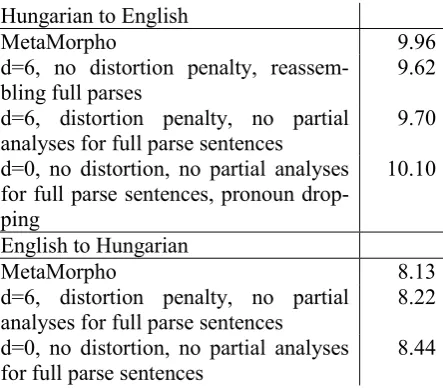
Unfortunately, even with the best parameter set-tings that we have found, we managed to achieve only a slight improvement in BLEU scores com-pared to the original heuristics used in MetaMor-pho. The following table lists the (case insensi-tive) BLEU scores achieved by the original purely rule based system and various versions of the hybrid system on the WMT09 test set.3
Hungarian to English
MetaMorpho 9.96
d=6, no distortion penalty, reassem-bling full parses
9.62
d=6, distortion penalty, no partial analyses for full parse sentences
9.70
d=0, no distortion, no partial analyses for full parse sentences, pronoun drop-ping
10.10
English to Hungarian
MetaMorpho 8.13
d=6, distortion penalty, no partial analyses for full parse sentences
8.22
d=0, no distortion, no partial analyses for full parse sentences
8.44
Although we got slightly better results using the hybrid system, we submitted the output of the original fully rule based MetaMorpho system as our primary submission.
4
A morpheme based Hungarian to
English statistical translation system
In addition to the hybrid system above, we also experimented with a statistical system using the Moses toolkit that we used to build a Hungarian to English translation system. The model that we implemented is based on a morpheme based rep-resentation of both languages instead of a word form based or factored representation.
4.1 The architecture of the system
The Hungarian side of the WMT09 parallel training corpus was analyzed and stemmed using the Humor morphological analyzer (Prószéky and Kis, 1999; Prószéky and Novák, 2005) and we used the Hunpos tagger (Halácsy, Kornai and Oravecz, 2007) for disambiguating the
logical tagging. For English tagging, we used
CRFTagger (Phan, 2006), a Java-based condi-tional random fields POS tagger, while stemming was performed by morpha (Minnen, Carroll and Pearce, 2001). We used the corresponding
morphg word form generator to generate the out-put surface word forms. Unfortunately, morpha neutralizes some present and past forms of the copula, we needed to fix this to get the proper forms in the output.
We segmented both sides of the corpus into morphemes based on the analyses, so the tokens in our system were morphemes instead of word forms. The following is a lowercased example sentence pair from the training corpus:
a[det] 137[szn] apró[mn] csillag[fn] [ela] álló[mn] spirál[fn] meg+[ik] duplázódik[ige] [me3] .[punct]
the_dt spiral_nn of_in 137_cd tiny_jj star_nn s_nns double_vb ed_vbd itself_prp ._.
The motivation for this approach was that Hungarian has a very rich morphology with thousands of possible inflected forms for each word in the open word classes. In addition, many English function words, such as prepositions, possessive and other pronouns etc. correspond to bound morphemes in Hungarian, which makes already the word alignment part of the Moses training procedure a difficult task. It is difficult capture generalizations like the ones above using a word form based representation. There are also systematic morpheme order differences between these corresponding morphemes: the inflectional suffixes (or postpositions) corresponding to Eng-lish prepositions follow noun phrases rather than preceding them and the same applies to posses-sive pronouns and subject pronouns (the latter corresponding to verb agreement suffixes). We hoped that these difficulties could be addressed by a morpheme based solution adequately.
The phrase table was built using the default
grow-diag-final heuristic from Giza++ align-ments that we acquired from the morpheme based representation of the corpus. We used the default settings for Giza++. We also used a lexi-calized reordering table. The distortion parameter was left at the default value. We also analyzed and tried to use a 5-gram language model built from the monolingual English corpus that was published as part of the WMT09 shared transla-tion task training material but the resulting model was too big to be loaded into the 3GB RAM of the machine that we used in our experiments. We tried to use IRSTLM instead of SRILM but we
did not manage to solve the memory overload problem. So in the end we used a 5-gram mor-pheme based language model that was built from the English side of the bilingual training corpus only.
We run the MERT parameter optimization procedure using a morpheme based BLEU score computed on the morpheme segmented version of the WMT09 Hungarian to English tuning set. MERT took several days to run.
4.2 Results
We used the parameter settings suggested by the (morpheme BLEU score based) MERT opti-mization and generated English surface word forms using morphg. We expected that the mor-pheme based solution would pose a new prob-lem: that of misplaced morphemes in the output that do not correspond to any valid surface word form. In such cases we resorted to skipping the misplaced morpheme, although this is obviously not an optimal solution.
The BLEU score we obtained on the detoken-ized output was not very encouraging, to put it mildly: 7.82. When we rerun the decoder with the parameter settings obtained from a previous broken down MERT session, we obtained somewhat better results: 7.95. But this is still very far from the 9.96/10.10 points achieved by MetaMorpho and the hybrid solution. Inspection of the translation results confirmed that the trans-lations generated by the morpheme based setup are far inferior to those generated by our rule based system.
Inspecting Giza++ alignments revealed that, contrary to our hopes, segmenting the training corpus into morphemes did not in itself solve the word alignment quality problem: the alignments look even worse than those achieved on the plain text version of the corpus. On the other hand, all the drawbacks of the approach that we predicted: reduced span of local dependencies in the lan-guage models and the phase table due to the in-creased number of tokens spanning the same span of input, misplaced morphemes, etc. seem to have hit us.
5
Conclusion
In this article, we described the rule based, hy-brid and statistical systems that we implemented and used in the WMT09 shared translation task.
with our first attempt at a morpheme based statis-tical system we obtained more modest results than we hoped, we think that it is still worth to make further attempts to build better translation systems for the Hungarian English language pair along these lines.
Acknowledgments
This research has been supported by the pean Commission in the FP6-IST project Euro-Matrix. We also would like to thank László Laki and Borbála Siklósi for the work they have put into the statistical system that we built.
References
Péter Halácsy, András Kornai, and Csaba Oravecz. 2007. HunPos – an open source trigram tagger In:
Proceedings of the 45th Annual Meeting of the As-sociation for Computational Linguistics Compan-ion Volume Proceedings of the Demo and Poster Sessions, Association for Computational Linguis-tics, Prague, Czech Republic, 209–212.
Philipp Koehn, Hieu Hoang, Alexandra Birch, Chris Callison-Burch, Marcello Federico, Nicola Ber-toldi, Brooke Cowan, Wade Shen, Christine Moran, Richard Zens, Chris Dyer, Ondrej Bojar, Alexandra Constantin, Evan Herbst. 2007. Moses: Open Source Toolkit for Statistical Machine Trans-lation In: Proceedings of the 45th Annual Meeting of the Association for Computational Linguistics Companion Volume Proceedings of the Demo and Poster Sessions, Association for Computational Linguistics, Prague, Czech Republic, 177–180. Guido Minnen, John Carroll and Darren Pearce. 2001.
Applied morphological processing of English,
Natural Language Engineering, 7(3). 207–223. Xuan-Hieu Phan. 2006. CRFTagger: CRF English
POS Tagger, http://crftagger.sourceforge.net/ Gábor Prószéky and Attila Novák. 2005.
Computa-tional Morphologies for Small Uralic Languages. In: A. Arppe, L. Carlson, K. Lindén, J. Piitulainen, M. Suominen, M. Vainio, H. Westerlund, A. Yli-Jyrä (eds.): Inquiries into Words, Constraints and Contexts Festschrift in the Honour of Kimmo Koskenniemi on his 60th Birthday, 116–125. Gummerus Printing, Saarijärvi/CSLI Publications, Stanford.