Overview of the Pathway Curation (PC) task of BioNLP Shared Task 2013
Tomoko Ohta1, Sampo Pyysalo1, Rafal Rak1, Andrew Rowley1, Hong-Woo Chun2, Sung-Jae Jung2,3,Chang-Hoo Jeong2 Sung-Pil Choi2,3,Jun’ichi Tsujii4,Sophia Ananiadou1
1National Centre for Text Mining and School of Computer Science, University of Manchester
2Software Research Center, Korea Institute of Science and Technology Information (KISTI)
3Department of Applied Information Science, University of Science and Technology (UST)
4Microsoft Research Asia, Beijing, China
Abstract
We present the Pathway Curation (PC) task, a main event extraction task of the BioNLP shared task (ST) 2013. The PC task concerns the automatic ex-traction of biomolecular reactions from text. The task setting, representation and semantics are defined with respect to pathway model standards and ontolo-gies (SBML, BioPAX, SBO) and docu-ments selected by relevance to specific model reactions. Two BioNLP ST 2013 participants successfully completed the PC task. The highest achieved F-score, 52.8%, indicates that event extrac-tion is a promising approach to support-ing pathway curation efforts. The PC task continues as an open challenge with data, resources and tools available from http://2013.bionlp-st.org/
1 Introduction
Following developments in molecular biology, bi-ological phenomena are increasingly understood on the molecular level, as the products of complex systems of molecular reactions. Pathway mod-els formalizing biomolecules and their reactions in machine readable representations are a key way of sharing and communicating human understand-ing of these phenomena and of developunderstand-ing com-putational models of biological systems (Kitano, 2002). Many pathway models integrate knowl-edge from hundreds or thousands of scientific pub-lications, and their curation requires substantial manual effort. To support this effort, we have de-veloped PathText (Kemper et al., 2010) which pro-vides a seamless environment integrating a path-way visualizer, text mining systems and annota-tion tools. Furthermore, automatic processing of the domain literature could thus potentially play
pyruvate kinase catalyzes the conversion of PEP to pyruvate. GGP Cause +Regulation Theme Conversion Theme Chem Chemical
Product
Figure 1: Event representation for a conversion re-action.
an important role in the support of pathway cura-tion.
Information extraction targeting biomolecular reactions has been a major focus of efforts in biomedical natural language processing, with sev-eral tasks, resources, and tools addressing in par-ticular protein-protein interactions (Krallinger et al., 2007; Pyysalo et al., 2008; Tikk et al., 2010). However, most such efforts have employed sim-ple representations, such as entity pairs, that are not sufficient for capturing molecular reactions to the level of detail required to support the curation of pathway models. Additionally, previous efforts have not directly involved the semantics (e.g. re-action type definitions) of such models. Perhaps in part due to these reasons, natural language pro-cessing and information extraction methods have not been widely embraced by biomedical pathway curation communities (Ohta et al., 2011c; Ohta et al., 2011a).
We believe that the extraction of structured event representations (Figure 1) pursued in the BioNLP Shared Tasks offers many opportuni-ties to make significant contributions to support the development, evaluation and maintenance of biomolecular pathways. The Pathway Curation (PC) task, a main task of the BioNLP Shared Task 2013, is proposed as a step toward realizing these opportunities. The PC task aims to evaluate the ap-plicability of event extraction systems to pathway curation and to encourage the further development of methods for related tasks. The design of the task aims to address current issues in information extraction for pathway curation by explicitly bas-ing its representation and extraction targets on
GTP GDP GAPs
re1 re1
Protein Modifier Reactant Molecule Molecule
Product
Conversion
GAPs catalyze the hydrolysis of GTP to GDP.
GGPCause+RegTheme Conversion ThemeChem Chem
Product
(a) CONVERSION
p38 gamma P
p38 gamma
MKK6
re1
re1
MKK6 phosphorylates p38 gamma.
Protein Protein
Protein
Modifier Reactant Product
Phosphorylation
MKK6 phosphorylates p38 gamma. GGP CausePhosphorylation ThemeGGP
(b) PHOSPHORYLATION
NF-kappaB p65
p50
p65
p50
re1
p65 binds to p50.
GGP Theme Bind Theme2GGP
p65-p50 complex formation.
Complex Product Binding
p65 and p50 form p65-p50 complex.
Protein Protein Reactant2 NC binding Product Complex
Reactant
[image:2.595.95.507.66.232.2](c) BINDING
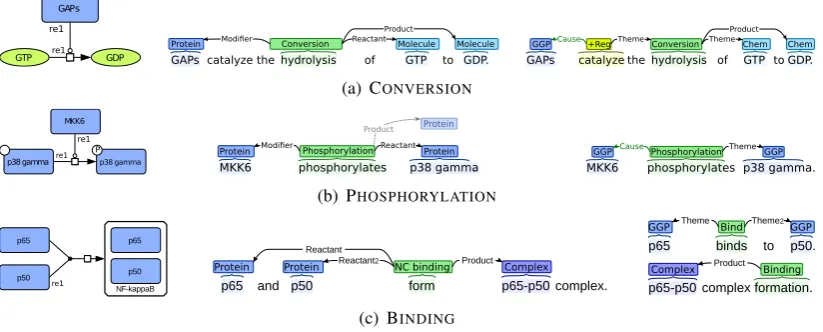
Figure 2: Illustration of pathway reaction (left), matching representation as an idealized text-bound event structure (middle) and applied event representation for statements actually appearing in text (right).
jor standards developed in the biomolecular path-way curation community, such as SBML (Hucka et al., 2003) and BioPAX (Mi et al., 2011), and ontologies such as the Systems Biology Ontology1 (SBO) (Courtot et al., 2011). Further, The corpus texts are selected on the basis of relevance to a se-lection of pathway models from PANTHER Path-way DB2 (Mi and Thomas, 2009) and BioMod-els3(Li et al., 2010) repositories. The PC task set-ting and its document selection protocol aim to ac-count for both signalling and metabolic pathways, the latter of which has received comparatively lit-tle attention in recent domain IE efforts (Li et al., 2013).
2 Task setting
The PC task is formulated as an event extraction task (Ananiadou et al., 2010) following the general representation and task setting first introduced in the BioNLP ST 2009 (Kim et al., 2011). The pri-mary aim is the extraction of event structures, or events, each of which can involve any number of physical entities or other events in specific roles.
The event representation is sufficiently expres-sive to allow the definition of event structures that closely parallel the definition of reactions in path-way representations such as SBML and BioPAX. These pathway representations differentiate be-tween three primary groups of reaction partici-pants: reactants (“inputs”), products (“outputs”), and modifiers, where the specific roles of modi-fiers can be further identified to differentiate e.g.
1http://www.ebi.ac.uk/sbo/main/
2
http://www.pantherdb.org/pathway/
3http://www.ebi.ac.uk/biomodels-main/
reaction catalysts from inhibitors. Correspond-ingly, the PC task applies theThemerole defined in previous BioNLP ST tasks to capture reactants, introduces a new Product role for products, and applies the previously definedCauserole and reg-ulatory events to capture modifiers (Figure 2; see also Section 2.3).
It is important to note that while the event repre-sentation allows a one-to-one mapping to reactions in principle, an annotation scheme cannot guar-antee that actual statements in text map to fully specified reactions: in free-form text, authors fre-quently omit mention of some entities taking part in reactions, perhaps most typically to avoid re-dundancies such as in “p38γ is phosphorylated into phospho-p38γ” (Figure 2b). Representations extracted from explicit statements in text will thus in some cases omit aspects of the corresponding complete reactions in pathway models.
Systems addressing the PC task are expected to extract events of specific types given 1) free-form text and 2) gold standard annotation for mentions of physical entities in that text. The task annota-tions also include equivalence relaannota-tions and event modifications, a secondary extraction target. The annotation types are detailed below.
2.1 Entities
Entity type Scope Reference Ontology ID
SIMPLE CHEMICAL simple, non-repetitive chemical entities ChEBI SBO:0000247
GENE OR GENE PRODUCT genes, RNA and proteins gene/protein DBs SBO:0000246
COMPLEX entities of non-covalently linked components complex DBs SBO:0000253
[image:3.595.77.523.138.358.2]CELLULAR COMPONENT parts of cell and extracellular environment GO-CC SBO:0000290
Table 1: Entity types, definitions, and reference resources.
Event type Core arguments Additional arguments Ontology ID
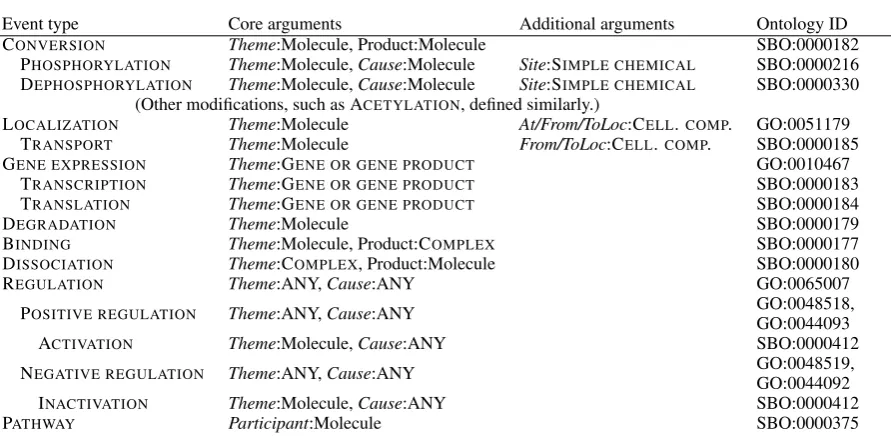
CONVERSION Theme:Molecule, Product:Molecule SBO:0000182
PHOSPHORYLATION Theme:Molecule,Cause:Molecule Site:SIMPLE CHEMICAL SBO:0000216
DEPHOSPHORYLATION Theme:Molecule,Cause:Molecule Site:SIMPLE CHEMICAL SBO:0000330
(Other modifications, such as ACETYLATION, defined similarly.)
LOCALIZATION Theme:Molecule At/From/ToLoc:CELL.COMP. GO:0051179
TRANSPORT Theme:Molecule From/ToLoc:CELL.COMP. SBO:0000185
GENE EXPRESSION Theme:GENE OR GENE PRODUCT GO:0010467
TRANSCRIPTION Theme:GENE OR GENE PRODUCT SBO:0000183
TRANSLATION Theme:GENE OR GENE PRODUCT SBO:0000184
DEGRADATION Theme:Molecule SBO:0000179
BINDING Theme:Molecule, Product:COMPLEX SBO:0000177
DISSOCIATION Theme:COMPLEX, Product:Molecule SBO:0000180
REGULATION Theme:ANY,Cause:ANY GO:0065007
POSITIVE REGULATION Theme:ANY,Cause:ANY GO:0048518,
GO:0044093
ACTIVATION Theme:Molecule,Cause:ANY SBO:0000412
NEGATIVE REGULATION Theme:ANY,Cause:ANY GO:0048519,
GO:0044092
INACTIVATION Theme:Molecule,Cause:ANY SBO:0000412
PATHWAY Participant:Molecule SBO:0000375
Table 2: Event types and arguments. “Molecule” refers to an entity annotation of any of the types SIMPLE CHEMICAL, GENE OR GENE PRODUCT, or COMPLEX, and “ANY” refers to an annotation of any type, either entity or event. The indentation corresponds to ontological relationships between the event types: for example, PHOSPHORYLATION is-a CONVERSION and TRANSCRIPTION part-of GENE EXPRESSION.
GENE OR GENE PRODUCT, annotated with refer-ence to gene and protein databases such as UniProt (Consortium, 2011), Entrez Gene (Maglott et al., 2005) and PFam (Finn et al., 2010); COMPLEX, annotated with reference to database resources covering complexes; and CELLULAR COMPO -NENT, annotated following the scope of the Gene Ontologycellular componentsubontology (Ashburner et al., 2000) (Table 1). For discussion of the relation between these types and the repre-sentations applied in pathway models, we refer to Ohta et al. (2011c).
In terms of mention types in text, the annotation for SIMPLE CHEMICAL, GENE OR GENE PROD
-UCT and COMPLEX covers entity name mentions only, while the annotation for CELLULAR COM
-PONENT covers entity name mentions, nominal mentions, and adjectival references (e.g. “ mito-chondrial”).
2.2 Relations
The PC task defines one relation type, Equiv
(equivalence), which can hold between entity
mitogen-activated protein kinase (MAPK, also known as ERK)
Gene or gene product Equiv GGP Equiv GGP
Figure 3: ExampleEquivannotation.
mentions of the same type and specifies that they refer to the same real-world entity (Figure 3). These relations are only applied to determine if two events match during evaluation, where entities connected by anEquivrelation are considered in-terchangeable. Gold standardEquiv relations are applied also for test data, and systems participat-ing in the task are not expected to extract these relations.
2.3 Events
anno-Pathway Repository ID Publication
mTOR BioModels MODEL1012220002 (Caron et al., 2010)
mTORC1 upstream regulators BioModels MODEL1012220003 (Caron et al., 2010)
TLR BioModels MODEL2463683119 (Oda and Kitano, 2006)
Yeast Cell Cycle BioModels MODEL1011020000 (Kaizu et al., 2010)
Rb BioModels MODEL4132046015 (Calzone et al., 2008)
EGFR BioModels MODEL2463576061 (Oda et al., 2005)
Human Metabolic Network BioModels MODEL6399676120 (Duarte et al., 2007)
NF-kappaB pathway - - (Oda et al., 2008)
p38 MAPK PANTHER DB P05918
-p53 PANTHER DB P00059
-p53 feedback loop pathway PANTHER DB P04392
-Wnt signaling pathway PANTHER DB P00057
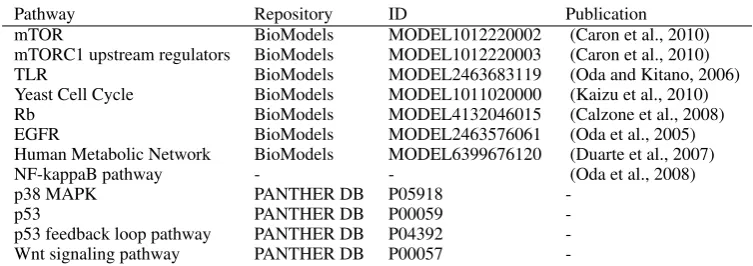
-Table 3: Pathway models used to select documents for the task, with pathway repository model identifiers and publications presenting each model (when applicable).
tated in the PC task and their arguments. We refer again to Ohta et al. (2011c) for detailed discussion of the relation between these types and other rep-resentations applied in pathway models.
The role in which each event argument (entity or other event) participates in an event is specified as one of the following:
Theme entity/event that undergoes the effects of the event. For example, the entity that is tran-scribed in a TRANSCRIPTIONevent or transported in a TRANSPORTevent.
Cause entity/event that is causally active in the event. Marks, for example, “P1” in “P1inhibits P2 expression”.
AtLoc,FromLoc,ToLoc : location in which the
Themeentity of a LOCALIZATION event is
local-ized (At) in LOCALIZATION events not involving movement or is transported (or moves) from/to (From/To) in LOCALIZATION and TRANSPORT
events involving movement.
Site site on theThemeentity that is modified in the event. Can be specified for modification events such as PHOSPHORYLATION.
Participant general role type identifying an en-tity that participates in some underspecified way in a high-level process. Only applied for the PATH -WAYtype.
2.4 Event modifications
In addition to events, the PC task defines a sec-ondary extraction target, event modifications. Two modification types are defined: NEGATION and
SPECULATION. Both are binary flags that mod-ify events, the former marking an event as be-ing explicitly stated as not occurrbe-ing (e.g. “P is
not phosphorylated”) and the latter as being stated in a speculative context (“P may be phosphory-lated.”). Both are defined in terms of annotation scope and semantics identically as in the BioNLP ST’09 (Kim et al., 2009).
2.5 Evaluation
The PC task evaluation applies the standard evalu-ation criteria established in the BioNLP ST 2009. These criteria relax exact matching between gold and predicted events in two aspects: approximate trigger boundary matching, and approximate re-cursive event matching. The former allows pre-dicted event triggers to differ from gold triggers by one word, and the latter requires recursively re-ferred events to only match in their core arguments (see Table 2). We refer to Kim et al. (2011) for a detailed definition of these criteria.
3 Corpus
This section presents the PC task corpus and its annotation process.
3.1 Document selection
[image:4.595.110.487.60.193.2]literature providing evidence for specific pathway reactions, we applied an alternative strategy where reactions from a selection of PANTHER DB mod-els were entered into the PathText system (Kem-per et al., 2010),4 which is capable of suggest-ing documents relevant to given reactions based on an SBML model. We then selected a random set of reactions to query the system, and manually evaluated the highest-ranking documents to iden-tify those whose abstracts explicitly discuss the se-lected reaction. We refer to Miwa et al. (2013a) for a detailed description of this approach. Table 3 presents the pathway models on which the docu-ment selection was based.
3.2 Annotation process
The base entity annotation for the PC corpus was created automatically using state-of-the-art entity mention taggers for each of the targeted entity types. For SIMPLE CHEMICAL tagging, the
OS-CAR4 system (Jessop et al., 2011) trained on the chemical named entity recognition corpus of Corbett and Copestake (2008) was applied. For GENE OR GENE PRODUCTmention detection, the NERsuite5 system trained on the BioCreative 2 Gene Mention task (Wilbur et al., 2007) corpus was used. NERsuite was also applied for CEL
-LULAR COMPONENT mention detection, for this task trained on the Anatomical Entity Mention (AnEM) corpus (Ohta et al., 2012). Finally, COM
-PLEX annotations were created using a combi-nation of a dictionary and heuristics making use of the GENE OR GENE PRODUCT annotation (for mentions such as “cyclin E/CDK2 complex”). To support the curation process, these tools were in-tegrated into the NaCTeM text-analysis workflow system Argo (Rak et al., 2012).
Based on the evaluations of each of these tools in the studies presenting them, we expected initial automatic tagging performance to be in the range 80-90% in both precision and recall. Following initial automatic annotation, the entity mention an-notation was manually revised to improve quality and consistency. As the entity annotation is not itself a target of extraction in the shared task, we did not separately evaluate the consistency of the revised entity mention annotation.
To assure that the quality and consistency of the event annotation are as high as possible,
ini-4
http://nactem.ac.uk/pathtext/
5http://nersuite.nlplab.org/
Item Train Devel Test Total
Documents 260 90 175 525
Words 53811 18579 35966 108356
Entities 7855 2734 5312 15901
Events 5992 2129 4004 12125
[image:5.595.317.519.63.123.2]Modifications 317 80 174 571
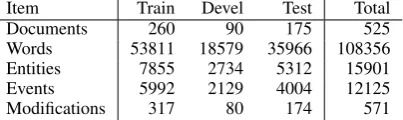
Table 4: PC corpus statistics
tial event annotation was created entirely man-ually, without automatic support. This annota-tion effort was carried out using the BRAT anno-tation tool (Stenetorp et al., 2012) by a group of biologists in collaboration between NaCTeM and KISTI. Following initial annotator training and re-finement of guidelines based on the event type def-initions provided by the reference ontologies, the primary event annotation was created by three bi-ologists. To evaluate and maintain annotation con-sistency, a random 20% of documents were an-notated redundantly by all annotators, and these overlapping annotations were periodically evalu-ated and differences in annotation were discussed between the annotators and annotation coordina-tors. Following initial annotation, a round of semi-automatic consistency checks were applied using
BRAT. Evaluation of the redundantly annotated documents using the primary task evaluation cri-teria gave an inter-annotator agreement of 61.0% in F-score. For the final corpus, the redundantly annotated documents were evaluated separately by an annotation coordinator to select the best of each set.6
The overall statistics of the corpus are summa-rized in Table 4. We note that the among the previous BioNLP ST corpora, only the GENIA (GE) task corpus has a larger number of annotated events than the PC corpus.
4 Results
4.1 Participation
Two groups submitted final results to the PC task, one from the National Centre for Text Min-ing (NaCTeM) and one from the University of Turku BioNLP group (TEES-2.1) (Table 5). Both participants applied their well-established, state-of-the-art event extraction systems, EventMine7 (Miwa et al., 2012) (NaCTeM) and the Turku
6This selection implies that the consistency of the event
annotation of the final corpus is expected to exceed the 61% F-score of the IAA experiment. Consistency after selection was not separately evaluated.
NLP Events Other resources
Rank Team Org Word Parse Trig. Arg. Group. Modif. Corpora Other
1 NaCTeM 1NLP Snowball Enju, GDep SVM SVM SVM SVM (see text) triggers
[image:6.595.76.531.62.105.2]2 TEES-2.1 1BI Porter McCCJ + SD SVM SVM SVM SVM GE hedge words
Table 5: Participants and summary of system descriptions. Abbreviations: BI=Bioinformatician, NLP=Natural Language Processing researcher, McCCJ=McClosky-Charniak-Johnson parser, Char-niak=Charniak parser, SD=Stanford Dependency conversion, GE=GE task corpus.
Team recall prec. F-score NaCTeM 52.23 53.48 52.84 TEES-2.1 47.15 55.78 51.10
Table 6: Primary evaluation results
Event Extraction System8 (Bj¨orne et al., 2011) (TEES). The two systems share the same over-all architecture, a one-best pipeline with SVM-based stages for event trigger detection, trigger-argument relation detection, trigger-argument grouping into event structures, and modification prediction. The feature representations of both systems draw on substructures of dependency-like representa-tions of sentence syntax, derived from full parses of input sentences. TEES applies the Charniak and Johnson (2005) parser with the McClosky (2009) biomedical model, converting the phrase-structure parses into dependencies using the Stan-ford tools (de Marneffe et al., 2006). By contrast, EventMine uses a combination of the predicate-argument structure analyses created by the deep parser Enju (Miyao and Tsujii, 2008) and the out-put of the the GDep best-first shift-reduce depen-dency parser (Sagae and Tsujii, 2007). All three parsers have models trained in part on the biomed-ical domain GENIA treebank (Tateisi et al., 2005). Interestingly, both systems make use of the GE task data, but the application of EventMine ex-tends on this considerably by applying a stacked model (Miwa et al., 2013b) with predictions also from models trained on the BioNLP ST 2011 EPI and ID tasks (Pyysalo et al., 2012) as well as from four corpora introduced outside of the shared tasks by Thompson et al. (2011), Pyysalo et al. (2011), Ohta et al. (2011b) and Ohta et al. (2011c).
4.2 Evaluation results
Table 6 summarizes the primary evaluation results. The two systems demonstrate broadly similar per-formance in terms of F-scores, with NaCTeM achieving an 1.7% point higher overall result.
8http://jbjorne.github.io/TEES/
However, the systems show quite different per-formance in terms of the precision/recall balance: while the NaCTeM system has little difference between precision and recall, TEES-2.1 shows a clear preference for precision, with 8.6% lower re-call than precision.
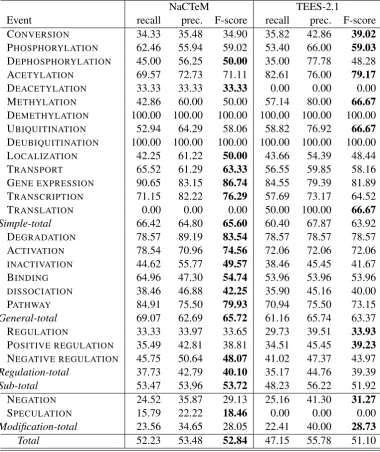
Results are shown separately for each event type in Table 7. The results largely mirror the over-all performance, with the NaCTeM system show-ing better performance for 13 out of the 21 event types present in the test data and more balanced precision and recall than TEES-2.1, which em-phasizes precision over recall for almost all event types. Although the results do not include evalu-ation of EventMine with a reduced set of stacked models in training, the modest difference in per-formance suggests that comprehensive use of pre-viously released event resources in EventMine did not confer a decisive advantage, perhaps in part due to differences in the event definitions between the PC task and previous resources.
Overall, the two systems appear quite similar not only in architecture but also performance, with the clearest systematic difference observed being the different emphases on precision vs. recall. As both systems are based on machine learning meth-ods with real-valued outputs, it would be relatively straightforward to use prediction confidences to analyse performance over the entire precision-recall curve instead of a single fixed point. Such analysis could provide further insight into the rel-ative strengths and weaknesses of these two sys-tems.
5 Discussion
[image:6.595.93.266.172.212.2]NaCTeM TEES-2.1
Event recall prec. F-score recall prec. F-score
CONVERSION 34.33 35.48 34.90 35.82 42.86 39.02
PHOSPHORYLATION 62.46 55.94 59.02 53.40 66.00 59.03
DEPHOSPHORYLATION 45.00 56.25 50.00 35.00 77.78 48.28
ACETYLATION 69.57 72.73 71.11 82.61 76.00 79.17
DEACETYLATION 33.33 33.33 33.33 0.00 0.00 0.00
METHYLATION 42.86 60.00 50.00 57.14 80.00 66.67
DEMETHYLATION 100.00 100.00 100.00 100.00 100.00 100.00
UBIQUITINATION 52.94 64.29 58.06 58.82 76.92 66.67
DEUBIQUITINATION 100.00 100.00 100.00 100.00 100.00 100.00
LOCALIZATION 42.25 61.22 50.00 43.66 54.39 48.44
TRANSPORT 65.52 61.29 63.33 56.55 59.85 58.16
GENE EXPRESSION 90.65 83.15 86.74 84.55 79.39 81.89
TRANSCRIPTION 71.15 82.22 76.29 57.69 73.17 64.52
TRANSLATION 0.00 0.00 0.00 50.00 100.00 66.67
Simple-total 66.42 64.80 65.60 60.40 67.87 63.92
DEGRADATION 78.57 89.19 83.54 78.57 78.57 78.57
ACTIVATION 78.54 70.96 74.56 72.06 72.06 72.06
INACTIVATION 44.62 55.77 49.57 38.46 45.45 41.67
BINDING 64.96 47.30 54.74 53.96 53.96 53.96
DISSOCIATION 38.46 46.88 42.25 35.90 45.16 40.00
PATHWAY 84.91 75.50 79.93 70.94 75.50 73.15
General-total 69.07 62.69 65.72 61.16 65.74 63.37
REGULATION 33.33 33.97 33.65 29.73 39.51 33.93
POSITIVE REGULATION 35.49 42.81 38.81 34.51 45.45 39.23
NEGATIVE REGULATION 45.75 50.64 48.07 41.02 47.37 43.97
Regulation-total 37.73 42.79 40.10 35.17 44.76 39.39
Sub-total 53.47 53.96 53.72 48.23 56.22 51.92
NEGATION 24.52 35.87 29.13 25.16 41.30 31.27
SPECULATION 15.79 22.22 18.46 0.00 0.00 0.00
Modification-total 23.56 34.65 28.05 22.41 40.00 28.73
[image:7.595.107.488.65.518.2]Total 52.23 53.48 52.84 47.15 55.78 51.10
Table 7: Primary evaluation results by event type.
task participants, a balanced F-score of 52.8%, is a good estimate of the performance level that can be attained for this task by present event extraction technology.
The results achieved by the two systems are broadly comparable to the best results achieved by any system in similar previously introduced event extraction tasks (Kim et al., 2012; Pyysalo et al., 2012). Given the novelty of the task domain and reference resource and the broad selection of doc-uments, we find the results highly encouraging re-garding the applicability of event extraction tech-nology to supporting the development, evaluation, and maintenance of pathway models.
6 Conclusions
event annotation marking over 12,000 event struc-tures in the corpus.
Two participants in the BioNLP ST 2013 sub-mitted final predictions to the PC task, applying established, state-of-the-art event extraction sys-tems, EventMine and the Turku Event Extrac-tion System. Both systems achieved F-scores over 50%, with the EventMine system achiev-ing the best overall result of 52.8%. This level of performance is broadly comparable with re-sults achieved in comparable previously proposed tasks, indicating that current event extraction tech-nology is applicable to the projected pathway cu-ration support tasks.
To allow the further development and evalua-tion of event extracevalua-tion methods for the task, the PC task continues as an open challenge to all inter-ested participants, with the annotated corpus data, supporting resources, and evaluation tools avail-able under open licenses from the task homepage, http://2013.bionlp-st.org/
Acknowledgments
We would like to thank Yonghwa Jo, Hyeyeon Choi, Jeong-Ik Lee and Ssang-Goo Cho of Konkuk University for their contribution to the de-velopment of the relevance judgment annotation criteria. We also wish to thank Hyun Uk Kim, Jinki Kim and Kyusang Hwang of KAIST for their efforts in producing the PC task annotation. This work is a part of joint research of KISTI and NaCTeM, and partially supported by the Biotech-nology and Biological Sciences Research Council (BBSRC) [BB/G53025X/1].
References
Sophia Ananiadou, Sampo Pyysalo, Jun’ichi Tsujii, and Dou-glas B. Kell. 2010. Event extraction for systems biology by text mining the literature. Trends in Biotechnology, 28(7):381–390.
Michael Ashburner, Catherine A. Ball, Judith A. Blake, David Botstein, Heather Butler, J. Michael Cherry, Al-lan P. Davis, Kara Dolinski, et al. 2000. Gene ontology: tool for the unification of biology.Nature genetics, 25:25– 29.
Jari Bj¨orne and Tapio Salakoski. 2011. Generalizing biomedical event extraction. In Proceedings of the BioNLP Shared Task 2011 Workshop, pages 183–191. Jari Bj¨orne, Juho Heimonen, Filip Ginter, Antti Airola, Tapio
Pahikkala, and Tapio Salakoski. 2011. Extracting contex-tualized complex biological events with rich graph-based feature sets.Computational Intelligence, 27(4):541–557. Laurence Calzone, Am´elie Gelay, Andrei Zinovyev, Franc¸ois
Radvanyl, and Emmanuel Barillot. 2008. A
comprehen-sive modular map of molecular interactions in rb/e2f path-way.Molecular systems biology, 4(1).
Etienne Caron, Samik Ghosh, Yukiko Matsuoka, Dariel Ashton-Beaucage, Marc Therrien, S´ebastien Lemieux, Claude Perreault, Philippe P Roux, and Hiroaki Kitano. 2010. A comprehensive map of the mtor signaling net-work.Molecular systems biology, 6(1).
Eugene Charniak and Mark Johnson. 2005. Coarse-to-Fine n-Best Parsing and MaxEnt Discriminative Reranking. In
Proceedings of ACL’05, pages 173–180.
The UniProt Consortium. 2011. Ongoing and future devel-opments at the universal protein resource. Nucleic Acids Research, 39(suppl 1):D214–D219.
Peter Corbett and Ann Copestake. 2008. Cascaded classifiers for confidence-based chemical named entity recognition.
BMC Bioinformatics, 9(Suppl 11):S4.
M´elanie Courtot, Nick Juty, Christian Kn¨upfer, Dagmar Wal-temath, Anna Zhukova, Andreas Dr¨ager, Michel Dumon-tier, Andrew Finney, Martin Golebiewski, Janna Hastings, et al. 2011. Controlled vocabularies and semantics in sys-tems biology.Molecular systems biology, 7(1).
Marie-Catherine de Marneffe, Bill MacCartney, and Christo-pher D Manning. 2006. Generating typed dependency parses from phrase structure parses. In Proceedings of LREC, volume 6, pages 449–454.
Kirill Degtyarenko, Paula De Matos, Marcus Ennis, Janna Hastings, Martin Zbinden, Alan Mcnaught, Rafael Alc´antara, Michael Darsow, Micka¨el Guedj, and Michael Ashburner. 2008. Chebi: a database and ontology for chemical entities of biological interest. Nucleic acids re-search, 36(suppl 1):D344–D350.
Natalie C Duarte, Scott A Becker, Neema Jamshidi, Ines Thiele, Monica L Mo, Thuy D Vo, Rohith Srivas, and Bernhard Ø Palsson. 2007. Global reconstruction of the human metabolic network based on genomic and bib-liomic data.Proceedings of the National Academy of Sci-ences, 104(6):1777–1782.
Robert D. Finn, Jaina Mistry, John Tate, Penny Coggill, An-dreas Heger, Joanne E. Pollington, O. Luke Gavin, Prasad Gunasekaran, et al. 2010. The Pfam protein families database. Nucleic Acids Research, 38(suppl 1):D211– D222.
Michael Hucka, Andrew Finney, Herbert M Sauro, Hamid Bolouri, John C Doyle, Hiroaki Kitano, Adam P Arkin, Benjamin J Bornstein, et al. 2003. The systems biology markup language (SBML): a medium for representation and exchange of biochemical network models. Bioinfor-matics, 19(4):524–531.
David M. Jessop, Sam Adams, Egon L. Willighagen, Lezan Hawizy, and Peter Murray-Rust. 2011. Oscar4: a flexible architecture for chemical text-mining.Journal of chemin-formatics, 3(1):1–12.
Jin-Dong Kim, Tomoko Ohta, Sampo Pyysalo, Yoshinobu Kano, and Jun’ichi Tsujii. 2009. Overview of BioNLP’09 Shared Task on Event Extraction. In Proceedings of BioNLP’09.
Jin-Dong Kim, Tomoko Ohta, Sampo Pyysalo, Yoshinobu Kano, and Junichi Tsujii. 2011. Extracting bio-molecular events from literature – the bionlp’09 shared task. Com-putational Intelligence, 27(4):513–540.
Jin-Dong Kim, Ngan Nguyen, Yue Wang, Jun’ichi Tsujii, Toshihisa Takagi, and Akinori Yonezawa. 2012. The genia event and protein coreference tasks of the bionlp shared task 2011.BMC bioinformatics, 13(Suppl 11):S1. Hiroaki Kitano. 2002. Systems biology: a brief overview.
Science, 295(5560):1662–1664.
Martin Krallinger, Florian Leitner, and Alfonso Valencia. 2007. Assessment of the Second BioCreative PPI task: Automatic Extraction of Protein-Protein Interactions. In L. Hirschman, M. Krallinger, and A. Valencia, editors,
Proceedings of BioCreative II, pages 29–39.
Chen Li, Marco Donizelli, Nicolas Rodriguez, Harish Dharuri, Lukas Endler, Vijayalakshmi Chelliah, Lu Li, Enuo He, et al. 2010. BioModels Database: An enhanced, curated and annotated resource for published quantitative kinetic models.BMC Systems Biology, 4:92.
Chen Li, Maria Liakata, and Dietrich Rebholz-Schuhmann. 2013. Biological network extraction from scientific litera-ture: state of the art and challenges. Briefings in bioinfor-matics.
Donna Maglott, Jim Ostell, Kim D. Pruitt, and Tatiana Tatusova. 2005. Entrez gene: gene-centered information at ncbi.Nucleic Acids Research, 33(suppl 1):D54. David McClosky. 2009. Any Domain Parsing: Automatic
Domain Adaptation for Natural Language Parsing. Ph.D. thesis, Brown University.
Huaiyu Mi and Paul Thomas. 2009. PANTHER pathway: an ontology-based pathway database coupled with data anal-ysis tools. In Protein Networks and Pathway Analysis, pages 123–140. Springer.
Huaiyu Mi, Anushya Muruganujan, Emek Demir, Yukiko Matsuoka, Akira Funahashi, Hiroaki Kitano, and Paul D Thomas. 2011. Biopax support in celldesigner. Bioinfor-matics, 27(24):3437–3438.
Makoto Miwa, Paul Thompson, and Sophia Ananiadou. 2012. Boosting automatic event extraction from the liter-ature using domain adaptation and coreference resolution.
Bioinformatics, 28(13):1759–1765.
Makoto Miwa, Tomoko Ohta, Rafal Rak, Andrew Rowley, Douglas B. Kell, Sampo Pyysalo, and Sophia Ananiadou. 2013a. A method for integrating and ranking the evidence for biochemical pathways by mining reactions from text.
Bioinformatics. in press.
Makoto Miwa, Sampo Pyysalo, Tomoko Ohta, and Sophia Ananiadou. 2013b. Wide coverage biomedical event extraction using multiple partially overlapping corpora.
BMC bioinformatics, 14(1):175.
Yusuke Miyao and Jun’ichi Tsujii. 2008. Feature forest mod-els for probabilistic HPSG parsing. Computational Lin-guistics, 34(1):35–80.
Kanae Oda and Hiroaki Kitano. 2006. A comprehensive map of the toll-like receptor signaling network.Molecular Systems Biology, 2(1).
Kanae Oda, Yukiko Matsuoka, Akira Funahashi, and Hiroaki Kitano. 2005. A comprehensive pathway map of epider-mal growth factor receptor signaling. Molecular systems biology, 1(1).
Kanae Oda, Jin-Dong Kim, Tomoko Ohta, Daisuke Okanohara, Takuya Matsuzaki, Yuka Tateisi, and Jun’ichi Tsujii. 2008. New challenges for text mining: mapping between text and manually curated pathways.BMC bioin-formatics, 9(Suppl 3):S5.
Tomoko Ohta, Sampo Pyysalo, Sophia Ananiadou, and Ju-nichi Tsujii. 2011a. Pathway curation support as an infor-mation extraction task.Proceedings of LBM’11.
Tomoko Ohta, Sampo Pyysalo, Makoto Miwa, and Jun’ichi Tsujii. 2011b. Event extraction for dna methylation.
Journal of Biomedical Semantics, 2(Suppl 5):S2. Tomoko Ohta, Sampo Pyysalo, and Jun’ichi Tsujii. 2011c.
From pathways to biomolecular events: opportunities and challenges. In Proceedings of BioNLP’11, pages 105– 113.
Tomoko Ohta, Sampo Pyysalo, Jun’ichi Tsujii, and Sophia Ananiadou. 2012. Open-domain anatomical entity men-tion detecmen-tion. InProceedings of DSSD’12, pages 27–36. Sampo Pyysalo, Antti Airola, Juho Heimonen, Jari Bj¨orne, Filip Ginter, and Tapio Salakoski. 2008. Comparative analysis of five protein-protein interaction corpora. BMC Bioinformatics, 9(Suppl 3):S6.
Sampo Pyysalo, Tomoko Ohta, Makoto Miwa, and Jun’ichi Tsujii. 2011. Towards exhaustive event extraction for pro-tein modifications. InProceedings of BioNLP’11, pages 114–123.
Sampo Pyysalo, Tomoko Ohta, Rafal Rak, Dan Sullivan, Chunhong Mao, Chunxia Wang, Bruno Sobral, Jun’ichi Tsujii, and Sophia Ananiadou. 2012. Overview of the id, epi and rel tasks of bionlp shared task 2011. BMC bioin-formatics, 13(Suppl 11):S2.
Rafal Rak, Andrew Rowley, William Black, and Sophia Ana-niadou. 2012. Argo: an integrative, interactive, text mining-based workbench supporting curation. Database: The Journal of Biological Databases and Curation, 2012. Kenji Sagae and Jun’ichi Tsujii. 2007. Dependency parsing and domain adaptation with lr models and parser ensem-bles. InProceedings of the CoNLL Shared Task Session of EMNLP-CoNLL 2007, pages 1044–1050.
Pontus Stenetorp, Sampo Pyysalo, Goran Topi´c, Tomoko Ohta, Sophia Ananiadou, and Jun’ichi Tsujii. 2012. Brat: a web-based tool for nlp-assisted text annotation. In Pro-ceedings of EACL’12, pages 102–107.
Yuka Tateisi, Akane Yakushiji, Tomoko Ohta, and Junichi Tsujii. 2005. Syntax annotation for the genia corpus. In
Proceedings of IJCNLP, volume 5, pages 222–227. Paul Thompson, Raheel Nawaz, John McNaught, and Sophia
Ananiadou. 2011. Enriching a biomedical event corpus with meta-knowledge annotation. BMC Bioinformatics, 12(1):393.
Domonkos Tikk, Philippe Thomas, Peter Palaga, J¨org Haken-berg, and Ulf Leser. 2010. A comprehensive benchmark of kernel methods to extract protein-protein interactions from literature. PLoS Comput Biol, 6(7):e1000837, 07. John Wilbur, Lawrence Smith, and Lorraine Tanabe. 2007.