
arXiv:hep-lat/0201003v1 3 Jan 2002
Progress in lattice algorithms
Mike Peardona
aSchool of Mathematics, Trinity College, Dublin, Dublin 2, Ireland.
The development of Monte Carlo algorithms for generating gauge field configurations with dynamical fermions and methods for extracting the most information from ensembles are summarised.
1. INTRODUCTION
This conference illustrated that most large col-laborations actively investigating QCD physics are performing simulations of the theory with dynamical quark fields. Dynamical staggered fermion simulations have been pursued for many years now, however it is clear that the commu-nity is now also firmly in the era of full Wilson fermion studies. These calculations will address one of the biggest systematic error in many non-perturbative QCD predictions from the lattice; use of the “quenched approximation”. At present, most simulations are not being performed at re-alistic values of the quark masses, or with the correct number of flavours of light fermions. A technically challenging extrapolation of data to the up and down quark masses must subsequently be performed.
At the conference, statements were given [1] by the biggest collaborations. Estimated costs for reproducing the state-of-the-art in quenched spectrum data in the full theory were in the range 10-100 Tflop-years. In this review, efforts to de-velop better algorithms to simulate closer to the physical parameters of QCD are discussed.
2. ALGORITHMS FOR WILSON
FERMION SIMULATIONS
In this section, the main features of the tech-niques for simulating dynamical Wilson fermions are summarised. The simulations of dynamical staggered fermions are more mature; the principle difficulty at present is one of controlling the choice of discretisation [2]. The new challenge is to find
efficient methods for including recently proposed improved discretisations. Developing algorithms incorporating “fat-link” gauge fields, designed to enhance the flavour symmetry of the action are presented later. It is worth noting that the exact algorithms developed for odd-flavour simulations with Wilson fermions are being applied to stag-gered fermion simulations.
The Hybrid Monte Carlo (HMC) algorithm [3] is still the work-horse powering most large Wil-son fermion simulations. Over the past few years there have been further advances in our under-standing of the issue of finite precision arithmetic and the reversibility and stability of the molecu-lar dynamics (MD) integrator component. HMC is an exact algorithm if the MD integrator is re-versible and area preserving. It has long been un-derstood that the Hamiltonian evolution of QCD is chaotic, and the Liapunov exponents were stud-ied in detail [4,5]. More recently, the stability of the MD leap-frog integrator [4] has been investi-gated in detail by the UKQCD collaboration [6]. Their findings were presented to the conference by Jo´o [7]. Analysis of a leap-frog integrator of the simple harmonic oscillator reveals the solution di-verges once the step-size exceeds a critical value. The problem is exacerbated for higher-order in-tegrators. This same behaviour is observed in QCD, and the critical step-size is seen to fall as the quark mass,mq →0. The suggestion is that
the problem of simulating light Wilson fermions with HMC will amount to managing this stability problem.
approximation to the inverse of the fermion ma-trix, then expressing the polynomial as a product of roots. The determinant is expressed as a lo-cal bosonic partition function involving a large number (the degree of the polynomial) of auxil-iary fields. The beauty of the method is that a local change in the gauge fields leads to a local computation for the change in the action. Un-fortunately, the simplest implementations of this method suffer from long autocorrelations [9]; a large number of auxiliary fields are coupled to the gauge fields, and so only small changes in these degrees of freedom can be made in each sweep. The problem can be circumvented by using lower-order polynomials, and correcting for any discrep-ancy between the approximation and the true in-verse using a noisy accept-reject step [10]. This idea lead to the development of the two-step multi-boson (TSMB) algorithm [11], where two polynomials are constructed, P1(x) (low-order) andP2(x) (high-order) such that
P1(x)P2(x)≈ 1
xNf/2. (1)
P1(x) is replaced by a partition function of a small number of boson fields, and P2(x) is used in the acceptance test.
Polynomial approximations have been incorpo-rated into other techniques. The Polynomial Hy-brid Monte Carlo (PHMC) algorithm [12] pro-posed by Frezzotti and Jansen is one such devel-opment. A single auxiliary field,φis introduced, rather than the large number of LBA, and the action is
Sφ=SG[U] +φ∗P(M†M)φ (2)
This avoids the stiff update dynamics, however the action is now non-local, so HMC is used to update the gauge fields. The algorithm can be made exact either via an accept-reject step or by a re-weighting of expectation values by a correction factor:
hOitrue= hO
detQ2P(Q2)i
φ
hdetQ2P(Q2)i
φ . (3)
Frezzotti and Jansen advocate this re-weighting and the break-down of the approximation close to zero is now regarded as advantageous. The
polynomial weight generates more configurations with low eigenvalues (which are then assigned a lower weight in the ensemble average), and this over-sampling should lead to a more reliable de-termination of quantities that are sensitive to the details of the lowest eigenvalues.
The ALPHA collaboration have made a com-parison [13] between PHMC and pseudofermionic HMC. In the range of parameters of interest, they find there is a slight advantage to PHMC and favour this method for future simulations, on ac-count of its over-sampling property. Schroers pre-sented results to the conference [14] that suggest the performance of the tuned LBA is faster than the SESAM production HMC code. Performance comparisons between TSMB and HMC in com-pact QED were presented to the conference by Zverev [15]. The study finds the two algorithms are equally competitive, although the authors em-phasise their TSMB implementation can still be optimised by changing the local gauge update scheme and tuning the polynomials P1 and P2 more carefully.
One remarkable feature of these comparisons is that the results are, in fact, so close. de For-crand emphasises that the LBA algorithm turns into a standard local heatbath/over-relaxation al-gorithm as the fermions are made heavier, and the expectation there is that the over-relaxation algorithms should out-perform (global) HMC sig-nificantly.
3. ODD-FLAVOUR SIMULATIONS
from the modified partition function,
Z+=
Z
DU |detM|e−SG. (4)
The sign of the determinant can be included in a
post-hocreweighting of observables:
hOitrue= hOsgn(detM)i+ hsgn(detM)i+
. (5)
This may lead to a “sign problem”, where statisti-cal estimates of reweighted observables fluctuate wildly if a mixture of configurations with both positive and negative sign determinants occur in the ensemble. Empirical studies of this problem for new simulations of QCD with three quarks (with a target of mq ≈ms/4) were presented to
the conference by Gebert [16]. They expect the sign problem to be very mild in this region.
The local boson algorithm can approximate the partition function of Eqn. 4; starting from a poly-nomial approximation to 1/√xin the range [ǫ,1] leads directly to the one-flavour partition func-tion. Polynomials of the non-hermitian fermion matrix M also present a solution, as suggested in Ref. [10] and developed in Ref. [17,18]. A polynomial approximation toM−1 of order 2nis constructed,
M−1≈ P(M) = 2n
Y
k=1
(M−zk). (6)
For a suitably chosen polynomial, the roots, zk
come in complex-conjugate pairs, so the polyno-mial can be written
P(M) =
n
Y
k=1
(M−zk)(M −z∗k). (7)
Theγ5 hermiticity ofM means
det(M −z∗
k) = det(M†−zk∗) (8)
so |detM| can be represented approximately by a gaussian integral,
|detM| ≈
Z
DφDφ∗exp
−φ∗Tn†(M)Tn(M)φ (9)
with
Tn(M) = n
Y
k=1
(M −zk). (10)
The scheme can be made exact with a Metropo-lis test; two alternatives were proposed in Refs [17,18], both of which rely on a noisy Kennedy-Kuti [19] acceptance test. The three-flavour sim-ulations of QCD are being carried out by the JLQCD collaboration and results were presented to the conference [20].
4. ACCELERATING HMC
HMC remains the most popular tech-nique for generating ensembles of gauge fields with two flavours of dynamical Wilson (and Sheikholeslami-Wohlert improved) fermions. Most of the simulations use this well-established method, so it is useful to find simple schemes to enhance the method.
4.1. ILU preconditioning
Replacing the fermion determinant by a gaus-sian integral couples extra stochastic degrees of freedom to the gauge fields. This in turn leads to a lower Metropolis acceptance rate in HMC. It has been known for a long time that coupling the gauge fields and pseudofermions with the even-odd preconditioned fermion matrix (whose deter-minant is equal to that of the original fermion ma-trix) leads to a higher acceptance rate for a given molecular dynamics step-size [21]. The SESAM collaboration [22] emphasised that the even-odd preconditioning scheme is an example of an in-complete LU factorisation technique for matrix preconditioning. ILU preconditions a matrix by left and right multiplication by two readily invert-ible matrices;
˜
M = (I−L)−1M(I
−U)−1 (11)
where L and U are the lower and upper sections of the matrix. Defining L and U first requires sites on the lattice,xare assigned an index,s(x) then site ordering is defined as
x>y if s(x)> s(y). (12)
0 0.01 0.02 0.03 0.04 0.05 0.06
dτ
0 0.1 0.2 0.3 0.4 0.5 0.6 0.7 0.8 0.9 1
〈
P acc
〉
[image:4.612.83.285.98.286.2]No preconditioning Even−odd eo−ILU
Figure 1. Schwinger model HMC Metropolis ac-ceptance probability for pseudofermions coupled via different preconditioned matrices [23].
fields. This holds for any choice of ordering function, s(x). In Ref. [23], different site or-derings were tested in HMC simulations of the two-flavour Schwinger model. An unusual pat-tern emerged; the optimal ordering for speeding up matrix inversion was the global lexicographic scheme, while the best ordering for improving Metropolis acceptance was the usual even-odd preconditioner. In Ref. [24], it was noted that the even-odd matrix itself can be ILU factorised again, and this both accelerates matrix inver-sion and improves the Metropolis acceptance rate. Ref. [23] tested a range of two step (eo-ILU) preconditioned matrices (defined now by differ-ent choices of an indexing function,s(xe) on the
even sub-lattice only). These simulations found the same pattern emerged; the optimal ordering for inversion is a globally lexicographic one, while using a “locally ordered” scheme is best for im-proving Metropolis acceptance. Using an eo-ILU ordered interaction allows a three times larger step-size for a given Metropolis acceptance rate. The naive expectation that the autocorrelations of the update scheme are independent of the inte-grator step-size at a fixed acceptance is supported by simulation data.
4.2. Splitting the pseudofermions
Hasenbusch [25] recently proposed modifying the pseudofermion sector of HMC to improve the acceptance rate for a fixed molecular dynamics step-size. The key observation is (as above) that coupling the gauge fields to pseudofermions via a well-conditioned matrix allows a larger molec-ular dynamics step-size to be taken for a fixed Metropolis acceptance. The fermion determinant is first split into two pieces, namely
detM = detMM¯−1det ¯M . (13) The two-flavour determinant is then represented by a gaussian integral,
detM2=
Z
D[φ, φ∗ψ, ψ∗] exp{−S
φ−Sψ} (14)
with
Sφ=|M M¯ −1φ|2 and Sψ=|M¯−1ψ|2. (15)
Hasenbusch then chooses ¯M =I−κ∆ and recog-˜ nises that for 0<κ < κ, the two matrices˜ MM¯−1 and ¯M are better conditioned than M. This leads to improved acceptance. In Ref [25],
Hasen-0.00 0.18 0.20 0.22 0.24 0.26
κ∼ //
12000 14000 16000 18000 20000 22000 24000 26000
cost
Figure 2. Schwinger model simulation cost vs ˜κ for the split pseudofermion scheme [25,26].
[image:4.612.324.530.431.578.2]splitting parameter, ˜κis summarised in Fig. 2 In the Schwinger model study, simulations are accel-erated by a factor of 1.7 when the pseudoscalar meson mass,mP = 0.210(3), rising to a speed-up
of 2 whenmP = 0.124(5). This increase at lighter
fermion mass is an encouraging result. The stud-ies in QCD [26] are more exploratory, but effects of similar magnitude are seen.
4.3. Multiple time-scale integration
Based on the idea of separating the infra-red and ultra-violet sectors of the fermion matrix, Jim Sexton and I are working on a practical im-plementation of a multiple time-scale molecular dynamics integrator. A low-order polynomial ap-proximation to the fermion matrix inverse, which captures the short distance scale effects of quark loops is used, along with a pseudofermion ac-tion to reproduce long-range physics. The force on the gauge field from the polynomial term in the action is integrated (along with the easy-to-compute force from the Yang-Mills discretisation) using a finer time-step, and the long-range modes, contained in the pseudofermion action are inte-grated using a larger time step [27].
4.4. Are these schemes compatible?
If these ideas could be combined, the possibil-ity of an order-of-magnitude acceleration of Wil-son fermion simulations would open up. ILU preconditioned pseudofermions (Sec. 4.1) can be used straightforwardly in the multiple time-scale scheme of Sec. 4.3. This idea is under inves-tigation, and it seems likely the benefits from each component will be combined. Hasenbusch demonstrated directly that his scheme works with even-odd preconditioned pseudofermions.
5. NEW DEVELOPMENTS
The Kentucky group [28] are developing a new dynamical fermion updater based on a Kennedy-Kuti noisy acceptance test on changes in the de-terminant. The ratio of the determinants evalu-ated on the new and old configurations is com-puted using aZ2stochastic estimate of the trace of a Pad´e approximation to the logarithm of the fermion matrix. The scheme is still being devel-oped. One interesting feature [29] is the
possibil-ity of using the algorithm to simulate finite den-sity QCD, by including a projection onto states with definite particle number.
Bakeyev [30] has proposed a new scheme for performing exact, finite updates of the gauge fields interacting with dynamical fermions. The update involves finding a new configuration, ˜U that solves
M( ˜U)η=ωM(U)η (16)
for a stochastic parameter, ω and gaussian noise source, η. The idea is in its infancy as yet, and may prove to be most useful as an additional step in an HMC simulation.
The flavour-symmetry breaking of staggered fermions can be reduced by using a “fat link” to induce quark-gluon interactions. Simulating these staggered actions poses a new problem in algorithm design. The fat link is constructed following a similar procedure to APE smearing, which involves summing the six staples around a link, then projecting the resulting matrix back into the gauge group. The fattening step is re-peated iteratively. The challenge for simulation is that the force term on the underlying gauge fields is difficult to compute. New algorithms are being developed and tested to circumvent this problem. Knechtli [31] presented these ideas to the conference. HMC fat-link simulations with four flavours when the lightest pion has mass r0mπ = 2.0 are seven times more costly than
runs where the quarks interact directly with the link variables. This factor is reduced to about 3 once r0mπ reaches 1.6 This extra overhead is
more than offset by the much better flavour sym-metry of the fat-link actions, and the quark mass accessible to these studies should be much lighter.
6. HIERARCHICAL NOISE
REDUC-TION IN YANG-MILLS THEORIES
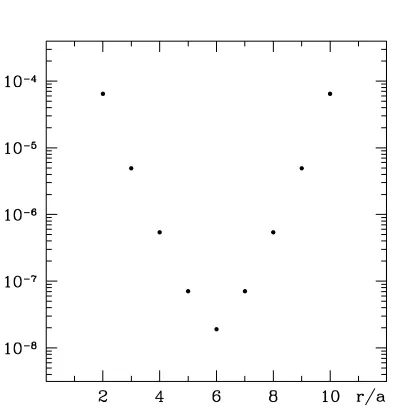
re-Figure 3. The Polyakov loop correlator on a 124, β = 5.7 lattice, computed using the hierar-chical noise reduction method. Statistical errors are smaller than the plot symbols [32].
duced Monte-Carlo integration over the degrees of freedom inside each domain. The results at each level are passed up the hierarchy to con-struct variance reduced averages of larger and larger objects. The scheme is a natural exten-sion of the temporal link “multi-hit” method [33]. They illustrate their proposal with a calcula-tion of the correlator of two spatially-separated Polyakov lines (see Fig. 3), and show a reduction of many orders of magnitude in the statistical er-ror over the standard technique.
The scheme can be extended to include mat-ter fields. If the fermion demat-terminant is included using the LBA, the action is localised within a small neighbourhood. With Wilson fermions (and the Wilson parameter set to unity) the hi-erarchical measurement scheme can be incorpo-rated without modification. The difficulty is in-cluding the stochastic accept-reject schemes usu-ally employed with the LBA to make the method exact. These rely on lattice-wide observations, involving all the gauge degrees of freedom and the domain decompositions of Ref [32] would no longer apply.
It remains an unsolved challenge to include
the highly developed tools for optimising ground-state overlap into the hierarchy scheme. Methods such as APE smearing and Teper blocking have proved crucial in the accurate calculations of the inter-quark potential and its excitations in Yang-Mills theory. Variational techniques, which build a large basis sets of creation operators for the states of interest, then find an optimal ground-state operator by diagonalisation have also dra-matically improved these calculations (for an ex-ample, see Ref. [34]). While the theoretical as-pect of including these ideas is readily resolved, it is not obvious how well this toolkit can be used within the hierarchy method in practice. An em-pirical test seems the only way to resolve this is-sue. If the noise reduction of the method of Ref. [32] can be married to the excellent ground-state construction of the smoothing and operator basis methods, then extremely precise calculations of the detailed nature of the confining string spec-trum at large separations could be performed.
7. ALL-TO-ALL FERMION PROPAGA-TORS
Having expended such a considerable number of cycles on some of the world’s largest supercom-puters in generating an ensemble of gauge field configurations, it is clear we are duty bound to make the most of the information they contain.
For many observables, believed to be sensitive to vacuum fluctuations in the quark fields, tra-ditional point-source propagator methods are in-efficient. To extract a useful signal from the en-semble, the propagator from all (or many) points to all points on the lattice is needed. There has been a good deal of interest in improving these techniques in recent years.
7.1. Gaussian and Z2 stochastic estimators A gaussian representation of a fermion matrix entry can be written [35]:
Qij =
Z
DφDφ∗ φi(φ∗Q)j exp−φ∗Q2φ . (17)
[image:6.612.90.288.105.310.2]At the conference, Duncan [36] presented simu-lation data using a gaussian all-to-all scheme. He emphasised that for many interesting physics ap-plications, this simplest of methods is adequate to ensure the dominant source of statistical er-ror is from fluctuations within the gauge ensem-ble, rather than the stochastic estimator. The stochastic degrees of freedom can be updated in a global heatbath step, but this requires a matrix inversion. Ref. [37] gives a scheme to accelerate the process; the iterative matrix solver is stopped after a small number of steps, and a Metropolis test is used to correct for the error in this step.
The Kentucky group [38] noted that other stochastic variables can be used to compute ma-trix traces, and exploited random elements ofZ2. These estimators have been employed in a range of calculations involving disconnected diagrams.
7.2. Improving stochastic estimators
Ref. [39] suggests reducing the noise in a gaus-sian estimator by dividing the lattice into two segments, then computing the independent sets of integrals in each segment exactly in a fixed background of the degrees of freedom on the in-terface between the segments. Conceptually, the new L¨uscher-Weisz hierarchy method, described in Sec. 6 is reminiscent of this scheme. The method has one restriction; the source and sink points of the propagator can not be in the same domain, so closed fermion loops can not be com-puted. In Ref. [40] a further enhancement of the method is presented.
At the conference, a method was presented by Wilcox [41] to mix gaussian and Z2 noise, al-lowing an approximate heatbath with Metropolis correction to be used.
The SESAM collaboration [42] improvedZ2 es-timators by breaking the vector space into sub-spaces (in their study, the 4 sub-sub-spaces corre-sponding to the spin indices) and performing separate stochastic estimators in each sub-space. The idea was tested further in Ref [43]. While this means more matrix inversion must be performed for a fixed stochastic ensemble size, the resulting estimators can have a significantly smaller vari-ance. This idea of thinning can be extended be-yond just spin and colour indices to spatial sites
as well. If the scheme were to be carried to the extreme, where the N dimensional vector space is decomposed intoN 1-dimensional spaces, aZ2 estimator would reproduce the exact result for any ensemble size. This is not such a surprising result, since this computation would require N inversions to be performed and it is a trivial re-sult that the trace ofM−1can be computed inN inversions. Without thinning however the error falls off, as any statistical estimate should, like 1/√N so eventually thinning must become more efficient.
The thinning procedure has not been explored fully for computations of all-to-all propagators in QCD, and it would be worthwhile to investigate this more completely.
7.3. Eigenvalue decomposition
If all the eigenvectors (and eigenvalues) of the fermion matrix are known, then any propagator entry can be computed straightforwardly. It is natural to expect that the long-range physics of QCD are contained in the lowest-lying eigenvec-tors, and these will then dominate in the spec-tral representation of a mesonic correlator (for example). The importance of understanding the physics of the lowest modes of the fermion matrix was emphasised in the plenary talk of Edwards [44].
Neff presented the conference [45] with an in-vestigation of methods for computing the low-lying eigenvectors efficiently. The acceleration comes from using a polynomial to isolate the region of eigenvalues of interest, and this leads to more rapid converges of the Arnoldi method. At the conference, Schilling [46,47] discussed the dominance of theπandηcorrelators by the low-lying eigenmodes. Truncating the spectral expan-sion introduces a systematic error, but this can be avoided by computing all-to-all propagators in a hybrid scheme (as noted by Edwards [44]).
7.4. Hybrid schemes
remain-0 0.0005 0.001 0.0015 0.002 0.0025 0.003 0.0035 0.004
0 5 10 15 20 25 30
Two-loop Function
∆t
κ=0.1575 LL l=300
[image:8.612.84.296.92.273.2]SET TEA
Figure 4. The disconnected (hairpin) correlator for the η′, computed using both an eigenvalue
decomposition (TEA) and stochastic estimators (SET) [46].
ing eigenvalues is estimated stochastically. This involves building a projection operator onto the reduced sub-space spanned by the explicitly com-puted eigenvectors.
For illustration, consider the observable
TrQ−1Γ =
N
X
i
1 λi
v∗
i Γvi. (18)
If the lowestm(m≪N) eigenvectors of the her-mitian matrixQ=γ5M are computed, then it is natural break the the spectral representation of Qinto two parts,
Q=
m
X
i=1
λivivi∗+ N
X
i=m+1
λivivi∗. (19)
Defining the (sub-space) inverses and projectors,
¯ Q(0)=
m
X
i=1 1 λi
viv∗
i, P(0)=
m
X
i=1
vivi∗ (20)
the trace becomes
TrQ−1Γ = Tr ¯Q(0)Γ + Tr ¯Q(1)Γ.
The first term is the truncated estimate, and the remaining term can be estimated stochastically;
Tr ¯Q(1)Γ = hη∗Γ ¯Q(1)ηi
= hη∗Γ(Q−1
−Q¯(0))ηi = hη∗ΓQ−1(I
− P(0))ηi. (21)
The operation ofI− P(0) is an orthogonalisation of the noise vector,ηwith respect to allmknown eigenvectors. The matrix inversion in this last step is accelerated, since the eigenvectors corre-sponding to the low-lying eigenvalues have been removed from η. It will be interesting to see hy-brid schemes tested in practical applications. The developments of GMRES algorithms presented to the conference [48] look particularly interesting in this context.
8. CONCLUSIONS
For the next few years, most large-scale simu-lations of full QCD will use the Wilson or stag-gered fermion formulation, while the chiral lattice actions [49] are beyond the reach of current com-puting resources; Ginsparg-Wilson fermions are a factor of 100 times more expensive. As pointed out by Karl Jansen, the Hybrid Monte-Carlo algo-rithm is not far off its twentieth birthday and re-mains (largely unmodified) the most popular tool for dynamical Wilson fermion simulations.
Current predictions [1] are that resources avail-able in the next few years are an order of mag-nitude below the requirements for reliable QCD simulations. Including the newest ideas psented, it might be hoped to get close to the re-quired factor of ten improvement in performance. Realistic comparative tests of HMC vs LBA have been carried out in recent years, leading to the observation that the two methods have identi-cal costs (for all practiidenti-cal purposes). These com-parisons are always very difficult to make. It would be helpful to see a standard benchmark emerge on which direct comparisons of algorithms can be made. Defining a standard is difficult but with this in place, fair races of new methods against “thoroughbred” algorithms rather than the simplest implementations could be made.
to a wider range of applications.
I am grateful to Ph. de Forcrand, C. Gebert, M. Hasenbusch, B. Jo´o, A. Kennedy, J. Kuti, M. L¨uscher, I. Montvay, H. Neff, W. Schroers, J. Sex-ton and N. Zverev for many stimulating discus-sions, observations and helpful correspondence.
REFERENCES
1. Statements to conference by A. Ukawa, H. Wittig, T. Lippert, S. Gottlieb, K. Jansen and N. Christ.
2. D. Toussaint, hep-lat/0110010 and references therein.
3. S. Duane, A. D. Kennedy, B. J. Pendleton and D. Roweth, Phys. Lett. B 195 (1987) 216. 4. R. G. Edwards, I. Horvath and A. Kennedy,
Nucl. Phys. B 484 (1997) 375.
5. C. Liu, A. Jaster and K. Jansen, Nucl. Phys. B 524 (1998) 603.
6. B. Jooet. al.[UKQCD Collaboration], Phys. Rev. D 62 (2000) 114501.
7. B. Joo [UKQCD Collaboration], hep-lat/0110047.
8. M. Luscher, Nucl. Phys. B 418 (1994) 637. 9. K. Jansen, Nucl. Phys. Proc. Suppl. 53 (1997)
127 and references therein.
10. A. Borici and P. de Forcrand, Nucl. Phys. B 454 (1995) 645.
11. I. Montvay, Nucl. Phys. B 466 (1996) 259. 12. R. Frezzotti and K. Jansen, Phys. Lett. B 402
(1997) 328.
13. R. Frezzotti et. al. [ALPHA Collaboration], Comput. Phys. Commun. 136 (2001) 1. 14. W. Schroerset al., hep-lat/0110033. 15. I. L. Bogolyubskyet. al.these proceedings. 16. F. Farchioni, C. Gebert, I. Montvay and
W. Schroers, hep-lat/0110130.
17. T. Takaishi and P. de Forcrand, hep-lat/0108012.
18. S. Aoki et al. [JLQCD Collaboration], hep-lat/0110107.
19. A. D. Kennedy and J. Kuti, Phys. Rev. Lett. 54 (1985) 2473.
20. S. Aoki et al. [JLQCD Collaboration], hep-lat/0110088.
21. R. Guptaet. al.Phys. Rev. D40 (1989) 2072., T. A. DeGrand and P. Rossi, Comput. Phys.
Commun. 60 (1990) 211.
22. S. Fischeret. al.Comput. Phys. Commun. 98 (1996) 20.
23. M. J. Peardon, hep-lat/0011080.
24. P. de Forcrand and T. Takaishi, Nucl. Phys. Proc. Suppl. 53 (1997) 968.
25. M. Hasenbusch, Phys. Lett. B 519 (2001) 177. 26. M. Hasenbusch and K. Jansen,
hep-lat/0110180.
27. J. C. Sexton and D. H. Weingarten, Nucl. Phys. B 380 (1992) 665.
28. L. Lin, K. F. Liu and J. H. Sloan, Phys. Rev. D 61 (2000) 074505.
29. Balint Jo´o. Talk presented at DUBLAT01 30. T. Bakeyev, Phys. Lett. B 519 (2001) 277. 31. A. Hasenfratz and F. Knechtli,
hep-lat/0110156.
32. M. Luscher and P. Weisz, JHEP 0109 (2001) 010.
33. G. Parisi, R. Petronzio and F. Rapuano, Phys. Lett. B 128 (1983) 418.
34. K. J. Juge, J. Kuti and C. J. Morningstar, hep-lat/0110157.
35. F. Fucito, E. Marinari, G. Parisi and C. Rebbi, Nucl. Phys. B 180 (1981) 369. 36. A. Duncan, E. Eichten and J. Yoo,
hep-lat/0110141.
37. P. de Forcrand, Phys. Rev. E 59 (1999) 3698. 38. S. J. Dong and K. F. Liu, Phys. Lett. B 328
(1994) 130.
39. C. Michael and J. Peisa [UKQCD Collabora-tion], Phys. Rev. D 58 (1998) 034506. 40. C. McNeile and C. Michael [UKQCD
Collab-oration], Phys. Rev. D 63 (2001) 114503. 41. W. Wilcox, hep-lat/0109008.
42. J. Viehoff et al. [SESAM Collaboration], Nucl. Phys. Proc. Suppl. 63 (1998) 269. 43. W. Wilcox, hep-lat/9911013.
44. R. Edwards, plenary review at this confer-ence. hep-lat/0111009.
45. H. Neff, hep-lat/0110076.
46. K. Schilling, H. Neff, N. Eicker, T. Lippert and J. W. Negele, hep-lat/0110077.
47. H. Neff, N. Eicker, T. Lippert, J. W. Negele and K. Schilling, hep-lat/0106016.
48. R. B. Morgan and W. Wilcox, hep-lat/0109009.
![Figure 2. Schwinger model simulation cost vs ˜κfor the split pseudofermion scheme [25,26].](https://thumb-us.123doks.com/thumbv2/123dok_us/1499369.690588/4.612.83.285.98.286/figure-schwinger-model-simulation-kfor-split-pseudofermion-scheme.webp)
![Figure 4. The disconnected (hairpin) correlatorfor the η′, computed using both an eigenvaluedecomposition (TEA) and stochastic estimators(SET) [46].](https://thumb-us.123doks.com/thumbv2/123dok_us/1499369.690588/8.612.84.296.92.273/figure-disconnected-hairpin-correlatorfor-computed-eigenvaluedecomposition-stochastic-estimators.webp)