A Framework for the Generation of Computer System Diagnostics in
Natural Language using Finite State Methods
Rachel Farrell
Dept Computer Science University of Malta [email protected]
Gordon Pace
Dept Computer Science University of Malta [email protected]
Michael Rosner
Dept Intelligent Computer Systems University of Malta
Abstract
Understanding what has led to a failure is crucial for addressing problems with com-puter systems. We present a meta-NLG system that can be configured to gener-ate natural explanations from error trace data originating in an external computa-tional system. Distinguishing features are the generic nature of the system, and the underlying finite-state technology. Results of a two-pronged evaluation dealing with naturalness and ease of use are described. 1 Introduction
As computer systems grow in size and complexity, so does the need for their verification. Whilst sys-tem diagnostics produced by automated program analysis techniques are understandable to devel-opers, they may be largely opaque to less tech-nical domain experts typically involved in script-ing parts of the system, usscript-ing domain-specific guages (Hudak, 1996) or controlled natural lan-guages (CNLs) (Kuhn, 2014). Such individuals require higher level, less technical explanations of certain classes of program misbehaviour.
The problem boils down to an NLG challenge, starting from the trace (representing a history of the system) and yielding a narrative of the be-haviour at an effective level of abstraction. The choice of an appropriate level of abstraction is par-ticularly challenging since it is very dependent on the specification being matched or verified.
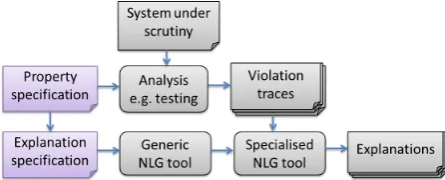
[image:1.595.308.531.206.296.2]Pace and Rosner (Pace and Rosner, 2014), showed how a finite-state (FS) system can be used to generate effective natural language descriptions of behavioural traces. Starting from a particular property, they show how more natural and abstract explanations can be extracted from a system trace violating that property. However, the approach is manual and thus not very feasible for a quality as-surance engineer. We show how their approach can be generalised to explain violations of general specifications. Since the explanation needs to be tailored for each particular property, we develop a general system, fitting as part of a verification flow as shown in Fig. 1. Typically, a quality assurance engineer is responsible for the top part of the dia-gram — giving a property specification which will be used by an analysis tool (testing, runtime verifi-cation, static analysis, etc) to try to identify viola-tion traces. With our approach, another artefact
Figure 1: The architecture for general system di-agnostics
is required, the explanation specification, which embodies the domaspecific natural language in-formation for the property in question. From this, a generic NLG tool produces a specialised gen-eration tool (embodying the domaspecific in-formation and general inin-formation implicit in the traces) which can produce explanations for viola-tions of that property. Our techniques have been implemented in a generic NLG tool, for which we show that the cost of adding user explanations for a property at an appropriate level of abstraction and naturalness is very low especially when compared to the cost of extending the system to identify such behaviours (e.g. developing test oracles or ex-pressing a property using a formal language). The main novelty has been to develop a framework for generalising the approach developed earlier. We also further substantiate the claim that there is a place for FS methods in NLG.
2 Trace Explanation Styles
doors can then either close (<c>) automatically, or after a floor request. Monitoring the prop-erty that the lift should not move with an open door, we will illustrate explanations with differ-ent degrees of sophistication of the violation trace: <a4,o,r4,a4,r2,c,d,a3,d,a2,o,r3,u>.
The simplest explanation is achieved in CNL0, where every symbol is transformed into a separate sentence, with an additional sentence at the end giving the reason why a violation occurred.
CNL0
The lift arrived at floor 4. The doors opened. A user requested to go to floor 4. The lift arrived at floor 4. A user requested to go to floor 2. The doors closed. The lift moved down. The lift arrived at floor 3. The lift moved down. The lift arrived at floor 2. The doors opened. A user requested to go to floor 3. The lift moved up. However this last action should not have been allowed because the lift cannot move with open doors.
In CNL1, the text is split into paragraphs con-sisting of sequences of sentence:
CNL1 1. The lift arrived at floor 4.
2. The doors opened. A user requested to go to floor 4. The lift arrived at floor 4.
3. A user requested to go to floor 2. The doors closed. The lift moved down. The lift arrived at floor 3. The lift moved down. The lift arrived at floor 2.
4. The doors opened. A user requested to go to floor 3. The lift moved up. However this last action should not have been allowed because the lift cannot move with open doors.
In CNL2, aggregation (Dalianis, 1999) tech-niques combine the single clause sentences from the previous two realisations to build multi-clause sentences, thus eliminating redundancy achieved through (i) the use of commas and words such as ‘and’, ‘then’, ‘but’ or ‘yet’, and (ii) the grouping of similar events, for example by stating the number of occurrences (e.g. ‘moved down two floors’).
CNL2 1. The lift arrived at floor 4.
2. The doors opened and a user requested to go to floor 4, yet the lift was already at floor 4. 3. A user requested to go to floor 2, then the
doors closed. The lift moved down two floors and arrived at floor 2.
4. The doors opened, a user requested to go to floor 3, and the lift moved up. However this last action should not have been allowed be-cause the lift cannot move with open doors.
Since the explanation contains detail which may be unnecessary or can be expressed more con-cisely, CNL3 uses summarisation — for instance, the first sentence in the explanation below sum-marises the contents of what were previously para-graphs 1–3. The last paragraph is left unchanged, since every sentence included there is required to properly understand the cause of the error.
CNL3
1. The lift arrived at floor 4, serviced floor 4, then serviced floor 2.
2. The doors opened, a user requested to go to floor 3, and the lift moved up. However this last action should not have been allowed be-cause the lift cannot move with open doors.
For Pace and Rosner the explanation language is a CNL, whose basis, described in the Xerox Finite State Toolkit (XFST) (Beesley and Kart-tunen, 2003) by a human author, states how sys-tem trace actions should be expressed. The natu-ral language explanation is obtained by composing FS transducers in a pipeline. FS technologies are best-known for the representation of certain kinds of linguistic knowledge, most notably morphol-ogy (Wintner, 2008). In contrast, we used XFST to implement linguistic techniques such as struc-turing the text into paragraphs, aggregation, con-textuality — as previously illustrated.
3 Generalised Explanations
Given a particular property, one can design a NLG tool capable of explaining its violation traces. Some of the explanation improvements presented in the previous section are common to most prop-erties. We thus chose to address the more gen-eral problem of trace violation explanations, such that, although domain-specific concepts (e.g. the meaning of individual events and ways of sum-marising them) need to be specified, much of the underlying machinery pertaining to the implied se-mantics of the event traces (e.g. the fact that a trace is a temporally ordered sequence of events, and that the events are independent of each other) will be derived automatically. The resulting ap-proach, as shown in Fig. 1, in which we focus on theGeneric NLGcomponent uses the domain-specific information about a particular property (the Explanation Specificationscript provided by a QA engineer) to produce an explanation genera-tor for a whole class of traces (all those violating that property). A specification language was cre-ated to facilitate the creation of a specification by non-specialist users. A script in the general trace-explanation language is used to automatically con-struct a specific explanation generator in XFST, going beyond a NLG system by developing a gen-erator of trace explanation gengen-erators.
4 Specifying Trace Explanations
Scripts for our framework allow the user to spec-ify the domain-specific parts of the explanations for a particular property, leaving other generic language features to be deduced automatically. The core features of the scripting language are:
Explaining events: Rather than give a com-plete sentence for each event represented by a symbol, we split the information into thesubject andpredicate, enabling us to derive automatically when sequential actions share a subject (thus allowing their combination in a more readable form). For example, theEXPLAINsection of the script is used to supply such event definitions:
EXPLAIN { <a4>: {
subject: "the lift";
predicate: "arrived at level four"; }
Events in context: Certain events may be better explained in a different way in a different context. For instance, the eventa4would typically be de-scribed as ‘The lift arrived at floor four’, except for when the lift is already on the fourth floor, when one may say that ‘The lift remained at floor four’. Regular expressions can be used to check the part of the trace that precedes or follows a particular event to check for context:
<a4>: {
subject: "the lift"; predicate {
context: {
default: "arrived at level four"; <r4>_ : "remained at floor four"; }
} }
Compound explanations: Sometimes, groups of symbols would be better explained together rather than separately. Using regular expressions, the EXPLAIN section of the script allows for such terms to be explained more succinctly:
<r2><c><d><a3><d><a2>: { subject: "the lift"; predicate: "serviced floor 2"; }
Errors and blame:Errors in a violation trace typ-ically are the final event in the trace. We allow not only for the description of the symbol in this con-text, but also an explanation of what went wrong and, if relevant, where the responsibility lies:
ERROR_EXPLAIN { [<u>|<d>]: {
blame: "due to a lift controller malfunction"; error_reason:
context: { default: "";
[<o>[<r1>|<r2>|<r3>|<r4>]]_:
"the lift cannot move with open doors"; }
} }
Document structure: A way is needed to know how to structure the document by stating how sen-tences should be formed and structured into para-graphs. Using CNL1 as an example, we can add a newline after the lift arrives at a floor. Similarly, based on the example for CNL2, we specify that the event sequence <o><r4><4> should be ag-gregated into a (enumerated) paragraph:
SENTENCE_AGGREGATION{
[<1>|<2>|<3>|<4>]: { newline: after; } <o><r4><4>;
}
5 Evaluation
Two aspects of our approach were evaluated: (i) How much effort is required to achieve an accept-able degree of naturalness, and (ii) How difficult it is for first time users to write specifications.
5.1 Effort In-Naturalness Out
Since, using our framework a degree of natural-ness can be achieved depending on the complexity of the logic encoded in our script, unsatisfactory explanations may be caused by limitations of our approach or just a badly written script. The frame-work was first evaluated to assess how effort put into writing the script for a particular property cor-relates with naturalness of the explanations.
To measure this, we considered properties for an elevator controller, a file system and a coffee vending machine. We then built a series of scripts, starting with a basic one and progressively adding more complex features. For each property, we thus had a sequence of scripts of increasing com-plexity, where the time taken to develop each was known. These scripts were then executed in our framework on a number of traces, producing a cor-pus of natural language explanations each with the corresponding trace and associated script develop-ment time. The sentences together with the cor-responding trace (but not the script or time taken to develop it) were then presented using an online questionnaire to human judges who were asked to assess the naturalness, readability and understand-ability of the generated explanations.
Explanations were rated on a scale from 1–61.
Evaluators were presented with a fraction of the generated explanations, shown in a random order, to prevent them from making note of certain pat-terns, which might have incurred a bias. Over 477 responses from around 64 different people.
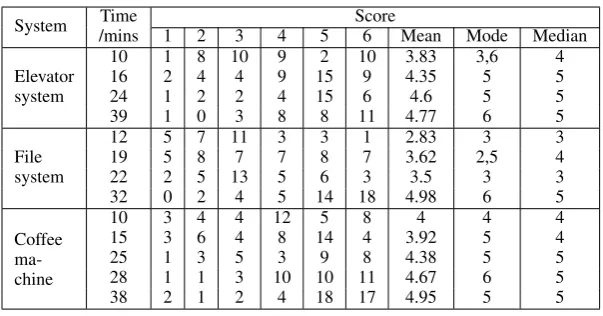
The results of this analysis can be found in Ta-ble 1, which shows the scores given to explana-tions for the different systems and for traces pro-duced by the scripts with different complexity. The results show that the naturalness of the gen-erated explanations was proportional to the time taken to write the scripts — the best-faring expla-nations having a high rate of aggregation and sum-marisation. Interestingly, even with scripts written quickly e.g. 15–20 minutes2many evaluators still
found the explanations satisfactory.
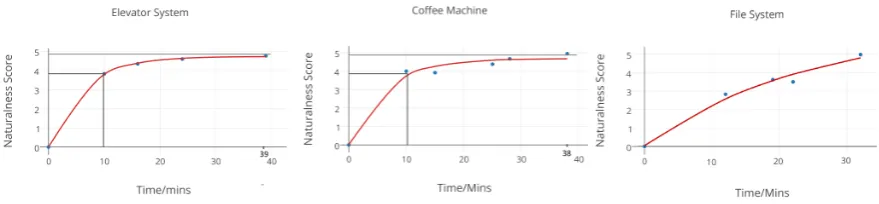
Figure 2 shows the results of plotting time taken to write the script (x-axis) against naturalness of the explanation (y-axis). For the coffee machine and elevator controller traces, the graphs begin to stabilise after a relatively short time, converging to a limit 80% of which is roughly achieved dur-ing the first 20–30% of the total time taken to cre-ate the most comprehensive script we wrote. The graph for the file system traces gives a somewhat different view; a higher overall score is obtained, yet we do not get the same initial gradient steep-ness3. A reason for the discrepancy in the graph
shape could be that traces obtained for this system contained many repeated symbols in succession, hence until a script handled this repetition, the ex-planations received low scores. This shows that there may exist a relation between the kind of sys-tem being considered and the effort and linguistic techniques required to generate natural sounding explanations for its traces.
1From 1–6: unnatural and difficult to follow, unnatural but somewhat easy to follow, unnatural but very easy to follow, contains some natural elements, fairly natural, very natural and easy to follow.
2Recall that one script can be used to explain any counter-example trace for that property, and would thus be repeatedly and extensively used during system verification or analysis.
Table 1: Overall scores given to generated explanations
System /minsTime 1 2 3 4 5 Score6 Mean Mode Median
10 1 8 10 9 2 10 3.83 3,6 4
Elevator 16 2 4 4 9 15 9 4.35 5 5
system 24 1 2 2 4 15 6 4.6 5 5
39 1 0 3 8 8 11 4.77 6 5
12 5 7 11 3 3 1 2.83 3 3
File 19 5 8 7 7 8 7 3.62 2,5 4
system 22 2 5 13 5 6 3 3.5 3 3
32 0 2 4 5 14 18 4.98 6 5
Coffee ma-chine
10 3 4 4 12 5 8 4 4 4
15 3 6 4 8 14 4 3.92 5 4
25 1 3 5 3 9 8 4.38 5 5
28 1 1 3 10 10 11 4.67 6 5
38 2 1 2 4 18 17 4.95 5 5
We can thus conclude that whilst a certain inher-ent limit exists, natural-sounding explanations can be well achieved using this system. Effort however is rather important, and usually, the more time in-vested in building a script, the better the quality of the output. Nevertheless, even with minimal ef-fort, a script author highly familiar with the input language can obtain a rather satisfactory output.
5.2 User Acceptance Test
To assess the framework’s accessibility, we ran a four-hour experiment with four new users familiar with concepts such as regular expressions. They were requested to produce scripts to explain dif-ferent properties unaided and were then asked to rate the ease of use and expressivity of the input language, their satisfaction with the output gener-ated, and whether it matched their expectations. Given the low number of participants, the results are only indicative, and assessing the quality of the scripts they produced would not have given statis-tically meaningful results.
Overall, these users characterised the script-ing language between somewhat difficult toeasy to use. Dealing with contextual explanation of events presented the greatest challenges, although all managed to produce an error explanation which required using this concept. Apart from simply ex-plaining every symbol as a complete sentence, the users also managed to create scripts involving ag-gregation and summarisation. The users expressed satisfaction with the explanations produced, al-though one of the subjects commented that scripts sometimes had to be executed to understand ex-actly the effect of a particular line of code.
The fact that all users managed to produce suc-cessful scripts within four hours indicates that it is not excessively difficult to use. That the over-all idea was easily understood and the input lan-guage quickly learnt suggests that this kind of sys-tem could minimise the overheads associated with the task of automated explanation generation for systems more complex than those illustrated here. 6 Related Work
BabyTalk BT-45 (Reiter et al., 2008) generates textual summaries of low-level clinical data from
a Neonatal Intensive Care Unit. Summaries are created for different audiences, such as doctors and nurses, to help them in making treatment decisions. Generated summaries were found to be useful, but lacking in narrative structure com-pared to those created by humans. Further inves-tigation is needed to determine where the trade-offs lie between acceptable explanations, underly-ing data complexity, and computational efficiency. Power (Power, 2012) describes OWL-Simplified English, a CNL for non-specialists used to edit semantic web ontologies in OWL, notably em-ploying FS techniques for the definition of a user-oriented communication language. See also (Gal-ley et al., 2001) whose NLG system combines FS) grammars with corpus-based language mod-els. These works are limited to producing gener-ators for any trace, rather than creating a higher-order framework which is used to write scripts which produce the generators.
7 Conclusions
Figure 2: Graphs of the naturalness score given against the time after which the corresponding input script was created
References
Kenneth R Beesley and Lauri Karttunen. 2003.
Finite-state morphology, volume 3 ofStudies in computa-tional linguistics. CSLI Publications.
Hercules Dalianis. 1999. Aggregation in naltural
language generation. Computational Intelligence,
15(04).
Michel Galley, Eric Fosler-lussier, and Ros Potami-anos. 2001. Hybrid natural language generation
for spoken dialogue systems. In In Proceedings of
the 7th European Conference on Speech Communi-cation and Technology, pages 1735–1738.
Paul Hudak. 1996. Building domain-specific
embed-ded languages. ACM Computing Surveys, 28:196.
Tobias Kuhn. 2014. A survey and classification of
con-trolled natural languages. Computational
Linguis-tics, 40(1):121–170, March.
Gordon J. Pace and Michael Rosner. 2014. Explain-ing violation traces with finite state natural language generation models. In Brian Davis, Kaarel
Kalju-rand, and Tobias Kuhn, editors, Controlled
Natu-ral Language, volume 8625 of Lecture Notes in Computer Science, pages 179–189. Springer Inter-national Publishing.
Richard Power. 2012. Owl simplified english: A finite-state language for ontology editing. In To-bias Kuhn and Norbert E. Fuchs, editors,Controlled Natural Language, volume 7427 ofLecture Notes in Computer Science, pages 44–60. Springer Berlin Heidelberg.
Ehud Reiter, Albert Gatt, Franc¸ois Portet, and Marian van der Meulen. 2008. The importance of narra-tive and other lessons from an evaluation of an nlg
system that summarises clinical data. In
Proceed-ings of the Fifth International Natural Language Generation Conference, INLG ’08, pages 147–156, Stroudsburg, PA, USA. Association for Computa-tional Linguistics.
Shuly Wintner. 2008. Strengths and weaknesses of finite-state technology: a case study in
morphologi-cal grammar development. Natural Language