Proceedings of the Second International Conference on Dependency Linguistics (DepLing 2013), pages 98–107,
Pragmatic Structures in Aymara
Petr Homola
Codesign, s.r.o.
Czech Republic
[email protected]
Matt Coler
INCAS
3The Netherlands
[email protected]
Abstract
The paper describes overt marking of in-formation structure in the indigenous An-dean language Aymara. In this paper we show that although the word order is free, Aymara is not a discourse-configurational language (Kiss, 1994); instead, informa-tion structure is expressed only morpho-logically by pragmatic suffixes. The mark-ing of ‘topic’ is more flexible that the marking of ‘focus’ (be it at the clause level or NP-internal). Since overt marking of information structure is partial, this pa-per also devotes considerable attention to the resolution of underspecification in Ay-mara.
1 Introduction
Chomsky’s original approach to formal syntax as-sumes that sentences consist of constituents and that the type and order of these constituents define configurations that specify grammatical relations. As has been shown by Hale (1983), there are lan-guages in which word order has no or limited rele-vance for grammatical relations and the respective constituent trees are flat. In most such languages, word order is said to specify information struc-ture (hence the name discourse-configurational languages coined by Kiss (1994), as opposed to syntax-configurational languages). We show that Aymara is neither syntax-configurational nor discourse-configurational. In this language, in-formation structure is expressed solely morpho-logically. This is very rare and therefore Ay-mara is very important for the research of informa-tion structure in general. As Bossong (2009) puts it (referring to Aymara and Quechua): “Cross-linguistically, grammemes explicitly expressing the function of theme are not very frequent; gram-memes expressing the function of the rheme are a
highly marked typological rarity [. . . ]. Still more idiosyncratic is the combination of the thematic marker with a grammeme combining the two func-tions ofquestionandnegation.”
We are not aware of any other language (except for, to some extent, Quechua) in which word or-der is irrelevant to information structure. Hard-man (2000) says about Aymaran languages that “[t]he structural elements of a sentence may occur in any order and are at the disposal of the speaker for stylistic play.” Hardman et al. (2001) say that word order in Aymara “affects only style, not the grammar nor basic semantics.” Bossong (1989) says about Quechua (which is typologically very similar) that “word order is not only free but it is not primarily used as a means for expressing pragmatic functions as such.” A detailed analy-sis of morphological information structure mark-ing in Aymara can thus shed light on this module of grammar which is not expressed morphologi-cally in most languages.
Section 2 presents basic facts about Aymara. Section 3 describes the overtly marked discourse categories in Aymara. Section 4 describes the means of morphosyntactic, semantic and matic referent identification. Section 5 treats prag-matic marking in complex predicates. Finally, we conclude in Section 6.
2 Basic Facts about Aymara
Aymara is spoken by communities in a region en-compassing Bolivia, Chile and Peru, extending north of Lake Titicaca to south of Lake Poopó, be-tween the western limit of the Pacific coast val-leys and eastward to the Yungas valval-leys. The lan-guage is spoken by roughly two million speakers, over half of whom are Bolivian. The rest reside in Peru and Chile. The Aymaran family (com-prised of Aymara, Jaqaru, and Kawki) is a lin-guistic isolate with no close relative. Aymara is
an affixal polysynthetic1 language (according to Mattissen’s (2006) classification) with a rich mor-phology. It is SOV with modifier-head word order. Aside from the morphologically unmarked sub-ject, all syntactic relations are case-marked, typi-cally on the NP head. Roots can be divided into nouns (including qualitative words), verbs, and particles. Suffixes, which may have a morpholog-ical or syntactic effect, can be classified as nomi-nal, verbal, transpositionomi-nal, independent, or prag-matic suffixes. The category of independent suf-fixes is comprised of three sufsuf-fixes which are not classifiable as members of either nominal or verbal morphology which likewise cannot be said to be pragmatic suffixes. These suffixes generally occur prior to inflectional morphology and/or the prag-matic suffixes. Pragprag-matic suffixes, by comparison, typically suffix to the last word of the entire sen-tence and/or the NP or VP. As their name suggests, their function is overall pragmatic in nature. Nom-inal and verbal suffixes can be subdivided into inflectional and derivational categories, but given the ease with which category-changing transposi-tional suffixes attach to words of any category, of-ten multiple times, it is common to find words with several nominal, verbal, transpositional, and inde-pendent suffixes.
Detailed information can be found in (Hardman et al., 2001; Briggs, 1976; Adelaar, 2007; Cerrón-Palomino and Carvajal, 2009; Yapita and Van der Noordaa, 2008).
3 Overt Marking of Information
Structure
As mentioned in the introduction, word order in Aymara is not used to express information struc-ture. As an example, consider the following sen-tences in English (syntax-configurational), Rus-sian (discourse-configurational) and Aymara (sub-script N marks contextually new, i.e. nonpre-dictable information):
(1)
(a) Peter cameN
It’s PeterNwho came(*Came Peter) (b) Pëtr prišëlN
Prišël PëtrN
(c) Pedrox jutiwaNorJutiwNPedroxa PedrowNjutixaorJutix PedrowaN 1See (Baker, 1996).
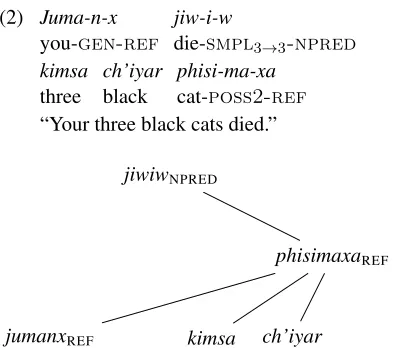
Due to overt morphological marking of infor-mation structure, there are discontinuous phrases in which the “gap” is not motivated by pragmat-ics, such as (2)2. The corresponding tree is given in Figure 1.
(2) Juma-n-x
you-gen-ref
jiw-i-w
die-smpl3→3-npred
kimsa
three ch’iyarblack phisi-ma-xacat-poss2-ref
“Your three black cats died.”
jiwiwNPRED
phisimaxaREF
[image:2.612.316.513.118.293.2]jumanxREF kimsa ch’iyar
Figure 1: The surface syntax tree of (2) with a dis-continuous noun phrase
Of course, the possessive pronounjumanxcould also form a continuous constituent with the rest of the NP. Or, it might be omitted since the posses-siveness is already expressed with the suffix-ma
(phisimaxa).
Overt marking of information structure is oblig-atory in Aymara. A sentence without proper prag-matic suffixes (or with marking that would destroy intersentential cohesion) is considered ill-formed. It should also be noted that the marking of infor-mation structure is orthogonal to the morphosyn-tactic expression of evidentiality.3
3.1 Referentiality
Aymara has overt marking of referentiality. The notion of referentiality roughly corresponds to 2We use the following abbreviations in the glosses: ACC=accusative, AG=agentive, AGGR=aggregator, ALL=allative, BEN=benefactive, CAUS=causative, COM=comitative, CONJ=conjectural, DIR=directive, FUT=future tense, GEN=genitive, HON=honorific, HUM=human, IMPER=imperative, INCMPL=incompletive, INF=infinitive,LIM=limitative,LOC=locative,MIR=mirative, NEG=negative, NPRED=nonpredictable, PAST=past tense, PART=past participle, POSS=possessive, POSS1=1st person possessive, POSS2=2nd person possessive, POSS3=3rd person possessive, POT=potential, PROGR=progressive, QM=question marker, REF=referential, REFL=reflexive, SMPL=simple tense, TRGRDS=transgressive (differ-ent subject), TRGRSS=transgressive (same subject), VRBL=verbalizer
what Sgall et al. (1986) call ‘contextual bound-edness’. We follow Sgall’s (2009) terminology here: “[Contextually bound] items are presented by the speaker asreferringto entities assumed to be easily accessible by the hearer(s), in the pro-totypical case ‘given’. They refer to ‘established’ items, i.e. to those that were mentioned in the pre-ceding co-text and thus still are sufficiently salient, or to the permanently established ones (indexicals, those given by the relevant culture or technical do-main, etc.).”4
For the majority of bilingual speakers, referen-tiality is optionally marked with the suffix -xa,5 however for monolinguals it is done so more con-sistently. There are also slight dialectal differ-ences.
For example, in (3) the verb is marked as refer-ential because the event is known from the context (the speaker supposes that the hearer knows that someone came, otherwise he would not ask). (3) Khiti-s
who-qm jut-i-xa?come-SMPL3→3-REF “Who did come?”
On the other hand, in (5) the verb is not marked as referential because it expresses an event which is apparently unknown to the hearer (since he has expressed surprise in (4)).
(4) Aka-n-ka-sk-ta-sä
this-loc-vrbl-progr-smpl2→3-mir
“Oh, you are here!” (5) Jïsa,
yes wasüru-wyesterday-npred kutin-x-ta
return-COMPL-SMPL1→3 “Yes, I came back yesterday.”
The adverbial expressionwasüruw“yesterday” is marked as nonpredictable6 (even though it is inherently referential) because it is more salient than the verb7 (B is surprised to see A because 4We do not use the terminology ‘topic-focus’ or ‘theme-rheme’ because the paradigms of suffixes that express infor-mation structure do not correlate with it. For example, the two paradigms are not always mutually exclusive (two suf-fixes from different paradigms can mark the same word).
5In the literature this suffix is usually called “topic marker” or “attenuator”.
6This grammatical feature is described in the next subsec-tion.
7“More salient” means that it is more important in the cur-rent context. Informally, we could also say “less predictable”. The scale of salience is important for intersentential referent identification.
he thought that A had left or was about to leave). Nonetheless, the verb is nonpredictable, too, be-cause B does not know what exactly happened (A may have come back earlier or may not have left at all).
Note that -xa marks referentiality, not known/given information, as illustrated in (6). (6) Qharüru-x
tomorrow-ref sara-:-wago-fut1→3-npred
“I will go tomorrow.”
The adverbial expressionqharürux“tomorrow” is marked as referential because it is inherently ref-erential but there is no marking which would spec-ify if it is predictable or not (the verb is already marked as nonpredictable and there can be at most oneNPRED-marker per clause, as explained in the next subsection).8
It should be noted the theREF-marking is priva-tive, i.e. the absence of-xadoes not mean that the entity is not referential.
3.2 Nonpredictability
Entities are nonpredictable if they are ‘new’ to the hearer (cf. the usual dichotomy of informa-tion structure known/given vs. unknown/new).9 Overt marking of nonpredictability in Aymara is much more consequent than that of referentiality. In affirmative sentences, the most salient nonpre-dictable entity is marked with the suffix -wa.10 The placement of the NPRED-marker can be best explained by question/answer pairs, such as (7) and (8).
(7) Khiti-taki-s
who-ben-qm ut-xhouse.acc-ref uta-ch-ta-xa
house-caus-smpl2→3-ref
“For whom did you build the house?” 8A reviewer suggested to compare pragmatic marking in Aymara with ‘topic’-markers in Japanese and/or Korean. First of all, whereas in the mentioned languages, topic mark-ing interferes with case markmark-ing, in Aymara they are orthog-onal. Also, in Aymara the use of pragmatic markers does not affect word order. Finally, there are no free topics as in the following sentence from (Iwasaki, 2013):
Zoo-waTOPhana-gaNOMnagai “The elephant; its nose is long.”
In Aymara, even if the word order of a NP is relaxed, all parts of the NP agree with each other.
9Again, we follow Sgall’s (2009) terminology: “[Contex-tually non-bound] items are presented asnotdirectly pre-dictablein the given context, as ‘new’ information (at least as chosen from a set of available alternatives).”
(8) Jilata-ja-taki-w
brother-poss1-ben-npred (uta-ch-t-xa)
house-caus-smpl1→3-ref
“(I built it) for my brother.”
In negative sentences, the NPRED-marker is usually attached to the negative particle jani, as in (9).
(9) Jani-w
not-npred kullaka-ma-rsister-poss2-all uñj-k-t-ti
see-incmpl-smpl1→3-neg
“I did not see your sister.”
However, if an argument of the verb is more salient than the verb (i.e., it is contrastive), it at-tracts theNPRED-marker, as in (10).
(10) Kullaka-ma-ru-w
sister-poss2-all-npred jan
not
uñj-k-t-ti
see-incmpl-smpl1→3-neg
“It is your sister whom I did not see.”
There are constructions in whichNPRED-marks are disallowed, for example in imperative con-structions or in those marked with the conjectural evidential suffix:
(11) Chur-ita-ya
give-imper2→1-hon
“Give it to me, please.”
(12) Jut-chi-ni
come-conj-fut3→3
“Maybe he will come.”
NPRED-unmarked affirmative sentences in the future tense tend to have imperative meaning:
(13) Sara-ñäni
go-fut4→3
“Let us go.”
An affirmative sentence without NPRED -marking in the future tense does not alter the context of the present discourse and may have modal meaning (Hardman et al., 2001):
(14) Nay
I
sar-ä-xa
go-fut1→3-ref
“I will go, right? / Should I go?”
Noun phrases introduced bymä“one” are indef-inite and therefore always nonpredictable. Noun phrases with the determiners aka “this”, uka
“that”, khaya (khä) “yonder” and khuri “away yonder” are definite and therefore usually pre-dictable unless they are explicitlyNPRED-marked (in which case they are contrastive). The following example illustrates that referentiality and nonpre-dictability do not exclude each other.
(15) Aka
this
warmi-mpi-w
woman-com-npred mäone
jisk’a
small
marka-n
village-loc jiki-s-t-xameet-refl-smpl1→3-ref
“It is this woman whom I met in a small village.”
In verbal complexes, the main (nonfinite) verb may beNPRED-marked, as in (16) and (17):
(16) T’ant’
bread.ACC
ala-ñ-w
buy-inf-npred mun-ta
want-smpl1→3
“I want to buy bread.”
(17) T’ant’
bread.ACC
al-iri-w
buy-ag-npred sara-sk-ta
go-progr-smpl1→3
“I am going to buy bread.”
3.3 Deeply Embedded Nonpredictable Elements
Nonpredictability is usually marked at clause level but it can occur inside a noun phrase11 if it is required by the discourse context, as in (18) (from (Hardman et al., 2001)).12
(18) Naya-n-x
I-gen-ref pusi-wfour-NPRED uta-ja-x
house-poss1-ref utj-ituexist-smpl3→1
“As for houses, I have four.”
This example shows thatREFandNPRED mark-ers need not appear at the end of a (semantic) phrase. Similarly, a nominal modifier may follow 11Hajiˇcová et al. (1998) call this kind of information-structural markingproxy focus.
its governor if its information structure status dif-fers from that of its head in which case both words receive pragmatic marking, as in (19) (from (Hard-man et al., 2001)).
(19) Uka-x
that-ref apilla-xoca-REF luxu-cha-ta-wa
freeze-caus-part-npred
“That isFROZENoca.”
Aymara is a radically nonconfigurational lan-guage.13 However, even languages from this class may pose word order constraints on “deeply” em-bedded phrases. Indeed, in Aymara noun phrases have more rigid word order than clause con-stituents.14 For example, while (20) is well-formed, (21) is ill-formed because the modifier
suma“good” does not precede its head.
(20) Suma
good
chuq’i-w
potato-npred akathis
marka-n-x
village-loc-ref ach-ugrow-smpl3→3
“In this village grow good potatoes.”
(21) *Chuq’i-w
potato-npred sumagood
aka
this
marka-n-x
village-loc-ref ach-ugrow-smpl3→3
Intended meaning: “In this village grow good potatoes.”
Nevertheless the order of a nominal modifier and its head is not restricted if both have a prag-matic marker, as in (22)–(24).
(22) Suma-w
good-npred aka
this
marka-n-x
village-loc-ref chuq’i-x
potato-ref ach-ugrow-smpl3→3
“GOODpotatoes grow in this village.”
(23) Uta-cha-ña-taki-x
house-caus-inf-ben-ref qala-xstone-ref alluxa-w
a-lot-npred apthapi-ñagather-inf
“One must gatherMANYstones to build a house.”
13In terms of the generative grammar, languages with the rule S→ C+at clause level.
14Unlike, for example, in Latin, where the word order of NPs is less rigid although not completely free.
(24) Qullq-x
money.acc-ref allux-wa-lot.acc-npred ap-kat-ta
put-dir-smpl1→3
“I collectedA LOTof money.”
Thus Aymara, like many nonconfigurational languages, allows discontinuous constituents. For example, in (22), the noun phrasesumaw chuq’ix
“good potatoes” is discontinuous because aka markanx“in this village” is not part of its surface syntax subtree.
3.4 Focalizers
“Focalizers” (i.e. focusing operators, in English adverbs such asonly, even, also, always, at least,
etc., see (Hajiˇcová et al., 1998)) are mostly ex-pressed by suffixes in Aymara. In many cases, the word with a focalizing suffix attracts theNPRED -marking, as in (25)–(28).
(25) Kimsa-ni-ki-w
three-hum-lim-npred sar-igo-smpl3→3
“Only three went.”
(26) Wawa-pa-x
child-poss3-ref
may-ni-ki-wa
one-hum-lim-npred
“He has only one child.”
(27) Iki-ña-k-w
sleep-inf-lim-npred mun-t-xa
want-smpl1→3-ref
“I only want to sleep.”
(28) Nay
I kuna-wwhat-npred sar-t-xago-smpl1→3-ref
“Even I went.”
Another pattern is attaching the independent ag-gregator -sa to the focalized word together with NPRED-marking of the verb, as in (29) and (30).
(29) Naya-s
I-aggr sara-rak-t-wago-‘also’-smpl1→3-npred
“I also went.”
(30) Juma-ki-s
you-lim-aggr yati-sma-waknow-pot2→3-npred
“At least you should know it.”
see (10)). Two focalizers can be combined, as in the case of jani and puni “always” which gives the formjanipuni“never” orjaniandraki“also” which gives the form janiraki “neither”. Both forms attract theNPRED-marking.
3.5 Resolving Underspecification
As was demonstrated in the above description, overt marking of information structure in Aymara is partial, as it leaves some elements underspec-ified. Since Aymara is a radical pro-drop lan-guage15 (any argument of the verb may be unex-pressed, not only the subject), predictable argu-ments are often omitted. As a consequence, direct objects are usually omitted if they can be inferred from the context, as in (31).16
(31) Tata-ja-taki-w
father-poss1-ben-npred ala-sk-t-xa
buy-progr-smpl1→3-ref
“I am buying it for my father.”
It follows that if a verb is NPRED-marked and has an overt object, the latter is nonpredictable, too, unless it isREF-marked, as in (32).
(32) Naya-w
I-npred um-xwater.acc-ref wayu-ni-:-xa
carry-dir-fut1→3-ref
“It is me who will bring the water.”
The same holds for other verbal arguments. The only ambiguity arises from inherently referen-tial expressions which appear REF-marked or un-marked (e.g.,qharürux/qharüru“tomorrow”) and this marking does not correlate with their nonpre-dictability.17
3.6 Intersentential Cohesion
Overt marking of information structure, described in the previous section, has crucial importance for intersentential cohesion and can be helpful for coreference resolution. Consider, for example, the following two sentences:
15See (Cole, 1987).
16The sentence is an answer to the questionWho are you
buying it for?
17It is possible that the category of referentiality is under-going a reanalysis as a result of language contact. A more detailed analysis of the speech of monolingual speakers is needed.
(33) Mä
one
marka-n
village-loc mäone
jisk’a
small
imilla-w
girl-NPRED utj-i
exist-smpl3→3
“There was a little girl in a village.” (34) Jupa-x
she-ref MariyaMaría suti-ni-waname-poss-npred
“Her name was María.”
In (33), both noun phrases as well as the verb are nonpredictable. The noun imilla “girl” is NPRED-marked (i.e., marked as the most salient part of the utterance) because in (34), it is referred to by the pronounjupa“he/she”.
The analysis of utterances in texts such as sto-ries and narratives reveals that Aymara speakers consequently take intersentential cohesion into ac-count when they decide where to place pragmatic markers.
4 Referent Identification
Surface and deep syntax as well as semantics oper-ate on isoloper-ated sentences. Now we will discuss the formalization of pragmatics, the level of discourse context.
For the purposes of this subsection we assume that we have a discourse that consists of sentences s1, . . . , snand that we have the corresponding fea-ture strucfea-turesf1, . . . , fn. An entity we call a fea-ture strucfea-ture that represents a person, an object or an event (an event may be dynamic if described by a verb or statal if described by a nominal predi-cate). Every entity has a special attribute, INDEX, to represent coreferences.
The discourse context is formally a list of indices (values of the INDEX attribute) C =
hi1, . . . , imi. The sentences are processed one by
one. At the beginning,C=∅. For everyfi, we do the following:
1. For every entity infi, we try to find its refer-ent inC(we describe below how referents are identified). If a referent was found for an en-tity, its index inC is moved to the beginning of the list. Otherwise, a new index is assigned to the entity and prepended to the list. 2. The index of the NPRED-marked entity is
4.1 Morphosyntactic Referent Identification
Aymara has a rich system of switch-reference suf-fixes that help to identify referents in the discourse context. For example, the sentence
(35) Tumasi-xi Thomas-ref klasi-n-ka-ska-:n-wa
class-loc-vrbl-progr-past3→3-npref
“Thomasiwas in the class room.”
may be followed by the following sentence:
(36) Yatichiri-xj
teacher-ref manta-n-isin-xenter-dir-trgrss-ref nuw-i-wa
hit-smpl3→3-npred
“When the teacherjentered, hejhit himi.”
The first sentence adds the index of the en-tity Tumasixi “Thomas” to C. The second sen-tence adds the index of the entityYatichirixj “the teacher” to C. Furthermore, there are two unre-solved (covert) pronouns that represent the actor and the patient ofnuwiwa“to hit”. In this case the switch-reference transgressive suffix -sina speci-fies that the actor ofnuwiwais the actor of man-tasinx“entered”, thus the actor ofnuwiwahas the index i. The patient is coindexed with the next entity in C with which it agrees morphologically (e.g., in terms of animacy) or semantically. On the other hand, the sentence
(37) Yatichiri-xj
teacher-ref manta-n-ipan-xenter-dir-trgrds-ref nuw-i-wa
hit-smpl3→3-npred
“When the teacherjentered, heihit himj.”
changes the indexes of the pronouns in the ma-trix sentence because the switch-reference trans-gressive suffix-ipanaspecifies that the subject of
mantanipanxis different from that ofnuwiwa.
4.2 Semantic Referent Identification
If there is the sentence
(38) Tumasi-mpi
Thomas-com Marya-mpMary-comj uñj-t-wa
see-smpl1→3-npred
“I saw Thomasiand Maryj.”
followed by (39) Jani-w
not-npred usuri-:-ta-ppregnant-vrbl-part-poss3 yat-k-t-ti
know-incmpl-smpl1→3-neg
“I did not now that shej was pregnant.” the referent identification of the covert pronoun which is the actor ofusurïtap“that she was preg-nant” is not morphosyntactically restricted (Ay-mara has one pronoun, jupa, for both “he” and “she”) but it is semantically restricted. It is obvi-ous that the semantic information of this kind has to come from the lexicon. Likewise, there will be lexically encoded semantic gender for words such astayka“mother”,jilata“brother”,imilla“girl”, etc.
4.3 Pragmatic Referent Identification
As described in Subsection 3.6, explicitlyNPRED -marked entities are more salient than other non-predictable entities in the same sentence. If there is the sentence
(40) Tayka-ma-wi
mother-poss2-npred yatichiri-ma-mpj
teacher-poss2-com jik-i-simeet-smpl3→3-refl
“Your motherimet your teacherj.” followed by
(41) Usuta-:-ta-m-x
sick-vrbl-part-poss2-ref yat-x-i-wa
know-compl-smpl3→3-npred
“Sheialready knew that you were sick.” the actor ofyatxiwa“s/he already knew” is coin-dexed withtaykamaw“your mother” because this entity is NPRED-marked in the first sentence and therefore more salient (it precedes other entities in C). If we move theNPRED-marker in the first sen-tence to the “teacher”, the meaning of the second sentence will change:
(42) Tayka-ma-xi mother-poss2-ref yatichiri-ma-mpi-wj
teacher-poss2-com-npred jik-i-si
meet-smpl3→3-refl
(43) Usuta-:-ta-m-x
sick-vrbl-part-poss2-ref yat-x-i-wa
know-compl-smpl3→3-npred
“Hejalready knew that you were sick.”
5 Complex Predicates
A special case of pragmatic marking represent the so-called complex predicates, i.e. monoclausal predicates composed of (at least) two predicative elements. In such constructions, a (fully) semantic verb combines with a modal or auxiliary element to express complex predication such as causative, volitive, supine, etc. The concept of complex predicates, elaborated by Alsina (1996), has been applied to a number of phenomena and languages including, for example, Hindi light verbs (Mo-hanan, 1994) or Turkish causatives (Çetino˘glu et al., 2008). We will leave aside the rather compli-cated formal treatment of these constructions in unification-based grammars (Homola and Coler, 2013) and focus on the linguistic description of these form in Aymara from the pragmatic point of view here.
Sentences (16) and (17) are examples of com-plex predicates. The constructions contain only one NPRED-marker, i.e. they are monoclausal and should be represented by a single feature structure with a complex functor. For (16), we get:
(44) FUNC ‘muna-’ ARGS *
subjact,
FUNC ‘ala-’ ARGS hsubjact,
dobjpati pat +
For (17), we get:
(45) FUNC ‘sara-’ ARGS *
subjact,
FUNC ‘ala-’ ARGS hsubjact,
dobjpati pat +
In a more concise notation, (44) can be written as:
(46) muna(subjact,ala(subjact,dobjpat)pat)
Likewise, (45) can be written as:
(47) sara(subjact,ala(subjact,dobjpat)pat)
Unlike in languages with morphologically formed volitive verbal complexes, such as
Guaraní, in Aymara such constructions are formed syntactically (i.e. the complex predicate value is not created in the lexicon). As for motion verbs, such as (45), there is a morphological alternative:
(48) Jichha-x
now-REF t’ant
bread.ACC ala-ni-rapi-:ma-wa
buy-DIR-BEN-FUT1→2-NPRED
“I will go to buy bread for you now.”
Further evidence that such predicates are mon-oclausal is the fact that polypersonal agreement is expressed on the auxiliary or modal verb, not the full one, as in (49) and (50).
(49) Ch’uq
potato.ACC
alja-ñ-w
sell-INF-NPRED mun-sma
want-SMPL1→2
“I want to sell potatoes to you.”
(50) Tump-iri-w
visit-AG-NPRED
jut-sma
come-SMPL1→2
“I came to visit you.”
It is noteworthy that a complex predicate with a motion verb can have two complements, namely a locative phrase and a verbal complement:
(51) Al-iri-w
buy-AG-NPRED
Chukiaw
La.Paz.ACC sara-:na
go-SMPL3→3
“He went to La Paz to buy it.”
Even more evidence for monoclausality can be found in sentences like (52):
(52) Chukiaw
La.Paz.ACC
sara-ñ-w
go-INF-NPRED mun-t-x
want-SMPL1→3-REF
irnaqa-ña-taki-xa
work-INF-BEN-REF “I want to go to La Paz for work.”
In (52), the nominalized verb irnaqañatakixa
“to work” depends onsarañw“to go” creating a long-distance dependency. Without considering the verbal complexsarañw muntxa monoclausal predicate, it would be linguistically counterintu-itive and computationally hard to parse the sen-tence.
verb. This fact supports the hypothesis that modal (deictic) syntactic elements should be considered synsemantic, i.e. at the level of deep syntax they should be represented as attributes of the nodes of their heads rather then autonomous nodes or fea-ture strucfea-tures. This approach, adopted by us, is consistent with (Sgall et al., 1986).
We omit from the discussion morphologi-cally built complex predicates, such as causatives (e.g. (53)). In other languages where they are ex-pressed syntactically, they would be treated in the same way as the constructions described above. (53) Jacha-y-t-wa
cry-CAUS-SMPL1→3-NPRED
“I made him/her cry.” (54)
FUNC ‘caus’
ARGS
*
subjact, "
FUNC ‘jacha-’ ARGS hdobjacti
#
pat +
6 Conclusions
We have described the overt marking of informa-tion structure and its pivotal role both in intersen-tential cohesion in Aymara as well as coreference resolution. Through an analysis of morphological information structure marking withpragmatic suf-fixesin this language, we illustrate the irrelevance of word order for information structure. While overt marking of referentiality is not always conse-quent, nonpredictability is marked with strict regu-larity. Having demonstrated that nonpredictability can be marked both at clause level and inside a NP and that focalizing suffixes tend to attractNPRED morphology, we explained how underspecification is resolved, noting, for example, that the overt ob-ject of aNPRED-marked verb is also unpredictable unless it isREF-marked. We also treated the iden-tification of morphosyntactic, semantic and matic referents through a formalization of prag-matics. The specifics of pragmatic marking in complex predicates show how theNPRED-marker typically attaches to the full verb thus supporting the hypothesis that modal syntactic constructions should be considered monoclausal.
References
Willem Adelaar. 2007. The Languages of the Andes. Cambridge University Press.
Alex Alsina. 1996. The Role of Argument Structure in Grammar: Evidence from Romance. CSLI Publica-tions.
Mark C. Baker. 1996. The Polysynthesis Parameter. Oxford University Press.
Georg Bossong. 1989. Morphemic marking of topic and focus. In Michel Kefer and Johan van der Auw-era, editors,Universals of Language, pages 27–51. Georg Bossong. 2009. Divergence, convergence,
con-tact. In Kurt Braunmüller and Juliane House, edi-tors,Convergence and divergence in language con-tact situations, pages 13–40.
Lucy Therina Briggs. 1976.Dialectal Variation in the Aymara Language of Bolivia and Peru. Ph.D. thesis, University of Florida.
R. Cerrón-Palomino and J. Carvajal Carvajal. 2009. Aimara. In M. Crevels and P. Muysken, editors,
Lenguas de Bolivia. Plural Editores, La Paz, Bolivia.
Özlem Çetino˘glu, Miriam Butt, and Kemal Oflazer. 2008. Mono/bi-clausality of Turkish Causatives. In
Proceedings of the 14th International Conference on Turkish Linguistics.
Peter Cole. 1987. Null Objects in Universal Grammar.
Linguistic Inquiry, 18(4):597–612.
Eva Hajiˇcová, Barbara H. Partee, and Petr Sgall. 1998.
Topic-focus articulation, tripartite structures, and semantic content. Kluwer Academic Publishers, Dordrecht.
Kenneth L. Hale. 1983. Warlpiri and the grammar of non-configurational languages. Natural Language & Linguistic Theory, 1:5–47.
Martha Hardman, Juana Vásquez, and Juan de Dios Yapita. 2001. Aymara. Compendio de estructura fonológica y gramatical. Instituto de Lengua y Cul-tura Aymara.
Martha Hardman. 2000.Jaqaru. LINCOM EUROPA.
Petr Homola and Matt Coler. 2013. Causatives as Complex Predicates without the Restriction Opera-tor. In Miriam Butt and Tracy Holloway King, edi-tors,Proceedings of the LFG Conference.
Shoichi Iwasaki. 2013. Japanese. John Benjamins Publishing.
Katalin É. Kiss. 1994.Discourse Configurational Lan-guages. Oxford University Press.
Joanna Mattissen. 2006. On the Ontology and Di-achrony of Polysynthesis. In Dieter Wunderlich, editor,Advances in the theory of the lexicon, pages 287–354. Walter de Gruyter, Berlin.
Tara Mohanan. 1994. Argument Structure in Hindi. CSLI Publications.
Petr Sgall, Eva Hajiˇcová, and Jarmila Panevová. 1986.
Petr Sgall. 2009. Where to look for the fundamentals of language.Linguistica Pragensia, 19(1):1–35.
Juan de Dios Yapita and J.T. Van der Noordaa. 2008.