Vowel Harmony and Subsequentiality
Jeffrey Heinz and Regine Lai University of Delaware {heinz,rlai}@udel.edu
Abstract
Attested and ‘pathological’ vowel har-mony patterns are studied in the context of subclasses of regular functions. The anal-ysis suggests that the computational com-plexity of phonology can be reduced from regular to weakly deterministic.
1 Introduction
The expressivity of ordered rewrite-rule grammars for phonology (Chomsky and Halle, 1968, hence-forth SPE) and two-level phonology (Kosken-niemi, 1983) are exactly the class of regular re-lations (Johnson, 1972; Kaplan and Kay, 1994; Beesley and Kartunnen, 2003). Since SPE-style grammars can express virtually any phonologi-cal generalization, it follows that the generaliza-tions themselves are regular, even if they are rep-resented with other formalisms (such as OT gram-mars).
This result can be interpreted cognitively as establishing a universal property of phonological patterns: humanly possible phonological patterns are regular. If correct, this would mean, for ex-ample, that humanly possible syntactic patterns which are nonregular are not humanly possible phonological patterns (Heinz and Idsardi, 2011; Lai, 2012; Heinz and Idsardi, 2013).
Recent research suggests that stronger univer-sals than “being regular” can be established for phonology. It has been shown that segmental phonotactic patterns are star-free (Heinz et al., 2011), as are virtually all stress patterns (Rogers et al., to appear), and the semantics of two-level rules appear to ensure that these mappings have star-free-like properties, provided the contexts to the rules are star-free (Yli-Jyr¨a and Koskenniemi, 2006).1
1There are multiple ways to generalize the class of
star-free regular sets to regular relations (Benedikt et al., 2001) so
This paper examines the hypothesis that subse-quentiality is a necessary property of phonologi-cal patterns by studying theories of iterative vowel harmony. Informally, a function is left (right) sub-sequential if there is a finite-state transducer de-scribing the function which processes strings from left to right (right to left) deterministically on the input. We use the term ‘subsequentiality’ to mean eitherleft or right subsequential.
Previous work has found that synchronically at-tested metathesis patterns and partial reduplica-tion patterns are either left or right subsequen-tial (Chandlee et al., 2012; Chandlee and Heinz, 2012). Also Gainor et al. (2012) show that the vowel harmony generalizations in Nevins (2010) are also left or right subsequential mappings. Gainor et al.’s analysis, while insightful, is in-complete since Nevin’s theory of vowel harmony invokes underspecification and other theories of vowel harmony do not. Phonological underspec-ification is explained in section 3. The linguis-tic generalizations examined in this paper come from two types of theories of vowel harmony patterns in linguistics which do not use under-specification: traditional directional theories and dominant/recessive/stem-control theories.
We prove that subsequentiality separates di-rectional theories from logically possible but ‘pathological’ vowel harmony patterns (Wil-son 2003). (This claim was also made by Gainor et al. without proof.) It is also shown that dominant/recessive/stem-control theo-ries posit generalizations which are neither left nor right subsequential, but which are weakly deter-ministic. Informally, this means that these gen-eralizations can be decomposed into a left sub-sequential and right subsub-sequential function with-out the left-subsequential function marking up its output in any special way. We conjecture this is
it would be interesting to determine more exactly the nature of such two-level rules.
not the case for the pathological patterns. Since subsequential and weakly deterministic functions are proper subclasses of regular relations, these results suggest concretely how the computational complexity of phonology established by earlier re-searchers can be improved.
Mathematical and phonological preliminaries are given in sections 2 and 3, respectively. Sec-tions 4, 5, and 6 consider the vowel harmony pat-terns with respect to the regular and subsequential boundaries. and weakly deterministic boundaries, respectively. Section 7 concludes.
2 Preliminaries
2.1 Regular relations and functions
If X denotes a finite alphabet then X∗ and Xn denotes the sets of all finite strings and the set of all strings of length nover X, respectively. The length of a string w is |w|. The unique string of length zero is denotedλ. A string wof length k
can be written w1w2· · ·wk, where wi is the ith letter ofw. The reverse of a stringw=w1· · ·wk iswr =w
k· · ·w1. For finite alphabetsXandY,
arelationis a subset ofX∗×Y∗. IfRis a relation,
thereverse relationRr={(xr, yr)|(x, y)∈R}. Note the reverse relation is not the inverse rela-tion. A relation R islength-preserving iff for all
(x, y) ∈ R it is the case that |x| = |y|. It is length-increasing iff there exists(x, y) ∈ R such that|x|<|y|.
Any relation R ⊆ X∗ ×Y∗ is a function iff for all x ∈ X∗, there is at most y ∈ Y∗ such
that (x, y) ∈ R. In this case, we often write R : X∗ → Y∗. For two functionsf :X∗ → Y∗ and
g : Y∗ → Z∗, the composition of f and g is a
functionh:X∗ →Z∗such thath(x) =g(f(x)). We writeh=g◦f.
For allx ∈ X∗, the prefixes ofx areP r(x) =
{u∈X∗| ∃v∈X∗such thatx=uv}. For any setL⊆X∗, the longest common prefix ofLis
lcp(L) =w⇔w∈ \ x∈L
P r(x) ∧
∀w′ ∈ \ x∈L
P r(x)
|w′| ≤ |w| (1)
Regular relations are those describable by finite-state transducers (FSTs).2 A finite-state transducer T is a tuple (Q, X, Y, I, F, δ) where
2In the algebraic theory of automata, these are called
ra-tionalrelations (Berstel, 1979; Sakarovitch, 2009).
Q is a finite set of states, X and Y are finite al-phabets,I, F ⊆ Qare the initial and final states, respectively, and δ ⊆ Q × X∗ × Y∗ × Q is
the transition function. For all FSTs, the transi-tion functransi-tionδis recursively extended toδ∗ in the usual way. The relation that a finite state trans-ducerT = (Q, X, Y, I, F, δ) recognizes/accepts/-generates is
R(T) =n(x, y)∈X∗×Y∗ |(∃qi∈I)
(qf ∈F)
(qi, x, y, qf)∈δ∗
o
.
(2)
LetRRdenote the class of regular relations. This class is closed under concatenation, Kleene clo-sure, union, composition, and inversion, but not intersection or complement.
A subsequential transducer is a tuple
(Q, q0, X, Y, σ, δ), where Q is a finite set of
states, X and Y are finite alphabets, q0 ∈ Q is
the initial state, and σ ⊆ Q×Y∗ is the output function. Informally, subsequential transducers are weighted acceptors that are deterministic on the input, and where the weights are strings and multiplication is concatenation.
Formally, the transition functionδ⊆Q×X×
Y∗×Qis deterministic:
(q, a, u, r),(q, a, v, s)∈δ⇒u=v∧r=s .
The transition function δ is also recursively ex-tended to δ∗. The relation that a subsequen-tial transducer T = (Q, q0, X, Y, σ, δ)
recog-nizes/accepts/generates is
R(t) =n(x, yz)∈X∗×Y∗ |(∃q∈F)
(q0, x, y, q)∈δ∗∧z=σ(q)
o
.
(3)
Since subsequential transducers are deterministic, the relations they recognize are functions.
Functions recognized by subsequential trans-ducers are called left subsequential. A function
f is right subsequential iff its reverse fr is left subsequential. Observe that for all w ∈ X∗, the image of a right subsequential functionfofwcan be calculated by reversingw, processing the result with the subsequential transducer T recognizing
fr, and then reversing the result. Formally,
(∀w∈X∗)[f(w) =T(wr)r]. (4)
towfrom right to left, instead of from left to right. WhenT processeswright to left, we write←T−(w)
and when T processes w left to right, we write −
→
T(w). Then we can restate Equation 4 as
(∀w∈X∗)[f(w) =←T−(w)]. (5)
LetLSF andRSF denote the class of left and right subsequential functions, respectively.
Theorem 1 (Mohri 1997) The following hold: 1. LSF, RSF (RR.
2. RSFr =LSF.
3. LSF andRSF are incomparable.
There are some relevant subclasses and gen-eralizations of subsequentiality. A subsequential transduction T is sequential iff for all q ∈ Q, it is the case that σ(q) = λ.3 Mohri (1997)
gen-eralizes subsequentiality top-subsequentiality (al-lowing up topoutputs for each input), preserving many important properties. Mohri’s generaliza-tions are important here because there are likely to be a bounded number of exceptions, or optional forms, in actual vowel harmony systems that fall outside the purview of the 1-subsequential anal-ysis presented here, but which would presumably not fall outside ap-subsequential analysis (not pre-sented here).
Elgot and Mezei proved the following.
Theorem 2 (Elgot and Mezei 1965) Let
T : X∗ → Y∗ be a function. Then T ∈ RR
iff there exists L : X∗ → Z∗ ∈ LSF, and R : Z∗ → Y∗ ∈ RSF with X ⊆ Z such that
T =R◦L.
What this decomposition means is that the com-putation of T(x) = y can be accomplished by (1) readingxsequentially from left to right with a subsequential transducer, which transforms it into a word z possibly marking it up with additional symbols; (2) reading the resulting word z from right to left with another subsequential transducer and writing from right to left the final outputy. As their proof makes clear, this decomposition of T
is possible because the alphabetZ may be strictly
3Sakarovitch (2009) prefers the term ‘sequential’ for
sub-sequential functions and the term ’pure sub-sequential’ for se-quential functions. While his arguments are reasonable (pp. 651-2), we adopt the more widely adopted terminology.
larger thanX, and sozcan be marked-up with ad-ditional symbols which carry adad-ditional informa-tion.4
Finally, we review one important property of subsequential transducers and regular sets. For any functionf : X∗ → Y∗ and x ∈ X∗, let the tailsofxinf be defined as
T Lf(x) =
(y, v)|f(xy) =uv∧
u=lcp(f(xX∗)) . (6)
Every subsequential transducer T computing a function f admits a canonical form, where the states ofT are in one-to-one correspondence with
T Lf(x)for allx∈X∗.
Theorem 3 (Oncina et al. 1993) f ∈ LSF ⇔ {T Lf(x)|x∈X∗}has finite cardinality.
This theorem is the functional counterpart to the Myhill/Nerode relation. Recall that for any set of strings L, the tails of a wordwwith respect toL
is defined as T LL(w) = {u | wu ∈ L}. This relation partitions the set of all logically possible strings into a finite set of equivalence classes iff the setLis regular. These equivalence classes are the basis for constructing the smallest determinis-tic acceptor for a regular language.
Similarly, in the construction of the canonical subsequential transducer for a left subsequential function, the states correspond to the sets of tails defined in (6) above. There is a rich literature on subsequential functions (Elgot and Mezei, 1965; Berstel, 1979; Oncina et al., 1993; Mohri, 1997; Roche and Schabes, ; Sakarovitch, 2009).
2.2 Weak Determinism
Here we introduce the notion of weak determin-ism. Informally, these are regular functions which decompose into left and right subsequential func-tions as in Elgot and Mezei’s theorem butwithout the mark-up given by the intermediate, larger al-phabet. Thus, they are not necessarily determinis-tic, but they are “more” deterministic than regular functions where Elgot and Mezei decomposition requiresthe intermediate mark-up.
While the mark-up can be accomplished by introducing new symbols (as done in Elgot and
4
X∗
X∗
Z∗ X∗
T
L′=h◦L
L
R
R′ =R◦h−1
h
[image:4.595.82.268.58.181.2]h−1
Figure 1: Decompositions of regular function T
withX ⊆Z.
Mezei’s proof), for any alphabet with at least two symbols, the mark-up can also be accomplished by coding these new symbols as strings formed over the original alphabet.5 Figure 1 illustrates. LetX be a finite alphabet containing the symbols {a, b}. Consider anyalphabet-preserving regular function T : X∗ → X∗. By Elgot and Mezei’s theorem, there exists left subsequentialL:X∗ →
Z∗ and right subsequential R : Z∗ → X∗ with X ⊆Z such thatT =R◦L. Leth : Z∗ → X∗
be a function which encodes each word w inZ∗
by coding each symbol in was follows. Assume some enumeration of the symbols in Z and the rewrite the nth symbol ofZ asabna. For exam-ple if Z = {a, b, c} and w = cabthen h(w) = abbaaaaba. It is not difficult to verify that h is length-increasing and that bothhandh−1
are sub-sequential functions. Letting R′ = R◦h−1 and
L′ = h◦L, it follows thatT = R′ ◦L′ and that bothR′andL′have domain and co-domainX∗.
For this reason, it is not sufficient to require that the decomposition be alphabet-preserving (i.e.
Z = X) to avoid any mark-up. It is also neces-sary that the first factorLnot belength-increasing. This is because the only way to unambiguously en-code a larger alphabet into a smaller one is with length-increasing functions (like h in the above example).
Definition 1 A regular function T isweakly de-terministiciff there existsL :X∗ →X∗ ∈LSF, and R : X∗ → X∗ ∈ RSF such that L is not length-increasing and T = R◦L. The class of weakly deterministic functions is denotedWD.
The corollary below is immediate from this def-inition and Elgot and Mezei’s theorem.
Corollary 1 LSF, RSF ⊆W D ⊆RR.
5We are indebted to an anonymous reviewer for this
im-portant observation.
noun genitive gloss
[image:4.595.346.486.64.142.2]a. ip ip-in rope b. el el-in and c. son son-un end d. pul pul-un stamp
Table 1: Examples illustrating a fragment of the Vowel harmony from Turkish (Nevins 2010:32).
(a)
w f(w)
/ip-un/ [ip-in] /el-un/ [el-in] /son-un/ [son-un] /pul-un/ [pul-un]
. . .
(b)
w f(w)
/−C+C/ [−C−C] /C+C+C/ [C+C+C] . . .
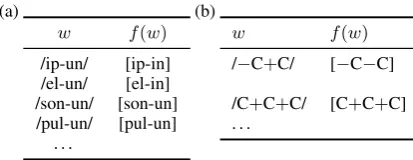
Table 2: Examples showing fragments of the phonological function describing Turkish back harmony assuming the underlying genitive mor-pheme is /-un/.
The vowel harmony analysis below is sufficient to go a step further and demonstrate a separation be-tween LSF, RSF on one side and WD on the other. We conjecture that one unattested ‘pathological’ vowel harmony patterns separates WD from RR.
3 Vowel Harmony
Vowel harmony is a pattern wherein vowels assim-ilate with respect to some feature. Table 1 shows two allomorphs of the genitive suffix, in] and [-un]. The allomorph is predictable based on the front/back dimension of the preceding vowel: if the preceding vowel is front then [-in] occurs, but if it is back then [-un] occurs. (Turkish also has rounding harmony, which is not shown here.)
Phonological analysis conceives of the phono-logical grammar as a function which maps an abstract lexical representation (the ‘underlying form’) to a more concrete—but still abstract— phonological representation (the ‘surface form’) (Hyman, 1975; Kenstowicz, 1994; Hayes, 2009). Phonological transcriptions, like the ones in Ta-ble 1, represent surface forms.
[image:4.595.312.519.187.267.2]indi-cates [−back] vowels, and C consonants.
Nevins’ (2010) analysis of vowel harmony uti-lizes underspecification. We illustrate this concept ostensively with the Turkish example above. In-stead of positing the underlying form of the suffix to be either /-in/ or /-un/, underspecification the-ory would posit it to be /-Vn/ where V is high, unrounded vowel unspecified for backness. In Nevins’ theory, underlying vowels which have fea-ture specifications can spread those feafea-tures only to vowels unspecified for those features. Under-specification is not congruent with research in Op-timality Theory (Prince and Smolensky, 2004), which, by the principle of the rich base, requires every underlying form to be considered (includ-ing those where every vowel is fully specified). Gainor et al. (2012) show that the iterative map-pings Nevins describes are subsequential, but this does not address those theories (like OT) which may not consider underlying forms to permit un-derspecification. All the vowel harmony patterns considered in this paper do not admit any under-specification whatsoever.
A traditional view of vowel harmony analyzes vowel harmony patterns as either instances of progressive harmony(PH) or regressive harmony (RH). Informally, progressive harmony means the value of a feature can be thought to spread from left to the right (as in the Turkish example above). Conversely, regressive harmony can be thought of as spreading from right to left. This is illustrated with examples (a-d) in Table 3.
Other theories of vowel harmony reject that di-rectionality is a primitive of the theory and argue that vowel harmony is either dominant/recessive (DR) or stem-controlled (SC) (Bakovi´c, 2000; Kr¨amer, 2003) (see also (Archangeli and Pulley-blank, 1994)). Dominant/recessive theories ana-lyze vowel harmony patterns by postulating that a particular feature value of a harmonizing feature is the dominant one. The DR function in Table 3 identifies the [+] value as the dominant one; so any underlying representation containing the har-monizing feature with the value [+] will surface so that the harmonizing feature in all vowels will also be[+]. Stem-controlled analyses are similar to dominant-recessive theories, however the fea-ture that spreads is determined not by its value but instead by the morphological position of the vowel to which the feature belongs (for instance, is the vowel in a stem or affix?).
An additional complication is that variations of the above functions are introduced by neu-tralvowels, which never undergo harmony. They come in two kinds: transparentvowels which per-mit features to spread through them, andopaque vowels, which block the spread of harmony, but trigger their own harmony domain. Some effects of neutral vowels are shown in rows (e-f) in Ta-ble 3. (Symbols [⊟] and [⊖] are [−F] vowels that are opaque and transparent, respectively. Likewise we use [⊞] and [⊕] to denote opaque and transpar-ent vowels which are [+F].)
Additionally, the phonological literature in-cludes discussion of logically possible, unattested and unnatural vowel harmony patterns that are predicted by classical approaches to vowel har-mony in OT. These patterns include sour grapes (SG) (Padgett, 1995; Wilson, 2003) and major-ity rules(MR) (Lombardi, 1999; Bakovi´c, 2000). Informally, SG is like progressive harmony ex-cept that vowels only harmonize if every vowel is guaranteed to harmonize. For example, if an opaque vowel occurs after the trigger, no non-neutral vowel harmonizes with the trigger. Ma-jority Rules instantiates the following rule: If the number of segments with αF is greater than the number of segments with −αF, then segments withαF are the triggers of harmony and segments with −αF are the targets and undergo change. Because phonologists consider SG and MR to be bizarre, they are referred to as ‘pathologies’ (Wil-son, 2003; Wil(Wil-son, 2004; Finley, 2008) and it is a strike against a theory if it predicts the existence of either SG or MR.
Henceforth, let X = Y = {+,−, C,⊟,⊞}. These symbols represent equivalence classes of a partition of the phonemic inventory of any lan-guage which exhibits progressive harmony for the feature F. The symbols + and − represent the classes of all harmonizing vowels which are +F
and−F, respectively. Phonemes invisible to har-mony are in theCclass; this includes consonants and transparent vowels. The symbol⊞(⊟) refers to opaque vowels which are +F (−F), which block the spread of−F (+F), and which begins a new harmonic domain spreading+F (−F).
w PH(w) RH(w) DR(w) SG(w) MR(w)
[image:6.595.141.456.64.169.2]a. /+− −/ [+ + +] [− − −] [+ + +] [+ + +] [− − −] b. /−+ +/ [− − −] [+ + +] [+ + +] [− − −] [+ + +] c. /− − −/ [− − −] [− − −] [− − −] [− − −] [− − −] d. /−+−/ [− − −] [− − −] [+ + +] [− − −] [− − −] e. /+−⊟/ [+ +⊟] [− −⊟] [+ +⊟] [+−⊟] [− −⊟] f. /+⊖ −/ [+⊖+] [− ⊖ −] [+⊖+] [+⊖+] [− ⊖ −]
Table 3: Example mappings of underlying forms (w) given by progressive harmony (PH), regressive har-mony (RH), dominant/recessive harhar-mony (DR), sour grapes harhar-mony (SG), and majority rules harhar-mony (MR). Symbols [+] indicates a [+F] vowel and [−] indicates a [−F] vowel where “F” is the feature harmonizing. Symbols [⊟] and [⊖] are [−F] vowels that are opaque and transparent, respectively.
cross-linguistically, and the metathesis patterns analyzed by Chandlee and Heinz (2012) are not sequential (though they are subsequential). For this reason, we keep the analysis focused at the level of subsequentiality.
4 The regular boundary
In this section we show that the regular boundary is sufficient to distinguish the pathological Major-ity Rules pattern from the attested progressive and regressive harmony patterns.
Formally, MR functions can be defined as fol-lows. Let|w|+F and|w|−F denote the number of participating vowels (i.e. non transparent vowels) which are+F and−F, respectively, inw ∈ X∗.
Then we define a Majority Rules Harmony pattern as any same-length function which at a minimum obeys the following:
M R(w) =
+|w|if |w|
+F >|w|−F −|w|if |w|
−F >|w|+F
(7)
The result below seems to be widely known (see Riggle (2004, chapter 7, section 5)) though we have not been able to find a proof in print.
Theorem 4 Majority Rules is not regular.
ProofBy way of contradiction, suppose thatM R
is a regular relation. Since regular relations are closed under inverse, so isM R−1. The image of a
regular set under a regular relation is also a regular set (see Roche and Schabes (, pp. 41-43)). There-fore, M R−1(+∗) is a regular set. Since regular
sets are closed under intersection, it follows that
M R−1
(+∗)∩(+∗−∗)is regular as well. Call this setS.
However, S is in fact not a regular set. Since
M R is length preserving, for all odd k ∈ N, it
0,λ
1,λ
2,λ
−,⊟
+,⊞ ⊟ ⊞
C C, −, ⊟, + :−
C, +, ⊞, −:+
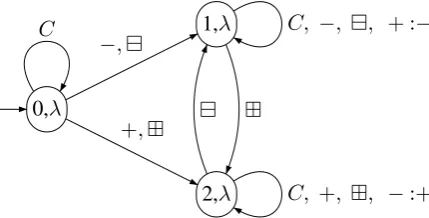
Figure 2: A subsequential transducer which rec-ognizes iterative, progressive harmony.
is the case that M R(+k) ∩ (+∗−∗) = +m−n where0≤m, n≤kandm+n=kandm > n. Furthermore, for all for all odd k, it is the case that T LS(+k), includes −n for all n < k−1 but excludes−nfor alln > k+ 1. Thus there is a distinct Nerode-equivalence class for each odd
k, and hence S is not a regular set, and therefore
M Ris not a regular relation.
On the other hand, progressive and regressive harmony are regular; in fact, subsequential. For concreteness we analyze a canonical progressive harmony pattern which includes neutral vowels.
The subsequential transducer TP H in Figure 2 faithfully captures the PH function. Labels on the transitions are interpreted as in Beesley and Kar-tunnen (2003): commas delimit multiple transi-tions; the labelx:ymeansxis the input andythe output; absence of a colon means the input and output are identical. The rightmost symbol inte-rior to a state is the output of theσfunction.
[image:6.595.308.523.239.348.2]subsequen-tial, this establishes the left subsequentiality of it-erative, progressive harmony patterns without un-derspecification.6
As for iterative regressive harmony patterns, they are simply the reverse of iterative progres-sive patterns. In other words, for all w ∈ Σ∗, RH(w) =←−−TP H.
5 The subsequential boundary
In this section we show that while the regular boundary is not sufficient to separate the patho-logical Sour Grapes pattern from attested harmony patterns, the subsequential boundaryissufficient.
Padgett (1995) defines Sour Grapes Harmony as “Either all features must spread, or none will. . . ” For concreteness, consider a progressive Sour Grapes pattern. The form+− −−would be mapped to+ + ++as in progressive harmony, but the form+− −⊟is mapped to+− −⊟because the opaque vowel will not become+F, and so the spreading process grumpily chooses not to spread at all. Therefore, a progressive Sour Grapes Har-mony pattern is defined as any length-preserving function which at a minimum includes the follow-ing mappfollow-ings for alln∈N:
SG(+−n) = ++n∧SG(+−n⊟) = +−n⊟ (8)
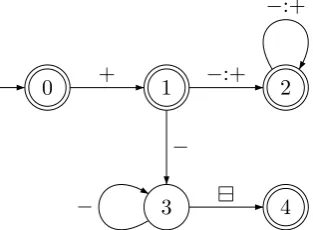
There is a finite state transducer which describes this fragment of the SG function, shown in Fig-ure 3. As a total function, for SG to be regular, it is important that the image of the complement of ∪n∈N{+−n} ∪n∈N{+−n⊟} under SG also be
regular. Pictorially, this would mean that the frag-ment shown in Figure 3 is a subgraph of the full SG pattern. Crucially, however, there can also be no transition from state 2 bearing the input symbol
⊟that can lead (even eventually) to a final state. We now prove the main theorem of this paper.
Theorem 5 SG is neither left nor right subse-quential.
Proof We show that, for all distinct n, m ∈ N, the tails of +−n is not the same as the tails of
+−m. This immediately implies that the canon-ical left subsequential transducer would have in-finitely many states, and hence that any SG pattern meeting Equation 8 is not left subsequential.
6It is true thatT
P Hdoes not model progressive harmony patterns where transparent vowels can trigger harmony. It is not difficult to modifyTP H to accommodate this without sacrificing subsequentiality.
0 1 2
3 4
+ −:+
−
⊟
−:+
[image:7.595.333.490.49.164.2]−
Figure 3: A non-deterministic transducer which recognizes a fragment of SG harmony.
To illustrate, considerx= +−. SinceSG(+−
X∗)includes elements+ + +and+−⊟(mapped from e.g. + − − and + − ⊟, resp.), it fol-lows that lcp(SG(+ − X∗)) = +. Therefore,
(−,++) ∈T LSG(+−). Observe that(−,+n) 6∈ T LSG(+−) for all n 6= 2 since SG is length-preserving.
More generally it is the case that(−,+n+1
) ∈
T LSG(+−n)and(−,+m)6∈T LSG(+−n)for all m 6= n+ 1. Therefore there are infinitely many distinct sets of tails for functions conforming to (8), and thus no SG pattern is subsequential.
A similar argument (omitted) establishes that any SG pattern is not right subsequential.
Consequently, the subsequential boundary sepa-rates SG and MR from PH and RH.
6 The weakly deterministic boundary As mentioned earlier, the dominant/recessive and stem-control theories of vowel harmony reject the directionality generalizations inherent in the PH and RH mappings. If these theories are correct, then it is important to see what boundary (if any) separates MR and SG from vowel harmony pat-terns described with dominant/recessive and stem-control based generalizations. We show that the mappings these theories posit are, like SG, not subsequential. However, we believe there is an interesting complexity difference between SG on the one hand and DR and SC on the other. In par-ticular, we show that DR and SC are weakly de-terministic. We conjecture that SG is not weakly deterministic and provide the intuition behind this conjecture, though its proof currently escapes us.
under-lying representation contains a vowel specified as
+F, then all other non-neutral vowels in the word will be realized as+F as well.
Therefore, we can define a function as dom-inant/recessive as any length-preserving function which includes the following mappings:
∀w∈ {+,−}∗,
DR(w) =
+|w| if (∃0≤i≤ |w|)[w i = +] −|w| otherwise
(9)
The next two theorems establish that DR har-mony is properly weakly deterministic.
Theorem 6 DR is neither left nor right subse-quential.
ProofThe proof is similar to the one for SG. We show that, for all distinctn, m∈N, the tails of−n is not the same as the tails of−m.
Consider firstx=−−. To find its tails we must know lcp(DR(− −X∗)). Since DR(− −X∗)
includes elements − − − and + + + (mapped from e.g. − − − and − − +, resp.), it fol-lows that lcp(DR(+ −X∗)) = λ. Therefore,
(−,− − −) ∈ T LDR(−−). Observe that for all n 6= 2, it is the case that(−,+n) 6∈ T L
DR(−−) sinceDRis length-preserving.
Next considerx = − − −. To find its tails we must knowlcp(DR(− − −X∗)).DR(− − −X∗)
includes elements− − −−and+ + ++(mapped from e.g. − − −− and − − −+, resp.), and so again the longest common prefix isλ. There-fore,(−,+ + ++)belongs toT LDR(− − −)and
(−,+n) 6∈ T L
DR(+−)for alln 6= 3since DR preserves string lengths.
More generally for all distinct n, m ∈ N it is the case that (−,+n+1) ∈ T L
DR(−n) and
(−,+m) 6∈ T L
DR(+−n) for all m 6= n + 1. Therefore there are infinitely many distinct sets of tails for functions conforming to (9), and thus no DR pattern is subsequential.
A similar argument (omitted) establishes that any DR pattern is not right subsequential.
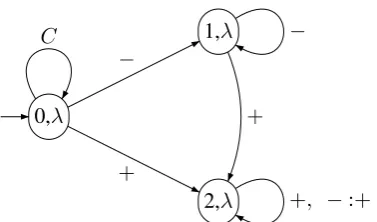
On the other hand, DR is weakly determinis-tic. We establish this for the case when the al-phabet contains only{+,−}. In fact, DR is sim-ply the composition of progressive harmony and regressive harmony where only the dominant fea-ture value spreads. Figure 4 shows a subsequen-tial transducerTP HP describing a progressive har-mony function where only [+] spreads. Observe
0,λ
1,λ
2,λ
−
+
+
C −
+, −:+
Figure 4: The subsequential transducer TP HP which recognizes iterative, progressive harmony where only the+value spreads.
that the transducer in Figure 4 is nearly identical toTP H in Figure 2 without the opaque vowels and the C symbol. The important difference is that in Figure 2 there is a transition from state 1 to itself which reads a[+]input and outputs a [−], but in Figure 4, the transducer in state 1, upon reading input[+]transitions to state 2 and writes out[+].
LetP HP denote the functionTP HP computes.
Theorem 7 DR is weakly deterministic.
Proof We show that for all w ∈ {+,−}∗, DR(w) =←−−−TP HP ◦
−−−→
TP HP(w).
Case 1. There exists0 ≤i≤ |w|such thatwi =
+. ThenDR(w) = +|w|. It follows from the
definition ofP HP that for all j ≥ i, wj =
+. Letting u = P HP(w)r, it follows that u1 = +. ThusP HP(u) = +|w|. The reverse
of+|w|is clearly itself. Therefore,P HPr◦
P HP(w) = +|w|.
Case 2. Case 1 does not hold. ThenDR(w) =
−|w|. By definition, P HP(w) = −|w|.
Clearly thenP HPr◦P HP(w) =−|w|.
Since DR = ←−−−TP HP ◦ −−−→
TP HP, since −−−→
TP HP and ←−−−
TP HP are alphabet-preserving, and since −−−→
TP HP is not length-increasing, the theorem is proved.
While, the proof of theorem 7 is limited to words in{+,−}∗, we believe the extension to words in {+,−, C,⊟,⊞}∗ is only challenging technically, and not conceptually. For example, the definition of DR harmony above in Equation 9 should be more articulated so that, for instance,DR(−−⊟− −+− −⊟− −) =− −⊟+ + + + +⊟− −.
[image:8.595.307.496.47.158.2]w SC(w)
a. +#−#− − − −
b. −# + #+ + + +
c. −#−#− − − −
[image:9.595.107.259.64.140.2]d. −# + #− + + +
Table 4: Example mappings of underlying forms (w) with three vowels given stem control theories of vowel harmony. In each example, the middle vowel is the only vowel in the stem.
happens when there is more than one stem vowel? The stem precedence generalization (Bakovi´c, 2003) states that “an alternating affix vowel always agrees with the adjacent vowel in the stem to which the affix is attached.” Therefore stem vowels themselves are not targets of the harmony process. Consequently, underlying
/ − −# + − + −# + +/ would surface as
[+ + # +−+−#− −].
Since every underlying form is assumed to contain a stem, the domain of SC har-mony is X∗#X+
#X∗. Then ∀w#u#v ∈
X∗#X+#X∗, it is the case that
SC(w) =
+|w|#u# +|v|if u
1 = + ∧ u|u|= + +|w|#u#−|v|if u
1 = + ∧ u|u|=−
−|w|#u# +|v|if u
1 =− ∧ u|u|= +
−|w|#u#−|v|if u
1 =− ∧ u|u|=−
(10) The analysis of SC is the same as DR; and so the proofs are omitted.
Theorem 8 SC is neither left nor right subsequen-tial.
Theorem 9 SC is weakly deterministic.
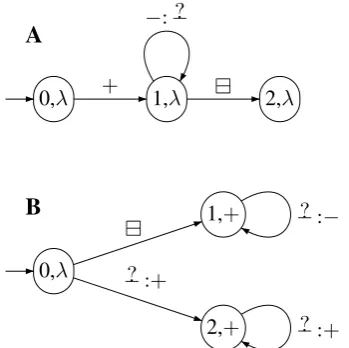
We believe there is a difference between DR and SG: we conjecture that SG is not weakly de-terministic. To get an intuition why, consider the two subsequential transducers A and B in Figure 5. Limiting our attention to the domain {+−n}∪{+−n⊟}∪{λ}, the composition←B−◦−→A equals SG. This is possible because these func-tions make use of an additional symbol [−], indi-? cating a minus value whose left context matches the environment to become [+].
Table 5 illustrates the role the additional symbol plays in the derivation. We are doubtful that it is possible to decompose SG into a left and right de-terministic function where the left function is
pro-0,λ + 1,λ ⊟ 2,λ
−: ?− A
0,λ
1,+
2,+ ⊟
?
−:+
?
−:−
?
−:+
[image:9.595.333.508.70.244.2]B
Figure 5: Two subsequential transducers such that ←−
B ◦ −→A = SG. The symbol [−] indicates a?
[−] which would undergo harmony provided no opaque vowel occurs downstream.
w +− − −⊟ +− −− −
→
A(w) + ?−−?−?⊟ + ?−−?−? ←−
B ◦−→A(w) +− − −⊟ + + ++
Table 5: Illustrations of the role of [−] in the de-? terministic decomposition of SG=←B−◦−→A.
hibited from marking up its output in any way (ei-ther with extra symbols or with a length-increasing coding trick).
7 Conclusion
[image:9.595.326.506.315.373.2]Non-regular
Regular
Weakly deterministic
Left
Subsequential
Right
Subsequential
×
PH
×
RH
×
DR
×
SC
×
SG
×
MR
[image:10.595.74.526.62.290.2]??
Figure 6: Hierarchies of transductions with the results of this paper shown. PH=progressive harmony, RH=regressive harmony, DR=dominant/recessive harmony, SC=stem control harmony, SG=sour grapes harmony, and MR=majority rules harmony.
Although the harmony patterns in this paper are all describable with same-length relations, we de-liberately chose not to focus on the special prop-erties same-length relations engender. This is largely because there are phonological processes such as epenthesis and deletion which are not same-length, and we would like our conclusions to hold for all phonological patterns. Nonetheless, future work which explores the same-lengthness aspect may lead to some interesting insights. One reviewer of this paper conjectured, for example, that if the same-length relations were coded as lan-guages that they would then bek-reversible (An-gluin, 1982).
With respect to learnability, total subsequential functions are identifiable in the limit from posi-tive data (Oncina et al., 1993), though this algo-rithm appears to require data points unavailable in natural language corpora (Gildea and Jurafsky, 1996). Investigating subclasses of subsequential functions which cover attested phonological pat-terns may thus not only better characterize possi-ble phonologies, but may also provide insights for learning (Chandlee and Koirala, 2013).
Finally, we believe Elgot and Mezei’s theorem can shed new light on the old problem of abstract-ness in phonology (Hyman, 1970), and suspect a hierarchy of complexity depending on how much markup (either new symbols or with a
length-increasing function) needs to be introduced in the intermediate alphabet to order to decompose a reg-ular function into left and right subsequential ones. Computational work whose results should be more carefully investigated with this in mind include Kempe (2000) and Crespi Reghizzi and San Pietro (2012).
Acknowledgments
We thank the three anonymous reviewers for their insightful comments. We also thank the 2012-2013 computational linguistics group at the Uni-versity of Delaware, especially Jim Rogers, for useful discussion.
References
Dana Angluin. 1982. Inference of reversible lan-guages. Journal for the Association of Computing Machinery, 29(3):741–765.
Diana Archangeli and Douglas Pulleyblank. 1994.
Grounded Phonology. Cambridge, MA: MIT Press.
Eric Bakovi´c. 2000. Harmony, Dominance and Con-trol. Ph.D. thesis, Rutgers University.
Kenneth Beesley and Lauri Kartunnen. 2003. Finite State Morphology. CSLI Publications.
Michael Benedikt, Leonid Libkin, Thomas Schwentick, and Luc Segoufin. 2001. A model-theoretic approach to regular string relations. Logic in Computer Science, Symposium on, 0:0431.
Jean Berstel. 1979. Transductions and Context-Free languages. Teubner-Verlag.
Jane Chandlee and Jeffrey Heinz. 2012. Bounded copying is subsequential: Implications for metathe-sis and reduplication. InProceedings of the 12th Meeting of the ACL Special Interest Group on Com-putational Morphology and Phonology, pages 42– 51, Montreal, Canada, June. Association for Com-putational Linguistics.
Jane Chandlee and Cesar Koirala. 2013. Learning local phonological rules. Penn Linguistics Collo-quium, March.
Jane Chandlee, Angeliki Athanasopoulou, and Jeffrey Heinz. 2012. Evidence for classifying metathesis patterns as subsequential. InThe Proceedings of the 29th West Coast Conference on Formal Linguistics, pages 303–309. Cascillida Press.
Noam Chomsky and Morris Halle. 1968. The Sound Pattern of English. Harper & Row, New York.
Stefano Crespi Reghizzi and Pierluigi San Pietro. 2012. From regular to strictly locally testable lan-guages. International Journal of Foundations of Computer Science, 23(08):1711–1727.
C. C. Elgot and J. E. Mezei. 1965. On relations de-fined by generalized finite automata. IBM Journal of Research and Development, 9(1):47–68.
Sara Finley. 2008. The formal and cognitive restric-tions on vowel harmony. Ph.D. thesis, Johns Hop-kins University, Baltimore, MD.
Brian Gainor, Regine Lai, and Jeffrey Heinz. 2012. Computational characterizations of vowel harmony patterns and pathologies. InThe Proceedings of the 29th West Coast Conference on Formal Linguistics, pages 63–71.
Daniel Gildea and Daniel Jurafsky. 1996. Learn-ing bias and phonological-rule induction. Compu-tational Linguistics, 24(4).
Bruce Hayes. 2009. Introductory Phonology. Wiley-Blackwell.
Jeffrey Heinz and William Idsardi. 2011. Sentence and word complexity.Science, 333(6040):295–297, July.
Jeffrey Heinz and William Idsardi. 2013. What complexity differences reveal about domains in lan-guage.Topics in Cognitive Science, 5(1):111–131.
Jeffrey Heinz, Chetan Rawal, and Herbert G. Tan-ner. 2011. Tier-based strictly local constraints for phonology. InProceedings of the 49th Annual Meet-ing of the Association for Computational LMeet-inguis- Linguis-tics, pages 58–64, Portland, Oregon, USA, June. As-sociation for Computational Linguistics.
Larry Hyman. 1970. How concrete is phonology?
Language, 46(1):58–76.
Larry Hyman. 1975. Phonology: Theory and Analysis. Holt, Rinehart and Winston.
C. Douglas Johnson. 1972. Formal Aspects of Phono-logical Description. The Hague: Mouton.
Ronald Kaplan and Martin Kay. 1994. Regular models of phonological rule systems. Computational Lin-guistics, 20(3):331–378.
Andr´e Kempe. 2000. Reduction of intermediate al-phabets in finite-state transducer cascades. CoRR, cs.CL/0010030.
Michael Kenstowicz. 1994. Phonology in Generative Grammar. Blackwell Publishers.
Kimmo Koskenniemi. 1983. Two-level morphology. Publication no. 11, Department of General Linguis-tics. Helsinki: University of Helsinki.
Martin Kr¨amer. 2003. Vowel Harmony and Corre-spondence Theory. Berlin: Mouton de Gruyter.
Regine Lai. 2012. Domain Specificity in Phonology. Ph.D. thesis, University of Delaware.
Linda Lombardi. 1999. Positional faithfulness and voicing assimilation in Optimality Theory. Natural Language and Linguistic Theory, 17:267–302.
Mehryar Mohri. 1997. Finite-state transducers in lan-guage and speech processing. Computational Lin-guistics, 23(2):269–311.
Jos´e Oncina, Pedro Garc´ıa, and Enrique Vidal. 1993. Learning subsequential transducers for pat-tern recognition tasks. IEEE Transactions on Pat-tern Analysis and Machine Intelligence, 15:448– 458, May.
Jaye Padgett. 1995. Partial class behavior and nasal place assimilation. In K. Suzuki and D. Elzinga, ed-itors,Proceedings of the 1995 Southwestern Work-shop on Optimality Theory.
Alan Prince and Paul Smolensky. 2004. Optimality Theory: Constraint Interaction in Generative Gram-mar. Blackwell Publishing.
Jason Riggle. 2004. Generation, Recognition, and Learning in Finite State Optimality Theory. Ph.D. thesis, University of California, Los Angeles.
James Rogers, Jeffrey Heinz, Margaret Fero, Jeremy Hurst, Dakotah Lambert, and Sean Wibel. to appear. Cognitive and sub-regular complexity. In Proceed-ings of the 17th Conference on Formal Grammar.
Jaques Sakarovitch. 2009.Elements of Automata The-ory. Cambridge University Press. Translated by Reuben Thomas from the 2003 edition published by Vuibert, Paris.
Colin Wilson. 2003. Analyzing unbounded spread-ing with constraints: marks, targets, and derivations. Unpublished manuscript, UCLA.
Colin Wilson. 2004. Experimental investigation of phonological naturalness. In Proceedings of WC-CFL 22, pages 534–546.
Anssi Yli-Jyr¨a and Kimmo Koskenniemi. 2006. Com-piling generalized two-level rules and grammars. In