Multilingual summarization system based on analyzing the discourse
structure at MultiLing 2013
Daniel Alexandru Anechitei
”Al. I. Cuza” University of Iasi,
Faculty of Computer Science
16,General Berthelot St., 700483, Iasi,
Romania
[email protected]
Eugen Ignat
”Al. I. Cuza” University of Iasi,
Faculty of Computer Science
16,General Berthelot St., 700483, Iasi,
Romania
[email protected]
Abstract
This paper describes the architecture of UAIC1’s Summarization system participating at MultiLing – 2013. The architecture includes language independent text processing mod-ules, but also modules that are adapted for one language or another. In our experiments, the languages under consideration are Bulgarian, German, Greek, English, and Romanian. Our method exploits the cohesion and coherence properties of texts to build discourse struc-tures. The output of the parsing process is used to extract general summaries.
1
Introduction
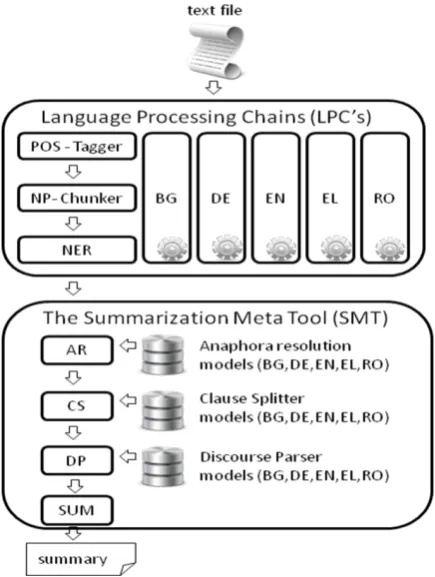
[image:1.595.306.524.339.628.2]Automatic text summarization is a well studied research area and has been active for many years. In this paper, we describe the automatic text summarization system implemented by UAIC for participation at MultiLing 2013 single document track. Our approach to summarization follows the one presented in (Anechitei et al., 2013). The summarization architecture that this system uses includes two main parts that can be viewed in Figure 1. The text is passed to the language pro-cessing chain (LPC) which processes the data. As revealed from the figure each language has its own LPC. The LPC’s, acts as a prerequisite for the summarization meta tool (SMT). In this pa-per we will focus more on the SMT engine, which is composed of four modules: anaphora resolution (AR), clause splitter (CS), discourse parser (DP) and the proper summarizer (SUM). The intermediate format between the modules consists of XML files. The summary of a text is
1
University “Al. I. Cuza” of Iasi, Romania
obtained as a sequence of discourse clauses ex-tracted from the original text, after obtaining the discourse structure of the text and exploiting the cohesion and coherence properties.
Figure 1: Summarization system architecture
2
Language Processing Chains
Every document is analyzed by the LPC in the following consecutive steps: sentence splitter, tokenizer, Part of Speech tagger, lemmatizer, Noun phrase extractor and Named entity recog-nizer. All tools are self-contained and designed
to work in a chain, i.e. the output of the previous component is the input for the next component.
3
Anaphora Resolution
Anaphora resolution is one of the key steps of the discourse parser, by resolving anaphoric pro-nouns, automatically generated summaries may be more cohesive and, thus, more coherent. Cal-culating scores for references and transitions would be impossible without the proper identifi-cation of the co-referential chains.
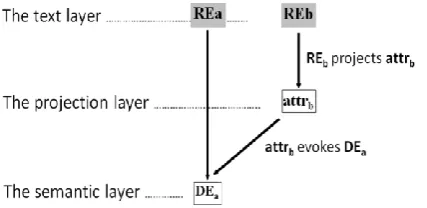
Anaphora resolution is defined in (Orăsan et. al, 2008) as the process of resolving an anaphoric expression to the expression it refers to. The tool used for the anaphora resolution named RARE (Robust Anaphora Resolution Engine) uses the work done in (Cristea and Dima, 2001), where the process implies three layers (Figure 2):
The text layer, containing referential ex-pressions(RE) as they appear in the dis-course;
An intermediate layer (projection layer) that contains any specific information that can be extracted from the corre-sponding referential expressions.
[image:2.595.76.290.461.565.2] A semantic layer that contains descrip-tions of the discourse entities (DE). Here the information contributed by chains of referential expressions is accumulated.
Figure 2: Three layers representation of co-referencing REs (Cristea and Dima, 2001)
The core of the system is language independ-ent, but in order to localize it to one language or another it requires specific resources. These spe-cific resources are as follows:
constraints – containing the rules that match the conditions between anaphor and antecedent;
stopwords – containing a list of stopwords;
tagset – implies a mapping from the tagset used in the input file to a more simplified tagset used by the system.
window – here is defined the length of the window where the antecedent should be looked for by the system.
The process of anaphora resolution runs as fol-lows: The text is “read” from the left to right. When a new NP is found, a new RE is created and contains the morphological, syntactic and semantic features. All the features are tested us-ing the constraints and it is decided whether the RE introduces a new discourse entity, not tioned before, or it revokes one already men-tioned.
4
Clause Splitter
Numerous techniques are used to recognize clause boundaries for different languages, where some are rule based (Leffa, 1988), and others are hybrid methods, like in (Parven et al., 2011) and (Orăsan, 2000), where the results of a machine learning algorithm, trained on an annotated cor-pus, are processed by a shallow rule-based mod-ule in order to improve the accuracy of the meth-od. Our approach to discourse segmentation starts from the assumption that a clause is headed by a main verb, like “go” or a verbal compound, like “like to swim” (Ex.1). Verbs and verb com-pounds are considered pivots and clause bounda-ries are looked for in-between them.
Ex. 1 <When I go to river>< I like to swim with my friends.>
Verb compounds are sequences of more than one verb in which one is the main verb and the others are auxiliaries, infinitives, conjunctives that complement the main verb and the semantics of the main verb in context obliges to take the whole construction together. The CS module segments the input by applying a machine learn-ing algorithm, to classify pairs of verbs as belearn-ing or not compound verbs and, after that, applying rules and heuristics based on pattern matching or machine learning algorithms to identify the clause boundary. The exact place of a clause boundary between verbal phrases is best indicat-ed by discourse markers. A discourse marker, like “because” (Ex.1), or, simply, marker, is a word or a group of words having the function to signal a clause boundary and/or to signal a rhe-torical relation between two text spans.
When markers are missing, boundaries are found by statistical methods, which are trained on ex-plicit annotations given in manually built files. Based on the manually annotated files, a training module extracts two models (one for the CS module and one for the DP module). These mod-els incorporate patterns of use of markers used to decide the segmentation boundaries and also to identify rhetorical relations between spans of text. The clauses act as terminal nodes in the process of discourse parsing which is described below.
5
Discourse Parser
Discourse parsing is the process of building a hierarchical model of a discourse from its basic elements (sentences or clauses), as one would build a parse of a sentence from its words (Ban-galore and Stent, 2009). Rhetorical Structure Theory (Mann and Thompson, 1988) is one of the most popular discourse theories. In RST a text segment assumes one of two roles in a rela-tionship: the nucleus (N) or satellite (S). Nuclei express what is more essential to the understand-ing of the narrative than the satellites. Our Dis-course Parser uses a symbolic approach and pro-duces discourse trees, which include nuclearity, but lacking rhetorical relation names: intermedi-ate nodes in the discourse tree have no name and terminal nodes are elementary discourse units, mainly clauses. It adopts an incremental policy in developing the trees, on three levels (paragraphs, sentences and clauses) by consuming, recursive-ly, one entire structure of an inferior level, by attaching the elementary discourse tree (edt) of the last structure to the already developed tree on the right frontier (Cristea and Webber, 1997). First, an edt of each sentence is produced using incremental parsing, by consuming each clause within the sentence. Secondly, the edt of the par-agraph is produced by consuming each sentence within the paragraph. The same approach is used at discourse level by attaching the paragraph tree of each paragraph to the already developed tree. The criterion to guide the discourse parsing is represented by the principle of sequentiality (Marcu, 2000). The incremental discourse pars-ing approach borrows the two operations used in (L)TAG (lexicalized tree-adjoining grammar) (Joshi and Schabes, 1997): adjunction and sub-stitution.
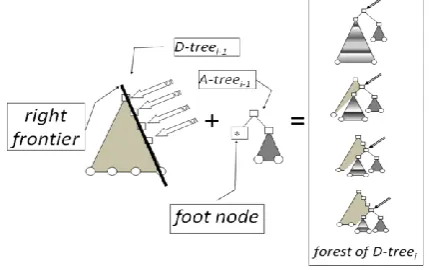
Adjunction operation (Figure 3) occurs only on the right frontier and it takes an initial or de-veloping tree (D-treei-1), creating a new
develop-ing tree (D-treei) by combindevelop-ing D-treei-1 with an auxiliary tree (A-tree), by replacing the foot node
[image:3.595.307.522.137.272.2]with the cropped tree. This is done for each node on the right frontier resulting in multiple D-trees. Figure 3 depicts this idea.
Figure 3: Adjunction operation
Substitution operation (Figure 4) replaces a placed node on a terminal frontier, called
[image:3.595.324.528.345.463.2]substi-tution node, with an auxiliary tree (Figure 14).
Figure 4: Substitution operation
The uses of different types of auxiliary trees (Figure 5) are determined by two factors:
the type of operation in which are used:
alpha and beta are used only for
adjunc-tion operaadjunc-tions and gamma and delta for substitution operations;
the auxiliary tree introduces or not an expectation: beta and gamma are auxilia-ry trees that raise an expectation and
al-pha an delta are auxiliary trees which do
not raise an expectation.
At each parsing step there is a module which decides the type of the auxiliary tree between
alpha, gamma, beta, delta (Anechitei et al.,
2013) together with the relations type (R1 and R2, which can be N_N, N_S or S_N; the notation express the nuclearity of the child nodes: left one and the right one) by analyzing the structure which is processed (clause, sentence or para-graph). This module uses the compiled model described in previous section and doesn’t pro-duce a unique auxiliary tree for each structure but rather a set of trees.
At each level, the parser goes on with a forest of developing trees in parallel, ranking them by a global score (Figure 6) based on heuristics that are suggested by both Veins Theory (Cristea et al., 1998) and Centering Theory (Grosz et al., 1995). After normalizing the score for each heu-ristic, the global score is computed by summing the score of one heuristic with the corresponding weight. The weights were established after a cal-ibration process.
Figure 6: Global score for each discourse tree
The trees used at the next step are only the best ranked trees. The aim of this filtering step is to reduce the exponential explosion of the ob-tained trees. For this task the threshold was set to
five best trees from iteration to another and six (N=6) heuristics chosen in a way to maximize the coherence of the discourse structure and im-plicitly the coherence of the summary.
6
The Summarizer
The mentioned system produces excerpt type summaries, which are summaries that copy con-tiguous sequences of tokens from the original text.
The structure of a discourse as a complete tree gives more information than properly needed (at least for summarization purpose). By exploiting the discourse structure, we expect to add cohe-sion and coherence to our summaries. From the discourse structure we can extract three types of summaries: general summaries, entity focused summaries and clause focused summaries. For the summarization task we only extracted the general summary. The module that extracts the summaries (SUM) takes the tree of a discourse structure and produces a general summary, of a certain length, depending on the length of the
computed vein (Cristea et al., 1998). As the task supposed summaries containing a maximum of 250 words and the summaries the system was providing were always bigger, a new scoring sys-tem was needed. This scoring syssys-tem needed to shorten the summaries to under 250 words, yet keep as much coherence and cohesion as the sys-tem provided. For this end the scoring syssys-tem took all the clauses from the vein and scored them as follows: in each clause the noun phrases were found, for each noun phrase a coreferential score was given. These scores are added and computed for each clause. The clauses were sort-ed and only the first N clauses were selectsort-ed such as the maximum coherence was retained, where N is the number of the clauses so that the final summaries are below the word count threshold. The score for each noun phrase is giv-en taking into account how big the corefergiv-ence chain is.
7
Conclusion and Results
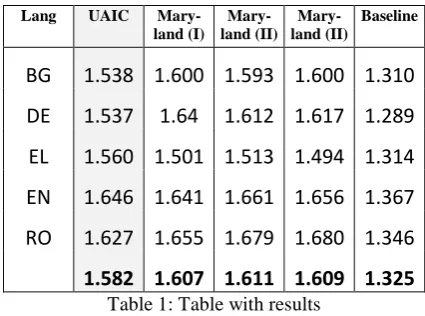
This year, the evaluation at MultiLing 2013 was performed automatically using N-gram graph methods, which were interchangeable in the single document setting. Below we provide the results based on average NPowER grades.
Lang UAIC
Mary-land (I) Mary-land (II)
Mary-land (II)
Baseline
BG 1.538 1.600 1.593 1.600 1.310
DE 1.537 1.64 1.612 1.617 1.289
EL 1.560 1.501 1.513 1.494 1.314
EN 1.646 1.641 1.661 1.656 1.367
RO 1.627 1.655 1.679 1.680 1.346
1.582 1.607 1.611 1.609 1.325 Table 1: Table with results
[image:4.595.308.521.429.587.2]References
Anechitei A. Daniel, Cristea Dan, Dimosthenis Ioan-nidis, Ignat Eugen, Karagiozov Diman, Koeva Svetla, Kopeć Mateusz and Vertan Cristina. 2013.
Summarizing Short Texts Through a Discourse-Centered Approach in a Multilingual Context. In Neustein, A., Markowitz, J.A. (eds.), Where Hu-mans Meet Machines: Innovative Solutions to Knotty Natural Language Problems. Springer Verlag, Heidelberg/New York.
Bangalore Srinivas and Stent J. Amanda. 2009. In-cremental parsing models for dialog task structure, in Proceedings of the 12th Conference of the Euro-pean Chapter of the Association for Computational Linguistics.
Cristea Dan and Webber Bonnie. 1997. Expectations in incremental discourse processing. In Proceed-ings of the 8th Conference of the European Chapter of the Association for Computational Linguistics.
Cristea Dan, Ide Nancy and Romary Laurent. 1998: Veins Theory: A Model of Global Discourse Cohe-sion and Coherence, in Proceedings of the 17th in-ternational conference on Computational linguis-tics.
Cristea Dan and Dima E. Gabriela. 2001. An integrat-ing framework for anaphora resolution. In Infor-mation Science and Technology, Romanian Acad-emy Publishing House, Bucharest, vol. 4, no. 3-4, p 273-291.
Grosz J. Barbara, Joshi K. Arvind and Weinstein Scott. 1995. Centering: A Framework for Model-ling the Local Coherence of Discourse. Computa-tional Linguistics, 21/2: 203-25.
Joshi K. Aravind and Schabes Yves. 1997: Tree-Adjoining Grammars. In G. Rozenberg and A.Salomaa, editors, Handbook of Formal lan-guages.
Leffa J. Vilson. 1988. Clause processing in complex sentences. In Proceedings of the First International Conference on Language Resource and Evaluation, volume 1, pages 937 – 943, May 1998.
Mann C. William and Thompson A. Sandra. 1988.
Rhetorical structure theory: a theory of text organ-ization. Text 8(3):243–281.
Marcu Daniel. 2000. The Theory and Practice of Dis-course Parsing and Summarization. The MIT Press, November 2000.
Orasan Constantin. 2000. A hybrid method for clause splitting in unrestricted English texts. In Proceed-ings of ACIDCA, Corpora and Natural Language Processing, March 22-24, Monastir, Tunisia, pp. 129 – 134.
Orăsan Constantin, Cristea Dan, Mitkov Ruslan and Branco Antonio. 2008. Anaphora Resolution
Exer-cise – An Overview. In Proceedings of LREC-2008, Marrakech, Morocco.