TECHLIMED system description for the Shared Task on Automatic
Arabic Error Correction
Djamel MOSTEFA
Techlimed 42 rue de l’Universit´e
Lyon, France
Omar ASBAYOU
Techlimed 42 rue de l’Universit´e
Lyon, France
{firstname.lastname}@techlimed.com
Ramzi ABBES
Techlimed 42 rue de l’Universit´e
Lyon, France
Abstract
This article is a system description paper and reports on the participation of Tech-limed in the ”QALB-2014 shared task” on evaluation of automatic arabic error cor-rection systems organized in conjunction with the EMNLP 2014 Workshop on Ara-bic Natural Language Processing. Cor-recting automatically texts in Arabic is a challenging task due to the complexity and rich morphology of the Arabic language and the lack of appropriate resources, (e.g. publicly available corpora and tools). To develop our systems, we considered sev-eral approaches from rule based systems to statistical methods. Our results on the development set show that the statistical system outperforms the lexicon driven ap-proach with a precision of 71%, a recall of 50% and a F-measure of 59%.
1 Introduction
Automatic error correction is an important task in Natural Language Processing (NLP). It can be used in a wide range of applications such as word processing tools (e.g. Microsoft Office, Openof-fice, . . . ), machine translation, information re-trieval, optical character recognition . . . Automatic error correction tools on Arabic are underperform-ing in comparison with other languages like En-glish or French. This can be explained by the lack of appropriate resources (e.g. publicly available corpora and tools) and the complexity of the Ara-bic language. AraAra-bic is a challenging language for any NLP tool for many reasons. Arabic has a rich and complex morphology compared to other latin languages. Short vowels are missing in the texts but are mandatory from a grammatical point of view. Moreover they are needed to disambiguate between several possibilities of words. Arabic
is a rich language.There are many synonyms and Arabic is a highly agglutinative, inflectional and derivational language and uses clitics (proclitics and enclitics). Arabic has many varieties. Mod-ern Standard Arabic includes the way Arabic is written in the news or in formal speech. Classi-cal Arabic refers to religious and classiClassi-cal texts. Dialectal Arabic has no standard rules for orthog-raphy and is based on the pronunciation. There-fore a same word can be written using many differ-ent surface forms depending on the dialectal ori-gin of the writer. Another very popular way of writing Arabic on the Internet and the social me-dia like Facebook or Tweeter is to use ”Arabizi”, a latinized form of writing Arabic using latin letters and digits (Aboelezz, 2009).
For our participation in this evaluation task, we tried to implement two different approaches. The first approach is a lexicon driven spell checker. For this, we have plan to adapt and test state-of-the-art spell checkers. The second approach is a pure statistical approach by considering the correction problem as a statical machine translation task.
The paper is organized as follows: section 2 gives an overview of the automatic error correction evaluation task and resources provided by the or-ganizers; section 3 describes the systems we have developed for the evaluations; and finally in sec-tion 4 we discuss the results and draw some con-clusion.
2 Task description and language resources
The aim of the QALB Shared Task on Automatic Arabic Error Correction (Mohit, 2014) is to evalu-ate automatic text correction systems for the Ara-bic language. The objective of the task is to cor-rect automatically texts in Arabic provided by the organizers. The QALB corpus is used for the eval-uation task. A training set and a development set with gold standard is provided for system
ing and development. The training and develop-ment sets are made of sentences with errors com-ing from newspapers articles and the gold stan-dard is made of manual annotations of the sen-tences. The annotations were made by human annotators who used a correction guidelines de-scribed in (Zaghouani, 2014). The corrections are made of substitutions, insertions, deletions, splits, merges, moves of words and punctuation marks.
The training set is made of 19,411 sentences and 1M tokens. The development set includes 1,017 sentences for around 53k tokens.
The evaluation is performed by comparing the gold standard with the hypothesis using the Lev-enshtein edit distance (LevLev-enshtein, 1966) and the implementation of the M2 scorer (Dahlmeier, 2012). Then for each sentence the Precision, Re-call and F-measure are calculated.
Finally a test set of 968 sentences for 52k tokens with no gold standard has to be corrected automat-ically for the evaluation.
3 System description
For our participation in this evaluation campaign, we studied two main approaches. The first one is a lexical driven approach using dictionaries to correct the errors. Different lexicons were evalu-ated using Hunspell as spellchecking and correc-tion tool.
The second approach is a statistical machine trans-lation point of view by considering the automatic error correction problem as a translation task. For this we used the statistical machine translation sys-tem Moses (Koehn, 2007), to train a model on the training data provided by the organizers.
3.1 Baseline system
Since this the time first we are trying to develop a spellchecker and correction tool for Arabic, we wanted to have some figures about the perfor-mance of spellcheckers on Arabic.
We used the development set to test the per-formance of various spellchecker and correction tools. We corrected the development set automati-cally using the spellchecker module of the follow-ing softwares:
• Microsoft Word 2013
• OpenOffice 2014
• Hunspell
For Microsoft Word and OpenOffice we used the default configuration for correcting Arabic text and disabled the grammar correction.
Hunspell is an open source spellchecker widely used in the open source community. It is the spellchecker of many well-known applications such as OpenOffice, LibreOffice, Firefox, Thun-derbird, Chrome, etc. It is the next generation of lexical based spellcheckers in line with Myspell, Ispell and Aspell. It is highly configurable, sup-ports Unicode and rich morphology languages like Arabic or Hungarian. Hunspell uses mainly two files for spellchecking and correction. The first one is a dictionary file *.dic which contains ba-sically a wordlist and for each word, a list of ap-plicable rules that can be applied to the word. The second one is an affix file *.aff which contains a list of possible affixes and the rules of application. More information on these files can be found in the Hunspell manual1.
Hunspell is an interactive spellchecker. It takes as an input a text to be corrected and for each word that is not found using the loaded dictionary and affix files, it gives a list of suggestions to correct the word. For the correction which must be fully automatic, we forced Hunspell to always correct the word with the first suggestion without any hu-man intervention.
The dictionaries/affixes used for the evalua-tion is coming from the Ayaspell project(Ayaspell, 2008). The dictionary contains 52 725 entries and the affix file contains 11859 rules.
The results are given in Table 1
Dictionary Precision Recall F-measure
Word 45.7 16.6 24.3
Hunspell 51.8 18.8 27.6
OpenOffice 56.1 20.7 30.2
Table 1: Results on the development set for Word, Hunspell/Ayaspell and OpenOffice(in percentage)
The best results are the ones obtained by OpenOffice with a precision of 56.1%, a recall of 20.7% and a F-measure of 30.2%.
We would like to mention that these spellcheck-ers do not correct the punctuations which may ex-plain the relative low recall scores.
3.2 Statistical machine translation system
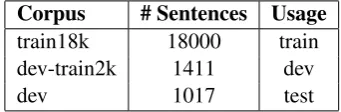
Our second approach is to consider the automatic correction problem as a translation problem by considering the sentences to be corrected as a source language and the correct sentences as a tar-get language. Since the organizers provided us with a 1 million tokens corpora with and with-out spelling errors, we tried to build a statisti-cal machine translation system using the parallel data. We used the Moses (Koehn, 2007), a Statis-tical Machine Translation (SMT) system to train a phrase based translation model with the train-ing data. The traintrain-ing data provided is made of erroneous sentences and for each sentence a list of corrections to be applied. To build the paral-lel error/correct text corpus we applied the correc-tions to the sentences. We came up with a par-allel corpus of 19421 sentences and 102k tokens for the error version and 112k tokens for the cor-rected version. Moses requires a parallel corpus to train a translation model, a development set to tune the translation model and also a monolingual language model in the target language. Since we had to evaluate the performance on the develop-ment data provided by the organizers, we had to use part of the training data as a development data for Moses. So we split the 20k sentences included in the training data in a new training set of 18k and a new development data of 2k sentences. We trained standard phrase based models using the surface word form with no morphological analy-sis or segmentation. For the word alignment in the training process, we used GIZA++ (Och, 2003). The 2k sentences were used to tune the SMT mod-els.
Corpus # Sentences Usage
train18k 18000 train
dev-train2k 1411 dev
[image:3.595.95.266.549.605.2]dev 1017 test
Table 2: Bitexts used for the SMT system
For the language models we used corpora of newspapers publicly available or collected by Techlimed. The sources are coming from the Open Source Arabic Corpora (Saad, 2010) (20M words), the Adjir corpus (Adjir, 2005) (147M words) and other corpora we collected from var-ious online newspapers for a total of 300M words. The language model was created with the IRSTLM toolkit (Federico, 2008).
We evaluated the translation models on the de-velopment set using different sizes of monolin-gual corpus. The 3 systems were trained on the same parallel corpus but with different size for fir monolingual data for System100, System200 and System300 with respectively 100M words, 200M words and 300M words. The results are given in table 3.
System Precision Recall F-measure
System100 70.7 48.8 57.8
System200 70.7 49.6 58.3
System300 70.8 50.1 58.7
Table 3: Results on the development set (in per-centage) for the 3 SMT systems
We can see from table 3 that the size of the lan-guage model has no impact on the precision but increases slightly the recall of 1.3% in absolute (2.6% in relative).
The BLEU scores (Papineni, 2002) measured on Sytem100, System200, System300 are respec-tively 65.45, 65.82 and 65.98.
We also tried to combine Hunspell/Ayaspell with the SMT system by correcting the output of the SMT system with Hunspell/Ayaspell but didn’t get any improvement.
4 Discussion
con-cern 4,117 annotations of the gold standard of the development set (25.4%). Another point that we would like to mention is that a spell checker and correction tool is usually used in an inter-active mode by proposing n-best candidates for the correction of a word. When looking at Hun-spell/Ayspell correction candidates for an error, we saw the correction was not in position 1 but in the list of candidates. So it would be interesting to compare the correction on the n-best candidates and not only on the first candidate for Hunspell and the SMT system.
5 Conclusion
This paper has reported on the participation of Techlimed in the QALB Shared Task on Auto-matic Arabic Error Correction. This is the first time we tried to develop a spellchecker for Arabic and have investigated two approaches. The first one is a lexicon driven approach using Hunspell as a spellchecker and correction tool and the second one is a SMT systems using Moses for training a statistical machine translation model on the 1 mil-lion tokens corpus provided by the organizers. The best results were obtained with the SMT system which, especially, was able to deal with the punc-tuation marks corrections. We also tested an hy-brid system by combining Hunspell and the SMT system but didn’t get better results than the SMT system alone. Our perspective is to improve the results by using hybrid systems based on the Di-iNAR lexical database (Abbes, 2004) and also a large arabic named entity dictionary, both owned and developped by Techlimed We will also try to used factored translation models with the Tech-limed Part-Of-Speech taggers. And more training data will also improve the quality of the correc-tions.
Acknowledgments
We would like to thank the QALB Shared Task or-ganizers for setting up this evaluation campaign on automatic error correction tool for Arabic and for providing us with the language resources and tools that we used for the development of our systems.
References
Ramzi Abb`es, Joseph Dichy, and Mohamed Hassoun. 2004. The architecture of a standard arabic lexical database: some figures, ratios and categories from the Diinar. 1 source program. InProceedings of the
Workshop on Computational Approaches to Arabic Script-based Languages, pages 15–22. Association for Computational Linguistics, 2004.
Mariam Aboelezz. 2009. Latinised arabic and connec-tions to bilingual ability. In Papers from the Lan-caster University Postgraduate Conference in Lin-guistics and Language Teaching, 2009.
Ahmed Abdelali. 2005. http://aracorpus.e3rab.com/
Ayaspell Arabic dictionary project, 2008.
http://ayaspell.sourceforge.net
Daniel Dahlmeier and Hwee Tou Ng. 2012. Bet-ter evaluation for grammatical error correction. In
Proceedings of the 2012 Conference of the North American Chapter of the Association for Computa-tional Linguistics: Human Language Technologies, pages 568–572. Association for Computational Lin-guistics, 2012.
Marcello Federico, Nicola Bertoldi, and Mauro Cet-tolo. 2008. Irstlm: an open source toolkit for han-dling large scale language models. InInterspeech, pages 1618–1621, 2008.
Hunspell, 2007. http://hunspell.sourceforge.net/
Philipp Koehn, Hieu Hoang, Alexandra Birch, Chris Callison-Burch, Marcello Federico, Nicola Bertoldi, Brooke Cowan, Wade Shen, Christine Moran, Richard Zens, et al. 2007. Moses: Open source toolkit for statistical machine translation. In Pro-ceedings of the 45th Annual Meeting of the ACL on Interactive Poster and Demonstration Sessions, pages 177–180. Association for Computational Lin-guistics, 2007.
Vladimir Levenshtein. 1966. Binary codes capable of correcting deletions, insertions and reversals. In So-viet physics doklady, volume 10, page 707, 1966.
Behrang Mohit, Alla Rozovskaya, Nizar Habash, Wa-jdi Zaghouani, and Ossama Obeid. 2014. The First QALB Shared Task on Automatic Text Correction
for Arabic. InProceedings of EMNLP Workshop on
Arabic Natural Language Processing, Doha, Qatar, October 2014.
Franz Josef Och and Hermann Ney. 2003. A sys-tematic comparison of various statistical alignment
models. Computational Linguistics, 29(1):19–51,
2003.
Kishore Papineni, Salim Roukos, Todd Ward, and Wei-Jing Zhu. 2002. Bleu: a method for automatic evaluation of machine translation. InProceedings of the 40th annual meeting on association for compu-tational linguistics, pages 311–318. Association for Computational Linguistics, 2002.
Motaz K Saad and Wesam Ashour. 2010 Osac: Open
source arabic corpora. In6th ArchEng Int.
Wajdi Zaghouani, Behrang Mohit, Nizar Habash, Os-sama Obeid, Nadi Tomeh, Alla Rozovskaya, Noura Farra, Sarah Alkuhlani, and Kemal Oflazer. 2014. Large scale arabic error annotation: Guidelines and
framework. In Proceedings of the Ninth