Statistical models for text normalization and machine translation
Kevin Scannell
Department of Mathematics and Computer Science Saint Louis University
St. Louis, Missouri, USA [email protected]
Abstract
Irish and Scottish Gaelic are closely-related languages that together with Manx Gaelic make up the Goidelic branch of the Celtic family. We present a statistical model for translation from Scottish Gaelic to Irish that we hope will facilitate communication between the two language communities, especially in social media. An important aspect of this work is to overcome the orthographical differences between the languages, many of which were introduced in a major spelling reform of Irish in the 1940’s and 1950’s. Prior to that date, the orthographies of the two languages were quite similar, thanks in part to a shared literary tradition. As a consequence of this, machine translation from Scottish Gaelic to Irish has a great deal in common with the problem of normalizing pre-standard Irish texts, a problem with applications to lexicography and information retrieval. We show how a single statistical model can be used effectively in both contexts.
1 Introduction
Irish and Scottish Gaelic are closely-related languages in the Celtic language family. Each is spoken as the day-to-day language by minority communities in Ireland and Scotland, respectively. While each language can be considered “under-resourced” in terms of language technology when compared with English, French, Spanish, etc., they are significantly better-off than many European minority languages, and far ahead of most indigenous languages of Australia, Africa, and the Americas (Judge et al., 2012), (Bauer, 2014).
Our primary aim in this paper is to describe a machine translation (MT) engine for translating from Scottish Gaelic into Irish. This is not the first time this language pair has been considered in the literature. We developed a rule-based system for translating between these two languages almost ten years ago, but in the opposite direction (Scannell, 2006). Some of that work has since been ported to the Apertium MT framework (Corb´ı-Bellot et al., 2005), (Forcada et al., 2011), and in particular is now available as free software; because of this we were able to reuse those resources in the present project. We believe strongly in open source approaches to language technology development for minority languages, and so the source code and lexicons for the present project are all freely available under the GPL.1
Our secondary aim is to apply the same statistical model to an equally important language-processing challenge, namely the standardization of historical Irish texts. The Irish language underwent a major spelling reform in the 1940’s and 1950’s with the introduction of the the so-calledCaighde´an Oifigi´uil
(Official Standard) by the Irish government. The Official Standard succeeded in simplifying the orthogra-phy in a number of ways, and has been almost universally adopted in textbooks, government publications, and by the news media. On the other hand, from the perspective of a language technologist, it has caused great difficulties. For example, pre-standard texts are rendered invisible to search engines when users search via standard spellings. And a tremendous amount of high-quality writing by native Irish speakers
1Seehttps://github.com/kscanne/caighdean.
This work is licenced under a Creative Commons Attribution 4.0 International License. Page numbers and proceedings footer are added by the organizers. License details:http://creativecommons.org/licenses/by/4.0/
(tens of millions of words) produced between about 1925 and 1945 is effectively unusable for language modeling or other NLP applications.
This explains the importance of Irish standardization, but what does it have to do with Scottish Gaelic– Irish MT? The answer is twofold: first, we can cast the standardization problem as an MT problem between twoveryclosely-related languages (namely, pre-standard and standard Irish), and second, the orthography of pre-standard Irish has a great deal in common with the orthography of Scottish Gaelic, and so it turns out that a single statistical model works well to solve both problems. A brief description of the standardizer has appeared previously in (U´ı Dhonnchadha et al., 2014), as part of a more complex pipeline for processing historical Irish texts for lexicography.
Many authors have considered MT between closely-related language pairs, including dozens of papers describing rule-based systems based on the Apertium engine (Forcada et al., 2011).2 Several other
papers have taken statistical or hybrid approaches, e.g. (Hajiˇc, 2000) for Czech and Slovak, (Altintas and Cicekli, 2002) for Turkish and Crimean Tatar, (Nakov and Tiedemann, 2012) for Macedonian and Bulgarian, and (Miller, 2008) and the references therein. Statistical MT techniques have also been used previously for historical text normalization; see for example (Pettersson et al., 2013).
The outline of the paper is as follows: In section 2, we describe the shared statistical model in general terms, and discuss the problematic notion of “standard Irish”. In section 3 we describe gd2ga, our Scottish Gaelic–Irish MT system, along with the parallel corpus used in its development. Finally, in section 4, we introduce and evaluate the Irish standardizer.
2 The Model
In this section we describe the statistical model that underlies both thegd2gamachine translation system and the Irish standardizer. We view both problems as instances of machine translation between very closely-related languages, the latter requiring translation from what we will call “pre-standard Irish” to “standard Irish” (with scare quotes because both terms are problematic; more on this below). Because of the limited syntactic differences between source and target in each case, it suffices to use a simple word-based model without reordering, a variant of the well-known IBM model 1 (Brown et al., 1993). It is important to distinguish the statistical model per se (which assigns probabilities to translation candidates) from the means by which those probabilities are acquired. In the context of the IBM models, Expectation Maximization (EM) is typically used for the latter; here we take a simpler approach, described in section 2.2. In the two subsections that follow, we will describe the language model and translation model, respectively.
2.1 Language Model
The target language in both cases is what we are calling “standard Irish”, and so a single language model suffices for both systems. We use a trigram model which is typical in this context and normally would require little further comment. In our situation, however, we run into a couple of major difficulties.
First, there is not complete agreement with respect to what “standard Irish” means. The first movement toward standardization of the written language goes back to the 1930’s with the establishment of govern-ment committees to look at the question. A simplified spelling system was published in 1945 (Rann´og an Aistri´uch´ain, 1945) and implemented by the government translation office around the same time. A simplified grammar was published in 1958 (Rann´og an Aistri´uch´ain, 1958), followed by two important bilingual dictionaries (de Bhaldraithe, 1959; ´O D´onaill, 1977) that helped encourage use of the standard language by the general public. The problem is that these dictionaries do not completely conform to the published standard, nor do many grammar books that are used in schools and by independent learners even today. To compond the confusion, a revised version of the official standard was recently published (U´ıbh Eachach, 2012), and has been criticized by some in the language community (Mac Lochlainn, 2012), so it remains to be seen the extent to which it will be embraced as the new “standard Irish”.
The second difficulty is that, even to the extent that everyone agrees on certain elements of the standard,
no oneimplements them completely in their writing, which is to say that virtually all non-trivial texts in
Irish contain some non-standard forms. In the case ofgd2ga, this is not of great concern; we could train the target language model with the texts we have, and the output would resemble the fluent, natural Irish of the training texts. For the standardizer, however, we are aiming at very high precision, with the output conforming tosomeversion of the standard. In short, the problem is this: we want to train an n-gram model for a certain language, but there areno non-trivial texts written in that language.
We get around these issues by making use of a suite of open-source Irish language proofing tools calledAn Gramad´oir.3 From an initial corpus of about 100 million words, we selected a subset of about
40 million words comprised of the texts that are most conformant to the standard. To do this, the rules implemented inAn Gramad´oirwere first separated into those representing true “errors” (misspellings, grammatical mistakes, etc.) from those representing standardizations. Then,An Gramad´oirwas run on every text in the corpus in order to assign each a numerical measure of “non-standardness” (the number of standardizations flagged per 100 words). The subcorpus was chosen from the texts with the lowest standardness scores. Finally, we applied a small number of automated substitutions to certain non-standard forms that are nearly as common as their non-standardizations in real-world texts, e.g.nach dt´ainig
vs.n´ar th´ainig(“did not come”).
Once the training corpus is generated in this way, we tokenize and compute the probabilities for the trigram language model (no pruning), and smooth using absolute discounting (Chen and Goodman, 1996). The implementation of the language model is included as part of the translator itself in order to avoid external dependencies on libraries such as IRSTLM, KenLM, etc.
2.2 Translation Model
The translation model represents the conditional probability of some source language word correspond-ing to a given target language word. Since the parallel corpora for our two translation problems are relatively small, and since our goal is very high-precision translation, a statistical word alignment ap-proach using Expectation Maximization does not give suitable results. Instead, we take advantage of the resources that we have at hand; specifically, high-quality bilingual lexicons together with a well-understood set of spelling rules for mapping source language words to cognates in the target language. In the context of Scottish Gaelic to Irish MT, the latter include mappings like-chd→-chtand-eu-→ -´ea-(together these two rules map a word likecreuchd(“wound”) to its Irish cognatecr´eachtfor exam-ple). For Irish standardization, there is a separate set of rules but with significant overlap, e.g.-idhea-→ -´ıo-, which mapsbuidheach(“thankful”) tobu´ıochandfuidheall(“remainder”) tofu´ıoll. These last two examples are valid for bothgd2gaand for the standardizer.
A source-to-target language mapping is often discovered through a combination of rule-based spelling changes like the ones above, plus a lexical mapping when the rules do not suffice. We define the transla-tion model in the following simple way: (1) all source language words that are paired with a given target language word are assumed to have the same conditional probability; and (2) when a source language word is paired with a target language word by applying some numbernof spelling rules, we multiply the conditional probability by a fixed “penalty”βn. When more than one sequence of rules leads to the
same target word, we take the shortest sequence. The constantβwas optimized through a tuning process using held-out data from the parallel corpora; we used the value ofβwhich gave the smallest word-error rate on the held-out test set.
Choices (1) and (2) above were made for the sake of simplicity. In future work, we plan to experiment with allowing different probabilities for different rules, as well as using EM to train the translation probabilities, restricting to the lexicographical translation pairs.
The decoding process is quite simple. The algorithm processes the source sentence word-for-word from left-to-right, and keeps track of all possible target language hypotheses along with their probabili-ties, as computed using the translation model and language model. When multiple hypotheses share the same final two words, we are able to discard all but the one with the highest probability. When we reach the end of the sentence, the highest probability candidate is output as the translation.
3 Scottish Gaelic to Irish MT
Scottish Gaelic and Irish are are sufficiently distinct as spoken languages that even fluent speakers with-out experience in the other language are usually only able to understand bits and pieces. As a result, there are very few spoken-language contexts in which Scottish Gaelic and Irish speakers are able to interact with each other in either language, and often have to resort to English.4
The written language is significantly easier, even in light of the Irish spelling reform and more recent reforms on the Scottish Gaelic side (Scottish Qualifications Authority, 2009) which have made things more difficult than they might conceivably be. Indeed, there are vibrant online communities of Irish and Scottish Gaelic speakers availing themselves of social media, especially Facebook and Twitter, and there is evidence of a significant amount of bilingual communication going on between the two language communities. (Scannell, 2013)
We believe there could be even more, given the right tools. By implementing high-quality Scottish Gaelic to Irish machine translation, and by deploying it in combination with our earlierga2gdsystem, we hope to encourage greater communication between the two communities.
3.1 Parallel Corpus
A parallel corpus plays a key role in the development of the bilingual lexicon and spelling rules, as well as being used for evaluation purposes. Unfortunately, direct translations between the two languages are extremely rare (despite the relative ease with which such translations could be made), and even translations of a common English source text proved hard to come by. So we chose to include quite a bit of material that might otherwise have been left out of a parallel corpus: software translations (Firefox, LibreOffice, etc.), poetry, song lyrics, prayers, bilingual word lists, Irish glosses on Scottish Gaelic source material (and vice versa), bilingual tweets, titles of linked Wikipedia pages, and so on. When combined with more traditional material (Bible texts, fiction and non-fiction prose translations), we were able to assemble roughly a million words of parallel text: 129,983 translation segments containing 1,016,041 words of Scottish Gaelic and 956,598 words of Irish. This is, to our knowledge, the only non-trivial parallel corpus for this language pair.5
3.2 Bilingual Lexicography
The heart of the system is the bilingual lexicon which is being painstakingly constructed by hand (work in progress), drawing upon a number of freely available resources for both languages. Even though the translation system does no part-of-speech tagging, the lexicon stores lemmas in Scottish Gaelic tagged by part-of-speech, mapped to lemmas in Irish, also tagged by part-of-speech. Then, mappings between surface forms are produced by employing morphological generators on both sides (cf. (Tyers, 2009)). This produces mappings for over 150,000 surface forms from a bilingual lexicon with about 13,000 lemmas.
We have used the following resources while building the lexicon.
• The parallel corpus described in section 3.1
• Scottish Gaelic–English dictionaries created by Michael Bauer (Bauer, 2014)
• Various Scottish Gaelic–English dictionaries hosted by Sabhal M`or Ostaig6
• The bilingual lexicon created for (Scannell, 2006)
4This despite the efforts of organizations likeColmcille(formerlyIomairt Cholm Cille), established to encourage precisely
this sort of interaction.
5We have made the portions of the corpus that are under open licenses available herehttp://borel.slu.edu/pub/
ccgg.zip.
3.3 Evaluation
We began by evaluating the coverage of the source language lexicon. For this, we gathered a monolin-gual Scottish Gaelic corpus comprised of 3.9M tokens from 14713 web-crawled texts (Scannell, 2007). The system recognized96.74% of the tokens in this corpus, a result which is comparable to, or even better than, the coverage of many open-source spell checkers on (noisy) web texts. This result is due to (1) the fact that we were able to re-purpose a number of open-source lexical resources when building our dictionary, (2) the addition of a large database of “untranslatables”: proper names (e.g. Facebook,
Akerbeltz), non-Gaelic words (mostly English, but some Latin, French, etc.), and abbreviations (e.g.km,
vs) and (3) the ability of the system to handle misspellings and variants either by including them in the lexicon (with mappings to “standard” forms) or through the application of spelling rules.
Evaluating the MT system itself proved problematic. Even though we were able to assemble a parallel corpus, the vast majority of the texts are translations from a common English source (principally, the open-source software translations and the Bible texts), as opposed to direct translations between Irish and Scottish Gaelic. To get around this issue, the author manually translated a collection of 593 sentences from Scottish Gaelic to Irish and used this as a test corpus. When comparing the output of gd2ga
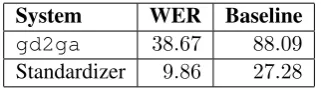
with these reference translations, the word-error rate (WER) was38.67%. This can be compared with a baseline system that simply leaves the Scottish Gaelic source text unchanged, yielding a WER of88.09%. This is still not completely satisfactory as an evaluation for a couple of reasons. First, given the nature of the statistical model, the translations produced bygd2gastay very close to the source language text, and so a sentence like
Tha mi a’ tuigsinn a-nis.
(“I understand now.”) translates to
T´a m´e ag tuiscint anois.
whereas a human translator might render this more naturally in Irish as “Tuigim anois.”. Similar exam-ples in other verb tenses abound. Secondly, the system sometimes gets initial mutations wrong (tending to be conservative and preserving the mutations of the source text due to the penalty factorβ), though this rarely impacts comprehension or fidelity of the translation. It might be reasonable to compute a modified WER for Celtic languages that ignores differences in mutations, but we did not pursue this.
4 Irish Standardizer
The standardizer described in this section takes as input an Irish language text and outputs a version that conforms as closely as possible to “standard Irish”, subject to the vagaries discussed above in section 2.1. The principal application of the standardizer has been to the indexing of pre-standard texts to enable search and retrieval via standard spellings, mainly for lexicographical purposes (U´ı Dhonnchadha et al., 2014). In this application, the standardized texts are used only for indexing purposes, which is to say that the pre-standard texts are displayed to users in search results.
An interesting second application would be to apply the standardizer to the huge amount of Irish language literature (novels, plays, many of them in translation) published from the 1920’s through the 1940’s in order to make those texts accessible to a modern readership that has grown up on the standard orthography. Indeed, a number of these books have been republished in recent years, but to my knowl-edge they have all been standardized by hand, e.g. (Doyle, 2012). To do this automatically, somewhat more care would be needed in order to not completely destroy the richness of the Irish dialects found in these texts (as the standardizer in its current form does, more or less), probably by creating customized versions of the standardizer for each dialect, together with limited post-editing.
4.1 Parallel Corpus
sentence pairs. The standardizations were taken from republications of older material of the kind de-scribed above, and were performed manually by human editors. In all, we used eighteen books together with their standardizations, segmented by sentences and aligned into 46,914 translation pairs (almost all one sentence to one sentence). There are 814,365 words on the pre-standard side and 801,236 words on the standard side.
4.2 Lexicography
The bilingual lexicon is similar in structure to the Scottish Gaelic–Irish lexicon described above in section 3.2, with pre-standard lemmas being mapped to standard lemmas, and morphological generators applied to each side to create mappings of surface forms. The lexicon again draws upon existing resources; first and foremost, about 22,000 standardization pairs used byAn Gramad´oirfor spelling and grammar correction, along with an additional 10,000 pairs drawn directly from an electronic version of ( ´O D´onaill, 1977). After applying the morphological generators, we end up with mappings for about 135,000 surface forms. Keep in mind, however, that the spelling rules play a more important role for the standardizer than they do for the Scottish Gaelic translator, and so the actual source language coverage on pre-standard Irish texts is significantly better than the number 135,000 might suggest.
4.3 Evaluation
We performed two evaluations of the standardizer.
The first evaluation is similar to the one we performed on gd2ga, described above in section 3.3. Namely, we held out a sample of 200 sentence pairs from the parallel corpus, applied the standardizer to the pre-standard sentences, and compared the results with the reference standardizations, yielding a WER of9.86%. Of course the translation problem here is much easier, as illustrated by a baseline WER of27.28%obtained by leaving the pre-standard texts unchanged.
System WER Baseline
gd2ga 38.67 88.09
[image:6.595.219.380.398.443.2]Standardizer 9.86 27.28
Table 1: Summary of results (Word Error Rates)
As a second evaluation, we looked atsentence-level accurancy. The point here is that in most cases there really is one “optimal” standardization of a given input sentence and that should be our aim. For example, the pre-standard
Acht go h-´adhmhail bh´ı lucht s´ıothch´ana thall agus i bhfos.
(“But, luckily, there were peaceful people on both sides.”)
must, in a just world, map to:
Ach go h´adh´uil bh´ı lucht s´ıoch´ana thall agus abhus.
and we would consider any other standardization as incorrect.
The second evaluation, therefore, involves holding out a sample of 4147 sentence pairs from the par-allel corpus, applying the standardizer to the pre-standard sentences, and comparing word-for-word with the standardized sentence (ignoring differences in punctuation). The current version gets 35.06% of these sentences completely correct. This can be compared with a score of 7.45% for a baseline system that does nothing to the input text (that is, 7.45% of the pre-standard sentences require no standardization at all, mostly very short sentences).
Acknowledgements
Gaelic. When combined with my own translations into Irish, these make up fully half of the Irish– Scottish Gaelic parallel corpus. Thanks also to Caoimh´ın ´O Donna´ıle for providing access to a wealth of Scottish Gaelic lexicographical material and for answering many linguistic questions over the years. Donncha King kindly provided copies of several hard-to-find Irish translations of Scottish Gaelic short stories, along with the originals. I am grateful also to Ciar´an ´O Duibh´ıın for a number of useful email conversations regarding Irish standardization. The teams from the New English-Irish dictionary project and the Royal Irish Academy’sFocl´oir na Nua-Ghaeilge, especially P´adraig ´O Mian´ain, Cathal Convery, Ruair´ı ´O hUiginn, and M´aire Nic Mhaol´ain, manually corrected the output of early versions of the standardizer which greatly sped up development. Finally, thanks to Elaine U´ı Dhonnchadha and Brian ´O Raghallaigh for bravely installing and running unwieldly versions of the standardizer. This work was partially supported by US NSF grant 1159174.
References
Kemal Altintas and Ilyas Cicekli. 2002. A Machine Translation System Between a Pair of Closely Related Languages. InProceedings of the International Symposium on Computer and Information Sciences, 192–196. Michael Bauer. 2014. Am Faclair Beag: Faclair G´aidhlig is Beurla le Dwelly ’na bhroinn [An English–Scottish
Gaelic dictionary incorporating Dwelly] http://www.faclair.com/. Retrieved June 26, 2014.
Michael Bauer. 2014. Speech and Language Technology on a Shoestring and how to get there in a hurry. http://www.akerbeltz.org/iGaidhlig/wp-content/uploads/2014/07/ SALT-on-a-Shoestring.pdf. Retrieved July 3, 2014.
Peter F. Brown, Vincent J. Della Pietra, Stephen A. Della Pietra, and Robert L. Mercer. 1993. The mathematics of statistical machine translation: parameter estimation. Computational Linguistics, 19(2):263–311.
Stanley F. Chen and Joshua Goodman. 1996. An empirical study of smoothing techniques for language modeling.
InACL ’96 Proceedings of the 34th annual meeting on Association for Computational Linguistics, 310–318.
Antonio M. Corb´ı-Bellot, Mikel L. Forcada, Sergio Ortiz-Rojas, Juan Antonio P´erez, Gema Ram´ırez-S´anchez, Felipe S´anchez-Mart´ınez, I˜naki Alegria, and Kepa Sarasola. 2005. An Open-Source Shallow-Transfer Machine Translation Engine for the Romance Languages of Spain. InProceedings of the 10th European Associtation for
Machine Translation Conference, 79–86.
Tom´as de Bhaldraithe. 1959.English–Irish Dictionary. Oifig an tSol´athair, Baile ´Atha Cliath.
Niall ´O D´onaill. 1977.Focl´oir Gaeilge-B´earla [Irish–English Dictionary]. Oifig an tSol´athair, Baile ´Atha Cliath.
Elaine U´ı Dhonnchadha, Kevin Scannell, Ruair´ı ´O hUiginn, Eil´ıs N´ı Mhearra´ı, M´aire Nic Mhaol´ain, Brian ´O Raghallaigh, Gregory Toner, S´eamus Mac Math´una, D´eirdre D’Auria, Eithne N´ı Ghallchobhair, and Niall O’Leary. 2014. Corpas na Gaeilge (1882-1926): Integrating Historical and Modern Irish Texts. Proceed-ings of the Workshop “Language resources and technologies for processing and linking historical documents
and archives” at LREC 2014.
Arthur Conan Doyle. 2012. C´u na mBaskerville [The Hound of the Baskervilles]. Translated by Niocl´as T´oib´ın, standardized by Aibhist´ın ´O Duibh. Evertype, Co. Mhaigh Eo.
Vivian U´ıbh Eachach, ed. 2012. Gramadach na Gaeilge: An Caighde´an Oifigi´uil, Caighde´an
Athbhrei-thnithe [Irish Grammar: The Official Standard, Revised Standard]. http://www.oireachtas.ie/
parliament/media/Final-Version.pdf. Seirbh´ıs´ı Thithe an Oireachtais, Baile ´Atha Cliath.
Mikel L. Forcada, Mireia Ginest´ı-Rosell, Jacob Nordfalk, Jim O’Regan, Sergio Ortiz-Rojas, Juan Antonio P´erez-Ortiz, Felipe S´anchez-Mart´ınez, Gema Ram´ırez-S´anchez, and Francis M. Tyers. 2011. Apertium: a free/open-source platform for rule-based machine translationMachine Translation, 25(2):127–144.
Jan Hajiˇc, Jan Hric, and Vladislav Kuboˇn. 2000. Machine translation of very close languages. InANLC ’00 Proceedings of the sixth conference on Applied natural language processing, 7–12.
Antain Mac Lochlainn. 2012. L´eirmheas ar an Chaighde´an Oifigi´uil, 2012 [Review of the Official Standard, 2012].http://www.aistear.ie/news-details.php?ID=33. Retrieved May 2, 2014.
Bryce Miller. 2008. Translating Between Closely Related Languages in Statistical Machine Translation. MS Thesis, University of Edinburgh.
Preslav Nakov and J¨org Tiedemann. 2012. Combining word-level and character-level models for machine transla-tion between closely-related languages. InACL ’12 Proceedings of the 50th Annual Meeting of the Association for Computational Linguistics: Short Papers - Volume 2, 301–305.
Eva Pettersson, Be´ata Megyesi, and J¨org Tiedemann. 2013. An SMT Approach to Automatic Annotation of Historical Text. InProceedings of the Workshop on Computational Historical Linguistics at NODALIDA 2013,
NEALT Proceedings Series 18; Linkping Electronic Conference Proceedings, 54–69.
Rann´og an Aistri´uch´ain [The Translation Section]. 1945. Litri´u na Gaeilge: L´amhleabhar an Chaighde´ain Oifigi´uil [Irish Spelling: Handbook of the Official Standard]. Oifig an tSol´athair, Baile ´Atha Cliath.
Rann´og an Aistri´uch´ain [The Translation Section]. 1958. Gramadach na Gaeilge agus Litri´u na Gaeilge [Gram-mar of Irish and Spelling of Irish]. Oifig an tSol´athair, Baile ´Atha Cliath.
Kevin P. Scannell. 2006. Machine translation for closely related language pairs. InProceedings of the Workshop
“Strategies for developing machine translation for minority languages” at LREC 2006, 103–107.
Kevin P. Scannell. 2007. The Cr´ubad´an Project: Corpus building for under-resourced languages. InProceedings
of the 3rd Web as Corpus Workshop (WAC3) in Louvain-la-Neuve, Belgium, 5–15.
Kevin P. Scannell. 2013. Mapping the Celtic Twittersphere. http://indigenoustweets.blogspot. ie/2013/12/mapping-celtic-twittersphere.html. Retrieved May 2, 2014.
Scottish Qualifications Authority. 2009. Gaelic Orthographic Conventions. http://www.sqa.org.uk/ sqa/files_ccc/SQA-Gaelic_Orthographic_Conventions-G-e.pdf Ughdarras Theisteanas na h-Alba, Glasgow.
Francis M. Tyers. 2009. Rule-based augmentation of training data in BretonFrench statistical machine translation.