Proceedings of LAW IX - The 9th Linguistic Annotation Workshop, pages 1–10,
Scaling Semantic Frame Annotation
Nancy Chang, Google,[email protected]
Praveen Paritosh, Google,[email protected]
David Huynh, Google,[email protected]
Collin F. Baker, ICSI,[email protected]
Abstract
Large-scale data resources needed for progress toward natural language under-standing are not yet widely available and typically require considerable expense and expertise to create. This paper addresses the problem of developing scalable approaches to annotatingsemantic frames and explores the viability of crowdsourcing for the task of frame disambiguation. We present a novel supervised crowdsourcing paradigm that incorporates insights from human com-putation research designed to accommodate the relative complexity of the task, such as exemplars and real-time feedback. We show that non-experts can be trained to perform accurate frame disambiguation, and can even identify errors in gold data used as the training exemplars. Results demonstrate the efficacy of this paradigm for semantic annotation requiring an intermediate level of expertise.
1 The semantic bottleneck
Behind every great success in speech and language lies a great corpus—or at least a very large one. Ad-vances in speech recognition, machine translation and syntactic parsing can be traced to the availabil-ity of large-scale annotated resources (Wall Street Journal, Europarl and Penn Treebank, respectively) providing crucial supervised input to statistically learned models.
Semantically annotated resources have been com-paratively harder to come by: representing meaning poses myriad philosophical, theoretical and practi-cal challenges, particularly for general purpose
re-sources that can be applied to diverse domains. If these challenges can be addressed, however, seman-tic resources hold significant potential for fueling progress beyond shallow syntax and toward deeper language understanding.
This paper explores the feasibility of developing scalable methodologies for semantic annotation, in-spired by three strands of work.
lexical coverage (since the project is ongoing) as well as the relatively limited amount of annotated data. More impressive results have been based on PropBank (Palmer et al., 2005), a semantic resource whose frames are more lexically specific than those of FrameNet. PropBank frames are generally more tightly linked to surface syntax (and thus afford less generalization across words), but are relatively sim-pler to define and annotate, as reflected by its greater coverage and amount of annotated data. It seems natural to investigate whether a comparable amount of FrameNet data would yield equally good perfor-mance (along with the further benefits of frame-level generalizations).
Third, a handful of studies from the relatively new field ofhuman computationsuggest that some as-pects of frame annotation may be amenable to non-expert curation, such as made possible by crowd-sourcing platforms like Amazon Mechanical Turk (AMT) (Hong and Baker, 2011; Fossati et al., 2013). These findings are not altogether surprising: frame semantics purports to capture generalizations that depend on everyday, non-specialist language use. Frame annotation should therefore not require the same level of training as, for example, syntactic annotation. On the other hand, while competent speakers of a language are assumed to make im-plicit use of frame-like structures—i.e., understand-ing who did what to whom and other kinds of re-lationships implied by a specific expression—they do not explicitly annotate semantic information as a natural part of everyday language use. Thus, un-like translation—which (some) humans do rather naturally—frame annotation is unlikely to occur in the wild, and will likely require more instruction than a typical AMT task.
These three strands together suggest that frame semantics is a promising option for meaning rep-resentation; that larger-scale frame-annotated data could drive ASRL models; and that the task of frame annotation may be amenable to crowdsourc-ing methods. We take these strands as a startcrowdsourc-ing point for exploring how richer human computation frameworks can support scalable frame annotation, focusing in this paper on one part of frame annota-tion (theframe disambiguationtask).
In the remainder of the paper, we first describe rel-evant previous work in more detail (Section 2). We
then introduce a novel supervised crowdsourcing
framework that adapts previous work by introducing multiple kinds of feedback and supervision (Section 3) and describe experiments using this framework to crowdsource frame disambiguation (Section 4). Finally, we discuss results and future avenues sug-gested by this research (Section 5), in particular the possibility that non-experts can be efficiently and ef-fectively trained to perform tasks requiring an inter-mediate level of expertise.
2 Background
In this section we briefly describe the target rep-resentation of semantic frames, the FrameNet re-source, the frame disambiguation annotation task, and some relevant past human computation efforts.
2.1 Frame semantics
Asemantic frame(or simplyframe), as developed by the late Charles J. Fillmore (Fillmore, 1976; Fill-more, 1982), is a conceptual gestalt that represents a generalization over similar scenes—typically cor-responding to events, relations, states, or entities. Frames are structured around a set of semanticroles, also calledframe elements(FEs), corresponding to participants in the scene.
The key theoretical insight of frame semantics
is that the meanings of most words (and other con-structions) can be understood in relation to the se-mantic frames they evoke. The much-discussed Commercial Transaction frame, for example, has FEs for the Buyer, Seller, Goods and Money; and it is associated with a set of words, orlexical units
(LUs), that profile (or highlight) different FEs or sets of FEs (e.g., the verbbuyis typically expressed along with the Buyer and the Goods FEs, while the nounpriceis mainly associated with the Money).
Frames vary considerably in complexity and level of granularity. Moreover, individual lemmas (or words) might be associated with multiple frames. For example, the lemma like (as a preposition and verb, respectively) is associated with two frames:
• Similarity:Skiing is LIKE windsurfing.
• Experiencer focus:I LIKE looking in windows.
• Measure duration: CENTURIES of farming have shaped our countryside.
• Calendric unit:By the 13th CENTURY. . . .
For simplicity, the examples above do not show the FEs defined for each frame and how they re-late to different parts of the text, but a fully frame-annotated sentence would include that information.
2.2 FrameNet and frame disambiguation
FrameNet is a lexical resource for English based on frame semantics, in development since 1997 (Fill-more and Baker, 2010; Ruppenhofer et al., 2006). It includes nearly 1,200 frame definitions; 200,000 manually annotated examples; and about 13,000 LUs linked to specific frames.
The frame annotation process traditionally em-ployed by Berkeley FrameNet combinesframe cre-ationwithlexicographic frame annotation, where annotators select sentences from a corpus containing a lemma illustrating a frame. A separate full-text frame annotation process attempts to annotate all frames evoked by a sentence.
For either style of frame annotation, one must de-cide whether a lemma used in a given sentence is an instance of a particular frame, or more generally decide which of several candidate frames it evokes. Since the FrameNet project is ongoing (i.e., many frames have not yet been defined), the evoked frame may not even be among the known candidate frames. We call this taskframe disambiguation(FD), cor-responding roughly to word sense disambiguation.
FD is only the first step toward complete frame semantic annotation. The second isframe element annotation(FEA), the assignment of FEs to words in the sentence. The output of FEA corresponds to that of ASRL systems like those mentioned above; these systems often make precisely the same divi-sion of labor among FD and FEA phases (Das et al., 2013).
2.3 Insights from human computation
Human computation, in particular the use of large numbers of non-expert judgments to complement or substitute for expert judgments, has been well-established for many types of data collection, both commercial and scientific. Several crowdsourcing experiments have explored frame disambiguation and related tasks.
2.3.1 Crowdsourcing for frame disambiguation
The most relevant precursor of the current work is a series of experiments on crowdsourcing frame annotation, in particular the frame disambiguation task, using Amazon Mechanical Turk (AMT), re-ported at LAW V (Hong and Baker, 2011).
The target sentences consisted of unannotated sentences from the FrameNet database, plus a few annotated sentences for measuring annotator accu-racy. Several task designs were tried:
• frame choice: Workers choose from a list of candidate frames, plus ”None of the above”. • simplified frame names: as above, but with
FrameNet terms rewritten for non-experts. • frame sorting, with randomly chosen gold
exemplars: Workers see a list of sentences and “piles” corresponding to candidate frames, each with a starter gold exemplar. They sort sentences into the appropriate frame pile (and freely recategorize sentences if desired).
Several experiments were run with the last design, varying the qualifications of the workers and the pay rate, over words with varying degrees of ambiguity.
The results showed that AMT workers could per-form the FD task fairly well, that accuracy varied across lemmas (and did not depend only on the num-ber of candidate frames per lemma), and that in a few cases, workers strongly (and correctly) dis-agreed with gold data. These studies suggest that crowdsourcing for FD is feasible at least on a small scale (about 6 lemmas with a maximum of 5 candi-date frames per lemma). The current study adopts and extends many components of that framework to support larger-scale validation of the approach.
2.3.2 Crowdsourcing for WSD
coarse. They found that (1) rephrasing the sense def-inition improved accuracy, (2) more frequent words were resolved less accurately, and (3) annotators who spent more time per item were less accurate. They also found that all the workers were roughly equal in ability, and those who answered more items did not get more accurate, i.e. there was no measur-able practice effect, contrary to the findings of Chen and Dolan (2011), who paid more for better work and tried to retain the more accurate workers.
2.4 Other crowdsourcing for semantics
Few precedents exist for crowdsourcing complex se-mantic tasks. Bernstein et al. (2010) describe Soy-lent, a word processor that uses workers on AMT to help writers improve their text. They used a find-fix-verify pattern to iteratively evaluate and refine the quality of tasks like text paraphrasing and summa-rizing. DuoLingo (von Ahn, 2013) turns translation into an educational game, and translates web content using its language learners.
Freebase is a large human curated collaborative knowledge base (Bollacker et al., 2008) of struc-tured data. The schema for Freebase includes types and relationships that are human curated and val-idated via large scale crowdsourcing (Kochhar et al., 2010). A key methodological finding from this work was to focus on reproducibility as a key crite-ria when collecting semantic judgments from human annotators (Paritosh, 2012).
3 Supervised crowdsourcing
The findings discussed above provided promising ways of accommodating some challenges of the FD task. Our goals in extending the FD crowdsourcing framework were twofold: (1) adapt previous efforts to accommodate larger-scale annotation; and (2) incorporate multiple kinds of supervision, broadly construed. We discuss each of these below.
3.1 Scaling up frame disambiguation
We adopted the basic frame-sorting paradigm of Hong and Baker (2011), organizing tasks around specific lemmas. In each task, a set of sentences (each including the target lemma) was presented along with a set of candidate frames (each known to be associated with the target lemma).
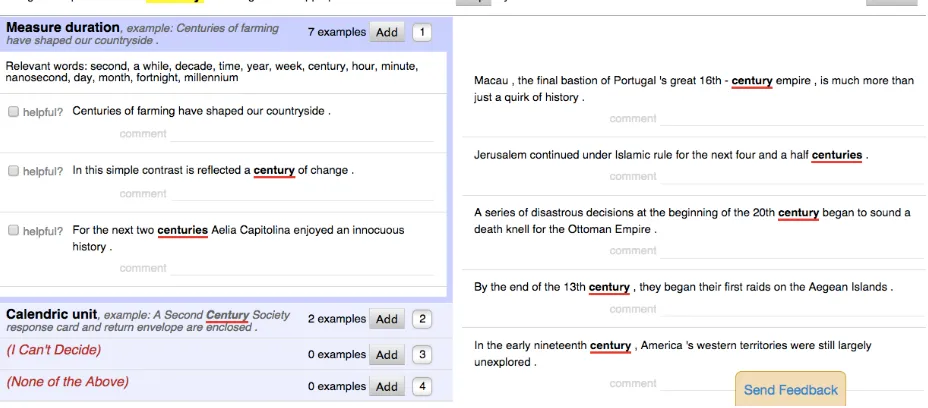
Several challenges arose in expanding from these small-scale experiments to less constrained condi-tions: The 32 lemmas used for our pilot study typ-ically had 3-4 candidate frames but in some cases as many as 10, necessitating an interface that could flexibly accommodate the need for detailed frame definitions within a limited space—while trying to avoid sensory overload that would likely detract from performance. Figure 1 shows a screenshot of the task user interface.
Another problem came from the need to adapt a resource designed for experts for use in a non-expert context. The prose used in FrameNet frame defi-nitions varies considerably in the degree of techni-cal jargon employed—perhaps as much as annota-tors varied in their appreciation or effective use of those definitions. Hong and Baker (2011) found im-proved performance with replacing just the frame name with a more easily interpretable title.
Given the impracticality of abridging the frame definitions for each task, we chose to show them unchanged, but to also provide more example uses and related words for each frame to de-emphasize the technical definitions. (We also explicitly warned annotators about the technical jargon and directed them to focus on example uses.)
Finally, we anticipated that a broader range of lemmas would make the task more difficult in var-ious ways. The potential for more candidate frames per lemma raises the chance of ambiguity and simi-larity among frames. It also seemed likely that there might be cases that fit none of the presented candi-date frames for a lemma, either because the appro-priate frame had not yet been created or because the lemma in question had not yet associated with that frame. We thus included extra choices correspond-ing to these failure modes (”None of the above” and ”I can’t decide”), as well as a way for workers to in-dicate uncertainty or provide additional comments.
defini-Figure 1: Frame identification task interface for the lemmacentury. Candidate frames (here,Measure durationand
Calendric unit) are shown on the left, each featuring typical examples of usage with the target lemma. The frame definition (not shown in figure) as well as other related words are also available. The examples to be classified are on the right side of the screen.
tions to a minimum.
3.2 Incorporating supervision
In moving to the middle ground of task complexity, we made two broad assumptions that informed how supervision could be introduced.
First, we assumed that the task was complex enough to need some training time, and that anno-tators with practice and experience would perform better. We thus required a crowdsourcing platform that would allow us to main a relatively stable anno-tator pool. In contrast to crowdsourcing platforms based on an open marketplace—where anyone is potentially eligible for any task, and no continuity across tasks or workers is guaranteed—we made use of a platform that tracks individual annotators’ his-tory and allows some form of communication be-tween task designers and annotators.
This interactive potential of our platform was cru-cial to our iterative design process: at every stage we were able to conduct small pilot studies that yielded useful qualitative feedback. More broadly, the fact that the same annotators would be working on multi-ple tasks allowed us to expect and plan for improved performance over exposure to the task—which in turn made it more worthwhile (for both the
design-ers of the task and the annotators) to invest in some amount of training.
Second, we assumed that some gold data would be available for our task. (In our case, it was easy to draw this from the available FrameNet data.) Gold data allows us to follow both conventional wisdom (that people learn best by example) and common practice in (supervised) machine learning of pro-viding explicit training examples of the task being learned. (We have relaxed this assumption in subse-quent experiments.)
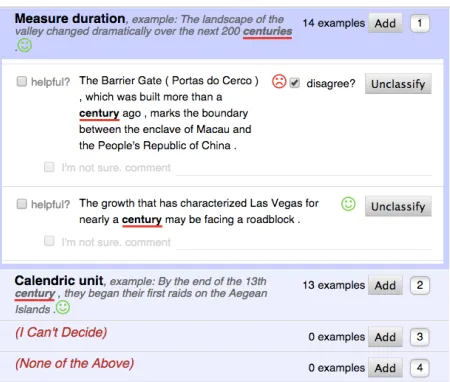
[image:5.612.77.541.83.287.2]Figure 2: Close-up of task UI used with feedback. Green smiling and red frowning icons indicate correctness of an annotator’s selection with respect to the correct (gold) an-swer, but annotators are allowed to indicate disagreement with the feedback.
4 Frame disambiguation experiment To investigate how frame disambiguation can be ac-complished at scale and with feedback, we used the frame-sorting design and UI described above in sev-eral annotation experiments. Below we describe the basic experimental set-up and methodology, fol-lowed by our evaluation metrics and results.
4.1 Methodology
We chose lemmas from existing gold examples from FrameNet’s full-text annotations, further restricting ourselves to examples from the American National Corpus. We chose 32 target lemmas (occurring in a total of 881 sentences) which satisfy the following conditions:
• At least 15 occurrences in the corpus.
• More than 1 candidate frame for each lemma. The actual number of candidate frames per lemma ranged from 2 to 10 (average 3-4). • At least 3 examples of the lemma’s use in each
candidate frame.
The first restriction above (15+ occurrences) was made purely to create tasks of a reasonable size for evaluation; tasks with significantly fewer occur-rences have been run with no effect on results.
The second restriction was intended to fo-cus the task on disambiguation among multiple frames rather than simply validation of a single frame (though other experiments included validation cases). Note that of the current 10K lemmas in FrameNet, 1900 (19%) are polysemous (i.e., asso-ciated with more than one frame). These lemmas are thus relatively more ambiguous than the average lemma in FrameNet.
The final restriction, on the number of exemplars available to be shown for the task, was made to facil-itate the testing of the feedback condition. Note that more general versions of the task could be run with fewer (or even no) exemplars, or expert annotators could supply those needed.
4.1.1 Experimental design
We used a 2x2 within-subjects factorial design. The lemmas were randomly split into two equal batches (n=16): No Feedback and Feedback. In theFeedbackcondition, the annotators received real-time positive or negative feedback in response to their sorting actions, based on whether their action matched the gold answer, while no such feedback was provided for lemmas in the other condition. Each annotator performed the task for each lemma, and each lemma was presented with the same type of feedback to all annotators. Each lemma was pre-sented to at least 7 annotators. In both conditions, the annotators were allowed to undo and change their sorting, and every annotator action was logged. The annotators were randomly allocated to two equal-sized groups: Group 1 and Group 2. Anno-tators from Group 1 were presented the Feedback
batch of exemplars before the No Feedback batch; and annotators from Group 2 were presented No Feedbackbefore theFeedbackbatch. This gives us fully counterbalanced, within-subjects data for com-parison of performance across conditions.
4.2 Analysis
We focused our analyses on howaccuracy—that is, correctness with respect to gold data—varied based on two factors:
Feedback. This is the main dimension we var-ied across experimental conditions. We compare the difference in performance acrosssFeedbackand
Feedback condition into two subcategories: Since the task UI allowed annotators to change their selec-tion (potentially in response to gold feedback), we were able to record each frame choice and thus track how well annotators in theFeedbackcondition per-formed on their first choice for a given item (which we call thePre Feedbackcondition), as well as what they eventually settled upon (which we call thePost Feedbackcondition).
Number of annotators. We also compared accu-racy across different numbers of annotators, ranging from 1 to 7 annotators.
We measured accuracy of the chosen frame against the gold-annotated frame. Our resolution policy was to require a threshold of 75% inter-rater agreement as the minimum for which a resolved an-swer would be considered usable.
[image:7.612.316.539.188.352.2]4.3 Results
Figure 3 shows the mean accuracy for the three pos-sible feedback conditions, and Figure 4 shows preci-sion results for different numbers of annotators per lemma (n=1 to 7).
Figure 3: Mean annotator accuracy across three experi-mental conditions: (1)No Feedback, for annotators who received no feedback. (2) Pre-Feedback, the accuracy of annotators’ first responseprior toreceiving feedback based on gold data. (3) Post-Feedback, the accuracy of annotators’ final response after receiving feedback, and after any number of revisions. Note that the Post-Feedback accuracy is significantly less than 1.0, showing that annotators have developed strong enough opinions to disagree while learning via the same gold data.
Figures 5 and 6 show individual annotator
[image:7.612.71.297.411.561.2]re-sponses for two lemmas, like and century. These were both typical in exhibiting a fairly clean division of responses between the candidate frames: i.e., the usages were straightforward to disambiguate. The latter example also includes a panel displaying in-dividual responses, including annotator’s disagree-ment with feedback and frame selection history.
Figure 5: Results for the lemmalike. The nodes in the top row correspond to candidate frames (Experiencer focus and Similarity) and three problem conditions(”I can’t De-cide”, ”None of the above”, and an unmarked ”Other”). The nodes in the bottom row correspond to classified sentences; lines between nodes in the top and bottom rows represent annotator choices, with thicker lines cor-responding to more annotators making that choice. This situation was typical: most sentences had a strong major-ity for one of the two expected frames, with a few outliers expressing indecision or otherwise disagreeing with the crowd. The red line highlights the results for the single sentence shown below.
We discuss our findings below: Findings 1-3 cerning the effect of feedback, and Finding 4 con-cerning the effect of number of annotators.
Finding 1. Feedback improves annotator ac-curacy. Unsurprisingly, we found that feedback improved accuracy: the mean annotator accuracy in the No Feedback condition was 0.78, Pre Feed-back condition was 0.81, and Post Feedback con-dition was 0.92. All differences are significant (p
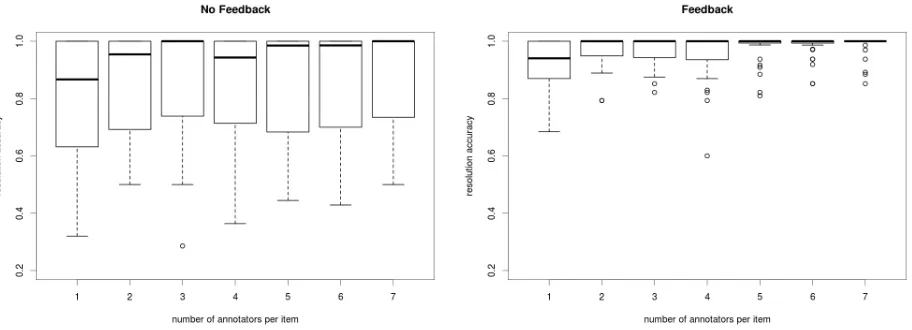
Figure 4: Accuracy of resolutions by number of annotators, in theNo Feedback(left) andFeedback(right) conditions. Box and whisker plots show median (marked by a heavy bar) and variance (indicated by box size) of accuracy across all lemmas. The resolutions are computed by combining independent answers from multiple annotators using a plurality threshold of 0.75.
Figure 6: Results for a task with lemma century. The responses for individual annotators (names masked) are displayed below, showing that many explicitly disagreed with the gold feedback (some providing additional justifi-cation). Note that the history of choices made is shown in one case, also suggesting some uncertainty. This exam-ple was one of several that further investigation revealed to be an error in the gold data.
reliable performance. Figure 4 shows two box and whiskers plots of resolution accuracy by number of annotators. There is much wider variance in annota-tor behavior in the No Feedback condition, as indi-cated by longer boxes and whiskers.
Finding 2. Feedback works even with
imper-fect gold data, and can be reliably used to cor-rect it. Our crowdsourced resolutions were signif-icantly better than the gold data that was used to train the annotators. In all conditions, annotators were allowed to change their responses; thus, those in the feedback conditions could in theory have per-formed at 100% accuracy by adhering strictly to the feedback. We were surprised to find, however, that the average accuracy even with feedback was less than perfect—an indication that annotators some-times chose not to adhere to gold data. We were aware that there might be some errors in the gold data, and allowed and encouraged the annotators to disagree with the feedback.
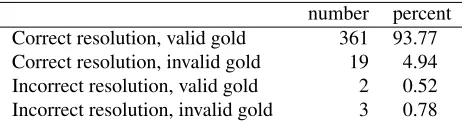
To investigate cases in which the annotators re-liably disagreed with the gold, we asked experts to manually validate gold data for sentences with a re-solved answer from the crowd, which was 385 sen-tences (87.10%). (Recall that we required agreement of 0.75 to be considered resolved.)
number percent Correct resolution, valid gold 361 93.77 Correct resolution, invalid gold 19 4.94 Incorrect resolution, valid gold 2 0.52 Incorrect resolution, invalid gold 3 0.78
Table 1: Accuracy of resolved judgments (total 385) based on validated gold data. The top two lines reflect all cases in which the crowd was correct, either in agreement or disagreement with gold data. The bottom two lines re-flect very rare cases of incorrect crowd resolutions.
This finding suggests that a richer framework can support crowdsourced semantic annotations even with imperfect data; even better, reliable crowd-sourced signals might be an effective avenue to the discovery and correction of imperfect gold data.
Finding 3. Even first responses improve with feedback. Figure 3 shows that the Pre Feedback
condition was significantly better than theNo Feed-backcondition: that is, there seemed to be a boost to performance even on annotator’s first guesses (be-fore receiving any feedback). This result suggests that feedback may have had effects that spread be-yond the current item, such that subsequent items were learned faster. One possible explanation for this apparent learning based on prior feedback is that there may be increased attention due to the expec-tation of feedback, such that the annotator homed in more quickly on the correct concept. These hy-potheses need further examination.
Finding 4. More annotators produce better results. Unsurprisingly, more is better: resolution accuracy increases with the number of annotators in all conditions. The mean resolution accuracy is higher in the Feedback condition, which is as ex-pected since per-annotator accuracy is higher in that condition. In fact, performance was fairly high (in both conditions) with as few as three annotators, but variance in resolution accuracy was significantly lower in theFeedbackcondition, further establishing the effectiveness of feedback. This difference is im-portant, since both mean and variance affect crowd-sourcing cost in terms of redundancy required.
5 Discussion and future directions
Our challenge was to devise effective and scalable ways of training annotators to perform the relatively
complex task of frame disambiguation. In this paper we have leveraged insights about human learning, in particular the value of exemplars and feedback (early, often and even imperfect), to create a novel crowdsourcing approach suitable for more complex tasks. A key feature of this approach is that it em-phasizes examples over explicit instructions, tapping into the cognitive capacity to learn deeply from a limited amount of data. It further exploits supervi-sion, particularly in the form of real-time feedback.
We demonstrated that real-time feedback can sub-stantially increase mean annotator accuracy and dra-matically increase inter-annotator agreement. Our experiments also showed the surprising result that even feedback based on imperfect gold data is effec-tive for training annotators—and that they can learn to produce resolutions of higher accuracy than the gold data they trained on. This suggests that we can train annotators with tarnished gold, and as part of that process even improve the gold data.
Besides being valuable in its own right as a ver-sion of word sense disambiguation, this task is also a small step on the road to full frame semantic anno-tation. We are currently piloting the task for the next step toward full frame annotation (frame element an-notation), applying the same principles of feedback and supervision.
More generally, the supervised crowdsourcing paradigm developed here explores a useful middle ground of expertise, one we believe to be suitable for many semantic annotation tasks too complex for standard transient crowdsourcing. An effective way of producing such data on a large scale using faster, less expensive methods has great potential for eas-ing the semantic bottleneck and facilitateas-ing progress toward richer natural language understanding.
Acknowledgments
John Giannandrea and Amar Subramanya for useful discussion and feedback.
Thanks also to the reviewers for very thoughtful, constructive comments. Any opinions or errors are those of the authors alone.
References
Michael S. Bernstein, Greg Little, Robert C. Miller, Bj¨orn Hartmann, Mark S. Ackerman, David R. Karger, David Crowell, and Katrina Panovich. 2010. Soylent: A word processor with a crowd inside. InProceedings of the 23nd annual ACM symposium on User interface
software and technology, pages 313–322. ACM.
Kurt Bollacker, Colin Evans, Praveen Paritosh, Tim Sturge, and Jamie Taylor. 2008. Freebase: a col-laboratively created graph database for structuring hu-man knowledge. In Proceedings of the 2008 ACM SIGMOD international conference on Management of data, pages 1247–1250. ACM.
Chris Callison-Burch and Mark Dredze, editors. 2010.
Proceedings of the NAACL/HLT 2010 Workshop on Creating Speech and Language Data with Amazon’s
Mechanical Turk, Los Angeles, CA, June. ACL.
David L. Chen and William B. Dolan. 2011. Building a Persistent Workforce on Mechanical Turk for Mul-tilingual Data Collection. InProceedings of The 3rd
Human Computation Workshop (HCOMP 2011),
Au-gust.
Dipanjan Das, Nathan Schneider, Desai Chen, and Noah A. Smith. 2010. Probabilistic Frame-Semantic Parsing. InProceedings of the North American Chap-ter of the Association for Computational Linguistics
Human Language Technologies Conference, Los
An-geles, June.
Dipanjan Das, Desai Chen, Andr´e F. T. Martins, Nathan Schneider, and Noah A. Smith. 2013. Frame-Semantic Parsing.Computational Linguistics, 40(1). Charles J. Fillmore and Collin F. Baker. 2010. A Frames
Approach to Semantic Analysis. In Bernd Heine and Heiko Narrog, editors,Oxford Handbook of Linguistic
Analysis, pages 313–341. OUP.
Charles J. Fillmore. 1976. Frame semantics and the na-ture of language. Annals of the New York Academy of Sciences: Conference on the Origin and Development
of Language and Speech, 280(1):20–32.
Charles J. Fillmore. 1982. Frame semantics. In
Lin-guistics in the Morning Calm, pages 111–137.
Han-shin PubliHan-shing Co., Seoul, South Korea.
Marco Fossati, Claudio Giuliano, and Sara Tonelli. 2013. Outsourcing FrameNet to the Crowd. In Proceed-ings of the 51st Annual Meeting of the Association for
Computational Linguistics (Volume 2: Short Papers),
pages 742–747, Sofia, Bulgaria, August. Association for Computational Linguistics.
Daniel Gildea and Daniel Jurafsky. 2002. Automatic La-beling of Semantic Roles. Computational Linguistics, 28(3):245–288.
Jisup Hong and Collin F. Baker. 2011. How Good is the Crowd at “real” WSD? InProceedings of the 5th
Lin-guistic Annotation Workshop, pages 30–37, Portland,
OR, June. ACL.
Richard Johansson and Pierre Nugues. 2006. A FrameNet-based Semantic Role Labeler for Swedish.
In Proceedings of Coling/ACL 2006, Sydney,
Aus-tralia, July 17-21.
Adam Kapelner, Krishna Kaliannan, H. Andrew Schwartz, Lyle Ungar, and Dean Foster. 2012. New Insights from Coarse Word Sense Disambiguation in the Crowd. InProceedings of COLING 2012: Posters, pages 539–548, Mumbai, India, December. COLING. Shailesh Kochhar, Stefano Mazzocchi, and Praveen Par-itosh. 2010. The anatomy of a large-scale human computation engine. InProceedings of the acm sigkdd
workshop on human computation, pages 10–17. ACM.
Martha Palmer, Daniel Gildea, and Paul Kingsbury. 2005. The Proposition Bank: An Annotated Cor-pus of Semantic Roles. Computational Linguistics, 31(1):71–106, March.
Praveen Paritosh. 2012. Human computation must be reproducible. InCrowdSearch, pages 20–25.
Miriam R. L. Petruck and Gerard de Melo, editors. 2014.
Proceedings of Frame Semantics in NLP: A Workshop
in Honor of Chuck Fillmore (1929-2014), Baltimore,
MD, USA, June. Association for Computational Lin-guistics.
Sameer Pradhan, Eduard Hovy, Mitch Marcus, Martha Palmer, Lance Ramshaw, and Ralph Weischedel. 2007. OntoNotes: A Unified Relational Semantic Representation. International Journal of Semantic
Computing, 1(4):405–419.
Josef Ruppenhofer, Michael Ellsworth, Miriam R. L. Petruck, Christopher R. Johnson, and Jan Scheffczyk. 2006. FrameNet II: Extended Theory and Practice. International Computer Science Institute, Berkeley, CA. Distributed with the FrameNet data.
Rion Snow, Brendan O’Connor, Daniel Jurafsky, and An-drew Ng. 2008. Cheap and Fast — But is it Good? Evaluating Non-Expert Annotations for Natural Lan-guage Tasks. In Proceedings of the 2008 EMNLP, pages 254–263, Honolulu, HI, October. ACL.
Luis von Ahn. 2013. Duolingo: Learn a language for free while helping to translate the web. In Proceed-ings of the 2013 International Conference on