Soil Property Analysis Process by Multi Sensor
Technique
Ranjan Kumar Sapkota1, Bobin Thapa2, Anshul Dixit3 1
UG student, Electrical and Electronics Engineering, Phonics group of Institution, India
2
UG student, Bsc Agriculture, Phonics group of Institution, India
3
Assistant Professor, Department of Electrical and Electronics Engineering, Phonics group of Institution, India
Abstract: Two significant issues in present day Agriculture are water shortage and high work costs. These issues can be settled utilizing agricultur task robotization, which empowers accuracy agribusiness. Thinking about plenitude of daylight in India, this paper examines the plan and advancement of an IoT Agribot that computerizes water system task and empowers remote ranch checking. The Agribot is created utilizing a PIC microcontroller. While executing the undertaking of water system, it moves along a pre-decided way of a given ranch, and faculties soil dampness substance and temperature at standard focuses. At each detecting point, information obtained from different sensors is prepared locally to choose the need of water system and in like manner homestead is watered. Further, Agribot goes about as an IoT gadget and transmits the information gathered from numerous sensors to a remote server utilizing GPS/GPRS. At the remote server, crude information is prepared utilizing sign handling tasks, for example, separating, pressure and expectation. As needs be, the broke down information measurements are shown utilizing an intuitive interface, according to client demand.
Keywords: soil moisture, smart agriculture, smart farming, soil temperature sensing, soil humidity sensing
I. INTRODUCTION
As indicated by the ongoing insights, the land utilized for yield development in India is diminishing at a quickening rate. Obsolete water system procedures and accessibility of water assets are the essential purposes behind disjointed creation. Subsequently, innovative answers for agribusiness task robotization are the need of great importance. Specifically, improved water system components lessening water wastage are basic, which empower exactness agribusiness. Innovative answers for water system and agrarian undertaking mechanization are driven by electric power. Henceforth innovative answers for agribusiness task mechanization can yield better benefits for Indian ecological conditions.
II. LITERATURE REVIEW
Kalyan et al (2011): The requirement for frameworks that make agribusiness simpler and progressively reasonable includes expanded inside the previous couple of years.[1] Priyanka et al (2012): includes a few sensors, LCD show, and GSM and ARM processor.[2] Anjum Awasthi et al, (2013):
The proposed framework in this paper is planned by considering the necessity of a sugarcane crop for Indian climatic conditions.[3] Sanjukumar et. al. (2013): The Soil dampness substance based water system framework was created and effectively executed alongside stream sensor.[4] Swarup et al (2013) : Smart sensors based checking framework for agribusiness have been utilized to build the yield of plants by observing the ecological conditions (parameters) and in this manner giving the important data to the customers (ranchers).[5]
The proposed framework is primarily produced for the improvement of ranchers.[6] Saleemmaleekh et el (2013) : With the headway in innovation, our general surroundings in all aspects of our life getting computerized.[7] Fredlund and Xing (1994) recorded the different works did to infer conditions for the dirt water trademark bend.[8] Estimating water content in soils is a significant assignment and numerous creators have proposed and endeavored a few inventive, savvy and efficient methodologies. Sun et al (2008) built up a multi-sensor framework, which comprises of a phone with three sensors for estimating soil water content, mechanical quality and Electrical Conductivity (EC).[9]
III. SENSORS AND OTHER HARDWARE USED
A. Turbidity Sensor
TCS3200 Color Recognition Sensor is a little module planned with TCS3200 Color Sensor that can change over light power to recurrence. The TCS3200 can identify and quantify an almost boundless scope of noticeable hues. The TCS3200 has a variety of photograph identifiers, each with either a red, green, or blue channel or no channel. The channels of each shading are conveyed equally all through the cluster to dispense with area predisposition among the hues. Interior to the gadget is an oscillator which creates a square-wave yield whose recurrence is relative to the power of the picked shading.
Fig.1 Turbidity Sensor
1) Features: Supply voltage: (2.7v-5.5v) DC, Programmable color and full-scale output frequency, Power down feature, Compact design
2) Applications: Test strip reading, Sorting by color, Color matching LED and LCD backlighting
B. Humidity Sensor
Humidity and mugginess is the nearness of water in air. The measure of water vapor in air can influence human solace just as many assembling forms in businesses. The nearness of water vapor likewise impacts different physical, synthetic, and organic procedures. Dampness estimation in ventures is basic since it might influence the business cost of the item and the wellbeing and security of the faculty. Consequently, stickiness detecting is significant, particularly in the control frameworks for mechanical procedures and human solace.
C. pH Sensor
[image:3.612.138.476.151.336.2]Utilize the pH Sensor similarly as you would a customary pH meter with the extra points of interest of robotized information accumulation, diagramming, and information investigation. Average exercises utilizing our pH sensor incorporate; Acid-base titrations, Studies of family unit acids and bases, Monitoring pH change during synthetic responses or in an aquarium because of photosynthesis, Investigations of corrosive downpour and buffering, Analysis of water quality in streams and lakes.
Fig.3 pH Sensor
1) Features: Supply voltage: 5VDC, Soil Tester Moisture - Light – PH, Output: Analog. 2) Applications: Acid-base titrations, Analysis of water quality in streams and lakes.
D. Temperature Sensor
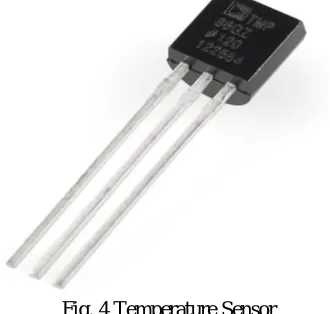
LM35 Precision Centigrade Temperature Sensors: The LM35 series are precision integrated-circuit temperature sensors, whose output voltage is linearly proportional to the Celsius (Centigrade) temperature. The LM35 thus has an advantage over linear temperature sensors calibrated in ° Kelvin, as the user is not required to subtract a large constant voltage from its output to obtain convenient Centigrade scaling. The LM35 does not require any external calibration or trimming to provide typical accuracies of
±1⁄4°C at room temperature and ±3⁄4°C over a full −55 to +150°C temperature range. Low cost is assured by trimming and
calibration at the wafer level. The LM35’s low output impedance, linear output, and precise inherent calibration make interfacing to readout or control circuitry especially easy. It can be used with single power supplies, or with plus and minus supplies.
Fig. 4 Temperature Sensor
1) Features: Calibrated directly in ° Celsius (Centigrade) , Linear + 10.0 mV/°C scale factor, 0.5°C accuracy guaranteeable (at
+25°C), Rated for full −55° to +150°C range, Suitable for remote applications, Low cost due to wafer-level trimming,
Operates from 4 to 30 volts, Less than 60 µA current drain, Low self-heating, 0.08°C in still air, Nonlinearity only ±1⁄4°C
[image:3.612.222.387.500.657.2]E. Soil Moisture Sensor
This sensor can be utilized to test the dampness of soil, when the dirt is having water deficiency, the module yield is at significant level, and else the yield is at low level. By utilizing this sensor one can consequently water the blossom plant, or some other plants requiring programmed watering strategy. Module double yield mode, advanced yield is basic, simple yield progressively precise. Soil dampness sensors measure the volumetric water content by implication by utilizing some other property of the dirt, for example, electrical opposition, dielectric consistent, or cooperation with neutrons, as an intermediary for the dampness content. 1) Features: Input voltage: 5v, Output voltage:0-5v, Output: Analog, Sensitivity: adjustable, Threshold level can be configured,
Module triple output mode, digital, analog, serial outputs.
2) Applications: Agriculture, Landscape irrigation, Simple sensor for Gardeners, Research.
F. PIC16F877A
High-Performance RISC CPU
1) All single-cycle instructions except for program branches, which are two-cycle
2) Only 35 single-word instructions to learn
3) Pinot compatible to other 28-pin or 40/44-pin PIC16CXXX and PIC16FXXX microcontrollers
4) Operating speed: DC – 20 MHz clock input DC – 200 ns instruction cycle
5) Up to 8K x 14 words of Flash Program Memory, Up to 368 x 8 bytes of Data Memory (RAM), Up to 256 x 8 bytes of
EEPROM Data Memory
Fig.5 PIC16F877A
G. LCD (2*160)
The Liquid Crystal Display (LCD) was first created at RCA around 1971. LCDs are optically inactive showcases (they don't create light). Accordingly, LCDs require all most no capacity to work. Numerous LCD adding machines can work from the intensity of a sun based cell, others can work for quite a long time from little catch cell batteries. LCDs work from the capacity of fluid gems (LC) to turn energized light in respect to a couple of crossed polarizers covered to the outside of the showcase. There are two principle sorts of LCD presentations utilized for mini-computers today: Twisted nematic (TN) and supertwisted nematic (STN). TN showcases bend captivated light to 90 degrees and have a constrained review point. STN presentations were created to bend spellbound light between 180 to 260 degrees bringing about better differentiate and a more extensive review point.
H. Transformer
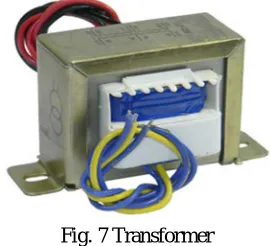
[image:5.612.238.373.173.296.2]It is a universally useful case mounting mains transformer. Transformer has 240V essential windings and focus tapped optional winding. The transformer has flying hued protected associating drives (Approx. 100 mm long). The Transformer go about as venture down transformer diminishing AC - 240V to AC - 12V. Power supplies for a wide range of undertaking and circuit sheets. Venture down 230 V AC to 12V with a limit of 500mAmp current. In AC circuits, AC voltage, current and waveform can be changed with the assistance of Transformers. Transformer assumes a significant job in electronic gear. Air conditioning and DC voltage in Power supply gear are nearly accomplished by transformer's change and replacement.
Fig. 7 Transformer
1) Features: Output current:500mA, Supply voltage: 220-230VAC, Output voltage: 12VAC , Soft Iron Core, 500mAmp Current Drain.
I. LM7805
This arrangement of fixed-voltage integratedcircuit voltage controllers is intended for a wide scope of uses. These applications incorporate on-card guideline for end of clamor and appropriation issues related with single-point guideline. Every one of these controllers can convey up to 1.5 An of yield current. The inward currentlimiting and warm shutdown highlights of these controllers basically make them resistant to over-burden. Notwithstanding use as fixed-voltage controllers, these gadgets can be utilized with outer segments to get movable yield voltages and flows, and furthermore can be utilized as the powerpass component in accuracy controllers.
1) Features: Output Current up to 1A , Output Voltages of 5v, Thermal Overload Protection , Short Circuit Protection, Output Transistor Safe Operating Area Protection.
IV. SOFTWARE USED
A. MPLAB
MPLAB is a restrictive freeware incorporated advancement condition for the improvement of installed applications on PIC and dsPIC microcontrollers, and is created by Microchip Technology. MPLAB and MPLAB X bolster venture the board, code altering, investigating and programming of Microchip 8-piece PIC and AVR (counting ATMEGA) microcontrollers, 16-piece PIC24 and dsPIC microcontrollers, just as 32-piece SAM (ARM) and PIC32 (MIPS) microcontrollers. MPLAB is intended to work with MPLAB-guaranteed gadgets, for example, the MPLAB ICD 3 and MPLAB REAL ICE, for programming and troubleshooting PIC microcontrollers utilizing a PC. PICK it software engineers are likewise upheld by MPLAB.
B. Embedded C
V. CIRCUIT DESCRIPTION AND POWER SUPPLY
A power supply (once in a while known as a power supply unit or PSU) is a gadget or framework that provisions electrical or different sorts of vitality to a yield burden or gathering of burdens. The term is most regularly applied to electrical vitality supplies, less frequently to mechanical ones, and once in a while to other people.
Fig. 8 basic block diagram of power supply
[image:6.612.169.443.310.386.2]Circuit Description: This circuit is a little +5V power supply, which is helpful when exploring different avenues regarding advanced hardware. Little reasonable divider transformers with variable yield voltage are accessible from any gadgets shop and grocery store. Those transformers are effectively accessible, however for the most part their voltage guideline is exceptionally poor, which makes then not truly usable for computerized circuit experimenter except if a superior guideline can be accomplished here and there. The accompanying circuit is the response to the issue. This circuit can give +5V yield at around 150 mA current, yet it very well may be expanded to 1 A when decent cooling is added to 7805 controller chip. The circuit has over-burden and therminal assurance. The capacitors must have enough high voltage rating to safely handle the input voltage feed to circuit. The components used are 7805 regulator IC 100 uF electrolytic capacitor, at least 25V voltage rating 10 uF electrolytic capacitor, at least 6V voltage rating 100 nF ceramic or polyester capacitor.
Fig. 9 power supply circuit diagram
VI. RESULT
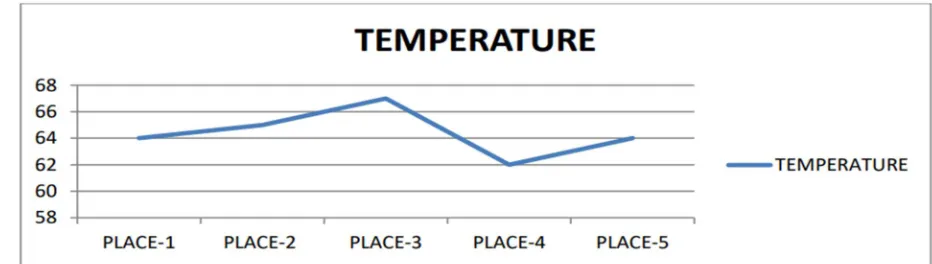
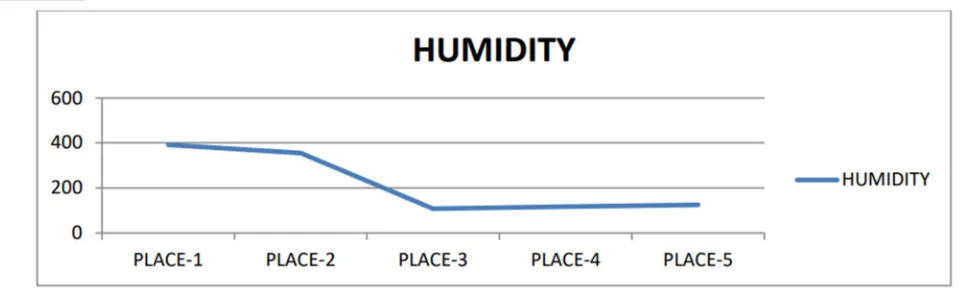
Following is a table and the graphical representation of the data we received.
S.N DATE SOIL MOISTURE pH TEMPERATURE TURBIDITY HUMIDITY
1 2019/05/16 3:41:22 AM 100 100 100 100 100
2 2019/05/16 3:43:12 AM 100 100 100 100 100
3 2019/05/16 3:44:12 AM 0000 0000 0064 0024 0015
4 2019/05/16:48:15 AM 0000 0000 0064 0011 0012
5 2019/05/16 3:51:27 AM 0000 0000 0064 0000 0015
6 2019/05/16 3:54:37 AM 0407 0000 0065 0011 0013
7 2019/05/16 3:57:44 AM 0000 0000 0065 0028 0014
8 2019/05/16 2:10:09 PM 0000 0000 0067 0448 0396
9 2019/05/16 2:13:29 PM 0000 0000 0067 0446 0391
10 2019/05/16 14:15:12 PM 0000 0000 0067 0412 0373
11 2019/05/16 14:17:45 PM 0000 0000 0067 0462 0402
12 2019/05/16 14:20:33 PM 0000 0000 0066 0419 0387
13 2019/05/16 14:22:24 PM 0000 0000 0066 0417 0387
14 2019/05/16 14:25:27 PM 0166 0000 0067 0373 0354
[image:6.612.89.526.450.725.2]15 2019/05/16 14:27:45 PM 0000 0000 0067 0405 0379
Fig. 11 graph showing the value of temperature at different time
Fig.12 graph showing different value of soil moisture at different time
[image:7.612.81.542.421.557.2]Fig. 15 Graph showing different values of humidity at different time
VII. CONCLUSION
All the five soil properties i.e Temperature, pH, Turbidity, Humidity, and Soil Moisture has been analyzed at five different places through IOT and readings are presented in line graph along with date and time and it has been uploaded to the website precisely. Hence, these different properties of soil can be analyzed by this technique.
REFERENCES
[1] Charman, P.E.V. and Murphy, B.W. (1991) 'Soils - their properties and management' A Soil conservation handbook for New South Wales (Sydney University Press; Soil Conservation Service, NSW)
[2] Gunn, R.H., Beattie, J.A., Reid, R.E., van de Graaff, R.H.M. Ed (1988) 'Soil and Lard Survey Handbook. Guidelines for Conducting Surveys'. (Inkata Press, Melbourne)
[3] Abdalla, C. W. 1990. Agriculture and groundwater quality: Emerging issues and policies. Pp. 1-16 in Proceedings of the Philadelphia Society for the Promotion of Agriculture. Philadelphia, Pa.: The Society.
[4] Addiscott, T. M., and R. J. Wagenet. 1985. Concepts of solute leaching in soils: A review of modeling approaches. Journal of Soil Science 36:411-424. [5] Alexander, E. B., and J. C. McLaughlin. 1992. Soil porosity as an indication of forest and rangeland soil condition (compaction) and relative productivity. Pp.
52-61 in Proceedings of the Soil Quality Standards Symposium. Report No. W0-WSA-2. Washington, D.C.: U.S. Department of Agriculture, Forest Service. [6] Allmaras, R. R., G. W. Langdale, P. W. Unger, R. H. Dowdy, and D. M. VanDoren. 1991. Adoption of conservation tillage and associated planting systems.
Pp. 53-84 in Soil Management for Sustainability, R. Lal and F. J. Pierce, eds. Ankeny, Iowa: Soil and Water Conservation Society.
[7] American Society of Agricultural Engineers. 1977. Soil Erosion and Sediment. Proceedings of a National Symposium: Soil Erosion and Sedimentation by Water. ASAE Publication 4-77. St. Joseph, Mich.: American Society of Agricultural Engineers.
[8] American Society of Agricultural Engineers. 1988. Manure Production and Characteristics. ASAE Data D384. St. Joseph, Mich.: American Society of Agricultural Engineers.
[9] Arshad, M. A., and G. M. Coen. 1992. Characterization of soil quality: Physical and chemical criteria. American Journal of Alternative Agriculture 7:25-32. [10] Baker, D. B. 1985. Regional water quality impacts of intensive row-crop agriculture: A Lake Erie Basin case study. Journal of Soil and Water Conservation