©IJRASET: All Rights are Reserved
797
Digits and Character Recognition using KNN
Sneha Thatte1, Rupesh Jaiswal2
1, 2
Department of Electronics and Telecommunication, Pune Institute Of Computer Technology
Abstract: The proposed work is about offline recognition of digits and characters using machine learning. MNIST dataset has CSV file. From this, image is obtained by reading it. Then it is preprocessed using RGB converter into binary form that contains some noise, this noise is removed using median filter and then convert into filtered image. Some further pre-processing is done on the image. If the characteristics for one class are distinct and remain constant with variations in this class, then we can call the features as good and desired. KNN Technique is used for classification and recognition of handwritten digits through training and testing. Then, system is made portable by using Raspberry pi and text is converted into speech signal.
I. INTRODUCTION
Character recognition was introduced in 1870 by Carey who invented retina scanner in which image transmission was done using photocell. Later, Emanuel Goldberg, in 1920 he converted a machine that could read characters and mapped them into telegraphic codes into first electronic retrieval system. But a drastic change took place in 1960 when OCR was first used a data processing medium in business. From early 2000’s, a host provides service (via API) to detect any text by OCR. It is used in many applications like automatic number plate recognition, multi choice examination
II. LITERATURE SURVEY
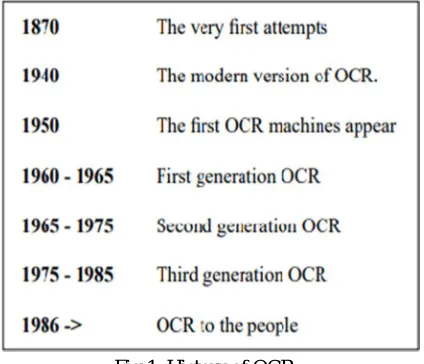
[image:1.612.231.443.410.592.2]Optical character recognition system (OCR) allows us to convert a document into electronic text, which we can edit and search etc. The process of OCR starts by examining text in an electronic image and converting into a form that can be further processed. OCR involves hardware and software. Where hardware is used for scanning and software looks over actual processing. The technology has evolved tremendously from 1870 to 1986. All versions (generations) differ in terms of versatility, robustness and efficiency.
Fig 1. History of OCR
A. First Generation OCR.
The commercial first generation existed from 1960 to 1965. It was mainly dependent on the shape of character read. Special symbols were designed for machine to read which looked unreal. Later, some machines were invented that can read up to ten different forms. Template matching, pattern recognition techniques were used.
B. Second Generation OCR.
©IJRASET: All Rights are Reserved
798
C. Important Inventions In This Period
1) Toshiba invented the first automatic letter sorting machine for postal code numbers.
2) Hitachi made the first OCR machine for high performance and low cost.
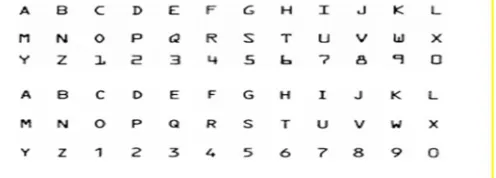
In 1966, standard OCR character set was defined as follows: -
a) OCR-A: This font was readable to humans. Also, European form was designed similar to this font.
[image:2.612.184.432.159.248.2]b) OCR-B: It had more natural forms that standard American forms.
Fig 2. Standard OCR set in second generation
D. Third Generation OCR
During this period poor quality documents and large printed hand-written character sets were present. The objectives of this generation were low cost and high performance. More advanced machines for OCR detection were available in market. In the age of use of printers for typing, uniform print spacing, and small number of fonts became very useful.
E. Advantages of OCR Technique
1) Scanners are accurate and produces high quality image.
2) Large quantity of input is accepted
3) Processing time is slow.
F. Drawbacks of OCR Technique
1) Works only on printed text, not on handwritten text.
2) Both hardware and software for OCR are expensive.
3) Some properties of images are lost during pre-processing.
4) Manual intervention is needed to correct errors.
G. Machine Learning Algorithms
Due to presence of some drawbacks, machine learning techniques are implemented in which the module is first trained and then it is tested against the trained data. These algorithms are widely divided as Supervised machine learning algorithms, Unsupervised machine learning algorithms and semi-supervised algorithms.
H. Supervised Machine Learning Algorithms
In this algorithm, input X is already known to us and output Y is determined by mapping function.
( ) = ( )
In this, we already know correct answers and the algorithm iteratively predicts the correct mapping output, we can correct the algorithm anytime when it goes out of control. Learning of algorithm stops when it reaches desired accuracy.
I. Unsupervised Machine Learning Algorithms
Unsupervised learning is where you only have input data (X) and no corresponding output variables. All the data is unlabeled. The goal for unsupervised learning is to model the underlying structure or distribution in the data in order to learn more about the data. Algorithm discover their own responses. No observer can interrupt the process.
J. Semi-supervised Machine Learning Algorithms
©IJRASET: All Rights are Reserved
799
III. SYSTEM DESIGN
[image:3.612.133.456.76.458.2]
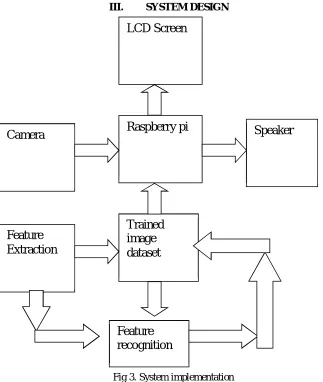
Fig 3. System implementation
To fulfill the above-mentioned requirements, and aim and objectives of the proposed work, following steps were executed.
A. If The Input Image Is Directly Taken From The Present Dataset
1) Read the image in open CV.
2) Preprocessing of image which includes noise removal, cropping of an image.
3) Convert the given RGB image into gray scale image and resizing it and again transforming it into binary image.
4) Perform morphological operations such as dilation and erosion.
5) Convolute the image with the standard mask selected.
6) Abstract the features of characters and digits.
7) Implement KNN classifier algorithm and match it exactly with the standard result obtained by machine learning.
8) Display the result in text format on LCD screen.
9) Convert the text signal into an audio signal in open CV and result will be given by the speaker interfaced with Raspberry pi.
B. If the Image is Taken as an Input by the Camera
1) The image will be scanned by the camera using OCR technique.
2) The image will be stored in Raspberry pi processors memory.
3) It will be processed by using above mentioned functions.
By machine learning the characters and digits will be identified
4) The result present in text will be converted into an audio signal.
Camera
LCD Screen
Raspberry pi
Trained
image
dataset
Feature
Extraction
Speaker
©IJRASET: All Rights are Reserved
800
C. KNN Classification Algorithm
1) K nearest neighbors is a supervised machine learning algorithm that can solve both classification and regression problems.
2) It stores all available scenarios and classifies new scenarios based on distance functions. KNN is used in statistical estimation and pattern recognition.
3) KNN believes that all similar things exist near each other.
4) KNN executes the idea of similarity (called as distance, proximity, or closeness).
D. Types of Problems solved by KNN
1) Regression Problem: This approach is used when input and output data both are a set of dependent and independent dataset and all these numbers are real numbers. Where each row is example and a column is predictor or dimensions.
2) Classification Problem: This is used when discrete values are present in the output. There are no middle group values present. Output labels are represented as integer numbers like 1, 0 etc.
E. Given
1) A set of training example{xi,yi} is given as an input to KNN learning module. Where xi and yi are the attributes that we want to find out.
2) The reference point x is the one we call as a testing point. That is distance of each point will be calculated with respect to this point.
F. Algorithm
1) Load input images.
2) Initialize 'k' value to neighbors.
3) calculate distance between reference and desired value.
4) Add distance and index of the input.
5) Sort the input images based on the distance.
6) Pick first 'k' entries from the data.
7) Map all the labels of collected entries.
8) If regression type is used (distinct values) find mean of labels.
9) If classification type is used (all i/p and o/p are dependent) find mode of the labels.
G. Tips and Tricks for Using KNN
1) If we reduce the value of 'K', the system becomes more stable.
2) When value of 'K' is increased, system is more stable due to voting/ averaging.
3) While choosing desired output, usual take 'K' as an odd number.
H. Advantages of Proposed System
1) Scanned document stored as an image file which doesn’t allow editing and searching. The proposed model will convert a document
into digital files so that document becomes searchable and editable.
2) It recognizes handwritten characters available on bank cheques, government records, passport, invoice, bank statement and receipt
etc.
3) Data entry errors can be reduced.
4) Paper work reduces so it becomes easy to access and manage.
5) It occupies less space as compared to an image file, so it saves computer space.
6) The model benefiting users who are unfamiliar with optical character recognition or who might become confused with multiple applications.
I. Future Scope of Proposed System
1) Implementing pattern recognition algorithm using same machine learning algorithm.
2) Interfacing human touch sensor screen to Raspberry pi for drawing patterns.
©IJRASET: All Rights are Reserved
801
4) Building an android application for the whole process.
5) Also adding the facility of converting detected object name /pattern name into voice signal.
6) Using this android application system for scanning different documents and classifying them according to the area of interest.
7) Using the model in automatic electronic billing system
IV. CONCLUSION
The KNN algorithm used can successfully detect handwritten digits and characters and the recognized parameter is converted into a speech signal.
V. ACKNOWLEDGEMENT
I am really thankful to my project guide, Dr. R.C Jaiswal for constantly motivating me guiding me. Moreover, his valuable suggestions have always been very useful.
REFERENCES
[1] Elima Hussain, Abdul Hannan, Kishore Kashyap"A Zoning based Feature Extraction method for Recognition of Handwritten Assamese Characters".
[2] U Ravi Babu, Dr. Y Venkateswarlu "Handwritten Digit Recognition Using K-Nearest Neighbour Classifier"2014 World Congress on Computing and Communication Technologies
[3] Jenil Shah,Viral Gokani “A Simple and Effective Optical Character Recognition System for Digits Recognition using the Pixel-Contour Features and Mathematical Parameters” Jenil Shah et al, / (IJCSIT) International Journal of Computer Science and Information Technologies, Vol. 5 (5) , 2014, 6827-6830 [4] George Margulis, CS229 Final Report, “Optical Character Recognition: Classification of Handwritten Digits and Computer Fonts”
[5] Ivor Uhliarik, "HANDWRITTEN CHARACTER RECOGNITION USING MACHINE LEARNING METHODS", 2014 [6] Gregory Cohen Saeed Afshar, Jonathan Tapson, André van Schaik "EMNIST: an extension of MNIST to handwritten letters" [7] Batuhan Balci ,Dan Saadati ,Dan Shiferaw "Handwritten Text Recognition using Deep Learning"