International Journal for Research in Applied Science & Engineering Technology (IJRASET)
ISSN: 2321-9653; IC Value: 45.98; SJ Impact Factor: 6.887 Volume 7 Issue III, Mar 2019- Available at www.ijraset.com
2225
©IJRASET: All Rights are ReservedStudy on the Use of Local Additives for
Stabilization of Road Subgrade
Muhammad Wajahat Ali Khawaja1, Rawid Khan2 1
PG student, 2Professor, Department of Civil Engineering, University of Engineering & Technology, Peshawar, Pakistan.
Abstract: Stabilization of the soil with additives is an economical and efficient solution to the problem, because during construction of motorways in Pakistan waterlogged soil was excavated due to poor engineering properties and was substituted with suitable material which lead to massive budget consumption. My objective in this research was to increase the strength of poor road subgrade with different additives by chemically stabilizing soil with different percentages of the additives and getting the optimum content of that stabilizer which is efficient and economical too. Subgrade was stabilized with different locally available inexpensive additives such as brick powder, cement, Bentonite and lime. Tests involve in this research were finer sieve#200 passing, Plasticity Index, modified proctor compaction test, CBR test to find the strength of road subgrade, Unconfined compression and triaxial compression test to find the shear strength of soil, all these tests were done in both untreated and treated condition and then comparison of results in different percentages were evaluated. During research it was observed that the engineering properties at optimum content of additives of poor subgrade soil can be improved efficiently where more strength is achieved at low cost hence economical solution to a problem.
Keywords: Stabilization, subgrade, additives, brick powder, stabilizers, bentonite
I. INTRODUCTION
The significance of road infrastructure in the progress of a nation is multidimensional. The most important in all transportation mean is the road system, trade is mostly done through roads where goods and products are transported to the distribution points or to the end user ultimately through the road.
Main cause of road failure is the weak subgrade which is due to waterlogging in the soil so the soil with this nature is not suitable to be use for the road foundation layer as it cannot withstand against the dynamic load of the traffic transfer to it. Usually this poor subgrade soil is replaced with a granular material having suitable nature, shear strength and bearing capacity or if being economical, it can be treated with different stabilizers or additives such as geo grids and chemical stabilization. Subgrade soil in different parts of KPK is mostly clayey which is assorted with sandy and silty soil and shingles that belongs to A-6 type of AASHTO table of classification of soil where the leading percentage is A-6 soil type category. This earth have extra inflation or swell probability with very low strength to resist the traffic load in some part of Khyber Pakhtunkhwa province in areas like Risalpur, Mardan, Warsak correspondingly other several parts of Peshawar the earth is water logged, may not be recommended to be used as a subgrade material.
A. Experimental Investigation
In this study, we collected the soil samples from different localities and checked their CBR value, the soil with CBR value lower than 7 was our required soil which requires stabilization. OMC was required for the CBR test because CBR samples were prepared according to the OMC of each sample whether in treated or non-treated condition. After testing of soil in untreated condition then we added additives in different percentages so that its CBR can be increased. The additives used were the one available easily and cheaply in our area. Bentonite was collected from Ghari Chandan area where it is available in copiousness, brick powder was obtained from a brick kiln in Charsadda, where it is existing in frequent amount.
International Journal for Research in Applied Science & Engineering Technology (IJRASET)
ISSN: 2321-9653; IC Value: 45.98; SJ Impact Factor: 6.887 Volume 7 Issue III, Mar 2019- Available at www.ijraset.com
2226
©IJRASET: All Rights are ReservedFig. 1 Methodology of research work
B. Experimental Results
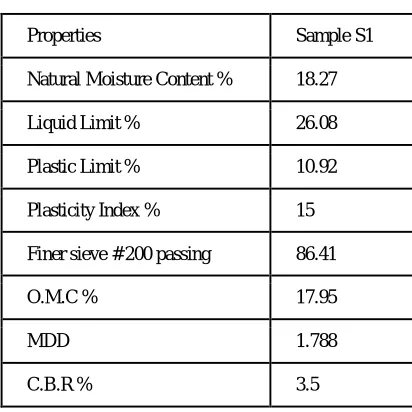
Tests were performed on virgin soil samples and found out that soil belongs to A-6 category of AASHTO soil classification table. Results were tabulated as:
TABLEIVIRGINSOILPROPERTIES
Properties Sample S1
Natural Moisture Content % 18.27
Liquid Limit % 26.08
Plastic Limit % 10.92
Plasticity Index % 15
Finer sieve # 200 passing 86.41
O.M.C % 17.95
MDD 1.788
C.B.R % 3.5
Sample S1 Test Results with different Additives:
Different additives in different percentages/contents (%) were tested and following results were interpreted:
TABLEIISOILTREATEDWITHBRICKPOWDERPROPERTIES
Brick Powder Content (%)
Properties 0% 1% 2% 5% 10% 15% 20% 30% 50%
O.M.C % 17.95 17.93 17.7 17.45 17.1 16.9 16.6 16.43 16.58
MDD g/cc 1.788 1.802 1.79 1.856 1.844 1.897 1.93 1.873 1.952
[image:2.612.78.516.70.265.2] [image:2.612.202.408.342.548.2]International Journal for Research in Applied Science & Engineering Technology (IJRASET)
ISSN: 2321-9653; IC Value: 45.98; SJ Impact Factor: 6.887 Volume 7 Issue III, Mar 2019- Available at www.ijraset.com
2227
©IJRASET: All Rights are Reserved3.5 4.5
8.8
11.5
16.3 17
0 2 4 6 8 10 12 14 16 18
0 5 10 15 20 25
CB
R
(%)
Bentonite Content (%)
Bentonite Content (%) vs CBR (%)
Sample S1
3.5 6.9 6.02
7.64 7.89
8.52 9.33
12.12
15.7
0 4 8 12 16 20
0 10 20 30 40 50 60
CB
R
(%)
Brick Powder Content (%)
Brick Powder Content (%) vs CBR (%)
Sample S1
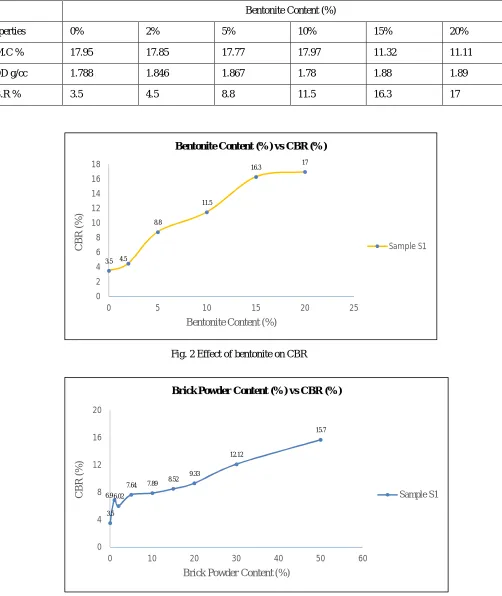
TABLEIIISOILTREATEDWITHBENTONITEPROPERTIES
Bentonite Content (%)
Properties 0% 2% 5% 10% 15% 20%
O.M.C % 17.95 17.85 17.77 17.97 11.32 11.11
MDD g/cc 1.788 1.846 1.867 1.78 1.88 1.89
[image:3.612.56.558.114.710.2]C.B.R % 3.5 4.5 8.8 11.5 16.3 17
Fig. 2 Effect of bentonite on CBR
International Journal for Research in Applied Science & Engineering Technology (IJRASET)
ISSN: 2321-9653; IC Value: 45.98; SJ Impact Factor: 6.887 Volume 7 Issue III, Mar 2019- Available at www.ijraset.com
2228
©IJRASET: All Rights are Reserved0
0.2
0.4
0.6
0.8
1
1.2
1.4
Bentonite Brick Powder
1.16 1.16
1.29 1.19 1.24 1.15 1.15 1.1 1.04 1.01
0.89 0.94
0.76
0.81 0.79
0.76
0.68 0.69
S w el l V a lue % Additives Content
Effect of Additives on Swell value of sample S1
[image:4.612.71.544.87.303.2]0% 1% 2% 5% 10% 15% 20% 30% 50%
Fig. 4 Comparison of the effectiveness of different additives for sample S1
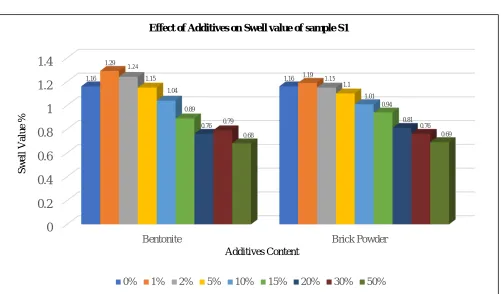
Fig. 5 Comparison of the effect of different additives on soil sample S1 swell values
II. CONCLUSION
From the study, the result was concluded that the use of bentonite 10% and brick powder 30% are recommended for improvement of subgrade soil in water logged areas being the cost-effective additives. Lime 1% with brick powder 5%, and Bentonite 4% with cement 1% are also economical combination of additives to be used. Brick powder can more effectively be used in addition to lime, combination of cement and lime is recommended to be the most effective stabilizer in terms of both strength and cost effectiveness. Further testing with other different local additives and field trials are recommended for further study.
6.9
6.02 7.64 7.89 8.52 9.33
12.12
15.7
29.75
4 4.5 8.8
11.5
16.3 17
23 31 0 5 10 15 20 25 30 35
0 10 20 30 40 50 60 70
CB
R
(%)
Additive Content (%)
Comparative improvement of different additives for sample S1
brick
[image:4.612.62.563.320.614.2]International Journal for Research in Applied Science & Engineering Technology (IJRASET)
ISSN: 2321-9653; IC Value: 45.98; SJ Impact Factor: 6.887 Volume 7 Issue III, Mar 2019- Available at www.ijraset.com
2229
©IJRASET: All Rights are ReservedREFERENCES
[1] A review on effect of Stabilizing Agents for Stabilization of Weak Soil by (Mukesh A. Patel1, Dr. H. S. Patel) Ganpat University, Mehsana-384002, Gujarat,
India.
[2] Arora.S, and Aydilek, A.H. (2005). " Class F Fly- Ash-Amended Soils as Highway Base Materials in Civil Eng., 17(6) 640-649.
[3] Mitchell, James K. & Soga, K. (2005), Fundamentals of Soil Behaviour 3rd ed., John Wiley & Sons, Inc. ISBN 978-0-471-46302-3.
[4] Terzaghi, K., Peck, R.B. and Mesri, G. (1996), Soil Mechanics in Engineering Practice 3rd Ed., John Wiley & Sons, Inc. ISBN 0-471-08658-4.
[5] Punmia B.C.1994. Soil mechanics and Foundation: Design Methods for Flexible Pavements page no 872-876 13th edition Laxmi publications PVT.LTD New
Delhi.
[6] Khanna S.K. and Justo.C.E.G. 2004. Highway Engineering Flexible Pavement Page no 465-471. 5th edition. Indian road congress.
[7] Shaukat A. K. 2006. Soil Mechanics‖ HEC Islamabad Pakistan.
[8] Anwar hussain K.M. 2011: ―Stabilized soils incorporating combinations of Rice.
[9] Hicks. R.Gary. February 2002. Alaska Soil Stabilization Design Guide: Lime Stabilization page no 27 prepared for State of Alaska Department of
Transportation and public facilities Research and Technology Transfer Fairbanks, AK99709-5399.