Abstract— This paper presents some tips for the selection and application of neighborhood operators in local search methods, with a special focus on the VRP for which a scheme is given. It comes as one of a series of related papers the authors have been working on and, the main aim, based on the consideration of such tips and their use, lies on allowing decision makers to better select and apply the most appropriate operators, what helps to escape from local optima when a construction heuristic, for the VRP, has been trapped. Each one of the tips given, besides resting on a good literature review and having taken into account some of the gaps and achievements remaining in the states of the art and practice, is mainly based on some important elements as the way the initial solution is obtained, the particularities of each case study, the availability resources, the precision desired for the local search, among others. Some frequently and successfully applied neighborhood operators are given in the appendix accompanying the tips.
Index Terms— Vehicle Routing Problem (VRP), local search, Variable Neighborhood Search (VNS), Granular Neighborhood Search (GNS), improvement heuristic, neighborhood operators, Multiple Criteria Threshold (MCT).
I. INTRODUCTION
Since combinatorial problems appeared, the computational complexity in their solutions also became the concern of researchers and decision makers. The use of Heuristics, Metaheuristics or even Hyperheuristics providing a faster, feasible and at least nearly optimal solution, became a need and more and more of these methods began to be used in the different fields instead of the classical exact ones. In accordance with all this and due to its huge combinatorial complexity, the VRP and even the Travelling Salesman Problem (TSP) as its less complex form, received a particular attention and numerous authors, who are almost all cited in Laporte (2006), started working on them.
Despite a lot of these methods have been being created and proved, most of them, as it is found when scanning the literature, are commonly stuck in local optima stopping from exploring a lot of neighborhoods which could yield a better solution, (Stattenberger et al., 2007; Cowling & Keuthen, 2005; Hansen & Mladenovic, 2001; Gilbert et al., 2005; Chen et al., 2010, Hemmelmayr et al., 2009, Schreiber & Tanuska, 2007-1, Schreiber & Tanuska, 2007-2). It becomes relevant in these situations the use of local search heuristics (improvement heuristics), to explore as many other
1Department of Industrial Engineering, Central University “Marta Abreu”
de Las Villas, Santa Clara, Villa Clara, Cuba
2 Faculty of Materials Science and Technology (MTF) , Institute of Applied
Informatics and Automation, Slovak University of Technology, Bratislava, Slovakia
neighborhoods as possible allowing to compare them and at the end, to obtain the closest one to a global optimal solution as well as a hierarchical list with the others. As stated in Laporte (2006) and Gilbert et al. (2005), improvement heuristics for the VRP operate on each vehicle route taken separately or on several routes at a time. In the first case, any improvement heuristic for the TSP can be applied. In the second case, procedures that exploit the inter-route structure of the VRP can be developed. In each case the use of neighborhood operators is required.
One important gap for this paper, found when reading and revising the states of the art and practice, is the absence of proper documentation, on which neighborhood operators to use and how to use them according to each particular situation and the way the initial solution has been generated among others elements. However there are a few heterogeneous proposals of application criteria regarding their order, the way the initial solution is obtained, their quantity and others regarding if reducing or not the space to search. In Level & Palhazi (2009) three operators are used alternating the order of application and concluding of its incidence in the final results. Moretti et al. (2009) makes use of five operators at a time and the best one is executed. In Stattenberger et al. (2007) it was proved that commonly the use at first of small moves (intra-route) and then higher order moves (inter-route) could yield better global optima if using a good underlying (construction) heuristic and not a randomly generated initial solution. Opposite to the last author´ ideas and also regarding the application order, in Zhao et al. (2009); Caric & Gold (2008) and Chen et al. (2010), it was proved it is better the application of the inter-route operators first and the intra-inter-route ones at the end. Other proposal related to this local search has been the VNS initially proposed by Hansen & Mladenovic (2001) and modified by authors like Cowling & Keuthen (2005); Bräysy (2003), Hemmelmayr et al., 2009, among others. The basic idea of VNS is a systematic change of neighborhood operators within a local search procedure. When exploring large neighborhoods, it frequently remains considerably large the computation time. Several authors have dedicated some effort to reduce the search area to what it has been called Granular Neighborhood (Toth & Vigo, 2003; Moretti et al. 2009, etc.), Candidate Lists (Cowling & Keuthen, 2005; Zhao et al., 2009, etc.), promising candidates of the moves (Stattenberger et al., 2007) or even as frequently heard, Bounded Neighbor Lists. In each case the basic idea is the same and rests on reducing the search area under the application of reduction criteria which in most of the cases is the distance or costs. None of these works reflects the use of a multiple criteria approach neither on the design of the routes nor in the improvements
A Selection and Application Scheme of Local
Search Neighborhood Operators for the Vehicle
Routing Problem
heuristics which could better focus the routes design to the clients or even to the company itself.
The main aim of this paper rests on presenting some tips, which through a selection and application scheme and supported in a good bibliographical search and some of the most used and successful operators, allow deciding which ones to select and how to use them (guidelines on the selection and application). The general scheme has included the multiple criteria paradigm so that not only the distance is regarded when searching, but also some other criteria for increasing the Customer Service Level (CSL) and the benefits of the company as well. The rest of the paper will be organized in section 2 “A selection and application scheme of local search neighborhood operators for the Vehicle Routing Problem” and section 3 “Conclusions and further research issues”.
II. A SELECTION AND APPLICATION SCHEME OF LOCAL SEARCH NEIGHBORHOOD OPERATORS FOR THE VEHICLE
ROUTING PROBLEM
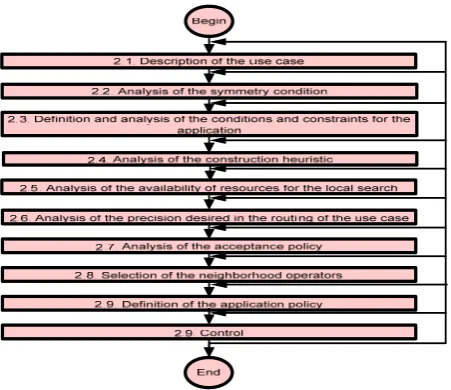
The proposal has been intended under relevant concepts of novel methods such as VNS, GNS and another approach presented by Moretti et al. (2009), and is better applied if the construction heuristic used several criteria, this keeps a direct relation with the multiple criteria approach within the MCT proposed to be used inside the local search. In the figure 1 its scheme can be seen. The operators are classified in intra-route and inter-route (Caric & Gold, 2008; Laporte & Semet, 1998; Zhao et al. 2009), or also as small moves and higher order ones, (Stattenberger et al., 2007).
2.1. Description of the use case
The use case must be detailed herein; this and the further analysis of some of its elements allow defining which operators could best fit and how to use them. It could be interesting to know among others the following elements: constraints and conditions for the functioning of the system, typology of VRP under consideration, number of nodes, number of nodes with time windows if these ones exist, width of the time windows, frequency of the visits, definition of reliability for the system, routes construction decision criteria, geographical location of the nodes and symmetry condition among others.
2.2. Analysis of the symmetry condition
[image:2.595.316.542.55.250.2]In cases where the symmetry totally holds, it is suitable the use operators that allow segments reversals, in instances that are totally asymmetric, just the operators that do not allow such segment reversals and for instances where symmetry holds absolutely or approximately between most pairs of cities, it is better to use the last curse of action since exploring, in case of symmetry, a neighborhood thoroughly, even with a simple local search procedure based on tour segment reversals as 2-opt, could yield considerable improvements but could also implicate a high computational cost, (Stattenberger et al., 2007). Similar ideas are also stated in Cowling & Keuthen (2005) and in Bräysy & Gendreau [2005(a)], it is besides stated that some results indicates that less of the 10 % of the improvements in local search have involved the segment reversals.
Figure 1: Scheme for the selection and application of local search neighborhood operators in the VRP.
2.3. Definition and analysis of the conditions and constraints for the application
It must be considered the reliability defined within the construction heuristics as well as all the constraints and conditions. Commonly unnecessary interchanges of clients and segments of these between geographically opposite routes and non-adjacent ones must be avoided. If a permutation between two adjacent routes is executed, those nodes coming from an initial route, Ex.: South, and that have been already moved to another one, Ex.: East, should not be moved to an opposite one, e.i.: North.
2.4. Analysis of the construction heuristic
Those solutions randomly generated, demand the use of a rigorous local search, e.i.: higher order moves or even in a combination with small moves, while those with a better underlying heuristic, Ex.: under a multiple criteria approach, could just apply one or a few simple operators. For this last type of instances it has besides been proved, totally random permutations could increase the computational effort by unnecessarily spreading the solutions. It is advised for new problems to apply as many small moves operators as possible at first and then, as many of higher order as possible, however there are successful applications of the opposite approach, (Zhao et al., 2009; Caric & Gold, 2008 and Chen et al., 2010).
2.5. Analysis of the availability of resources for the local search
Resources like time, software, hardware are analyzed and then less or more complex operators could be selected and applied.
2.6. Analysis of the precision desired in the routing of the use case
use of the most complex ones, (Bräysy 2003), necessarily improve the heuristic.
2.7. Analysis of the acceptance policy
It is decided if stopping applying the operators with the first improvement or with the best one. The last option makes necessary to apply the operators in all the combinations while the other has been more commonly accepted in the literature.
2.8. Selection of the neighborhood operators
In the appendix the most used operators are given making emphasis in some other tips for their use. The final selection of the operators will lie on such tips, the previous ones stated in this scheme and its correspondence to each case study.
2.9. Definition of the application policy
In the literature several approaches for the application have been proposed, among the most relevant ones it is found: (1) to apply several operators at a time selecting for the move the better one and reducing the search area by means of the GNS, (Moretti et al., 2009), (2) to apply several sequences of operators analyzing them and selecting the best as stated in (Level & Palhazi, 2009) and (3) to apply the VNS which origins lies on Hansen & Mladenovic (2001) and has been also worked and modified by authors like Cowling & Keuthen (2005); Bräysy (2003), Hemmelmayr et al., 2009. Being regarded in this paper all of the cited previous approaches, it is stated a mixture of the relevant aspects of these ones, with the main particularity of using the multiple criteria approach in the construction of the candidate lists of the local search, this is mainly appropriate when the construction heuristic was also based in using several criteria. This constitutes a novelty, e.i.: the philosophy of the VNS is applied with some differences like the use of several operators at a time to select the best result instead of only one and the application of a GNS that lies on the use of the so called candidate lists. These lists will only be conformed by those arcs which are superior to a MCT that is stated in this paper, plus those important ones that are related directly to the depot or are already part of a previous solution.
Similarly to what Toth & Vigo (2003) stated, this philosophy would not imply the absence of arcs in the final solution whose values behave negatively to the MCT, however only a move will be executed if containing at least one arc with a positive value regarding the Threshold. After iterating each operator, the arcs selected by the move will be inserted to the Granular Neighborhood initially defined, since they would already be part of the best solution gotten so far and not necessarily because they have a better value than the MCT.
The Granular Neighborhood will be reconstructed each time there is 2 * n iterations, being n referred to the number of clients. The values of the positive parameter β that appears in the next expression can vary from 1, 2 till 2, 5 based on previous successful results, it is proved that 1, 25 is a convenient one, (Toth & Vigo, 2003), however its values could be continuously varying during the application what gives the local search a dynamic approach.
∑ , ⁄
(1)
where:
Let us assume the terms b and e are referred to the beginning and end of an arc of the route and ∑ , is referred to a weighted value of the route regarding the weighted values of all its arcs. The weighted values of the arcs are obtained from the construction heuristics where the decision of moving from b to e lies on the best weighted value found with the iteration, , , ; β: positive parameter that determines the size of the neighborhood; v: number of routes or vehicles; v + n: number of arcs of the instance.
For all this, it is necessary the construction of a matrix where all the WV between each pair of nodes are captured. Let us denote this square matrix: MWVA (Matrix of Weighted Values of the Arcs). This WV of each arc will be a metric in the decision of what arcs to add or not to the Granular Neighborhood according to the MCT. From the appendix some other tips can be taken for the application. For obtaining the MWVA, it must be analyzed under the scope of the construction heuristics, all the possible combinations between each pair of nodes calculating for each one its WV. The Weighted Product Method could be used as any other multiple criteria approach for determining the WV for the pairs, then it could be constructed the MWVA.
Application of a Weighted Product Method (WV)
∏ , (2)
where:
Wr: Relative weight or importance of the criterion 1, ; WVl: Weighted Value of l
NVl, r: Homogenized and Normalized Value of the alternative 1, according to the criteria 1,
Table 1. Matrix of Weighted Values of the Arcs
MWVA =
1,2 1,3
2,1 2,3
3,1 3,2
Notice that this matrix could be either symmetric or not in dependence of the use case.
2.10. Control
The new alternative solutions must neither violate the reliability nor the conditions and constraints defined and, they must be concordant with the criteria used in the construction heuristic, e.i.: if the construction heuristic initially used several criteria, the new alternatives could just be assumed as better if they are better in those same criteria or at least in the WV of these ones. The feedbacks allow continuously checking and improving the results.
APPENDIX.NEIGHBORHOOD OPERATORS AND SOME TIPS TO CONSIDER IN THEIR APPLICATION Operators Some tips to take into consideration Graphical representation of the operator
Intra-route operators Relocate or 2, 5-opt:
a client is moved to another place in the route. It is a special case of 3-opt because in one of the three subsequences there is only one 1 node.
It slightly influences in escaping from local optima since it poorly diversify the neighborhood. It is not recommended its use at first when several operators are intended to be used. It is suitable when hardware and time are limited, (Level & Palhazi, 2009; Chen et al., 2010; Moretti Branchini et al., 2009; Balseiro, 2007; Toth & Vigo 2003; Stattenberger et al. 2007; Caric, T & Gold, H., 2008) Exchange or Swap:
it shifts 2 any clients in the route. It is a special case of the 4-opt. 4 arcs are eliminated
Simple transformation that propitiates moderate perturbations in the neighborhood. It has been proved that when used at first among others operators it yields good results. However it has been widely proved in the literature as the worst of the small moves operators. It can be occasionally seen as the application of 2 Relocate ones. (Level & Palhazi, 2009; Chen et al. 2010; Balseiro 2007, Toth & Vigo, 2003; Stattenberger et al., 2007; Caric, T & Gold, H., 2008)
2-opt: 2 non-adjacent arcs are eliminated in the route, then 2 others are added which does not follow the same path which tries to eliminate the crosses. A chain of clients is inverted
It is also a simple operator whose goal is to eliminate crosses so that is better to apply it when the solution contains a lot of these. It implies an acceptable processing time and one of the sequences is inverted. It generates a moderate diversification and its use is more effective when the initial solution was randomly generated and can also be used when it was not. In its use is suitable to apply the first better move acceptance criteria. It is the best of the small moves operators when hardware and time are not enough, { Chen et al., 2010; Balseiro, 2007; Laporte, 2006; Gilbert et al., 2005; Toth & Vigo, 2003; Stattenberger et al. 2007; Cowling & Keuthen, 2005; Caric, T & Gold, H., 2008; Bräysy & Gendreau [2005(a)]}. 3-opt: 3
non-adjacent arcs are eliminated in the route and are replaced by 3 others in all possible positions looking for a better value. Sequences could be inverted.
Or-opt: it moves one chain of consecutive clients of length (n≤
3) to another position in the route
It is one of the most effective and fast operators and its use is proved to be more effective either when the initial solution has not been randomly generated or not. However its combination with 2-opt is better and easy. It is suggested to be applied under the first better move acceptance criteria and the sequence of clients can be inverted, { Hemmelmayr et al., 2009; Moretti Branchini et al.; 2009; Balseiro, 2007; Laporte, 2006; Gilbert et al., 2005; Toth & Vigo, 2003; Caric, T & Gold, H., 2008; Bräysy, 2003; Bräysy & Gendreau [2005(a)]}.
4-opt: 4 arcs are eliminated creating 4 subsequences which are joined in all possible ways. Similarly this is done with higher k operators. In the fig on the right 6-opt is presented.
It is one of the most expensive moves specially when there are more than 100 nodes, if the order is increased after 4 some authors consider the local search approach is lost starting from a new randomly generated solution, however these higher orders are used with good results in the shakes of some methods like the VNS, (Glover, 1996; Toth & Vigo, 2003; Stattenberger et al., 2007; Cowling & Keuthen, 2005, Chen et al. 2010)
Inter-routes operators Relocate: it moves a
client to the best position of another route
It is a simple operator in its class and it is recommended to be used if time is limited and not commonly for the shakes {Moretti Branchini et al., 2009; Toth & Vigo, 2003; Chen et al., 2010; Balseiro, 2007; Cowling & Keuthen, 2005, Caric, T & Gold, H., 2008; Bräysy, 2003, Bräysy & Gendreau [2005(a)]}.
Exchange or swap: 2 clients are shifted between routes
It is a simple operator in its class and it is used when some nodes of a route are better located in the other. The sequence if the visit is maintained. (Chen et al., 2010; Balseiro, 2007; Cowling & Keuthen, 2005, Caric, T & Gold, H., 2008).
2-opt*: each route is divided in 2 parts by eliminating 1 arc, then the first part of a route is combined with the second of the other, the other parts are treated the same way.
It is also based in the same crosses elimination principle and the time required its shorter tan the rest of its kind. Its selection rests on the structure of the initial solution. There is no inversion, {Chen et al., 2010; Balseiro, 2007; Cowling & Keuthen, 2005; Caric, T & Gold, H., 2008; Bräysy, 2003; Zhao et al., 2009; Bräysy & Gendreau [2005(a)]}.
Cross-exchange: 2 chains of clients of length ≤ 4 are shifted.
ACKNOWLEDGEMENTS
The authors want to thank Professors Dr. N. Coello Machado, Dr. F. Marrero Delgado and Dr. C. A. Machado Oses from the Central University “Marta Abreu” de Las Villas (UCLV), Cuba, also and very specially the Prof. Dr. Karol Velíšek, Director of the Institute of Production Systems and Applied Mechanics from (MTF), Slovakia for making possible the research and all the support given and, lastly the high valuable personnel of the Institute of Production Systems and Applied Mechanics and the Department of Industrial Engineering of the UCLV for its support in improving the present paper.
REFERENCES
[1] Balseiro, S. (2007). Logística y Distribución: Algoritmos para problemas de ruteo de vehículos con restricciones de capacidad y ventanas de tiempo. Resumen Ejecutivo de Tesis de Ingeniería Industrial. Universidad de Buenos Aires. Disponible en el sitio: http://www.iosuperior.com.ar/files/ResumenEjecutivoTesisBalseiro.p df.
[2] Bräysy, O. & Gendreau, M. [2005(a)] .Vehicle Routing Problem with Time Windows, Part I: Route Construction and Local Search Algorithms. TRANSPORTATION SCIENCE, vol. 39, No. 1, February 2005, pp. 104–118 issn 0041-1655 _eissn 1526-5447 _05 _3901 _0104
[3] Bräysy, O. (2003). A Reactive Variable Neighborhood Search for the Vehicle Routing Problem with Time Windows. SINTEF Applied Mathematics, Department of Optimization, P.O. Box 124 Blindern, N-0314 Oslo, Norway
[4] Caric, T & Gold, H. (Ed.). (2008). Vehicle Routing Problem. Edited by Tonci Caric and Hrvoje Gold. Published by In-The. Croatia. ISBN: 978-953-7619-09-1.
[5] Chen, P.; Hou-kuan, H. & Xing-Ye, D. (2010). Iterated variable neighborhood descent algorithm for the capacitated vehicle routing problem. Expert Systems with Applications 37 (2010) 1620–1627 [6] Cowling, P.I. & Keuthen, R. (2005). Embedded local search
approaches for routing optimization. Computers & Operations Research 32 (2005) 465–490
[7] Gilbert, B.; Deneault, S. & Laporte, G. (2005). Improvements to the Or-opt Heuristic for the Symmetric Traveling Salesman Problem. Cahier du GERAD no. G-2005-02. GERAD – Group for Research in Decision Analysis. Montréal, Québec, Canada.
[8] Glover, F. (1996).Finding a best traveling salesman 4–Opt move in the same time as a best 2–Opt move. Journal of Heuristics, 2, pp.: 169–179.
[9] Hansen, P. & Mladenovic N. (2001). Variable neighborhood search: principles and applications. European Journal of Operational Research 2001; 130:449–67.
[10] Hemmelmayr, V. C.; Doerner, K. F. & Hartl, R. F. (2009). A variable neighborhood search heuristic for periodic routing problems. European Journal of Operational Research 195 (2009) 791–802 [11] Laporte, G. (2006). A short history of the Traveling Salesman
Problem. Canada Research Chair in Distribution Management, Centre for Research on Transportation (CRT) and GERAD HEC Montréal, Canada.
[12] Level, E. & Palhazi, A. (2009). Vehicle Routing Problem. Implementación de Meta-Heurísticas. Departamento de Computación y Tecnología de la Información. Universidad Simón Bolívar. [13] Moretti Branchini, R.; Amaral Armentano, V. & Lokketangen, A.
(2009). Adaptive granular local search heuristic for a dynamic vehicle routing problem. Computers & Operations Research 36 (2009) 2955 – 2968
[14] Stattenberger, G.; Dankesreiter, M.; Baumgartner, F. & Schneider, J. J. (2007). On the Neighborhood Structure of the Traveling Salesman Problem Generated by Local Search Moves. J Stat Phys (2007) 129: 623–648. DOI 10.1007/s10955-007-9382-1
[15] Toth, P., & Vigo, D. (2003). The granular tabu search and its application to the vehicle routing problem. INFORMS Journal of Computing, 15, 333–348
[16] Zhao, F.; Mei, D.; Sun J. & Liu, W. (2009). A hybrid genetic algorithm for the vehicle routing problem with simultaneous pickup and delivery. Chinese Control and Decision Conference (CCDC) [17] Schreiber, P. & Tanuska, P. (2007-1). The robot system movement
optimization by genetic algorithms. In: Proceedings of the 18th DAAAM Symposium „Intelligent Manufacturing & Automation: Focus on Creativity, Responsibility and Ethics of Engineers“, 24.-27.10.2007, Zadar, Croatia, pp. 677-678, ISBN 3-901509-58-5 [18] Schreiber, P. & Tanuska, P.(2007-2). Detection of the shortest robot