Beyond Centrality and Structural Features:
Learning Information Importance for Text Summarization
Markus Zopf, Eneldo Loza Menc´ıa, and Johannes F¨urnkranz Research Training Group AIPHES / Knowledge Engineering Group Department of Computer Science, Technische Universit¨at Darmstadt
Hochschulstraße 10, 64289 Darmstadt, Germany
{zopf@aiphes,eneldo@ke,juffi@ke}.tu-darmstadt.de
Abstract
Most automatic text summarization sys-tems proposed to date rely on centrality and structural features as indicators for information importance. In this paper, we argue that these features cannot reli-ably detect important information in het-erogeneous document collections. Instead, we propose CPSum, a summarizer that learns the importance of information ob-jects from a background source. Our hy-pothesis is tested on a multi-document cor-pus where we remove centrality and struc-tural features.CPSumproves to be able to perform well in this challenging scenario whereas reference systems fail.
1 Introduction
The goal of text summarization is to take an in-formation source, extract content from it, and present the most important content to the user [...] (Mani, 2001). Identifying important information in source documents is therefore a major goal in summarization. Most methods to date rely on structural features such as sentence position, num-ber of upper-case words, or title words, and a wide range of measures of sentence centrality as signals for what is important in source documents.
In particular in news articles, such as those used for the DUC2002 single-document summarization and the DUC2004 multi-document summarization tasks,1 it is quite common that the most impor-tant information is repeated most frequently. In-deed, Nenkova et al. (2006) showed that informa-tion which appears frequently in the input doc-uments is likely to appear in a human-generated summary. Similar conclusions can be drawn for
1http://duc.nist.gov/
single-document news corpora, where, for exam-ple, important information is likely to be found at the beginning of the document (for impatient read-ers), and repeated and expanded later in the article. Even though most research in text summa-rization to date focused on newswire documents, this special kind of text genre is not the only one to be considered for summarization. Re-cently, about 400 journalists organized by the In-ternational Consortium of Investigative Journal-ists (ICIJ)2spent more than a year to analyze 11.5 million documents in the Panama Papers reposi-tory,3 which consists of emails, PDFs, and other text documents not belonging to the newswire genre. In such a heterogeneous collection of raw and unprocessed source documents we can-not assume that frequency information correlates with importance, and therefore cannot rely on (in)frequency as (un)importance signal.
Nevertheless, journalists are able to cope with such situations because they bring along their background knowledge about the world, which al-lows them to estimate what information is impor-tant and what is not. We therefore propose to in-corporate world knowledge to handle more chal-lenging summarization scenarios where centrality cannot be used as a signal for importance. Our as-sumption is that summarization systems which are aware of the importance of information without analyzing the structure of the source documents are able to summarize heterogeneous documents properly. The key question of the paper is whether a knowledge-based summarization system is still able to detect important information even when structural and centrality-based features cannot be used as signals for importance.
We first review well-known summarization
sys-2https://www.icij.org/
3https://panamapapers.icij.org/
A
C B A
C B
A
B
A
A
C
D
C A
C
A
C B A
C B
SDS
MDS
5
5&
55
65
5&
5&
6&
75
6 [image:2.595.95.508.61.242.2]B D
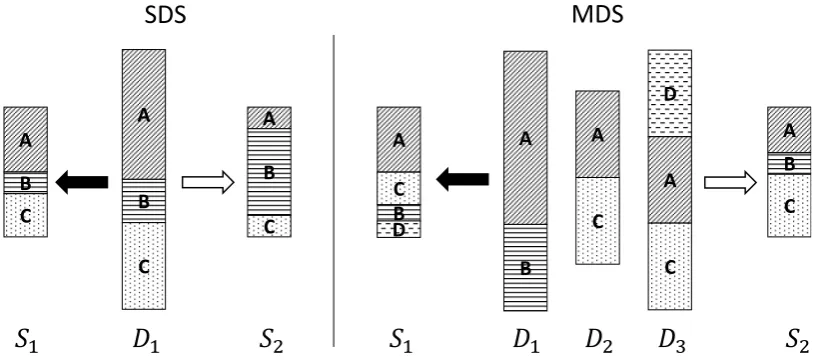
Figure 1: Differences between centrality-based summarization (black arrow) and importance-aware sum-marization (white arrow) in single- (left) and multi-document sumsum-marization (right).
tems for single- and multi-document summariza-tion in Secsummariza-tion 2. Particular emphasis is put on the methodologies used to identify important in-formation and avoid redundancy since this is the main innovation of our knowledge-based system described in Section 3.
CPSum learns about importance by ana-lyzing an independent background corpus of document-summary pairs and applies this knowl-edge in the summarization task. A major differ-ence to previous systems is that we do not use sim-ilarity measures to compute centrality, neither for detecting importance nor for avoiding redundancy. In order to verify our assumptions, we compare our approach on a commonly used evaluation cor-pus, both in its original version and in various ver-sion in which we remove redundancy and sentence order. We describe the corpus modification in Sec-tion 4. Expectedly, our experiments described in Section 5 and 6 show a substantial performance decrease for all tested reference systems, whereas the performance ofCPSumremains essentially un-changed. The conclusions we draw from this study are summarized in Section 7.
2 Related Work
In this section, we review prior work in single-and multi-document summarization. The essen-tial differences between these approaches and our approach are illustrated in Figure 1. On the left, a centrality-based SDS system summarizes a document D to a summary S1. The result
is a text with a similar topic distribution as in the source document. A system with a
differ-ent notion of importance is able to produce a summary S2 with a varied distribution of
top-ics. On the right, we observe a similar situation, where a centrality-based MDS system summarizes a document collection D1, . . . , D3 to a summary S1 and a importance-aware summarization
sys-tem produces the summary S2 with a different
topic distribution. Centrality-bases methods pro-duce a smaller version of the source document(s) whereas an importance-aware summarization sys-tem is able to emphasis on important parts even if they are not frequent.
2.1 Single-Document Summarization
Early work in single-document summarization (SDS) by Luhn (1958) and Edmundson (1969) tries to identify salient information in documents. Luhn (1958) identifies words which are frequent in the source documents and infrequent in a back-ground corpus. Edmundson (1969) extends this approach by using cue words and structural fea-tures such as title words and sentence position.
also rely on sentence order by always including the first sentences in the summary.
Parveen and Strube (2015) use a bipartite graph to represent a document. This so-called topic graph has two sets of nodes, one containing tences and one containing topics. To rank the sen-tences, they apply HITS . Since they deal with very long texts which may contain repetitive informa-tion they also apply a redundancy avoidance strat-egy by maximizing topic coverage in the summary and therefore minimizing redundancy.
All these approaches have in common that they focus on selecting the most central information from a document. However, in a noisy docu-ment with a significant amount of unimportant text, extracting the most central text may not be a good strategy. Summaries produced by these ap-proaches will rather contain noise than important information, since the noise might be quite central (c.f. Figure 1). Most of the approaches assume that there is no redundancy in the source document and do not apply a redundancy avoidance strategy.
2.2 Multi-Document Summarization
In comparison to SDS the task in extractive multi-document summarization (MDS) is to summarize not one but a set of documents. The additional challenge in comparison to extractive SDS is that the document set may contain the same informa-tion redundantly in different documents. There-fore, in addition to detect important information, a second challenge is to avoid redundancy in the generated summary.
McKeown and Radev (1995) introduce the task of summarizing multiple news documents. Their system, called SUMMONS (SUMMarizing Online NewS articles), extends already existing template-driven message understanding systems.
Carbonell and Goldstein (1998) introduce Max-imal Marginal Relevance (MMR) to reward cen-trality and penalize redundancy jointly with a lin-ear combination of both attributes. In a query-based setup, sentences are greedily selected ac-cording to their similarity to the query and simi-larity according to already selected sentences. The similarity measure is based on the Cosine similar-ity between sentences.
Radev et al. (2000) use a clustering method to find a centroid. Clusters are built based on a topic detection system. For redundancy avoidance, they apply a redundancy penalty similar to the
nega-tive factor proposed by Carbonell and Goldstein (1998) and re-rank the sentences iteratively until re-ranking does not change the resulting summary. LexRank (Erkan and Radev, 2004) is a graph-based MDS method inspired by social networks which uses intra-sentences cosine similarity to compute an adjacency matrix to represent the sen-tences as a graph similar to the graph-based meth-ods in SDS. The most central sentence is consid-ered to be the most important sentence. LexRank itself does not apply redundancy avoidance but only ranks sentences according to importance. As redundancy avoidance strategy, cross-sentence in-formational subsumption (CSIS) (Radev, 2000) is applied as a re-ranking strategy.
The best performing system at the DUC 2004 shared task in MDS, CLASSY (Conroy et al., 2004), uses TF-IDF scores to calculate the im-portance of sentences. ICSI Summ (Gillick et al., 2009), a well-performing system at TAC 2009, ap-plies a global linear optimization to search for a set of sentences that covers relevant concepts in the source documents as well as possible. As con-cepts they use word bi-grams weighted by their frequency, thereby deriving importance from fre-quency. Since they search for a set of sentences which maximizes the sum of unique concept val-ues, their system is able to avoid redundancy im-plicitly.
Lin and Bilmes (2011) treat MDS as a submod-ular maximization problem. By rewarding diver-sity rather than penalizing redundancy they cre-ated a monotone nondecreasing submodular utility function (in comparison to Carbonell and Gold-stein (1998)) which has a constant factor guaran-tee of optimality. In contract to ICSI Summ, Yo-gatama et al. (2015) seek to not maximize bi-gram coverage but to maximize the semantic volume. They use embeddings to represent sentences and choose the subset of sentences that maximizes the size of the convex hull in the generated embedding space as summary.
3 TheCPSumAlgorithm
In this section, we first define the summariza-tion task formally. We then present the novel preference-based summarization system CPSum in detail. In particular, we explain our training pro-cedure and (contextual) sentence ranking method-ology.
3.1 Problem Definition
The task of a generic extractive summarization system is to create sequences of sentences (the summaries) from given sequences of sentences (the source documents) for different topics. The objective is that the selected sentences form a good summary of the source documents.
To formalize the task, we define asentencesof length n as a sequence of nwords (s1, . . . , sn).
For convenience we use the term wordfor all el-ements of a sentence identified by a sentence seg-mentation method. Therefore, numbers, punctu-ation marks, and similar elements are all consid-ered to be words. AdocumentDof lengthmis a sequence ofmsentences(s1, . . . ,sm), and
conse-quently also a sequence of words.|X|denotes the length of the sequenceX.
A topic is a pair (D = {D1, . . . , Do},R =
{R1, . . . , Rp}) of input documents D and
refer-ence summaries R. |D| = 1in single-document summarization and |D| > 1 in multi-document summarization where |D| denotes the size of D. Since we do not distinguish between different source documents we introduceD˙ =D1◦· · ·◦Do
as the concatenation of all sentences of all source documents inD.
The task of extractive document summariza-tion is to find a sequence of sentences Sˆ ∈ Plmax( ˙D) that maximizes a utility function u wherePlmax( ˙D) denotes the set of all sequences of elements inD˙ withPs∈D˙|s| ≤lmax. Formally,
the task is to search forSmaxwith
Smax = arg max S∈Plmax( ˙D)
u(S). (1)
A proper utility functionuis supposed to mea-sure the quality of the summary. Approaches are usually evaluated by a comparison with given ref-erence summaries. We refer to Section 5 where we introduce ROUGE as the utility function which is used to grade the produced summaries. The diffi-culty when developing summarization systems is
to find an approximation ofu without having ac-cess to the reference summaries.
3.2 Object Importance
The key idea of our approach is to learn the im-portance of objects from external sources. This as-sessment of importance should then be used in or-der to select the most relevant sentences indepen-dently of features derived directly from the source documents, such as structural information or re-dundancy and centrality. Hence, we believe that our system is more suitable for handling hetero-geneous summarization scenarios where such fea-tures may not helpful for detecting important in-formation.
As a proof-of-concept, we study a simple ap-proach which learns the importance of objects from a large background corpus of document-summary pairs. Note that this corpus does not have to consist of document-summary pairs. The system could also learn from very diverse sources such as stock market prices to judge the impor-tance of a company, the length of Wikipedia arti-cles for learning about the importance of people, or the number of inhabitants as a signal of im-portance for cities. In a way this corresponds to the way humans use fast and frugal heuristics for problem solving (Gigerenzer and Todd, 1999).
We model object importance in the form of pairwise preferences (F¨urnkranz and H¨ullermeier, 2011). A preference a b models the situa-tion that objectais preferred to objectb. In this paper, we take a simple approach and model ob-ject importance in the form of pairwise prefer-ences between bi-grams of stemmed words that occur in the documents. Preferences may be prob-abilistic, i.e., the probability that a b rather than b a is Pr(a b) ∈ [0,1], and it holds thatPr(ab) + Pr(ba) = 1. Due to the large number of observed preferences, each preference only provides a weak signal about the importance of an object, and object importance will be de-termined by aggregating probabilistic preferences (cf. Section 3.4).
al-ready observed information. Since object prefer-ences are context-aware they can be used to adapt to difference users and summarization situations. We use the context to model already observed in-formation of a user. Since we select summary sentences iteratively, we model with the context knowledge which is already contained in a par-tial summary. Since we measure importance in a context and model the context with the partial summary we do not need an additional redundancy avoidance mechanism like most other approaches for multi-document summarization.
The fact, that object importance is learned from an external corpus, also increases the adaptiveness of our system. Since all people may have a differ-ent notion of importance, the system can be trained easily on different sources which reflect these dif-ferent notions. For example, a summary generated for an engineer may look differently than a sum-mary created for a business administration em-ployee. Systems which do not have an adaptive notion of importance are not able to create differ-ent summaries for differdiffer-ent information needs.
3.3 Learning of Object Importance
To learn the importance of an object we use a background corpus denoted by B = S(Di, Ri)
which provides a set of document-summary pairs. For thei-th topic in the corpus we observe the doc-umentDi as well as the summaryRi. We use the
same notation for the occurrence of objects in sen-tences and documents as for words, hencea ∈ s
ora∈Didenotes that objectacan be observed in sorDi, respectively.
For each object paira, b, for which it holds that
aoccurs in the summary as well as in the source document, and b occurs in the source document but not in the summary, we observe a preference
a b, sinceawas selected to be included in the summary whereas b was not. To formalize this, we first define two setsPi andNi for topici. Pi
contains all elements which were selected from the source document to be included in the sum-mary andNi contains all elements which are not
included in the summary. To define the sets Pi
andNi we introduce first the notationσ(Di) and σ(Ri)to reduce the sequencesDi andRi to sets
which contain each element at most once. We then definePi =σ(Di)∩σ(Ri)andNi =σ(Di)\Pi.
WithPiandNiwe define the number of
observa-tions fora > bin the background corpusBas
nB(ab) =
X
(Di,Ri)∈B
1Pi(a)·1Ni(b) (2)
where1X(x)is 1 ifx∈Xand 0 otherwise.
To define the number of observationsabfor a context C we extend the definitions for σ(Pi)
and σ(Ni). First, we define A\\B for two
se-quencesA andB similarly to the set difference, i.e., the result is a sequence of elements where we remove elements from the first sequence which ap-pear in the second sequence. If an elementx oc-curs n-times inA andm-times in B, A\\B con-tains the elementxexactlymax(0, n−m)-times (e.g. (a, a, b, c)\\(a, b, d) = (a, c)). We then de-fine the setPi | C = σ(Di)∩σ(Ri\\C) and the
setNi |C =σ(Di)\σ(Ri\\C).Pi |Ccontains,
similarly to Pi, all elements which are contained
in the source document as well as in the reference documents without the context elements. The in-tuition is that these elements are important in the context ofCwhereas the elements inNi |C are
not important givenC.
The number of contextual preferences for the elementsaandb and the sequence of context el-ements C in the background corpus B is defined as
nB(ab|C) =
X
(Di,Ri)∈B
1Pi|C(a)·1Ni|C(b). (3)
The context C models the objects which are al-ready in a partial summary. Since our approach selects sentences sequentially, we have to detect the importance of objects according to already se-lected objects.
We can estimate the prior probability of observ-ingabas
Pr(ab) = n(anb() +anb()ba) (4)
and analogously forPr(ab|C).
3.4 Sentence Ranking
In this section, we propose a ranking methodology for all available sentencesD˙ in a multi-document summarization topic from a sentence-level utility functionu. To rank the sentences, we iteratively search for the sentenceˆswith
ˆs= arg max
whereu(s | C)is a utility function that encodes the importance of sentencesin a contextC. The intuition is that the value of a sentence depends on already selected sentences which are modeled by the contextC. Hence, we greedily set
ˆ
S←Sˆ◦arg max
s∈D˙ u(s|
ˆ
S) (6)
as long asSˆ∈Plmax( ˙D)and starting withSˆ=∅. Since we do not have access to the reference summaries when generating summaries, we use the learned knowledge from the training phase to estimate the utility of each sentence in order to find the sentence with the highest utility value. To do so, we propose a utility functionuin the next sec-tion, which assigns a utility score to each individ-ual sentence.
It is important to note at this point that we nei-ther use any form of similarity measure between sentences nor any structural features such as sen-tence positions to determine the importance of a sentence, which is a crucial difference to previous works.
3.5 Individual Sentence Scoring
We obtain individual sentence scores, which means that each sentence is assigned a score inde-pendently from the other available sentences. Re-moving or adding sentences to the source docu-ments will therefore not change the value of the sentences. The intuition of the score is, that we want to find the sentence which has the highest average probability that the objects in the sentence occur in the reference summary. The desired sen-tenceˆsis therefore selected by the utility function
u(s|C) =
P
x∈sv(x|C)
n (7)
where v is an object-level utility function which measures the importance of an objectain a con-textC. We definevfor elementxand a corpusB as
v(a|C) = |V1| X
x∈V
Pr(ax|C) (8)
whereV = S(Di,Ri)∈B{x:x∈Di} is the set of
all considered objects in the background corpusB (i.e. the vocabulary) andPr(ab)ifC =∅and Pr(ab|C)are estimated as in (4).
Note that it may happen that an object aor a preference a b | C might not have been ob-served in the background corpus. These cases are ignored in the computation.
4 Evaluation Corpora
The fundamental hypothesis of centrality-based summarization systems is that frequency within the source documents implies importance of infor-mation. All information which is frequent in the source documents is considered to be important and therefore extracted for the summary. While this may be a suitable assumption for some doc-ument collections (such as newswire docdoc-uments), we do not believe that it is suitable for the task of summarizing heterogeneous document collec-tions.
Since most of the work in summarization has been done for newswire data, there is a lack of evaluation data where structural and centrality sig-nals do not provide a strong indicator for im-portance. We therefore modify the DUC2004 multi-document summarization corpus by shuf-fling andoversampling to remove the commonly used indicators for importance. By doing so, we intend to demonstrate that centrality-based document summarization algorithms break down, whereasPLSumwill maintain its performance. Shuffling: In order to remove order-dependency, we randomly shuffle the sentences to hide the very strong sentence position signal, which is com-monly used to detect importance in news docu-ments.
Oversampling: With oversampling we aim for hiding the important information in the corpus by increasing the frequency of unimportant informa-tion. In particular, we iteratively search for a sen-tenceˆswith
ˆ
s= arg min
s∈D˙
X
sx∈D˙
sim(s,sx), (9)
where sim is a similarity measure for two sen-tences, and addˆs to a random document in topic D. Since we duplicate the sentences we make sure that we do not introduce new, important informa-tion to the corpus which is not reflected in the sum-mary. For the similarity measure we use
sim(s1,s2) = cos(s1,s2) +2jacc(s1,s2) (10)
Dataset ∅Similarity
DUC2004 0.0877
DUC2004 0.0880
[image:7.595.113.248.60.123.2]DUC2004 200% 0.0692 DUC2004 500% 0.0620 DUC2004 1000% 0.0607
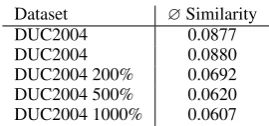
Table 1: Average similarities of the sentences con-tained in the test corpora.
combination lead to reasonably good results on the English subtask of the SemEval2014 Seman-tic Textual Similarity dataset.4
With this methodology, we create four new cor-pora with 100%, 200%, 500%, and 1000% of the size of DUC2004. The bigger the corpora is, the more unimportant information has been added to it. In the 100% corpus sentences are only shuffled without duplicating sentences. With increasing size we hide the originally frequent information better and make it therefore harder to detect impor-tant information. An analysis of the result of the oversampling is displayed in Table 1. The aver-age similarity decreases which means that we hide dense regions by adding sentences to less dense regions.
5 Evaluation
Since the DUC data provides manually written reference summaries, we can compare these gold standard summaries to the newly generated sum-maries of the automatic summarization systems. We provide in the evaluation ROUGE-1 (R1) and ROUGE-2 (R2) based recall scores according to Owczarzak et al. (2012) who showed that R2 provides the best agreement with manual evalu-ations when using stemming and without remov-ing stopwords. As Rankel et al. (2013) showed that there is no clear winner between R1 and R2, we provide R1 as well, which is well suited to identify the better summary in a pair of sum-maries. Furthermore, all automatically gener-ated summaries are truncgener-ated at a length of 100 words by the ROUGE system (Hong et al., 2014). Summarized, we use ROUGE-1.5.5 with pa-rameters -a -m -n 2 -x -c 95 -r 1000 -f A -p 0.5 -t 0 -l 100 -d.
5.1 Reference Systems
We will compare our algorithm, CPSum, to two baselines and to two well-known summarization algorithms.
4http://alt.qcri.org/semeval2014/
Baselines: The first baselineOptimalhas access to the reference summaries and is therefore no fair competitor for the remaining systems. Neverthe-less, it provides useful information about the max-imal reachable score for each dataset. Since com-puting the true optimal score is computational ex-pensive, we only provide a pseudo-optimal value computed by a greedy search. The second base-line system, Random, selects sentences from the source documents randomly. It does not have access to the reference systems and is therefore the first system which can be compared with the other systems. Since most important information in news are often contained in the first sentences, just selecting the first few sentences as a summary is a strong baseline. We useLeadto provide eval-uation scores for a system, which selects the first sentences of each document.
Summarization Systems: We use Centroid (Radev et al., 2000) as a representative system for centroid-based systems. To generate the summaries for this approach we apply the widely used MEAD system (Radev et al., 2004), in which Centroid is implemented. For Centroid we used the default linear feature combination, length cutoff and re-ranker. As a competitive state-of-the-art representative for graph-based approaches (Hong and Nenkova, 2014) we apply LexRank(Erkan and Radev, 2004), which is also implemented in the MEAD system. ForLexRank we used the LexRank feature, standard length cutoff and the default re-ranker.
5.2 CPSum
ROUGE-1 Recall ROUGE-2 Recall
[image:8.595.79.520.62.143.2]System / Dataset D04 D04-1 D04-2 D04-5 D04-10 D04 D04-1 D04-2 D04-5 D04-10 Optimal 0.4043 0.4043 0.4046 0.4043 0.4044 0.0940 0.0941 0.0943 0.0940 0.0942 Random 0.2955 0.3095 0.2863 0.2736 0.2633 0.0435 0.0463 0.0360 0.0313 0.0322 Lead 0.3424 0.3138 0.2786 0.2636 0.2548 0.0766 0.0524 0.0382 0.0313 0.0282 Centroid 0.3542 0.3158 0.3082 0.2690 0.2474 0.0867 0.0605 0.0576 0.0396 0.0331 LexRank 0.3231 0.3219 0.3186 0.3052 0.2990 0.0659 0.0645 0.0631 0.0542 0.0522 CPSum 0.3267 0.3247 0.3264 0.3264 0.3264 0.0603 0.0604 0.0617 0.0617 0.0617 Table 2: ROUGE-1 and ROUGE-2 scores on the original and the modified DUC 2004 corpora.
0 50 100 150 200
0.310 0.315 0.320 0.325 0.330
Number of training documents (in 1000) ROUGE-1
0.04 0.05 0.06 0.07
ROUGE-2
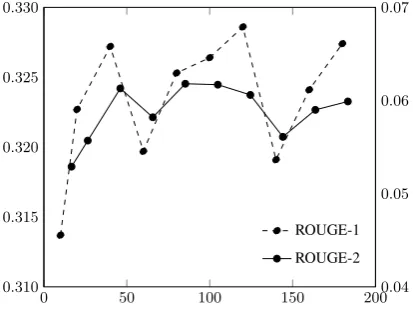
Figure 2: Learning curve of CPSum on DUC2004 for different background corpus sizes. ROUGE-1 scores (left scale) are displayed in blue and ROUGE-2 (right scale) in red.
sophisticated linguistic analysis of the data and re-lying solely on simple elements is an even stronger argument for the strength ofCPSum.
For learning the importance of bi-grams we use a background corpus originally created by Hermann et al. (2015) for question answering tasks. Although this corpus does not provide well-written summaries for each article but only sentence-length bullet points summarizing the content of the article, we can use this informa-tion to derive the necessary training signals for learning object importance. The corpus con-tains about 100k CNN document-summary pairs crawled from CNN and about 197k pairs crawled from DailyMail. For training, we use a subset of 100k randomly selected documents in total.
Since we will not observe most of the bi-grams from the training corpus in the test data, we apply a lazy learning strategy to only learn about ele-ments which appear in the test data. Furthermore, we only learn preferences for contexts which we actually observe during summarization. This de-creases the learning effort significantly.
6 Results
Table 2 shows the ROUGE evaluation scores of the tested systems on the test datasets. First, we see that the evaluation scores for both, ROUGE-1 and ROUGE-2 recall stays nearly constant for the oracle systemOptimal. From this result we con-clude that our modifications did neither remove from nor add important information to the corpus. After the modifications, it is still possible to gen-erate summaries with a ROUGE-1 value of at least 0.40 and a ROUGE-2 value of at least 0.09. The performance of Random decreases when we add more irrelevant information to the corpus. This behavior is expected since the probability of pick-ing an irrelevant sentences increases when more irrelevant sentences are in the corpus. The base-lineLead, which simply uses the first sentences of each article, but is considered to be a strong base-line in newswire documents, is able to summa-rize the original DUC 2004 data reasonably well. However, in the modified corpora with random-ized sentence order, its performance is obviously not better thanRandom.
As expected, the two state-of-the-art reference systems work well on the original DUC 2004 cor-pus, whereCentroidachieves the best results. This behavior is also expected, since it uses positional and centrality features, which provide very good signals for importance in the corpus. When these signals are more and more removed in D04-1 – D04-10, we observe a big performance decrease in both, ROUGE-1 and ROUGE-2.LexRankbehaves similarly toCentroid but with a less fast decrease of performance.
[image:8.595.78.285.185.344.2]Saudi exileOsamabin Laden,the allegedmastermindof aconspiracy toattackU.S.targetsaround
the world, andMuhammadAtef,the allegedmilitary commanderofbin Laden’sterrorist organi-zation,Al-Qaeda,werechargedin aseparate238-pageindictmentwith murderandconspiracyin thebombings.
Saudi exileOsamabin Laden, theallegedmastermindof aconspiracy toattackU.S. targetsaround theworld,andMuhammadAtef,theallegedmilitarycommander ofbinLaden’sterrorist organi-zation, Al-Qaeda,were chargedin aseparate238-pageindictmentwith murderandconspiracyin thebombings.
Figure 3: Example of the importance of the elements in a sentence before (top) and after (bottom) adding the sentence to the summary. The darker the font color the more important the element. Elements with less than 100 gathered preferences are displayed in italics. The importance scores are estimated byvas defined in Equation 8.
approaches. In terms of ROUGE-1 scores,CPSum has the best performance on the four modified cor-pora. In terms of ROUGE-2, its original perfor-mance is similar to the perforperfor-mance ofLexRank, but lower thatCentroid. The performance of Cen-troid drops significantly after shuffling the tences. If we add more and more irrelevant sen-tences, the performance of Centroid drops again faster than the performance ofLexRank. CPSum outperforms all systems when we increase the amount of noise in the corpora D04-5 and D04-10. We show an example of the sentences scoring in Figure 3. We display the same sentence twice. In the top, we display the context-free scores of the elements of the sentence by using a darker font for more important information. In the bottom, we show the contextual scores of the same sentence after adding this particular sentence to the sum-mary. We observe that the importance scores of elements such asOsama bin Ladenare estimated properly. After adding the sentence to the sum-mary we can see howPLSumdiscounts the scores for different elements differently.
7 Conclusions
In this paper we introducedCPSum, a text summa-rization system that learns the importance of en-tities from an independent background corpus of document-summary pairs. CPSumis able to cope with summarization scenarios where neither cen-trality nor structural features help to detect impor-tant information. We showed that the performance of conventional text summarization systems de-creases in such a setting. Previous approaches can be confused easily by adding more and more ir-relevant information whereas the performance of CPSum stays constant. We would argue that by
relying on learned prior knowledge about what in-formation is important for a summary, CPSumis able to detect important information similar to the way human experts address a summarization task. CPSumis also different in the way it copes with redundancy. Instead of measuring the similarity to already selected sentences such as the major-ity of the previous systems, we estimate the score of the elements with contextual preferences. This enables CPSum not only to detect redundancy, but also to use synergy effects between sentences. Adding one sentence to the summary can therefore also increase the utility of other sentences. Fur-thermore, our system can be adapted easily to dif-ferent user interest by learning from other source documents.
We intend to investigate other basis elements for the preferences as well as alternatives for mod-eling world knowledge in future work. Simi-larly, we are also working on a corpus with which we can further investigate summarization scenar-ios where centrality and structural features are no good signals for importance. The results of this first study make us confident that a knowledge-based approach towards importance information is necessary in order to enable summarization sys-tems to handle difficult summarization scenarios where signals for importance cannot be inferred from the source documents.
Acknowledgments
References
D. B¨ar, T. Zesch, and I. Gurevych. 2013. DKPro Simi-larity: An open source framework for text similarity. InProc. 51st Annual Meeting of the Association for Computational Linguistics: System Demonstrations, pp. 121–126, Sofia, Bulgaria. ACL.
S. Brin and L. Page. 1998. The anatomy of a large-scale hypertextual web search engine. Computer networks, 30(1-7):107–117.
J. Carbonell and J. Goldstein. 1998. The use of MMR, diversity-based reranking for reordering documents and producing summaries. In Proc. 21st Annual International ACM SIGIR Conference on Research and Development in Information Retrieval, pp. 335– 336. ACM.
J.M. Conroy, J.D. Schlesinger, J. Goldstein, and D.P. O’Leary. 2004. Left-brain/right-brain multi-document summarization. In Proceedings of the Document Understanding Conference (DUC 2004). H.P. Edmundson. 1969. New methods in automatic
extracting. Journal of the ACM, 16(2):264–285. G. Erkan and D.R. Radev. 2004. LexRank:
Graph-based lexical centrality as salience in text summa-rization. Journal of Artificial Intelligence Research 22:457–479.
J. F¨urnkranz and E. H¨ullermeier (eds.) 2011. Prefer-ence learning. Springer.
G. Gigerenzer and P.M. Todd. 1999. Simple heuristics that make us smart. Oxford University Press, USA. D. Gillick, B. Favre, D. Hakkani-Tur, B. Bohnet, Y. Liu, and S. Xie. 2009. The ICSI/UTD summariza-tion system at TAC 2009. InProc. 2nd Text Analysis Conference (TAC-09), Gaithersburg, MD (USA). K.M. Hermann, T. Kocisky, E. Grefenstette, L.
Espe-holt, W. Kay, M. Suleyman, and P. Blunsom. 2015. Teaching machines to read and comprehend. In Ad-vances in Neural Information Processing Systems 28 (NIPS-15), pp. 1684–1692.
K. Hong and A. Nenkova. 2014. Improving the estimation of word importance for news multi-document summarization. In Proc. 14th Confer-ence of the European Chapter of the Association for Computational Linguistics (EACL-14), Gothenburg, Sweden, pp. 712–721.
K. Hong, J.M. Conroy, B. Favre, A. Kulesza, H. Lin, and A. Nenkova. 2014. A repository of state of the art and competitive baseline summaries for generic news summarization. In Proc. 9th International Conference on Language Resources and Evaluation (LREC-14), Reykjavik, Iceland, pp. 1608–1616. J.M. Kleinberg. 1999. Authoritative sources in a
hyperlinked environment. Journal of the ACM, 46(5):604–632.
H. Lin and J. Bilmes. 2011. A class of submodu-lar functions for document summarization. InProc. 49th Annual Meeting of the Association for Com-putational Linguistics: Human Language Technolo-gies, Vol. 1, pp. 510–520. ACL.
C.-Y. Lin. 2004. Rouge: A package for automatic eval-uation of summaries. InProceedings of the ACL-04 Text Summarization Workshop, pages 74–81.
H.P. Luhn. 1958. The automatic creation of literature abstracts. IBM Journal of Research and Develop-ment, 2(2):159–165.
I. Mani. 2001. Automatic summarization, Vol. 3. John Benjamins Publishing.
K. McKeown and D.R. Radev. 1995. Generating sum-maries of multiple news articles. InProc. 18th an-nual international ACM SIGIR Conference on Re-search and Development in Information Retrieval, pp. 74–82. ACM.
R. Mihalcea and P. Tarau. 2004. TextRank: Bring-ing order into texts. In Proc. 2004 Conference on Empirical Methods in Natural Language Processing (EMNLP-04), pp. 404–411. ACL.
A. Nenkova, L. Vanderwende, and K. McKeown. 2006. A compositional context sensitive multi-document summarizer: exploring the factors that in-fluence summarization. InProc. 29th Annual Inter-national ACM SIGIR Conference on Research and Development in Information Retrieval, pp. 573–580. ACM.
K. Owczarzak, J.M. Conroy, H. Trang Dang, and A. Nenkova. 2012. An assessment of the accu-racy of automatic evaluation in summarization. In Proc. Workshop on Evaluation Metrics and System Comparison for Automatic Summarization, pp. 1–9. ACL.
D. Parveen and M. Strube. 2015. Integrating im-portance, non-redundancy and coherence in graph-based extractive summarization. In Proc. 24th International Conference on Artificial Intelligence (AAAI-15), pp. 1298–1304. AAAI Press.
D.R. Radev. 2000. A common theory of informa-tion fusion from multiple text sources—Step one: cross-document structure. In Proceedings of the 1st SIGdial workshop on Discourse and dialogue (SIGDIAL-00), Vol. 10, pp. 74–83. ACL.
D.R. Radev, H. Jing, and M. Budzikowska. 2000. Centroid-based summarization of multiple docu-ments: sentence extraction, utility-based evalua-tion, and user studies. InProceedings of the 2000 NAACL-ANLP Workshop on Automatic Summariza-tion, pp. 21–30. ACL.
P.A. Rankel, J.M. Conroy, E.V. Slud, and D.P. O’Leary. 2011. Ranking human and machine summarization systems. In Proc. 2011 Conference on Empirical Methods in Natural Language Processing (EMNLP-11), pp. 467–473. ACL.
P.A. Rankel, J.M. Conroy, H. Trang Dang, and A. Nenkova. 2013. A decade of automatic content evaluation of news summaries: Reassessing the state of the art. InProc. 51st Annual Meeting of the As-sociation for Computational Linguistics (ACL-13), Sofia, Bulgaria, pp. 131–136.
J. Sj¨obergh. 2007. Older versions of the rougee-val summarization erougee-valuation system were easier to fool. Information Processing & Management, 43(6):1500–1505.
X. Wan. 2010. Towards a unified approach to simul-taneous single-document and multi-document sum-marizations. InProc. 23rd International Conference on Computational Linguistics (ACL-10), pp. 1137– 1145. ACL.