Abstract—Recycling industry is developing rapidly in Hong
Kong recently. However, there is insufficient information about the current situation of this industry in Hong Kong. The aims of this study were to 1) understand the situations and possible causes of the safety and health problems of workers in Hong Kong recycling industry, 2) identify and evaluate their safety and health problems, 3) propose possible solutions, and 4) provide recommendations and indications of further possible work. By conducting interview with the use of questionnaire, risk analysis, and measurement of workplace condition, the situations and possible causes of the problems were understood, identified and evaluated. Possible solutions were proposed accordingly and indications for further work were suggested.
Index Terms— ergonomics, safety and health, recycling
I. INTRODUCTION
N Hong Kong, commercial and industrial wastes are categorized as municipal solid waste. According to the information from Environmental Protection Department [1], a total of 5.7 million tones of solid waste were generated in 2004, of which 2.3 million tones (40%) were recovered and 3.4 million tones (60%) were disposed of at landfills. In 2008, the recovered municipal solid waste was about 3.14 million tones. The major types of recyclable waste in Hong Kong included paper, plastics, ferrous metal, non-ferrous metal, which accounted for 97% of the waste recovered. The remaining 3% covered wood, glass, textile, rubber tyre, and electrical and electronic materials. These recyclable wastes were either recycled locally (0.02 million tones) or exported to Mainland and other countries for recycling (3.12 million tones). This might suggest that local industries are mainly responsible for collection of materials and material sorting of materials.
Within the normal local waste recovery process flow, there are different characters playing different roles, which include waste generators, scavengers, recyclable material collectors and recyclable material exporters [2]. Waste
Manuscript received Jan 5, 2011.
Alan H. S. Chan is with the Department of Manufacturing Engineering and Engineering Management, City University of Hong Kong (corresponding author. phone: +852 27888439; fax: +852 2788 8423; e-mail: [email protected]).
Philip C.T. Leung was with the Department of Manufacturing Engineering and Engineering Management, City University of Hong Kong (corresponding author. phone: +852 91398323; e-mail: [email protected]).
generator means parties producing waste which could be commercial, domestic and industrial, while scavengers involve workers from waste collection services or cleansing companies, who separate valuable materials from the mixed waste and sell them to waste collectors for further processing. After receiving waste material from waste generators and scavengers, recyclable waste collectors would sell the materials to exporters who will then compact and export the waste materials to other countries (mainly to Mainland China), or sell to local recyclable waste recyclers for recycling. From 2004 to 2008, the overall quantity of recovered waste rose from 1758600 to 3142000 tones, and the recovery rate has risen from 40% to 48% [1], which shows the rapid development of the recycling industry. Along with the growth of the industry, news about injuries and fatal accidents in the industry was sometimes noticed. However, there is inadequate research and statistics of the related ergonomics, safety and health problems associated with the workers in the recycling industry.
Early studies on occupational accident were reported from Denmark. The incidence of occupational accidents during 1989 to 1992 was 95 per 1000 employees per year among workers in the waste collection industry, and 17 per 1000 employees per year in the total work force [3]. The most common accidents were fractures, sprains, wound and soft tissue accidents. It was also reported that exposures in recycling industry could lead to different kinds of health effects [4], for example, diesel exposure could lead to eye irritation, asthma, decreased lung function, upper respiratory tract irritation, lung cancer; exposure to micro-organisms could cause Organic Dust Toxic Syndrome (ODTS) and flu symptoms. In addition, heavy lifting in workers’ duties was found to have related health effect like disorders of the neck, shoulder and back, tendon diseases, extremes, etc.
As shown in the United States Bureau of Labor Statistics, in 2008, the fatal work injury rate (per 100,000 full-time equivalent workers) of refuse and recyclable material collectors was 35.5, which was the 6th highest fatal work injury rate, and was very high when compared to the all worker fatal injury rate of 3.7. As the Hong Kong recycling industry is developing rapidly, it was believed that workers in this industry in Hong Kong would have similar problems as those found in other countries. Thus, the objectives of this study were to understand the situations and possible causes of the workers’ safety and health problems in the
Occupational Safety and Health Problems of
Workers in Hong Kong Recycling Industries – A
Preliminary Ergonomic Study
Alan H.S. Chan, Philip C.T. Leung
local recycling industry, to identify and evaluate the safety and health problems of the workers in the industry, to propose possible solutions for the identified problems, and to provide indications of further possible work.
II. METHODOLOGY
A. Overview
In order to achieve the objectives of the study, it was decided to conduct a field study in the local recycling industry, which allows both qualitative and quantitative surveying in workplace. During field study, interview, collection and evaluation of workplace data, and risk analysis of workers’ job duties were carried out. Besides, a comprehensive literature review of past studies related to the health and safety situations, and causes of the related problems were conducted for deriving possible solutions. In this study, recycling companies were contacted through phone invitation with the recycling companies listed by Environmental Protection Department.
B. Interview
To gather information about the health and safety condition of workers of the companies, one-to-one face interview was conducted during field study with the use of two sets of detailed questionnaires.
Questionnaire for Workers
The first set of questionnaire was designed for interviewing workers based on an instrument previously used for estimation of prevalence of work-related musculoskeletal disorders of carpenters [5]. It was customized to specifically address the occupational safety and health problems in recycling industry, and was organized in such a way that would be conveniently used in face-to-face interview during field study. There were five sections in total, namely, Work Practice, Health Condition, Work History, Occupational Safety and Health Situation at Work, and Personal Information.
Questionnaire for Factory Management
For the questionnaire for factory management, it was modified from the instrument proposed by one of the authors [6]. There were five sections, namely, Work Practice, Work Related Health Problem and Illness, Control Measures at Workplace, Collective and Individual Means of Protection, and Risk of Accident at Workplace.
After the data collection, the information was processed by statistical software package SPSS® to analyze the distribution of working background, frequency of some phenomenon and to generate descriptive statistic tables and charts.
C. Collection and Evaluation of Workplace Data
It was known that noise, poor illumination and thermal stress might act with high work pace and muscle fatigue to produce high incidence rate of occupational accident [3]. Thus, during field study, three parameters including lighting level, noise level and thermal condition in workplace were
evaluated.
Lighting level at workplace
To evaluate the lighting condition, a lux meter (CENTER 337) was used to measure illuminance of the working area, which was then compared with the recommended lighting level. In general, there is no standard of lighting level specifically for recycling centers. In this study, the recommended illumination levels adopted from Canadian Center for Occupational Health and Safety (CCOHS) 2003, Lighting Ergonomics – Survey and Solution, and minimum illuminance levels and uniformity for different tasks (International Commission On Illumination CIE S 015:2005) were included for comparisons.
Noise level at workplace
Noise measurement was done by sound level meter TES 1350A, and the obtained values were substituted into the following Recommended Exposure Level equation for evaluation.
where T is duration permitted (hours) and L is exposure level (dBA).
Thermal Condition of workplace
Thermal parameters in workplace were measured by Thermo-anemometer AZ Instrument 8908. Heat Index and Wind Chill Temperature Index were used to evaluate if the thermal condition of workplace was suitable for workers to work and minimize unsafe behavior beyond the preferred temperature range of 17°C - 23°C [7].
D. Risk Analysis of Workers’ Job Duties
The ergonomic tool Rapid Upper Limb Assessment (RULA) [8] was used to assess the conditions of different job duties in recycling industry. It provides calculated rating of musculoskeletal load in task where people have a risk of neck and upper-limb loading. The risk is expressed in a score of 1 (low) to 7 (high), which will then be grouped into four action levels to check whether it is necessary to expect initiate risk control (see TABLE I). The longest held postures and those appearing to be the worst ones would be chosen for further assessment and improvement.
TABLE I RULA ACTION LEVELS
Action level 1 Score of 1 or 2 indicates that the posture is acceptable if it is not maintained or repeated for long periods Action level 2 Score of 3 or 4 indicates that further investigation is
needed, and changes may be required
Action level 3 Score of 5 or 6 indicates that investigation and changes are required soon
Action level 4 Score of 7 indicates that investigation and changes are required immediately
III. RESULTS & DISCUSSION
A. Company Background
Company A is a material exporter who buys materials form material collectors and exports to other countries. It collects different kinds of materials including metals, plastics, computer products, etc. It has open-air workplaces with thirteen workers. The main job duties of workers include materials sorting, forklifts driving, putting sorted materials into compactors and operating compactors to compact sorted materials into cubes. Besides, workers have to load compacted materials from the compaction area to forklifts and unloading them from forklifts to storage area.
Company B is a material exporter selling plastic flakes which are generated through crushing and chopping plastic bottles by machines. There is a semi-open air workplace (covered working area) for eight workers. Workers are responsible for plastic bottle sorting, transferring materials into the crusher, forklift driving, loading materials to the forklift from crusher or out from the forklift to storing area.
Company C is also a material exporter which solely processes tyres. It has an open-air workplace with nine workers, who have to put tyres onto forklift, organize the tyres, drive forklift and put tyres from forklift into containers.
B. Questionnaire Results
In this study, 10 workers in company A, 7 workers in company B, 7 workers in company C, and one management personnel from each company were successfully interviewed. The duration of interview for each worker and management personnel was about 20-25 minutes.
Work Practice
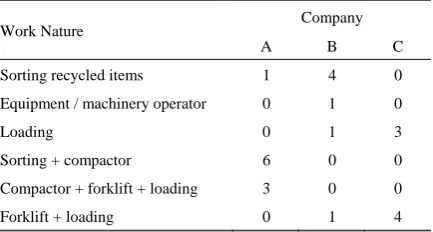
[image:3.595.299.555.249.375.2]Among the three companies, most workers were within the age range of 41-50. All the interviewees were full time workers. Twelve of them were males while another 12 were females. 58.3% of employees had 5-day work and 41.7% of them had 6-day work. In general, 70.8% of the employees had 8-hour daily work and the rest 29.2% a 9-hour work day. Except lunch break, there was no other break provided in all three companies. For work experience, it was found that 54.2% of the interviewees worked 6-10 years, 41.7% worked 3-5 years, and the rest 4.2% worked less than three years. For the work cycles of the interviewees, it was noted that the workers had more than one job duty, which were relatively repetitive in nature (see Table II). Job duties involve materials loading were usually performed by male workers.
TABLE II
NATURE OF WORK IN EACH COMPANY
Work Nature Company
A B C Sorting recycled items 1 4 0 Equipment / machinery operator 0 1 0
Loading 0 1 3
Sorting + compactor 6 0 0
Compactor + forklift + loading 3 0 0
Forklift + loading 0 1 4
For company A, job nature concentrated on ‘sorting materials and compacting process’ and ‘compacting process, driving forklift and loading materials’, while in company B, job duties were mainly on ‘sorting materials’, and in company C, workers were mainly responsible for ‘loading tyres’ and ‘driving forklift and loading tyres’.
Health Condition, Work History & Satisfaction
[image:3.595.61.278.644.760.2]The results of interviews showed that all the workers in the three companies had musculoskeletal problems with more than one body locations at ‘mild’ and ‘moderate’ levels. The main musculoskeletal problems were with the shoulders (58.3%) and the back (50%) (Table III).
TABLE III
NUMBER OF WORKERS HAVING PROBLEMS IN DIFFERENT BODY PARTS
Problem areas Number of workers
Shoulder 14 Back 12 Knee 8 Neck 7
Elbow /forearm 5
Hip / thigh 3
Hand / wrist 2
Ankle 2
Other than two interviewees had consulted doctors owing to neck problem, and three workers sought for medical help because of back problem, no employee had seen doctors or health providers for any musculoskeletal treatment.
According to the interview results, it was noted that all workers in the three companies felt ‘somewhat satisfied’ with their current job position. During the work cycles, 45.8% workers expressed that they sometimes had to work in fast speed. In general, it could be understood that workers in the three companies had low health seeking behavior as just a few of them had consulted doctor or medical help for their musculoskeletal problems.
Occupational Safety and Health Situation at Work
In companies A and B, workers were provided with personal gears for their job duties (masks and gloves in company A, gloves and anti-slip footwear in company B), and workers in company C did not receive any personal gear. All of the employees in the three companies stated that they did not receive any occupational safety and health training. According to the information provided by the management personnel of the three companies, there was no injury log kept in the companies.
C. Risk Analysis of Workers’ Job Duties by RULA
‘Putting tyres into container” in company C.
For job duties “Sorting materials” in companies A and B, “Putting materials into compactor” in company A, which had the highest score “7” and required immediate improvements, they had one common characteristic that materials to be grabbed by the workers were in fact not in the position close to them. It was hard for the workers to reach or grab the materials which made them adopting wrong postures and eventually bent and twisted their backs and necks during the work cycle. The awkward postures combined with the highly repetitive movements were believed to be the causes of the cumulative trauma disorders and musculoskeletal problems of workers observed in the study [9] [10].
[image:4.595.42.302.338.650.2]For “Putting tyres into container” in company C, workers had to bend and twist their trunks, and as well raise their arms to put the tyres into correct position. As the tyres were large in size, the upper arms would be abducted, which led to high ‘wrist and arm score’, and the high final score of ‘7’ and action level ‘4’.
TABLE IV
FINAL SCORES AND ACTION LEVELS OF DIFFERENT JOB DUTIES IN RULA
Company Job Duty Side Wrist
& Arm Score
Neck Trunk &
Leg Score
Final Score
Action Level
A Sorting materials RHS 5 9 7 4
LHS 5 9 7 4 Putting materials
into compactor
RHS 7 8 7 4 LHS 7 8 7 4 Operating
forklift
RHS 4 3 3 2
LHS 4 3 3 2
Loading materials
RHS 4 3 3 2
LHS 4 3 3 2
B Sorting materials RHS 5 9 7 4
LHS 4 9 7 4 Putting materials
into crusher
RHS 3 4 4 2
LHS 4 4 4 2
Operating forklift
RHS 4 4 4 2
LHS 4 4 4 2
Loading materials
RHS 4 3 3 2
LHS 4 3 3 2
C Putting tyres into forklift
RHS 6 2 4 2
LHS 6 2 4 2
Operating forklift
RHS 4 4 4 2
LHS 4 4 4 2
Putting tyres into container
RHS 7 8 7 4 LHS 7 8 7 4
D. Workplace Evaluation
In this study, the companies visited had open or semi-open working areas. It was thus expected that the working environment of workers was directly affected by the local weather conditions.
Lighting Condition
When conducting the site visit in the three companies, there was fine weather. So, in general, the lighting condition of the open-air workplace was satisfactory and the measured
illumination levels were higher than recommended levels (Table V). However, the working area for ‘putting tyres into containers’ was found not acceptable. It was because this job duty was done within a container which had no lighting system inside. The work environment was very dark with lighting level 1.2 lux, which was much lower than the recommended value of 150 lux suggested by CCOHS (2003). Under this low light condition, workers would have higher chances of having injuries and accidents such as fall from forklift.
Though most measured lighting levels in company were found acceptable, there were still some concerns of the authors. As all the three companies were in open/semi open area without a good lighting system, the main light source was from the natural daylight which was much dependent on the weather condition. During evening period (after 5:00 p.m.), the daylight level was lower than the recommended levels. Although there was a simple lighting system installed in the covered working area, it was told that there was no regular maintenance practice, and the installed lighting system might not be able to provide enough illuminance to some tasks requiring high level of vision from the workers.
TABLE V
LIGHTING LEVELS OF DIFFERENT WORKING AREAS
Company Working area Lighting Level (lux)
Recommended Lighting Level
(lux) A Sorting materials Natural Daylight 300
Putting materials into compactor
Natural Daylight
100 Operating forklift Natural Daylight 30 Loading Materials Natural Daylight 150 B Sorting materials Natural Daylight 300
Putting materials into crusher
137.9
100 Operating forklift Natural Daylight 30 Loading materials Natural Daylight 150 C Organizing tyres in
storage place
Natural Daylight
150 Operating forklift Natural Daylight 30 Putting tyres to
forklift
Natural Daylight
150 Putting tyres into
containers
1.2
150
Noise Condition
[image:4.595.303.548.354.566.2]TABLE VI
NOISE LEVELS MEASURED IN DIFFERENT WORKING AREAS Company Area Condition Average Noise
Level (dBA) A Sorting process Compactor Off 81.96
Sorting process Compactor On 103.72 Compacting materials Putting material
into compactor 84.88 Compacting materials Compactor On 108.36
Operating forklifts &
loading materials / 85.00
B Sorting plastic bottles / 94.70
Putting materials to the
crusher / 94.94
Storing crushed and
uncrushed material / 85.80
Output area of the
crusher / 95.82
C Putting tyres into
containers / 85.46
Operating forklift and
putting tyres into forklift / 84.34
Thermal Condition
[image:5.595.60.276.586.750.2]As the field study of the three companies was conducted in winter, the Heat Index was not applicable here. The Windchill Temperature Index is only defined for temperatures at or below 10 °C (50 °F) and wind speeds above 4.8 km per hour (3.0 mph), it also could not be applied. However, when compared to the preferred temperature range of 17°C - 23°C recommended by past study [7], it was found that the temperatures of all the working areas in company A were outside this range (Table VII). This implied that workers would have higher chance of having unsafe behavior, and hence the chance of having accident would be increased. The thermal conditions of open and semi-open working areas in the three companies would seriously be affected by weather condition especially during winter and summer. As there was no break given to workers in all three companies, working under strong sunlight and high temperature environment in summer may suffer imbalance of thermoregulation. Possible health problems of heat illness such as heat stroke, heat exhaustion, heat syncope, etc. may also occur.
TABLE VII
THERMAL CONDITIONS OF DIFFERENT WORKING AREAS Company Working area for Average
Temperature (°c)
A
Sorting Materials 15.77 Putting Materials into
Compactor 15.70
Driving Forklift 15.73 Loading Materials 15.77
B
Sorting Materials 18.67 Putting Materials into
Plastic Crusher 18.60 Driving Forklift 18.53 Loading Materials 18.63
C
Organizing Tyres in place
for storage 18.13
Driving Forklift 18.07 Putting Tyres to Forklift 18.07
E. Other Observations
The three companies visited in this study were material exporter companies. It was believed the chance for workers to be exposed to bio aerosol should be low. It was noticed in company A, workers usually had dangerous acts during their work cycles, such as putting hands into an operating machine for preventing materials coming out from the compactor. If the workers fail to pull out their hands from the machine in time, they would get hurt and injuries would be seen. Apart from that, in company C, workers who were responsible for operating forklift and putting tyres into container did not wear anti-slip footwear and would have a high chance of accidents. Also, it was noted that there was no protecting-shield to prevent workers’ hands or clothes from getting into the compactor in company A.
IV. CONCLUSION AND RECOMMENDATION
In this preliminary study, three recycling companies were visited and some workers and management personnel were interviewed. Past research studies showed that workers in recycling industry have higher chance of occupational accidents due to poor working conditions, musculoskeletal problems, and some health problems due to exposure to bio-aerosol and volatile organic compounds, diesel exhaust, etc. The current results of interviews showed that all workers in the three companies had musculoskeletal problems, and shoulder and back problems were the most common ones among the workers. The results of RULA indicated that owing to the poor organization of the materials and inappropriate postures, workers were subjected to high risk of musculoskeletal problems.
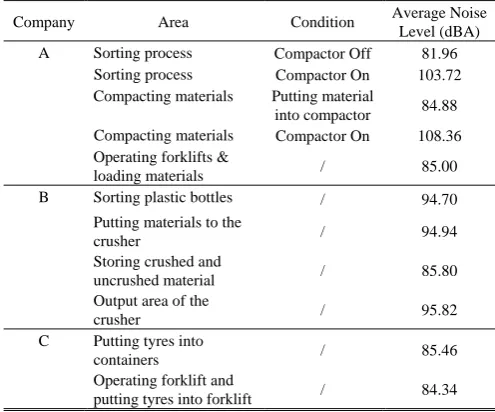
To evaluate the working environment, lighting level, noise level, and thermal condition were measured. The lighting and thermal conditions of the three companies, which have open and semi-open workplaces, were in general satisfactory. However the thermal parameters would be affected directly by environmental conditions, especially under too hot or too cold conditions in summer and winter. For noise consideration, the noise exposure levels in areas nearby machines in companies A and B were higher than the recommended exposure limit and posed hearing damage to workers.
From the above findings, it was noticed that follow up actions were necessary to rectify the existing problems.
Possible Preliminary Solutions
To improve lighting condition, it was recommended to install adequate lighting fixtures such that the lighting level of the workplaces could be independent of the weather and sunlight, and sufficient lighting could be provided to the workers. In addition, factory managements should be encouraged to have regular maintenance of lighting system.
For noise level condition, it was found that machines employed were the main noise source (compactor in company A and plastic crusher in company B). It is known that the most effective way to reduce noise level and prevent noise-induced hearing loss is to remove the hazardous noise from the workplace or to remove the worker from the hazardous noise [11]. As it was impossible to remove the machines from the workplace, it was advised to increase the distance between the noise source and workers (or working area) in order to lower the exposure level. Another method was to provide hearing protection gears. Considering the reluctance of workers to wear hearing protectors, individual training to workers in the selection, fitting, use, repair and replacement of the hearing protectors should be provided [12-14].
For thermal condition, to deal with thermal stress, companies were encouraged to install ventilation system to increase the air movement or introduce rest pause to workers [15]. To deal with cold stress, workers were recommended to consume high-energy food during winter, and wear warm clothing.
In addition, another important measure was to raise the awareness of the concerns of the recycling workers’ safety and health by advertising through media, conducting comprehensive and intensive research on these topics such that the public would have better understanding of situation and start to be aware of these problems.
Recommendations for further work
In this study, only three companies were visited. In order to have more accurate and detailed information for knowing the real situations, more data of the related study would be needed. Besides, to have more complete information, study should be conducted in different seasons as open and semi-air workplaces are affected by weather directly. Also, as the three companies were all materials exporter here, it was suggested to have a study in other worker groups in the waste recovery flow like the ‘scavengers’ and ‘recyclable materials collectors’ to have a more comprehensive understanding of the occupational health and safety problems in the industry.
ACKNOWLEDGEMENT
We would like to thank Dr Annie NG for giving comments during the questionnaire development, Mr. Matthew Ka Lap LAM in locating the recycling companies, and Mr. Pak Hin LAW and Mr Man Ting WU in conducting parameter measurements and interviews during field study.
REFERENCES
[1] Mr. Jason S.M. LEUNG, Mr. Terence L.C. TSOI, Mr. Derek T.L. LEUNG, Ms. Pauline M.Y. POON, 2009, Monitoring of Solid Waste in Hong Kong Waste Statistics for 2008, Environmental Infrastructure Division, Environmental Protection Department, Hong Kong [2] Environmental Protection Department, Hong Kong’s Environment –
Municipal Solid Waste in Hong Kong
[3] Poulsen OM, Breum NO, Ebbehoj N et al. 1995a, Collection of domestic waste. Review of occupational health problems and their possible causes. Sci Total Environ; 170: 1–19.
[4] James D. Englehardt, Lora E. Fleming, Judy A. Bean, Huren AN, Nicolette John, Jeff Rogers, Melissa Danits 2000, Solid Waste Management Health and Safety Risks: Epidemiology and Assessment to Support Risk Reduction, State University System of Florida, Florida [5] Grace Kawas Lemasters and Margaret R.Atterbury. 1996, The Design and Evaluation of a Musculoskeletal and Work History Questionnaire, Occupational Ergonomics Theory and. Applications, p431, MARCEL DEKKER, INC, New York
[6] Leung, M.K.H., Ng, A.W.Y. and Chan, A.H.S., 2009, Occupational Safety and Health Management for the Recycling Industry, Proceedings of the IEEE 16th International Conference on Industrial Engineering and
Engineering Management, 21-23 October, Beijing, China.
[7] Jerry D. Ramsy, Charles L. Burford, Mohamed Youssef Beshir, and Roger C. Jensen, 1983. Effects of Workplace Thermal Conditions On Safe Work Behavior, Journal of Safety Research, Vol. 14, pp. 105-114 [8] McAtamney, L. and Corlett, E.N. 1993, RULA: a survey method for
the investigation of work-related upper limb disorders, Appl. Ergonomics, 24, 91-99.
[9] Tayyari, F. and Sohrabi, A-K. 1990, Carpal tunnel syndrome update. In: Advances in Industrial Ergonomics and Safety II (das, B., ed.). Taylor & Francis, London.
[10] Tayyari, F. and Emanuel, J.T. 1993, Carpel tunnel syndrome: an ergonomics approach to its prevention. International Journal of Industrial Ergonomics.
[11] NIOSH 1998, Criteria for a Recommended Standard: Occupational Noise Exposure. Cincinnati, OH: U.S. Department of Health and Human Services, Public Health Service, Centers for Disease Control Prevention, National Institute for Occupational Safety and Health, DHHS (NIOSH) Publication No. 98-126
[12] Gasaway DC. 1985, Documentation: the weak link in audiometric monitoring programs.Occup Health Saf 54(1):28-33.
[13] Royster JD, Royster LH. 1990.Hearing conservation programs: practical guidelines for success. Chelsea, MI: Lewis Publishers, pp. 73-75.
[14] NIOSH 1996, Preventing occupational hearing loss—a practical guide.Cincinnati, OH: U.S. Department of Health and Human Services, Public Health Service, Centers for Disease Control and Prevention, National Institute for Occupational Safety and Health, DHHS (NIOSH) Publication No. 96-110.