IOT based Smart Device Management using
MQTT Services
Vedha N S1, Prof. B. Naveen Kumar2
1, 2
Department of computer science and engineering, UBDTCE
Abstract: IOT has gained the major interest of people in the present days as the innovative achievements have occurred in this area. This results the growth in numbers of IOT devices installed which give rise to the challenge of data acquisition, management and inter-communication among these IOT devices. To make over this, we propose cloud-based IOT platforms which focus on bestowing the higher-priority IOT devices and also peak reduction through solar energy by executing the device supply management algorithm along with the integration of MQTT which is the avant-grade IOT protocol.
Keywords: IOT, MQTT and MATLAB.
I. INTRODUCTION
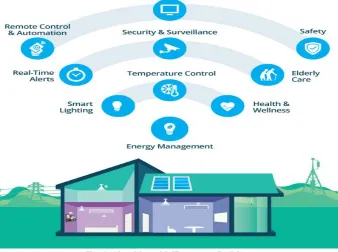
[image:1.612.136.474.373.625.2]As the technology increases, smartness of the people living culture also increases. One outcome of this smartness is IOT devices. With recent achievements within the space of the web of Things (IoT), a better range of IoT devices goes to be deployed within the close to future. IoT platforms provide provisions for most electronic devices to gather, process, and monitor various forms of information. Moreover, the IOT platform will make buildings, which is able to accommodate several IoT devices in coming years, smarter as several systems will act with every other mechanically via the web protocols so as to respond to pre-defined things.
Fig 1: Cloud-based IoT in smart Buildings
Among the assorted on the market choices for realizing information sharing over the net, Message Queue Telemetry Transport (MQTT) is that the most typical and globally accepted protocol for Machine-to-Machine (M2M) electronic communication. MQTT is a lightweight protocol that makes it the foremost favoured choice for developers so as to implement information acquisition systems with a demand for in depth information sharing in real time.
A. Problem Statement
Innovative achievements in the area of IOT made the increased number of usage of IOT platform in smart societies. This platform demands large amount of data exchange and effective interactions between devices which is key issue. Our challenge is to build secure, reliable, peak reduction and interoperable IOT platform. This challenge is taken as “Smart device management using MQTT services and MATLAB”.
B. Proposed System
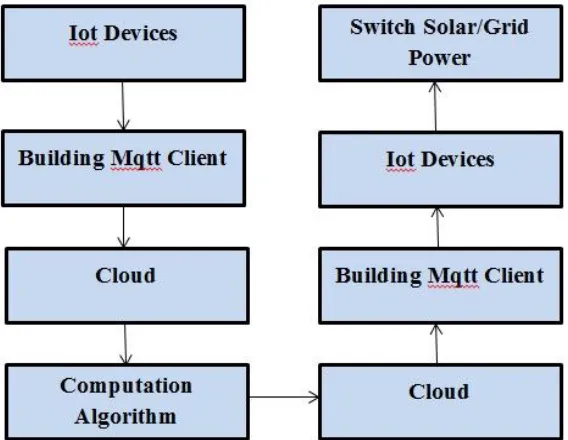
Message Queue Telemetry Transport (MQTT) that is that the progressive Internet of Things (IOT) protocol has been adopted during this work to include communications between the devices and therefore the controller. MQTT publisher and subscriber are deployed within the Python programming language. A cloud-based knowledge aggregation platform has been used with the MATLAB interface, during which the device management algorithmic rule runs. From the results, it might be observed that the cloud based IOT platform with success achieves the desired objectives of the proposed platform. The block diagram of proposed platform is shown below.
Fig.2: Block diagram of proposed cloud-based IOT platform
The prime tasks that are administrated by this platform are: collect: device sensor knowledge is sent to the cloud privately using MQTT. Analyse: analysing, visualizing, and running management algorithms on the collected knowledge with MATLAB. Taking action on incoming data: triggering a reaction and causing control signals back to the devices.
C. Objectives
An efficient cloud-based IOT platform is developed to disseminate the multifarious IOT devices which facilitate data acquisition, management and communication among the devices. The objective of proposed platform is as follows:
1) To make a cloud-based IOT secured, reliable and interoperable platform which include numerous of IOT devices?
2) To provide top-priority devices from renewable energy and achieve peak reduction.
3) To incorporate efficient communication between the devices and distributed decision-making control scheme through MQTT
protocol.
II. LITERATURESURVEY
In 2011, F. I. Vazquez, W. Kastner, S. C. Gaceo, C. Reinisch [1] adopts a control approach for maintaining the electricity load in smart home control devices. They focused on the elasticity improvement regarding the electricity market and worked on the peak reduction of smart homes.
In 2012, Jinsung Byun, Youngil Kim, Zion Hwang and Sehyun Park [2] work on the machine to machine communication and developed an intelligent cloud-based energy management system (iCEMS) by considering the upcoming energy environment. They explained the efficiency of smart grid can be enhanced by peak reduction.
In 2013, Y. Yan, Y. Qian, H. Sharif and D. Tipper [3] present the motivation and requirements of communication infrastructure in smart grid systems. They also provide the challenges and key requirements of the smart grid systems. In addition to this renewable energy can also be used for peak reduction in mentioned.
In 2015, Y. W. Chen and J. M. Chang [4] provides the cloud-based platform considering the customer oriented energy management which is taken as service for DER providers. Furthermore, EMaaS might be adopted and operated economically by existing REPs or utilities, and is sensible with the cooperative procedure.
In 2015, M. Singh, M. A. Rajan, V. L. Shivraj and P. Balamuralidhar [5] provides the different types of MQTT protocols and also explains the security level these protocols are providing. The communication security is enable by disseminating these protocols is the key factor they explained. Also give details on vulnerabilities of various scenarios.
In 2016, G. Suciu, O. Fratu, L. Necula, A. Pasat and V. Suciu [6] present the overview of the advantages of machine-to-machine communication to the business environment. Mainly they explained the energy management through cloud platform for economic growth of the SMEs.
In 2017, N. Tantitharanukul, K. Osathanunkul, K. Hantrakul, P. Pramokchon and P. Khoenkaw [7] provide the detailed framework of MQTT protocol. It is compared with HTTP protocol and its featured are presented. Also explains the behaviour of MQTT in various infrastructures.
III. METHODOLOGY
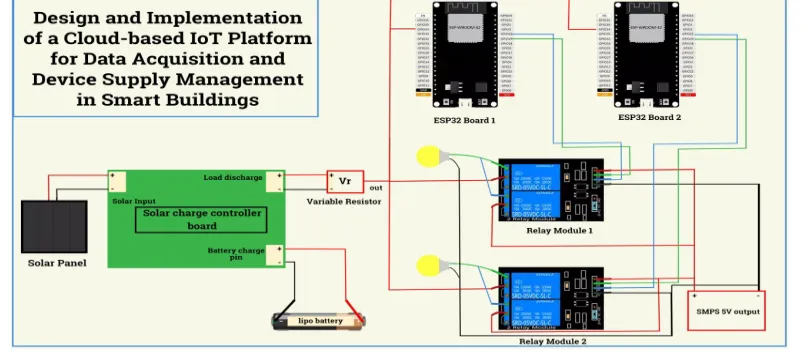
[image:3.612.106.510.445.621.2]The proposed keen structure contains diverse IoT apparatus, for example, Electric Vehicles (EVs), Heating, Ventilation, furthermore, Air Conditioning (HVAC), and home machines all having Wi-Fi modules associated with a Wireless Neighbourhood (WLAN). These apparatus in smart structures are equipped for distributing information for checking and revealing occurrences/estimations and buying in to control directions from the structure nearby controllers by means of a two-way continuous correspondence.
Figure 3: Architecture of proposed system
The fundamental three errands which are done by this stage are: 1) gather: apparatus sensor information are secretly sent to the cloud, 2) investigate: dissecting, imagining, and running proposed algorithm calculations on the gathered information, 3) taking move on approaching information: setting off a response and sending control motions back to the apparatus.
The centre component of the cloud action is the channel. A channel stores the information that is sent by the apparatus. There is a one of a kind ID doled out to every private channel along write application Programming interface key and a read API key. The one of a kind read/write API keys are required to send the gathered information from the MQTT customer to the channel and to recover gathered information. To actualize the calculation, a solitary MQTT distributer is created in Python language. This code speaks to any apparatus in the shrewd structure and associates with the message intermediary running on any apparatus in the system.
[image:4.612.165.449.287.507.2]This Python code distributes the ideal parameters of the apparatus to a client characterized theme. Additionally, a Python code is created as a solitary MQTT supporter, speaking to any home apparatus, to buy in to the messages originating from the foreordained themes. The Publisher and Subscriber need to know the IP address of the machine that runs the MQTT dealer. The time goals for distributing MQTT messages in the actualized IoT stage in this work is client adaptable also, could be in the scope of seconds, minutes, or hours. The structure information aggregator required to understand the calculation is essentially a MQTT customer that buys in to the messages from all apparatus and sends them to the cloud.
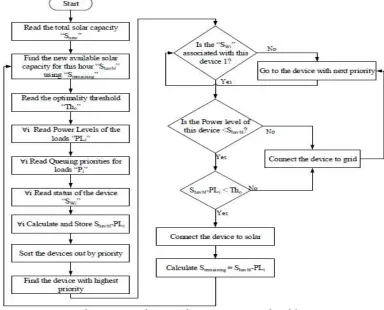
Figure 4: Flow diagram of proposed system
This MQTT customer is additionally grown independently in the Python programming language and is responsible for two errands: 1) to buy in to the modified themes characterized by apparatus distributers, 2) to connect with the cloud bi-directionally. This MQTT customer gets the distributed information from the apparatus and sends them to the cloud channel by means of HTTP POST solicitations to the server. So also to refreshing the channel feed by POST demands, this customer can get the channel feed by HTTP GET demands and pass the got information as MQTT messages to the apparatus supporters so as to be activated. The apparatus in this work distribute two qualities: 1) the apparatus control level, and 2) the apparatus status (on/off) by means of MQTT to the cloud; after running the proposed computation algorithm, the outcomes, which show whether the apparatus must be associated with the on location sun powered board or to the grid, will be distributed to the apparatus endorsers.
A. MQTT
[image:5.612.152.463.123.228.2]Message Queue Telemetry Transport (MQTT) is the state-of the- workmanship distributer supporter convention for Internet of Things (IoT) applications. MQTT is received in this work as an easy to- execute ISO-standard informing system.
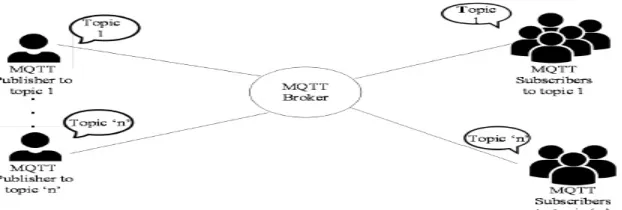
Figure 5: MQTT convention segments
There are three fundamental segments in MQTT informing:
1) MQTT Publisher (distributer),
2) MQTT Subscriber (endorser), and
3) Message Intermediary (broker).
In this distributer supporter instrument, distributer and supporter don't really keep running in the meantime. Besides, the distributer and the supporter don't have to know one another by IP address. There is a third part called Message Intermediary which is known by both the distributer and the endorser also, is accountable for circulating the majority of the approaching messages appropriately. Information sharing by means of the MQTT convention occurs through explicit adjustable themes. This implies distributers send the information to predefined subjects and the endorser need to know which themes to buy in from the agent. These subjects are characterized by the distributers. The three primary parts of MQTT correspondence are demonstrated in Figure 1. In outline, MQTT informing is a bi-directional specialized strategy, implying that a MQTT customer can be both a distributer and an endorser in the meantime.
a) MQTT Distributer (Publisher): A MQTT distributer could be any apparatus from a smaller scale controller up to a genuine server with a running MQTT library. MQTT distributer must be associated with a MQTT dealer over any sort of system. Every distributer must characterized two components before sharing the information over MQTT convention:
i) The payload of the message, and
ii) Message theme.
Since MQTT does not bolster naming messages with metadata, characterizing a significant theme for the messages by the MQTT distributer could exhibit some metadata of its message.
b) MQTT Endorser (Supporter): The partner to a MQTT Distributer is a MQTT supporter. Also to a MQTT distributer, a MQTT supporter could likewise be any apparatus from a tiny and asset obliged apparatus to a commonplace PC running a graphical MQTT customer for testing purposes. Fundamentally, any apparatus that has a TCP/IP stack and is associated with an arrange and speaks MQTT could be a MQTT supporter. The endorser has to realize the point name characterized by the distributer so as to get the information and respond on that.
B. Algorithm
The fundamental point of the proposed algorithm is to supply higher-need apparatus from sun oriented power and to expand sun powered power use. The utilization of this calculation is in areas where network control is untrustworthy and the higher-need apparatus should be provided consistently.
The contributions to the calculation are: the need of the apparatus (Pi), their capacity levels (PLi), status (on/off) of the apparatus
(SWi), the complete sunlight based limit introduced nearby (Snew), and a user defined ideal limit (Tho). The clients can organize their
machines to pick their solace level. The apparatus send their control levels at regular intervals if and just on the off chance that they are exchanged on. The calculation peruses the power levels and statuses of the machines and, contingent upon the accessibility of sun based power, it chooses whether the apparatus is provided by sun oriented or the regular current. In request to expand the sun oriented power usage, the calculation mulls over a client characterized ideal limit control level before interfacing any machine to the sun based. In other words, there is a trade-off between the need of the apparatus what’s more, the sun based power usage by that apparatus.
This client characterized edge esteem is contrasted and the distinction between the usable suns oriented power and the power dimension of the machine to be associated. On the off chance that a higher-need apparatus has a distinction with the usable sun based limit more than the client characterized edge, it is not going to be associated with sun based and is associated with the network. In this manner, the apparatus with the following need is checked as the following stage of the calculation. Each time an apparatus is associated to sun oriented power, the calculation subtracts the apparatus control level from the accessible sun powered
limit and stores this incentive as the staying sun powered limit (Sremaining) for basic leadership on the next apparatus. Likewise, at
whatever point a apparatus is killed or if an apparatus diminishes its capacity utilization, the calculation includes/lessens the
progressions of the apparatus control level to the accessible sun oriented limit and updates Sremaining to be utilized for the next
apparatus. It must be seen that the calculation considers the changes in the sunlight based limit at every hour too. This is
accomplished by utilizing Sremaining and the extra/decrease limit of the hourly sunlight based ability to compute the accessible
sunlight based limit (Shavbl). Moreover, the calculation abstains from utilizing the whole accessible sunlight based limit by the
[image:6.612.117.501.403.713.2]apparatus so as to keep a cradle.
IV. EXPERIMENTALRESULTS
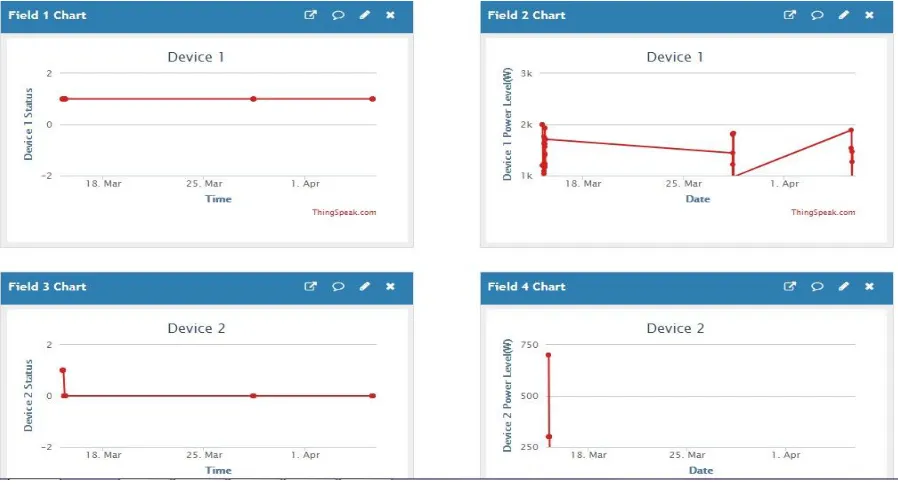
To feature the usefulness of the created calculation and feature the execution of the actualized IoT stage, a case situation has been planned and tried. In this situation, 2 apparatus are considered in a keen structure with power levels, statuses, and needs characterized. The input information to the calculation are: 1) outer inputs including client characterized apparatus need and the absolute sun oriented limit introduced nearby, 2) apparatus power levels and statuses gotten from the MQTT customer. In the structured case situation, there are 2 apparatus each sending 2 esteems, subsequently 4 fields of the made channel are empowered to get information from the structure MQTT customer. The consequences of the 'read' execution which demonstrates the got information in these 4 fields are pictured in Figure 7
[image:7.612.81.530.260.503.2]The plots in Figure 7 delineate the power levels got from the apparatus distributers by means of MQTT messages. These plots are legitimately caught from the graphical UI of the on the web server collaborating with the structure MQTT customer. For this situation, the absolute sun based limit introduced nearby is 1 kW, the limit considered for augmenting the sunlight based power use is 200 W, and the cradle sun powered limit is 300 W. Figure 4 demonstrates that the 'read' some portion of the correspondence to get information from 2 apparatus distributers works appropriately and it has caught information for the length of one hour with 10-minute goals.
Figure 7: Device_data channel results
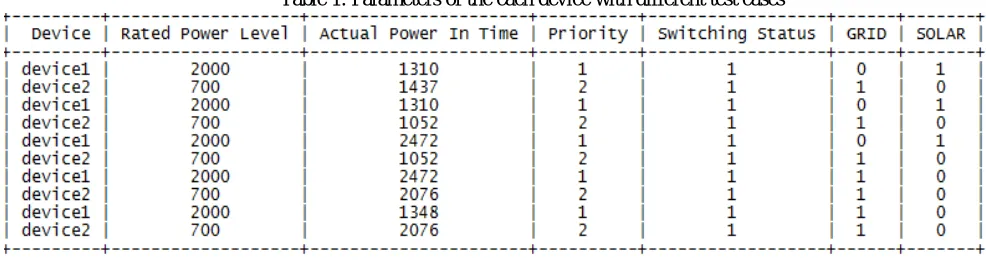
The collected apparatus information by utilizing the channel read API key for running the planned apparatus supply algorithm calculation. The calculation keeps running at every moment of time that apparatus' information are gotten. Subsequent to executing the calculation on the got information, the consequences of the apparatus the executives calculation, which decides if the apparatus ought to be associated with the lattice or to the sun oriented board are written in another channel arranged and committed to accepting the calculation results (device_algo channel) which is shown in figure 8.
[image:7.612.96.512.596.713.2]The following table 1 contains the updated values of each device power usage, status of devices and power level for every 10 minutes.
Table 1: Parameters of the each device with different test cases
V. CONCLUSION
A cloud-based IoT stage for information securing furthermore, apparatus supply method in savvy structures is planned and executed. An apparatus supply method calculation to supply high-need apparatus in the structure persistently and to amplify the usage of the sun powered power limit introduced on location is created and introduced in detail. To accomplish the objectives of the created calculation, apparatus are required to collaborate with a controller bi-directionally so as to trade data (for example apparatus control levels) and respond to the sign originating from the controller. To understand this two-way correspondence, the stage embraces the MQTT convention. MQTT distributers/endorsers alongside altered MQTT themes are sent in the Python programming language to speak to savvy home machines. This stage utilizes a designed private channel to store the approaching information from the apparatus in a cloud with. The apparatus executives calculation keeps running in the system and the aftereffects of the calculation go right back to the apparatus utilizing read/compose Programming interface keys of the channel. An experiment situation is intended to demonstrate the usefulness of the proposed framework. In the last segment, results are examined further in detail for each time interim so as to give per users a superior comprehension of this work.
REFERENCES
[1] F. I. Vazquez, W. Kastner, S. C. Gaceo, C. Reinisch ‘‘Electricity loadmanagement in smart home control’’, 12th Conference of InternationalBuilding
Performance Simulation Association, 2011, pp. 957 -- 964.
[2] Jinsung Byun, Youngil Kim, Zion Hwang and Sehyun Park, "An intelligentcloud-based energy management system using machine to machinecommunications
in future energy environments," IEEE InternationalConference on Consumer Electronics (ICCE), Las Vegas, NV, 2012, pp.664-665.
[3] Y. Yan, Y. Qian, H. Sharif and D. Tipper, "A Survey on smart gridcommunication infrastructures: motivations, requirements andchallenges," in IEEE Communications Surveys & Tutorials, vol. 15, no.1, pp. 5-20, First Quarter 2013.
[4] Y. W. Chen and J. M. Chang, "EMaaS: Cloud-based energy managementservice for distributed renewable energy integration," in IEEE Trans. OnSmart Grid,
vol. 6, no. 6, pp. 2816-2824, Nov. 2015.
[5] M. Singh, M. A. Rajan, V. L. Shivraj and P. Balamuralidhar, "SecureMQTT for Internet of Things (IoT)," 2015 Fifth International Conferenceon Communication Systems and Network Technologies, Gwalior, 2015,pp. 746-751.
[6] G. Suciu, O. Fratu, L. Necula, A. Pasat and V. Suciu, "Machine-to-Machine communications for Cloud-based energy management systemswithin SMEs," IEEE
22nd International Symposium for Design andTechnology in Electronic Packaging (SIITME), Oradea, 2016, pp. 114-117.
[7] N. Tantitharanukul, K. Osathanunkul, K. Hantrakul, P. Pramokchon andP. Khoenkaw, "MQTT-topics management Ssystem for sharing of OpenData," 2017
International Conference on Digital Arts, Media andTechnology (ICDAMT), Chiang Mai, Thailand, 2017, pp. 62-65.