Comparative Study on the Seismic Behaviour of
Diagrid Structure and Shear Wall Structure
Ravikiran G1, H. R Shyam Prasad2, Poorna Chandra S3 1, 3
M.Tech Student, Computer Aided Design of Structures, Department of Civil Engineering, PES College of Engineering, Mandya, Karnataka
2
Assistant Professor, Department of Civil Engineering, PES College of Engineering, Mandya, Karnataka
Abstract: The design of the multi-storeyed buildings are primly depends on the lateral loads like earthquake and wind forces acting on them. It is uneconomical to design the whole structure to resist these lateral forces. Hence lateral force resisting systems such as moment resisting frames, bracing systems, shear walls, outriggers and recently diagrids have been introduced. This paper presents the comparative study on the seismic behaviour of diagrid structure and shear wall structure. A diagrid structure and a shear wall structure of 16 stories each are designed with the same design loads and are analysed using response spectrum method. The seismic performances of both the structures are compared with one another. The results shows that the use of diagrids in the structure will reduces the displacements, drifts and storey shear whereas implementation of shear wall in the structure increases the natural time period and reduces the vibration (storey acceleration) of the building caused due to seismic activity.
Keywords: Diagrids, shear walls, storey displacement, storey shear, storey stiffness, storey drift, storey acceleration, natural time period, overturning moments.
I. INTRODUCTION
Predicting a structure's reaction to a specific form of loading is of paramount significance for structural design. Basically, the codes and past experiences give us a lot of data about the type of loads and their intensities for distinct kinds of constructions and circumstances at the site. To make the structure earthquake resistant, it is vital to incorporate a lateral force resistant system. Significant horizontal forces act on the buildings during the seismic activity, causing serious hazards to the structural components leading to structural failure. Lateral forces can create elevated stresses, generate sway, or cause vibration, resulting in failure of buildings. To prevent damage from lateral forces such as earthquake forces and wind forces, it is essential to provide the structure with lateral force resistant system. Hence it is very essential to understand which sort of scheme provides better performance under seismic activity to study various types of lateral force resisting system. In this research, emphasis is placed on analyzing lateral force-resistant constructions such as diagrids and shear walls. In diagrid structures, almost all the peripheral vertical columns are eliminated. The diagonal members in diagrid structural systems can carry both gravity and lateral forces owing to their triangulated configuration. Diagrid structures do not involve high shear stiffness cores because shear can be carried by the diagrids situated on the perimeter. Diagrid has virtuous appearance and it is easily acknowledged.
A. Advantages of Diagrid Structures
1) Increased stability due to triangulation.
2) Combination of the gravity and lateral load‐bearing systems, potentially providing more efficiency.
3) Alternate load paths (redundancy) provided in the event of a structural failure (which is lacking in standard framed
construction).
4) Reduced superstructure weight may result in a reduced load on foundation.
5) By adopting this system we can save up to about 20% of structural steel in high rise buildings compared to frame structures.
B. Advantages of Shear wall Structures
1) Cost efficient since only a few shear walls are required
2) Have large stiffness and strength for resistance
3) Can provide torsional strength when positioned in a symmetrical layout.
4) Can be used as walls, stairs, or lift shafts for fire compartments.
5) Architectural layout won't be obstructed.
In this study, a diagrid structure and a shear wall structure are analysed using ETABS software. Response spectrum analysis is used as the method for the dynamic analysis. Both the models are of same dimensions and interior core structural elements such as beams and columns are of same property. The design loads are same for both the models. The analysis results are compared with one another to understand the performance of the diagrids and shear walls and to know their suitability.
II. OBJECTIVES
The following are the principal objectives of the current study:
A. To carry out the response spectrum analysis of the diagrid and shear wall structures subjected to earthquake loading in various
seismic zones.
B. To study the seismic characteristics of the above models.
C. The results are taken in terms of Storey displacement, Storey Drift, Storey Shear, Storey Acceleration, natural time period and
Storey Stiffness.
D. The results of all the models are compared with one another.
E. Finally, the analysis results are concluded based on the performance of the structures in various seismic zones.
III. METHODOLOGY
For the analysis, 16 storey diagrid and shear wall buildings are modelled. The storey height is 3.6m and the plan dimensions are 24m x 24m each. Steel diagrids are considered for the study. Design loads are kept same for both the models. M20 concrete filled composite columns are considered for the study. The analysis is done for all the zones as per Indian standards (IS: 1893-part 1). ETABS 2015 software is used for the response spectrum analysis. The results of both the models are tabulated for comparison.
Table II
Materials used Building particulars
Concrete M20 and M30 Slab 150mm
Reinforcement Steel Fe-500 Wall 230mm
Structural steel Fe-345 Building type SMRF
Beams Shear wall
Type Steel sections Dimension 200mm thick
Section ISMB 450 Rebar layers 2
ISMB 500 materials M30 and Fe500
Columns Diagrids
Type Filled steel tube Type circular steel pipe
Fill material M20 concrete Dimension 400mm diameter
steel wall thickness 20mm Diagrid angle 50 degrees
Section 650 x 650mn Section 650 x 650mn
Loads Seismic parameters
Live loads 3kN/m² Zone factors 0.10, 0.16, 0.24 & 0.36
Floor finish 1.5kN/m² Soil type Medium (Type II)
Wall load 12.26kN/m Importance factor 1
[i] [ii]
Fig. 1 3D models of [i] diagrid building [ii] shear wall building
[image:3.612.137.487.318.476.2][i] [ii]
Fig. 2 plan of [i] diagrid building [ii] shear wall building
IV. RESULTS AND COMPARISON
The results obtained in terms of Storey displacement, Storey drift, Storey shear, Storey stiffness, Storey Acceleration and natural time period for Diagrid and Shear wall building models for all seismic zones as per Indian standards and are tabulated. An effort has made to study the comparative behavior of Diagrid and Shear wall buildings under Seismic loads.
[image:3.612.43.555.565.709.2]A. Storey Displacement
The storey displacement is maximum at the top storey. The maximum storey displacements for both the buildings are within the limits. The results shows that the diagrid model has less displacement as compared to the shear wall model. Diagrids reduces the maximum displacements by 28.73% as compared to the shear wall buildings.
B. Storey Drift
Fig. 5 Storey v/s Storey drift curve for all seismic zones Fig. 6 Maximum storey drift data of all seismic zones
The storey drift is maximum at the tenth storey and the variation is linear. The maximum storey drift for both the buildings are within the limits. The results shows that the diagrid model has less drift as compared to the shear wall model. Diagrids reduces the maximum drift by 31.31% as compared to the shear wall buildings.
[image:4.612.48.555.132.266.2]C. Storey Shear
Fig. 7 Storey v/s Storey shear curve for all seismic zones Fig. 8 Maximum storey shear data of all seismic zones
The storey shear is maximum at the base of the building. The results shows that the diagrid model has less shear as compared to the shear wall model. Diagrids reduces the maximum shear by 5.10% as compared to the shear wall buildings.
[image:4.612.45.545.344.480.2]D. Storey Stiffness
Fig. 9 Storey v/s Storey stiffness curve for all seismic zones Fig. 10 Maximum storey stiffness data of all seismic zones
[image:4.612.48.555.543.684.2]E. Storey Acceleration
Fig. 11 Storey v/s Storey acceleration curve for all seismic zones Fig. 12 Maximum storey acceleration data of all seismic zones
The acceleration is maximum at the top storey of the building. The results shows that the shear wall model has less acceleration as compared to the diagrid model. Shear wall reduces the maximum acceleration by 6.25% as compared to the diagrid buildings.
[image:5.612.111.497.318.454.2]F. Natural Time Period
Fig. 13 Natural time period data of first three modes
The shear wall model has larger mass as compared to diagrid building since there are no exterior walls in diagrid building. In the shear wall building as the displacements and drifts are more, the flexibility is also more. For these reasons the natural time period is also more in shear wall buildings. In the first and second modes, natural time period reduces by 27.59% in diagrid building as compared to shear wall building. In third mode, there is a drastic reduction of time period by 119.42% in diagrid structure.
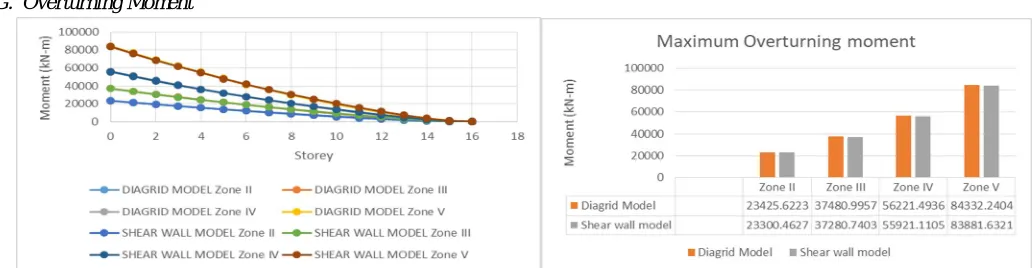
G. Overturning Moment
Fig. 9 Storey v/s overturning moment curve for all seismic zones Fig. 10 Maximum overturning moment data of all seismic zones
[image:5.612.44.562.545.679.2]V. CONCLUSIONS
In this work, comparative study on the seismic behavior of diagrid structure and shear wall structure are carried out. Plan of 24m x 24m dimension is considered for both the type of structures. Sizes of core columns and interior structural beams of both the structures are kept same. Core columns and interior structural beam sizes are selected in such a way that, the sections are economical and adequate to carry the loads considered. ETABS 2015 is used for the modelling and analysis of the structures. Response spectrum analysis is considered for the study. The conclusions made from the study are:
A. Storey displacement is 28.73% less in diagrid building as compared to shear wall building. Hence diagrids structure is more
efficient in reducing lateral displacements.
B. Maximum Storey drift is reduced by 31.31% in the diagrid structure.
C. Storey shear is maximum at the base in shear wall structure as the weight of the shear wall building is high as compared to
diagrid structure. Maximum storey shear reduces by 5.10% in diagrid building.
D. Overturning moment is maximum at the bottom storey. There is no much variation in overturning moments in both the type of
structure. There is only 0.53% reduction in the overturning moments in diagrid structure.
E. Stiffness is more at bottom storey and less at top storey. Stiffness is higher in shear wall buildings since the mass of the shear
wall structure is more as compared to diagrid building. Stiffness increased by 50.58% in shear wall building.
F. Since the mass and displacements are more in shear wall building, natural time period is more. In first and second modes, time
period increased by 27.59% in shear wall structure and in third mode, time period increased by 119.42% in shear wall building.
G. Acceleration is inversely proportional to the time period. Hence the acceleration is more in diagrid building as compared to
shear wall building. The acceleration in shear wall structure is 6.25% less than diagrid structure.
H. Diagrids and shear walls performs almost similar in terms of overturning moments.
I. Shear wall increases the stiffness of the building hence the acceleration of the building is reduced. Time period is more in shear
wall building. Hence shear wall structures can withstand the seismic vibrations effectively.
J. As far as the displacements are concerned, diagrids performs well as a lateral load resisting system where as the seismic
vibrations are considered, shear wall performs better in reducing the acceleration of building.
REFERENCES
[1] Nishith B. Panchal1, Vinubhai R. Patel2, “Diagrid structural system: strategies to reduce lateral forces on high-rise buildings”, International Journal of Research in Engineering and Technology volume 3, Issue 04, April 2014.
[2] Arpitha L M1, Sahana T S2, Siddu Karthik C S 3, “Comparative Study of Diagrid Structures over Braced tube Structures”, International Journal of Innovative Research in Science, Engineering and Technology volume 5, Issue 7, July 2016.
[3] Manthan I. Shah1, Snehal V. Mevada2, Vishal B. Patel3, “Comparative Study of Diagrid Structures with Conventional Frame Structures”, International Journal of Engineering Research and Applications volume 6, Issue 5, May 2016.
[4] Mr. Avnish KumarRai1, Dr. Rajeev Arya2, Smt. Rashmi Sakalle3, “Cost analysis and comparison of a composite diagrid frame with bare frame under dynamic loading”, International Research Journal of Engineering and Technology (IRJET) volume 4, Issue 12, Drecember 2017.
[5] Vivek Suwalka1, Mr. Nandeshwar Laata2, Dr. Bharat Nagar3, “Comparative Study and Modeling of Framed Structure with Shear Wall & without Shear Wall by using Etabs”, International Research Journal of Engineering and Technology (IRJET) volume 5, Issue 9, September 2018.
[6] Mahdi hosseini1 , prof.n.v.ramana rao1, “dynamic analysis of high rise structures Under different type of reinforced concrete Shear wall for an earthquake resistant Building” IJIRAE- International Journal of Innovative Research in Advanced Engineering, Issue 22 January 2017.
[7] IS 456(2000): Plain and Reinforced Concrete – Code of Practice. [8] IS 800(2007): Code of Practice for General Construction in Steel.
![Fig. 1 3D models of [i] diagrid building [ii] shear wall building](https://thumb-us.123doks.com/thumbv2/123dok_us/1239511.649820/3.612.132.485.89.294/fig-d-models-diagrid-building-shear-wall-building.webp)