Abstract- identikit is a graphical representation of the face formed on the basis of the description of a witness who has provided information based on his or her memory. In the past, such identikits were produced by professional cartoonists. Since a draftsman is not always available, new ways have been created, such as creating an identikit that uses templates with different parts of the face. This results in a composition of a complete face. This method is only slightly effective. This is mainly because many people have a good memory for faces, but can not describe them. Genetic algorithms offer the possibility to significantly improve the whole process. The use of genetic algorithms with a witness works directly with the full face and not only with its individual features. Faces are made through generations and evolve, and each generation becomes increasingly more similar to the sought after real life face. In this way, the witness may not give a description of the face, just to know the face when one sees it.
Index Terms— genetic algorithm, fitness, identikit, witness
I. INTRODUCTION
The identification of a person may be made using a number of methods. These methods can be divided into two groups: artificial and natural.
The artificial methods, which are used by our own civilization, are created by the use of name, identity card, number and so on.
The natural processes are those related to the physical form of man, such as height, voice, eye and hair colour, figure and face.
Identification of one’s face is one of the most basic ways to identify a person. The classic method of identikit is in principle simple: to provide a witness to describe the shape and a draftsman to draft a face accordingly. This method is considered by many to be the best way to create an identikit, although it is not as easy as it seems at first sight, the result depends primarily on the witness and the artist. Given that a draftsman may not always be available, new methods have been developed. These methods use templates of facial features such as eyes, nose, and the like. The chosen templates are placed in layers on top of each other in order to create the entire face. .
Manuscript received July 02, 2012; revised July 28, 2012.
Milan Kováč, Slovak University of Technology, Faculty of Material Science and Technology in Trnava, Paulínska 16, 917 24 Trnava, Slovak republic (e-mail: [email protected])
Peter Schreiber, Slovak University of Technology, Faculty of Material Science and Technology in Trnava, Paulínska 16, 917 24 Trnava, Slovak republic (e-mail: [email protected])
Oliver Moravčík, Slovak University of Technology, Faculty of Material Science and Technology in Trnava, Paulínska 16, 917 24 Trnava, Slovak republic (e-mail: [email protected])
Today, in the digital era, the same principle is used, only paper and film have been replaced by screens.
This method is less effective, its success varies below ten percent. The main problem is the people themselves. The human mind has evolved so well that it can recognize faces of other people. Overall, most people have a good memory for faces, a face can be remembered quite well, but one may not be unable to provide its description. There are several studies dealing with the ability to perceive the human face. If working as a whole, we can say that the brain is used to perceive the face as a whole. The perception of the individual parts of a face such as the eyes or mouth, although perceived by the brain, a link is not created between them, so if one is forced to work with the different parts separately this can be a real problem for the individual. A very important factor is the psychology, perception of the witness, stress, his/her emotional condition and the like. These factors must be taken into account. Everyone sees and remembers things differently. Therefore, it is not unusual to get ten different descriptions from ten people; many of them may also be inaccurate. [1] The use of genetic algorithms could stop a lot of these problems. The main benefit of using genetic algorithms is that the witness does not work with individual features, but will be shown a complete finished face. There is no fishing around in one’s mind thinking of how to describe the nose, just a view of a face that can then be compared with that in the mind, which remembers and chooses the most similar match.
II. FACIAL FREATURES
When creating a face with identikit, the face is put together from several features. There are different ways of producing the face, in principle they are all the same. It is based on a database that stores the individual features that are used for the resulting face. . Perhaps the best known method is the classic film method, as this has been shown in the media. The films are assigned to different parts of the face and the resulting gradual overlap that occurs gives the creation of a full face. A variation of this is the film strip; here the face is cut up into several horizontal strips. . With the development of computers and the emergence of new technologies, various programs have been designed for this purpose; these are still only different variations which are based on the same principle. The program offers a variety of databases regarding the face thus resulting in a drawn face. The idea is that the witness’s choice is limited by the offered possibilities that he/she can choose from. When creating identikit some basic facts must be taken in account:
Using Genetic Algorithms for Identikit Creation
1. First one sees the face as a whole rather than a composition of several parts. If one is forced to focus on individual parts and to compose a final shape to the jigsaw "puzzle" - without having the whole unit in the background, the result can considerably vary from reality, in some cases it may not even be possible to compile.
2. Too many options may overwhelm the witness, who may become lost in it. Therefore, the witness should gradually compose the face.
3. The longer one waits to build an identikit, the outcome is usually worse. Therefore it does not make sense to make an identikit after a week. The identikit should be ready within at least two days, ideally within a few hours after the event.
4. The result will never be perfect. The witness could have seen the perpetrator under different angles, bad lighting, or could be frightened or under stress.
The use of graphics depends on the final show, but some things can be less beneficial. For example, research has shown that colour plays a rather negative role in the reconstruction of the face, because of its subjective perception. In addition, the creation of such an identikit is
much more difficult. .
A witness may get embarrassed if too many little details are used. The creation of an identikit from the point of view of a witness should be as simple as possible and at the same time the result should capture the main features of the face without diverting the attention of the witnesses to less important details. Of course, the perfect identikit does not exist but it should be sufficiently accurate for the identification of the person and thus it completes its functions.
For these reasons, only black ink with the basic features of: moustache, facial hair, head, jaw, eyes, nose, mouth, hair and eyebrows is used. These make it possible to capture the main anatomical features of the face, while the attention of the witness does not go to the less important details. [2] Facial features are stored as images in the database. The following features are put together and complete faces are shown to the witness. The database is divided into several parts. In one part eyes are placed, in another part the mouth and the like. In each part there are features that are ranked according to similarity, and each is assigned a number. The database is stored externally outside the main application, so any possible changes such as adding new features or changes to the entire database is simple.
Fig.1. Separate facial features and a finished constructed face
Before creating the first generation it is possible to choose from several options. For example, you can choose whether to have generated facial hair or not. In the case when looking for a bald man, it is quite unnecessary to have to generate facial hair, because it would only delay a good result.
If this option is selected, the gene responsible for hair will be assigned a zero value and the generated faces will be without hair. The same option can also be applied for a moustache and beard. If these options are not specified, the generated face may or may not have these features; it will depend purely on chance. . There is also the possibility of setting the lines. You can choose from three levels. Overall, the lines do not affect the anatomical features of the face, but may be useful for certain witnesses. Wrinkles can be turned off. If all these options are selected, the first generation can be generated. It meets the criteria selected, otherwise it is purely coincidental.
III. PROCEDURE OF IDENTIKIT CREATION The principle of using genetic algorithms is that when creating identikit we use a genetic algorithm for the generation of faces and these are offered to the witness. The classic way if there is not a draftsman available, the witness will view individual features and will try to put them together to create a face similar to that of which he remembers. In his mind he must he must break down the face into individual parts. When there is a draftsman, the witness describes what he remembers of the face and in doing so the witness can use one’s own vocabulary. The witness must only choose the right face, it is not necessary to describe it in a complicated way. In this way, there is the possibility to choose and compare them with the face he remembers, thus passing the need to describe the face in mind. A problem is when the witness is able to remember the right face, but is unable to give its description. In this case the witness will only have to look at different options and choose the one that is correct. Many options should not be available at the same time otherwise the original face in mind may be lost. [3]
After generating the first generation the next step depends on the witness. The witness must now look at the faces and choose the one which is in his opinion the most likely. When one is selected it is noted. The face is then taken as the best fit (elite) that is currently the best solution. Subsequently, all faces are compared with this face. When done, crossover and mutation are applied and a new generation is created.
the witness can not see the face, which he will be satisfied with.
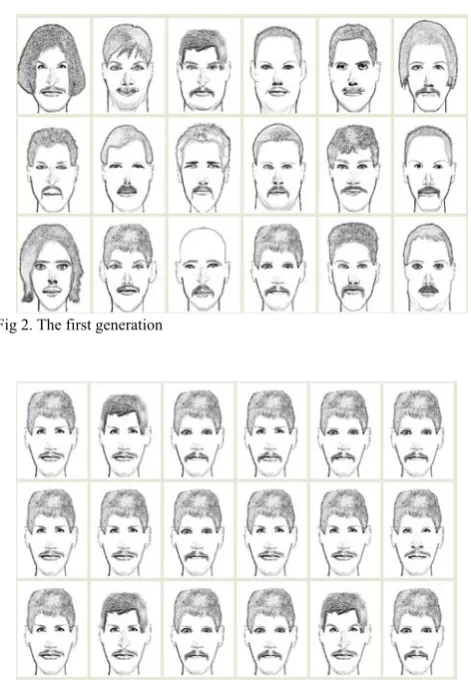
[image:3.595.312.546.423.530.2]Fig 2. The first generation
Fig 3. After several generations
IV. USE OF GENETIC ALGORITHMS
Genetic algorithms are quite complex, offering many opportunities as they adjust and adapt to a particular problem. A simple genetic algorithm was used with one-point crossing and roulette as the selective mechanisms. The basis is the initial population which consists of individuals, in this case, the individual’s face. Each individual is composed of genes, which in this case are facial features. . Crossing and mutating creates a new generation of faces that are more similar than the real face of the previous generation.
Each generation consists of several faces, their number should be enough to offer enough variety, but there should not be too many in order to avoid confusion. It is necessary to kept in mind the picture of the actual face. Therefore, the number of individuals is limited to eighteen faces. This number provides sufficient diversity of features and at the same time there are not many that could not be easily and simultaneously viewed. [4] Often it is difficult to determine in advance which features are useful. Therefore, by testing, it is necessary to determine
which properties have proved effective in creating identikit. .
Identikit should always be based on the witness’s view. Using genetic algorithms, the witness does not describe the face in a true sense, but is still a key point. By viewing the
generated faces one is chosen as that of the best match. When using genetic algorithms there is a condition that one needs know to evaluate the outcome, so we know what we are looking for, but during the creation of the identikit one can not determine in advance which would be the best result and how many generations will be needed. Therefore, when creating an identikit the use of the so-called interactive genetic algorithm is needed. When choosing from each generation the best individual of the population is taken. The choice is up to the user, in this case the witness. [5]
When one generates a population, the witness selects the best face of a generation that is subsequently identified as the best match. This depends on the completion by the witness; the process takes place while the witness is not satisfied with the outcome.
A. Tool for selection
Roulette was originally used as a tool for selecting. This method has proved unsuitable because large differences emerged in the evaluation of individuals, especially during the first generations, which resulted in the elite face being at an advantage when compared to the worst faces that did not participate in crossing, which leads to reducing the diversity in the population. The method of choice depended on the order was chosen to solve this problem. In this method individuals from the population are ranked according to the
evaluation and ranking is used when selecting. [6]
Fig.4. Choice by: a) the order b) the value of fitness
Figure 4 shows the comparison of probability of the selection according to the order and according to fitness values; the difference is visible at first sight. With the help of this method there is a possibility that i-th individual will be selected in terms of quality, shown in equation (1)
1)
+
N(N
i)
-1
+
(N
2
i)
-1
+
(N
1
N
j i
j
p
(1)- Where N is the size of the population
- i is the order of the individual according to fitness, }
,..., 1
{ N
B. Elite
It is not required to lose the best result therefore the elite is used. The best face from the generation automatically goes to the next generation without changes. There is no threat that the best result so far will be lost. All other faces are new. With the help of roulette, there is always a choice of two faces which are crossing and these become the new. The best face is taken and seventeen new faces are created.
C. Crossing
As a way of crossing the two-point crossover was chosen. The advantage of two-point is that the search space can be searched more thoroughly. It is generally considered better than a single-point crossover, which was confirmed in this case. Facial features are also more mixed, which is also confirmed. The two-point crossover is also more likely to be maintained in a more integrated form of parental features, while a uniform crossover would be a rather disruptive influence.
The choice of two places in the chromosome which determines the places of the mixing of genes is random. When using one-point crossing the situation should appear or could happen, in which a parent has good genes at the beginning and at the end of the chromosome and therefore the descendant can not have two parts. Two-point crossing prevents this. [7]
D. Fitness
It is not known in advance how the solution will look like, it is necessary to use an interactive genetic algorithm. This means that in every generation the witness selects one face that is in his opinion the best, that is, the most similar shape to which it remembers. The face is marked as elite and all the other faces are compared with it. A fitness calculation takes place using the formula (2).
ni
i
i
b
a
f
1
(2)
- bi are the genes of the elite
- ai genes of compared face
- n is the number of genes in the chromosome
Each facial feature that is stored in the database is assigned a number. The database features are rated according to similarity, so two similar chins are closer to each other and have similar numbers, for example, twelve and fourteen, while some will be completely different and may have the number thirty. The face consists of several features, so the chromosome is composed of face numbers. The first gene of the elite is compared with the first gene of the second face and the difference is remembered. Thus, if the first gene of the elite has the number twelve and the gene of the second face is number seven, the difference is five. Subsequently, the second gene will be compared and so on. The differences are summed and this value is the fitness value for the face. When fitness is calculated for each face in the generations, all the faces are sorted by fitness values from
best to worst. When ranking we have to keep in mind that the smaller the fitness value is the smaller the difference between the face and the elite. [8] Mutation itself may be useful because a change in a bad face may improve it or a new feature, not present till now, can be added.
V. CREATIONOFIDENTIKIT
When creating the identikit using a genetic algorithm, it is constructed based on the first generation, so it is advantageous if the first generation has the basic features of the sought after face. When looking at a face without a beard, then it is useless to have the beard on the generated faces, otherwise it would be useless for a good result.
Fig.5 Randomly generated faces
There is the opportunity to choose whether the faces have generated facial whiskers, beard and hair, or to be without them. These options were chosen because they are universal and everyone understands them. The choice of such a possibility, such as short or long hair, is subjective as to what a specific user may mean by "long". Ten centimetres long hair in men may be considered as long by an older person while a rocker on the contrary will consider it as short. These evaluations are subjective and may cause potential confusion for some people. [9] There is also an option for wrinkles: small, medium and large or an option not to use them at all. Wrinkles as such do not capture the importance of anatomical features, but the witness can help better imagine the given face and create the impression of elderly persons, which in some faces, it is useful. After selecting the possibilities the first generation is generated.
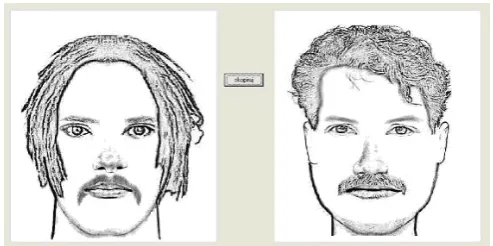
Figure 6 shows the generated first generation. Two options have been chosen, not to use a beard and to be without wrinkles. The next step is to choose the best face from the generation. This should be a witness. Make sure all the faces are seen and then the witness selects one that is most similar to the face that he remembers. If you want to see some face detail, it is possible to open a new window where the selected face is enlarged. This window can also be given a face in order for it to be compared with another face later. In this case it will be stored in the right side of the window. This method is easy to compare any two faces. [10]
Fig 7 Enlarged face, on the right side the face is remembered
[image:5.595.313.561.286.444.2]When a witness identifies one face, which is considered as most similar to the remembered one, the face is taken as the elite.
Fig. 8 Second generation
The second generation is created. The face on the top left is the one that has been identified as elite in the previous generation. Other faces are descendants. Now the whole process is repeated. The witness chooses a face again. Of course, you can always open a second window with the enlargement. If a face has already been stored it will appear on the right side, until now an open face is displayed on the left. In this way, it is easy to compare the two faces and see their differences. [11]
Fig. 9 Comparison of two faces, new and remembered
After a few generations the faces will be similar. There are still differences, but at first glance they look very similar. Due to these small differences it may be important, at this point, we demonstrate the benefits of a genetic algorithm. The process continues until the witness does not keep the face, which he will be satisfied with.
Fig. 10 Similar faces after several generations
In the event that a situation arises in which the faces after many generations are very similar, the witness will still be unsatisfied. In this case there is a possibility for a so-called reset, in which the elite face will be preserved and all other faces will be generated anew. The reached result will be kept and the witness will have new features.
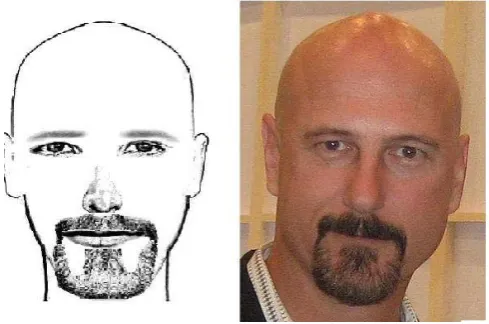
[image:5.595.52.300.432.578.2]Figures 11 and 12 show samples of created identikits of real people. They were created on the basis of memory.
[image:5.595.307.547.590.748.2]Fig. 12 Created identikit no. 2
VI. CONCLUSION
With the use of a genetic algorithm the whole process of the identikit creation will change. It is more effective, provides better results and from the perspective of a witness is even simpler. The witness does not have to divide the face into parts in his mind, and he does not need to think and find words to describe any feature. He just needs to recognize the face when it is seen. During this the witness is still working, always only with the whole shape and not just with individual characteristics, which is better. Of course, there is no perfect identikit, this is always a subjective creation, but if it is good enough to help recognize the person it fulfils its function. . It is good if the first generated generation is most like the sought after face as much as possible, this further improves the process. After generating the first generation the faces evolve until they reach the state when they are very similar to a real face. The process ends when the witness selects the face with which he is most satisfied with.
REFERENCES
[1] K. Taylor, “Forensic Art and Illustration,” Boca Raton, London, New York,Washington D.C.: CRC Press, 2001, ISBN: 978-0-8493-8118-8 [2] C. S. Parks: “Secrets to Drawing Realistic Faces,” F&W Publications
Inc, Ohio/US, 2003, ISBN 13: 9781581802160
[3] M. I. Chacon M. and P. Rivas P., Face Recognition Based on Human Visual Perception Theories and Unsupervised ANN, [Online]. Available:
http://baylor.academia.edu/prp/Books/1006603/Face_Recognition_Ba sed_on_Human_Visual_Perception_Theories
[4] P. Vazan, P. Tanuska, M. Kebisek, “The data mining usage in production system management,” In: World Academy of Science, Engineering and Technology, ISSN 2010-376X, Year 7, Issue 77 (2011), p. 1304-1308
[5] P. Bezak, and M. Iringova, “Optimalization using genetic algorithms,” In: Materials Science and Technology [online]. - ISSN 1335-9053. - Year. 8, vol. 8 (2008) Available:
http://www.mtf.stuba.sk/docs//internetovy_casopis/2008/8/bezak-iringova.pdf
[6] M. Mitchell, “An Introduction to Genetic Algorithms,” MIT press, 1996, ISBN: 0262631857
[7] J. Hynek, “Genetic algorithms and genetic programming,” Praha: GRADA, 2008, ISBN: 978-80-247-2695-3
[8] J.E. Baker, “Adaptive Selection Methods for Genetic Algorithms,” In: Grefenstette, J.J. (ed.). Proceedings of the First International Conference on genetic Algorithms and Their Applications. Hillsdale, NJ: Lawrence Erlbaum, 1987, p. 14-21
[9] P. Zavacky, M. Stremy, “Genetic algorithms in combined discrete dynamic systems,” In: International Doctoral Seminar 2010:
Proceeding. Smolenice, 16-19 May 2010, Trnava: AlumniPress, 2010, ISBN 978-80-8096-118-3, p. 547-553
[10] M. Kopcek, D. Mudroncik,: Using GA and Computation parallelism for the Optimal Pilot Bus Selection, In: Lecture Notes in Electrical Engineering. - ISSN 1876-1100. - Vol. 122. Advances in Automation and Robotics, Vol. 1: International Conference on Automation and Robotics, ICAR 2011, Dubai, 1 December 2011 through 2 December 2011 (2011). - ISBN 978-3-642-25552-6, s. 323-328