Effect of Staircase on a Structure Subjected to
Seismic Forces
Dr. A.R. Gupta
1, Miss. Priya R. Mundada
21, 2Department of Civil Engineering, COET, Akola, SGB Amravati University.
Abstract: Staircase is the part of secondary system of the structures and is one of the essential part because of its functional importance. Members of staircase contribute to the stiffness of the building having high seismic demandand can lead to a premature brittle failure. Hence, the effect of staircase in analysis and design of RC frame buildings cannot be ignored. The objective of this paper is to study the effect of seismic forces on the structural member of staircase and to show that seismic design of buildings claims special requirements on the design of staircase so as to make sure that staircases work as safe passage in strong earthquake.
Keywords: Staircase, Seismic analysis, Structural members.
I. INTRODUCTION
A. Aim
To study the effect of seismic forces on the structural member of staircase.
B. Objective
1) To study the effect of seismic forces on the structural member of the staircase.
2) To study the distribution of loads and its effect on staircase.
3) To study the seismic behavior of structural members subjected to staircase loading.
C. Need
An earthquake is a spontaneous event and behaves quite differently. The force generated by the seismic action of an earthquake is different than other types of loads, such as gravity and wind loads. It strikes the weakest spot in the whole three dimensional building. Ignorance in design and poor quality of construction results many weaknesses in the structure, thus causes serious damage to life and property. Staircase is the part of secondary system of the structures and it is one of the essential part of building because of its functional importance. From geometrical point of view, a stair is composed by inclined elements (beams and slabs) and by short (squat) columns.
These elements contribute to the stiffness of the building. For these reasons the elements that constitute the stair often have a high seismic demand.
The short columns are subjected to high shear force that can lead to a premature brittle failure .The inclined beams are subjected by high variation in axial force that can modify the resistance and deformability of all these elements. Due to complex modelling of staircase, it is designed separately for non-seismic and seismic forces. The effect of staircase on the RC frame structure includes discontinuity in the modelling, variation in failure of allied structural elements, contribution in non-linear performance of buildings, modification in various seismic parameters such as reduction in time period and storey drift of the building. Hence it can be concluded that the effect of staircase in analysis and design of RC frame buildings cannot be ignored.
The relative displacement of the stair’s ends which are on different floors, causes a considerable distress and must be taken into account in the design stage of the structure. Furthermore, the interaction between the staircases and the other parts of the three dimensional structure (space structure), i.e., the interaction with the beams, columns and shear walls, result to patterns of deformation should be studied during the design process.
II. LITERATURE REVIEW
Pratik Deshmukhet. al.presents the effects of staircase on the seismic performance of the RCC frame buildings of different heights and different plans have been studied. Generally, the stair model is not included in the analysis of RC frame buildings. Due to the rigidity of inclined slab and of short columns around staircase, beams and columns are often characterized by a high seismic demand. The identification of the weakest elements of the structure, the failure type considering the presence of the stairs, and their contribution in the nonlinear performance of RC frame buildings are some of the areas on which the present paper has presented. For analysis and design, Etab v.9 has been used. Performances of both categories of the buildings have been evaluated through Response Spectrum Method.
Ankit R. Shelotkaret. al. presents the effect of staircase position on RC frame structures has been carried out by adopting various
building models with and without staircase in longitudinal and transverse direction. The Linear Response Spectrum analysis of the models has been carried out as per IS: 1893 (Part 1) - 2002 and IS: 456 – 2000 with the help of Etab 2015 software. The Seismic characteristics in terms of Time period, Story Drift and Story Displacement have been compared with the seismic characteristics of models with and without a staircase. Further, the effect of change in location of the staircase on the behavior of the building has also been observed. In addition to these, short column effect, variation in moments of beams and columns that are attached to staircase slab, failure and deformation in staircase models have also been studied.
Zhang Wang-Jil et al results shows that existence of stair greatly affects the lateral stiffness of frame, dynamic performance, the
peak of internal force and node response spectrum under different earthquake compactable to Chinese code.
Cheng, Y et alpublish in their paper that by decoupling the stiffness of the stair, the stair stiffness contributions at each node were reported. It was observed from their study that stair can change the order of the mode and the weakness direction of the structure. Jiao Ke et al reported that for frame structures, corner column in staircase, staircase beams, staircase column and the slab of the staircase are yielded first and damage indicating the weakest point in the structure.
Qiwang Sureported in his paper that staircase arrangement can affect the torsional mode of the structure which can make the torsional mode to be the first mode of vibration and concluded from their study that shear failure becomes dominant in the squat column and slabs and precedes the conventional ductile failure.
J Lavadoet al suggested that under seismic loading, the effect of staircase can be very important in structures, constituted by frames. Study on a three and six storied building with and without staircase has been carried out. Results show development of local rigidity effect, generating a “shear wall effect” in columns surrounding the stairwell, hence increasing axial stresses in surrounding column and beams also, effecting strength and ductility demands which are not taken into account if the stair slabs are not introduced into the structure.
E Cosenza et alinvestigated seismic performance of existing moment resisting RC frame building and suggested that the stair
increases structural strength and stiffness of the structure resulting into reduction of fundamental time period, also, attracting seismic forces that could fail intoshort columns due to high shear forces.
J J Zhu et aldiscussed the active and hazard impacts of staircase on structures under earthquake. Comparison of overall properties, pushover performances, seismic response and internal force of elements are summarized and discussed between two models, with and without staircase and gave suggestions on designing process and also given shows that existence of stair greatly affects the lateral stiffness of frame, dynamic performance, the peak of internal force and node response spectrum under different earthquake. C Bellidoaet. al.
In this paper Author presents an assessment of the performance of pressurized staircases in six high rise buildings. All systems have been designed using a similar methodology but implemented in different ways. In all cases the control mechanism for the fan is a direct feedback loop from a single pressure sensor. The results have been evaluated showing the limitations of the control system in the event of multiple doors being opened and the limitations of the pressure release dampers (as a response mechanism) if the pressure becomes unstable.
III. DETAIL STUDY
A. Structural Classification of Staircase
Staircase is the part of secondary system of the building and constitutes a very important part of a structure, both architecturally as well as structurally. Regarding their structural configuration stairs are classified in one of the following categories:
1) Stairs spanning transversely and
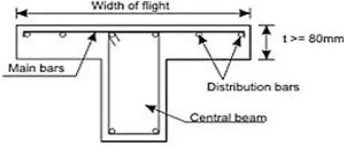
a) Stairs Spanning Transversely(Transverse To The Direction Of Movement): Transversely supported stairs include waist slabs or the slab components of isolated tread- slab and trade-riser units and are supported on their sides or are cantilever along the width direction from a central beam. The slabs thus bend in a transverse vertical plane.
The following are the different arrangements:
i) Simply supported steps supported by two walls or beams or a combination of both or slab supported between two stringer
beams or wall.
ii) Steps cantilevering from a wall or a beam or cantilever slabs from a spandreal beam or wall.
[image:3.595.158.434.217.301.2]iii) Stairs cantilevering from a central spine beam or doubly cantilever slabs from a central beam.
[image:3.595.227.399.338.411.2]Fig. 3.1: Slabs supported between two stringer beams or walls.
Fig. 3.2: Doubly cantilever slab from a central beam.
b) Stairs Spanning Longitudinally (In The Direction Of Movement): These stairs span between supports at the top and bottom of a flight and unsupported at the sides. Longitudinally supported stairs may be supported in any of the following manners:
i) Beams or walls at the outside edges of the landings.
ii) Internal beams at the ends of the flight in addition to beams or walls at the outside edges of the landings.
iii) Landings which are supported by beams or walls running in the longitudinal direction.
iv) A combination of (a) or (b), and (c).
v) Stairs with quarter landings associated with open-well stairs.
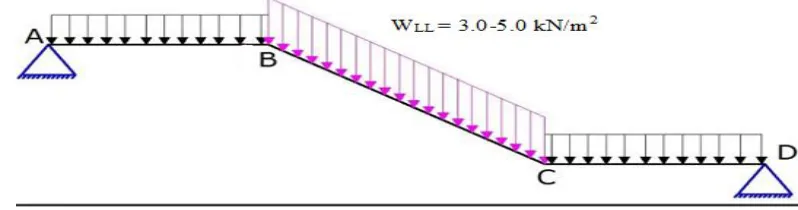
3) Design Procedure of Longitudinally Supported Staircase: This type of stairs is designed as one-way slab supported at the top and bottom of the flight, while the steps themselves are treated as non-structural elements. Figure shows a half-turn longitudinally supported stairs.
[image:3.595.191.427.576.733.2]4) Deflection Requirement: Since a flight of stairs is stiffer than a slab of thickness equal to the waist t, minimum required slab depth is reduced by 15 %.
5) Effective Span: The effective span is taken as the horizontal distance between centre lines of supporting elements. 6) Loading
a) Dead Load: The dead load, which can be calculated on horizontal plan, includes:
i) Own weight of the steps.
ii) Own weight of the slab.
iii) Surface finishes on the flight and on the landings.
b) Live Load: Live load is always given on horizontal projection.
[image:4.595.156.463.270.457.2]7) Design for Shear and Flexure: The stairs slab is designed for maximum shear and flexure. Main reinforcement runs in the longitudinal direction, while shrinkage reinforcement runs in the transverse direction. Special attention has to be paid to reinforcement detail at the opening and closing joints.
Fig 3.4: Opening and closing joints.
B. Distribution of Loads and its Effect on Staircase
Stair slabs are usually designed to resist gravity loads, comprising of dead loads and live loads as described below: 1) Dead Load: The components of the dead load to be considered are:
a) Self-weight of stair slab (tread/tread-riser slab/waist slab);
b) Self-weight of step in case of 'waist slab' type stairs;
c) Self-weight of tread finish (usually 0.5 - 1.0 kN/m2)
The unit weight of reinforced concrete for the slab and step may be taken as 25 kN/m3 as specified in IS 456:2000 (Cl. 19.2.1).
2) Live Load: Live loads are generally assumed to act as uniformly distributed loads on the horizontal projection of the flight. The
loading code [IS 875: 1987 (Part II)) recommends a uniformly distributed load of 3.0-5.0 kN/m2 in general, on the going, as
well as on landing. However, in buildings (such as residences) the specified live load do not exceed 3.0 kN/m2, and for the
staircases that are not liable to be overcrowded, the loading code recommends a lower live load of 3.5-5.0 kN/m2.
[image:4.595.85.484.620.725.2]Further, in the case of structurally independent cantilever steps, the loading code requires the tread slab to be capable of safely resisting a concentrated live load of 1.3 kN applied to the free end of each cantilevered tread.
Fig. 3.6: Live load distribution on cantilever steps.
It may be noted that the specified live loads are characteristic loads; these loads as well as the characteristic dead loads should be multiplied by the appropriate load factors in order to provide the factored load.
3) Distribution of Load in Special Case
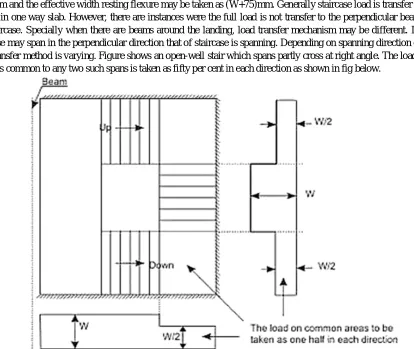
a) IS 456:2000 (Cl. 33.2) specifies the following: When a staircase takes a right-angled turn, fifty percent of the load on the areas (usually landings) common to the two flights (at right angles) may be assumed to act in each direction. When a longitudinally spanning flight (or landing) is embedded at least 110 mm into a side wall, then some marginal 'two-way' action can be expected. In such cases, the longitudinally acting component of the gravity load can be assumed to act on a reduced width of flight; a reduction of 150 mm is permitted. Furthermore, the effective width of the section can be increased by 75 mm for the purpose of design. In other words, if the width of the flight be W (in mm) then the load may be assumed to act over a reduced width (W-150) mm and the effective width resting flexure may be taken as (W+75)mm. Generally staircase load is transfer to the beam as it does in one way slab. However, there are instances were the full load is not transfer to the perpendicular beam that support the staircase. Specially when there are beams around the landing, load transfer mechanism may be different. Landing of the staircase may span in the perpendicular direction that of staircase is spanning. Depending on spanning direction of the landing, load transfer method is varying. Figure shows an open-well stair which spans partly cross at right angle. The load in such stairs on areas common to any two such spans is taken as fifty per cent in each direction as shown in fig below.
Fig 3.8: Loading on staircase built into wall.
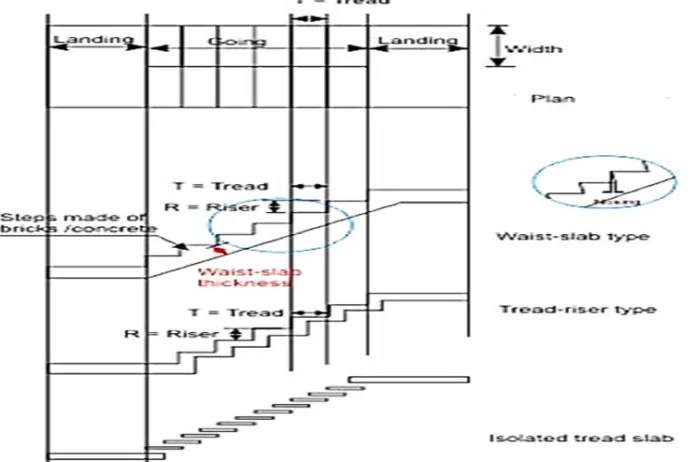
4) Effect of Loads in Waist Slabs: In the 'waist slab' type staircase, the longitudinal axis of the flight is inclined to the horizontal and the steps form a series of triangles on top of the waist slab. The steps' are usually treated as non-structural elements and it is the waist slab which is designed to resist the load effects on the stairs. Some nominal reinforcement is provided in the step (if made in concrete) – mainly to protect the nosing from cracking. The vertical acting gravity loads w may be resolved into two
orthogonal components. The component w, = w cosө acts normal to the waist slab and the component w, = w sinө acts
tangential to the waist slab. The manner in which these load components are resisted by the waist slab depends on whether the slab spans transversely or longitudinally. In waist slab spanning transversely, the normal load component w, causes the waist slab to bend in transverse planes normal to the sloping surface of the slab. The loading direction, cross sectional dimensions, neutral axis position, compression zone, main reinforcement and effective depth for a design strip of slab corresponding to one tread and the closed loop arrangement enhances both shear and the axial force resisting capacity as well as ductility of slabs the diameter or and spacing of the main bars in the tread riser unit may be suitably varied along the span in order to achieve an economical design.
5) Effect of Loads in Isolated Tread Slabs: Isolated tread slabs are invariably associated with stair slabs spanning transversely. The tread slabs are structurally independent and are designed as simple one-way slabs. If the tread slab is simply supported, the thickness required is generally minimum (for stair widths less than 2 m) having slab thickness of 150 mm, with minimum
reinforcement comprising of 12 mm ϕ bars with a nominal spacing of 150 mm. The distribution bars may be of 10 mm ϕ, with a
nominal spacing of 200 mm. In the case of cantilevered tread slabs, the slab thickness may be taken as at least one-tenth of the effective cantilever span.
[image:6.595.113.458.486.717.2]C. Effect of Seismic Forces on the Structural Members of Staircase
1) Effect On The Supporting Columns And Beams: When a RC frame building is subjected to seismic loading it is observed that there is a significant amount of reduction in time period of structure due to staircases. They provide extra stiffness to withstand lateral loads. This effect is more profound when there are number of staircases present in the building. Dog-legged staircase shows more stiffness to the lateral deformation of structure by acting as K-type braces in the stair well. However, in addition to that, these staircases in buildings also cause the secondary effect of formation of short columns at intermediate landing by dividing supporting columns into two parts. This results into the enhanced shear demand in the short columns. There is also increase in the axial load in these columns due to increased rigidity in the particular bay. Thus, shear force and axial force together can cause brittle failure of these columns. In general the presence of a stair creates a discontinuity in a reinforced concrete frame made of beams and columns. The short columns are subjected to high shear force that can lead to a premature brittle failure .The inclined beams are subjected by high variation in axial force that can modify the resistance and deformability of all these elements.
2) Effect On The Frame Columns Connecting To Staircases: The frame columns connecting to staircases are classified into two types, one connected to the landing slab at its upper end, such as the column at axis, the other intersected by the landing slab. For the former type of columns, when the effect of staircases is considered, the moment and shear force at the bottom of the column is slightly larger while the axial force is increased by 45%. For the latter type of columns, the shear-span ratio is decreased due to the intersection with the landing slab. The staircase makes the columns more critical and vulnerable to earthquakes.
3) Effect On The Waist Slab And Landing Slab: In engineering practice, the top reinforcement in the staircase slab is usually cut off at the section l/3 to 1/4 of the total span away from the end. If the effect of the staircase is considered, it is found that the stress in the concrete at the section of staircase slab 1/4 of the span away from the end exceeds the tensile strength of concrete. The reinforcement assumes most of the tensile forces under seismic actions due to the low tensile strength of concrete. After the cracking of the concrete, the tensile force at the section will be borne only by the steel bars so that they will yield easily. Due to the alternate pulling and pushing of the staircase slab acting as a truss, the landing slab connected to it is in a complex stress state, partially tensile and partially compressed, and therefore is easy to be destroyed in earthquakes.
4) Effect On The Landing Beam And Staircase Column: The landing beam acts as the horizontal brace and directly transmits the forces from staircase slabs when the space action of staircase is considered. Its stress state is complex under repeated pulling and pushing of the staircase slabs. Its axial force is also obviously increased under earthquakes. The axial forces which are parallel to the staircase slab are changed considerably due to the direct transmission of the seismic effect of the staircase slab under earthquakes. The axial force is increased to five times the effect of the vertical load alone. The junction of the staircase column and the landing slab is also easy to be damaged under earthquakes. It is founded that the internal forces in the staircase columns are increased significantly under earthquakes compared with the internal forces caused by the vertical loads alone. Effect of position of staircase in the building In addition to the shear column effect, the position of staircase in building also affects its seismic performance when subjected to lateral loads. This is due to development of torsional moments caused by stiffness irregularity in the plan, when these secondary structural are not provided symmetrically to the plan. Thus increasing torsional demand of the structuralelements and there is change in the fundamental mode of the structure, from shear or flexure mode to torsional mode. Hence, structural members adjoining to the stairwell may be subjected to torsional failure due to formation of high torsional moments in the structure.
staircase models and comparison of effects of infill panels should be taken into consideration. In general the presence of a stair creates a discontinuity in a reinforced concrete frame made of beams and columns. To make sure that staircases work as safe passage in strong earthquake, the study for seismic design of buildings claims special requirements on the design of staircase.
IV. CONCLUSION
From the above study, it can be concluded that the effect of staircase in analysis and design of RC frame buildings cannot be ignored. The relative displacement of the stair’s ends which are on different floors, causes a considerable distress and must be taken into account in the design stage of the structure. Furthermore, the interaction between the staircases and the other parts of the three dimensional structure (space structure), i.e., the interaction with the beams, columns and shear walls, result to patterns of deformation should be studied during the design process. The effect of changing position of staircase in the building should also be taken into consideration. In addition to these, short column effect, variation in moments of beams and columns that are attached to staircase slab, failure and deformation in staircase models and comparison of effects of infill panels should be taken into consideration. In general the presence of a stair creates a discontinuity in a reinforced concrete frame made of beams and columns. To make sure that staircases work as safe passage in strong earthquake, the study for seismic design of buildings claims special requirements on the design of staircase.
V. ACKNOWLEDGEMENT
It gives me an immense pleasure and pride to express my deep sense of gratitude & respect for my Co-Guide Dr. A R. Gupta, College of Engineering and Technology, Akola for his evergreen expertise and inspiring guidance during the period of my entire course, which has enlightened me on the finer skills of dealing with synthetic problems.
I would like to express my sincere thanks to Prof. R M. Phuke, HOD, Department of Civil Engineering and all Staff members of department for encouragement and helping me during my project work. We wish to express our warm and sincere thanks to Dr. S. K. Deshmukh, Principal, College of Engineering and Technology, Akola for making all the facilities available in college.
REFERENCES
[1] Pratik Deshmukh, M. A. Banarase, "Effects of staircase on the seismic performance of rcc frame buildings", International Journal of Advance Engineering and Research Development, Volume 4, Issue 4, April -2017.
[2] Ankit R. Shelotkar, Mayur A. Banarase, "Effect Of Staircase On Seismic Performance Of Multistoried Frame Structure", International Journal of Innovative and Emerging Research in Engineering Volume 3, Special Issue 1, ICSTSD 2016.
[3] Zhang, P.C. and Yuan, Q. (2011), “The Seismic Design of Staircase in Frame Structure”, Advanced Material Research, 368-373 (2012), 865-868. [4] Cheng, Y., Du, H., Zhang, S. and Xu, L. (2011), “Seismic Design of R.C. Stairs in Masonry.
[5] Jiao Ke et al “Dynamic Analysis of Multistoried Regular Building” IOSR Journal of Mechanical and Civil Engineering (IOSR-JMCE)e-ISSN: 2278-1684,p-ISSN: 2320-334X, Volume 11, Issue 1 Ver. II (Jan. 2014), PP 37-42.
[6] Qiwang Su (2010), “Finite Element Analysis of Staircase under Earthquake Action”, Advanced Material Research, 163-167 (2011), 2964-2968.
[7] Lavado, J. and Gonzalez, M.L. (2004), “Influence of Stair Slabs in Reinforced Concrete Buildings under Seismic Loads”, Proceedings of the Seventh International Conference on Computational Structures Technology, Stirlingshire, UK, 273.
[8] Cosenza, E., Vederame, G.M., and Zambrano, A. (2008), “Seismic Performance of Stairs in the Existing Reinforced Concrete Building”, 14th WCEE, Beijing, China.
[9] Zhu, J.J., Wang, C.X. and Lee, Y. (2011), “Analysis of impacts of Staircase upon Seismic Responses of Structure”, Applied Mechanics and Materials, 94-96 (2011), 469-475.