STUDIES ON THE PITUITARY
IX. CHANGES IN BLOOD CALCIUM FOLLOWING
INJECTION OF ANTERIOR LOBE EXTRACTS AND
SEXUAL EXCITEMENT IN FEMALE RABBITS
BY LANCELOT HOGBEN AND ENID CHARLES.
(From the Department of Social Biology in the University of London.)
(Received 12th September, 1931.)
I. INTRODUCTION.
IN a previous communication of this series (o it has been shown that removal of the pituitary gland in Amphibia results in retrogression of the ovaries and extensive changes in the calcium and magnesium content of the serum. At all stages after removal a fall of calcium was recorded. The effect of hypophysectomy on the magnesium in the blood was different in observations made upon animals from which the gland had been removed according to the time after operation and there-fore possibly according to the degree of retrogression of the ovaries. These results were obtained after removal of the entire gland or the anterior lobe alone. In-jection of anterior lobe extracts and anterior lobe transplants elicited ovulation in normal animals. To the surprise of the authors it was found that injection of anterior lobe extracts resulted in lowering the blood calcium of Xenopus laevis. Owing to the departure of the authors from Cape Town, where the foregoing experiments were carried out, the observation specified last was not repeated. No reference has hitherto been made to it because it was intended to explore the fruits of investigations on the effects of pituitary removal in the light of certain other observations. These are in particular: (a) those of Mirvish and Bosnian(») who have shown that ovarian extracts prepared by the method of Allen and Doisy injected into rabbits produces a fall of serum calcium; and (b) observations of Watchornb) suggesting significant disturbances in magnesium metabolism corre-lated with menstruation in the human subject.
difference between the calcium content of the sera of the three breeds employed. The ages of the rabbits varied from 11 to 16 months. All rabbits used in these experiments had been segregated previously for at least a month in separate cages to ensure that the ovaries were in a quiescent condition, ix. contained no freshly ruptured follicles or newly formed corpora lutea.
Our own experience has confirmed that of previous investigators who have noted a disturbance of the blood calcium level after bleeding. Successive bleeding was not adopted in these experiments for that reason. All the experiments here recorded involve analysis of the blood of parallel control and experimental groups. The analytical methods have been referred to in the previous communication (O. Spayed females were used in some experiments. In all cases bleeding was not attempted till 6 weeks after removal of the ovaries, so that healing was complete. When the same animals were bled for more than one experiment an interval of at least a week elapsed between two successive experiments. The expenses of this research were borne by a grant from the Trevelyan Fund of the Royal Society.
II. THE INJECTION OF ANTERIOR LOBE EXTRACTS.
Attention was first directed to the effects of injecting anterior lobe extracts upon the serum calcium level of the rabbit. Our observations agreed with the pre-vious unpublished experiments upon Xenopus referred to above. For this purpose it was necessary to employ concoctions injected within a few hours of killing. In the experiments which follow, the extracts were made by grinding the fresh anterior lobes with quartz into a uniform pulp. To this pulp saline was added. After thorough stirring the coarser material was removed by centrifuging. The amount injected into each individual corresponded to the juice exuded from about 4 gm. of fresh anterior lobes. The glands were collected by the authors at the abattoir. The injection occurred within 4J hours of killing. As the glands were collected they were frozen hard and kept in a thermos flask in that condition during the inevitable delay involved in transporting them from the abattoir to the laboratory. We wish to lay particular stress upon the necessity for these precautions. In researches of the senior author extending over a period of ten years it has become abundantly clear that the active materials of the anterior lobe are highly unstable in the condition in which they exist in the gland itself. There can be little doubt that conflicting testimony and much disappointment results from the use of stale glands which have not been collected under strict personal supervision. Mis-understanding would be avoided if investigators explicitly stated the exact time which elapsed between the slaughtering of the animals and the preparation and injection of their extracts.
Studies on the Pituitary
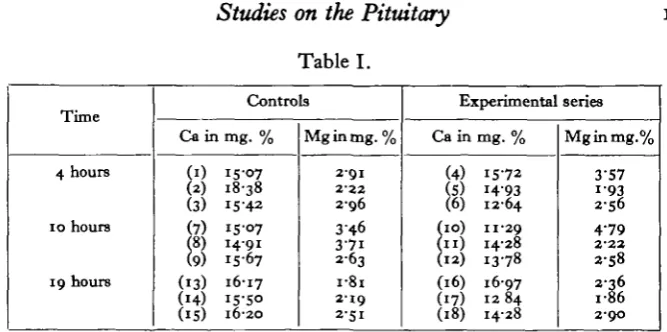
141Table I.
Time
4 hours
10 hours
19 hours
Cain
(1) (2)
(3)
(7) 8
(9)
(13) (14) (15)
Controls
mg. %
1507 18-38 15-42
1507 14-91 15-67
16-17 15-5° 16-20
Mg in mg. %
2 9 1 2-22 2-96
3 4 6
3 7 1 2 6 3
I-8I
2I 9 2-51
Experimental series
Cain
(4)
(5) (6) (10) ( » ) (12)
(16) (17) (18)
mg. %
1572 1493 12-64 11-20 14-28 13-78
16-97 12 84 1428
Mginmg.%
3-57 i-93 2-56
4-79 2-22 2-58
2-36 i-86 2-90
An autopsy made 48 hours after injection on all these animals revealed no ruptured follicles, corpora haemorrhagica or corpora lutea in the rabbits belonging to the control series. Large corpora haemorrhagica were present in both ovaries in all the rabbits injected with pituitary extract except Nos. 5 and 16. The mean values, excluding 5 and 16, on which the extract produced no visible somatic effect are therefore as follows:
Table II.
4 hours 10 hours 19 hours
Control series
Calcium
16-29 15-22 15-96
Magnesium
2-70 3 2 7 2-17
Experimental series
Calcium
14-18 13-12 I3-54
Magnesium
3O7 3 2 0 2 3 8
The results of this experiment indicate no effect upon the magnesium content of the serum. They suggest a fall of calcium beginning about 4 hours after injection. All the animals used in the first experiment were chinchillas. In the second experiment some months later sables and havanas were also used. The normal calcium level was lower. This may be correlated with the unusually cold and rainy weather in August, when the experiment was carried out. Four series of animals were used. These were (a) normal controls injected with saline, (b) normal rabbits injected with pituitary extract, (c) spayed females as controls to (d) spayed females injected with pituitary extract. The animals were bled 12 hours after injection. An autopsy was made 48 hours after to reveal the presence of ruptured follicles in series (b). The full details are given in Table III.
Table III.
Chinchillas
Sables
Havanas
Mean values
(b) Normal i
Chinchillas
Mean values
Chinchillas
Sables
Havanas
Mean values
Calcium Magnesium
(a) Normal controls
13-87 14-57 1469 13-57 1422 1457 15-21 i486 1427 1533 H-52
3 9 2 3-i5
2-33 — — — — — —
3J3
Condition of ovaries
No ruptured . follicles or corpora lutea
'abbits injected with pituitary extract 12 hours before
1269 11-27 10-03 12 10 11-45 14-57 12-02 I I - 5 I#
2 6 5 2-47 6 - i7
5-70 2-IO
I - 8 I 3-48
3-28*
(c) Ovariotomised controls
13-10 14-22 I5-I7 I4-75 1493 1386 14-63 I4-38
3-68
2-80 2-14 2-96 2-96 2-25 1 8 1
2 6 6
Corpora haemorr-hagica
One ovary Both ovaries Both ovaries One ovary Both ovaries Absent
— —
— — — — — — — —
(d) Ovariotomised rabbits injected with pituitary extract 12 hours before
Chinchillas
Sables
Havanas
Mean values
12-75 1369 13-28 12-57 1266 10-74 13-39 13-34 1280
1-40 2-82 2-41 2-17 1-51 i-95 — 2-30 2 0 8
— — — — — — — — —
Studies on the Pituitary
143III. THE CALCIUM LEVEL OF THE SERUM AFTER SEXUAL EXCITEMENT.
The foregoing observations encouraged us to investigate the possibility of changes in serum calcium following coitus. This enquiry was reinforced by two other considerations. One was the experiments of Fee and ParkesU) who have brought forward evidence that the reflex activation of pituitary secretion by the sexual act supplies the stimulus to ovulation in the rabbit. The other was an observation of Grant and Gates (5), who found that the calcium level is lower in rabbits kept together in pens than when they are segregated in cages. For penned animals they give a value of 11-64 mg. per cent. Our own experience confirms this observation as applied to female rabbits. It is well known that female rabbits indulge in Lesbian practices, and that such practices may evoke ovulation (Ham-mond) like heterosexual intercourse or coitus sensu stricto.
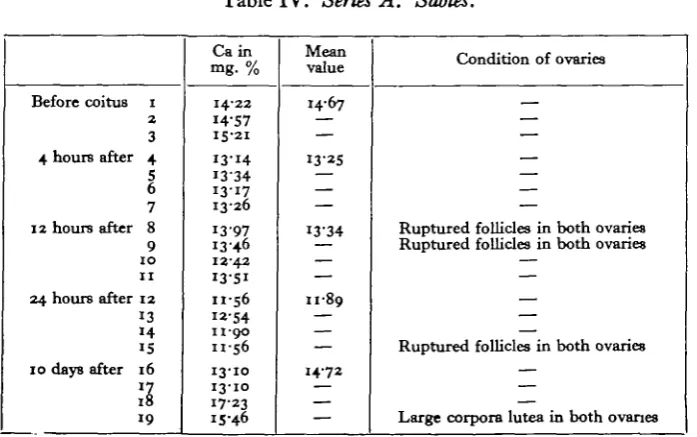
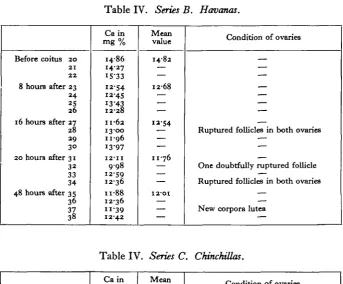
[image:5.451.52.401.414.632.2]We have therefore determined the serum calcium of previously segregated females at varying periods after association with vasectomised bucks. In each case the buck was placed with the doe sufficiently long to permit him to "jump" the doe several times. In several cases the doe refused to lift her tail, so that true intercourse was not consummated. Ovulation in such cases did not occur. An autopsy was carried out on every individual. Three series of females were used. Series A were sables, series B were havanas and series C were chinchillas. The protocols are as follows:
Table IV. Series A. Sables.
Before coitus I
2
3 4 hours after 4
5 6 7
12 hours after 8 9
1 0 1 1
24 hours after 12 13 14 15 10 days after 16
»7
18 19
Ca in mg. %
14-22 14-57 15-21
13-14 1334 13-17 13-26
I3-97 1346 13-42 13-51 11-56 " • 5 4 11-90 11-56
13-10 13-10 17-23 15-46
Mean value
14-67
— 13-25
— — —
I3-34
— — 1189
— — —
14-72 — — —
Condition of ovaries
— — — — — —
Ruptured follicles in both ovaries Ruptured follicles in both ovaries
— — — — —
Ruptured follicles in both ovaries
— — —
Table IV. Series B. Havana*.
Before coitus 20
2 1 2 2
8 houre after 23 2 4 25 2 6 16 hours after 27 28 29
3° 20 hours after 31 3 2 33 34 48 hours after 35 36 37 38
Ca in m g %
i486 14-27 1533 12-54 12-45 13-43 12-28 11-62 13-00 11-96 13-97 12-11 9 9 8 12-59 1236 n-88 12-36 11-39 1242 Mean value 14-82 — — 12-68 — — — 12-54 — — 11-76 — — — I2-OI
Condition of ovaries
— — — — — —
Ruptured follicles in both ovaries —
—
One doubtfully ruptured follicle —
Ruptured follicles in both ovaries —
— New corpora lutea —
Table IV. Series C. Chinchillas.
Before coitus 39 4 0 41 4 2 8 hours after 43 44 45 12 hours after 46 47 48 4 9 20 hours after 50 5 i 5 2 53 5 days after 54 55 56 57 Ca in mg. % 1499 14-04 13-57 1366 13-57 1274 1227 14-16 1522 13-69 14-87 :2-6o 14-32 13-01 12-84 13-92 1139 io-86 10-64 Mean value 14-07 — — — 1286 — — 14-49 — — 13-17 — — 11-64 — — —
Condition of ovaries
— — — — — — —
Ruptured follicles in both ovaries Ruptured follicles in both ovaries
—
Ruptured follicles in both ovaries —
—
— — —
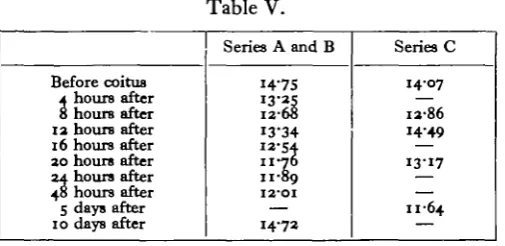
A comparison of the mean values of these series may be made from the data presented in Table V.
Studies on the Pituitary 145
[image:7.451.103.356.152.275.2]the rabbit about 10 hours after coitus. Our figures interpreted in the light of the data derived from autopsy indicate that there is a secondary rise immediately after the time at which ovulation occurs, and possibly only if ovulation does occur. This secondary rise is followed by a further and prolonged fall which subsides before the corpora lutea reach their maximal growth.
Table V.
Before coitus A hours after 8 hours after 13 hours after 16 hours after 30 hours after 34 hours after 48 hours after 5 days after 10 days after
Series A and B
14-75 12-68 13*34 12-54 11-76 11-89 12-01
—
14-72
Series C
1407
13-86 1449
13-17
— 11-64
—
These findings prompted us to test the effect of placing spayed does with bucks. Only eight animals (chinchillas) were available, four of which served as controls. The other four were jumped repeatedly, though true coitus did not occur. Un-fortunately one of these females had been deprived of its uteri as well as its ovaries, a circumstance that suggests further enquiry at a later date, since the calcium level of this animal was exceptionally high. Blood was taken 20 hours after the buck was introduced. The calcium content of the serum in mg. per cent, of these two series was as follows:
(a) Jumped by buck: 11*95, u#6o, 13-86, 15*11 (uterus removed also). (6) Controls: 13-33, W; H'40. W01
-The results of this experiment are too meagre to interpret with assurance. It is to be noted that two values for the jumped does are lower than occurred in other experiments in our laboratory on spayed females (twenty in all) during this period. The data are at least consistent with the conclusion stated earlier.
IV. THE CALCIUM AND MAGNESIUM LEVEL IN SPAYED FEMALES.
During the period in which this investigation has been carried out we have made determinations of the magnesium and calcium content of the serum following the injection of various endocrine extracts into normal and spayed animals. Of these it may be of interest to other workers to remark that we could detect no change in the magnesium content of the blood following injection with parathyroid extracts kindly supplied by the Eli Lilly Co. and Messrs Parke Davis \
In view of the observations recorded by Mirvish and Bosnian and by Miss Watchorn it is perhaps desirable to place on record a summary of all our obser-vations comparing the serum calcium and magnesium content of the blood of
1
normal female rabbits and rabbits from which the ovaries had been removed after sexual maturity. They provide no evidence that removal of the ovaries produces any significant effect of blood calcium or magnesium. The data are summarised below. All the figures given refer to does which had been kept in separate cages for at least one month before bleeding.
Table VI.
(a) Sables
Mean value
(b) Havanas
Mean value (c) Chinchillas
Mean value
A. Ovariotomised females
Calcium
14-27 1393 14-27 1475 14-93 14-43 1322 1299 14-04 1386 1463 1375 13-80 1499 1452 13-93 13-80 13-10 14-22 15-17 14-19
Mean values for all breeds taken
14-13
Magnesium
— — —
2 96 2-96 2-96 — — — 2-25
2 0 3
4-43 3-O3 4-23 3-°7
2-74
3-68
2-80 2-14 3-26
together:
3 0 1
B. Normal females
Calcium
14-22 14-57 15-21 — — 14-67 i 4 8 6
14-27 15-33 — — 1485 1387 14-57 14-69 13-57 1476 1529 1493 13-09
I4-35
Magnesium
— — — — — — — — — — — —
3 9 2 3-15 — 2-33 4-31 2-58 3 0 8 2-16 3-08
I4-52 | 3'°8
V. DISCUSSION.
pseudo-Studies on the Pituitary 147
pregnancy associated especially with the mammary glands may be the most pro-minent visible indications of the internal mechanism which determines the periodic nature of the reproductive function. We might express this by saying that repro-ductive cycles are made up of a series of somatic responses to periodic changes in the internal environment of the circulatory fluids. The relative sensitivity of these responses to the co-ordinating stimuli of internal secretion varies from species to species. The essential components are the same in all and the necessary stimuli which bring them into operation are the same in all.
Adopting provisionally this attitude to the problem of mammalian reproduction approached from the standpoint of comparative physiology we may be permitted to speculate on the relation of such observations as we have recorded in this com-munication to the interpretation of the reproductive cycles of other mammals. The rabbit is peculiar (like the ferret) in that ovulation does not occur without the stimulus of sexual excitement. Parenthetically we may remark that our experi-ments show that profound internal changes are consequent upon sexual excitement involving the muscular movements associated with coitus, even if no actual pene-tration of the vagina occurs. This is significant in relation to the observations of Fee and ParkesW, who claim that copulation induces ovulation in females after anaesthesia of the vagina. The most plausible way of interpreting the pheno-mena of reproductive activity in the rabbit is suggested by the following hypothesis. We may presume that in the rabbit as in other mammals there exists the same potential sequence of internal secretion as in other mammals. It is not unlikely to suppose that in other mammals pituitary secretion is reflexly activated by sexual excitement to some extent. The rabbit may be peculiar only in so far as the secretion of the anterior lobe hormone or hormones involved in activating the ovaries may never reach the requisite threshold for ovulation unless the additional stimulus of sexual excitement is superadded.
This approach to the problem suggests a field for further enquiry into the mechanism of periodicity. In order that a series of events such as occur in the ovarian cycle may form a closed chain with regular recurrence, each phase of the cycle must be the visible response to some stimulus which also activates the me-chanism which is responsible for the manifestations characteristic of the succeeding phase. At present we have good reason to believe that pituitary secretion activates the ovaries. We know that certain changes in the accessory reproductive organs are the result of ovarian secretion. We also know that a normal consequence of the rupture of a ripe follicle is the production of a corpus luteum. Thus a simple possible hypothesis to account for the existence of a closed chain of sequences is that the secretion of the corpus luteum stimulates the pituitary to increased secre-tion, thus repeating the preceding sequence. This possibility could be tested experimentally in a large number of ways.
used luteal substance alone. A suggestive circumstance is the fact that the drop in blood calcium which followed injection of ovarian extracts in their experi-ments was only manifest after a latent period of twenty-four hours. Our experiments clearly show that the fall of serum calcium which follows injection of anterior lobe preparations is not a secondary consequence of stimulating the ovaries. On the other hand, the protracted latent period of the result obtained by Mirvish and Bosman as contrasted with the rapid onset of the effect which we have described is fully compatible with the supposition that the effect of ovarian extracts is not a direct one. It may be due to the stimulation of the pituitary by the luteal autocoid. At this stage we put forward this possibility merely as a basis for further enquiry.
VI. SUMMARY.
1. The injection of fresh saline suspensions of ox pituitary produces a prolonged fall in the calcium content of the serum of normal female rabbits and rabbits deprived of their ovaries.
2. After sexual excitement there is a fall of blood calcium in the female rabbit beginning within 4 hours from association with the buck, followed by a secondary rise at the time when ovulation occurs with a further fall subsiding by the time the corpus luteum is fully formed.
3. The removal of the ovaries from sexually mature rabbits does not produce any significant change in the calcium or magnesium level of the serum.
REFERENCES.
(1) (a) CHARLES(1931). "Metaboh'cchangesassodatedwithpituitaryremovalmjy«no£i«/a«wf.II."
Proc. Roy. Soc. B, 107, 504.
(b) (1931). "Comparative studies of sex differences in the calcium and magnesium
content of the serum.'" Quart. Journ. Exp. Pkytiol. 21, 81.
(c) HOGBEN, CHARLES and SLOME (1931). "Studies on the Pituitary. VIII." Journ. Exp. Biol.
8,
345-(2) MmviSH and BOSMAN (1927). "The influence of the internal secretion of the ovary on the calcium blood level and on calcium metabolism." Quart. Journ. Exp. Phytiol. 18, 11. (3) WATCHORN (1926). "Serum magnesium in relation to menstruation." Brit. Journ. Exp. Pathol.
7, 120.
(4) FEE and PARKES (1929). "Studies on ovulation. I." Journ. Phytiol. 67, 383.
(5) GRANT and GATES (1928). "Serum calcium and phosphorus in normal rabbits." Proc. Soc.
Exp. Biol. Med. 22, 314.