©IJRASET: All Rights are Reserved
1169
Performance Analysis of FBMC/O-QAM System
using Peak to Average Power Ratio
Mohd. Araslan1, A.K. Shankhwar2, Ashutosh Singh3
1
M.Tech student, 2,3Associate Professor Electronics Engg. Deptt. Harcourt Butler Technical University Kanpur U.P-India
Abstract: Filter Bank Multicarrier with Offset Quadrature Amplitude Modulation (FBMC/O-QAM) is an alternate transmission method where a dedicated filter is applied on each subcarrier, that reduces the OOB (Out Of Band) emission and results in high spectral efficiency. FBMC/O-QAM system has many advantages, but being a MCM (Multicarrier Modulation) technique, it suffers from a major problem of high PAPR (Peak to Average Power Ratio). High PAPR reduces the power efficiency of the system and it needs to be addressed. In this research study, some PAPR reduction methods such as companding and clipping are studied and implemented on FBMC/O-QAM system, and it is found that clipping technique provides better result among the considered schemes.
Keywords: FBMC, FBMC/O-QAM, OFDM, PAPR, Companding, Clipping.
I. INTRODUCTION
OFDM (Orthogonal Frequency Division Multiplexing) is the most widely used MCM scheme in wireless networks. It uses CP (Cyclic Prefix) to minimize the ISI (Inter Symbol Interference), which reduces the spectral efficiency of the system. As low spectral efficiency is one of the major problems being faced today, OFDM will not be a suitable choice for future wireless networks [1-3]. In FBMC/O-QAM system a filter is applied on each subcarrier which significantly reduces the OOB (Out Of Band) emission. Because of low OOB emission, FBMC/O-QAM system does not require CP, hence provides high spectral efficiency. It also resolves other problems of OFDM system such as frequency sensitivity, high side lobes etc. [4-5]. FBMC/O-QAM is a MCM scheme and has high PAPR. Usually a HPA (High Power Amplifier) is used at the transmitter of the communication system. When a signal with high PAPR passes through the HPA, it gets distorted and because of this, power efficiency of the system gets reduced. Therefore, PAPR is a big issue and it needs to be resolved. To overcome this issue, many research works have been proposed to reduce PAPR. In [6], PPTS (Pretreated Partial Transmit Sequence) scheme is proposed. Iterative clipping method is used in [7]. In [8], SLM (selective mapping) technique is being proposed, DSLM (Dispersive Selective Mapping) is presented in [9]. In this research study, some PAPR reduction methods such as companding and clipping are studied and implemented on FBMC/O-QAM system, and it is found that clipping technique provides better result among the considered schemes.
II. SYSTEM MODELLING
In fig. 1, block diagram of FBMC/O-QAM system is shown. In FBMC/O-QAM system, the offset QAM modulation is used where the orthogonality condition is relaxed and applied only on the real (or imaginary) part of the complex data symbols. In O-QAM modulation, the in-phase and the quadrature-phase components of data symbols are shifted by half symbol duration (T/2). IFFT is applied on the symbols and filtering of each subcarrier is done efficiently by the poly-phase network (PPN).
Fig. 1: Block diagram of FBMC/O-QAM system. OQAM
pre-processing IFFT
OQAM
post-processing FFT PPN S/P
[image:1.612.91.517.585.722.2]©IJRASET: All Rights are Reserved
1170
III. MATHMATICAL MODELLING
Fig. 2: Implementation of FBMC/O-QAM system
Fig. 2, shows the implementation of FBMC/O-QAM system. If the total subcarriers are denoted by N, then data on subcarrier is represented as
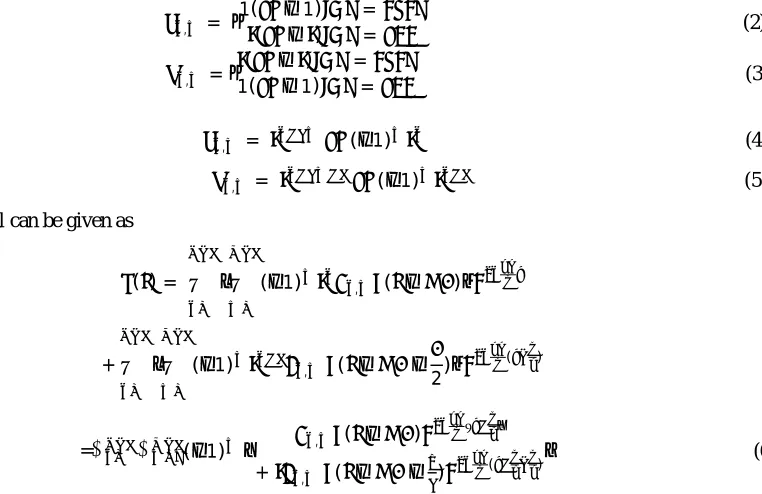
, = , + , (1)
Where, an,m and bn,m are the real and imaginary part of the complex symbols respectively. Now real and imaginary parts of the symbol get phase shifted, and the phase shift coefficients are given by , and , respectively.
For FBMC
, =
1( −1) =
( − ) = (2)
, =
( − ) =
1( −1) = (3)
In general,
, = (−1) (4)
, = (−1) (5)
Now, the composite signal can be given as
( ) = (−1) , ℎ( − )
+ (−1) , ℎ( − −2) ( )
=∑ ∑ (−1) , ℎ( − )
+ , ℎ( − − )
( ) (6)
[image:2.612.144.469.70.332.2] [image:2.612.145.526.429.676.2]©IJRASET: All Rights are Reserved
1171
IV. PROTOTYPE FILTER
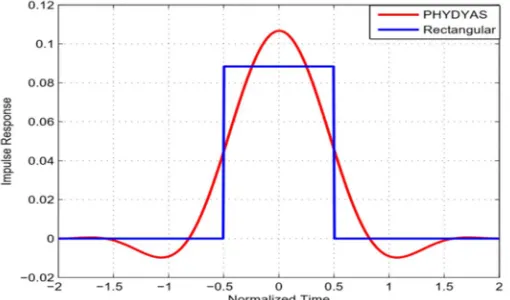
[image:3.612.173.428.128.278.2]In FBMC/O-QAM, a dedicated filter is applied on each subcarrier known as prototype filter. In this work, PHYDYAS filter is being used as the prototype filter [10]. The design of this filter is based on frequency sampling.
Fig. 3:Comparison of PHYDYAS and rectangular filter.
(0) = 1 1
= 0.971960
2
= 1
√2
3
= 1− 1 = 0.235147
4
= 0 ; 4≤ ≤ −1
Then,
ℎ( ) = 1 + 2∑ (−1) cos , 0≤ ≤ −1 (7)
V. PAPR ANALYSIS
PAPR is the ratio of peak power of the signal to the average power of the signal.
= ( ) | ( )| , = 0,1 … . . −1 (8)
PAPR is a random variable and a better way to characterized it, is by CCDF (Complementary Cumulative Distribution Function). CCDF gives the probability that the PAPR exceeds some threshold value X.
= { > }
VI. µ-LAW COMPANDING
Companding stands for compressing-expanding mechanism. In this, the stronger signals are compressed and the weaker signals are expanded. Companding action improves the average power of the signal and reduces the peak power of the signal hence PAPR reduces.
In [11], authors showed that out of µ-law companding, A-law companding, erf companding, log companding and tanh companding techniques, µ-law companding performs the best. The µ-law companding function is given by
( ) = ( ( | ( )|)) ( ( )) (9)
Where, µ is the compression parameter. At receiver, the original signal is obtained by
( ) = (1 + ) ( ) −1 ( )
©IJRASET: All Rights are Reserved
1172
VII. CLIPPING
In this technique, high peaks of the signal are clipped off, which reduces the peak power of the signal hence PAPR gets reduced. If the threshold value of clipping is A, then,
̅( ) = ( ) | ( )| ≤
| ( )| > (11) Then the PAPR of clipped signal,
= ( ) | ̅( )| , = 0,1 … . . −1 (12)
VIII. RESULTS
[image:4.612.172.444.489.706.2]Parameters that have been used in the simulation of this work are listed in the table 1.
Table 1: List of useful parameters
Parameter Value
Number of subcarriers 64
Number of FBMC symbols per frame 48
Oversampling factor for IDFT 4
Clipping Level 0.65×peak
value
SNR (dB) 1 to 15
No of frames for PAPR check 1000
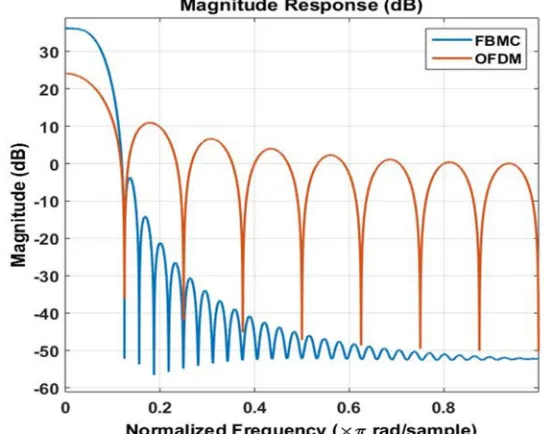
In fig. 4, it is clear from the magnitude spectrum of OFDM and FBMC/O-QAM that FBMC/O-QAM has lower side lobes hence better frequency localization. In fig. 5, magnitude response of FBMC/O-QAM for different value of K is shown, where, K is the oversampling factor. It is clear that side lobes decreases for higher values of k. In fig. 6, high amplitude peaks can be observed, which causes high value of PAPR, whereas in fig. 7 clipped samples are shown.
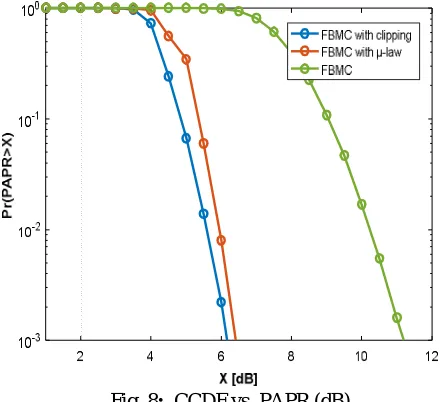
In fig. 8, PAPR performance in terms of CCDF is shown for various techniques. FBMC/O-QAM suffers the most from PAPR, FBMC/O-QAM with µ-law performs better than the FBMC/O-QAM, and clipped FBMC/O-QAM performs the best among the considered schemes. Quantitative results are shown in table 2.
+
©IJRASET: All Rights are Reserved
1173
Fig. 5: Magnitude response of FBMC and OFDM for different K.
Fig. 6: Variation in peak amplitude.
[image:5.612.203.406.78.265.2] [image:5.612.195.415.300.470.2] [image:5.612.201.422.502.693.2]©IJRASET: All Rights are Reserved
1174
Fig. 8: CCDF vs. PAPR (dB)
Table 2: PAPR for different methods.
Techniques PAPR(dB) (@ CCDF = 10-3)
FBMC 11.2
FBMC + µ Law 6.67
FBMC + clipping 6.1
IX. CONCLUSION
In this research study, different PAPR reduction techniques for FBMC/O-QAM were studied and implemented. It was found that FBMC/O-QAM suffers the most from PAPR, FBMC/O-QAM with µ-law companding performs better than the FBMC/O-QAM, and clipped FBMC/O-QAM performs the best among the considered schemes. Furthermore, in FBMC/O-QAM system PAPR at different clipping levels can be evaluated and selection of the appropriate clipping level can be made according to the requirements. Also, other PAPR reduction techniques can be studied and implemented for the FBMC/O-QAM system.
REFERENCES
[1] Qi, Yinan and Al-Imari, Mohammed, “An enabling waveform for 5GQAM-FBMC: Initial analysis”, 2016 IEEE Conference on Standards for Communications and Networking (CSCN), pp. 1-6, 2016..
[2] Ibrahim, AN and Abdullah, MFL,”The potential of FBMC over OFDM for the future 5G mobile communication technology”, AIP Conference Proceedings, vol. 1883, no. 1, pp 020001, 2017.
[3] Gerzaguet, Robin and Bartzoudis, Nikolaos and Baltar, Leonardo Gomes and Berg, Vincent and Dore, Jean-Baptiste and Kt ´ enas, ´ Dimitri and Font-Bach, Oriol and Mestre, Xavier and Payaro,´ Miquel and Farber, Michael and others ¨ ”The 5G candidate waveform race: a comparison of complexity and performance”, EURASIP Journal on Wireless Communications and Networking, vol. 2017, no. 1, pp. 13, 2017.
[4] Arndt, DeiseMonquelate and da Rocha, Carlos AurelioFaria ´ ”Performance comparison between OFDM and FBMC systems in digital TV transmission”, 2011 IEEE LatinAmerican Conference on Communications (LATINCOM), pp. 1-6, 2011.
[5] He, Qinwei and Schmeink Anke”Comparison and evaluation between FBMC and OFDM systems”, Proceedings of the 19th International ITG Workshop on Smart Antennas (WSA 2015), pp. 1-7, 2015.
[6] Liu K, Hou J, Zhang P, Liu Y. PAPR reduction for FBMC-OQAM systems using P-PTS scheme. J China Univ Posts Telecommun. 2015;22(6):78–85. [7] Kollar Z, Varga L, Czimer K, August. Clipping-based iterative PAPR-reduction techniques for FBMC. In OFDM 2012, 17th International OFDM Workshop
2012; Proceedings of VDE. 1–7, 2012.
[8] Bulusu SS, Hmaied S, Roviras D, Zayani R. “Reduction of PAPR for FBMC-OQAM systems using dispersive SLM technique. In 11th International Symposium on Wireless Communications Systems (ISWCS), IEEE, 2014.
[9] Parnika Kansal, A.K. Shankhwar “Performance Analysis of FBMC-OQAM based 5G Wireless System using PAPR.” International Journal of Computer Applications. vol. 161, no. 12, pp. 15-20, March 2017.
[10] Bellanger M., Le Ruyet D., Roviras D., Terré M., ossek J., Baltar L., Bai Q., WaldhauserD., Renfors M., Ihalainen T. “Fbmc physical layer: a primer. PHYDYAS (2010).
[11] Imad A. Shaheen, Abdelhalim Zekry, Fatma Newagy, Reem Ibrahim “Performance evaluation of PAPR reduction in FBMC system using nonlinear companding transform.” ICT Express
[image:6.612.191.411.85.286.2]