Impact of Artesian Pressure on Foundation: A
Case Study
Shashank Singh Bhadouria1 Anil Rajpoot2 Romi Parihar3 1
M.Tech (Structural Engineering), Student of Department of civil Engineering, Vikrant group of institution, Gwalior 2, 3
Assistant professor, Department of civil Engineering, Vikrant group of institution, Gwalior
Abstract: The case study covered in this paper is a unique attempt to investigate the cases of bottom plug failure. The safe and most elegant method of construction has been proposed in artesian conditions. The bridge across Chambal River on the Ater-Jaitpur Highway has been studied. The site has multiple layers with artesian ground water flow at different depths. The foundation design must be based on two salient features, bed boiling( quick condition) should not occur even in the case of maximum scour, a minimum soil cushion thickness should be compulsorily available at the time of construction. This cushion must be between foundation level and strata having artesian flow. In case of Low pressure Construction of false Steining to neutralize the effect of Artesian Pressure. Deep foundations embedded in artesian aquifers can be the cause of serious problems during, and more importantly, after their installation, due to a disproportionately high risk of washout during construction. In the case of well foundation, the failure in the bottom plug, error in sinking the well, faults in false Steining can trigger the sinking of the foundation after the final construction because of upward movement of the soil particles and finally the erosion of the soil due to Artesian Condition.
Keyword: Artesian Conditions, Low Artesian Pressure, High Artesian Pressure, False Steining, Bed Boiling, Soil Cushion, Deep Foundation,
I. INTRODUCTION
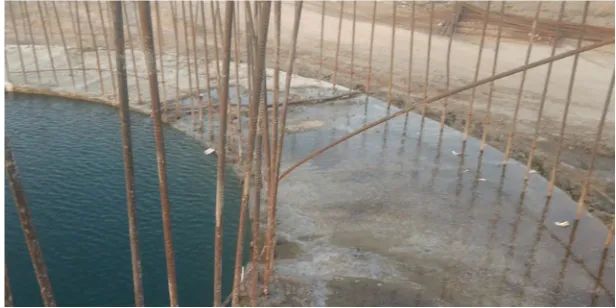
The water embedded in the underground gravel, sand and rock. The water has the pressure and it flows. This layer of the soil is called as aquifer. The positive pressure in water is responsible for the filling of water inside a well excavated for the foundation and this becomes constant when the hydrostatic balance is obtained. In case of intrusion of the aquifer open to atmospheric pressure like well, shaft or borehole initiates the up thrust and it leads to soil erosion finally instability in the civil structures. The deep foundation like well foundation having the artesian layers can result into the failure of the foundation after the construction. The soil erosion is triggered by sudden artesian pressure and the movement is naturally upwards. The global practice has been the use of water circulation drilling or polymer bentonite slurry to flush the well. The platforms above the ground level are constructed in the soil having embedded artesian layers. This method has been popular over several decades. But, this method is not foolproof and the evidence is the failure of few deep foundations like one discussed in this paper. Deep foundations under the artesian conditions can create hazards and lead to big problems during, and post installation. This is due to the high risk of soil erosion resulting from the foundation elements sometimes work like pathways or pits responsible for the upward movement of soil particles carried by groundwater following the newly introduced pressure relief openings to surface. This has been the most popular because it can manage the risks associated with breaching of the confining layer of an artesian aquifer.
[image:1.612.150.458.561.715.2]
II. LITERATURE REVIEW
A. Marta DolezalovaIvo Hladik (1976) have researched the Jiri Open-Pit Coalmine, with its profoundly profitable coal measure, is
situated in a secured district of the Czech Republic that is acclaimed for its spas and artesian warm springs. A pressurized spring underlies the mine. The mining advance is constrained by the danger of potential water driven breaking and resultant flooding of the mine, just as by genuine changes to the hydro geographical states of the entire district. The seepage wells have been built to stop the peril. This diminishes the spring weight. Among 1976 and right now, gauges were made of the practicality of the mining advance at any rate weight head decrease, for example for the base ecological effect. An intelligent method has been connected utilizing numerical models aligned by field estimations, and an observing framework refreshed by the numerical models.
B. Henry G. Haley(1978) has described about 15,000 uncontrolled flowing wells, many discharging water of poor quality are
wastefully discharging about 790 million gallons per day by surface and internal flow. The author has discussed the internal Flow in principal problem areas in 14 countries is estimated at 550 million gallons per day. Fourteen principal problem areas have been identified in Brevard charlotte, clay, De Soto, Duval, Flagler, Glades, Hendry, Hillsborough, Lee, Manatee, Martin, Nassau, and Sarasota Countries. In number of places uncontrolled discharge over the years has caused a decline in the potentiometric surface locally and regionally, and a deterioration of the potable water aquifers. Programs for control of flowing wells are being carried on by state above 20 countries.
C. Daniel D. Uranowski (2004) This paper describes that the bedrock for the site is comprised of crystalline dolomite with
alternating beds of sandy, cherty dolomite. Compressive strength test results for 2-inch diameter rock cores obtained during the subsurface investigation were approximately 23,000 psi. The interface between the bedrock and the soil mantle is characterized by pinnacle formations with joint channel development common. As expected, solution openings in the karstic region were encountered. Clay seams and voids were encountered throughout the bedrock to depths exceeding 100-feet. Brayman traversed these soil and bedrock conditions until the required rock socket length was penetrated in sound rock. The groundwater and artesian conditions were not encountered in the majority of the holes. The use of Micropiles technologies have been used in karstic dolomite geologies. Soil and clay-filled seams, pinnacled rock formations, and voids left from the dissolving action of water in these carbonate bedrock settings not allowed the use of conventional drilled shaft and spread footing foundation systems. The artesian conditions and high groundwater conditions were encountered at the SR 33 project, minimal groundwater was noticed for the Pennsylvania State University project.
D. Jim Bruce (2009) has depicted a contextual analysis, enumerating an ongoing utilization of this fitting methodology at a urban
transportation framework development venture requiring profound establishments in Canada . Profound establishments, as soil-fortified Micropiles, built with additional fortification so as to be reasonably hardened to fulfill the Structural Engineer's prerequisites, were progressed into an artesian spring locally infamous for causing issues. The artesian spring that underlies this site shows a head weight of 2 meters over the ground height. Keller, working at the time as Geo-Foundations Contractors, planned and introduced high-limit, soil-fortified Micropiles to help the new scaffold projections. Micropiles were effectively installed in the artesian spring.
E. Anil Misra1 (2009) have announced the strategies to ascertain the pullout load-uprooting conduct are significant for the
structure of Micropiles utilized for an assortment of restoration extends that require upgraded pullout limit and vertical redirection control. The "t-z" strategy is a famously utilized soil-structure collaboration model for such burden relocation conduct. Utilizing a "t-z" model and the Monte Carlo reproduction process, likelihood dispersions were resolved for Micropiles pullout limit at as far as possible state. These likelihood dispersions were broke down to create strategies for deciding the likelihood of Micropiles disappointment at as far as possible state.
F. Donald E. Splitstone (2010) This paper examines the total assessment of the structure, led simultaneous with crisis brief shoring
measures, including examination of the first establishment framework, and plan, establishment and testing of new Micropiles establishment frameworks that supplanted the lacking profound establishments at both Pier 10S and Pier 10N
G. Ronaldo Luna(2015). The paper exhibits an outline of the establishment of instrumentation and aftereffects of the observing
H. Hossam Elbadry (2016) have talked about accurate and unsafe issues of the extremely profound stores of exceptionally delicate mud soils for auxiliary establishments. It is accepted that the current utilized techniques for geotechnical building improvement
in delicate dirts are justified on the premise that pre-information of the potential issues can prompt monetary benefits. In the
event that, the arranging, structure, and development of ventures can be modified to suit the issues to give increment of its
quality, decrease of aggregate and differential settlement, sensible expense, and abbreviate development time. Thusly, the
practical choices assume significantly a basic job to assess extensively the effectiveness among the broadly utilized current
strategies in this evident hazardous field. The huge experience has been gained to take care of this issue through delicate ground
improvement before going to profound establishments which need impressively tremendous expense particularly for the profound exceptionally delicate ground. Shockingly, the improvement extents of the most broadly utilized flow strategies sometimes fall short for even reasonably with their required expense and their development issues which need largest amount of precision.
I. M.Heidarzadeh (2017) have announced designing encounters from the basic undertaking of alleviation well establishment
under high artesian stream conditions at the downstream toe of the Karkheh earth dam, Iran. Because of the foundation of over the top inspire weight at the downstream toe of the Karkheh dam, establishment of a progression of new help wells was considered to for all time soothe some portion of these weights. The referenced elevate weight, as high as around 30 m over the ground level, was created in a kept combination spring limited above and underneath by generally impenetrable mudstone layers which decreased the wellbeing variable of the dam toe to beneath 1.0. Examinations on the deficiencies of the old help wells introduced at the dam site demonstrated that the primary issues were: deficient well numbers, lacking great measurements, unpredictable well screens causing their blockage by time passing, and inadequate absolute opening zone. Regardless of building challenges and related danger of downstream toe shakiness, establishment of new help wells was effectively finished under high artesian stream conditions".
J. Sanjay Gupta (2017) have profoundly considered the extension crosswise over River Shivganga on the Kohalpur-Mahakali
Highway in the Terai area. of southwestern Nepal uncover the event of various layers at various profundities with artesian ground water stream. The idea for establishment plan in such strata ought to think about three angles. (a) bed bubbling (snappy condition) ought not grow regardless of whether most extreme scour happens, (b) during development, a base soil pad thickness ought to be accessible between establishment level and strata with artesian stream, and (c) for long haul dependability, the bearing limit at artesian level ought to be processed utilizing settled pressure rule.
K. Anthony Wade Fisher(2017) This examination depends on 350 wells introduced all through the bowl's four-spring framework
to divide the spatial appropriation of the 86 wells that have gone artesian somewhere in the range of 1995 and 2015. Artesian wells inside every one of the four springs happen at rises underneath 5.2 meters above ocean level (MASL) however dominatingly beneath 3.0 MASL. Indeed, even at lower rises, artesian conditions don't happen in districts of major siphoning inferable from critical drawdown. Inside low areas, wells may not be artesian where wellheads are situated at higher rises, for example, on a levee or other raised landforms.
L. Jun-Zhi Wang (2018) have detailed that streaming artesian wells could be geologically controlled, there is no quantitative research on artesian stream conditions in unconfined springs. In this examination, the water table, which has a lower adequacy than the land surface, is damped from the geography and utilized as the limit condition to acquire the scientific arrangement of pressure driven leader of a unit bowl with a solitary stream framework. The most extreme artesian head and the size of artesian zones are found to increment with the damping factor and the anisotropy proportion, and lessening with the proportion of bowl width to profundity and the profundity rot type of water driven conductivity. Also, the artesian head increments with profundity close-by the valley and diminishes with profundity close by the separation, and the variety rates are affected by the rot example and the anisotropy proportion.
M. Mohan Vasant Jatkar (2018) have informed that Long-range spans with caisson establishments have been the favored decision
for significant stream/rivulet connects in perspective on the staggering expense of the establishments. The establishments of these scaffolds are profound and the development speed is extremely moderate, this does not permit to assess the time required for the development. . With better hardware and comparing quality control, development of huge width heap establishments has created as a quicker and dependable choice. Improvements in pre-thrown segmental development have likewise added to a slow move in the favored range and establishment type to guarantee a lot shorter development periods.
N. Edmonton Shale Onur Kacar (2019) have revealed high-Capacity Micropiles in Two high-limit Micropiles burden tests were
gap empowered a quicker generation rate. Utilizing air flush rather than water flush decreased the need of gear. Heap burden tests demonstrated that this establishment strategy was tasteful in Edmonton Clay Shale. The attractive heap burden tests demonstrated that, Micropiles introduced in shale can oppose essentially high hub loads. It was likewise affirmed that Micropiles are an efficient practical profound establishment arrangement in transportation and scaffold ventures where obstruction with existing establishments are foreseen.
III. THE PROJECT DESCRIPTION
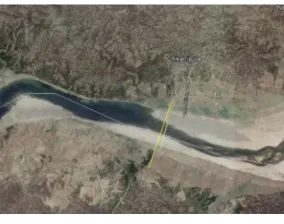
The proposed scaffold is crosswise over waterway Chambal is in Ater Jaitpur Road, Madhya Pradesh and Uttar Pradesh outskirt, India. In this locale the waterway run practically parallel to the two states. It is on the state thruway SH-2 Bhind-Ater-Porsa and 25 km away from Bhind. Fig 2 present a maps demonstrating span arrangement.
[image:4.612.238.380.205.317.2]
Fig 2 Vicinity Map
A. The River Details.
The Chambal locale is of topographical centrality. The region lies close to the intersection of two distinctive land frameworks, in particular Vindhyan framework (geographically exceptionally old framework having a place with the Paleozoic period) and the Aravalis framework. The Chambal stream valley all through its course from Kota onwards, till its confluence with Yamuna roughly speaks to the topographical limit between these two frameworks. Chambal River Basin is situated between scopes 22°27' and 27°20' and longitudes73°20' and 79°20'.There is generous progression of underground water because of the pressure driven angle between the catchment territory in the upstream slope sand the Terai fields. Along these lines, artesian conditions do exist at numerous areas here. It is equal to a streaming underground waterway and is to be treated as a hydrodynamic spring.
B. Site Stratigraphy and Measured Artesian Heads
Cross sectional profiles based on the investigation at Chambal river locations are presented here. These sections present the distribution of the strata across the river along the bridge alignment. The artesian head measured as height of the water column above the ground level at the borehole location at the time of the investigation is also shown in these illustrations
Table -1 :- River Chambal Artesian Head & Description of Strata
Borehole No
Depth of Strata With artesian pressure.(M)
Measured Artesian Head above
GL (M) Description of Strata
P-1 6.8-7.55 2 Fine Sand
P-2 13-21.76 3 Coarse Sand with Boulder
P-3 11.65- 32.55 1 Blackish soil with
clay patch fine gravels
P-4 25.77-42.14 2.5 Yellow soil with clay patch
fine gravels
P-5 27.62-42.52 4 Yellow soil with clay patch
[image:4.612.68.544.530.729.2]IV. THE PROPOSED FOUNDATION DESIGN
The seventeen span bridge has two abutments. The total length of the bridge is 850.00 mts and the spans are 50 m. The Low Water Level (LWL) 80.00 m and the Normal Scour depth is 24.07 m. The downward load at pier top is estimated to be about 550 Ton. For such a bridge with high load and substantial scour (12 m at pier location). it is normal practice to provide well foundation. It was planned to provide 8.150 m Diameter Wells for the piers and 8.350 m Diameter for abutments.
For Dealing Artesian condition it has been divided in to two categories :-
A. High Artesian Pressure
1) The Foundation Depth: The profundity of establishment is chosen by the profundity of artesian layers. The well establishment is the most well-known decision in India where the artesian exists at profundity in the strata with the mud. The Cutting edge and Well Curb of the establishment is stopped with the solid. The establishment must cross a couple of artesian layers. The Cutting edge and Well Curb of the well should be over any artesian layer lying underneath. If there should be an occurrence of artesian layer being at shallow profundity, the well establishment might be required to go further, crossing a couple of artesian layers. The Cutting edge and Well Curb might be established underneath the artesian layer, ideally in mud layer, which is adequately over the hidden artesian layer. A profound well with The Cutting edge and Well Curb in sand layer might be required at times relying on the stratigraphy. The sinking of the well ought to be finished during the reasonable climate season, during this season the artesian weights are moderately little. For this situation, sufficient safety measures ought to be taken to guarantee that the scaffold stays stable notwithstanding during the most exceedingly terrible conceivable circumstance.
2) Design Criteria: In addition to the usual checks for bearing capacity safety factor and settlement of the well foundation under the anticipated load, foundation design in strata with artesian flow is constrained by the following technical considerations: (i) The stability of riverbed is to be ensured against boiling due to artesian pressures (quick condition) from various layers, scouring up to maximum scour level takes place.(ii) It should be ensured that sufficient soil cushion is available between foundation tip level and the artesian level, so that the artesian pressure does not find the vent through soil layers below. The foundation system needs the check for the stability of the bed under quick condition when maximum scour condition occurs. In the event of bed boiling because of existing artesian conditions the bed protection is must to keep the scouring to minimum to avert the instability of the structure.. When the effective overload pressure at artesian level during the time the extreme scour
has occurred becomes negative (less than 0),“bed boiling” (quick condition) will occur. The artesian will break through the
overburden resulting in unsteadiness of the riverbed. Effective overburden pressure at artesian Level q′ = ϒt a – u
where, (1)
ϒt = bulk density of loam
a = thickness of soil strata between max. scour level and artesian level = RL of scour level − RL of artesian level
u = Pore water pressure= Maximum expected artesian pressure in artesian layer.
= ϒw [(RL of GL − RL of strata with artesian head) + p]
ϒw = unit weight of water
p = artesian head above ground level
In order to prevent the bed boiling (q′ ≤ 0), proper bed protection is must for the stability. The bed protection should be done
upstream and downstream of the structure up to necessary length so that the shifting nature of the artesian point, which could cause bed boiling and ensures the stability of the structure.
3) Soil Cushion Thickness: It is the deign requirement to have required soil cushion between the trailing end of the well and the artesian layer which is sand in our case, to withstand the upward pressure due artesian conditions in the soil strata. This equilibrium of pressure become vital at the time of construction. In the event of well sinking, the water level inside the well should be kept above ground level or the water level in the river, whichever is higher. The water level inside well should go up to counter the bed boiling during sinking and this is achieved by the construction of false Steining.
Downward Thrust = Water head inside well+ thrust due to soil cushion
= h1 ϒw + χ ϒt (2) Uplift Thrust , u = Maximum expected artesian thrust at layer below well tip
For the stability ,
h1 ϒw + χ ϒt ≥ (h1 + χ + p)ϒw (4) h1 = depth of well tip below ground level;
ϒw = unit weight of water;
χ = thickness of soil cushion between well tip and underlying sand (artesian level) layer
Hence, χ ≥ pϒw / ϒ′
Minimum Thickness of Soil cushion should be equal top/ϒ′ for factor of safety equal to 1.0.
4) Fixing of Foundation Level: The shallow well foundation are more suitable where the multiple artesian layers are present in the strata otherwise deep wells are better. The occurrence of bed boiling is indicative of maximum scour and the possibility of artesian pressure breaking through the soil cover. The design team decided to make the provision of bed protection nearby the bridge on both the sides. The bed protection prevents the scour. The height of wells was maintained above the artesian layer to provide the sufficient soil cushion. In some of the piers sand was at desired design level. The tip of well was increased beyond the top sand layer in order to prevent any failure due to artesian in future. The well tip was founded on an underlying clayey silt stratum. During construction, false Steining was provided above GL, where required as per site conditions, so that the artesian water does not cause sand boiling.
B. Low Artesian Pressure
It is a global problem that the artesian present in the deep foundation pose the challenges in the bridge construction. The artesian pressure sometimes trigger the soil erosion and becomes the cause of the instability in the foundation which eventually puts the safety of the bridge in danger. The effective and reliable solution in such situation is :
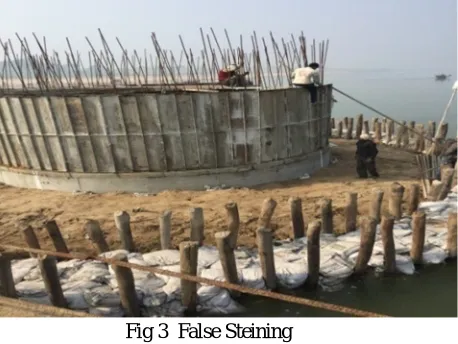
[image:6.612.202.431.423.595.2]1) The Construction of False Steining: The deep foundations where low water pressure exists, the false Steining is constructed to counteract the artesian pressure. This is the solution which protects the bridge structures over entire service period. The local artesian head is relieved by the construction of false Steining and this requires expert technical workforce. The wooden piles are provided below at 300 mm/cc spacing. This results into water tight surroundings and thus responsible for the stability of the soil. . The platform is constructed with double the diameter of the well and piles are driven along the boundary and sand bags are placed between the piles. This behaves like a coffer dam.
Fig 3 False Steining
2) Bottom Plug:The well is provided at founding level. At the founding level the bottom plug is constructed. The soundness test is
conducted to test the bottom plug. The water must flow at rate of 10 cm/hour as per the MORT&H specifications. But, when
there is Artesian Pressure present below at Founding Level it's impossible to plug well as a result cement will be washed out in plugging and there will be segregation of aggregate so the plug will fail.
3) Afflux: In order to Neutralize the effect of artesian pressure we need to build a structure up to the height of artesian head above ground level. Building Well cap up to the height of artesian head above ground level will disturb the natural waterway thereby increasing afflux of bridge, which will require fresh design.
Although, to neutralize the effect of both false Steining is considered as a effective solution by building false Steining up to the
height of artesian head above ground level will neutralize the negative artesian pressure.
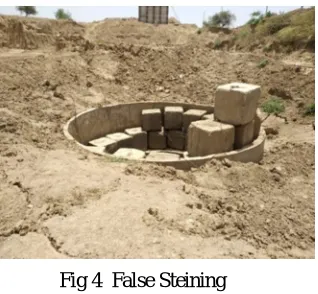
Fig 4 False Steining
The afflux effect can be neutralized by providing, false Steining with thickness of 300 mm and 4 m height which can be dismantled at the designed top level of the well cap.
V. RESULT AND DISCUSSION
The well foundation design worked well for the four wells but due to sudden artesian pressure P5 bottom plug failed. We have not
done false Stening in (P5) because at the time of plugging there was no artesian pressure. During plugging artesian pressure increased, which was tough to differentiate that rate of increase in water is due to Bottom Plug or due to artesian pressure. So, At the time of plugging no safety measures were adopted to stop artesian. As a result, the soundness test failed due to artesian. This paper covers the literature at global level and the some case studies show the following solutions where the bottom plug or the deep foundation fails.
Construction of relief well to transfer artesian pressure and additional bottom plug (2-5 m3)can also be provided.
Comparison between design for High Artesian Pressure well and Low Artesian Pressure well: The well foundation design is more challenging in case where the high artesian pressure exists. The bed boiling solution is cost effective. In case of low artesian condition the design is less costly. The bed stability is achieved by minimizing the scour. The sufficient soil cushion is required to counter the higher artesian pressure while it is less costly where the pressure is on lower side. The provision of false Steining is must in lower pressure and this is a cheaper solution. The afflux is neutralized by providing 300 mm thick Steining up to 4m height. The labour cost is lower for constructing the well foundation in low pressure area as the work is less complicated.
VI. CONCLUSION
The case study presented here is the technical description of the practical problems faced while executing the well foundation in artesian environment. The case of artesian pressure has not been studied so far the main finding are:-
A. The major flaws of existing old technique, which were responsible for the triggering artesian, were improper, irregular study
and measurement of artesian head and insufficient false Steining diameter and height. The design considerations were not there in deep foundation. We improved the technique of construction under flowing artesian condition by concreting the structure, drilling the wooden piles and controlling the river water by constructing the cofferdam.
B. The false Steining is constructed to provide the stability to the bridge by keeping the well free from artesian head. The stability
of water level showed that as a result of false Steining the safety factor was improved and closing the well by bottom plug
C. All the design consideration were added to the well foundation i.e. bed boiling, soil cushion thickness e.t.c with the help of bore
hole test all the details of strata were taken into consideration during design stage and thus eliminating the upcoming shortcomings at the time of construction.
D. It is a unique experience for the reasons such as the artesian pressure was relatively high as compared with the normal bridge
site. There was a concentrated artesian flow. We experienced uncontrolled artesian flow during the installation of false Steining, which endangered the safety of the foundation, and this washed out the soil particles.
E. Further research is required about the detail study of this unique problem and study about the design of Micropiles for dealing
REFERENCES
[1] Anil Misra1, Lance A. Roberts2, Raj Oberoi3, and C.-H. Chen4,” Monte Carlo Simulation and Serviceability Resistance Factors for Micropiles Pullout”, Geo-Congress, ASCE, 2009
[2] Anthony W. Fisher ,”Spatial Distribution Of Artesian Conditions Within The Niles Cone Basin, Alameda County, California”,Pproved For The Department Of Geology San Jose State University, August 2017,
[3] Anthony Wade Fisher ,"Spatial Distribution of Artesian Conditions within the NilesCone Basin, Alameda County" California San Jose State University,2017 [4] Daniel D. Uranowski, P.E.1, M. ASCE, Scott Dodds2, M. ASCE, Scott Stonecheck, P.E.3, M. ASCE,” Micropiles In Karstic Dolomite Similarities And
Differences Of Two Case Historie”,GeoSupport, ASCE,2004
[5] Donald E. Splitstone, Donald E. Splitstone, Scott A. Stonecheck,” Birmingham Bridge Emergency Repairs: Micropiles Foundation Retrofit”, GeoFlorida 2010: Advances in Analysis, Modeling & Design (GSP 199) © 2010 ASCE
[6] Dan Brown1, M.ASCE, Ph.D., P.E., DGE, “Recent Advances in the Selection and Use of Drilled Foundations”, Geotechnical Engineering State of the Art and Practice, page no. 519, ASCE, 2015
[7] Henry G. Healy ,"Appraisal Of Uncontrolled Flowing Artesian Wells In Florida",U.S. Geological Survey, Water Resources Division Suite F-240 325 John Knox Road Florida 32303 ,1978
[8] Hailong Li1 "An analytical study on artesian flow conditions in unconfined aquifer drainage basins",Artesian Flow Conditions, AGU Publications, page no. 8658, September, 2015
[9] Hossam Elbadry , Ashraf Eid, “Simplified technique achieving low cost and high performance impact for construction in very deep very soft ground sites”,Housing and Building National Research Center (HBRC), Cairo, Egypt, 2016
[10] Jim Bruce, Naresh Gurpersaud, Zhong Han, Mark Montgomery & Hiu Lee Keller Foundations Ltd., Acton, ON, Canada, “An appropriate method for constructing deep foundations that must penetrate artesian aquifers”, 2009
[11] Justin Bieber, P.Eng.1; David Ward2; Samuel Bandimere3; Nick Sargent4; Jacqueline Foley5; Norm Quail6; Marc Hinton, Ph.D.7; and Malaika Ulmi8, “Grouting Techniques Used to Decommission a Flowing Artesian Well”, ASCE, Grouting 2017
[12] Marta Dolezalova (1"An open-pit coalmine surcharged by artesian water pressure",International Journal of Geoengineering Case Histories ©, Vol. 1, Issue 1, p,1976
[13] M. Heidarzadeh1, A. A. Jun-Zhi Wang1,2, Xiao-Wei Jiang1, Li Wan1, Anders W€orman2, Heng Wang1, Xu-Sheng Wang1, and Mirghasemi, H. Niroomand, "Construction of relief wells under artesian flow conditions at dam toes: engineering experiences from Karkheh earth dam, Iran",International Journal of Civil Engineering, Vol. 13, No. 1, Transaction B: Geotechnical Engineering, March 2015
[14] Mohan Vasant Jatkar, Executive Director (Tech); Shirish Wasudeo Deshpande, “Challenges in Bridging Indian Rivers”,Structural Engineering International,2018)
[15] Edmonton Shale”,Onur Kacar, Ph.D., P.E., M.ASCE1; Andrew Cushing, P.Eng.2; and Michael R. Lewis, P,” High-Capacity Micropiles in Geo-congress, ASCE, 2019
[16] Ronaldo Luna1, PE, PhD, F.ASCE, Devin T. Dixon, “Monitoring Micropiles Foundations of Bridge during Construction”, IFCEE 2015 © ASCE 2015 [17] S.G. Xiao1, K.Cui2, D.P. Zhou3, and J. Feng4,” Analysis of a New Combined Micropiles Structure for Preventing Slope Slippage and Its Application in a
Practical Project”, ICCTP, ASCE, 2009
[18] Sanjay Gupta & Ravi , "Sundaram Geotechnics of Artesian Flow" , Sixth Madhav Lecture JNTU Hyderabad, October 2017
[19] T N Narasimhan "Groundwater: from mystery to management", Environmental research letters, department of materials science and engineering, department of environmental science, policy and management, 210 hearst memorial mining building, university of california, http://dx.doi.org/10.1088/1748-9326/4/3/035002,2009