On Experimenting with MuLTool: Multi-Lingua
Tool for Mobile Patient-Practitioner Interaction
John B. Oladosu, Justice O. Emuoyibofarhe
and Stephen O. Olabiyisi
Abstract—The problem of language barrier in medical consultations is a limitation to healthcare provisioning to the larger population of the developing and underdeveloped world. The doctor to patient ratio is dismally low, especially in cases where patients can only converse in their native languages. Hence there is the need to provide solutions to
the problem of language barrier in medical consultations. This work considers the over 250 ethnic communities with more than 350 local languages and dialects in Nigeria as a serious challenge knowing that a great percentage of this population are semi to stack illiterates. A multilingual application is developed to support information dissemination to multiple local languages in Nigeria while also supporting communication between medical practitioners and indigenous patient with natural language barrier. This enables an online real time medical consultation on mobile devices. A working model is designed for a language translator (English to Nigeria major languages: Hausa, Igbo and Yoruba) for a mobile medical consultation making use of various components such as the mobile client terminal, the internet application server etc. The resulting solution was subjected to evaluation by medical experts to ascertain the relevance of the solution in the current state of clinical solutions research. Results from this work show that patients who are not educated in the official language can communicate with clinicians of different lingua background.
Index Terms
—
E
thno-linguistic diversification, Language translation, medical consultation, mobile online chat, ubiquitous rural healthcare.I. INTRODUCTION
The field of electronic healthcare in a country like Nigeria and other developing countries in Africa is fast becoming an issue of growing concern to both the government of the countries as well as the different bodies of research institute actively dedicated to it development, more particularly with the increased use of the Global System for Mobile communication (GSM) across a wide range of these countries. Different research institutes of medical and computer development society in the universities and ministries of government agencies have actively dedicated research money into the awareness as well as its rapid development in countries capable of showing a reasonable and appreciable development.
Dr. John B. Oladosu is with the Department of Computer Science and Engineering, Ladoke Akintola University of Technology, Ogbomoso, Nigeria (corresponding author; Phone: +234-803-455-6065; e-mail: [email protected] ).
Dr. Justice O. Emuoyibofarhe is with the Department of Computer Science and Engineering, Ladoke Akintola University of Technology, Ogbomoso, Nigeria (e-mail: [email protected]).
Dr. Stephen O. Olabiyisi is with the Department of Computer Science and Engineering, Ladoke Akintola University of Technology, Ogbomoso, Nigeria.
The issue of proper delivery of substantial healthcare to the general populace has since plagued the government of this countries and the people at large, hence, creating a wide spectrum of research into its implementation in remote localities of the countries where health related services are either inadequate or simply absent. This research work concentrates on adequately delivering medical consultation and more likely medical information to the various localities in these countries.
A. Computer-assisted Translation
In practice, computer-assisted translation is a complex process involving specific tools and technology adaptable to the needs of the translator, who is involved in the whole process and not just in the editing stage [1], [2]. The computer becomes a workstation where the translator has access to a variety of texts, tools and programs: for example, monolingual and bilingual dictionaries, parallel texts, translated texts in a variety of source and target languages, and terminology databases. Each translator can create a personal work environment and transform it according to the needs of the specific task [1]–[5]. Thus computer assisted translation gives the translator on-the- spot flexibility and freedom of movement, together with immediate access to an astonishing range of up-to-date information [1], [2], [6]. The result is an enormous saving of time.
The following are the most important computer tools in the translator's workplace, from the most elementary to the most complex: Electronic Dictionaries, Electronic Glossaries, Terminology databases, Spell checkers and Grammar checkers. Functions performed by these translators can be any one or more of the following [2], [7], [8]:
Terminology management: The translator is allowed to manage its own terminology bank in an electronic form. This can range from a simple table formed in the translator's word processor or spreadsheet to a database formed in a software program such as FileMaker Pro. There are specialized software packages as well like LogiTerm, MultiTerm, Termex, etc. which also help the translator to manage its own terminology; either unilingual or bilingual dictionaries on CD-ROM [2], [9].
Full-text search (or indexers): Some popular ones are Naturel, ISYS Search Software and dtSearch[7,9].
Concordance: They retrieve instances of a word or an expression and their respective meaning in a monolingual, bilingual or multilingual language [8], [9].
Bitexts: The tool merges a source text and its translation, which can later be studied using a full-text search tool or a concordance [9]–[11].
r is s y
: - e a n y e ze
t w to different people, and track the progress of each of these tasks [9], [12].
Translation memory management (TMM): These tools comprise a database of text segments in a source language and their translations in one or more target languages [9], [12].
Using electronic or digital dictionaries on the computer does not at first appear substancially different from using paper dictionaries. However, the advantages soon become clear from the following experience. It takes far less time to type in a word on the computer and receive an answe than to look through a paper dictionary; there immediate access to related data through links; and it i possible to use several dictionaries simultaneously b working with multiple documents [2].
Electronic dictionaries are available in several forms as software that can be installed in the computer; as CD ROMs and, most importantly, through the Internet. Th search engine Google, for example, gives us access to huge variety of monolingual and bilingual dictionaries i many languages. Some of these information are freel available by direct access or free subscription, as with th Oxford English Dictionary. On-line dictionaries organi material for us from their content because they are no simply a collection of words in isolation. They allo immediate cross-access to information. For example, we can ask for all words related to one key word, or for all words that come from a particular language [1], [2].
All the aforementioned language translation tools do not address the multi-lingua challenge of many African countries. Nigeria for instance has over 250 ethnic groups with more than 400 local languages and dialects. If quality healthcare would be provided for the entire population of a country like this, then the challenge posed by the language barrier between the patient and provider must be addressed. This work is aimed at addressing this challenge.
II. JUSTIFICATION AND SIGNIFICANCE OF STUDY
The essence of this work is to proffer solutions to barriers such as ethno-linguistic diversification, distance and cost in the process of effective healthcare delivery. Also to annex the advantages of the advent of mobile telephony technology to provide an on-line information exchange between doctors and patients allowing diagnosis as well as prescription to be given to connected patients irrespective of the preferred language of the patient. This work provides a fast, efficient, cost effective and reliable means of information exchange through the use of mobile application for information dissemination. It eliminates all forms of physical interaction between the doctors and patient, hence making delivery of health care possible anywhere and anytime. The application exchange information uses the GPRS, UMTS and the internet connections.
III. MODEL DEVELOPMENT
A. Architectural Analysis
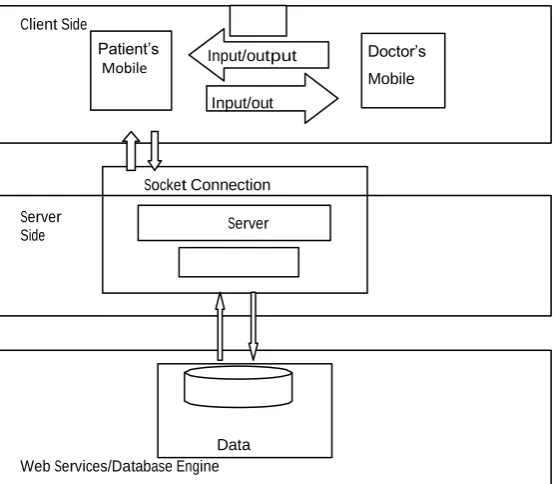
The architecture for a mobile patient-to-doctor chat application is based on existing structure presented in our previous publication. The basic requirements are certain level of infrastructural development which is necessary to facilitate data transfer within and amidst certain hardware devices which include the internet as shown in figure 1.
B. Requirement Specification
The requirement specification includes: The user interface requirement consisting of the mobile phones that are at least WAP or GPRS enabled with battery power and memory capacity. Another requirement is the setup requirement which implements a server. The server performs operations such as authentication and authorization, context extraction. Security requirement needs the database engine that holds personal information of registered clients. The functional requirement entails
mobile operators’ connection access through Wireless Application Protocol (WAP) and General Packet Radio Switch (GPRS).
C. Concepts and components
The concept employed for the development of the model for this work is defined by the protocol and platform used in the implementation. They include: Mobile phones internet connection protocols such as Wireless Application Protocol (WAP), 2.5G and 3.5G protocols. They provide a means of facilitated connection between mobile devices and the internet. JAVA language is the programming language used for implementation. The java programming language tool offers a means of writing scripted applications for the purpose of implementing result driven programs. It is used for the development of applications which are either used by the client tiers or the server tiers as well as interfacing database engines for record purpose. The internet platform is used to provide a functionality of online data processing schemes which mobile users connect to for information. It houses both the server and the client tier applications.
From the architectural design, there are four main component required for the development and
ISBN: 978-988-18210-9-6
implementation of the language translator for medical consultations facility application. They are:
Mobile terminal, that is, the mobile phone which both patients and doctors used for access to this application. It contains micro-controller and memory devices capable of implementing this application.
The second component is Application server typically resides on the server/internet and stores the necessary application for the model functionality. It is responsible for providing authentication, chat applications as well as message switching and data transfer schemes amongst others.
Mobile operators which are GSM service providers that are responsible for providing necessary protocol connection to the internet form the third component.
The last component is Database engine which houses the records of all patients and doctors connected to the language translator facility.
D.The Application Architecture
The modelled architecture is designed to strategically handle logged in users which include both doctor and patient clients. It is aimed at providing a suitable platform which handles a broad base of clients connected to central database. The architecture is based on a generic n-tier service-oriented architecture shown in figure 2.
Client Tier: The client tier consists of the mobile device and the mobile network operator. The mobile device lodges the mobile application allowing it to interact with the server side using the GPRS service provided by the mobile network operator.
Application Server Tier: The application server tier consists of the application server which is responsible for the execution of requests from the client side, processing it and sending the response to the client tier.
Web Services Tier: The web service tier consists of the service registry which manages the health database primarily for authentication and authorization.
Mobile Operator: The mobile operator is responsible for providing the General Packet Radio Service (GPRS), which the mobile terminal uses in transferring data.
Application Server: The application server is responsible for authentication and authorisation, context extraction and message switching transfer
Service Registry: The service registry is responsible for keeping database and it continues to monitor it for any kind of change in information of the patient which has been registered into it.
E. Analysis of the Model
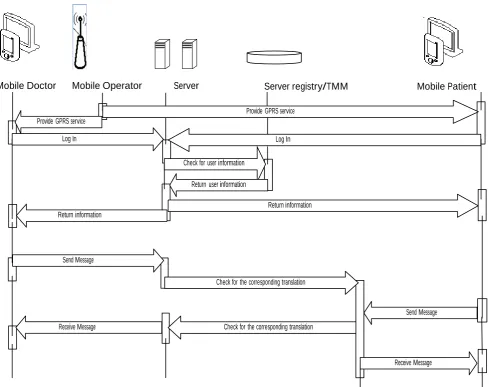
Figure 3 shows the system message flow where the mobile operator provides the necessary connection protocol (WAP/GPRS) which enable client terminals, connect to the server. The user logs on to the server by providing log-in parameters earlier setup and on authentication the user is allowed message request and receipt by the server which performs message switch between the users (patient and physician).
Client Side
Patient’s
Mobile
Input/output Doctor’s MobileInput/out
Server Side
Socket Connection
Server
[image:3.596.45.323.502.744.2]Data Web Services/Database Engine
Mobile Doctor Mobile Operator Server Server registry/TMM Mobile Patient
Provide GPRS service
Provide GPRS service
Log In Log In
Check for user information
Return user information
Return information
Return information
Send Message
Check for the corresponding translation
Receive Message Check for the corresponding translation
Send Message
[image:4.596.61.551.46.433.2]Receive Message
Figure 3: The System Message Flow Sequence Diagram
F. Activity Diagrams
The System Server Activity Diagram
The Mobile Doctor Activity Diagram
Start network connection
Input login credentials
Start the server
Establish connection with a patient
Listen for incoming connections
Otherwise
Reject connection Connection established with a patient
Accept connection
Open chart window
Receive login credentials
Reject login Send & Receive message
Reject login
Listen for messages
Otherwise
End of consultation
Process messages
Send prescription to phamacist if any
Reply messages Close chart window
[image:4.596.331.564.500.725.2]Figure 4: UML Activity Diagram showing the operation of the server
Figure 5: UML Activity diagram showing the operations of the Mobile Physician
ISBN: 978-988-18210-9-6
[image:4.596.61.263.558.724.2]The Mobile Patient Activity Diagram
Start network connection
Input login credentials
Establish network connection
Otherwise
B. The Client Side
[image:5.596.60.293.79.416.2]The client side contains two segments which are Mobile Physician segment and Mobile Patient segment. Both segments of the client section contain the same underlying codes but differ in some classes where extra user interface is used to derive extended functionalities. Figure 7 shows the sign in class field for the client user to enter parameter needed for connection.
Connection established
Receive Language Options
Select Language of choice
Check available doctors
Otherwise
Connection established with a Doctor
Open Chat window
Send & Receive message
Otherwise
End of consultation
Close chart window
Figure 6: UML Activity Diagram showing the operations of the mobile patient
IV. IMPLEMENTATION AND RESULTS
The architectural design for the illustrated model consists of two major sections server/web-services section and client side section.
A. The Server Section
The server section of the program performs the following functions: Accept client information, perform authentication of the client requesting to log on to the site by making routing query calls to the database engine,
accept and create a client’s record through sign-in data
parameter keyed in at the client sign-in form in the mobile phone end, perform data transfer functions of sending and receiving message entered by either one of the patient or doctor client once partners are assigned, perform the assign partner function by a client patient requesting to chat with doctor available on the network
and also perform disconnection functions between the client wanting to leave the chat centre as well as closing all connection to the database engine and performs the necessary socket connections between server programmes written in J2SE classes and client classes written in J2ME classes as well as the database engine.
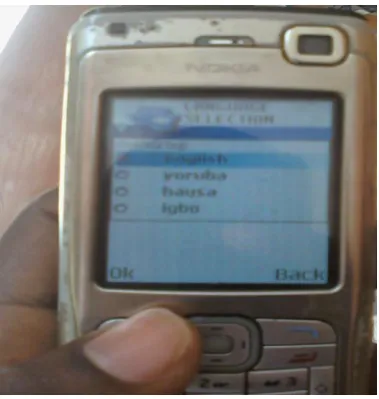
the language option is chosen, it prompts the user to the next user interface: the chat centre. The patient and doctor can communicate with each other by sending text messages on their mobile phones while the server performs message switching functions between both client applications. The patient communicates in his/her indigenous language while the practitioner communicates in English; with both receiving messages in translated form on-line real time.
[image:5.596.311.551.154.377.2] [image:5.596.305.495.549.749.2]V. DISCUSSION OF EVALUATION RESULTS
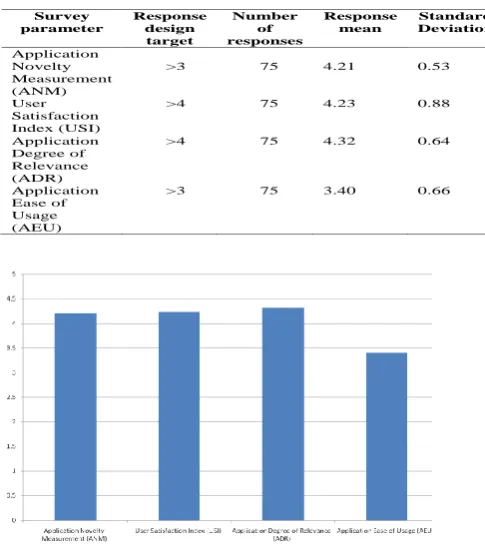
Matrix formulated with Application Novelty Measurement (ANM), User Satisfaction Index (USI), Application Degree of Relevance (ADR) and Application Ease of Usage (AEU), was used to evaluate the mobile e-Health tools developed in this research. Survey targets were set to give objective measurement of adequacy of the software tool based on equivalent parameter. The survey targets were not made known to the evaluators; they were merely set by the researcher to compare with the average rating of medical practitioners’ rating of the tools. Target of any average figure above 3.0 was set for Application Novelty Measurement (ANM) and Application Ease of Usage (AEU) while 4.0 was set as threshold for User Satisfaction Index (USI) and Application Degree of Relevance (ADR).
A total number of 75 medical personnel consisting of 25 Medical Doctors, 30 Nurses, 5 Pharmacists, 6 Medical Laboratory Scientists and 9 paramedical personnel participated in the evaluation. These medical professionals were selected from four healthcare institutions consisting of two tertiary health institutions – LAUTECH Teaching Hospital, Osogbo and Baptist Medical Centre, Ogbomoso; a government secondary care centre – General Hospital, Ogbomoso and an institutional healthcare centre – LAUTECH Health Centre, Ogbomoso all in Nigeria. As shown in Table 1 and Figure 9, evaluation for MuLTool shows the highest rating on Application Degree of Relevance (M = 4.32, SD = 0.64) and least rating on Application Ease of Usage (M = 3.4, SD = 0.66).
Table 1: Summarised evaluation matrix for multilingual tool (MuLTool) for mobile ubiquitous medical consultation
Survey parameter Response design target Number of responses Response mean Standard Deviation Application Novelty Measurement (ANM)
>3 75 4.21 0.53
User Satisfaction Index (USI)
>4 75 4.23 0.88
Application Degree of Relevance (ADR)
>4 75 4.32 0.64
Application Ease of Usage (AEU)
>3 75 3.40 0.66
Figure 9: Graph of evaluation matrix for multilingual tool (MuLTool) for mobile ubiquitous medical consultation
Results show that the tool has a good degree of novelty – above 60%. They are relevant to mobile healthcare provisioning as rated by medical experts – above 80%. Users were satisfied with having tools that can assist medical practitioners in doing their job and patients in accessing medical services anywhere anytime. Equally, an average mobile computing device user finds the tools relatively easy to use as a result of interactive menus embedded in all cases. Apparently, more than 90% of evaluators have never used similar tool as indicated in their response to question asking them if they have used similar tools; proving further the need for this tool.
VI. CONCLUSION AND FURTHER WORK
This work is an integral part of service oriented solution for mobile healthcare provisioning developed at our research centre. The solution includes a real time drug prescription and optional home delivery.
The usage of the complete deployment will help reduce long queues in hospitals, and proffer solutions to barriers such as language, distance and cost in the process of effective health care delivery. Work continues on this solution to further perfect the language translation and extend it to more indigenous languages in Nigeria and other African countries. Further work is also focused on voice-to-text, text-to-voice and voice-to-voice translation in a multi-lingua paradigm to provide solution that would not need textual input from the user. National and international government and non-governmental agency support is needed to develop this work into real life solution.
REFERENCES
[1] D. J. Arnold, Lorna Balkan, Siety Meijer, R.Lee Humphreys, and Louisa Sadler. ―Machine translation: an introductory guide.‖ Blackwells-NCC, London, 1994. ISBN: 1855542-17x.
[2] Olivia Craciunescu, Constanza Gerding-Salas ans Susan Stringer- O'Keeffe, Machine translation and computer-assisted translation: a new way of translating? Translation Journal Volume 8, No. 3 July 2004. Accessed at http://accurapid.com/Journal/29computers.htm, on March 1, 2010.
[3] John Hutchins, The origins of the translator's workstation, Journal of Machine Translation, Volume 13, Number 4 December, 1998, Springer Netherlands, ISSN: 0922-6567 (Print) 1573-0573 (Online), pp. 287-307.
[4] A book chapter accessed at: http://eprints.lancs.ac.uk/59/1/corpora_and_translation.pdf (Last Accessed March 15, 2010). Full reference to the book unknown. [5] W. John Hutchins, Machine translation: half a century of
research and use, Prepared for UNED summer school at Ávila,
Spain, July 2003. Accessed at: http://www.hutchinsweb.me.uk/Avila-2003.pdf (Last Accessed March 21, 2010)
[6] The National Microelectronics Applications Centre Ltd (Ireland), Czech Centrum for Science and Society (Czech Republic), CyberMoor Ltd (United Kingdom), Institute of Communication and Information Technologies Ltd.(Poland), Mainstrat (Spain)
and Power Lake AB (Sweden), ―Study on availability of access to Computer Networks in rural areas Contract No: 30-CE- 0099278/00-78, final report annex A case study fiches,‖
November 2007. Accessed at:
http://ec.europa.eu/agriculture/analysis/external/networks/annex.p df (Last Accessed March 1, 2010).
[7] Osku Salerma, ―Design of a full text search index for a database management system‖, M. Sc. Thesis in the Department of Computer Science UNIVERSITY OF HELSINKI, January 2006.
Accessed at: http://www.oskusoft.com/osku/thesis.pdf (Last Accessed March 21, 2010)
[8] Verbatim et Litteratim, Linguist resources at translations Decoder,
unpublished web document accessed at:
http://www.translationsdecoder.com/linguistresources.htm (Last Accessed March 17, 2010)
[9] Computer Assisted Translation Tools, unpublished web document accessed at: http://www.thelanguagetranslation.com/computer- assisted.html (Last Accessed March 21, 2010).
[10] Ruwan Asanka Wasala and Ruvan Weerasinghe, ―Initial survey on the availability of translation memory tools,‖ PAN Localization Project Project No: 102042, 2007. Accessed at:
http://www.panl10n.net/english/Outputs%20Phase%202/CCs/Sril anka/Papers/2007/0702/Research_Report_on_TMs.pdf. (Last Accessed March 15, 2010).
[11] Francie Gow, ―Metrics for evaluating translation memory software,‖ M.A. Thesis, in the School of Translation and Interpretation, University of Ottawa. Accessed at: http://www.chandos.ca/
Metrics_for_Evaluating_Translation_Memory_Software.pdf. (Last Accessed March 21, 2010).
[12] Wikipedia, “Computer-assisted translation and machine
translation,‖ Accessed at:
http://www.translationdirectory.com/articles/article1629.php. (Last Accessed March 21, 2010).
ISBN: 978-988-18210-9-6
[image:6.596.41.284.374.648.2]