Abstract— Abstract-This research study attempts to review the pedagogical and cognitive aspects in e-learning. Conditioning e-learning system according to the characteristics of knowledge for students involves attitude survey of simultaneously artistic and pedagogical features. The main feature of e-learning systems is the ability to incorporate and deal with various types of contents and react efficiently to the needs of students.
Index Terms— Pedagogical, Cognitive, E-Leaning, challenges, Leaning Content Management
I. INTRODUCTION
E-learning has become an important part of our educational life. Different web-based Learning Management Systems (LMS) have been developed to support the learner in the learning process. Previous learning methods were restricted to access and assimilation of knowledge. A web-based system is a valuable support for face to-face communication as well as a way of transmitting the learning material to enhance the students own studies [22]. The pedagogical techniques, which improves the learning performance, in addition to utilize the learner association in e-learning for constructing and updating the course materials by using high-quality presentation methods, utilize a theme and analogies techniques in exhibit the main information and key concepts, using of the games to view and solve the problem that have a challenge. And construct and organizing the adaptation of course contents according the demand and the needs of learners and ensure to implement a life cycle process for creating and upgrading the course contents [10].
With regards to the evolution and augmentation in e-learning in education sector and, in collaboration with training sector[7], interest in personalization of content delivery, using multimedia for delivering e-learning, broader access to broadband networks, Wi-Fi and 3G mobile networks have magnetize the e-learning domain in the direction of the ubiquitous learning. This leads to create an innovative ubiquitous performance responsive e-learning environment, as example the PEACOCK, (Performance-based E-learning Adaptive Cost-efficient Open Corpus framework), which facilitate an intellectual assortment and
Jabar H. Yousif is with Sohar University, Sohar, Sultanate of Oman, ([email protected])
Dinesh Kumar Saini is with Sohar University, Sohar, Sultanate of Oman, ([email protected])
Hassan S. Uraibi is with University Putra Malaysia.
distant delivery of personalized the media content to e-learners in order to make it the closest to perfection of learning objectives and interests, desirable media content formatting and delivery costs.
The use of such system leads to increase their learning gratification by providing a prosperous media e-learning content those correspondence users’ expectations given substantial cost, device and network constraints [7].
In the context of e-learning framework supports intelligent context and semantic e-learning by fetching the awareness of semantic context in multimedia information processing of learning and learning practices. In addition, it will help to raise awareness of the personality of the learner in supporting the customization of learning development [17]. We can examine that the design of intelligent educational model needs to be implemented on three stages for the establishment of a model for e-learning scenario based on the semantic, which can be brought to the presence of trainer of the educational process or without a trainer led by the learner himself. The first phase, a phase of pre-learning process and you need to work on the preparation of learners and trainers alike. The second phase is the process of learning, involving different types of learning activities such as determining the educational materials and reading materials and writing ideas that helps to raise the standard of learning, and give the area of the joint debate to increase understanding and exchange of experiences and information, and then self-assessment and review, [8]. The final stage is the stage after the learning process, which includes the reporting and assessment of learning outcomes on both sides of the learning process the learners and the trainers [21].
II.ADAPTIVE LEARNING APPROACHES
Adaptive Learning is one of the methods of education that uses computers and interactive learning. Computers are equipped with educational material displays the information needed by the students and focus on addressing weaknesses in the topics that students could not understand properly, which was reflected by their answers on a sheet of questions [18]. And then allowing the teacher to give students the marks they deserve after the actual exam performance through e-learning and increase the amount of interaction given to the student by the teacher through inquiries or discussions. The use of technology in this type includes aspects from various fields including the study of Computer Science, Education and Psychology [11].
Artificial Intelligence in E-Leaning-Pedagogical
and Cognitive Aspects
A. Intelligent tutoring systems
Intelligent tutoring system (ITS) is educational application which used the implantation of intelligent learning agents’ to supervise the teaching process to get a high performance of a learner. Besides, it helps to customize training on the strength of alteration to learner’s learning approach and decide the teaching level and policy [18]. Adaptive hypermedia (AH) is also another type of system which was also used in computer based instruction. However, Adaptive hypermedia is best suited for the instruction of concepts whereas ITS assists in the use of these concepts to solve problems. After combing both ITS and Adaptive hypermedia (AH) the e-learning system will become more adaptive. This paper describes a conceptual for combining ITS and AH in to adaptive Intelligent tutoring system for e-learning systems which support the independent of the knowledge domain, storage of transfer knowledge relation ships and prerequisite knowledge relationship. IT’S evaluated each learner’s action individually according to interactive environment of training and utilizes new courses models which are suitable for of their ability of thinking, talent and knowledge. ITS system is composed of three type of knowledge’s, organized into four separate modules.
The expert model is a computer program that stores and retrieves knowledge in an easy and efficient method. It is must possess the ability to display knowledge of a number of different topics (declarative knowledge), as well as the ability to solve problems (procedural knowledge). Moreover, the expert model used the information available in the knowledge base in order to compare the actions of the learner and limitations that restrict the learner in order to assess the level of the learner and to determine the quality and trends of the knowledge possessed by the learner. As well as determine the types of information that learner has not known yet.
B. Conjunction of technical and pedagogical aspects
Hypermedia Systems is a system that supports developing models on a typical user and concepts to create a suitable learning environment. As well as, it to be able to decide what is appropriate contents of knowledge and the type of navigation required. Hypermedia placed with the user models which used to provide the best service. It will be given to the learner in the system of Hypermedia offer education specifically designed to the type of knowledge of the learner or her relationship with the topic you offer, In addition it presenting the possibility to propose a set of links related more to the training subject which gives the learner the ability to proceed.
Selection of taxonomy of learning methods to classify the user according to the type of knowledge they possess. The user model is designed based on some parameters by which they can identify and diagnose the needs of the learner and meets the interests and the difficulties faced by the user, and logically should match the system according to the data and adaptation. In order to obtain an accurate classification for the user, some systems implement dynamic accommodations
which analysis the individual behavior of the learner when dealing with the system. This only in order to infer the learning style must be appropriate for a learner and accommodate their needs. Other systems as well as apply an assessment tool to discover the level the learner for the purpose of classification of learning style manner. Such systems may uses questionnaires on the basis of classification of the learner in different categories or patterns of learning or it can be used questionnaires developed by the users themselves to determine their preferences. The system which accommodates dynamic selection of user learning style has one difficulty. It is complicated to conclude what student’s actions are indicative of their learning style. One of the disadvantages of the use of systems based on questionnaires to determine the user's learning style is the problem of reflection. As one of the solutions to overcome this problem is modified some of the questions in the questionnaire based on the user's request and the level of learning in order to exactly reflect the true level of the user, which gives more credibility and reliability of the questionnaire. Feijoo.net is a system developed in university of Oviedo, which uses the CHAEA test for determining the learning style, classify in to four: Active, Reflexive, Theoretical and Pragmatic.
C. Fuzzy user modeling
Another approach is fuzzy user modeling [1] for an adaptive system which represents the user knowledge (who the learner is) and utilized alteration to regulate the scheme of training to the user (how to train.). Moreover, it deals with uncertainty in the explanation of knowledge.
The researchers divided the adaptation system into three parts, the first unit of the user, and then determine the domain of the system and finally unit adaptation. And must possess the ability to adapt the system in order to determine the scope of evidence of education, knowledge of individual users, and monitor the amount of progress made to learn.
In domain model, they have specify the teaching domain as a set of fixed domain concepts, and then determine the learning dependencies connecting to the concepts which they can be symbolized in a set of ordered indispensable relation R. in case of two domain concepts are associated (Ci<Cj), then the first concept (Ci) must be defined clearly in order to understand the related concept (Cj). In other word we can say the first concept Ci is a precondition of the concept Cj. The acyclic graph can depict the domain concepts that configured in order as GD = (C, R) where C is the set of domain concepts and R represent the prerequisite relation on the domain concept. The user knowledge of the domain concepts can be described by defining three sets of fuzzy attribute include the unknown, known, and learned concepts. Therefore, the user knowledge of a domain concept can be depicted by defining values of association functions for the three fuzzy sets as a triple relation.
(µU(c), µK(c), µL(c)) or (µU, µK, µL)
requires that new relationships are added to link this knowledge. On the other hand, when the user provides weak performers, it cannot reduce the knowledge. Therefore, for each concept, can increase the value of membership function for a set of concepts learned, and reduce the value of membership function of all these concepts is not known, or both can remain as is. In this way, the value of a function of knowledge of the concepts will be increased and maintained
their level at its highest value [20].
To determine the user's knowledge and periodically update the user model is initialized using tests to examine how to learn a particular concept by providing a set of interview questions when you test each unit of learning. After passing the learner's test is added this concept to current knowledge, and if you did not respond to test questions in a satisfactory manner, the value of knowledge of this concept is not changed.
D. Learner profiling and learning resources
The majority of e-learning systems model the learner [16] as an entity accompanied by a static predefined set of interests and options, without giving the appropriate attention to their needs. In this study, they determine the learners’ interests through a pre-evaluation process, monitoring their progress and filtering the offered educational material according to those interests. Based on this approach, authors propose an e-learning environment in the framework of SPERO (SPERO) that adapts to the learner’s ICT level and knowledge.
Firstly, they have used the electronic questionnaires (e-questionnaires) designed by field experts aiming at detecting the learner’s ICT level and learning preferences prior, during and after the learning process. Learners’ preferences are utilized for personalization of the multimedia educational content offering and retrieval process, aiming at suitable content delivery through the integrated e-learning system. For more accurate and reliable profile extraction, a novel clustering algorithm is also implemented within the profiling procedure. Taking into consideration learners’ answers to the above mentioned questionnaires, statistical information is analyzed and evaluated.
E. AI techniques
Adaptive e-learning according to the individual student skills through AI techniques has embedded instructional design theories as well as learning and cognition theories in to e-learning environment. Today, most learning concepts are available synchronously and asynchronously in a multi different ways of representation. To pick up the most appropriate for a specific course, which empowers students learning as well as teacher’s course preparation and delivery, a smart e-learning vision is used. This will help student in their cognitive goals, developing skills for self monitoring, problem comprehension and organizing knowledge. It also guides teachers to set their course objectives, understand the student’s cognitive models and present the concepts according above.
The model of the smart learning focuses on the student, the teacher and the material. An individual student model must be maintained and learning materials must be composed of and small granular multimedia objects, referred to as learning objects. Student models should be used for tailoring the teaching strategy and dynamically adapting it according to the student’s ability and previous knowledge. However, learning objects must be designed to suit specific individual student may be drawn from learning object repositories. Learning object repositories (LOR) are specified using standard metadata formats, such a SCORM and IEEE LOM [19].
Smart e-learning environment is composed of two processes. They are teacher apprentice for authoring (TAA) and tutor apprentice for delivery (TAD). Bloom’s instructional design theory is used to adjust the course objectives and organize course materials whereas, Felder and Silverman learning style theory is used for adapting course delivery according to each individual student model.
The extra attribute which is used to classify the learning objects in to two categories-namely, expositional and assessment objects. The other attribute is suggested to specify an learning object (LO) according to recall level which consist introduction, overview, definition, fact, remark, remembering example, understanding level which consist explanation, description, illustration, comparison, summary, conclusion , understanding example and applying level which consist of theory , rule, procedure, algorithm, exercise, case study, real world problem and applying example. Teaching strategy is a third attribute which is used for expository or inquisitor presentations. A fourth attribute is the instructional role, whose suggested values satisfy effective strategies supporting the first three level of revised Bloom’s levels. Smart e-learning, learning object supports global/sequential, Sensing/Intuitive and Visual/Verbal based on Felder and Silverman model.
III. PERSONALIZED LEARNING
Personalized Learning is the tailoring of Pedagogy, curriculum and learning support to meet the needs and aspirations of individual learners [5].
A. Knowledge driven model for personalization
Uses a knowledge model [16]) and concept map approach will enhance the learning experience and development by creating a platform for continuous dialogue between learners and sources of knowledge.
technique of data analysis and knowledge representation based on concepts of mathematical theory. FCA’s mathematical semantics can be used to utilize and modified the concept map approach in order to extend its application to e-learning.
B. Vector space models for user modeling
The user model is one in which we collect a small number of definite facts about the person and then invoking knowledge about the groups to which the person belong [9]. The recommendation system is the first user modeling system. Therefore, there are multiple users modeling system as the initial development.
To develop a modeling system of merit in the use of a prerequisite must be involved sufficiently distinct. Information present within the user models is used to determine the level of knowledge and experience of the student in various areas, and the subject and related subjects course of their studies.
The Representation technique for user modeling is used a non-hierarchical modules (stereotype) and vector space models. A collection of typical user attributes are collected together into a stereotype. Each module in the hierarchy contains a set of attributes connected with a specific subset of users.
In each class of students a number of individual student groups were determine to analyze the data fed by the user modeling component. The grouping system can be constructed by consider each user as a vector model in an n- dimensional space. The Euclidean distance algorithm is used to calculate the distance between any two users in weighted n- dimensional.
IV. APPLICATIONS
A. Self regulated learning and problem based learning Web enabled self regulated learning [22] and problem learning occurs with those students who have not achieved the higher grades to enter the specialization required in the national universities or in the traditional, while it is to accept students with scores relatively low in private professional collages.
Online learning differs from educational presentation, where the student has little chances to move away from the teacher’s presentation of the material. As can be seen that the number of students in professional colleges use the Internet more of students in public universities. This can represents a significant challenge for teachers to help students in professional institutes to participate in an online course in an environment full of things that attract students to study outside where there is a range of shopping sites and online games for free. The use of Self-regulated learning can helps students to develop habits of learning. In order to further motivate students to learn and develop practical skills, learning is based on a problem and one of the most appropriate solutions.
The involvement is of one of the effective means to
improve the ability of university students in all aspects of development and cognitive and affective. Based on the peculiarity of SRL, It is believed that students learning about the complex and difficulties in science fields using Hypermedia will be more successful if they devote themselves to a series of repeated cycles of activities, cognitive and metacognitive central in learning and knowledge building. Learning based on understanding of the problem is the way of teaching that can engage students in the development of learning activities through the use of professional practice issues such as motivation, and determine the starting point and focus on learning based on the problem.
To measure differences in student participation in learning under different conditions have been studied and tested by multiple researchers [6]. You can use the concepts of statistics, including the T-test to compare continuous variables between the two groups. From the results indicate that participation in learning in the PBL with an initiation set was much higher than those in PBL without an initiation set. Consequently it is authenticate that the possessions begin to engage the student in an online course were positive and higher than that with enable the PBL Web environment. A. Fuzzy based professional learning modeling
The proposed model, namely [14] fuzzy logic-based professional learning modeling(FL-PLM), was built from a cascade mode of five fuzzy inference systems, each model used to depict explicit attribute of professional learning. According to findings of H-PLM, i.e., a heuristic model of professional learning [14], climate and planning were deeming to be its two key parameters. Work conducted by using eleven variables were engaged to representation the latter and provided as the structural basis for the fuzzy logic-based expert learning modeling (FL-PLM) method. The examination of the fuzzy logic-based expert learning modelling (FL-PLM) method on some data, exposed the efficiency of the proposed model to utlize a huge number of parameters and variables and deducted upon them to construct results that correspond with the findings of the H-PLM qualitative approach on the same data set thus provided us with an alternative quantitative approach to appraise professional learning.
B. Fuzzy automata in learning system
The proposed model characterizes a nonsupervised learning system, where the learning division comprises of a combined fuzzy machine. The performance assessor provides as an untrustworthy “teacher” who attempted to educate the student (the learning division and the decision maker) to construct accurate decision. The decision implemented by the decision maker is deterministic [23].
interesting or favorite reply. The system can documents all e-learning historical data for each user during the training process or Q/A phase, including the questions of matching records and answers. An additional scheme to obtain the knowledge requirement of users is by analyzing their behavior in the reading process [23]. The reading behaviors comprise a certain actions such as underline, highlight, circle, annotation and reference. For the sake of recording the movements of the learner behavior, the behavior table is used. The matrix of behavior and weight matrix is used to record for the relative quantity of each topic. These matrix can be used later to determine the level of knowledge requirements of each user on the ontology of course.
One of the ways to represent the course ontology is used a directed graph that defines the relation of the title of a chapter and a section in the course, or by using the course content. And these relations can be categorized by the instructor number. In order to accumulate the interactive question and answers the board structure is produced according to the course ontology topics. For each question, a lot of answers can be generated. The Q/A space is built by collecting the posted and answered questions of each user on the corresponding boards. The knowledge requirement of each user is determined based on each questioning the Q/A space and each idiom in the course ontology.
In order to determine the knowledge requirement of each user about the course ontology from reading behavior logs, we classify the e-documents read by user based on the course ontology [23]. Then we record the reading behavior data for each user including actions like the number of underlines (UDL), the number of highlights (HLT), the number of circles (CIR), the number of annotations (ANT) and the number of bookmarks (BMK), and store them in two dimensional tables. Then we construct the weight matrix on the basis of these for each user. We calculate behavior of each user with respect to every document.
Knowledge requirement of the users, two experiments are designed and implemented. First data is collected from user’s Q/A logs and other data is collected from reading behavior log. These data are collected from 10 students majoring in artificial intelligence. The result shown that knowledge requirement of each student acquired from the Q/A logs and from the reading behavior logs are consistent. Thus, the experimental results show that the two proposed approaches can capture the knowledge requirement of the users precisely in the e-learning systems.
V.E-LEARNING EVALUATION
The affective interactions between user and computers are still release research concerns due to the complexity and interdependency of the dynamic interactions user machinery [12]. In spite of last-decade progressions in philosophy associated to usability design, there is still an ever-present require to better understand user-technology relationship to achieve work-related tasks at operational and strategic levels within organizational dynamics. In addition, community attitudes, favorites, physical and cognitive abilities and
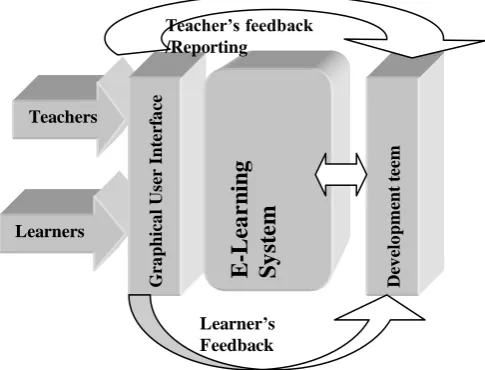
positions require more innovative techniques to design user experiences. The gathering and analysis of technical reports and users' feedback are required effective methods and tools. This situation makes e-learning evaluation process a complex task [11]. Furthermore, understanding of an evaluation outcome involves an extra set of skills. Figure 1 shows the main aspects to consider when evaluation e-learning experiences.
[image:5.595.308.551.225.410.2]The acceptance and usage of a system by the users are addressed the usability and accessibility of system performance. The performance and satisfaction will incite the initiatives for enhance or utilize new developments at operational and strategic levels. These include the following:
Fig. 1 E-learning interactions scheme
The acceptance and usage of a system by the users are addressed the usability and accessibility of system performance. The performance and satisfaction will incite the initiatives for enhance or utilize new developments at operational and strategic levels. These include the following: A. Evaluating People-Related Issues
The learning styles are an important stage that influences the learning process. Many researchers consider learning style as a key component to design and evaluate effective and satisfactory education oriented methodologies [2,3,4] . The majority of researcher’s findings are not convincing and often contradictory concerning the effect of learning styles on outcomes of e-learning [4]. Nevertheless, the measurement of learning styles is complicated and time-consuming, since it is evaluated using questionnaire or psychometric test.
B. Evaluating Instruction-Related Aspects
Since the framework is instruction and design (methodology, content, and tasks), so an attention to the allocation of organizational resources must paid to learning content creation and updating.
C. Evaluating System-Related Aspects
The responsibility of an e-learning system is an intermediary mediator between teachers and learners. Therefore the e-learning system must design to be effective.
Teachers
Learners
G
ra
p
h
ica
l
Us
er
I
n
te
rf
a
ce
E
-Le
a
r
n
in
g
S
y
ste
m
De
v
elo
p
m
en
t
te
em
Teacher’s feedback /Reporting
Effectiveness is concerned with learning objectives, methods, and usability goals. Efficiency is concerned with measuring the usage of resources to achieve defined objectives. [11].
VI.CONCLUSION
Artificial intelligence techniques are reviewed and analyzed including pedagogical and cognitive aspects in e-learning environment. Today the offer of e-e-learning courses is increasing at an unrestrainedly pace. However, the learning experience is often perceived by the user as a one-way highly constrained communication process, where the computer is only the mechanical device that conveys the content. How is actually get the user content is totally absent in this E-learning interaction. The art of designing good e-E-learning systems is difficult and is of great challenge for the human mind. The way this is done is also dependent on the learning culture in each country. The key issue is to facilitate new learning modalities for younger generations. This is like a self-learning process where previous goals undergo continuous changes.
REFERENCES
[1] Alenka, Kavcic, “Fuzzy User Modeling for Adaptation in Educational Hypermedia”, IEEE Transactions On Systems, Man, And Cybernetics-Part C: Applications And Reviews, Vol. 34, No. 4, pp. 439-449, November 2004.
[2] Atkins, H., et al. (2000). Learning style theory and computer mediated communication. World Conference on Educational Multimedia, Hypermedia & Telecommunications, 2001(1), 71–75.
[3] Bajraktarevic, N., Hall, W.&Fullick, P.(2003). Incorporating learning styles in hypermedia environment: Empirical evaluation. Retrieved
June 2004, from
http://www.is.win.tue.nl:8080/ah2003/proceedings/www-4/.
[4] Bernardes, J., O'Donoghue, J. (2003). Implementing online delivery and learning support systems: Issues, evaluation and lessons. In C. Ghaoui (Ed.) , Usability evaluation of online learning programs (pp. 19–39). Hershey, PA: Idea Group Publishing.
[5] Chao Boon Teo and Robert Kheng Leng Gay, “A Knowledge-Driven Model to Personalize E-Learning”, Journal of Educational Resources in Computing, ACM, Vol. 6, No.1, pp. 1531-4278, 2006.
[6] Chia-Wen Tsai, Pei-Di Shen, “Applying web-enabled self-regulated learning and problem-based learning with initiation to involve low-achieving students in learning”, Computers in Human Behavior, Elsevier, pp.1189-1194, 2009.
[7] Cristina Hava Muntean, and Gabriel-Miro Muntean, “Open corpus architecture for personalised ubiquitous e-learning”, Personal and Ubiquitous Computing, Springer Verlag, ISSN:1617-4909, Volume 13 , Issue 3 Pages: 197 - 205, 2009.
[8] Ebru Özpolat, Gözde B. Akar,”Automatic detection of learning styles for an e-learning system”, Computers and Education, Elsevier, pp. 355-367, 2009.
[9] Eleni Mangina, John Kilbride,”Utilizing vector space models for user modeling within e-learning environments”, Computers and Education, Elsevier, pp. 493–505, 2008.
[10] Fathi Essalmi, Leila Jemni Ben Ayed, Mohamed Jemni, Kinshuk, Sabine Graf, “A fully personalization strategy of E-learning scenarios”, Computers in Human Behavior, Elsevier, pp. 581-591, 2010.
[11] Garrett, B. M. (2004). Employing an experimental approach to evaluate the impact of an intelligent agent. Interactive Technology & Smart Education Journal, 1(1), 41–53.
[12] Horvtiz, E., & Apacible, J. (2003). Learning and reasoning about interruption. Proceedings of the 5th International Conference on Multimodal Interfaces, November 5–7, 2003(pp. 20–27). New York: ACM Press.
[13] Ma del Puerto Paule Ruiz, Ma Jesús Fernández Díaz, Francisco Ortín Soler, and Juan Ramón Pérez, ”Adaptation in current e-learning systems”, Computer Standards & Interfaces 30, Elsevier, pp. 62–70, 2008.
[14] Maria N. Gravani , Sofia J. Hadjileontiadou ,Georgia N. Nikolaidou , Leontios J. Hadjileontiadis, “Professional learning: A fuzzy logic-based modelling approach”, Learning and Instructions, Elsevier, pp. 235-252, 2007.
[15] Meilun Shih , Jui Feng , Chin-Chung Tsai , “Research and trends in the field of e-learning from 2001 to 2005: A content analysis for cognitive studies in selected journals”, Computers and Education, Elsevier, pp. 955-967, 2008
[16] Paraskevi Tzouveli , Phivos Mylonas, Stefanos Kollias, “An intelligent e-learning system based on learner profiling and learning resources adaptation”, Computers and Education, Elsevier, pp. 224-238, 2008 [17] Paul Lefrere, “Activity-based scenarios for and approaches to
ubiquitous e-Learning”, Personal and Ubiquitous Computing, Springer Verlag, ISSN:1617-4909, Vol 13 , Issue 3, pp. 219 – 227, 2009. [18] Pipatsarun Phobun, and Jiracha Vicheanpanyaa, ”Adaptive intelligent
tutoring systems for e-learning systems”, WCES, Procedia Social and Behavioral Sciences, Elsevier, pp. 4064–406, 2010.
[19] Weihong Huang, David Webster, Dawn Wood and Tanko Ishaya,”An intelligent semantic e-learning framework using context-aware Semantic Web technologies, British Journal of Educational Technology”, Vol. 37, No 3, pp. 351–373, 2006.
[20] William G. Wee, K. S. Fu, “A Formulation of Fuzzy Automata and its Application as a Model of Learning Systems”, IEEE Transactions on Systems Science and Cybernetics, Vol. Sec-5, No. 3, July 1969. [21] Won Kim, “Using Technologies to Improve E-Learning”, Journal of
Object Technology, Vol 7, No 8, December 2008.
[22] Xin-hua Zhu, “Designing an open component for the Web-based learning content model”, Journal of Educational Technology & Society, IFETS, Vol. 8, No. 2, pp.1436-4522, 2005.