Wilton Park House Wilton Place Dublin 2 Ireland
Tel: +353 1 607 3000 Fax: + 353 1 607 3030 Website: www.forfas.ie Email: [email protected]
F
o
rf
á
s
A
n
n
u
a
l
R
e
p
o
rt
In accordance with the Official Languages Act2003this publication is available in Irish.
Forfás Annual Report
2005
Forfás’
mission is to inform and to build
coalitions for change which will influence and
underpin implementation of ambitious,
coherent and widely understood enterprise,
science and innovation policies.
These policies will promote competitiveness and
support creative and dynamic management
teams and individuals to establish and grow
innovative and successful companies in Ireland.
In this way,
Forfás and its sister agencies will
support Government in improving the economic
opportunities for Ireland’s people and,
1
F o rfá s A n n u a l Re p o rt 2 0 0 51993 31 December 2005.
1993, 31
2005,
Chairman
Forfás is the national policy and
advisory board for enterprise,
trade,
science,
technology and innovation
To the Minister for Enterprise,Trade and Employment
Pursuant to the Industrial Development Act, , Forfás herewith presents its report and accounts for the year ended
Do Aire Fiontar,Trádála agus Fostaíochta
De bhun an Achta um Fhorbairt Tionscail, tá a thurascáil agus a chuntais don bhlian dar chríoch Nollaig, a dtíolacadh leis seo ag Forfás.
Martin Cronin
Chief Executive
Forfás provides research & administrative support
T
IR
ISH
OWNED ENTER
PRIS
E
INW
W
A
RD INVESTM
T
EN
T
S
C
IE
N
T
IF
IC
R
ES
EA
RC
H
ENTERPRISE TRADE SCIENCE TECHNOLOGY INNOVATION
PO
LIC
Y
AN
A
LYLY
S
IS
A
N
D
A
D
V
V
V
I
C
C
E
Minister for
Enterprise, Trade
and Employment
Cabinet Committee
on Science, Technology
& Innovation
The NCC reports to theTaoiseach on key competitiveness Issues
The EGFSN also reports to the Minister for Education and Science
ADVISORY COUNCILS
3
Functions
Forfás is the national policy and advisory board for
enterprise, trade, science, technology and innovation. It
is the body in which the State’s legal power for
industrial promotion and technological development
has been vested. It is also the body through which
powers are delegated to Enterprise Ireland for the
promotion of indigenous industry and to IDA Ireland for
the promotion of inward investment. Science
Foundation Ireland was established as a third agency of
Forfás in July 2003. The broad functions of Forfás are to:
Advise the Minister on matters relating to the development of industry in the State;
Advise on the development and coordination of policy for Enterprise Ireland, IDA Ireland, Science Foundation Ireland and such other bodies
(established or under statute) as the Minister may by order designate;
Encourage the development of industry, technology, marketing and human resources in the State;
Encourage the establishment and development in the State of industrial undertakings from outside the State; and
Advise and coordinate Enterprise Ireland, IDA Ireland and Science Foundation Ireland in relation to their functions.
Feidhmeanna
Is é Forfás an bord comhairleach agus polasaí náisiúnta
do fhiontar, thráchtáil, eolaíocht, theicneolaíocht agus
nuálaíocht. Is é an comhlacht ina bhfuil cumhacht
dlíthiúil an Stáit dílsithe i leith tionscail a chur chun
cinn agus forbairt teicneolaíochta. Is é an comhlacht
freisin trína thiomnaítear cumhachtaí go Enterprise
Ireland chun tionscal dúchais a chur chun cinn agus do
IDA Ireland chun infheistíocht isteach a chur chun cinn.
Bunaíodh Science Foundation Ireland mar thríú
gníomhaireacht de Forfás in Iúil 2003. Is iad na
feidhmeanna leathana de Forfás ná chun:
Comhairle a thabhairt don Aire ó thaobh cúrsaí a bhaineann le forbairt tionscail sa Stát;
Comhairle a thabhairt maidir leis an bhforbairt agus an gcomhordú de pholasaí do Enterprise Ireland, IDA Ireland, Science Foundation Ireland agus d'aon chomhlacht eile dá leithéid (bunaithe nó faoi reacht) mar a d'fhéadfadh an tAire a thiomnú de réir ordaithe;
An fhorbairt de thionscal, theicneolaíocht,
mhargaíocht agus acmhainní daonna a spreagadh sa Stát;
An bunú agus an fhorbairt sa Stát de ghnóthais tionsclaíochta a spreagadh ó áiteanna lasmuigh den Stát; agus
Enterprise Ireland, IDA Ireland agus Science
5
F o r f á s A n n u a l R e p o r t 2 0 0 5
Contents
Forfás Board Members
6
Statement
of the Chairman and Chief Executive
7
Statistical Overview
11
Activities in
2005
19
The Irish National Accreditation Board
47
Statutory Obligations
51
Forfás Management
Structure and Advisory Councils
53
Publications
2005/2006
60
Forfás Board Members
1
2 3 4 5
6 7 8 9
13
10 11 12
14
1 Mr Eoin O’Driscoll,Chairman 8 Mr Rody Molloy
Managing Director, Aderra Director General, FÁS 2 Mr Martin Cronin 9 Mr William O’Brien1
Chief Executive, Forfás Managing Director, William O’Brien Plant Hire Limited
3 Mr Sean Dorgan
Chief Executive, IDA Ireland 10 Ms Anne Heraty1 Chief Executive 4 Mr Sean Gorman
Computer Placement Resources (cpl) plc Secretary General,
Department of Enterprise, Trade 11 Mr Frank Ryan
and Employment Chief Executive, Enterprise Ireland
5 Dr William Harris 12 Dr Don Thornhill
Director General, Chairman,
Science Foundation Ireland National Competitiveness Council 6 Mr PatBarry1 13 Ms Jane Williams
Communications Advisor Managing Director, The Sia Group 7 Dr Rosheen McGuckian 14 Mr Michael O’Leary
Chief Executive Officer, GE Money Secretary to the Board
The following members retired from the Forfás Board in December 2005:
Forfás Audit
Committee
Prof. Michael Hillery, Emeritus Professor of Engineering, University of Limerick Ms Jane Williams, Chairman Mr William Murphy, Partner, Tynan Dillon and Company Dr Rosheen McGuckian Mr Feargal O’Rourke, Partner Taxation, PricewaterhouseCoopers. Mr Eoin O'Driscoll
Mr William O'Brien
2 0 0 5
7
Chairman
F o rfá s A n n u a l Re p o rt
Statement
of the Chairman and Chief Executive
Mr Martin Cronin
Chief Executive
Economic Performance
The Irish economy performed very well in 2005.GNP is
estimated to have grown by 5.4 percentin 2005 compared
with an OECD average of 2.7percent.Rapid growth has
lifted income per capita in this country to among the
highestin the world.Provisional figures for 2005 indicate
thatGNP per capita reached €31,741,placing Ireland
above the EU average.
Total employment reached 1.98 million by the end of 2005, while the labour force is expected to exceed two million for the first time during the summer of 2006. The public finances are in a strong position.
There have been changes in the drivers of Ireland’s growth in recent years. In the early years of the “Celtic Tiger” growth was driven by a strong performance in exports. In more recent years, however, Ireland’s growth has largely been driven by increases in consumer and Government spending and the growth of the construction sector.
We are a small open economy and we need to continue to focus on building success in international markets, as exports will continue to be a vital determinant of our longer term success. Enterprise Ireland’s new strategy for internationalisation, export growth and industry led research and innovation reflects this reality. So, while overall economic performance remains strong, Ireland now faces an unprecedented challenge to sustain its performance into the future.
Today’s challenges
Globalisation
In today’s increasingly globalised economy, firms, capital and skilled people are increasingly mobile, and can be attracted by low cost, proximity to markets, access to rapidly growing economies, and – in the case of skilled people – by a high quality of life.
This opens up new opportunities for Ireland access to new markets and to lower cost goods and services. However, we face more intense competition for market share, for skilled people and in the attraction of investment. Many parts of China, India, South East Asia and Central Europe now also target the kind of high tech manufacturing and service activities that have driven Ireland’s growth over the last 15 years.
Continuing Importance of Manufacturing
The Irish manufacturing sector, both indigenous and foreign owned, is a substantial contributor to our economy. It employs 220,000 people and spent over €25 billion on payroll, services and raw materials in the Irish economy in 2004. In the same year manufacturing exports were valued at €84.3 billion. Manufacturing has been a key component of the Irish economy over the past two decades of growth and will remain a very significant contributor to exports, employment and economic growth in the future. While acknowledging the central
importance of manufacturing in driving productivity and prosperity in Ireland, it is important to understand the considerable changes underway globally and their implications. Ireland is strong enough in modern manufacturing to consolidate its position, while at the same time building up new areas of capability and competitive advantage.
Growing Importance of Services
Services activities take on increased importance in more developed economies and we are already seeing this shift in emphasis in Ireland’s economic structure. One third of Irish exports are now derived from internationally traded services, largely generated by foreign subsidiaries based in Ireland.
We are also seeing the impact of the increased
internationalisation of services on the high proportion of Irish enterprise that operates in the domestic market. Historically this sector operated in a relatively sheltered regulatory and competitive environment, but today, international chains across a range of sectors present locally trading indigenous companies with intense competition. However, this trend also presents an opportunity for a growing group of Irish service companies to pursue similar overseas direct investment strategies to deliver their services locally in foreign markets.
9
F o rfá s A n n u a l Re p o rt 2 0 0 5Addressing the Challenges
As Ireland aims to become a truly knowledgebased economy, we must continue to enhance our
competitiveness building from competitive costs, high skills and low tax. As a developed economy, we need to
Build a partnership approach and improve collaboration across industries, education and government; Build a focused research and development capacity; Improve productivity; and Develop more advanced and pervasive education to support innovationoriented enterprise.
Collaboration
In this new phase of Irish economic development, Forfás believes that a collaborative approach to innovation oriented economic growth is required. Significant responsibilities lie in the hands of, among others, the managers and employees of individual firms,
educationalists, industry associations and trade unions to promote company capabilities in international sales and marketing, imbue an innovation culture and drive efficient provision of higher value goods and services.
The State also has an important role. A Government strategy to promote competitiveness and growth through innovation in enterprise remains as relevant as ever. Ireland needs joined up public policies that proactively reinforce specific business activities where Ireland can become a significant player in an international context.
Within the family of development agencies, there will be an increasingly critical role in facilitating the creation of networks, enterprise and trade associations, innovation and technology centres that provide an infrastructure for enterprise to drive its development and to take the lead on cross cutting issues.
Science and Technology – The Foundation
The rapid rise in our cost base in recent years is forcing us to accelerate our transition from relatively labour intensive, low value activities to an economy dominated by knowledge intensive, higher value activities.
The Government’s Strategy for Science and Technology, will set out a roadmap to optimise the economic and societal benefits of Ireland’s considerable investment in scientific research. The investments already made and committed to by Government are now beginning to show results and a focused Strategy will reinforce a research driven culture, enhance the capacity of research
institutions to plan strategically and develop their research strengths. This focused approach will help us achieve the goal of sustaining levels of competitive performance in line with the world’s best.
If we wish to compete on knowledge we must be better, not only at undertaking research, but also at innovating and operating businesses which span the value chain from opportunity identification to product and service development and commercialisation.
Productivity and Innovation – Maintaining
Competitive Advantage
It is crucial that Ireland has the policies to underpin productivity growth which will ultimately be the long term determinant of our competitiveness. Our ability to catch up with the living standards of the world’s richest regions will depend less on increasing employment and more on increasing the productivity of those at work across all sectors in the economy. As services continue to play a greater role we must develop our understanding of what drives innovation and productivity increases in the services sector and put in place appropriate policy and programme initiatives.
Education and Enterprise – A Partnership
Without doubt Ireland’s education system, primary, secondary and tertiary, played a fundamental role in our economic transformation. The responsiveness of our education system is critical to our future successes. More and different skills are required to generate innovative new ideas and exploit technological change. High performing economies and societies will increasingly rely on a labour force which engages in continuous learning and adaptation. The Enterprise Strategy Group Report,
Ahead of the Curve, cited world class skills, education and training as one of the key areas of potential advantage for Ireland.
Today’s high value enterprises require advanced and pervasive education to succeed. It is fair to say that both enterprise and the education sector share the goal that people should become all they are capable of being – and this goal is best achieved through more pervasive education.
There are four principles which Forfás believes should inform the national approach for the future role of education. We must:
Commit to both adequate investment and teaching excellence in our education system;
Demonstrate these commitments across the entire education system right through from primary to fourth level;
Recognise the growing interdependence, in the best sense of that word, of enterprise and education; and
Upskill the existing workforce and raise overall education levels.
We have some way to go in relation to lifelong learning. The initiatives being undertaken in this area to improve educational access are welcomed, but we need a continued focus on this topic. The lower skilled must not be left behind in our move towards a knowledge economy.
Acknowledgements
In its day to day work Forfás itself relies heavily on a partnership approach for success. Our achievements during 2005 were based on collaboration and we would like to acknowledge the contributions of many people and organisations throughout the year. Firstly, the Taoiseach, Mr Bertie Ahern TD, and Mr Micheál Martin TD and Minister for Enterprise Trade and Employment and other Government Ministers and Departments.
The development agencies, Enterprise Ireland, FÁS, IDA Ireland, Shannon Development and Údarás na Gaeltachta all contributed in their respective areas in supporting Ireland’s enterprise base and the work of Forfás. Science Foundation Ireland, the education sector, employer bodies, business organisations, trade unions and the media also contributed to the success of Forfás during the year.
We also wish to thank the Irish National Accreditation Board chaired by Dr Máire Walsh, the Interim Board of the National Consumer Agency, Ms Ann Fitzgerald, Executive Chairperson, and the independent advisory groups with which Forfás worked closely during the year including the:
Advisory Council on Science Technology and Innovation, chaired by Ms Mary Cryan;
Business Regulation Forum, chaired by Mr Dónal de Buitléair;
Discover Science and Engineering, chaired by Mr Leo Enright;
Expert Group on Future Skills Needs, chaired by Ms Anne Heraty;
National Competitiveness Council, chaired by Dr Don Thornill;
We offer our sincere sympathy to the family of Mr William Burgess, who died earlier this year. William served seven years as a member and two years as the Chairman of the Council;
Office of the Chief Science Adviser. We wish Mr Barry McSweeney well in his new role in the Department of Communications, Marine and Natural Resources; and
Small Business Forum, chaired by Mr Joe Macri.
The last year has seen a number of retirements and new members joining the Forfás Board. We extend our sincere appreciation to Mr William Murphy who served on the Forfás Board since its establishment in 1994, and to Professor Michael Hillery and Mr Feargal O’Rourke, each of whom served on the Board for seven years. They provided valuable contributions to the work of Forfás, bringing with them a strong understanding of the wide range of issues dealt with by the organisation.
We welcome Mr Pat Barry, Communications Advisor, Ms Anne Heraty, Chief Executive, CPL Resources Plc and Mr William O’Brien, Managing Director, Wm O’Brien Plant Hire Ltd who joined the Board in early 2006.
11
F o r f á s A n n u a l R e p o r t 2 0 0 5Statistical Overview
Source: Annual Business Survey of Economic Impact, co-ordinated by Forfás and administered by the Survey Unit, ESRI
Table 1
Contribution of Agency Supported Firms in the Irish Economy
Expenditure by Agency Supported Firms
in
the Irish Economy
The Annual Business Survey of Economic Impact incorporates the former Irish Economy Expenditure Survey. It presents results relating to all manufacturing and internationallytraded services firms (with 10+ employees) that are under the remit of IDA Ireland, Enterprise Ireland, Shannon Development and Údarás na Gaeltachta. It tracks the performance of agency assisted client companies in terms of outputs (sales, exports, net output) and monitors the direct expenditure of these companies within the Irish economy in terms of their payroll costs and purchases of Irishsupplied materials and services.
In 2005, 3,805 companies comprising 2,908 indigenous
and 897 foreign owned firms were surveyed. Of these companies included in the survey in 2005, 2,728 are operating in the manufacturing industry and 1,077 in the internationally traded services sector.
Data relating to the direct expenditure on payroll costs, Irish raw materials and services purchased in Ireland, of agency supported companies in 2004 was compiled by Forfás and the agencies (Enterprise Ireland, IDA Ireland, Shannon Development and Údarás na Gaeltachta) during
2005.
IRISHOWNED FIRMS
2003 2004
Sales €m 22,460 23,708
The overall output of agency assisted firms in manufacturing and internationally traded services increased by 3.8 percent in 2004 (in nominal terms) while direct expenditure in the economy increased marginally by
0.8 percent.
Direct expenditure by these firms in the economy totalled €34.2 billion in 2004, made up of payroll costs (€10.9 billion), Irish raw materials (€13.5 billion) and expenditure on Irish services (€9.8 billion). Irish owned companies accounted for €16.2 billion of this direct expenditure with raw material inputs accounting for the largest share. Foreign owned companies spent €18.0 billion directly in the economy, which was spread quite evenly across the three categories of payroll costs, raw materials purchases and services purchased in Ireland.
FOREIGNOWNED FIRMS ALL FIRMS
2003 2004 2003 2004 CHANGE
79,006 81,612 101,466 105,319 3.8%
Payroll Costs €m 4,325 4,492 6,121 6,390 10,446 10,882 4.2%
Irish RawMaterials €m 8,201 8,660 5,426 4,824 13,628 13,485 1.1%
Services boughtin Ireland €m 2,863 3,050 6,962 6,751 9,826 9,801 0.3%
DirectExpenditure
in the Economy €m 15,389 16,202 18,509 17,965 33,900 34,168 0.8%
DirectExpenditure
[image:14.595.35.572.503.681.2]13
Fo rfá s A n n u a l Re p o rt 2 0 0 56000
5000
4000
3000
2000
1000
0
95 96 97 98
91
[image:15.595.55.294.109.322.2] [image:15.595.321.552.110.320.2]90 92 93 94 99 00 01 02 03 04 05
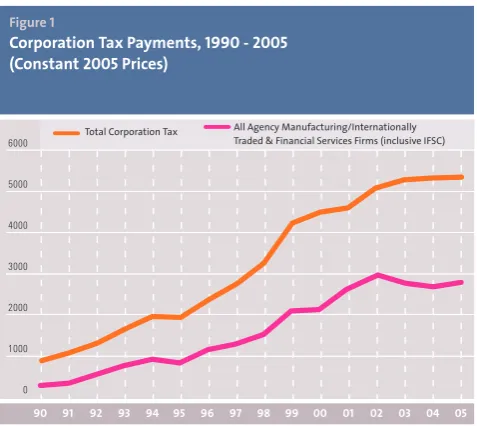
Figure 1
Corporation Tax Payments, 1990 - 2005 (Constant 2005 Prices)
Total Corporation Tax All Agency Manufacturing/Internationally Traded & Financial Services Firms (inclusive IFSC)
Source: Exchequer Returns for 2005, Department of Finance. Annual Business Survey of Economic Impact, co-ordinated by Forfás and administered by the Survey Unit, ESRI
Corporation Tax Payments
In addition to expenditure in the economy, manufacturing and internationally traded and financial services
companies provide a very significant direct return to the Exchequer by way of corporation tax payments.
The total corporation tax yield from all sources was €5.5 billion in 2005, a slight increase in real terms on the previous year. It is estimated that agency supported firms accounted for €2.8 billion (51 percent) of the €5.5 billion total corporation tax paid in the economy.
Agency assisted companies in the chemicals/ pharmaceuticals and international financial services accounted for around 26 and 27 percent of the €2.8 billion, respectively, with ICT hardware and software accounting for 19 percent of the total figure.
350,000
300,000
250,000
200,000
150,000
100,000
50,000
0
96 97 98 99 00 01 02 03 04 05
Foreign Owned
Source: Forfás - Annual Employment Survey
Irish Owned Overall Total Figure 2
Permanent Full-Time Employment 1996-2005 Manufacturing and Internationally
Traded/Financial Services
Employment
in Agency Supported Companies
Total full time employment in companies under the remit of IDA Ireland, Enterprise Ireland, Shannon Development and Údarás na Gaeltachta amounted to 298,372 in 2005, an increase of 2,879 on the previous year. While figures since 2002 have shown minimal growth in job numbers, this is the highest net jobs increase recorded since 2000. There are now 52,016 more people employed in agency assisted manufacturing and internationally traded services companies than in 1996.
The overall net increase of 2,879 in 2005 comprises 1,610
more jobs in foreign owned companies and 1,269 more jobs among Irish owned companies in manufacturing and internationally traded services. Employment in Irish owned manufacturing and internationally traded services has increased from 125,611 in 1996 to 147,683 in 2005. Employment in foreign owned manufacturing and internationally traded services has increased from 120,745
Gross Job Losses Net Change Gross Job Gains
Source: Forfás - Annual Employment Survey 50,000
40,000
30,000
20,000
10,000
0
-10,000
-20,000
-30,000
-40,000
[image:16.595.308.549.108.326.2] [image:16.595.42.276.167.325.2]96 97 98 99 00 01 02 03 04 05
Figure 3
Job Gains, Losses and Net Change in Permanent Full Time Employment 1996-2005 Manufacturing and
Internationally Traded/Financial Services
Approximately 27,055 jobs were created in manufacturing and internationally traded services in 2005 with 24,176 job losses during the year. Figure3 highlights the trend in the number of jobs being created and lost over the 19962005
period and shows that the rate of job losses has
significantly reduced since 2002. There are also interesting sectoral dynamics underpinning these aggregate trends:
Permanent employment in manufacturing companies fell for the fifth successive year to 215,686, down 12
percent from its 2000 peak. Net job losses in 2005
were concentrated in traditional manufacturing sectors such as the food products and beverages
(1,350), nonmetallic minerals (889) and paper,
publishing and printing (502), reflecting ongoing restructuring, productivity improvements and competition from lowercost locations.
There were net job increases in more modern sectors such as electrical and optical equipment (including medical devices) (+2,042) and chemicals (including pharmaceuticals (+286)).
Net job losses in manufacturing in 2005 were more than offset by net job gains in internationally traded services sector. Total employment in financial and other international services increased to 71,296 in
2005 (+2,441), accounting for 24 percent of all jobs in
agency supported companies in 2005, compared with just 10 percent in 1996. Net job creation was highest in international services (+1,702), with the increase largely accounted for by firms in consulting, software and other computerrelated services.
35.0%
30.0%
25.0%
20.0%
15.0%
10.0%
5.0%
0.0%
96 97 98 99 00 01 02 03 04 05
Share of Total Employment Share of Jobs Created
Figure 4
Share of Employment in Agency Supported Companies Accounted for by BMW Region
Regional Distribution of Employment
Figure 4 shows the share of employment in manufacturing and internationally traded services accounted for by the Border, Midlands and West (BMW) region over the period 19962005. In 2005 more than 7,500
jobs were created in the BMW region which equates to around 28 percent of jobs created in agency supported firms throughout the country, compared to 20 percent in
2000, the peak year of employment in agency assisted companies. While the overall percentage share of jobs created accounted for by the BMW region has increased, the number of jobs created has remained stable since
2002.
3.00% 2.50% 2.00% 1.50% 1.00% 0.50% 0.00% 96 98
[image:17.595.319.563.109.324.2] [image:17.595.52.296.111.323.2] [image:17.595.319.555.374.580.2]94 00 02 04
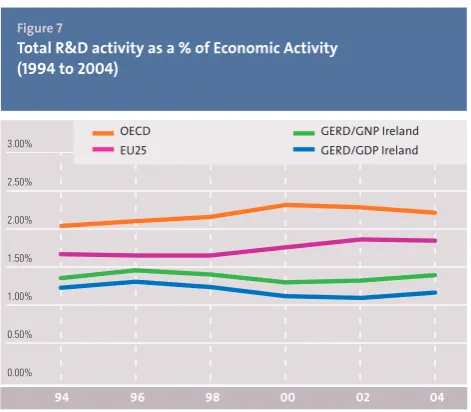
Figure 7
Total R&D activity as a % of Economic Activity (1994 to2004)
OECD EU25
GERD/GNP Ireland GERD/GDP Ireland
Source: Derived from the Survey of R&D in the Business Sector 2003 (Forfás); survey of R&D in the higher education sector, 2004 (Forfás); State Expenditure on Science & Technology, 2005 (Forfás)
15
Fo rfá s A n n u a l Re p o rt 2 0 0 5Foreign Owned Irish Owned Overall Total
96 97 98 99 00 01 02 03 04 05
40,000 35,000 30,000 25,000 20,000 15,000 10,000 5,000 0
Figure 5
Trends in Part-Time, Temporary and Short-Term Contract Employment 1996-2005* Manufacturing and Internationally Traded/Financial Services
*Excluded companies under the remit of Shannon Development
Source: Forfás - Annual Employment Survey
PartTime,
Temporary and ShortTerm
Contract
Employment
In addition to the 298,372 persons employed full time in manufacturing and internationally traded services, 36,156
persons were also employed in part time, temporary and short term contract positions in 2005. Employment in this category has grown over the last decade and now accounts for almost 11 percent of all jobs in agency assisted companies. Taking the two categories of employment together (permanent full time and temporary/parttime), there are now 334,528 persons employed in agency assisted companies, up from 272,598
in 1996.
Research and Development
Total expenditure on research and development (R&D) continued to climb strongly in 2005. Figure 6 shows that gross expenditure on R&D activities performed in all sectors of the economy (GERD) rose to an estimated
€1,910 million in 2005. This represented a 7.3percent
increase in nominal terms compared to 2004, and an estimated 4.8 percent rise in real terms. The main driver of the total rise in R&D continued to be from increasing R&D activity performed in the higher education sector.
Business sector performed R&D is also estimated to have regained momentum in 2005 and will be confirmed in the forthcoming 2005 Business R&D Survey.
GERD Current Prices €m
97 98 99
96 00 01 02 03 04 05
GERD Constant 2005 Prices€m Figure 6
Gross Expenditure on R&D (€million)
Ireland,1996 - 2005 (constant and current prices)
2,000 1,800 1,600 1,400 1,200 1,000 800 600 400 200 0
Source: Derived from the Survey of R&D in the Business Sector 2003 (Forfás); survey of R&D in the higher education sector, 2004 (Forfás); State Expenditure on Science & Technology, 2005 (Forfás)
Figure7 shows how total R&D activity performed in relation to the overall economy (GDP and GNP measures). Total R&D intensity rose to 1.43 percent of GNP in 2004 the same intensity as in 1998 but a climb from the 1.32
percent ratio recorded in 2000. The continuing trend of strong rises in R&D spending is now pushing the R&D intensity ratio higher, though remains below the average R&D intensities in the EU and OECD which stood at 1.85
Figure 9
International Government Budget Allocations to Civil R&D* (GBAORD as % Economic Activity) - 2004
*(excludes R&D spending on defence)
Finland
France
Netherlands
Sweden
Norway
Germany
Denmark
Italy
Portugal
Austria
Belgium
Spain
UK
Ireland (GNP)
United States
Greece
Source: Derived from the State Expenditure on Science & Technology 2005 (Forfás); Main Science & Technology Indicators.2005-1 (OECD)
0.00% 0.20% 0.40% 0.60% 0.80% 1.00% 1.20%
0.30% 0.49%
0.50% 0.52%
0.59% 0.63%
0.64% 0.65% 0.67%
0.71% 0.72%
0.73% 0.74%
0.76% 0.80%
1.00%
Other sources 1.7% Public sector
(incl.EU) 34.4%
Industry63.9%
Source: Derived from the Survey of R&D in the Business Sector 2003 (Forfás); survey of R&D in the higher education sector, 2004 (Forfás); State Expenditure on Science & Technology, 2005 (Forfás)
Figure 8
Sources of funding of R&D (% of total) 2004
Sources of Funding of R&D
All sources of funding (public and private) for research are continuing to rise in nominal terms in parallel with the overall increase in research activities. In 2004, of the total €1.78 billion of performed R&D activities, €1.13 billion was funded from the private sector with €611.9 million of funding sourced from the public sector and €30.8 million funded from other areas. The share of private sector funding as a proportion of total R&D funding has fallen from 71.7 percent in 2000 to 63.9 percent in 2004. In contrast the share of public sources funding of R&D has climbed from a 26.9 percent share in 2000 to a 34.4
percent share in 2004. These changing shares are a result of very strong increases in publicly sourced funding growth, outstripping the more moderate growth in privately sourced R&D funding.
Figure9 focuses on the Government Budget Allocation to R&D activities and compares them internationally. In Ireland the government budget allocation as a percentage of economic activity rose to 0.50 percent of GNP in 2004 (and an estimated 0.51 percent of GNP in
17
Fo rfá s A n n u a l Re p o rt 2 0 0 5)
€ billion in 2004
2003.
1.03
1998 and 2004
10
,
1
)
2004 and 2005
€ million in
2004, a23.5 2003.
2005 €550
2000 to 2004
[image:19.595.318.560.109.321.2] [image:19.595.60.291.122.319.2] [image:19.595.320.554.390.565.2]in 2005 , allowing
Figure 11
Average Annual BERD Growth Rate (1993-2003)
China Iceland Israel Hungary Portugal Finland Ireland Denmark Spain Sweden Norway Australia Canada Netherlands United States United Kingdom Italy Germany France Japan
Source: Derived from the State Expenditure on Science & Technology 2005(Forfás); Main Science & Technology Indicators.2005-1(OECD)
0.0% 5.0% 10.0% 15.0% 20.0% 25.0% 30.0%
1.80 1.60 1.40 1.20 1.00 0.80 0.60 0.40 0.20 0.00
94 96 98 00 02 04
Figure 10
Business Sector R&D Performance as a % of Economic Activity (1994 -2004)
OECD BERD/GNP Ireland BERD/GDP Ireland EU 25
%
Source: Derived from the Survey of R&D in the Business Sector, 2003 (Forfás), Main Science & Technology Indicators 2005-1 (OECD)
0.50 0.45 0.40 0.35 0.30 0.25 0.20 0.15 0.10 0.05 0.00
94 96 98 00 02 04
Figure 12
Expenditure on R&D performed in the Higher education as a % of economic activity (HERD) -1994 to 2004
%
Source: Derived from the Survey of R&D in the Business Sector 2003 (Forfás); survey of R&D in the higher education sector, 2004 (Forfás); State Expenditure on Science & Technology, 2005 (Forfás)
OECD HERD/GNP Ireland HERD/GDP Ireland EU 25
Business Expenditure on R&D (BERD
R&D performed by the business sector (BERD) climbed to an estimated 1.15 . This represented a 7.0
percent rise in nominal terms compared to BERD in At present the BERD intensity ratio R&D expenditure performed in the business sector as a percentage of economic activity stands at 0.93 percent of GNP. This compares to an intensity ratio of percent of GNP in
0.93 percent of GNP in . It should be noted that despite strong rises in BERD in recent years (Figure
), R&D expenditure has continued to be matched by strong growth across the overall economy therefore constraining the intensity ratio below percent of GNP.
Higher Education Expenditure
on R&D (HERD
Expenditure on R&D performed in the higher education sector increased strongly in . Higher Education R&D spending (HERD) rose to 491.7
percent increase in nominal terms from HERD expenditure in is estimated to be around million, backed by further increases in funding from Science Foundation Ireland, Enterprise Ireland, the Programme for Research in Third Level Institutions and from other State sources. Significant increases in funding from state sources over recent years has pushed the HERD intensity ratio (HERD as a % of GNP) from 0.27% of GNP in
0.40% of GNP in . Further increases in HERD will further push up this intensity
160
140
120
100
80
60
40
20
0
[image:20.595.46.278.118.306.2]95 96 97 98 99 00 01 02 03 04 05
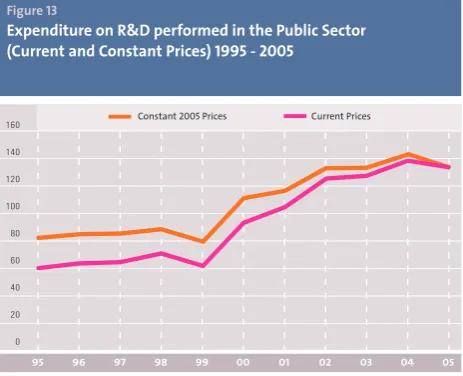
Figure 13
Expenditure on R&D performed in the Public Sector (Current and Constant Prices) 1995 - 2005
Constant 2005 Prices Current Prices
Source: Derived from the Survey of R&D in the Business Sector 2003 (Forfás); survey of R&D in the higher education sector, 2004 (Forfás); State Expenditure on Science & Technology, 2005 (Forfás)
Government
Expenditure
on R&D
19
F o r f á s A n n u a l R e p o r t 2 0 0 5Activities in
2005
22
24
25
25
Oil Dependency 25
26
26
27
27
27
1
29
30
30
31
32
32
32
33
33
34
34
34
2
Annual Competitiveness Reportand Competitiveness Challenge2005
Broadband Benchmarking Electricity Benchmarking
Waste ManagementBenchmarking
Business Regulation Forum Trade and InvestmentReport National Trade Forum
Trade Negotiations ImpactStudy Consumer Policy
Improving Framework Conditions for
Innovation and Enterprise Development
Small Business Forum Productivity
Gateways Study
Regional Aid Guidelines 2007 – 2013
Environmental Supports and Incentives for Enterprise PreBudgetSubmission
InternetData Centres
Implementation ofebusiness Strategy Open Source Software
PatentRoyalty Exemption Employee Financial Participation Enterprise Areas Certification
2 0 0 5
21
3
3536
36
36
36
37
37
37
Q Q 38
38
4
2006201341
42
42
43
43
44
44
45
Fo rfá s A n n u a l Re p o rt
Human Capital Development
to Support
an
Innovation Driven Economy
Skills Needs in the Irish Economy and the Role of Migration 35
National Skills Strategy Research Languages and Enterprise
InEmploymentEducation and Training in Ireland
Skills Requirements of the International Digital ContentIndustry Career Guidance Information Dissemination
Regional Skills Gap in Ireland
Submissions by the ExpertGroup on Future Skills Needs National Workplace of the Future
Forfás submission to N AI on European ualifications Framework Discover Science and Engineering
Capturing the Economic Benefits
from Public Investment
in Research
Strategy for Science,Technology and Innovation 40
Assesmentof National InvestmentOptions for Nanotechnology Advisory Council for Science,Technology and Innovation
National Code of Practice for Managing and Commercialising Research from Collaborative Public Private Research
Review of implementation of the National Code of Practice for Publicly Funded Research
Strengthening Commercialisation Infrastructure for Research Evaluation of Science Foundation Ireland
EU Seventh Framework Programme Negotiations
Irish Participation in the Sixth EU Framework Programme for Research
2005
1
I
Improving Framework Conditions
for Innovation and Enterprise
Development
It
has been long recognised that
enterprise in Ireland depends heavily on supportive
framework conditions in the areas of taxation,
education,
finance,
physical
infrastructure and regulation.
In 2005,
the Government
adopted the Enterprise
Strategy Group Report,
Ahead of the Curve
,
as the blueprint
for Ireland’s strategy on
enterprise framework conditions and put
in place an Enterprise Action Plan and
Enterprise Advisory Group to give effect
to the Report’s recommendations.
In 2005,
through the international benchmarking of policies and performance,
Forfás,
with the support
of our sister agencies,
DA Ireland and Enterprise Ireland and of the
National Competitiveness Council and the Forfás Tax Advisory Group,
concentrated its
efforts on work to contribute to setting the agenda on framework conditions for Irish
enterprise.
Annual Competitiveness Report
and Competitiveness Challenge
The National Competitiveness Council (NCC) published its eighth Annual Competitiveness Report(ACR) and
Competitiveness Challengeduring 2005.Forfás provides
research and secretariatsupportto the NCC.
The ACR benchmarks Ireland’s competitiveness
performance. The format of the report was revised in 2005
and analysed Ireland’s competitiveness using 171
indicators, drawing on data from bodies such as the OECD, IMD and Eurostat.
The ACR, published in September 2005, highlights the strong performance of the Irish economy over the past decade which reflects a number of national strengths.
Taxation: Ireland remains highly competitive in terms of both corporation tax (Ireland ranks first of the 16
countries benchmarked and on personal taxes first out of 15).
Entrepreneurship: Ireland has a strong entrepreneurial culture. Ireland is ranked second in the EU and 7th among the OECD countries for entrepreneurial activity.
Labour marketadaptability: Labour market regulations in Ireland are seen as above average in terms of facilitating business activity (7 out of 16).
Openness to trade and investment: Ireland continues to be one of the most open economies in the world in terms of trade in goods and services and in foreign investment. Ireland continues to have the highest stock of foreign direct investment per capita among the benchmarked countries
The report also highlights areas where Ireland’s
performance needs to improve to sustain our growth and performance.
Education
While participation rates in secondary education have grown substantially, they remain below those in leading countries. In terms of performance, 15 year olds in Ireland perform strongly in terms of reading skills, although less well in terms of scientific and
mathematical literacy. A relatively high proportion of the Irish population in the 2534 age group has a third level education, and Ireland continues to perform well in terms of science and engineering graduates per thousand population. Participation in life long learning in Ireland has increased considerably in recent years, although there is still a significant gap between Ireland and the leading countries. Despite additional
23
Fo rfá s A n n u a l Re p o rt 2 0 0 5Pictured atthe Forfás conference,Productivity and Public Policy,are Mr Andrew McDowell,Manager, Competitiveness Division, Forfás,Mr Martin Cronin, Chief Executive,Forfás and Mr Micheál Martin TD, Minister for Enterprise, Trade & Employment.
Science and Technology
While both public and business sector investment in R&D have increased substantially in recent years, they are still below the levels pertaining in other advanced economies. Despite progress, patent applications and approval rates remain below those in other countries.
Prices and Costs
Prices and costs remain a key competitiveness issue. The ACR outlined that Irish consumer price inflation dropped close to the EU and eurozone average over the course of 2004. However, Ireland remains the most expensive country in the eurozone for consumer goods and services, and the second most expensive country in the EU, behind Denmark.
Drawing on the ACR, the Competitiveness Challenge report highlights the significant success of the Irish economy in recent years. However, success brings its own challenges, and the Competitiveness Challenge notes that the strategies applied over the last 15 years need to be adapted to take account of far reaching domestic and global economic changes. The NCC considers that there are five interlinked medium term challenges:
Globalisation and Increased Competition
The pace and scale of globalisation, the movement of capital, products, services, ideas and people across national borders, are reshaping the international division of labour and the structures of developing and advanced economies alike.
Our Rising CostBase
The intensification of competition from low cost locations has coincided with a sharp rise in Ireland’s cost base in recent years. The average cost of Irish goods and services increased by over a fifth relative to our trading partners in the period 20002004.
Growing Importance of Traded Services
Given growing competition and an increasing cost base, the most cost sensitive parts of the Irish economy are suffering. Employment in manufacturing fell for the fifth successive year in 2005. However, employment and export growth in high value added internationally traded services activities have offset most of the losses in that period.
The Increasing Role of Knowledge and Technological Change
Closely linked with globalisation and increased competition is rapid technological change, which is revolutionising business processes and shortening product life cycles. The ability of Irish companies to quickly develop and absorb new technologies into their products and processes will be a decisive driver of future competitive advantage.
Quality of Life Issues and Demographic Changes The growing focus on environmental sustainability, linking economic growth to improvements in quality of life and the effects that demographic changes will have, are also presenting new challenges.
These challenges imply two complementary and crosscutting strategic economic imperatives.
Raising productivity across the entire economy Productivity is the key long term determinant of a nation’s living standards and competitiveness. Productivity growth in Ireland has been largely concentrated in a small number of capital intensive industries dominated by multinational companies, such as chemicals, pharmaceuticals and electronics. Productivity levels and growth in more traditional manufacturing sectors, and in those sectors of the Irish economy less exposed to international competition such as construction and retailing, are significantly poorer. Most of the opportunities for improving average Irish productivity and living standards are, therefore, in locally trading and public services.
The Competitiveness Challenge report sets out a comprehensive range of policy directions that will be needed to give effect to these strategic imperatives. These are centred on:
Improving the regulatory and taxation environment;
Promoting the development of economic infrastructure;
Enabling an already strong Irish education and training system to become one of the best in the world; and
Creating an environment that supports the creation and development of more high growth indigenous firms.
Broadband Benchmarking
Forfás measured progress on the supply and demand
for broadband telecommunications a key
competitiveness consideration for Ireland.
The report,
Benchmarking Ireland’s Broadband Performance
,
published in December
2005
, compares Ireland’s
broadband performance with that of other countries.
This study, published annually, has become a significant contributor to the debate on policy implementation in telecommunications and related issues. The study includes comparisons between Ireland and other countries on broadband cost, access, quality and takeup. In 2005, the study was broadened to include consideration of the reasons for Ireland’s international rankings in broadband availability and takeup. It also focused on the policy and institutional frameworks in other countries, from which lessons might be drawn.
A steering group for the study comprised the main stakeholders from Government, the regulator, the enterprise agencies, regional bodies and selected businesses. Consultations were also held with the main service providers.
Key Findings
Broadband Takeup
At the end of Q22005, Ireland ranked 25th of 32
countries for broadband takeup. When the comparator group is limited to the 21 countries benchmarked in the 2004 study, Ireland’s position had actually deteriorated, from 18th out of 21 in
2004 to 19th out of 21 in 2005. Broadband Costs
The cost of entrylevel DSL in Ireland has decreased sharply since the launch of services in 2002. Based on the amortised monthly costs for 1Mbit/s, DSL costs in Ireland ranked seventh lowest of 32
countries benchmarked.
SME Broadband Takeup
In terms of broadband takeup by SMEs, out of 20
EU countries included, Ireland ranks 17th for take up by companies with a workforce of between 10
and 49 employees and 19th for takeup by companies employing 50 to 249 people. Broadband Availability
Notwithstanding significant improvements in DSL availability in Ireland since its launch in 2002, DSL coverage in Ireland based on population stood at
72 percent, making it the second lowest of the EU15 countries. This figure has increased since the publication of the report, as a number of DSL exchanges have since been enabled.
Quality of Service
A broadband innovation index, used to measure quality of service (bandwidth capacity/choice of advanced products) performance across the benchmark countries, ranks Ireland 21st of 30
countries on this important indicator. A number of operators have since increased the capacity of their entrylevel products in 2006.
25
Fo rfá s A n n u a l Re p o rt 2 0 0 5Electricity Benchmarking
In
2005
Forfás began research into the effect that
electricity pricing and availability have on Ireland’s
competitive position.
Electricity is a key infrastructure for enterprise. A comparative study of the characteristics of electricity, price, availability, security of supply and quality in Ireland was carried out using key performance indicators. These were identified and measured for all the countries, and the regulatory and market structures were also compared.
The results of the study will inform Forfás inputs into other activities, including the preparation by:
The Department of Communications, Marine and Natural Resources of a national energy policy for Ireland; and
The Department of Enterprise, Trade and
Employment (DETE) in the preparation of the next National Development Plan.
Waste Management
Benchmarking
In
2005
Forfás undertook research into waste
management, a policy area identified by the National
Competitiveness Council as important for Ireland’s
competitiveness.
Ireland’s recent economic growth has been accompanied by an increase in waste, including municipal waste, industrial waste and hazardous waste. Increasing regulation in the environmental field is encouraging prioritised responses to the waste problem, with prevention as the most favoured option and disposal as the least favoured. From an enterprise perspective, the availability of a range of waste treatment solutions at reasonable cost is an important factor for business growth.Forfás carried out a benchmarking study by selecting a number of countries and regions for comparison and developing a set of indicators to summarise relative positions in key areas, including waste generation, treatment facilities, costs, ownership, accessibility and capacity.
The report found that Ireland has performed poorly relative to a selection of other countries in meeting the waste needs of enterprise, especially in terms of costs and facilities, better progress has been made in the recycling
The report concludes that:
Ireland has the highest municipal waste generation per capita of the 11 benchmark countries and manufacturing waste generation per employee is also relatively high.
Ireland has made much progress in the area of municipal waste management in recent years with
33 percent being recycled in 2004 compared with 13
percent in 2001. Despite this, Ireland ranks seventh of the ten available countries benchmarked in terms of the proportion of municipal waste recycled. Our industrial waste performance, with a recovery rate of 35 percent in 2004 (25 percent in 2001), also compares poorly relative to the benchmark countries. Ireland’s dependence on landfill can be attributed to the limited progress in delivering waste infrastructure in preferred waste treatment options such as thermal treatment and biological treatment. These infrastructure deficits are likely to impact on Ireland’s ability to meet the targets set down in the EU Landfill Directive.
Of the countries benchmarked, Ireland has the highest waste management costs for nonhazardous landfill and biological waste treatment. Recycling costs and hazardous waste treatment costs are also higher than most competitor countries because of Ireland’s reliance on export markets for the treatment of recyclable materials.
Oil Dependency
Forfás published a study, in April
2006,
which
analysed Ireland’s oil dependency. The study was
conducted in
2005
and it examined the extent to
which the economy was vulnerable to an oil shock
and oil peaking scenarios.
The policies required were
explored through national and international analysis.
Early consideration of emerging long term issues at international level which may have implications for enterprise policy in Ireland is a key part of Forfás’ remit.
The area of oil dependence and peaking was considered in the light of spatial development issues, Ireland’s
environmental obligations and increased international uncertainty of oil supplies.
Principal conclusions of the report include:
There is growing evidence to suggest that the era of a plentiful supply of conventional oil is coming to an end. Various experts have developed projections for when peak oil will occur. While there is a wide variation of estimates about the likely timing, most expert commentators believe that in ten to twenty years from now conventional oil supply may no longer be capable of satisfying world demand at current prices.
Ireland is particularly vulnerable to an oil shock whether in the form of high prices or the unavailability of oil. Taking into account the Irish economy’s relative dependence on imported oil and the relative share of oil in total Irish energy consumption, Ireland is among the most sensitive to rising oil prices and therefore among the most vulnerable to a peak oil scenario.
Ireland consumed nine million tonnes of oil in 2004, an amount that has doubled since 1990. In 2002, Ireland ranked third highest among the EU25 countries in terms of oil consumed per capita. Electricity generation and transportation are the two main reasons for Ireland’s high oil dependence. For electricity generation Ireland is the sixth most oil dependent country of the EU25 countries. For transportation Ireland consumed
50 percent more per capita than the average of the EU25.
As it will take ten to fifteen years to significantly reduce our dependence on oil the report recommends that we prepare a national strategy to deal with the challenge. It outlined a list of key policy options for Ireland that should be considered including initiatives aimed at reducing the usage of oil in transportation, addressing security of supply concerns and improving energy efficiency.
Business Regulation Forum
The Government announced the establishment of
the Business Regulation Forum in June
2005
, as part
of its programme on better regulation. The Forum
will analyse existing and proposed regulations and
the wider regulatory process from a business
perspective and will make proposals for the reduction
of the regulatory burden on business. Forfás is a
member of the Forum and provides the Forum with
research support and advice.
The Minister for Enterprise, Trade and Employment announced the membership of the Business Regulation Forum in October 2005, which includes business associations, individual businesses, Forfás and representatives from a number of GovernmentDepartments including the Department of the Taoiseach, the Department of Finance and the DETE. The Secretary to the Forum has been provided by Enterprise Ireland and Forfás provides research support and advice.
The inaugural meeting was held in December 2005. The Forum has finalised its priorities and work programme for
2006. The programme includes a review of existing recommendations on regulatory reform and the identification of particular regulatory issues at sectoral and crosssectoral level. The work of the Forum is expected to lead to improved framework conditions for enterprises operating in Ireland.
Trade and Investment
Report
The annual Forfás
International Trade and Investment
Report
2005, published in February
2006
,
presented
an analysis of Ireland’s trade and investment
performance in the context of international
developments. The report highlights the emergence
of trends in the Irish economy which indicate that
Ireland is evolving towards a new stage of economic
development.
Key conclusions of the report include: Services exports continued to expand rapidly, particularly in computer, finance and insurance services. The importance of internationally traded services exports to the economy, measured as a percentage of GDP, now surpasses that of many other developed economies by a significant margin.While still very large by international standards, the merchandise trade surplus has been declining since
2002, reflecting slow export growth and a surge in imports. The rise in imports was driven by buoyant consumer demand and the reliance of Ireland on increasingly expensive imported fuels.
27
Fo rfá s A n n u a l Re p o rt 2 0 0 5Ireland continues to attract a large share of global FDI inflows for its size. While our share fell
significantly in 2004, this largely reflected changes in the financial operations of multinationals based here, rather than a reduction in new operating facilities. In fact, the number of new IDA supported jobs has been increasing steadily since 2003.
National Trade Forum
In June
2005
, Forfás and the DETE jointly organised
the inaugural meeting of the National Trade Forum
in Farmleigh House.
The National Trade Forum is a new consultative forum designed to give interested stakeholders an opportunity to input into Forfás’ trade research programme and Ireland’s trade policy. The event opened with the launch of the National Trade Strategy, prepared by the DETE with the support of Forfás. This was followed by a presentation by Prof. Philip Lane of Trinity College outlining the challenges for trade policy and a presentation from Forfás outlining current trade research.
The inaugural meeting engaged senior representatives from industry, the social partners and NGOs in a
discussion on key trade policy issues. There was a positive response to the establishment of the Forum and to the trade research that has already been undertaken by Forfás. Research themes that have been identified by the Forfás following the Forum include:
Assessing the relationship between trade and productivity;
Identifying the latestoutward directinvestment (ODI) trends and the merits of ODI; Identifying opportunities offered by the World Trade Organisation (WTO) for Irish services companies; and Developing a better understanding of the trade performance of services sectors.
It is envisaged that meetings of the Forum will be held every 18 months to take stock of intervening
developments, to report on the findings of research and to discuss new research areas.
Trade Negotiations Impact
Study
Forfás commissioned a study on behalf of the DETE
in the context of the then upcoming WTO Ministerial
which was held in Hong Kong in December
2005
.
The study quantified the economic effects of potential outcomes of the negotiations and was published in September 2005.
Key Findings:
The research indicated thatimpacts of further trade liberalisation on Ireland are generally small,but positive. Mostsectors of the economy are only marginally affected by reform.Services and industrial liberalisation scenarios generate positive gains to Ireland,while agricultural liberalisation has a slightly negative effect. In aggregate,of the total economywide GDP growth of 4.6percentper annum forecastfor Ireland for the 2001–2014period,only +0.01percent can be attributed to these trade reforms.Pictured launching the National Consumer Rights Card were Mr Micheál Martin TD, Minister for Enterprise, Trade & Employment and Ms.Ann Fitzgerald, Executive Chairperson, The National Consumer Agency.
Established in 2004, the CSG was set up to advise and make recommendations on the development of a national consumer policy strategy. The Group’s report contained a comprehensive set of recommendations covering regulatory and institutional change. Entitled Making Consumers Count, the report identified the key
components of consumer policy, reviewed experience to date and the approach taken in other countries, compared prices in Ireland with those in other euro zone countries for a wide range of branded goods, analysed key sectors and the findings of surveys on consumer awareness and assessed the existing systems of redress available to consumers.
The main recommendations of the reportinclude:
The establishment of a national consumer agency to provide a range of services to consumers and help in their empowerment; and
The abolition of the Groceries Order.
The establishment of a national consumer agency was accepted by Government, and Forfás will provide a secretariat to the Interim Board of the National Consumer Agency until legislation is enacted for its establishment as a full statutory body. A high level inter departmental group, to review the other recommendations contained in the CSG report and to advise the Government accordingly was also established.
Minister Martin instituted a process of consultation on the abolition of the Groceries Order. The NCA prepared a submission recommending the abolition of the Order and conducted a public awareness campaign informing consumers on the Order. In October 2005 the Government announced the decision to abolish the Groceries Order, as advocated by the CSG. It was abolished in March 2006.
The NCA has also conducted a major awareness campaign on consumer rights which included:
A TV and printadvertising campaign;
The provision of a call centre for consumers to access information on their rights;and
2
2 0 0 5
29
Advancing Coherent
and Dynamic
Enterprise Development
Policies
Each of Ireland’s enterprise development
agencies – IDA Ireland,
Enterprise Ireland,
Shannon Development,
Údarás na Gaeltachta,
Science Foundation Ireland,
FÁS and the
County Enterprise Boards – focuses on different
aspects of enterprise promotion in
Ireland.
State supports for enterprise development
are most
effective when they are
complementary and consistent
with an overarching vision of enterprise development
and a strategy to acheive it.
During 2005 Forfás sought
to work with the Department
of Enterprise,
Trade and
Employment
(DETE) and our sister agencies to deliver coherence and responsiveness in
Ireland’s enterprise