A N N U A L - R E P O R T
FOR
~| JOINT
: RESEARCH
J CENTRE
COMMISSION OF THE EUROPEAN COMMUNITIES
A N N U A L - R E P O R T - 92
Central Bureau
FOR
Nuclear
Measurements
• * *
• • • •
• •
JOINT
RESEARCH
CENTRE
COMMISSION OF THE EUROPEAN COMMUNITIES
¿¡¡pc. )l^C5?
PARL EUROP. Biblioth.
Ş^Jgv15029
EN
LEGAL NOTICE
Neither the Commission of the European Communities nor any person acting on behalf of the Commission is responsible for the use which might be made
of the following information
TABLE OF CONTENTS
Page
EXECUTIVE SUMMARY 1
SPECIFIC RESEARCH PROGRAMME
PROJECT 1: REFERENCE MATERIALS 5
REFERENCE MATERIALS FOR NUCLEAR APPLICATION 9
PREPARATION OF SAMPLES AND TARGETS 9 REACTOR NEUTRON DOSIMETRY REFERENCE MATERIALS 11
ACTINIDE REFERENCE MATERIALS 13
REFERENCE MATERIALS FOR NON-NUCLEAR APPLICATION 16
BUREAU COMMUNAUTAIRE DE REFERENCE (BCR) 16
ENVIRONMENTAL AND SURFACE ANALYSIS 18 ISOTOPE ABUNDANCES AND ATOMIC WEIGHTS 22
PROJECT 2: NUCLEAR MEASUREMENTS 27
NUCLEARDATA 30
NUCLEAR DATA FOR STANDARDS 3ÛNUCLEAR DATA FOR FISSION TECHNOLOGY 39 NUCLEAR DATA FOR FUSION TECHNOLOGY 57
NUCLEAR METROLOGY 64
RADIONUCLIDE METROLOGY 64TDPAD STUDIES ATTHE 7MV VAN DE GRAAFF 70
TECHNICAL APPENDIX
LARGE FACILITIES 75
ACCELERATORS 75 SPECIAL LABORATORIES 79DATA PROCESSING AND ELECTRONICS 81
DISCRETIONARY RESEARCH
Page
SCIENTIFIC AND TECHNICAL SUPPORT
TO THE COMMISSION
SUPPORT TO DG I: INTERNATIONAL COLLABORATION
-NUCLEAR SAFEGUARDS 95
SUPPORTTODGVI:AGRICULTURE 97
SUPPORT TO DG XIII: TECHNOLOGY TRANSFER 97
SUPPORT TO DG XVII: NUCLEAR SAFEGUARDS 98
SUPPORT TO CONSUMER POLICY SERVICE 99
WORK FOR THIRD PARTIES
SAMPLES AND TARGETS FOR NUCLEAR MEASUREMENTS 103
REACTOR NEUTRON DOSIMETRY 103
REFERENCE SAMPLES AND REFERENCE MATERIALS 105
ALFA:APCPROGRAMME 105
METROLOGY OF RADIOACTIVE WASTE BARRELS 106
STANDARDIZATION OF AN EXTENDED VOLUME SOURCE 106
REGULAR EUROPEAN INTERLABORATORY MEASUREMENT
EVALUATION PROGRAMME (REIMEP) 107
INTERNATIONAL MEASUREMENT
EVALUATION PROGRAMME (IMEP) 107
CERTIFICATION OF BORON 108
GENERAL INFORMATION
LIST OF PUBLICATIONS I l l
CONTRIBUTION TO CONFERENCES I l l
SCIENTIFIC OR TECHNICAL ARTICLES 114
SPECIAL PUBLICATIONS 118
Note : This Annual Report is the last one being published under the name
of the Central Bureau for Nuclear Measurements. In the future
reports will appear under the new name
Institute
FOR
Reference Materials and Measurements
(IRMM)
For further information concerning the Research Areas Reference
Materials and Reference Measurements within the Programme
Measurement and Testing, please contact W. Müller, Programme
Manager, IRMM, Retieseweg, B-2440 Geel, Belgium
REFERENCE MATERIALS
AND
REFERENCE MEASUREMENTS
Executive
Summary
W. Müller
This report covers CBNM's activities during the first year of the multiannual
programme 1992-94, based predominantly on the programme "Reference
Materials and Reference Measurements" of the 3rd Framework Programme
Line "Measurement and Testing".
The structure of the programme was unchanged, the different parts being
Specific Programme, Support to Commission Services, Exploratory Research,
3rd Parties Work; the activities are to respect the criterium of subsidiarity, to
meet societal needs and to contribute to the improved competiti vity of European
industry.
Starting with the beginning of the year 1992, the support.to the Bureau
Communautaire de Référence (BCR) became part of the specific programme;
during the reporting period, part of JRC's contribution to Consumer Policy
Service (CPS) was taken over from the Environmental Institute (EI) Ispra. The
conditions for non-statutory staff were redefined in view of the new Framework
Programme Line "Human Capital and Mobility", fostering contracts with post
docs, establishing networks and promoting access to large installations.
The work described and the results presented in this annual report 1992 follow
a different order than in previous annual reports. This reflects the Institute's
reorientation towards emphasis on reference materials and increased
contributions to non-nuclear tasks. In addition, at the end of the reporting
period, the Commission authorized the change of the previous name of the Geel
Institute "Central Bureau for Nuclear Measurements" into "Institute for
Reference Materials and Measurements" (IRMM). This renaming of the
Institute will, of course, not affect the commitments defined in the Treaty of
Rome.
The Specific Programme covers the projects "Reference Materials" and
"Nuclear Measurements". The project "Reference Materials" increased its
contributions to both, the nuclear and the non-nuclear fields.
The
project
"Nuclear Measurements" furnished nuclear data for standards, fission and
fusion technologies and made contributions to nuclear metrology.
-2-In the field of non-nuclear reference materials, the support to the BCR was intensified by providing storage and dispatching of a high number of samples. Special reference materials of biological and environmental relevance were prepared, tested or characterized.
The uncertainty of the atomic weight of silicon could be reduced by a factor of 10 which resulted in a more accurate value of the Avogadro Constant. In concordance with EURACHEM, a workshop on "Traceability of Chemical Measurements to the SI Unit Mole" was organized at the Institute attracting more than 60 delegates from all EC and EFTA countries and observers from CIS, Poland, Hungary and USA.
Special efforts went to a measurement series of the standard cross-section ratio
of 235U(n,f)/H(n,n) using octacosanol layers of different thickness. Apparent
discrepancies in the results require additional experiments.
To improve the accuracy of data needed for fission technology, actinide fission cross-sections and structural material neutron interaction data were determined. These studies followed demands collected in the NEA High Priority Request List.
Despite of the delicate condition of the linear electron accelerator (GELINA), the machine could be successfully used in the nuclear data programme as well as in the new radiation physics application. Fortunately, the refurbishment of GELINA could be started by placing the first orders at the end of the year. At the Van de Graaff accelerator the ratio of non-neutron to neutron activities is approaching a value of two.
The construction of the Ultra-Clean Chemical Laboratory has been accomplished, and tests confirmed excellent air quality.
Radiation physics experiments started a couple of years ago as exploratory research. They are concentrating on X-ray and optical transition radiation studies. Trace metal analysis and speciation studies in biological and environmental media are making progress by use of various experimental methods.
Support was given to a couple of other Commission Services. The new support to the Consumer Policy Service departed with the coordination of meetings of the working group "Analytical Methods of Cosmetics".
Work upon requests involved the supply of a large variety of materials and services. Unfortunately, the orders are mostly of very limited significance and the ratio of investment to income is rather unfavourable.
-5-PROJECT
1
:
REFERENCE
MATERIALS
Introduction
W.Müller (a.i.)
In 1992the activity oftheUnit Reference Materialswassubdivided into several sub-projects, tacklingbothnuclear and non-nuclear topics.
The targets and samples preparation activities are on the basis of the nuclear work. The work included the preparation and characterization of10B and 6LiF ■reference deposits needed for a redetermination of the life-time of the free
neutron in co-operation with NIST, Gaithersburg. More than 100 samples and targets prepared comprised thin deposits, special films and bulk samples of metals,compounds and alloys.During the reporting period 118reactor neutron dosimetry reference materials were delivered to customers in seven different countries. The detailed analysis of an interlaboratory comparison exercise for the determination ofuranium byPotentiometrie titration isunder progress.The application of potentiometry to MOX fuel became operational. U r a n i u m hexafluoride samples were prepared for h i g h precision g a m m a - r a y spectrometry in the frame of a present round of the Regular European Interlaboratory Measurement Evaluation Programme (REIMEP). Actinides (uranium, plutonium) contaminations of soil at the level of 500 Bq/kg were determined after development of adequate separation and measurement procedures.
In the field of non-nuclear reference materials,much effort went into the BCR related activities as storage of various samples, distribution of material for round robins,dispatching of Reference Materials in the different steps of their certification. Biological Reference Materials were prepared, e.g. pig liver, treated byfreeze-drying and milling,orcharacterized, e.g.milk powder.
Environmental Reference Materials (fly-ash, soils, sediments) were prepared for stability and homogeneity testing. The collection of aerosol reference materials continued and reference layers for surface analysis were prepared andcharacterizedby RBS,the scanningnuclear microprobe couldbeapplied for environmental analysis (micro distribution of elements in particles). By adapting a new mass spectrometer, the uncertainty of the atomic weight of silicon wasdecreased to3 X I O- 7 (la),resulting in an improvedvalue ofNA, the Avogadro Constant. Isotope abundance and atomic weight of iron were improved byapplyingisotope dilutionmassspectrometry (IDMS).
For the study of trace metals and speciation in biological and environmental
material spectrophotometry electrochemical and chromatographic methods
have been applied. The binding of cadmium and zinc by different thioneins was
studied. The intracellular distribution of copper, zinc, cadmium and iron in the
marine clam Malcoma Baltica collected at the Westerschelde estuary has been
determined.
Within the Safeguards activities supporting DG I and DG XVII appropriate
uranium/plutonium metal spikes were prepared and characterized. Dried
uranium/plutonium spikes were certified and dispatched to IAEA and Euratom
Safeguards for use in various reprocessing plants. The Consumer Policy Service
of the Commission has been supported by first analyses of lead in hair lotion
and creams. Besides this, meetings of the working group "Analytical Methods of
Cosmetics" have been coordinated.
In the frame of work requested from outside customers a large number of thin
deposits, films and bulk samples have been supplied. Dosimetry materials have
been sold successfully. Two reference materials (powder of innards and of
tomatoes) were prepared upon request by the BGA (Bundesgesundheitsamt
Berlin). The analysis of conditioned and non-conditioned radwaste containers
was continued. REIMEP continued with measurement rounds on UF
6, MOX
pellets, synthetic input solutions and Pu nitrate solutions. In the International
Measurement Evaluation Programme, IMEP, synthetic and natural waters
were distributed and measured for trace elements. Finally, boron in low alloys
steel samples was certified for NIST by DDMS.
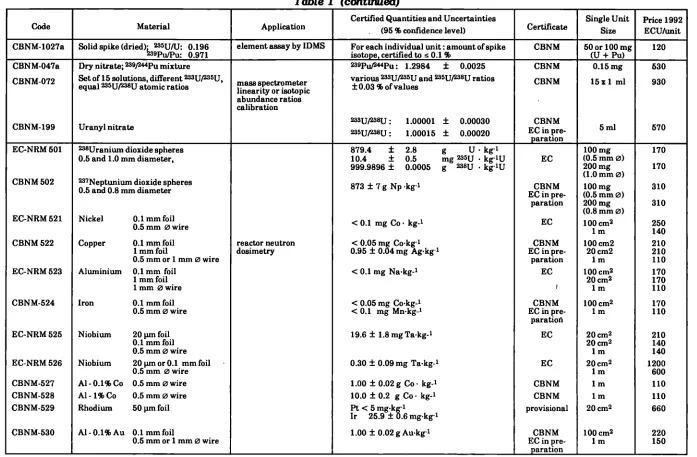
Code EC-NRM101 EC-NRM 110 CBNM-106 EC-NRM 210 EC-NRM 171 CBNM-271 CBNM-011 CBNM-014 CBNM-015 CBNM-016 CBNM-017 CBNM-018 CBNM-021 CBNM-022 CBNM-023 CBNM-024 CBNM-040a CBNM-042a CBNM-043 CBNM-044 CBNM-049 CBNM-050 CBNM-060 CBNM-610 CBNM-611 CBNM-615 CBNM-618 Tablei. Nuc Material
Uranium metal (0.5 - lg) Uranium dioxide pellets ( l g ) Uranium dioxide pellets (10g) Plutonium dioxide powder (5 g)
Set of 5 Al cans with U3Og of different
U/U abundances
Set of 3 stainless steel cans with P u 02
pellets of different Pu isotopie composition and M 1A m concentration
Boric acid
Iron cubes 0.5 mm 0 wire
Lithium carbonate
Lithium carbonate
Silicon
Silicon dioxide
Uranium hexafluoride
Spike solution; ^ U / U : 0.980 Spike solution; 2«Pu/Pu: 0.979 Spike solution; 242Pu/Pu: 0.88
Spike solution; 242Pu/Pu: 0.999 Spike solution; 242Pu/Pu: 0.999 Spike solution; ^ s u / U : 0.999 Spike solution; ¡»»Th/Th: 0.9985 Spike solution; ">B/B: 0.949 Spike solution; UB/B: 0.802
Spike solution; 6Li/Li: 0.956
Spike solution; «'Rb/Rb: 0.9799
lear and Isotopie Reference Materials available at CBNM
Application
element analysis
235UAJ abundance assay
by gamma spectrometry
Pu isotope
abundance/ratio and
M 1A m concentration
assay by gamma spectrometry
isotope analysis
element assay by isotope dilution mass
spectrometry (IDMS)
Certified Quantities and Uncertainties (95 % confidence level)
999.85 ± 881.34 ± 881.43 ± 880.26 ± 0.3206 ± 0.7209 ± 1.9664 ± 2.9857 ± 4.5168 ± 84.3985 ± 73.4248 ± 62.6562 ±
0.05 g U k g -1
0.13 g U k g - i 0.24 g U k g - i 0.44 g Pukg-i
0.0002 atom%235U 0.0005 a t o m * 2 3 5 u 0.0014 atom % ^HJ 0.0021 atom%23¡>u 0.0032 atom % ^ U
0.0084 atom % ¡«»Pu 0.0098 atom % ^ P u 0.028 atom % M9pu
and corresponding values for 2 3 8Pu,
24opu> 24iP u > 242pu an d ^ A m
19.824 ± 80.176 ± 95.610 ± 4.390 ± 7.525 ± 92.475 ± 92.233 ± 4.675 ± 3.092 ± 92.214 ± 4.688 ± 3.098 ± 0.43842 ± 0.72009 ± 3.2743 ± 5.0506 ± 0.9382 ± 0.9150 ± 44.25 ± 9.213 ± 91.23 ± 0.99996 ± 40.38 ± 36.8778 ± 44.31 ± 23.18 ± 9.743 ±
0.020 atom % 10B
0.020 atom % UB
See front page
0.025 atom % «Li 0.025 atom % ?Li
0.029 atom % «Li 0.029 atom % ^Li 0.014 atom%28Si 0.011 atom%29Si 0.008 atom%30Si
0.014 atom%28Si 0.011 a t o m * » S i 0.008 atomfcSOSi
0.00022 atom%235u 0.00036 atom%235U 0.0016 a t o m f t i a s u 0.0024 atom % ^>M
0.0026 mg233U.rl
0.0019 u g ^ P u g -1
0.13 n g ^ P u g -1
0.014 pg242pu.g.l
0.18 Ug242P u.g.l
0.00025 ug235U.g-i 0.30 ug230Th g-i 0.0088 ug 1 0B.gi
0.44 ug "B.g-i 0.16 ug «Li-g-1
0.015 ug «•'Rb.g-i
Certificate EC EC CBNM EC EC CBNM CBNM CBNM Single Unit Size l g 25 g 150 g 5 g 5 x 2 0 0 g
3 x 6.65 g
l g 200 mg 50 mg 50 mg l g 50 mg 5 g 20 g 10 ml 10 ml 10 ml 10 ml 10 ml 10 ml 10 ml 5 ml 5 ml 5 m l 5 m l
Code CBNM-1027a CBNM-047a CBNM-072 CBNM-199 EC-NRM 501 CBNM 502 EC-NRM 521 CBNM 522 EC-NRM 523 CBNM-524 EC-NRM 525 EC-NRM 526 CBNM-527 CBNM-528 CBNM-529 CBNM-530 Material
Solid spike (dried); ¡»HJ/U: 0.196 239Pu/Pu: 0.971 Dry nitrate; 239/244pu mixture
Set of 15 solutions, different 233ij/235u, equal 235U/238JJ atomic ratios
Uranyl nitrate
238Uranium dioxide spheres
0.5 and 1.0 mm diameter,
237Neptunium dioxide spheres
0.5 and 0.8 mm diameter
Nickel 0.1 mm foil 0.5 mm 0 wire Copper 0.1 mm foil
1 mm foil
0.5 mm or 1 mm 0 wire Aluminium 0.1 mm foil
1 mm foil 1 mm 0 wire Iron 0.1 mm foil
0.5 mm 0 wire
Niobium 20 urn foil 0.1 mm foil 0.5 mm 0 wire Niobium 20 pm or 0.1 mm foil
0.5 mm 0 wire Al - 0.1% Co 0.5 mm 0 wire Al-l%Co 0.5 mm 0 wire Rhodium 50 urn foil
Al-0.1% Au 0.1 mm foil
[image:16.842.59.756.71.528.2]0.5 mm or 1 mm 0 wire
Table I
Application
element assay by IDMS
mass spectrometer linearity or isotopie abundance ratios calibration
reactor neutron dosimetry
(continued)
Certified Quantities and Uncertainties (95 % confidence level)
For each individual unit : amount of spike isotope, certified to s 0.1 %
239pu/244pu: 1.2984 ± 0.0025
various 233U/2>5U and 235U/238U ratios ±0.03% of values
233U/238U: 1.00001 ± 0.00030 235U/238U: 1.00015 ± 0.00020
879.4 ± 2 . 8 g U • kg-1
10.4 ± 0.5 mg 235U . kg-iU 999.9896 ± 0.0005 g ^ y . kg^U
873 ± 7 g Np-kg1
< 0.1 mg Co • kg-1
< 0.05 mg Co-kg-1
0.95 ± 0.04 mg Ag-kg-1
< 0.1 mg Na-kg-1
< 0.05 mg Co-kg-1
< 0.1 mg Mn-kg-1
19.6±1.8mgTakg-1
0.30 ±0.09 mg Ta-kg-1
1.00 ± 0.02 g Co • kg-1
10.0 ± 0.2 g Co • kg-i Pt < 5 mg-kg-1
Ir 25.9 ± 0.6 mg-kg-1
1.00±0.02gAu-kg"1 Certificate CBNM CBNM CBNM CBNM EC in
pre-paration
EC
CBNM EC in
pre-paration
EC
CBNM EC in
pre-paration EC
; CBNM EC in
pre-paration EC EC CBNM CBNM provisional CBNM EC in
pre-paration
Single Unit Size 50 or 100 mg
(U + Pu) 0.15 mg 15x1 ml
5 ml
-9-REFERENCE MATERIALS FOR NUCLEAR APPLICATION
PREPARATION OF SAMPLES AND TARGETS
The reliability of experimental results is very much dependent upon a careful preparation of the material to be studied. Thus, the objective of the work on samples and targets is to provide a well defined basis for the execution of measurements. These measurements cover inside CBNM as outside activities in the nuclear field being data determination or basic research or safety and surveillance duties.
Preparation and Characterisation of *"B and 6LiF Reference Deposits
J. Pauwels, P. Robouch, R.D. Scott*, R. Eykens, J. Van Gestel
In view of an improved redetermination of the lifetime of the free neutron, an agreement for cooperation was signed in 1991 between NIST Gaithersburg and CBNM with the aim to achieve an accuracy close to 0.1 % in neutron counting. In the frame of this agreement an improved vacuum deposition design has been worked out to eliminate border effects and decrease areal density variations in
the produced reference deposits. The preparation of improved 10B and 6LiF
candidate reference deposits is now completed, and neutron induced particle measurements have been started at BRI using an upgraded counting facility.
Preparation and Characterization of Samples and Targets
J. Pauwels, C. Ingelbrecht, P. Robouch, R. Eykens, C. Louvrier, F. Peetermans, A. Dean, H. Mast, S. Palmeri, J. Van Gestel
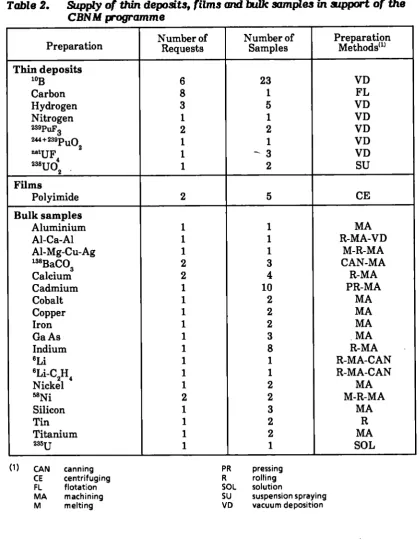
101 Samples and targets covering 40 different requests have been prepared in support to the CBNM specific programme. They comprise thin deposits, special plastic films and various bulk samples of metals, compounds and alloys (Table 2).
-10-Table 2. Supply of thin deposits, films and bulk samples in support of the CBN M programme
Preparation Thin deposits
i oB
Carbon Hydrogen Nitrogen
239PuFg
2 4 4 + 2 3 9Pu02 M tUF
238UO*2
Films Polyimide Bulk samples Aluminium Al-Ca-Al Al-Mg-Cu-Ag 138BaCO, o Calcium Cadmium Cobalt Copper Iron GaAs Indium 6Li 6Li-C2H4
Z 4
Nickel 5 8N i Silicon Tin Titanium M5U Number of Requests 6 8 3 1 2 1 1 1 2 Number of Samples 23 1 5 1 2 1 - 3 2 5 1 1 1 3 4 10 2 2 2 3 8 1 1 2 2 3 2 2 1 Preparation Methods™ VD FL VD VD VD VD VD SU CE MA R-MA-VD M-R-MA CAN-MA R-MA PR-MA MA MA MA MA R-MA R-MA-CAN R-MA-CAN MA M-R-MA MA R MA SOL
(1) CAN CE FL MA M canning centrifuging flotation machining melting PR pressing R rolling SOL solution SU suspension spraying VD vacuum deposition
New Developments
P. Robouch, J. Pauwels, C. Louvrier
Well-known techniques such as vacuum deposition, electrospraying and spray painting are routinely used at CBNM for the preparation of high quality
actinide deposits(1). The increasing demand for homogeneous deposits of rare
and expensive enriched isotopes made it necessary to investigate techniques with a potentially high efficiency, and allowing to make deposits with good resolution for fission fragments and/or charged particles measurements.
[image:18.595.84.504.74.627.2]
-11-A preliminary study was carried out in cooperation with the Target Laboratory of the Technical University of Munich (D), to investigate the use of a laser beam as a source for vacuum deposition. In the experiments the material to be evaporated was placed in an air-cooled copper crucible mounted on an x-y-z
moveable table in a vacuum chamber at 10 "5 Pa. The Nd-YAG CW laser beam
(60 - 80 Watt, 3 cm diameter) entered the vacuum system through a plano-convex lens. The focussed beam scanned the crucible surface to melt-evaporate the powder. Tests were performed to study the quantitative evaporation of LiF
and U02, the homogeneity of deposition and the interaction of the laser beam
with polyimide substrate films.
Electrodeposition of uranium and/or plutonium in aqueous and organic ("molecular plating") medium was successfully carried out on stainless steel, aluminium and polyimide substrates. New electrolysis cells allowing deposition of actinides on self-supporting thin metallic foils are under investigation.
Establishment of a Literature Database on Target Preparation
P. Robouch, C. Louvrier
Fifteen Conferences and eighteen years of Newsletters International Nuclear Target Development Society (INTDS) resulted in a collection of more than 530 publications and letters concerning the development, p r e p a r a t i o n , characterization and/or use of nuclear targets. A computer based database was developed to allow a rapid search of the available information in the field of targetry. Based on Paradox 3.5 (from Borland International), this electronic file is compatible with most of the commercial and public domain spreadsheets and databases; it is available to all INTDS members. This tool has proved to be useful when starting new projects.
REACTOR NEUTRON DOSIMETRY REFERENCE MATERIALS
-12-Sale and Certification of Reference Materials
C. Ingelbrecht
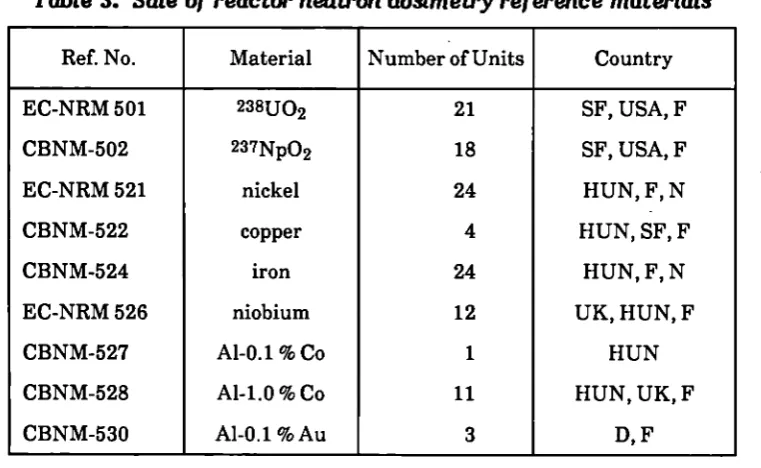
Thirteen dosimetry reference materials are currently available and during the last year 118 samples were ordered by customers in seven countries inside and outside the EC (Table 3).
EC certification of the two metal reference materials EC-NRM 522 (copper) and EC-NRM 524 (iron) was approved by the Nuclear Certification Group during
1992. Complementary certification analyses for CBNM-529 (rhodium) were
finished. The iridium mass fraction ((26.0 ± 0.6) mg-kg- 1, at 95 % confidence
level) has now been determined by six laboratories and the platinum mass
fraction (< 5 mg-kg-1) has been determined by three laboratories using four
[image:20.595.99.480.338.572.2]methods. The draft of the certification report has been completed.
Table 3. Sale
Ref. No. EC-NRM 501 CBNM-502 EC-NRM 521 CBNM-522 CBNM-524 EC-NRM 526 CBNM-527 CBNM-528 CBNM-530
of reactor neutron dosimetry ref
Material 238U02 237Np02 nickel copper iron niobium Al-0.1 % Co Al-1.0%Co Al-0.1 % Au
Number of Units
21 18 24 4 24 12 1 11 3 erence materials Country
SF, USA, F SF, USA, F HUN, F, N HUN, SF, F
HUN, F, N UK, HUN, F
HUN HUN, UK, F
D,F
Reference Material Preparation
C. Ingelbrecht, F. Peetermans, S. Palmeri
Titanium metal is useful for measuring fast neutron fluence rates primarily via
the 46Ti(n,p)46Sc reaction for neutron energies above 4.4 MeV and for
irradiations of up to about 250 days. In a thermal neutron environment there
may be interference from 45Sc(n,y)46Sc and it is important that the scandium
impurity content is low. Titanium metal with scandium content of about
0.1 mg-kg- 1 has been partly transformed into foil of 0.1 or 0.5 mm (1 kg of
-13-Three Ai-Co (0.01, 0.1 and 1.0 % Co) were prepared by spray deposition of powder (Osprey Metals, UK). Two of these alloys are to replace exhausting
stocks of reference materials and the 0.01 % Co composition will be a new
reference material for higher neutron fluence rates. The main use of such alloys
is thermal neutron metrology using the reaction 59Co(n,Y)60Co. The cobalt
homogeneity on a scale of 20 mg is of great importance and metallography of the spraying ingots shows a fine, homogeneous microstructure. The preparation of foil and wire from the three alloys is underway and certifications analyses (for cobalt content) are planned to commence early in 1993.
Another element of interest for thermal neutron metrology is silver via the
reaction 109Ag(n,Y)110mAg. Lévitation melted castings of composition Al-0.1 %
Ag have been prepared and will be transformed into foil and wire for a candidate reference material.
The preparation of a fission track glass reference material for geological dating is continuing and uranium doped glass powders have been mixed and melted (Institut National du Verre, B) for uranium homogeneity control at the University of Gent.
ACTINIDE REFERENCE MATERIALS
Spflce Reference Materials
A. Verbruggen, F. Hendrickx, A. Alonso, K. Mayer
The preparation of Spike Reference Materials is an important task at CBNM. In 1992, a total number of 211 units, corresponding to 14 orders from 12 customers, of Isotopie and Spike Reference Materials, has been delivered to various laboratories within and outside the European Community.
Certification measurements by Isotope Dilution Mass Spectrometry (LDMS) for
CBNM IRM-081 and CBNM IRM-082 have been achieved. Both are 239Pu
solutions with a certified molar concentration of resp. (4.820 0 ± 0.002 6)-10-4
mol ^ P u - k g "1 of solution and (4.926 5 ± 0.002 7)-10~5 mol ^ P u - k g "1 of
solution. Other plutonium isotopes present are related to the 2 3 9Pu
concentration through the certified molar abundance ratios:
238pu/239pu
240pu/239pu
241pu/239pu
242pu/239pu
14
Analytical
Chemistry
M.
Bickel,
B.
Dijckmans,
F.
Hendrickx,
W.
Leidert,
A.
Michiels,
W.
Nagel,
A.
Rodriguez,
B.
Slowikowski
Uranyl
Intercomparison:
The
last
results
of
the
second
phase
of
the
interlaboratory
comparison
exercise
for
the
determination
of
uranium
by
Potentiometrie
titration,
initiated
by
the
ESARDALEU
Working
Group,
have
arrived.
From
a
preliminary
rough
data
check,
they
indicate
that
most
of
the
participating
laboratories
show
satisfying
performance
in
terms
of
accuracy
and
precision
(Fig.
1).
A
more
detailed
analysis
is
under
progress.
The
raw
results
have
been
communicated
to
the
participants
in
coded
form.
MOX
Reference
Material:
The
material
to
be
used
will
be
prepared
in
1993
by
TUI
Karlsruhe
according
to
the
specifications
given
by
CBNM
arising
from
an
inquiry
among
future
users
(1).
Production
control
NDA
measurements
will
be
performed
by
JRC
Ispra.
SOLUTION A =
7.45-o
co
»
7.44-c 7.43H
O 7 . 4 2
I
-<
te 7.41■
UJ
O 7.40-z
o
° 7.39-S Z
7.38-<
oc 3 7.37
h
t.
i 1 1 1 1 1 i r A B C D E F G H
PARTICIPATING LABORATORY CODE
Fig.
1.
Part
of
results
of
uranyl
interlaboratory
comparison
The
glove
box
titration
device
for
the
determination
of
uranium
in
plutonium
bearing
materials
by
Potentiometrie
titration,
after
some
warm
test
runs
(uranium
only),
has
gone
into
operation
without
any
problems.
First
measurements
on
MOX
materials
yielded
very
satisfactory
results,
nevertheless,
systematic
experiments
are
necessary
and
will
be
performed
in
the
near
future.
Plutonium
determination
by
constant
potential
coulometry
also
has
been
applied
to
MOX
materials.
Results
were
good
but
systematic
tests
are
needed.
■15-Actinides in the Environment: The systematic investigation of precisions achievable in the determination of uranium by ICP-AES has been concluded withthe result that at concentrations around 300ppbthe reproducibility isstill acceptable (— 2 %relative), rather independently on the matrix. Taking into account that environmental concentrations are ^ 3 ppb, possible enrichment factors in the order of 100 are necessary. Systematic studies applying two different enrichment methods, ion exchange and solvent extraction, have been started.
Electrolysis as a tool to prepare alpha activity measurement sources has been further developed. The step from different matrices to the electrolyte matrix (5MNH4C1,pH2) hasbeen performed with goodresults.
As a first "real life" application of the new separation and measurement procedures the uranium and plutonium contents ofa contaminated soil sample from an old CBNM waste water transfer container were determined, yielding results of ^ 500 Bq/kg soil.An alpha spectrum ofa source obtained from a soil sample isshown inFig.2.
4000
i i i i i I I
200 400 600
CHANNEL
Fig.2. AlphaSpectrum of a U/Pusourcepreparedfrom contaminated soil
U r a n i u m Ores:Theevaluation ofthe y-ray spectrometry measurement results onEC-NRM113 and 114has been finished.
The final certification report containing all verification measurements on EC-NRM 113 and 114 was presented to the Nuclear Certification Group. It was acceptedwith several changes tobemade.Certification will take place by letter after the English translations of the original CEA certification reports have arrived from France.
I r o n D e t e r m i n a t i o n : The method developed for h i g h precision iron determination by Potentiometrie titration was further developed and put on a gravimetric basis. The reproducibility improved by a factor of 10 to 0.02 %
relative.
■16-REFERENCE
MATERIALS
FOR
NON-NUCLEAR
APPLICATION
BUREAU COMMUNAUTAIRE DE R E F E R E N C E (BCR)
Storage, Sale andDistribution of BCR Samples
E.DeConinck, G.N.Kramer, J. Pauwels
Support toBCRwasprovided by:
- storage ofvarioussamples,materials and documentation; - distribution ofBCRmaterials for round-robins;
- dispatching of candidate reference materials (RM's) for stability- and homogeneity testing andfor certification analysis;
- dispatching ofcertified reference materials (CRM's) forsale.
Inthe reporting period, lesssamples weresoldand distributed for analysis than in the previous one (Table 4). This was due on one hand to sales restrictions introduced by BCR, and on the other hand to problems with financing of certification projects. Despite this, the number of dispatches did not decrease considerably, asmoresmaller ordershad tobecarried out.
Table 4. Overview of BCR RMsashandledby CBNM
Period
1986/1987
1987/1988
1988/1989
1989/1990
1990/1991
1991/1992
Sale
1768
2407
4775
7925
8285
6853
Samplesforanalyses
1226
1258
1126
2027
2274
1110
Dispatches
396 475 753 1130
1242
1104
-17-Biological Reference Materials
G.N. Kramer, J. Pauwels, K-H. Grobecker, C. Louvrier, P. de Vos, C. Hofmann*
A pig liver candidate reference material for vitamins (BCR CRM-487) was prepared by jaw-crushing under liquid nitrogen cooling, freeze-drying and subsequent stud-milling under liquid nitrogen cooling. The powder was then sieved to < 125 urn, homogenized and bottled in penicillin vials under argon. 1600 Samples of 15 g each were prepared. Stability- and homogeneity testing is carried out at TNO, Zeist (NL).
BCR CRM-63R (spray-dried milk powder) was controlled for its lead and zinc microhomogeneity using solid sampling Zeeman atomic absorption spectrometry (SS-ZAAS). It could be demonstrated that the lead and zinc values certified by BCR are valid for samples of 10 and 87 mg, respectively.
Environmental Reference Materiala
G.N. Kramer, J. Pauwels, K-H. Grobecker, C. Louvrier, A. Oostra, P. de Vos
A fly ash candidate reference material for PCDD's and PCDF's (BCR CRM-490) was homogenized by turbula mixing, jet milled to < 125 urn, turbula mixed again and bottled using a sampler-divider. 1100 Bottles of 30 g each were prepared. 50 Samples were sent to VITO, Mol (B) for stability- and homogeneity testing.
Two coking plant soils (A: sandy soil BCR CRM-427; B: marl soil BCR CRM-428) for PAH's, phenols and cyanide were produced according to a similar preparation flow-sheet on soils collected on behalf of BCR by TÜV Essen (D). 1560 bottles of soil A (50 g/bottle) and 1300 bottles of soil B (40 g/bottle) were prepared. Samples of soil A were sent to TÜV Essen (D), for stability- and homogeneity testing.
Moreover, several preparations of soils and sediments with narrowly defined particle size distributions were prepared to study the influence of particle size on the chemical behaviour of environmental CRM's. These studies are carried out on behalf of BCR in cooperation with University of Cordoba (SP), TÜV Essen (D) and the Royal Holloway University, London (UK).
Industrial Reference Materials
C. Ingelbrecht, F. Peetermans, P. de Vos
Fourty zirconium samples doped with trace quantities of boron by quantitative alloying were sent to Max-Planck-Institut für Metallforschung, Dortmund (D)
-18-in preparation of a candidate reference material (BCR CRM-20).
2000 sharpy test samples were cleaned, greased and packed again on request of BCR.
Freeze-Drying of Isolated Chloroplasts
K.H. Grobecker, G. Zimmermann*, G.N. Kramer, C. Louvrier
The bio-assay of herbicides using chloroplasts from fresh spinach plants was
described by Zimmermann et al.(1). The determination of the oxygen produced
by the chloroplasts is used as an indicator for the presence of a group of herbicides inhibiting photosynthesis, and therefore the growth of plants.
To control the observation of legal limits of herbicides in drinking water, the chloroplast bio-assay can be used as a time and cost saving complementary method to the presently used one, i.e. gas chromatography. To perform the test under routine conditions, the testing laboratory has, however, to produce fresh chloroplasts daily.
The present investigation is aimed at producing powdered isolated chloroplasts with an activity (i.e. oxygen production under influence of light) similar to that of freshly isolated chloroplasts and which are stable over a long period of time. First encouraging results were obtained using forced opening of the chloroplasts by osmosis and subsequent freeze-drying. The shelf-life of the powder is expected to be acceptable, but has still to be tested over a longer period of time.
ENVIRONMENTALAND SURFACE ANALYSIS
Aerosol Reference Material
H. Cavé, M. Kriews**, U. Wätjen
For the elemental analysis of aerosol filter samples by X-ray techniques there is a lack of adequate reference materials (RM's). No genuine aerosol matrix is available, which has been collected on membrane filters from ambient aerosol. It was possible with a special high-volume sampling procedure to collect ambient aerosol samples with a uniformity of 5 % to 15 % in the elemental
deposit ranges of 10 ng/cm2 to ug/cm2, within probed spots of only 4 mm
diameter on suitable filter materials. Fig. 3 shows as an example the mass
* Visiting scientist from Fresenius Institut, Taunusstein, Germany ** Universität Hamburg, Germany
19
BTi^U
■FeMNiSCullZnQBifÉlSr^Pb
Fig.3. Variation of nine elemental masses inseven individual spots (4 mm 0) of acellulose nitrate filter. The relative deviations dj = (xi xj/x of the seven analyses from their mean value are given bythe histogramme bars. The errorbarsindicate the precisionAx£ ofthe singleanalysis
variation of nine elements determined by PIXE analysis in seven individual spots of a particular cellulose nitrate filter. Besides this filter type also polycarbonate (Nucleopore) membranes qualified with the needed uniformity of the dust deposits.
An aerosol collection campaign is now being performed which yielded already filter batches of rural and marine aerosol types, suitable for characterization by different analytical methods and compatible with Xray fluorescence analysis (XRF). Before entering the characterization phase, the batches of candidate RM's will be completed by an industrially influenced urban aerosol matrix.
Reference LayersandMaterialsfor Surface Analysis H. Bax, P. Rietveld, U. Wätjen
[image:28.595.127.439.108.283.2]
-20-of composite layers -20-of titanium and BaCl2 with different areal densities
[image:28.595.80.516.497.768.2](Table 5).
Table 5. Approximate areal density (ug/cm2) of composite
standards evaporated on vitreous carbon
Ti 60 60 60 60 25 20 40
BaCl2
2
5
20 40 100 100 40
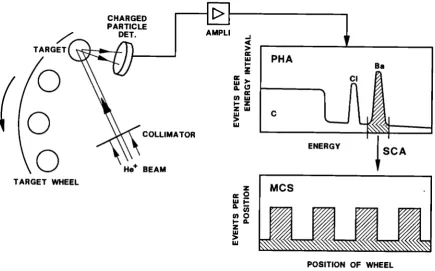
The characterization procedure follows the principle of traceability for the absolute values of areal density making use of the CBNM ultrahigh vacuum microbalance. The homogeneity assessment is based on the multi-channel scaling (MCS) of the titanium or barium signal in the RBS spectra of "pure"
titanium or BaCl2 samples (Fig. 4), evaporated simultaneously with the
composite layers. Up to 19 samples at a time are loaded on a target wheel, which is continuously rotating through the ion beam of 1 mm diameter. Half of the
standards set has been investigated so far. Relative inhomogeneities of < 1 %
have been measured.
TARGET WHEEL
POSITION OF WHEEL
Fig. 4. Scheme of the experimental setup to acquire MCS data of an energy
-21-Demonstrating the Capability of the Scanning Nuclear Microprobe for Environmental Analysis
L. Breitenbach, J. Injuk*, U. Wätjen
During the last two months of the year the scanning nuclear microprobe was available for microdistributional trace analysis. It was applied to two subjects of interest in atmospheric research:
- PIXE microdistribution analysis was done of very large (> 15 um 0) deposited dust particles, sampled on passive greasy collection plates according to VDI guideline 2119 part 4 (draft). The following elements could be detected at pg concentrations in some of the dust particles: titanium, chromium, manganese, iron and copper.
- River effluents and direct dumping into the sea have long been known as pollution sources of the North Sea. Recently also wet and dry deposition of atmospheric aerosol have been identified as important contributors to the North Sea heavy metal pollution. In spite of their low concentration in air, large particles ( > 3 urn 0) are of extreme importance for this pathway due to their comparably large individual mass and high deposition velocity. Such particles were collected above the North Sea on the research platform FPN with a cascade impactor. PIXE analysis of more than 100 single aerosol particles ( > 5 pm 0) has been performed with a proton beam of about 3 pm
X 3 pm size. In many of these particles the elements titanium, vanadium, chromium, manganese, iron, nickel, copper, zinc and gallium were detected. The quantitative evaluation of the complete data set is under way.
Trace Element Changes and Atherosclerosis
T. Pinheiro**, W. Maenhaut***, H. Cavé, U. Wätjen
Five different brain structures originating from both arteriosclerosis affected and healthy Portuguese individuals were examined for their elemental content. Potassium, calcium, manganese, iron, copper, zinc, selenium and rubidium were determined in all tissues with PIXE. The most prominent differences between the pathological and normal data were found for manganese, iron, copper and zinc in three of the five brain regions. The decrease of the potassium and rubidium content in the five brain structures from the pathological group and the changes for manganese in three of them can be associated with ageing. However, age cannot explain the trace element concentration changes of iron, copper and zinc. Most likely the changes for these elements are due to arteriosclerosis progression.
-22-Furthermore, the trace element concentration in serum and packed blood cells was investigated in samples originating from patients who had suffered from a myocardial attack and compared to samples from healthy individuals. In blood serum the iron, copper and zinc concentrations were found to be altered from normal, whereas in packed blood cells significant differences were encountered for calcium, manganese, iron, copper, selenium and lead. Factor analysis performed on the data matrices revealed one factor for each sample type which allowed distinguishing between healthy and pathological individuals. The elements related to this discrimination factor were iron and copper for serum and calcium, manganese, iron, copper and zinc for packed blood cells.
ISOTOPE ABUNDANCES AND ATOMIC WEIGHTS
Atomic Weight of Silicon for a better Avogadro Constant
P. De Bièvre, S. Valkiers, F. Schaefer*
The molar mass (atomic weight) Af(Si) [g/mol] in a silicon single crystal is an
essential parameter of the determination of the Avogadro Constant NA through
the relationship:
M{Sî)
A p - a3/ 8
where p[g/cm3] is the density of the crystal and ao [cm] is obtained from lattice
constant measurements. Absolute measurements of the molar mass require
absolute measurements of isotope abundances ft of the stable isotopes with
atomic mass M¿, i.e. of the abundance ratios i2¿. These in turn require
calibration by synthetic mixtures of highly enriched silicon isotopes:
2Ä.- M.
i
A long-term project 1980 - 2000 is ongoing at CBNM to reduce the uncertainty on the molar mass of silicon in order to bring back the uncertainty on the Avogadro Constant by a factor of 10 -100. Later on, the aim will be to reduce the uncertainty contribution of Af(Si) such that it becomes insignificant for the
uncertainty on iVA.
Anticipating the important need to further reduce the 1-10-6 uncertainty on
Af(Si) obtained in 1991, CBNM has been planning the construction of a new mass spectrometer of unprecedented capability ingas isotope abundance ratio
[image:31.595.74.519.155.408.2]
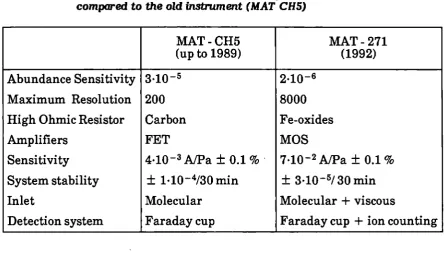
-23-measurements with the mass spectrometer manufacturer Finnigan-MAT, Bremen (D). After construction, assembly and testing of the instrument, appropriate new measurement procedures were designed and incorporated in the software. The characteristics of the new spectrometer are given in Table 6.
Table 6. The characteristics of the new mass spectrometer (MAT 271) compared to the old instrument (MAT CH5)
Abundance Sensitivity Maximum Resolution High Ohmic Resistor Amplifiers Sensitivity System stability Inlet Detection system MAT-CH5 (up to 1989)
3-10-5
200 Carbon FET
4 4 0 -3A / P a ± 0 . 1 %
± M0-4/30min
Molecular Faraday cup
MAT - 271 (1992)
2-10-6
8000 Fe-oxides MOS
7 - 1 0 -2A / P a ± 0 . 1 %
± 3-10 "5/30 min
Molecular + viscous
Faraday cup + ion counting
For the calibration process, a new series of synthetic silicon isotope mixtures was gravimetrically prepared from the same enriched silicon materials that were used in 1989-1991(1-2).
All of these efforts have resulted in a M(Si) = 28.085 446 2 with an uncertainty
(Is) of 3-10-7, which will yield an equivalent reduction of the uncertainty of
N (1)
As a by-product of the measurements(3), it was possible to make well understood
mass-dependent corrections as a function of time by extrapolating the observed
values to the moment that SiF4 is first admitted to the spectrometer through the
gold-leak. The diffusion of the gas into the ion source is governed by gas kinetic
laws. The time constants for diffusion are proportional to V M ( S Ì ) . Noting that
the kinetic gas theory relationships are independent of chemical composition, we attempted to apply the calibration by absolute M(Si) values to gases of some
other elements*4,5,6). Concordant results with best current values of their molar
masses were obtained (Table 7). The uncertainties displayed in Table 7 are in their own right much superior to previous data and the compatibility of the
(D P. De Bièvre, S. Valkiers, H.S. Peiser, F. Schäfer, P. Seyfried, CBNM Internal Report C E/R/M S/l 6/9 2
(2) F. Schäfer, S. Valkiers, P. De Bièvre, CBNM Internal Report GE/R/MS/17/92 (3) S. Valkiers, G. Lenaers, P. De Bièvre, J. Res. Nat. Bur. Stand. Tech. 96 (1991) 617 (4) S. Valkiers, B. Engelen, CBNM Internal Report GE/R/MS/21/92 ~~ (5) S. Valkiers, C. Verwimp, CBNM Internal Report GE/R/MS/27/92
-24-Af(E) values in Table 7 within the normal terrestrial ranges of the element E suggest that the error is not large. In the near future an "operational mole" unit for different elements may be defined and "near-absolute" gas isotope mass spectrometry may be performed without calibration since the measurement procedure seems to contain all necessary corrections at a given uncertainty level.
Table 7. Some uncalWrated M(E) Measurements with MAT 271 set
side by side with lUPAC-designated 'Best Measurements '
IUPACBest Measurement' from a single natural source
MAT271/CBNM 1992
IUPAC Evaluation of Extreme Range of
M(E) between 'normal terrestrial' specimens
B (from BF3)
10.811825 29 10.810 588 11 0.010 C (fromCF4)
12.01115 3 12.010 674 1 0.002 N (N2 gas)
14.006723 14 14.006 636 9 0.000 14 Ne 20.179 96 3 20.180 24 16 0.001 2 Si (fromSiF4)
28.085 526 56 28.085 528 2 0.000 6 S (fromSF6)
32.06433 14 32.064 876 2 0.012 Ar 39.947 68 2 39.947 74 2 0.002 Kr 83.796 03 14 83.798 94 2 0.02
Traceability of Chemical Measurements to the SI Unit Mole
P. De Bièvre
-25-Iaotope Abundance and Atomic Weights Measurements of Iron
P. Taylor, R. Maeck*, A. Kynaston**, P. Hansen, D. Vendelbo, P. De Bièvre
At the end of 1991, new absolute isotope abundance ratios as well as a calibrated atomic weight were obtained for the element iron. The new data will be submitted to IUPAC's Commission on Atomic Weights and Isotope Abundances. A special effort has been made to create awareness of the existence of the new Isotopie Reference Material (CBNM IRM 014) in the field of Geochemistry and Cosmochemistry.
Experimental activities were focussed on transforming an existing mass spectrometer (NBS type 90° 12" radius single collector) into an instrument which allows to perform accurate ion counting:
- installation of multiplier and suitable ion counting electronics;
- improving the vacuum (use of ion source housing equipped with gold seals; extensive use of cold traps) ;
- development of instrument control software for ion counting. This has been carried out to enable:
- the use of lower ionisation temperatures; - detection of lower amounts of iron.
The four to five orders of magnitude improvement in detection power (from
10 ~10 to 10 ~15 A) made it necessary to modify existing procedures for loading
the sample. A microloading device was constructed, consisting of an XYZ translation stage carrying the filament, a video camera for observing this filament and a micro syringe. The device allows to deposit very small droplets (down to 30 ni) on a very confined area of the sample filament (typical amount loaded: 300 ng of iron), making ion source refocussing superfluous during the measurement.
Preliminary estimates for the reproducibility of the isotope abundance ratios
are 3«10~3 for iron and better than 1 0- 3 for platinum overplated uranium
samples.
The use of lower ionisation temperatures leads to more accurate (reduced
isobaric interferences from 54Cr and 58Ni) and more precise results
(fraction-ation in the ion source is reduced and more constant), which lead to improved isotope abundance and atomic weight data. Furthermore, the enhanced detection power combined with suitable chemical and measurement procedures will allow to measure abundance ratios accurately on ng amounts of iron in biological and environmental samples.
For carrying out IDMS in the future, a 57Fe spike is in preparation. The
materia! has been purified using ion exchange procedures and transferred into quartz ampoules.
-27-PR0JECT2: NUCLEAR MEASUREMENTS
Introduction.
A.J. Deruytter
In 1992, the first year of the multiannual research programme (1992-1994), the Unit Nuclear Physics and Measurements contributed to the specific programme Measurement and Testing in the Project Nuclear Measurements and to Work for Third Parties.
The main objectives of the Project Nuclear Measurements in the subprojects Nuclear Data and Nuclear Metrology are: to improve the neutron standards data set, relative to which partial cross-sections or other quantitites, important for fission and fusion technology, are determined; to improve radionuclide data for standards application; to develop nuclear measurement techniques for nuclear and non-nuclear applications.
The major facilities of CBNM, the Geel linear electron accelerator GELINA and the 7 MV Van de Graaff accelerator were fully operational. They were used for neutron data measurements and in the non-nuclear applications. In 1992 the first phase of a refurbishment plan for GELINA was approved.
The efforts for the improvement of the set of standard neutron cross-sections and for other quantities selected within the INDC/NEANDC Standards File continued. In particular work on the s t a n d a r d cross-section r a t i o
236U(n,f)/H(n,n) continued with Frisch gridded ionization chambers and using
octacosanol samples as hydrogeneous layers.
A double Frisch gridded ionization chamber was used to measure
mass-energy-and angular distribution of fission fragments for 237Np(n,f) from 0.5 MeV to
5.5 MeV neutron energy.
Measurements of alpha-particle emission probabilities of 239Pu showed results
for the two major emissions to disagree with recent evaluated data.
Requests from the nuclear science community became more and more demanding and follow from deficiencies in available experimental data sets, which are detected by careful evaluation efforts in the framework of the International Evaluation Cooperation (IEC) of the NEA Nuclear Science Committee (NEA-NSC). The requests are summarized in the NEA High Priority Request List.
In the subproject on nuclear data for fission technology a measurement was
performed of the normalization of the 239Pu fission cross-section which solved a
-28-Parameters for 384 resonances in 58Ni and 350 resonances in 60Ni have been
analyzed upto 1 MeV and 800 KeV, respectively. The data were submitted for inclusion in the JEF and EFF files.
In the field of nuclear data for fusion technology, double differential
neutron-emission cross-sections for 9Be(n,2n) for incident neutron energies between
0.6 MeV and 11.1 MeV have been transmitted to the NEA Data Bank. During 1992 an extensive measurement campaign has been performed on neutron
emission cross-sections from 207Pb.
New measurements of 58Ni(n,a) relative to the 27Al(n,a) cross-section instead of
relative to H(n,n) were performed at 8 MeV neutron-energy under five angles with a AE-E telescope. Aim is to resolve the discrepancy of our earlier data with the ENDF/B6 evaluation.
Several more basic measurements linked to our nuclear data programme were performed mainly for PhD research and using GELINA as a high resolution
neutron spectrometer unique in Europe. They concern: spin assignments of 238U
p-wave resonances as a contribution to parity-non-conservation (PNC) studies
at Los Alamos, a search for the shape isomer in 239U and 233Th and the study of
y-ray decay towards the isomeric groundstate in 239U, high resolution 138Ba
(n,y) measurements in view of understanding the s-process nucleosynthesis, the
study of radioactive transitions from n-capture in 53Cr resonances, and 242Pu
and 244Pu mass and energy distributions and their correlations.
In the radionuclide metrology subproject contributions were made by the preparation of low-energy X-ray standard sources, measurements of K-shell
fluorescence yields, standardization of a 152Eu solution, evaluation of the second
EUROMET intercomparison of 192Ir brachytherapy sources, and low level
measurements on volcanic rock, archeological ceramics, soil and river sediments. Impressive was the background reduction in low-level measurements with a high-purity Ge detector in the underground laboratory HADES (collaboration with SCK/CEN, Mol (B)). The technique of time-differential perturbed angular distributions (TDPAD) of y-rays with the pulsed beam facility at the Van de Graaff was applied for identification of fluorine residence sites in silicon and germanium, as well as for radiation damage studies in GaAs.
In the area of neutron metrology fast neutron and y-ray fluences close to the GELINA target were measured in view of damage caused by irradiations with fast neutrons at a fluence level of 1015 n/cm2.
-30-NUCLEAR DATA
NUCLEAR DATA FOR STANDARDS
The objective of the work on standard nuclear data is to improve the set of neutron data to be used in measurements consistency checks. Competing reactions, angular and kinetic energy distributions of the reaction products have to be studied to increase the reliability of the given standard cross sections. Appropriate research topics are selected from listings of the INDC/NEANDC Standards File. Complementary work is devoted to radionuclide decay data and associated atomic data requested for calibration and reference purposes.
Neutron Data
Standard Cross Section Ratio 235C7(nffyH(n,n)
F.-J. Hambsch, R. Vogt, G. Willems*, P. Robouch, J. Van Gestel, J. Pauwels, A. Rodriguez, R. Besenthal
In continuation of this investigation^ measurements at incident neutron energies ranging from 0.3 to 2 MeV have been performed for six different octacosanol samples. The thickness of the octacosanol layers under
investigation are 136 ug/cm2, 137 ug/cm2, 217 ug/cm2, 280 ug/cm2, 353 ug/cm2
and 550 ug/cm2. The samples were prepared by two different evaporation runs.
Analysis of the proton-recoil spectra carried out for the first measurement series revealed a sharp distribution with an energy resolution of about 14 keV FWHM. This was deduced from the width of a high precision pulse generator peak, which was continuously connected during the experiment. The resolution is demonstrated by a fît with a Gaussian distribution to the measured pulse generator peak in Fig. 5.
Analysis of the second measurement series revealed, however, a much smoother spectral shape of the proton recoils, although the width of the pulse generator peak did not change.
A comparison of the proton recoil spectra measured for samples of 136 ug/cm2
and 137 ug/cm2 at about 2 MeV neutron energy at the high energy end of the
spectrum is given in Fig. 6. It is obvious that the two spectra are different, which accounts to about 1 % of the total counts. If the aim is to reduce the total measurement error to about 0.5 % such a dissent is not acceptable. This also
31
3
-io
O
« 2
-3 O U
1
-FWHM = (4.74± 0.07) ch = (13.8 ± 0.2) keV
■ i' | ■ i i i I i1 i—i i | i i i
710 720 730
CHANNELS (1ch=2.9keV)
740
Fig.S. Precise pulsegenerator peak andcorrespondinggaussian fit
because the difference appears at the high energy end of the spectrum, where those events are measured which are emitted close to 0° with respect to the normal on the cathode. There the energy loss in the sample should be a minimum, if a homogeneous surface is present. However, without notice the gas supplier had changed the gas quality. Furthermore also the neutron producing target had been replaced due to a low neutron yield.
Using a certified gas with N50quality and the former TiTtarget for the neutron production resulted in the spectrum shown in Fig. 7 by a dashed line. There is still a visible discrepancy with the first measured spectrum (solid line) at the high energy end. But compared to Fig. 6 the shape has considerably improved. Because of these non reproducible measurements of the proton recoil spectra, we tried to measure and compare also the tristearin samples used in earlier experiments(1). Up to now only the thinnest tristearin sample of
148 ug/cm2 has been investigated. The comparison with the best octacosanol
measurement is given in Fig. 8. The two distributions are very much the same. However, the tristearin distribution is obviously more extended to higher channel numbers. This is unexpected because energy loss calculations based on
(1) H.H. Knitter, C. BudtzJørgensen and H. Bax, Proc. Advisory Group Meeting on
328 0 0
-■ COUNT S o o o o
2 0 0
-ikø.
i i i 'wu'wUv
1 1 l ' " I 1
■■y,!.nA
ţi
M
l
\\
1
1 I Is
5 5 0 6 0 0 6 5 0 CHANNELS
Fig. 6. Comparison of the proton recoil
spectra for 2 MeV incident neutron
energy and octacosanol sample thick
nesses of 137 jig/cm2 fsolid line) and
136ng/cm2 (dashed line)
-i—i—i—r~i—i—i—i—|—i—i—i—i—|—i—i—i—r
5 5 0 6 0 0 6 5 0 CHANNELS
Fig. 7. Comparison of the proton recoil
spectra for 2 MeV incident neutron
energy and octacosanol sample thick
nesses of 137 ţig/cm2 fsolid line) and
136 jig/cm2 fdashed line). Certified
NSOgasandbetter TiTtarget used
8 0 0 ^
« 6 0 0
-z
3
8
4002 0 0
-i'll'*JI »ill"' [ "r i'
■ 1 ifl M l .nil.'IL1tíirt\Aik
i i ' i
'w.V«ViiA'1'
t A1
1 W Ih
V j *
1 \ 1 1 1 l l j
5 5 0 6 0 0 6 5 0 CHANNELS
Fig.8. Comparisonof the protonrecoil
spectra for 2 MeV incident neutron
energy and octacosanol sample of 137
yig/cm2(solidline)and tristearin sample
of 148 ng/cm2 (dashed line)
tables of Ziegler et al.(1) for protons of 2 MeV showed the same value of ~ 25 keV
energy loss for both the tristearin sample of 148 ug/cm2 and the octacosanol
sample of 137 ug/cm2. From this it is expected that both distributions end in the
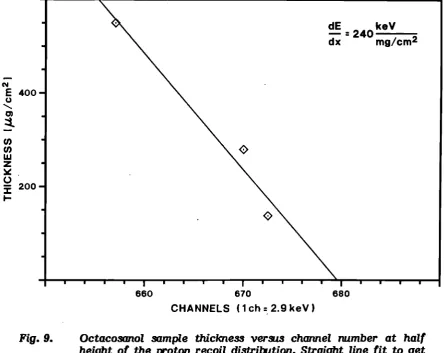
same channel. The measured difference of two to three channels, respectively 6 to 9 keV, however, seems to indicate that something might be wrong. For three different octacosanol samples of the first measurement a plot of the energy loss
-33-versus half height of the proton recoil distribution is given in Fig. 9. A straight line fit to the points gives the stopping power value for octacosanol at 2 MeV
proton energy. The resulting value from the fit of 240 keV/mg/cm2 is in
disagreement to the expected value of 179 keV/mg/cm2 (1).
To solve the existing discrepancies a new measurement series is foreseen including all the different octacosanol and tristearin samples available. To check also the influence of the neutron producing target new TiT-targets have already been ordered.
CM
£ 4 0 0 -o v.
3.
(0 (0
ILI
z
= 200 H
dE 2 4 Qk e V
dx mg/cm2
i 660
CHANNELS ( 1 ch : 2.9 keV)
Fig. 9. Octacosanol sample thickness versus channel number at half height of the proton recoil distribution. Straight line fit to get the stopping power at 2 MéV incident neutron energy
The 235U Fission Fragment Anisotropics
F.-J. Hambsch
On request from the NEANDC Standards Subcommittee, which has decided to present the NEANDC7INDC Standards file as an OECD/NEA document, a
review on the 235U fission fragment anisotropics has been written. Since the last
review in 1983(2) of the status of the measured fission fragment anisotropies as
(D J. F. Ziegler et al., The stopping and range of ions in solids, Pergamon Press, New York (1985)
[image:41.595.75.520.229.582.2]
-34-function of incident neutron energy in 235U only a few new measurements have
been performed. However, for measurements of fission cross sections which do not cover the whole 2n solid angle or for corrections of self absorption within the target for small emission angles with respect to the plane of the deposit the knowledge of the fragment angular distribution is needed. The main experimental emphasis has been devoted to the neutron energy range from
3 keV to 500 keV(1) and from 0.5 MeV to 6 MeV in steps of 0.5 MeV(2). The main
result was that the measured anisotropies in the energy range from 0.5 MeV to 6 MeV agree with the result already published, but have smaller errors. The negative anisotropies for neutron energies below 0.3 MeV measured already by several other authors have been confirmed.
Investigation of the Correlation Between Prompt Gamma-Ray Emission and Fission Fragments from 252Cf(SF)
F.-J. Hambsch, R. Vogt
Recently this type of activity has been partly restarted under different aspects. In a first instance the fission fragment signals from the used Frisch gridded ionization chamber served as input to a newly developed four parameter data acquisition system. This system connected to the SUN-SPARC based local area network made it possible to do directly data acquisition and online monitoring with LISA (Listmode and Spectral data Analysis, see page 83 for details) based on the commercial visualization package PV-WAVE.
The four parametric listmode data were directly acquired via the SCSI-interface
onto 4 mm DAT-tapes with 2 GByte capacity. Approximately 2.5-108 events
have been registered up to now. Different steps of data analysis are ongoing before fission fragment mass- and total kinetic energy distributions can be calculated.
The second aim of this experiment is to check the quality of the ionization chamber, the data reduction and the spontaneous fissioning target by the achieved mass resolution in comparison to recently published data of fission
fragment properties in the cold fragmentation region of 252Cf(SF).
Furthermore in a recent investigation*3* of the correlation of fission fragments
with prompt neutron emission from 252Cf(SF) an increased yield at asymmetric
fragment masses has been found. This is especially interesting to be verified
because the prompt neutron database measured(3) is extremely good (~ 108
coincident events) and inconsistencies with older prompt n e u t r o n measurements of fission fragments may become visible.
(D F.-J. Hambsch, H.-H. Knitter, C. Budtz-Jørgensen, Proc. of the Seminar on Fission, ed.
C. Wagemanş,Habay-la-Neuve,1986,BLG586
-35-Neutron Induced Fission of 237Np
P. Siegler*, F.-J. Hambsch, R. Vogt
The already mentioned measurement(1) of the fission fragment properties of the
reaction 237Np(n,f) has been started using the 7 MV Van de Graaff accelerator
as a neutron source. A double Frisch gridded ionization chamber is used to measure the mass-, energy- and angular distribution of fission fragments as function of the incident neutron energy.
The fact, that 237Np has a fission threshold at about 0.7 MeV neutron energy,
makes an investigation in this energy region especially interesting. It has not
yet been clearly proven by other experiments(2, 3) whether or not the fission
fragment properties exhibit changes with incident neutron energy.
Up to now measurements at 0.5, 0.7,1,1.09,1.3,1.6, 4, 4.6, 5, 5.5 MeV neutron
energy were performed. About 2 4 05 coincident fission events have been
measured at all neutron energies except the lowest. The D(d,n) reaction has been used for neutron energies above 4 MeV and the T(p,n) for the lower energies.
In the threshold region, where finer energy steps are needed the spread in neutron energy due to energy loss of protons in the tritium target becomes severe. To reduce this spread several additional runs between 0.3 MeV and
0.7 MeV with thin lithium-fluoride targets using the 7Li(p,n)7Be reaction are
planned.
A