Spin squeezing in a driven Bose-Einstein condensate
Stewart D. Jenkins*and T. A. Brian Kennedy†
School of Physics, Georgia Institute of Technology, Atlanta, Georgia 30332-0430
共Received 1 August 2002; published 30 October 2002兲
We consider a collection of atoms prepared in a Bose-Einstein condensate which interact via two-body elastic collisions. A resonant driving field couples two internal states which together constitute an effective spin 1/2 system for each atom, and from which a total spin for the gas can be defined. It is shown that in the limit of strong driving, the system dynamics reduces to a mechanism for spin squeezing similar to that of a recent proposal for undriven condensates. However, we find that the conditions for spatial stability in our driven system are complementary to those of the undriven system. Reasons for this difference, associated with the physics of dressed atom collisions, are discussed along with conditions for preparing and observing the spin squeezed state.
DOI: 10.1103/PhysRevA.66.043621 PACS number共s兲: 03.75.Fi, 03.65.Ud, 03.67.⫺a
I. INTRODUCTION
A system of NⰇ1 distinguishable two state quantum sys-tems has a Hilbert space of dimension 2N. Is it practically possible to prepare arbitrary quantum states, by accessing the recesses of this large space? The preparation of such mas-sively entangled states is a major focus of current research in quantum information physics. By definition, entangled states cannot be represented as product states, or statistical mix-tures of product states.
In recent years, a manifestation of a particular form of massive entanglement known as spin squeezing关1兴has been of great interest. Such correlated atomic wave functions could be used to enhance the accuracy of population mea-surements in spectroscopy and also have the potential to be used in atomic clocks关2– 4兴. Several methods for producing spin squeezed states have been proposed in the last decade 关3,5–11兴. Experimental realizations of these states have been made by mapping the quantum state of squeezed light onto a gas of cold uncondensed atoms 关12兴, as well as through quantum nondemolition measurements 关13,14兴.
In a recent paper, Sorensen et al.关15兴have suggested that an entangled wave function for the internal state of a system of N atoms can be produced by means of low-energy elastic collisions within a vapor prepared in a special initial state. The initial state is a zero-temperature Bose-Einstein conden-sate 共BEC兲. A short controlled electromagnetic pulse is ap-plied and, at the atomic level, coherently mixes two single-particle atomic states, labeled by 兩⫹
典
and兩⫺典
, which form an effective spin 1/2 system. The sum of N such atomic spins defines a resultant N-particle spin angular momentum for the gas. The effect of low-energy s-wave atomic collisions is to squeeze, hence entangle, the associated N-particle spin wave function of the condensate mixture 关1兴. The special initial condition, and the stability of a common spatial mode for condensates in either of the single-particle atomic states, leads to a squeezing which scales with N. This very attractive feature, by contrast with some of the earlier proposals, meansthat entanglement could be enhanced just by increasing the initial condensate particle number.
The stability of the common spatial mode, the so-called ‘‘breathe-together’’ mode is a nontrivial issue. A detailed sta-bility analysis was reported in Ref.关16兴, and, in the Thomas-Fermi limit, boils down to a condition on the relative strength of interstate and intrastate s-wave atomic collisions, i.e., g⫹⫺⬍g⫹⫹,g⫺⫺. Here g is proportional to the scat-tering length for the collision of atoms in the stationary states
兩
典
and 兩典
, respectively, and is defined precisely later. In short, for a pair of overlapping condensates, interacting only via elastic collisions, a common spatial mode is stable for atomic states which have relatively weak interstate colli-sions.In this paper we present a scenario for squeezing the N-particle spin wave function in the opposite limit g⫹⫺ ⬎(g⫹⫹⫹g⫺⫺)/2, when the interstate collisions are rela-tively strong. The procedure is similar to that of Ref. 关15兴, and again relies on the existence of a common breathe-together spatial mode, except that the initial BEC is strongly driven by an external field, so that the atomic single-particle states execute resonant Rabi oscillations at a frequency that exceeds other characteristic time scales of the problem. This type of driving between hyperfine ground states was origi-nally demonstrated experimentally in a rubidium BEC by Matthews et al.关17兴, and has since been used in the creation of vortices关18,19兴. Spin squeezing is again caused by elastic atomic collisions between condensate atoms which undergo rapid Rabi oscillations, i.e., collisions of dressed atoms. The reasons for the complementary stability criteria are, as will be discussed, a result of the different collision properties of bare atom and dressed atom condensates 关20兴.
The remainder of this paper is organized as follows. In Sec. II we present the basic theoretical model. An analysis of the model follows in Sec. III, where the limit of large Rabi frequency is used to simplify the equations. This section also includes a discussion of the breathe-together mode and its stability, an analytical calculation of the spin squeezing, and a comparison with the physics of Ref. 关15兴. Following our conclusion in Sec. IV, two appendixes provide further details on the breathe-together mode stability共Appendix A兲and the *Electronic address: [email protected]
†Electronic address: [email protected]
collisional interaction energy of bare and dressed conden-sates共Appendix B兲.
II. THEORETICAL MODEL
We consider an ultracold BEC atomic gas with two single-particle states labeled by兩⫹
典
and兩⫺典
, which form a closed two state system. In an alkali atom these states should be hyperfine states belonging to the ground electronic term2S
1/2, although their total angular momenta F, and hence their energy, may be different. The possibility of collision induced couplings to other degenerate hyperfine states means that the two state system will not, in general, be closed. This problem may be circumvented if one chooses the two inter-nal states with different F values such that both states have the minimum共or maximum兲possible values for MF in their respective manifolds. Doing this will forbid spin-exchange collisions between the two states, thus forming a closed two-state system. Alternatively, if this choice cannot be made, the unwanted degenerate states may be coupled via an off reso-nant laser field to higher energy levels, thereby raising the energy of the unwanted levels through the ac Stark shift, and making spin-exchange collisions energetically unfavorable 关15兴. It should be noted that with the former option, it is necessary to use an optical trap关21兴to confine the gas; since these states generally have opposite magnetic moments, it would not be possible to simultaneously trap them magneti-cally. By assuming that a careful choice of the states has been made, we will exclude from our model the influence of other hyperfine states. The role of atomic losses in degrading the squeezing has been discussed in Ref.关15兴, and we expect similar qualitative features with the current scheme.
BEC atoms in the states 兩⫹
典
and兩⫺典
suffer low-energy elastic collisions, while a resonant external electromagnetic field induces transitions between them. The Hamiltonian for the N-particle system may be writtenHˆ共t兲⫽Kˆ⫹Vˆext⫹0Sˆz⫹UˆC⫹HˆAF共t兲, 共1兲 where Kˆ is the kinetic energy, Vˆext is the external trapping potential, UˆC is the collisional interaction energy, and HˆAF(t) is the interaction between the atomic states and the external electromagnetic field. These operators are defined by
Kˆ⫽⫺
兺
⫽⫹,⫺冕
d3r ˆ†共r兲ប 2ⵜ2
2m ˆ共r兲, 共2兲
Vˆext⫽
冕
d3r ˆ⫹ †共r兲V⫹共r兲ˆ⫹共r兲
⫹
冕
d3r ˆ⫺†共r兲V⫺共r兲ˆ⫺共r兲, 共3兲HˆAF共t兲⫽⫺ប 2
冉
冕
d3r ˆ ⫹
†共r兲共r兲e⫺i(r)⫺iLt
⫻ˆ
⫺共r兲⫹H.c.
冊
, 共4兲whereˆ(r) andˆ†(r) are boson field annihilation and cre-ation operators for the bare atomic states,(r) and(r) are the effective Rabi frequency and phase of the external driv-ing field, respectively, and V⫾(r) are the external trapping potentials for the atomic states兩⫾
典
. For transitions between two hyperfine states separated by a microwave frequency, the wavelength can be assumed large with respect to the vapor, and we can take the Rabi frequency and phase to be constant throughout the sample, i.e.,(r)⫽0 and(r)⫽. The tran-sition frequency between the states is0 and the spin opera-tor Sˆz is defined in terms of the Pauli spin matrixz,Sˆz⫽ ប
2 ,
兺
⫽⫹,⫺冕
d3r ˆ†共r兲共z兲ˆ共r兲. 共5兲
We similarly define Sˆxand Sˆy, by replacingzwithxand
y, respectively.
The two-body collisional interaction potential may be written
UˆC⫽ 1 2 ,
兺
⫽⫾g
冕
d3r ˆ†共r兲ˆ†共r兲ˆ共r兲ˆ共r兲,where the collision coefficients g⫽42ប2a/m with a the scattering length between atoms in the internal states and . Note that aside from the atomic energy and Rabi coupling terms in the Hamiltonian, this is exactly the same Hamiltonian discussed by Sorensen et al.关15兴.
III. ANALYSIS OF THE MODEL
A. Limit of large Rabi frequency
We consider the limit that the Rabi frequency is the largest frequency in the problem. The analysis then proceeds by means of two unitary transformations 关22兴. The first is generated by Uˆ (t)⫽exp(⫺iLSˆz/ប), and yields a time depen-dent Schrodinger equation with a time independepen-dent Hamil-tonian Hˆ
⬙
. The latter is identical to the Hamiltonian Hˆ (t) with the substitutions HˆAF(t)→HˆAF(0)⫽⫺Sˆx and 0→⌬⫽0⫺L. Assuming atomic resonance,⌬⫽0, we may write Hˆ
⬙
asHˆ
⬙
⫽Kˆ⫹Vˆext⫹UˆC⫺Sˆx. 共6兲 A second unitary transformation is applied with Wˆ (t) ⫽exp(iSˆx/ប), which yields the Schro¨dinger equation iប(/t)兩(t)典
⫽Hˆ⬘
(t)兩(t)典
with Hˆ⬘
(t)⫽Kˆ⫹Wˆ†(t)(Vˆext ⫹UˆC)Wˆ (t). Here,兩(t)典
is the state vector in the rotating frame, and is related to the Schro¨dinger picture state vector in the laboratory frame 兩⌿(t)典
, by 兩⌿(t)典
⫽Uˆ (t)Wˆ (t)兩(t)典
.Wˆ†Vˆ
extWˆ⫽
兺
⫽⫹,⫺冕
d3r ˆ
†共r兲V¯共r兲ˆ 共r兲
⫹cost
冕
d3r关ˆ⫹†共r兲Vd共r兲ˆ⫹共r兲 ⫺ˆ⫺ †共
r兲Vd共r兲ˆ⫺共r兲兴
⫹i sint
冕
d3r关ˆ⫹†共r兲Vd共r兲ˆ⫺共r兲 ⫺ˆ⫺ †共r兲V
d共r兲ˆ⫹共r兲兴, 共7兲 where V¯ (r)⫽1
2关V⫹(r)⫹V⫺(r)兴 and Vd(r)⫽
1 2关V⫹(r)
⫺V⫺(r)兴. This expression is formally in agreement with the mean-field theory of Williams et al. 关22兴. The two-body in-teraction potentials transform as
Wˆ†UˆCWˆ⫽¯g
冕
d3r Tˆ0(0)共r兲⫹g
⬘
冕
d3r 关Tˆ z(1)共r兲cost
⫹Tˆy(1)共r兲sint兴⫺g
冕
d3r 关e2itTˆ⫺(2)2共r兲 ⫹e⫺2itTˆ2(2)共r兲兴⫹g
冕
d3r ˆ†x⫹共r兲ˆx†⫺共r兲ˆx⫺共r兲ˆx⫹共r兲, 共8兲whereˆx†⫹(r) 关ˆx†⫺(r)兴 are bosonic field creation operators for a spin one-half oriented in the positive 关negative兴 x di-rection, i.e., ˆx†⫹(r)⫽关ˆ⫹†(r)⫹ˆ⫺†(r)兴/
冑
2 and ˆx†⫺(r)⫽ ⫺i关ˆ⫹†(r)⫺ˆ⫺†(r)兴/冑
2 关26兴. Alternatively, it is useful to re-gard these as field operators for dressed atomic single-particle states, arising as a result of the Rabi coupling of the bare atom to the external electromagnetic field关20兴.The collision coupling coefficients are given by
g ¯⫽1
4 ,
兺
⫽⫹,⫺g, 共9兲
g
⬘
⫽14共g⫹⫹⫺g⫺⫺兲, 共10兲
g⫽1
4共g⫹⫹⫹g⫺⫺⫺2g⫹⫺兲. 共11兲
We have also defined the collision kernels Tˆq(k)(r) as fol-lows:
Tˆ0(0)共r兲⫽
兺
,⫽⫾ ˆ †共
r兲ˆ†共r兲ˆ共r兲ˆ共r兲, 共12兲
Tˆ⫾(1)1共r兲⫽⫿ 1
冑
2关ˆ x⫹ † 共
r兲ˆx†⫾共r兲ˆx⫿共r兲ˆx⫹共r兲
⫹ˆ x⫺ † 共r兲ˆ
x⫾ † 共r兲ˆ
x⫿共r兲ˆx⫺共r兲兴, 共13兲
Tˆ⫾(2)2⫽1 2ˆx⫾
† 共r兲ˆ x⫾ † 共r兲ˆ
x⫿共r兲ˆx⫿共r兲, 共14兲
and⫿
冑
2Tˆ⫾(1)1(r)⫽Tˆy(1)(r)⫾iTˆz(1)(r). The notation Tˆq(k)
indicates the q component of a rank k spherical tensor with respect to the effective spin, as defined by the commutation relations
关Sˆx,Tˆq(k)共r兲兴⫽បqTˆq(k)共r兲, 共15兲 关Sˆy⫾iSˆz,Tˆq
(k)
共r兲兴⫽ប
冑
共k⫿q兲共k⫾q⫹1兲Tˆq(k)⫾1共r兲. 共16兲 Rewriting the collision interaction in terms of these spherical tensors is useful for the purpose of calculating the unitary transformation, since it follows from their definition thatWˆ†共t兲Tˆq(k)共r兲Wˆ共t兲⫽e⫺iqtTˆq(k)共r兲. 共17兲 The one collision kernel that has not been explicitly defined in terms of tensors, is a linear combination of tensors of rank 0 and 2, each with component q⫽0. As a consequence, it is unaffected by the second unitary transformation, and thus we leave it in the explicit form given.
We are interested in the limit of large Rabi frequency compared to any other characteristic frequency. In this limit we make a form of rotating wave approximation and cycle average the rotating frame Hamiltonian Hˆ
⬘
(t) over the Rabi period to getHˆRWA
⬘
⫽Kˆ⫹兺
⫽⫾冕
d3r ˆ †共
r兲V¯共r兲ˆ共r兲
⫹1
2¯g,
兺
⫽⫾冕
d3r ˆ†共r兲ˆ†共r兲ˆ共r兲ˆ共r兲
⫹g
冕
d3r ˆx⫹ † 共r兲ˆx⫺ † 共
r兲ˆx⫺共r兲ˆx⫹共r兲, 共18兲
in which all collision tensors with q⫽0 have disappeared. In the limit of strong driving the vapor experiences only the average external potential V¯ (r) of the two strongly coupled single-particle states关22兴. In a far off-resonance optical trap 关21兴, unlike a magnetic trap, it is reasonable to assume that the latter potentials are identical, and thus equal to V¯ (r).
B. Single-mode approximation: the breathe-together mode
In the rotating frame the Hamiltonian HRWA
⬘
is indepen-dent of the driving field. This enables us to make use of the analysis of Ref. 关16兴, and assume the existence of a stable single common ‘‘breathe-together’’ mode ¯ (r,t). Perhaps surprisingly, the condition for stability of this mode, g⫹⫺ ⬎(g⫹⫹⫹g⫺⫺)/2, is opposite to that required for its stability in the BEC squeezing scheme of Ref. 关15兴. In the latter scheme squeezing results from the collisional interaction of two bare atomic condensates without any Rabi coupling.of the mean interaction energy of two condensates in which the macroscopically occupied single-particle states are, re-spectively, bare atomic states Eintb and dressed atomic states Eintd , is revealing共Appendix B兲. These energies are given by
Eintb ⫽g⫹⫺
冕
d3r ⫹共r兲⫺共r兲, 共19兲 where ⫾(r)⬅N⫾兩⫾(r)兩2 are the spatial densities of the bare states, andEint d ⫽1
2共g⫹⫹⫹g⫺⫺兲
冕
d 3r x⫹共r兲x⫺共r兲, 共20兲
wherex⫾(r)⬅Nx⫾兩x⫾(r)兩2are the spatial densities of the dressed states. The interaction energy is proportional to the overlap integral of the corresponding condensate spatial den-sity profiles, with the expected prefactor g⫹⫺ in the bare atom case, but with a prefactor (g⫹⫹⫹g⫺⫺)/2 for dressed condensates. Indeed the coefficient g⫹⫺ only contributes to the self-interaction energy of dressed condensates. These un-usual features of elastic collisions in dressed condensates are reflected in the different stability criterion for the breathe-together mode.
Assuming the atomic states are chosen such that the sta-bility condition for the breathe-together mode is satisfied, we may define annihilation operators for this mode by 关20,23,24兴
aˆx⫾共t兲⫽
冕
d3r¯*共r,t兲ˆx⫾共r兲, 共21兲 with corresponding definitions for creation operators, while the number operator aˆx†⫾(t)aˆx⫾(t)⫽aˆx⫾†
aˆx⫾ is time inde-pendent.
Hence, in HˆRWA
⬘
we replace the field operators ˆx⫹(r)→¯ (r,t)aˆx⫹(t), ˆx⫺(r)→¯ (r,t)aˆx⫺(t) to give
HˆRWA
⬘
→NE共t兲⫹ប⍀共t兲aˆx†⫹aˆx†⫺aˆx⫺aˆx⫹ ⫽NE共t兲⫺ប⍀共t兲冉
Sˆx2 ប2⫺
1 4N
2
冊
, 共22兲where
E⫽
冕
d3r ¯*共r,t兲共K⫹V¯兲¯共r,t兲⫹12 ¯g
冉
冕
d3r兩¯共r,t兲兩4冊
共N⫺1兲and
ប⍀共t兲⫽g
冉
冕
d3r兩¯共r,t兲兩4冊
.Thus in the breathe-together mode approximation HRWA
⬘
re-duces to the one-axis twist Hamiltonian originally discussed in the context of spin squeezing by Kitagawa and Ueda关1兴. The nomenclature arises since Sˆx generates a rotation about the x axis, and Sˆx2
generates a rotation in which the eigen-states of Sˆxare rotated in opposite directions.
The degree of spin squeezing that results from time evo-lution under this Hamiltonian can be quantified by the pa-rameter 2⫽inf兵N(⌬Sˆ⬜)2/兩
具
Sˆ典
兩2:Sˆ⬜⫽Sˆ•n, where n⬜具
Sˆ典
其. This definition for the degree of entanglement is consistent with those discussed by Wineland et al. 关3,4兴 and Sorensen et al.关15兴. It has been shown that if2⬍1, then the conden-sate exhibits massive entanglement and spin squeezing关15兴. It can also be demonstrated that we attain maximal squeezing when our initial state vector is a coherent spin state 共as de-fined by Kitagawa and Ueda 关1兴兲whose mean spin vector is perpendicular to the axis about which the one axis twisting occurs, in this case the x axis. A convenient realization of this initial condition would be a zero-temperature BEC with all atoms in the internal state,兩⫺典
.With the coherent state initial condition, the squeezing parameter as a function of time can be computed analytically 关1兴, and is given by
2共t兲⫽
再冋
1⫹14共N⫺1兲A共t兲
册
⫺ 14共N⫺1兲
冑
A共t兲2⫹B共t兲2
冎
cos2N⫺2
冉
冕
0t
⍀共t
⬘
兲dt⬘
冊
,
共23兲
where A(t)⫽1⫺cosN⫺2关2兰0 t⍀
(t
⬘
)dt⬘
兴, and B(t)⫽ ⫺4 sin关兰0t⍀(t⬘
)dt⬘
兴cosN⫺2关兰0t⍀(t⬘
)dt⬘
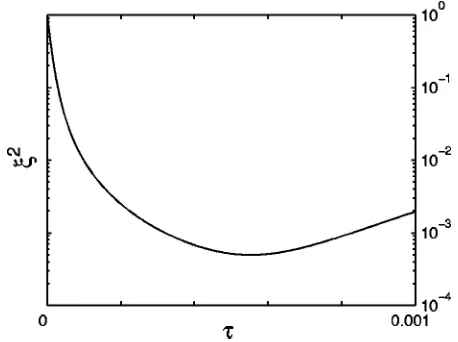
兴 共Fig. 1兲. For large N, it has been shown that the minimum attainable squeezing parameter scales as2⬃N⫺2/3关1兴.For spin squeezing to occur the collision coefficient g must be nonzero. Furthermore, for our approximations to be valid, the characteristic frequency ⍀ must be small com-pared to the Rabi frequency . To illustrate the time scales, we give some estimates of the characteristic parameters. We assume, for simplicity, that the vapor is trapped in a spheri-cally symmetric potential V(r)⫽V⫺(r)⫽V⫹(r) ⫽1
2mtra p 2
[image:4.612.323.552.58.229.2]r2. The initial wave function 0(r) can be deter-mined using the Thomas-Fermi approximation to the time FIG. 1. The squeezing parameter 2 as a function of time,
⫽兰0
t
⍀(t⬘)dt⬘, for the evolution of the system under the Hamil-tonian⫺⍀(t)Sˆx
2
independent Gross-Pitaevski equation关25兴. Using this proce-dure we numerically determine the characteristic frequency ⍀ to be
⍀关s⫺1兴⫽1.4⫻10⫺4m共a⫹⫹⫹a⫺⫺⫺2a⫹⫺兲
⫻共tra p关s⫺1兴兲6/5
冉
ainitN
冊
3/5, 共24兲
where the scattering lengths are given in Bohr radii, and the atomic mass m is measured in atomic mass units. The scat-tering length ainitcorresponds to the initial condensate, prior to the application of the external electromagnetic field. For example, if the system condenses in the single-particle state
兩⫺
典
, then ainit⫽a⫺⫺.We further note, using the results of Ref.关1兴, that the time taken to attain the minimum squeezing parameter is given by
tmin关s兴⬇
3.7⫻104 ainit3/5
m⫺1/5共tra p关s⫺1兴兲⫺6/5N⫺1/15 共a⫹⫹⫹a⫺⫺⫺2a⫹⫺兲 , 共25兲
which fortra p/2⬇1 kHz, is typically a fraction of a sec-ond, virtually independent of N for practical purposes.
C. Discussion of BEC spin squeezing scenarios
In the scheme of Ref.关15兴, spin squeezing is produced by coherent elastic collisions in a BEC mixture of atoms which individually constitute effective spin one-half bosons. A fast
/2 pulse is applied to the condensate with all atoms initially prepared in the internal state兩⫺
典
共for ease of comparison we will use as close a notation as is possible to that employed in the rest of our paper兲. The /2 pulse produces a bare atom condensate mixture with all of the ‘‘spins’’ oriented in the positive x direction. Elastic collisions then act to squeeze the initial coherent spin state. By contrast, in our scheme, elastic collisions take place during the resonant Rabi oscillations induced by a strong applied field, squeezing the dressed atom condensate mixture.The Hamiltonian of Ref. 关15兴is given in our notation by Hˆsor⬅Hˆ (t)⫺HˆAF(t) 共with0⬅0),
Hˆsor⫽Kˆ⫹Vˆ⫹ 1
2
兺
g冕
d 3r ˆ †共
r兲ˆ†共r兲ˆ共r兲ˆ共r兲⫹g⫹⫺
冕
d3r ˆ⫹†共r兲ˆ⫺†共r兲ˆ⫺共r兲ˆ⫹共r兲⫽Kˆ⫹Vˆ⫹1
4共g⫹⫹⫹g⫺⫺兲
兺
,冕
d3r ˆ†共r兲ˆ†共r兲ˆ共r兲ˆ⫹1
4共g⫹⫹⫺g⫺⫺兲
⫻
冕
d3r ˆ⫹†共r兲ˆ⫹†共r兲ˆ⫹共r兲ˆ⫹共r兲⫺14共g⫹⫹⫺g⫺⫺兲
冕
d 3r ˆ⫺ †共r兲ˆ
⫺ †共r兲ˆ
⫺共r兲ˆ⫺共r兲
⫺2g
冕
d3r ˆ†⫹共r兲ˆ⫺†共r兲ˆ⫺共r兲ˆ⫹共r兲. 共26兲For g⫹⫹⫽g⫺⫺, which is satisfied in the case of sodium, Hˆsorreduces to a form very similar to HˆRWA
⬘
in Eq.共18兲. The last term in Hˆsor, causes spin squeezing by means of a z axis twist. The operator Sˆz is diagonal for states with a definite occupancy of the single-particle states兩⫾典
. With HˆRWA⬘
, the wave function in the rotating frame is squeezed by an x-axis twist; Sˆxis diagonal for states with definite occupancy of the single-particle dressed states 兩x⫾典
. However, in both cases squeezing relies on an effective single-mode approximation. As discussed in the last subsection, and in more detail in Appendix A, the stability criteria for the existence of the breathe-together mode on the intraparticle and interparticle scattering lengths are opposite inequalities in the two sce-narios, i.e., g⫹⫺⬍g⫹⫹,g⫺⫺ for bare condensates, and g⫹⫺⬎(g⫹⫹⫹g⫺⫺)/2 for dressed condensates. The two sce-narios are thus complementary rather than alternatives. In the single-mode approximation, Hˆsor contains the z-axis twist operator 2⍀Sˆz2/ប, while HˆRWA⬘
contains the x-axis twist⫺⍀Sˆx2/ប. The factor two difference arises because we aver-age over fast Rabi oscillations in the derivation of HˆRWA
⬘
. In Ref. 关15兴, factors such as multiple modes and atomic losses, which reduce or destroy squeezing are analyzed. We will not discuss these further, as we expect their effect to be qualita-tively similar here.mean spin vector maintains the same orientation, along the negative z axis, so that
具
(t)兩Sˆz兩(t)典
⬍0 and具
(t)兩Sˆx,y兩(t)典
⫽0, although its magnitude shrinks with time. In the laboratory frame, relevant spin observablesshould be computed with the lab frame state vector兩⌿(t)
典
⫽Uˆ (t)Wˆ (t)兩(t)典
and the similarly transformed spin opera-tor SˆR(t)⫽U(t)W(t)SˆW†(t)U†(t). The latter can be written explicitly as冉
SˆxR共t兲 Sˆy R共t兲SˆzR共t兲
冊
⫽冉
1 0 0
0 cost sint 0 ⫺sint cost
冊冉
cosLt sinLt 0 ⫺sinLt cosLt 0
0 0 1
冊
冉
Sˆx
Sˆy
Sˆz
冊
. 共27兲
In terms of the laboratory frame Schro¨dinger picture state vector 兩⌿(t)
典
, we have, for example,具
(t)兩Sˆ兩(t)典
⫽具
⌿(t)兩SˆR(t)兩⌿(t)典
.The system is subject to two rotations: one about the z axis at a frequencyL, and another rotation about the nega-tive x axis at frequency . In the lab frame, one would see the mean spin vector rotating about the negative x axis at frequency ; this behavior is then superimposed on a rota-tion about the z axis at frequency L. The spin squeezing manifests itself as a modulation on the rotational motion of the mean spin, and occurs along axes that are perpendicular to this vector.
The spin squeezing could, in principle, be observed using a method similar to that described by Wineland et al.关4兴. For the purpose of measuring the spin components orthogonal to the mean spin, it is necessary to have the mean spin oriented in a known direction, say along the z axis. Since the direction of the mean spin vector oscillates rapidly, making such a measurement may be difficult at an arbitrary time. This ob-stacle may be overcome in the following way. Near the time when maximum squeezing is attained, tmin, a time T is cho-sen such that T⫽2n for some integer n. The coupling field would then be turned off leaving the Schro¨dinger picture and rotating frame state vectors related by 兩⌿(T)
典
⫽Uˆ (T)Wˆ (T)兩(T)典
⫽Uˆ (T)exp关iSˆx(2n/ប)兴兩(T)典
⫽Uˆ (T)兩(T)典
. Since the mean spin in the rotating frame is oriented along the ⫺z axis for all times 关1兴, and Uˆ (T) is nothing more than a rotation of 0T about the z axis, the mean spin as measured in the laboratory will be oriented along the ⫺z direction. The same Schro¨dinger state vector兩⌿(T)
典
may also be obtained by a variation of Ramsey spec-troscopy, by employing two resonant pulses, each of time duration T/2, and with Rabi frequencies and⫺, respec-tively. The net effect is that Wˆ (T)⫽exp(iTSˆx/2ប)exp (⫺iTSˆx/2ប)⫽1ˆ. We have already shown that the state vec-tor in the rotating frame,兩(T)典
, is squeezed independent of, since HˆRWA
⬘
is independent of.Once the final state has been produced, the standard de-viation of the spin along an arbitrary axis perpendicular to the mean spin vector is measured 关4,15兴. To do this, the system should be rotated about the zˆ axis by an appropriate amount, and then a/2 rotation about the yˆ axis should be
applied. The population of either the兩⫹
典
or兩⫺典
state is then measured, thereby also measuring Sˆz. A sub-shot-noise mea-surement of the projection noise indicates spin squeezing 关3,4兴.IV. CONCLUSION
We have considered the possibility of spin squeezing in a resonantly driven mixture of Bose-Einstein condensates. In the limit that the Rabi frequency is the largest frequency scale in the problem, we have shown that elastic collisions squeeze quantum fluctuations of the spin component trans-verse to the average spin vector, according to the single-axis twist mechanism of Ref. 关1兴.
We have further shown that the proposed scheme is complementary to the proposal of Sorensen et al. 关15兴 for spin squeezing of a BEC. While both scenarios depend on the existence of a mutually stable spatial mode for the inter-acting condensates, the stability criteria are mutually exclu-sive: g⫹⫺⬍g⫹⫹,g⫺⫺ for Ref. 关15兴, but g⫹⫺⬎(g⫹⫹ ⫹g⫺⫺)/2 here. The new stability criterion was attributed to the different collision properties of bare and dressed conden-sate mixtures, and is discussed in the appendixes. The present proposal is thus limited to atoms with relatively strong interstate collisions, just as Ref. 关15兴 is limited to those with strong intrastate collisions.
ACKNOWLEDGMENTS
We wish to thank M. Chapman, C. Raman, and A. Kuzmich for useful discussions, and the NSF, Grant No. 9803180, and NSA, under Grant No. ARO DAA55-98-1-0370, for support. One of us 共T.A.B.K.兲 would also like to thank the Aspen Center for its hospitality.
APPENDIX A: STABILITY OF THE BREATHE-TOGETHER MODE
HˆRWA
⬘
⫽Kˆ⫹兺
⫽a,b冕
d3r ˆ
†共r兲V¯共r兲ˆ 共r兲
⫹12
兺
⫽a,bg
冕
d3r ˆ†共r兲ˆ†共r兲ˆ共r兲ˆ共r兲⫹gab
冕
d3r ˆa †共r兲ˆb †共r兲ˆ
b共r兲ˆa共r兲, 共A1兲
where, for ease of our subsequent comparison, we use the notation 兩x⫹
典
⫽兩a典
and 兩x⫺典
⫽兩b典
to label the single-particle dressed states. The effective scattering coefficients are given bygaa⫽gbb⫽ 1
4共g⫹⫹⫹g⫺⫺⫹2g⫹⫺兲,
gab⫽ 1
2共g⫹⫹⫹g⫺⫺兲. 共A2兲
We can now adapt the results of Sinatra and Castin 关16兴, to identify an effective single mode or ‘‘breathe-together’’ so-lution. These authors considered the collisional interaction of a pair of condensates with a Hamiltonian identical in form to Eq. 共A1兲, but with a and b corresponding to bare atomic single-particle states, rather than dressed states. We briefly summarize the relevant theory in order to make the argu-ments clear.
By preparing an initial condensate in a self-consistent mode 0(r) and in the bare atomic state 兩⫺
典
⫽(兩a典
⫺i兩b典
)/冑
2⬅ca兩a典
⫹cb兩b典
关26兴, we have the corresponding N particle initial state in the rotating frame兩共0兲
典
⫽兺
Na⫽0N
冑
N!Na!共N⫺Na!兲ca Na
cbN⫺Na兩N
a:0,Nb:0典, 共A3兲
where Naand Nb are the occupancies of the dressed states a and b. The time evolution of this state according to HRWA
⬘
is given by兩共t兲
典
⫽兺
Na⫽0N
冑
N!Na!共N⫺Na兲! caNac
b N⫺Na
e⫺iA(Na,Nb;t) ⫻兩Na:a共Na,Nb;t兲,Nb:b共Na,Nb;t兲
典
, 共A4兲where a(r,0)⫽b(r,0)⫽0(r) for all Na. The dressed state mode functionsa,b(Na,Nb;r,t)⬅a,b(r,t) satisfy the coupled Gross-Pitaevskii equations,
共r,t兲 t ⫽
1 iប
冉
⫺ប2 2mⵜ
2⫹V¯共r兲⫹
兺
⫽a,bgN兩共r,t兲兩2
冊
⫻共r,t兲, 共A5兲and A(Na,Nb;t) is given by the equation
A˙共Na,Nb;t兲⫽⫺ 1 2
兺
⫽a,bN2g
冕
dr兩共r,t兲兩4⫺NaNb
冕
dr 兩a共r,t兲兩2兩b共r,t兲兩2. 共A6兲Using the fact that the variance of occupied states is much less than the mean ⌬Na,bⰆN¯a,b, one can approximate
(Na,Nb;r,t)→(N¯a,N¯b;r,t)⬅¯(r,t).
The conditions for the existence of a common spatial mode for the two dressed states ¯a(r,t)⫽¯b(r,t)⬅¯ (r,t), requires that the total effective potentials are equal关16兴, i.e.,
N
¯agaa⫹N¯bgab⫽N¯bgbb⫹N¯agab⬅Nge f f, 共A7兲
which implies that
N ¯
a
N ¯b⫽
gaa⫺gab gbb⫺gab
. 共A8兲
For this result to have physical solutions, it is necessary that either
gab⬍gaa,gbb 共A9兲
or
gab⬎gaa,gbb. 共A10兲
The linearized stability analysis of Ref. 关16兴 indicates that the former case is stable, whereas the latter is unstable to a demixing instability of the condensates. We note that in our case gaa⫽gbb⫽g¯ , so that the average particle number in each dressed state is equal N¯a⫽N¯b. The condition for sta-bility of the common mode gab⬍gaa,gbb reduces to
1
2共g⫹⫹⫹g⫺⫺兲⬍g⫹⫺, 共A11兲
which is opposite to the stability criterion in the entangle-ment scheme of Sorenson et al.关15兴.
Assuming that two bare atomic states which satisfy the stability criterion have been identified, then the breathe-together solution is¯a(r,t)⫽¯b(r,t)⬅¯ (r,t), where¯ sat-isfies the equation
t¯共r,t兲⫽ 1 iប
冉
⫺ប2 2mⵜ
2⫹V¯共r兲⫹Ng
e f f兩¯共r,t兲兩2
冊
¯共r,t兲, 共A12兲with g, the effective scattering coefficient, given by
ge f f⫽ 3
8共g⫹⫹⫹g⫺⫺兲⫹ 1
APPENDIX B: MEAN COLLISION ENERGY IN BARE AND DRESSED CONDENSATES
A straightforward calculation shows that the mean colli-sion energy in a pure Fock state兩Na:a;Nb:b
典
, with defi-nite occupancies of the dressed states 兩a典
and兩b典
, is given byEM Fd ⫽1 2g¯
兺
⫽a,bN⫺1 N
冕
d3r 2共r兲⫹1
2共g⫹⫹⫹g⫺⫺兲
⫻
冕
d3ra共r兲b共r兲, 共B1兲where (r)⬅N兩(r)兩2 is the spatial density of dressed state ⫽a,b. The last result may be contrasted with the mean-field energy of two condensates in a Fock state
兩N⫹:⫹;N⫺:⫺
典
, with definite occupancies of the bare atomic states兩⫹典
and兩⫺典
,EbM F⫽1 2 ⫽⫹
兺
,⫺gN⫺1 N
冕
d3r 2共
r兲⫹g⫹⫺
⫻
冕
d3r ⫹共r兲⫺共r兲. 共B2兲Comparison of these results indicates that the interstate scat-tering length g⫹⫺ plays a completely different role for a mixture of bare condensates and a mixture of dressed con-densates. In the former it contributes to the interaction en-ergy in proportion to the overlap of the condensate density profiles, whereas for the latter it influences only the self-interaction energy of each dressed state component.
关1兴M. Kitagawa and M. Ueda, Phys. Rev. A 47, 5138共1993兲.
关2兴D.J. Wineland, J.J. Bollinger, W.M. Itano, F.L. Moore, and D.J. Heinzen, Phys. Rev. A 46, R6797共1992兲.
关3兴D.J. Wineland, J.J. Bollinger, W.M. Itano, and D.J. Heinzen, Phys. Rev. A 50, 67共1994兲.
关4兴V. Meyer, M.A. Rowe, D. Kielpinski, C.A. Sackett, W.M. Itano, C. Monroe, and D.J. Wineland, Phys. Rev. Lett. 86, 5870共2001兲.
关5兴A. Kuzmich, K. Molmer, and E.S. Polzik, Phys. Rev. Lett. 79, 4782共1997兲.
关6兴K. Molmer, Eur. Phys. J. D 5, 301共1999兲.
关7兴K. Molmer and A. Sorensen, Phys. Rev. Lett. 82, 1835共1999兲.
关8兴A. Sorensen and K. Molmer, Phys. Rev. Lett. 83, 2274共1999兲.
关9兴A. Kuzmich, N. Bigelow, and L. Mandel, Europhys. Lett. 42, 481共1998兲.
关10兴J. Hald and E.S. Polzik, J. Opt. B: Quantum Semiclassical Opt.
3, S83共2001兲.
关11兴K. Helmerson and L. You, Phys. Rev. Lett. 87, 170402共2001兲.
关12兴J. Hald, J.L. Sorensen, C. Schori, and E.S. Polzik, Phys. Rev. Lett. 83, 1319共1999兲.
关13兴A. Kuzmich, L. Mandel, J. Janis, Y.E. Young, R. Ejnisman, and N.P. Bigelow, Phys. Rev. A 60, 2346共1999兲.
关14兴A. Kuzmich, L. Mandel, and N.P. Bigelow, Phys. Rev. Lett. 85, 1594共2000兲.
关15兴A. Sorensen, L.-M. Duan, J.I. Cirac, and P. Zoller, Nature
共London兲409, 63共2001兲.
关16兴A. Sinatra and Y. Castin, Eur. Phys. J. D 8, 319共2000兲.
关17兴M.R. Matthews, B.P. Anderson, P.C. Haljan, D.S. Hall, M.J. Holland, J.E. Williams, C.E. Wieman, and E.A. Cornell, Phys. Rev. Lett. 83, 3358共1999兲.
关18兴J.E. Williams and M.J. Holland, Nature 共London兲 401, 568 共1999兲.
关19兴M.R. Matthews, B.P. Anderson, P.C. Haljan, D.S. Hall, C.E. Wieman, and E.A. Cornell, Phys. Rev. Lett. 83, 2498共1999兲.
关20兴P.B. Blakie, R.J. Ballagh, and C.W. Gardiner, J. Opt. B: Quan-tum Semiclassical Opt. 1, 378共1999兲.
关21兴M.D. Barrett, J.A. Sauer, and M.S. Chapman, Phys. Rev. Lett.
87, 010404共2001兲.
关22兴J.E. Williams, R. Walser, J. Cooper, E.A. Cornell, and M.J. Holland, Phys. Rev. A 61, 033612共2000兲.
关23兴C.W. Gardiner, Phys. Rev. A 56, 1414共1997兲.
关24兴Y. Castin and R. Dum, Phys. Rev. A 57, 3008共1998兲.
关25兴F. Dalfovo, S. Giorgini, L.P. Pitaevskii, and S. Stringari, Rev. Mod. Phys. 71, 463共1999兲.
关26兴For the calculations performed in this paper, it is convenient to write the eigenstates ofˆxin terms ofˆzeigenstates,兩⫹典and
兩⫺典, using a nonstandard normalization, i.e., 兩x⫹典⫽(兩⫹典⫹