The growing of spring barley poses a great risk in obtaining malting quality of grain. The regular achievement of high yields and a satisfactory protein level is the motivation for farmers to grow malting barley on larger areas. However, a decreasing pro-portion of spring barley production in the Czech Republic achieved the required level (10–12%) of protein content in the grain (Kůst and Stehlíková 2016). This situation was explained by decreasing the area of suitable preceding crops and by the im-pact of climate change. Le Bail and Meynard (2003) reported that in an intensive farming region, where farmers achieve very good results with winter wheat or sugar beet, there are still many problems in the regular achievement of combined control of yield and grain protein content in spring malting barley. The decreased area of spring barley grown in the Paris Basin is explained by a greater variability of yields compared with winter cereals or maize.
Besides barley yield, the grain size is an important indicator which correlates with grain weight and the protein content. Many authors, however, point out that the relationship between these characteristics is complex (Eagles et al. 1995, de Ruiter 1999, Paynter et al. 2013). Bulman and Smith (1993b) stated that the post-flowering nitrogen (N) absorption affected grain protein in two years out of four. In some situ-ations, with the highest N application rates, yield may decrease while grain protein content continues to increase (Benzian and Lane 1979). It is difficult to control both these parameters at the same time.
In terms of economic success, malting quality traits are more important than grain yields. For the current situation in agricultural practice, it is necessary to develop coherent crop management practices that will increase yields and malt quality of grain even after a less suitable preceding crop and under the conditions of climate changes (Klem et al. 2011).
The effect of stand structure on the grain quality of spring barley
Jan Křen
1*, Martin Houšť
1, Ludvík Tvarůžek
2, Zdeněk Jergl
2 1Department of Agrosystems and Bioclimatology, Faculty of AgriSciences,Mendel University in Brno, Brno, Czech Republic
2Agrotest Fyto, Ltd., Kroměříž, Czech Republic
*Corresponding author: [email protected]
Citation: Křen J., Houšť M., Tvarůžek L., Jergl Z. (2019): The effect of stand structure on the grain quality of spring barley.
Plant Soil Environ., 65: 205–210.
Abstract: The results of 81 different crop management practices in spring barley grown in small-plot field trials on fertile soils in central Moravia were assessed during 2014–2016 with the aim to achieve the highest gross margin (GM – calculated as the difference between revenues and direct costs). GM was most affected by protein content in the grain below 12% corresponding to malting quality. Analyses identified greater determination level of non-linear relationships between stand structure elements and the content of nitrogen substances in the grain. This indicates that the probability of obtaining high quality malting barley is increased when a high level of sinks (number of grains/m2) corresponding to availability of sources, mainly water, is formed by optimal plant density (300–400/m2)
and balanced combination of both structural elements of crop stand, i.e. – number of spikes per plant (2–4) and number of grains per spike (18–26). In case that the high level of sinks will be formed predominantly by one element, the risk of higher protein content in grain increases. This constitutes the requirement of early sowing and uniform, synchronized tillering and efficient use of nitrogen fertilizers.
Keywords: Hordeum vulgare; uniformity of sinks; grain protein content; grain yield components; hierarchical grain yield formation
This article presents the comparison of crop man-agement practices in spring barley under the condi-tions of a typical sugar-beet growing region with a long-term tradition of breeding and growing malting barley. The objective was to identify the character-istics of stand structure to control yield and grain quality together with the achievement of the best economic results.
MATERIAL AND METHODS
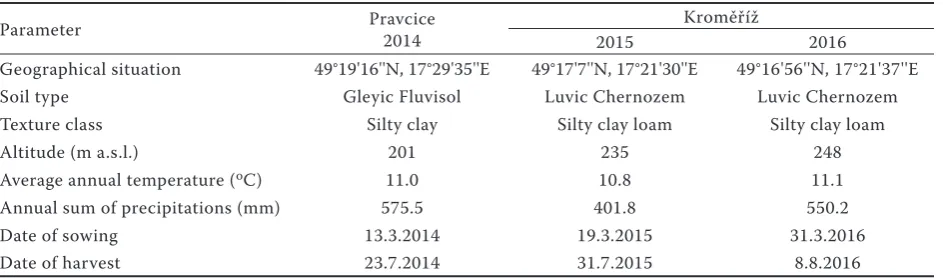
Spring barley management practices carried out dur-ing three seasons 2014–2016 in a sugar-beet growdur-ing region of central Moravia with winter rapeseed as a preceding crop in all the years were compared (Table 1).
Representatives of research institutions (9×), ag-ricultural enterprises (7×) and above all suppliers of agrochemicals and seeds (26×) from the Czech Republic took part in the comparison with the aim of creating the best economic outcome evaluated by gross margin. The participants in most cases pre-sented two variants of crop management practices. They had the choice of cultivar and seeding rate, which ranged between 300 and 500 seeds/m2. Further, they proposed the crop management measures (the date of application and the doses of fertilizers, pesticides and growth regulators). The proposed cultivation measures were carried out by the technicians of the Agrotest fyto, Ltd. in small-plot trials with four randomized repetitions with a plot size of 10 m2 (5 × 2 m). Sowing was carried out by a seeder of the type Oyord (Wintersteiger, Ried, Austria) and har-vest by a small-plot Sampo-Rosenlew SR 2010 (Pori, Finland) combine harvester. Records were taken for the date of treatment, growth stage (BBCH), type and amount of agrochemicals applied. The prices of agrochemicals were determined according to the price list of the regional seller (Navos a.s., http://
www.navos-km.cz/). The price of an agrochemical application (machinery and working cost) in a solid form was determined to be 250 CZK/ha and in a liquid form it was 300 CZK/ha. The total direct costs (CZK/ha) were determined for individual variants of crop management practices as the sum of costs for individual management treatments including the cost of agrochemicals and their application. Costs for crop treatments carried out uniformly for all the variants under comparison were not considered in calculations (soil tillage, sowing and grain harvest, uniform application of insecticides in all variants).
After emergence (BBCH 14), the number of plants on an area of 0.25 m2 was recorded (except for 2014). During grain formation (BBCH 65), the productive ears were counted in the same area. Finally, the num-bers of spikes per plant, numnum-bers of grains per spike and the numbers of grains per m2 were calculated.
[image:2.595.64.536.618.757.2]Grain yields were calculated for 14% moisture and parameters of grain quality were determined in the laboratory, namely the crude protein (determined by Dumas combustion method according to the ICC No. 167 using a LECO FP-528 analyser – LECO Corporation, St. Joseph, USA) bulk density (kg/100 L) and weight of thousand grains (g). Grain prices were obtained from a local trade organization (Navos a.s.). The major criterion for determining the price was the crude protein content in grains below 12%. Multiplication of yield (t/ha) and grain price (CZK/t) gave the revenues (CZK/ha). Consequently, gross margin (GM) was calculated as the difference between revenues and direct costs (CZK/ha). Obtaining the highest value of GM was the goal and the major criterion in comparisons of individual variants of crop management practices. The calculated GM values are relatively high because only measures which were different in individual variants were in-cluded in direct costs. The indicative exchange rate is:
Table 1. Characteristics of experimental localities
Parameter Pravcice 2014 2015 Kroměříž 2016
Geographical situation 49°19'16''N, 17°29'35''E 49°17'7''N, 17°21'30''E 49°16'56''N, 17°21'37''E
Soil type Gleyic Fluvisol Luvic Chernozem Luvic Chernozem
Texture class Silty clay Silty clay loam Silty clay loam
Altitude (m a.s.l.) 201 235 248
Average annual temperature (oC) 11.0 10.8 11.1
Annual sum of precipitations (mm) 575.5 401.8 550.2
Date of sowing 13.3.2014 19.3.2015 31.3.2016
1 EUR = 25.7 CZK, 1 USD = 22.6 CZK. Over 3 years, a total of 81 variants were evaluated. Their numbers in individual years are shown in Table 2.
The data were processed using basic statistical char-acteristics and correlation and regression analysis in the statistical software Microsoft Office 2013 (Redmont, USA) and Gretl (http://gretl.sourceforge.net/). The level of statistical significance was set to α = 0.05.
RESULTS AND DISCUSSION
While selling barley, the revenues are affected by the yield and grain quality that determines the price, which was most affected by the content of N-substances less than 12% in the grain. The price of malting barley was on average by 31.3% higher com-pared to the price of feeding quality grain (Table 2).
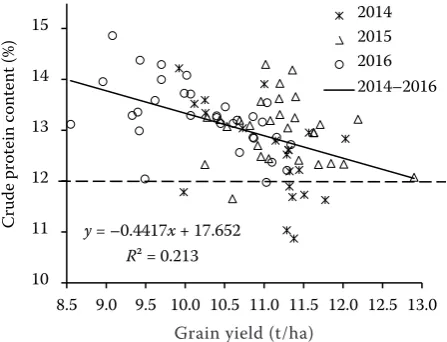
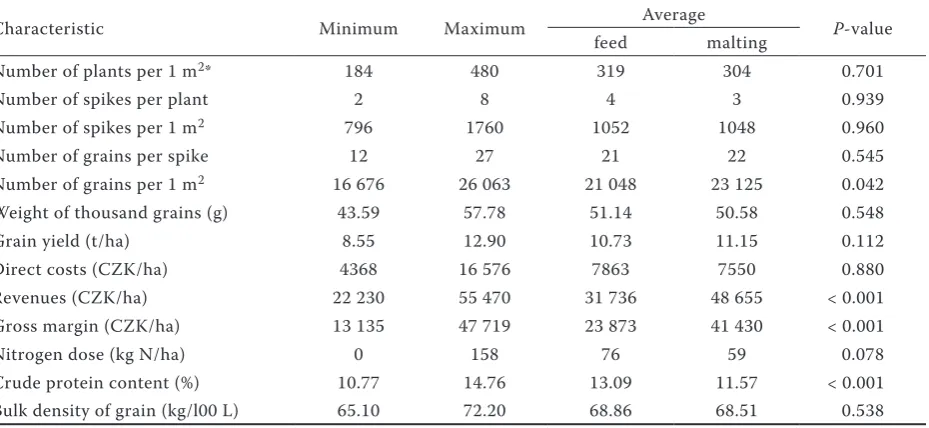
[image:3.595.63.291.139.311.2]These differences can be documented by an evident separation of two groups of variants based on the dependence of GM values on grain protein content (Figure 1). Therefore, the differences in the other evaluated characteristics between groups of feed and malting variants were searched (Table 3). Except for the economic characteristics (revenues, GM), the group of malting variants shows a significantly higher number of grains per m2. In the other evalu-ated characteristics, the differences between these two groups of variants were not significant, includ-ing the amount of N applied in mineral fertilizers (P = 0.078). Malting quality was achieved at N doses that were on average by 17 kg N/ha lower compared to the feed variants, but it was also achieved when 113 kg N/ha was applied. The increase of N dose by 1 kg per ha increased the content of N-substances in grain by 0.01% (absolute, r = 0.42**), however its impact on yield was insignificant (r = 0.08). Figure 2 shows a significant decrease of protein with in-creasing yield (r = 0.46**) which is also mentioned by several other authors (Grashoff and d’Antuono 1997, Boonchoo et al. 1998, Schelling et al. 2003). However, Figure 2 also shows that high grain yields can be associated with both – low and high protein content (10.8–14.1%).
[image:3.595.308.532.558.729.2]Le Bail and Meynard (2003) stated, based on the analysis of a large set of spring barley stands on farms in the Paris Basin, that the correlation between yield and protein content was not strong at grain yield above 7 t/ha. They also found that grain protein content at higher yields could be both higher and lower. High yield of grain with high protein content occurred in their field trials when great inputs of N were used at favourable conditions for its absorption. On the
Figure 2. The relationship between grain yield and crude protein content in grain (%) in the years 2014–2016 Table 2. Number of evaluated variants and prices
achieved in individual years for the feed and malting quality of barley
Characteristic Harvest year
2014 2015 2016
Number of evaluated variants 20 29 32
Number of variants with
malting quality of grain 7 2 2
Price of malting grain
quality (CZK/t) 4500 4300 4200
Number of variants with
feed quality of grain 13 27 30
Price of feed grain quality
(CZK/t) 3000 3300 2600
Feed grain prices in % of
malting grain prices 67 77 62
Figure 1. The relationship between gross margin and crude protein content in grain (%) in the years 2014–2016
y = –0.4417x + 17.652
R² = 0.213 10 11 12 13 14 15
8.5 9.0 9.5 10.0 10.5 11.0 11.5 12.0 12.5 13.0
C ru de p ro te in c on te nt (% )
Grain yield (t/ha)
2014 2015 2016 2014-2016 2014 - 2016
y = –7E-05x + 14.626
R² = 0.4857 10 11 12 13 14 15
10 15 20 25 30 35 40 45 50
C ru de p ro te in c on te nt (% ) 2014 2015 2016 2014-2016 2014 - 2016
y = –7E-05x + 14.626
R² = 0.4857 10 11 12 13 14 15
10000 15000 20000 25000 30000 35000 40000 45000 50000
C ru de p ro te in c on te nt (% )
Gross margin (CZK/ha) 2014 2015 2016
2014–2016
Gross margin (thousand CZK/ha) Grain yield (t/ha)
y = –0.4417x + 17.652
R² = 0.213 10 11 12 13 14 15
8.5 9.0 9.5 10.0 10.5 11.0 11.5 12.0 12.5 13.0
C ru de p ro te in c on te nt (% )
Grain yield (t/ha)
2014 2015 2016 2014-2016 2014 - 2016
y = –0.4417x + 17.652
R² = 0.213 10 11 12 13 14 15
8.5 9 9.5 10 10.5 11 11.5 12 12.5 13
C ru de p ro te in c on te nt (% )
Grain yield (t/ha)
2014 2015 2016
[image:3.595.65.288.560.727.2]contrary, absorption conditions in combination with water stress during stem elongation – grain ripeness led to low yield (4.15 t/ha) and high protein content. This confirms the conclusion of Savin and Nicolas (1996) that starch accumulation is more sensitive to post-anthesis stress than to N uptake by plants.
If too much nitrogen is available and absorbed, this does not further increase yield but increases grain protein (Varvel and Steverson 1987, Eagles et al. 1995), especially if it exacerbated water stress at the end of the growing cycle by generating strong growth in the vegetative structures (Bulman and Smith 1993a).
Spring barley was grown after winter rape whose yields (t/ha) were 3.85 (2013), 4.65 (2014) and 4.34 (2015). Mineralization of post-harvest residues returned to the soil could provide about 70–135 kg N/ha to barley
stands (Aufhammer et al. 1994, Trinsoutrot et al. 2000). Before sowing spring barley, the Nmin content per ha in the soil layer of 0–30 cm was 29 kg, 23 kg and 57 kg in 2014, 2015 and 2016, respectively. The average N dose in mineral fertilizers was 76 kg/ha for feed variants and 59 kg/ha for the malting ones (Table 3). The yield of malting variants ranged from 9.49 to 12.90 t/ha (Figure 2) which corresponds to the uptake of 200–250 kg N/ha. In addition to nitrogen supply, these high yields can be explained by high soil fertility and by the marginal effect in small plot field trials.
[image:4.595.68.533.127.341.2]The subsequent analysis of relationships among the assessed characteristics revealed that the required content of protein below 12% was obtained, except for higher grains number per m2 (r = –0.43**), also at a certain level of stand structure elements which are
Table 3. Minimum, maximum and the average values of variants with grain feed and malting quality for the period 2014–2016 and statistical significance between these averages expressed by P-value
Characteristic Minimum Maximum Average P-value
feed malting
Number of plants per 1 m2* 184 480 319 304 0.701
Number of spikes per plant 2 8 4 3 0.939
Number of spikes per 1 m2 796 1760 1052 1048 0.960
Number of grains per spike 12 27 21 22 0.545
Number of grains per 1 m2 16 676 26 063 21 048 23 125 0.042
Weight of thousand grains (g) 43.59 57.78 51.14 50.58 0.548
Grain yield (t/ha) 8.55 12.90 10.73 11.15 0.112
Direct costs (CZK/ha) 4368 16 576 7863 7550 0.880
Revenues (CZK/ha) 22 230 55 470 31 736 48 655 < 0.001
Gross margin (CZK/ha) 13 135 47 719 23 873 41 430 < 0.001
Nitrogen dose (kg N/ha) 0 158 76 59 0.078
Crude protein content (%) 10.77 14.76 13.09 11.57 < 0.001
Bulk density of grain (kg/l00 L) 65.10 72.20 68.86 68.51 0.538
*The data are only from the experiments in 2015 and 2016
Table 4. Statistical significance of the regression model parameters expressed by P-values
Independent variable
on the x-axis n constantP-value calculatedx x2 R2 P-value calculated for F-test regressionType of
Number of plants
per m2 61 < 0.001< 0.001 0.0760.118 0.069– 0.0520.105 0.0760.040 quadraticlinear
Number of spikes
per plant 61 < 0.001< 0.001 0.2550.079 0.118– 0.0220.063 0.2550.153 quadraticlinear
Number of grains
per spike (Figure 3) 81 < 0.001< 0.001 0.2650.232 0.280– 0.0160.030 0.2650.299 quadraticlinear
Number of spikes
[image:4.595.65.532.611.755.2]shown in Table 5. These results and higher determi-nation of quadratic functions in comparison to linear ones (Table 4) can be explained by considering plants as developing hierarchical gradually formed modular systems (White 1979, Porter 1983) influenced by com-petitive relationships within the stand.
Grain size is bigger on the main stems and declines with increasing tiller hierarchy (Lee et al. 1989, Naylor et al. 1998). In small grain fractions, a higher content of protein is detected (de Ruetier 1999, Magliano et al. 2014). Bingham et al. (2007) attributed this effect to the later development and lower growth potentials of grains on higher ranked tillers. However, both processes can contribute to increase of the differences between grains – developmental delay and competition for resources (Hucl and Baker 1990, Sadras and Denison 2009).
At high plant density due to inter- and intra-plant competition, the differences between the main stem and the tillers increase. At low plant density, compe-tition for resources does not appear, but more tillers are being developed that delay in development. In both cases, the unevenness of tiller’s spikes with
smaller grains and higher N-substances compared with the main stem is created.
Similarly, grain formation is influenced by the hierarchical arrangement of the spikes (Bonnett 1935, Lee et al. 1989). The largest grains are in the proximal part and are getting smaller towards the distal parts of spikes (Figure 3). These effects are less expressed in two-row spikes compared to six-row ones, grains of which are less uniform. Thus, a higher P-value (0.280) for x2 in the relation between the grain number per spike and grain protein content (Table 4) can be explained.
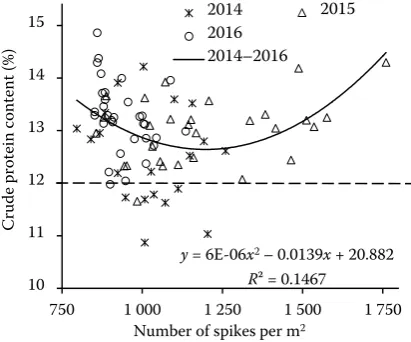
The number of spikes per m2 combines the effects of hierarchies in the tillering node and in the spikes, therefore the quadratic relationship between this char-acter and the content of N substances in the grain is more pronounced (Figure 4) and significant (Table 4).
The significance of the relations shown in Table 4 and Figures 3 and 4 depends on the proportion of smaller grains (sinks) richer in N-substances. The proportion of these smaller grains increases with the developmental delay of tillers and grain’s primordia in spikes and also as a result of their competition for resources. A well-designed stand structure can weaken these processes and thus reduce the risk of sinks dissimilarity.
[image:5.595.64.289.138.233.2]High level of sinks should be proportionally formed by a combination of the stand structural elements within the intervals shown in Table 5. Beyond these intervals, the risk of higher content of protein in grain increases. A suitable stand structure should be formed by uniform tillers from the beginning of stem elongation (Křen et al. 2014). This requires early sowing and uniform, synchronized tillering. The probability of obtaining malting quality grain increases with the
[image:5.595.309.515.545.716.2]Figure 3. The relationship between the number of grains per spike and crude protein content in grain (%) in the years 2014–2016
Figure 4. The relationship between the number of spikes per m2 and crude protein content in grain (%) in the
years 2014–2016 Table 5. Values of the structural elements of the spring
barley stand that increased the probability of achieve-ment malting quality of the grain
Characteristic Minimum Maximum Median
Number of plants per 1 m2 300 400 350
Number of strong tillers per plant at BBCH 25
(or spikes per plant) 2 4 3
Number of spikes per 1 m2 900 1200 1050
Number of grains per spike 18 26 22
10 11 12 13 14 15
12 15 18 21 24 27
C ru de p ro te in c on te nt (% )
Number of grains per spike
2014 2015
2016 2014-2016
2014 - 2016
y = 6E-06x2 – 0.0139x + 20.882 R² = 0.1467
10 11 12 13 14 15
750 1 000 1 250 1 500 1 750
C ru de p ro te in c on te nt (% )
Number of spikes per m2 y = 0.0065x2 – 0.2832x + 15.9; R2 = 0.0304
10 11 12 13 14 15
12 17 22 27
C ru de p ro te in c on te nt (% )
Number of grains per spike
2014 2015 2016 2014–2016 10 11 12 13 14 15
12 17 22 27
C ru de p ro te in c on te nt (% )
Number of grains per spike
2014 2015 2016 2014–2016 10 11 12 13 14 15
12 17 22 27
C ru de p ro te in c on te nt (% )
Number of grains per spike
2014 2015 2016 2014–2016 10 11 12 13 14 15
12 17 22 27
C ru de p ro te in c on te nt (% )
Number of grains per spike
2014 2015
[image:5.595.68.285.547.716.2]formation of high yield and a high number of grains per m2 with strong culms and uniform spikes.
By findings of other authors (Le Bail and Meynard 2003, Bingham et al. 2007) it can be stated that the malting quality of grain is the result of a complex interaction of several production factors with various additive and synergic effects. These are expressed through the stand structure. Generating a high level of uniform sinks (number of grains per m2) correspond-ing with the availability of resources, mainly water, through the balanced combination of all elements of barley stand structure increases the probability of obtaining malting quality of grain. Analysis of modifications of management inputs together with the analysis of stand structure enabled us to under-stand which combination of treatments produced satisfactory results and which did not.
REFERENCES
Aufhammer W., Kübler E., Bury M. (1994): Nitrogen uptake and nitrogen residuals of a winter oil-seed rape and fallout rape (Ger-man). Journal of Agronomy and Crop Science, 172: 255–264. Benzian B., Lane P. (1979): Some relationships between grain yield
and grain proteins of wheat experiments in South-East England and comparison with such relationships elsewhere. Journal of the Science of Food and Agriculture, 30: 59–70.
Bingham I.J., Blake J., Foulkes M.J., Spink J. (2007): Is barley yield in the UK sink limited?: II. Factors affecting potential grain size. Field Crops Research, 101: 212–220.
Bonnett O.T. (1935): The development of the barley spike. Journal of Agricultural Research, 51: 451–457.
Boonchoo S., Fukai S., Hetherington S.E. (1998): Barley yield and grain protein concentration as affected by assimilate and nitrogen avail-ability. Australian Journal of Agricultural Research, 49: 695–706. Bulman P., Smith D.L. (1993a): Yield and yield component response of
spring barley to fertilizer nitrogen. Agronomy Journal, 85: 226–231. Bulman P., Smith D.L. (1993b): Grain protein response of spring
barley to high rates and post-anthesis application of fertilizer ni-trogen. Agronomy Journal, 85: 1109–1113.
De Ruiter J.M. (1999): Yield and quality of malting barley (Hordeum vul-gare L. ‘Valetta’) in response to irrigation and nitrogen fertilisation. New Zealand Journal of Crop and Horticultural Science, 27: 307–317. Eagles H.A., Bedggood A.G., Panozzo J.F., Martin P.J. (1995): Culti-var and environmental effects on malting quality in barley. Aus-tralian Journal of Agricultural Research, 46: 831–844.
Grashoff C., d’Antuono L.F. (1997): Effect of shading and nitrogen application on yield, grain size distribution and concentrations of nitrogen and water soluble carbohydrates in malting spring barley (Hordeum vulgare L.). European Journal of Agronomy, 6: 275–293.
Hucl P., Baker R.J. (1990): Interplant and intraplant competition ef-fects on main stem yield of three diverse-tillering spring wheats. Canadian Journal of Plant Science, 70: 1–7.
Klem K., Hřivna L., Ryant P., Míša P. (2011): Diagnostic Methods for Decision-Making Processes in Spring Barley Crop Manage-ment Practices (Czech). Kroměříž, Agrotest Fyto Ltd., 88. Křen J., Klem K., Svobodová I., Míša P., Neudert L. (2014): Yield and
grain quality of spring barley as affected by biomass formation at early growth stages. Plant, Soil and Environment, 60: 221–227. Kůst F., Stehlíková J. (2016): Situation and Outlook Report –
Cere-als (Czech). Prague, Czech Ministry of Agriculture, 112. Le Bail M., Meynard J.-M. (2003): Yield and protein concentration
of spring malting barley: The effects of cropping systems in the Paris Basin (France). Agronomie, 23: 13–27.
Lee S.H., Scott W.R., Love B.G. (1989): Sources of screenings in malting barley in relation to the pattern of tillering. Proceedings Annual Conference – Agronomy Society of New Zealand (New Zealand), 19: 43–54.
Magliano P.N., Prystupa P., Gutiérrez-Boem F.H. (2014): Protein content of grains of different size fraction in malting barley. Jour-nal of the Institute of Brewing, 120: 347–352.
Naylor R.E.L., Stokes D.T., Matthews S. (1998): Biomass, shoot uni-formity and yield of winter barley. Journal of Agricultural Sci-ence, 131: 13–21.
Paynter B., Hills A., Malik R., McLarty A. (2013): Sensitivity of barley varieties to crop management. Western Australia, Grain Research and Development Corporation, 1–4.
Porter J.R. (1983): A modular approach to analysis of plant growth. I. Theory and principles. New Phytologist, 94: 183–190. Sadras V.O., Denison R.F. (2009): Do plant parts compete for
resourc-es? An evolutionary viewpoint. New Phytologist, 183: 565–574. Savin R., Nicolas M.E. (1996): Effects of short periods of drought
and high temperature on grain growth and starch accumulation of two malting barley cultivars. Australian Journal of Plant Physi-ology, 23: 201–210.
Schelling K., Born K., Weissteiner C., Kühbauch W. (2003): Rela-tionships between yield and quality parameters of malting barley (Hordeum vulgare L.) and phenological and meteorological data. Journal of Agronomy and Crop Science, 189: 113–122.
Trinsoutrot I., Nicolardot B., Justes E., Recous S. (2000): Decompo-sition in the field of residues of oilseed rape grown at two levels of nitrogen fertilisation. Effects on the dynamics of soil mineral nitrogen between successive crops. Nutrient Cycling in Agro-ecosystems, 56: 125–137.
Varvel G.E., Severson R.K. (1987): Evaluation of cultivar and nitro-gen management options for malting barley. Agronomy Journal, 79: 459–463.
White J. (1979): The plant as a metapopulation. Annual Review of Ecology and Systematics, 10: 109–145.