The first knowledge about the biological im-portance of selenium appeared in the 1950’s of the 20th century. The fact that the bacterium
Escherichia coli needs selenium for its metabolism (necessary for producing of formate dehydroge-nase enzyme) was discovered by J. Pinset in 1954. Animals and bacteria as well as microorganisms of domain Archaea have the selenoproteins in their structure. However plants and fungi do not produce selenoproteins due to the lack of needful mechanism. However, they are able to transform selenium into many various low molecular sub-stances, which have the similar value as vitamins for us and animals – thanks to them we are able to use trace amounts of selenium dispersed in soil and its background (Whanger 2002).
The deficiency of selenium is more serious than its toxicity and due to this fact it is necessary to deal with this issue more widely and observe the mutual relationships between the content of se-lenium in the soil and its following accumulation in the plants and the higher levels of food chain.
As the Slovak soils are not rich in selenium, it is necessary to increase its content in the agricul-tural products, just at the beginning of food chain. However, the boundary between the essential and toxic doses of selenium is very thin (Tan et al. 2002, Fargašová 2004, Hegedüs et al. 2007). The recommended daily intake of selenium is 1 µg/kg per person per day according to the World Health Organization (WHO). The daily intake of selenium is 25–150 µg per day by the population of European countries while the intake by the population of Slovak Republic is 27–43 µg per day (Maďarič and Kadrabová 1998).
Selenium enrichment of fertilizers is intended for fertilizing of agricultural crops (agronomic biofor-tification) and plant breeding (or genetic biofortifi-cation); they are supposed to be the most effective ways to increase selenium intake by population, whereby selenium reaches the different levels of food chain (Lyons et al. 2004, Hartikainen 2005, Ducsay and Ložek 2006). The way of biofortifica-tion and the form of selenium intended for this
The influence of selenium soil application
on its content in spring wheat
L. Ducsay, O. Ložek, L. Varga
Slovak University of Agriculture, Nitra, Slovak Republic
ABSTRACT
The influence of applicationof increasing doses of selenium (0.05 mg, 0.10 mg and 0.20 mg/kg) into soil in pot ex-periments, with NPK fertilization of spring wheat (Triticum aestivum L., variety Banti), on the biomass yield (grain, straw, roots) and on selenium accumulation was observed. Selenium in the form of sodium selenite (Na2SeO3·5H2O) and the NPK nutrients in the form of LAD-27, Ca(H2PO4)2 and KCl were applied. The average two-year results showed the expected indifferent effect of increasing doses of selenium on the yield of wheat grain, straw and roots. The differentiated doses of selenium into soil caused a significant increase of selenium content in dry matter (dm) of grain, straw and roots of wheat. The highest content of selenium (0.732 mg/kg in grain, 0.227 mg/kg in straw and 1.375 mg/kg in roots dm) was determined in the variant where 0.2 mg Se/kg of soil was applied. When applying the lowest dose of selenium (0.05 mg Se/kg of soil) the content of selenium was 0.155 mg Se/kg in grain. The selenium content in individual analysed parts of wheat was increasing in the following order: straw – grain – roots.
Keywords: spring wheat; soil application; content of selenium; utility of selenium
way remain open. There are not fertilizers with added selenium used in Slovakia at present times compared to e.g. Finland. Therefore it is necessary to focus the further research on identification of the most ideal period of selenium application from the point of the growth phases of individual crops, on recognizing of selenium transfer into plant production from various applied forms of selenium compounds, on various soil types, when knowing their agrochemical traits (Ducsay et al. 2008). The average content of selenium in the spring wheat cultivated in Finland in 1998 and 1999 (biofortification of fertilizers with selenium since 1984) was in the range from 0.08 mg Se/kg to 0.13 mg Se/kg kg in grain (Eurola et al. 2000).
In the pot experiment the influence of soil appli-cationof increasing doses of selenium, with NPK fertilization of spring wheat (Triticum aestivum L., variety Banti), on the yield of biomass (grain, straw, roots) and on selenium accumulation was observed.
MATERIAL AND METHODS
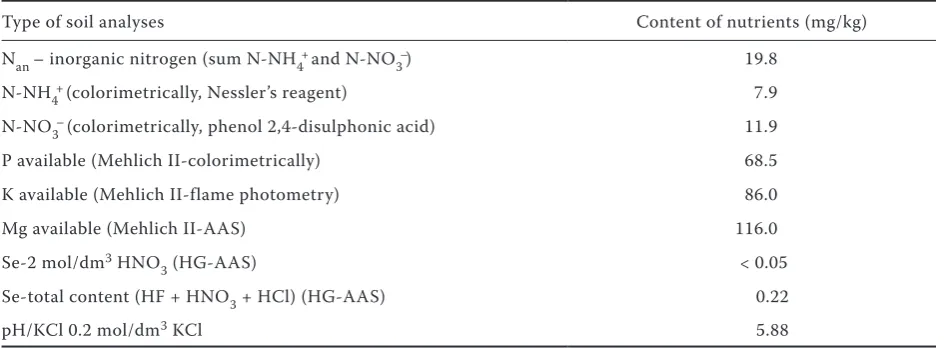
The pot experiments were carried out in the years 2000 and 2001 in the vegetation cage in the grounds of SAU in Nitra. We observed the yield (of seeds, straw and roots) and the distribution of selenium in various organs of spring wheat influ-enced by the increasing doses of selenium applied into the soil in pot experiments. Experiments were set on non-contaminated medium heavy brown soil, the agrochemical characteristics of which are given in Table 1.
The weight of the soil was 8 kg and of the silicate sand 4 kg. The diameter of pot was 0.28 m. About 40 seeds of spring wheat (Triticum aestivum L.)
variety Banti were sown per one pot. At the emer-gence stage, plants were thinned to 30 per pot. The experiment was carried out in three repeti-tions. The humidity of the soil was kept at 60% full water capacity by regular watering. We used basic fertilization with nitrogen, phosphorus and potassium before the sowing of seeds; the doses per pot were following: nitrogen 2.0 g, phospho-rus 0.4 g and potassium 1.6 g. Selenium in the form of Na2SeO3·5H2O was applied along with the basic fertilization. The layout of the variants is shown in Table 2. The harvest of wheat was re-alized in the phase of full physiological ripeness. The grain was homogenized on the laboratory crusher after harvesting and further analysed. The content of selenium was assessed by the atomic absorption spectrometer Varian Spectra 300A with the continual hydride generator VGA 76. The conditions of measurements were as follows: wave-length – 196 nm, width of rift – 1.0 nm, compensation of setting – deuterium lamp. The atomizing environment was presented by siliceous tube heated on 900°C. The reducing agent was NaBH4 (0.6% solution in 0.5% NaOH). We used the basic standard solution of selenium (Merck) with the concentration of 1 g/l. The gained results of yields and contents of selenium in the individual parts of spring wheat were statistically evaluated by the analysis of variance with LSD test.
RESULTS AND DISCUSSION
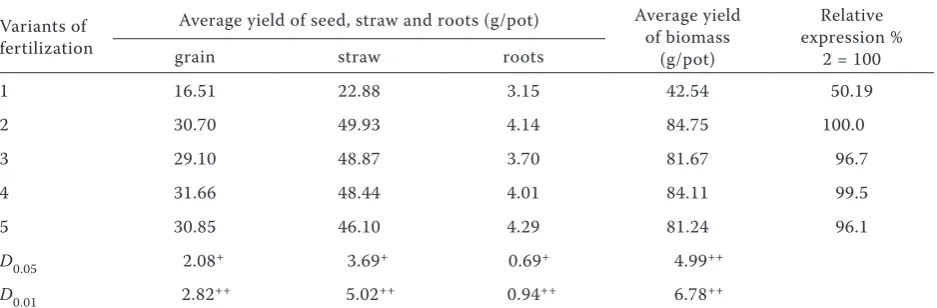
[image:2.595.63.536.589.763.2]The average weight of biomass (corn + straw + roots) statistically increased (significantly by 98.6%) as the effect of NPK nutrition (var. 2) in comparison with the non-fertilized variant 1 (Table 3).
Table 1. Agrochemical characteristics of the soil before conducting the experiment with spring wheat
Type of soil analyses Content of nutrients (mg/kg)
Nan – inorganic nitrogen (sum N-NH4+ and N-NO
3–) 19.8
N-NH4+ (colorimetrically, Nessler’s reagent) 7.9
N-NO3– (colorimetrically, phenol 2,4-disulphonic acid) 11.9
P available (Mehlich II-colorimetrically) 68.5
K available (Mehlich II-flame photometry) 86.0
Mg available (Mehlich II-AAS) 116.0
Se-2 mol/dm3 HNO
3 (HG-AAS) < 0.05
Se-total content (HF + HNO3 + HCl) (HG-AAS) 0.22
The application of increasing doses of seleni-um in the form of sodiseleni-um selenite (0.05, 0.1 and 0.2 mg Se/kg soil) together with the full NPK nu-trition did not affect significantly the weight of grown biomass of grain, straw and roots in com-parison with variant of full NPK nutrition (var. 2). So the assumed indifferent effect of the applied increasing doses of selenium on the production of spring wheat biomass was confirmed. The wheat belongs to the plants that are tolerant to the high content of selenium in the growing medium (soil, hydroponics). There was neither yield reduction of wheat nor symptoms of phytotoxicity observed while using doses of 120 g Se/ha or 500 g Se/ha in the form of sodium selenite (Lyons et al. 2005).
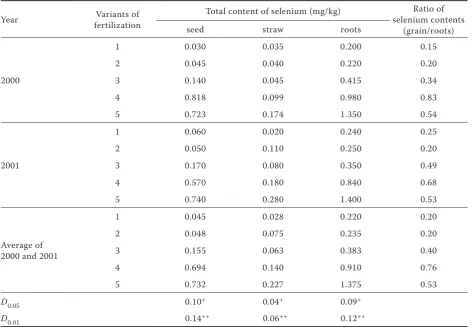
The average content of selenium (Table 4), (with-out NPK fertilizer and with(with-out applied selenium) was 0.045 mg/kg in grain in the variant 1, 0.028 mg/kg in straw and 0.220 mg/kg in roots. Comparing the content of selenium in the variant 2 and variant 1 we can state that there was no significant increase of selenium content in biomass of individual ana-lysed parts of wheat by optimization only with NPK nutrients. The content of selenium was 0.048 mg/kg in grain, 0.075 mg/kg in straw and 0.235 mg/kg
[image:3.595.64.530.85.196.2]in the roots. Mihailovic et al. (1996) refers that the average content of selenium in grain of wheat in Serbia is 0.027 mg/kg. Alfthan et al. (1992) found out that the average content of selenium is 0.034 mg/kg in grain in Hungary. Adams et al. (2002) observed the content of selenium in grain of winter wheat grown in the main crop regions of Great Britain between 1982 and 1998; they assessed that the content of selenium in grain of winter wheat was 0.025 mg Se/kg. The average content of selenium in grain of spring wheat grown in Finland between 1998 and 1999 (biofortification of fertilizers with selenium since 1984) ranged from 0.08 mg Se/kg to 0.13 mg Se/kg (Eurola et al. 2000). Wanger (2002) mentions that in the soils with enhanced selenium content, wheat grain con-tained 30 mg Se/kg, whereas in the soils with low selenium content, it was only 0.1 mg/kg. (Lyons et al. 2005) warn that the content of selenium ranged from 0.005 mg/kg to 0.720 mg/kg in wheat grain grown on soils with total selenium content lower than 0.2 mg/kg soil. The content of selenium of 0.720 mg/kg was determined in soils with high values of soil reactions and with low amount of Fe, S and organic material in the soil. Thus it is Table 2. Layout of variants of experiment with spring wheat
Variants NPK (g/pot) (mg/kg)Se (g/ha)*Se
1 – – –
2 NPK (2 g N + 0.4 g P + 1.6 g K) – –
3 NPK (2 g N + 0.4 g P + 1.6 g K) 0.05 150
4 NPK (2 g N + 0.4 g P + 1.6 g K) 0.10 300
5 NPK (2 g N + 0.4 g P + 1.6 g K) 0.20 600
*calculation of selenium dose on one ha into the soil depth of 0.2 m by the density of 1.5 g/cm3
Table 3. The influence of increasing doses of selenium on the yield of grain, straw and roots of spring wheat (average of the years 2000 and 2001)
Variants of fertilization
Average yield of seed, straw and roots (g/pot) Average yield of biomass
(g/pot)
Relative expression %
2 = 100
grain straw roots
1 16.51 22.88 3.15 42.54 50.19
2 30.70 49.93 4.14 84.75 100.0
3 29.10 48.87 3.70 81.67 96.7
4 31.66 48.44 4.01 84.11 99.5
5 30.85 46.10 4.29 81.24 96.1
D0.05 2.08+ 3.69+ 0.69+ 4.99++
[image:3.595.64.533.607.761.2]not able to generalize that the selenium content in the soil is the only criteria for evaluating the ways of selenium intake into the plant tissues. It is important to consider the soil type, the pH value of the soil, the content of organic matter in soil as well as the amount of available selenium in the soil. Hlušek et al. (2005) found out higher content of selenium in potato tubers in soils with pH 6.9 in comparison with soils with pH 5.9.
The application of increasing doses of selenium into soil caused a significant increase of selenium content in grain, straw and roots of wheat. We detected the highest content of selenium in 2-year average in the variant 5 where 0.2 mg Se/kg was applied (0.732 mg Se/kg in grain, 0.227 mg Se/kg in straw and 1.375 mg Se/kg in roots). In contrast, addition of the lowest dose of selenium (0.05 mg Se/kg soil) resulted in the content of 0.155 mg Se/kg in grain. Stadlober et al. (2001) applied 6 g NPK fertilizer into 8-kg pots while using the content of 30 mg Se/kg fertilizer. Adding of sele-nium in the form of selenite caused rising content of selenium in grain of spring wheat from 0.010 to 0.168 mg/kg and from 0.025 to 0.206 mg/kg in grain, respectively.
Lyons et al. (2004) found out that adding of selenium into soil in the form of selenite in the dose of 300 g Se/ha caused an increase of selenium content in grain on 8 and on 12 mg/kg. The dose applied in the form of selenite (0.1 mg Se/kg) into the soil in our experiment represents the dose of 300 g Se/ha (with the assumption that the weight of soil on 1 ha, into the depth of 0.2 m, by the density 1.5 g/cm3, is 3 000 000 kg); as a result we
observed the content of selenium in the wheat grain 0.694 mg/kg (var. 4), Table 4. The form of Se6+ is 10–20 times more available by plants
in comparison with Se4+ form (MacLoad et al.
1998).
The content of selenium in our experiment was rising in the individual parts of wheat in the order: straw < grain < roots. Koutník and Dočekalová (1994) report that with the application of 5 mg Se/kg soil the content of selenium rose in the roots of barley to 105 mg/kg, in grain to 39.2 mg/kg and in the straw to 19.6 mg/kg. Huang and Clausen (1994) applied 0.34 mmol/dm3 of selenite into the
[image:4.595.63.538.91.418.2]soil, and found out that the content of selenium was 6.87 mg/kg in grain of barley and 8.13 mg/kg solids in straw.
Table 4. The influence of increasing doses of selenium on the selenium content in grain, straw and roots of spring wheat
Year fertilizationVariants of Total content of selenium (mg/kg) selenium contents Ratio of (grain/roots)
seed straw roots
2000
1 0.030 0.035 0.200 0.15
2 0.045 0.040 0.220 0.20
3 0.140 0.045 0.415 0.34
4 0.818 0.099 0.980 0.83
5 0.723 0.174 1.350 0.54
2001
1 0.060 0.020 0.240 0.25
2 0.050 0.110 0.250 0.20
3 0.170 0.080 0.350 0.49
4 0.570 0.180 0.840 0.68
5 0.740 0.280 1.400 0.53
Average of 2000 and 2001
1 0.045 0.028 0.220 0.20
2 0.048 0.075 0.235 0.20
3 0.155 0.063 0.383 0.40
4 0.694 0.140 0.910 0.76
5 0.732 0.227 1.375 0.53
D0.05 0.10+ 0.04+ 0.09+
We calculated the ratio of the total selenium content in wheat grain and roots; the result showed that this ratio is the lowest (0.20) at the non-fer-tilized control (Table 4). The increasing doses of selenium caused that the content of selenium rose more significantly in grains than in the roots, al-though the total content of selenium was higher in the roots. The highest ratio of the total content of selenium in grain and roots (0.76) was determined in the variant with the dose of 0.1 mg Se/kg soil. In general, the transport of selenium from the roots to the biomass is closely connected with the chemical form of applied selenium (Zayed et al. 1998). The authors found out that in the case of crops such as broccoli, rice and sugar beet the ratio of the total content of selenium in biomass and roots after application of selenite was up to 0.5, whereas after the application of selenate it ranged from 1.4 to 17.2.
REFERENCES
Adams M.L., Lombi E., Zhao F.J., McGrath S.P. (2002): Evidence of low concentration in UK bread-making wheat grain. J. Sci. Food Agric., 82: 1160–1165. Alfthan G., Bogye G., Aro A., Feher J. (1992): The
hu-man selenium status in Hungary. J. Trace Elem. Elec-trolytes Health Dis., 6: 233–238.
Ducsay L., Ložek O. (2006): Effect of selenium foliar application on its content in winter wheat grain. Plant Soil Environ., 52: 78–82.
Ducsay L., Ložek O., Varga L., Marček M. (2008): The increase of selenium content in cereals. Agrochem., 48: 3–6. (In Slovak)
Eurola M., Hietaniemi V., Ekholm P., Varo P. (2000): Effect of increasing selenate supplementation level in fertilizers on the selenium content of foods and selenium intake in Finland. Vienna.
Fargašová A. (2004): Toxicity comparison of some possible toxic metals (Cd, Cu, Pb, Se, Zn) on young seedlings of Sinapis alba L. Plant Soil Environ., 50: 33–38.
Hartikainen H. (2005): Biochemistry of selenium and its impact on food chain quality and human health. J. Trace Elem. Med. Biol., 18: 309–318.
Hegedüs O., Hegedüsová A., Šimková S. (2007): Se-lenium as biogenic element. Fak. Prír. Vied, Univ. Konštantína Filozofa v Nitre. (In Slovak)
Hlušek J., Jůzl M., Čepl J., Lošák T. (2005): The effect of selenium supplementation on its concentration in po-tato tubers. Chem. Listy, 99: 515–517. (In Czech) Huang K.X., Clausen J. (1994): Uptake, distribution,
and turnover rates of selenium in barley. Biol. Trace Elem. Res., 40: 213–223.
Koutník V., Dočekalová H. (1994): Selenium distribu-tion in oat plants sown during onthogenesis. Rostl. Výr., 40: 163–172. (In Czech)
Lyons G., Judson G., Stangoulis J. (2004): Selenium sta-tus of humans and wheat in South Australia. J. Aust. Coll. Nutr. Environ. Med., 23: 19–21.
Lyons G., Stangoulis J., Graham R. (2005): Tolerance of wheat (Triticum aestivum L.) to high soil and solution selenium levels. Plant and Soil, 270: 179–188. MacLeod J.A., Gupta U.C., Milburn P., Sanderson J.B.
(1998): Selenium concentration in plant material, drainage and surface water as influenced by Se ap-plied to barley foliage in a barley-red clover-potato rotation. Can. J. Soil Sci., 78: 685–688.
Maďarič A., Kadrabová J. (1998): Selenium in foodstuffs and possibility its supplementation. Bull. Potrav. Výzk. 37: 11–17. (In Slovak)
Mihailovic M., Lindberg P., Jovanovic I. (1996): Sele-nium content in feedstuff in Serbia (Yugoslavia). Acta Veter. (Yugoslavia), 46: 343–348.
Stadlober M., Sager M., Irgolic K.J. (2001): Effects of selenate supplemented fertilisation on the selenium level of cereal-identification and quantification of selenium compounds by HPLC-ICP-MS. Food Chem., 73: 357–366.
Tan J., Zhu W., Wang W., Li R., Hou S., Wang D., Yang L. (2002): Selenium in soil and endemic diseases in China. Sci. Total Environ., 284: 227–235.
Whanger P.D. (2002): Selenocompounds in plants and animals and their biological significance. J. Amer. Coll. Nutr., 21: 223–232.
Zayed A., Lytle C.M., Terry N. (1998): Accumulation and volatilization of different chemical species of selenium by plants. Planta, 206: 284–292.
Received on October 24, 2008
Corresponding author:
Doc. Dr. Ing. Ladislav Ducsay, Slovenská poľnohospodárska univerzita, Katedra agrochémie a výživy rastlín, Trieda A. Hlinku 2, 949 76 Nitra, Slovenská republika