Evaluation of efficiency of technologies for wastewater
sludge hygienisation
Petr Junga*, Pavel Mach, Jan Mareček
Department of Agricultural, Food and Environmental Engineering, Faculty of Agronomy,
Mendel University in Brno, Brno, Czech Republic
*Corresponding author: [email protected]
Abstract
Junga P., Mach P., Mareček J. (2017): Evaluation of efficiency of technologies for wastewater sludge hygienisation. Res. Agr. Eng., 63: 54–61.
The paper compares the methods of hygienisation of wastewater treatment plants sludges with respect to meet legis-lative requirements of conditions for using the treated sludge on agricultural land. The paper draws a comparison of the experimental results between the method of hygienisation and stabilisation of the sludge through the autothermic aerobic thermophilic stabilisation (AATS) by pure oxygen and the method of sludge hygienisation by pasteurization. Results of the experiment confirm that sewage sludge treated by both assessed hygienisation technologies meets legisla-tion requirements for applicalegisla-tion to agricultural soil.
Keywords: wastewater treatment plant; sludge; indicator microorganism; microbiological standards; sludge, stabilisation
Wastewater treatment systems typically involve the generation of continuous and high volumes of sludge (Sinton et al. 1998). Proper management of sludge disposal is imperative for effective wastewa-ter treatment. The use of stabilised sewage sludge (biosolids) for various land applications increases and represents a disposal solution that is both eco-nomical and environmentally friendly (Salsali et al. 2006). Sewage sludge acts as the reservoir of several indicator and pathogenic microorganisms (Arthurson 2008). Sewage sludge utilization in agricultural production has been gaining increas-ing interest in recent years (Stone et al. 1998). The use of materials containing large numbers of microorganisms can, under certain conditions, contaminate surface or ground-waters. The risk of groundwater contamination from biosolids may be greatest with pathogenic microorganisms due to their relatively small size and poor adsorption by soil particles (Fukushi et al. 2003; Horan et al. 2004). The disinfection degree, which is influ-enced by a variety of interacting operational vari-ables and conditions, is however, highly
oxygen (Lapara, Alleman 1999). Nucleate boil-ing, which can transfer large amounts of thermal energy at small temperature difference, reveals pasteurization method as to biological sludge (Liu, Lee 2000). Continuously feeding influent wastewa-ter containing diverse bacwastewa-terial species to a waste-water treatment-activated sludge bioreactor may influence the activated sludge bacterial community temporal dynamics (Lee et al. 2015). The thick-ened sludge is a very complicated colloidal system, which is composed of organic and inorganic parti-cles. Thickened sewage sludge has the similar rheo-logical properties as activated sewage sludge or digested sewage sludge (Trávníček, Junga 2014).
The goal of this paper is to evaluate the experi-ment with application of autothermic aerobic thermophilic stabilisation (AATS) by pure oxygen (technology OSS – Oxyterm sludge system®), and the method of sludge hygienisation by pasteuriza-tion and the study of two different methods for hy-gienisation of wastewater treatment plant sludges, to compare their efficiency and a level of secondary contamination by indicator microorganisms before their subsequent treatment. Results of this paper confirm that sludge treated by both assessed hy-gienisation technologies meets legislation require-ments for agricultural utilization.
MATERIAL AND METHODS
The first analysed waste water treatment plant is located in Tetčice, South Moravia region, Czech Re-public. The operational capacity is 15,000 (popula-tion equivalent) and 2,250 m3 of waste water a day.
Technological conception is low-rate mechanical-biological waste water treatment plant with high efficiency disposal of nitrogen and chemical coagu-lation of phosphorus. Activated sludge technology consists of couple of oxidation tanks (overall 36.00 m wide, 12.00 m long and 4.80 m high; reaction volume 1,900 m3) and pneumatic aeration system. Sludge
management system consists of 3 tanks for accumu-lation and treatment of sludge. Activated sludge is continually pumped from activated sludge process to flotation sludge thickener. Thickened sludge is consequently pumped to the aerated and air-mixed equalization tank. Sludge is pumped (20-hour cycle) to the autothermic aerobic thermophilic stabilisa-tion reactor with middle hydraulic detenstabilisa-tion time of approximately 21 days. The sludge is
warmed-up with using biologically mediate and controlled oxidation by oxygen and temperature is maintained at hygienisation temperature above 55°C. Second equalization tank is used for homogenization of the hygienised sludge. Capacities in both equalization tanks are maintained in technological parameters which warrant specified duration of heat sludge treatment (min. 20 days).
The second analysed waste water treatment plant is located in Tišnov, South Moravia region, Czech Republic. The operational capacity is 18,000 (pop-ulation equivalent) and 2,400 m3 of waste water a
day. Technological conception is low-rate mechan-ical-biological waste water treatment plant. Acti-vated sludge technology consists of couple of mix-ing tanks (overall 4.80 m wide, 15.00 m long and 3.00 m high; reaction volume 347 m3) and aeration
system with 6 surface mechanical aerators. Activat-ed sludge is continually pumpActivat-ed to the accumula-tion tank. Next process is anaerobic fermentaaccumula-tion in anaerobic fermenter and pasteurization in pas-teurizer. Pasteurization of the sludge proceeds with continual intensive mixing at temperature 70°C for a period of 60 minutes.
Sampling of the sludge is in compliance with re-quirements ČSN EN ISO 5667-13:2011 (Water qual-ity – Sampling – Part 13: Guidance on sampling of sludges) and ČSN EN ISO 7218:2008 (Microbi-ology of food and animal feeding stuffs – General requirements and guidance for microbiological ex-aminations). Determination of total solids (TS) and water content is according to ČSN EN 12880:2001 (Characterization of sludges – Determination of dry residue and water content) and ČSN EN 15934:2013 (Sludge, treated biowaste, soil and waste – Calcula-tion of dry matter fracCalcula-tion after determinaCalcula-tion of dry residue or water content). Samples weight was determined with using the analytical balance Ad-venturer Pro (OHAUS Co., Greifensee, Switzerland) (accuracy 1 mg). Samples were dried in laboratory drier Venticell – (BMT Medical Technology s.r.o., Brno, Czech Republic) (drying process for a period of 12 h at 105 ± 5°C). Share of total solids in percent by weight is given according to equation:
wdr=m3–m1
m2–m1× f (%) (1)
f – the calculation factor (f = 100) for expression of result in percent by weight (%)
Determination of loss on ignition is done accord-ing to ČSN EN 15169:2007 (Characterization of waste - Determination of loss on ignition in waste, sludge and sediments) and ČSN EN 15935:2013 (Sludge, treated biowaste, soil and waste – Deter-mination of loss on ignition). The sample is an-nealing to the constant weight at 550 ± 25°C. Next, there is determination of sample weight differences before and after ignition. Loss of ignition is given according to equation:
wloi=m3–m4
m3–m1×100 (%) (2)
where: wloi– the loss of ignition (%); m1 – the weight of empty crucible (g); m3 – the weight of crucible with dried sample (g); m4 – the weight of crucible after igni-tion of sample (g)
Determination of indicator microorganisms is per-formed with the homogenized sludge sample. As the next step, starting suspension and denary thinning along with hygienic security are done. Thinned start-ing suspension is used for inoculation of sets in Petri dishes with solid selective medium designated for detection of indicator microorganisms. Scale of thin-ning is chosen with reference to final number of colo-nies on one Petri dish (range 15 as far as 150 CFU).
Thermostable coliform bacteria from the tested samples are determined on the surface of selec-tive medium (mFC agar; Merck Corp., USA). Petri dishes with inoculated agar are incubated in temper-ature-controlled oven at 44.5 ± 0.2°C for period of 24 hours. Enterococci are determined from thinned starting suspension with inoculated Petri dishes with m-enterococci selective medium (Slanetz – Bartley agar; Merck Corp., USA). Petri dishes with inocu-lated agar are incubated in temperature-controlled oven at 44.5 ± 0.2°C for period of 24 hours. Salmo-nella spp. bacteria are determined in four consecu-tive following steps. First step it is selecconsecu-tive propaga-tion of bacteria with inoculapropaga-tion of tested samples in pepton solution buffer water (incubation at 36 ± 2°C for period of 18 h). After propagation of bacteria, in-oculation of two liquid medium is performed. First selective medium contains magnesium chloride and malachite green (ČSN ISO 19250:2011, Water qual-ity – Detection of Salmonella spp.). Petri dishes with inoculated liquid medium are incubated in
temper-ature-controlled oven at 41.5 ± 1°C for two periods of 24 hours. Second selective medium contains so-dium selenite and cysteine (ČSN ISO 19250:2011). Petri dishes with inoculated liquid medium are incubated in temperature-controlled oven at 36 ± 2°C for two periods of 24 hours. Each of those cultures is subsequently inoculated in two solid selective mediums – agar with phenolic red and brilliant green (so-called BGA agar by Edel and Kampelmacher) and agar with xylose, lysine and desoxycholane (so-called XLD agar).
After incubation process all of typical bacterial colonies on each plate which contains less than 150 colonies are quantified. Number of indicator microorganisms (N) per 1 g of sample is deter-mined in accordance to equation:
N=
∑
c(n1+0.1×n2)×d×V (CFU) (3)
where: Σc – total sum of all colonies counted after iden-tification on chosen plates; n1 – number of plates applied for calculation out of the first thinning; n2 – number of plates applied for calculation out of the second thinning;
d – calculation factor of the first thinning; V – capacity of inoculum (ml); N – number of indicator microorgan-isms per 1 g of sample; CFU – colony-forming unit
From the results of number of indicator micro-organisms in 10 samples in input (A) and 10 sam-ples in output (B) of technological arrangement the median value is calculated. Level of inactivation is calculated in accordance to equation:
logIR = logmedA – logmedB (4) Concentration of chosen hazardous materials and elements (concretely As, Cd, Cu, Hg, Cr, Ni, Pb, Zn, AOX, PCB) in sludge are important evaluative indi-cator of sludge for use on agriculture soil. Limits of content and methods for experimental determina-tion of hazardous materials and equipment are given by legislation regulation (Decree of the Ministry of Environment No. 382/2001 Coll. on the conditions for using treated sludge on agricultural land).
Taking of samples for this survey was realized in the years 2008 to 2013. The samples were taken before and after the hygienisation process as well as hygienised and stabilised sludge from dumping site. The evaluated parameters were: total solids, loss of ignition, number of indicator microorgan-isms and concentration of chosen hazardous mate-rials and elements.
RESULTS AND DISCUSSION
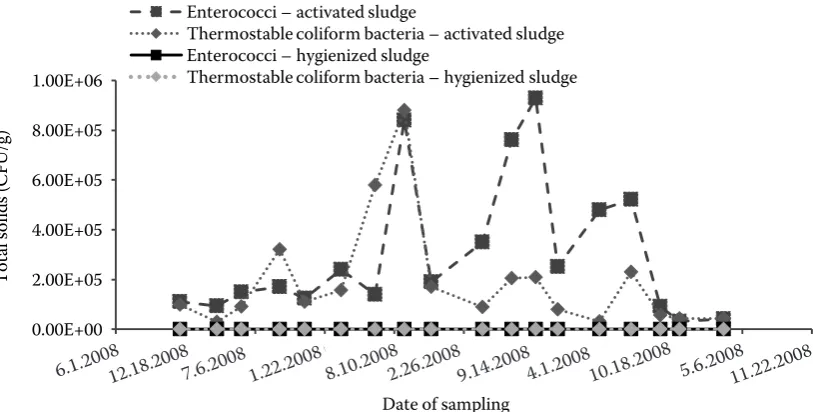
The microbiological parameters of the activated sludge from waste water treatment plant Tetčice in-coming into the process of stabilisation and
hygieni-sation are following: average value 1.90 × 10⁵ CFU
of thermostable coliform bacteria and 3.06 × 10⁵
CFU of enterococci per 1 gram of sludge total sol-ids. The maximal given number is 8.80 × 10⁵ CFU of
thermostable coliform bacteria and 9.29 × 10⁵ CFU
0.00E+00 2.00E+05 4.00E+05 6.00E+05 8.00E+05 1.00E+06
To
ta
l soli
ds
(C
FU
/g
)
Date of sampling Enterococci – activated sludge
Thermostable coliform bacteria – activated sludge Enterococci – hygienized sludge
Thermostable coliform bacteria – hygienized sludge
0.00 1.00 2.00 3.00 4.00 5.00 6.00 7.00 8.00 9.00 10.00
To
ta
l soli
ds
(%
)
[image:4.595.64.533.112.416.2]N Ca Mg K P
[image:4.595.92.499.521.727.2]Fig. 1. Evaluation of thermostable coliform bacteria and enterococci in sludge samples from waste water treatment plant Tetčice
Table 1. Statistical evaluation of microbiological parameters of sludge samples from waste water treatment plant Tetčice
Statistical parameter
Activated sludge Hygienized sludge Stabilized sludge
enterococci (CFU/g TS)
thermostable coliform bacteria
(CFU/g TS)
enterococci (CFU/g TS)
thermostable coliform bacte-ria (CFU/g TS)
enterococci (CFU/g TS)
thermostable coliform bacte-ria (CFU/g TS)
Count measurement 18 18 18 18 18 18
Valid measurement (%) 100 100 100 100 100 100
Average 3.06 × 10⁵ 1.90 × 10⁵ 0.00 0.00 1.72 × 101 1.39 × 101
Geometrical mean 2.02 × 10⁵ 1.21 × 10⁵ – – – –
Harmonic mean 1.31 × 10⁵ 8.30 × 10⁴ – – – –
Median 1.80 × 10⁵ 1.05 × 10⁵ 0 0 – –
Mode multiple 4.30 × 10⁴ 0 0 < 10 < 10
Frequency of mode 1 2 18 18 15 15
Sum 5,514,000 3,424,000 0 0 – –
Minimum 3.20 × 10⁴ 2.90 × 10⁴ 0 0 0 0
Maximum 9.29 × 10⁵ 8.80 × 10⁵ 0 0 1.60 × 10² 1.00 × 10² Lower quartile 1.10 × 10⁵ 5.70 × 10⁴ 0 0 < 10 < 10 Upper quartile 4.80 × 10⁵ 2.09 × 10⁵ 0 0 < 10 < 10
The variance 7.98 × 10¹⁰ 4.75 × 10¹⁰ 0.00 0.00 – –
Standard deviation 2.82 × 10⁵ 2.18 × 10⁵ 0.00 0.00 – –
The coefficient of variation 92.22 114.59 0.00 0.00 – –
Standard error 6.66 × 10⁴ 5.14 × 10⁴ 0.00 0.00 8.43 5.12
TS – total solids; TS – total solids; CFU – colony forming units
6.1.200812.18.20087.6.20081.22.20088.10.20082.26.20089.14.20084.1.200810.18.2008 5.6.200811.22.2008
of enterococci per 1 g of sludge total solids. The sta-tistical evaluation of other microbiological param-eters of sludge samples from waste water treatment Tetčice is given in Table 1 and Fig. 1.
In terms of all performed laboratory tests, thermo-stable coliform bacteria, enterococci or Salmonella spp. bacteria were not detected in hygienised sludge. Application of autothermic aerobic thermophilic sta-bilisation and hygienisation of sludge caused 100% dis-patch of monitored indicator microorganisms. Level of inactivation is calculated (IR) 5 log for enterococci as well as thermostable coliform bacteria. The results of indicator microorganism determination in sludge treated by autothermic aerobic thermophilic stabi-lisation and hygienisation process (AATS) confirm the results of Zwiefelhofer (1985) and Benešová (2004). Those authors stated that AATS process en-sures perfect stabilisation and hygienisation of sludge,
which means total dispatch of Salmonella spp. bac-teria and reduction of the number of enterococci and thermostable coliform bacteria on values of < 103 CFU per 1 gram of sludge total solids.
The number of thermostable coliform bacteria and enterococci <10 (CFU/g of TS) was determined in stabilised sludge from dumping site (period of deposition >10 days). No Salmonella spp. bacteria were detected in either of the obtained sludge sam-ples. Only one of obtained samples revealed ente-rococci as 1.60 × 10² (CFU/g of TS) and coliform
bacteria as 1.00 × 10² (CFU/g of TS). These values
represent recontamination of sludge in all likeli-hood caused by incorrect sampling. Despite this fact, stabilised sludge from dumping site meets all of the legislation microbiological criteria (category I) for application to agricultural soil.
The results of chemical analyses of sludge from waste water treatment Tetčice confirm that neither of the monitored indicators for sludge evaluation exceeds legislation limits of application to agri-cultural soil. Concentrations of chosen hazardous materials and elements in sludge samples are pre-sented in Table 2.
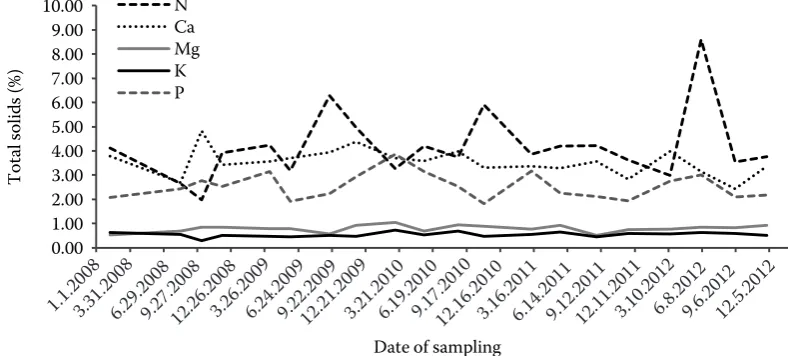
[image:5.595.64.291.139.303.2]The agrochemical characteristics of analysed sludge samples from waste water treatment plant Tetčice are following: average value of nitrogen con-tent is 4.16% of total solids, phosphorus 2.55% of dry matter, kalium 0.54% of dry matter, calcium 3.54% of total solids and magnesium 0.79% of total solids. Agrochemical composition of sludge for agricultural soil application is a rich source of majority of min-eral elements necessary for plant growth and suit-able alternative for industrial fertilizers supply. The agrochemical characteristics are presented in Fig. 2. Table 2. Concentration (CFU/g total solids) of chosen
hazardous materials and elements in sludge samples from waste water treatment plant Tetčice
Type of hazardous
material or element Average value Maximal value Limit value
Arsenic 2.93 7.4 30
Cadmium 1.23 2.3 5
Chromium 41.69 65 200
Copper 178.65 257 500
Mercury 1.08 2.2 4
Nckel 33.59 53 100
Lead 59.89 92 200
Zinc 1,288.00 1,652 2,500
AOX 146.55 293 500
PCB(sum of 6 congeners) 0.28 0.36 0.6
Fig. 2. Agrochemical characteristics of sludge samples from waste water treatment plant Tetčice
0.00E+002.00E+05 4.00E+05 6.00E+05 8.00E+05 1.00E+06
To
ta
l soli
ds
(C
FU
/g
)
Date of sampling Enterococci - activated sludge
Thermostable coliform bacteria - activated sludge Enterococci - hygienized sludge
Thermostable coliform bacteria - hygienized sludge
0.00 1.00 2.00 3.00 4.00 5.00 6.00 7.00 8.00 9.00 10.00
To
ta
l soli
ds
(%
)
Date of sampling N
Ca Mg K P
1.1.20083.31.20086.29.20089.27.200812.26.20083.26.20096.24.20099.22.200912.21.20093.21.20106.19.20109.17.201012.16.20103.16.20116.14.20119.12.201112.11.20113.10.20126.8.20129.6.201212.5.2012
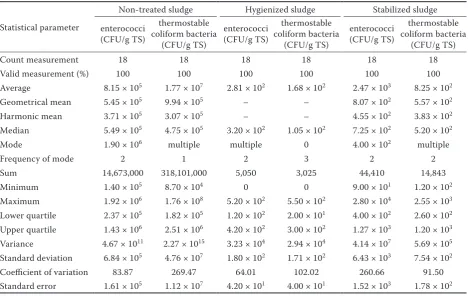
[image:5.595.101.498.558.736.2]The microbiological parameters of activated sludge from waste water treatment plant Tišnov incoming into process of stabilisation and hygieni-sation are following: average value 1.77 × 10⁷ CFU
of thermostable coliform bacteria and 8.15 × 10⁵
CFU of enterococci per 1 g of sludge total solids.
The maximal given number is 1.76 × 10⁸ CFU of
thermostable coliform bacteria and 1.92 × 10⁶ CFU
[image:6.595.64.533.112.408.2]of enterococci per 1 g of sludge total solids. The sta-tistical evaluation of other microbiological param-eters of sludge samples from waste water treatment Tišnov is given in Table 3 and Fig. 3.
Fig. 3. Evaluation of thermostable coliform bacteria and enterococci in sludge samples from waste water treatment plant Tišnov
Table 3. Statistical evaluation of microbiological parameters of sludge samples from waste water treatment plant Tišnov
Statistical parameter
Non-treated sludge Hygienized sludge Stabilized sludge enterococci
(CFU/g TS)
thermostable coliform bacteria
(CFU/g TS)
enterococci (CFU/g TS)
thermostable coliform bacteria
(CFU/g TS)
enterococci (CFU/g TS)
thermostable coliform bacteria
(CFU/g TS)
Count measurement 18 18 18 18 18 18
Valid measurement (%) 100 100 100 100 100 100
Average 8.15 × 10⁵ 1.77 × 10⁷ 2.81 × 10² 1.68 × 10² 2.47 × 10³ 8.25 × 10² Geometrical mean 5.45 × 10⁵ 9.94 × 10⁵ – – 8.07 × 10² 5.57 × 10² Harmonic mean 3.71 × 10⁵ 3.07 × 10⁵ – – 4.55 × 10² 3.83 × 10² Median 5.49 × 10⁵ 4.75 × 10⁵ 3.20 × 10² 1.05 × 10² 7.25 × 10² 5.20 × 10²
Mode 1.90 × 10⁶ multiple multiple 0 4.00 × 10² multiple
Frequency of mode 2 1 2 3 2 2
Sum 14,673,000 318,101,000 5,050 3,025 44,410 14,843
Minimum 1.40 × 10⁵ 8.70 × 10⁴ 0 0 9.00 × 101 1.20 × 10² Maximum 1.92 × 10⁶ 1.76 × 10⁸ 5.20 × 10² 5.50 × 10² 2.80 × 10⁴ 2.55 × 10³ Lower quartile 2.37 × 10⁵ 1.82 × 10⁵ 1.20 × 10² 2.00 × 101 4.00 × 10² 2.60 × 10² Upper quartile 1.43 × 10⁶ 2.51 × 10⁶ 4.20 × 10² 3.00 × 10² 1.27 × 10³ 1.20 × 10³ Variance 4.67 × 10¹¹ 2.27 × 10¹⁵ 3.23 × 10⁴ 2.94 × 10⁴ 4.14 × 10⁷ 5.69 × 10⁵ Standard deviation 6.84 × 10⁵ 4.76 × 10⁷ 1.80 × 10² 1.71 × 10² 6.43 × 10³ 7.54 × 10² Coefficient of variation 83.87 269.47 64.01 102.02 260.66 91.50 Standard error 1.61 × 10⁵ 1.12 × 10⁷ 4.20 × 101 4.00 × 101 1.52 × 10³ 1.78 × 10²
TS – total solids; CFU – colony forming units
1.00E+001.00E+01 1.00E+02 1.00E+03 1.00E+04 1.00E+05 1.00E+06 1.00E+07 1.00E+08 1.00E+09
To
ta
l soli
ds
(C
FU
/g
)
Date of sampling Enterococci – activated sludge
Termostable coliform bacteria – activated sludge Enterococci – hygienized sludge
Termostable coliform bacteria – hygienized sludge
0.00 1.00 2.00 3.00 4.00 5.00 6.00
To
ta
l soli
ds
(%
)
N Ca Mg K P
6.1.200812.18.20087.6.20091.22.20108.10.20102.26.20119.14.20114.11.201210.18.2012 5.6.201311.22.2013
[image:6.595.89.491.513.728.2]The following microbiological parameters of hy-gienised (pasteurized) sludge from waste water treat-ment plant Tišnov were determined: average value 1.68 × 10² CFU of thermostable coliform bacteria and
2.81 × 10² CFU of enterococci per 1 g of hygienised
sludge total solids. The maximal given number is 5.50 × 10² CFU of thermostable coliform bacteria and
5.20 × 10² CFU of enterococci per 1 g of hygienised
sludge total solids. In terms of all performed labora-tory tests, no thermostable coliform bacteria, entero-cocci or Salmonella spp. bacteria were detected in hy-gienised sludge. Average rate of dispatch monitored indicator microorganisms defined from measure-ments come to 99.95% of thermostable coliform bac-teria and 99.91 % of enterococci. The results of indi-cator microorganism determination in sludge treated by pasteurization (temperature 70°C for a period of
60 min) stabilisation and hygienisation process con-firm the results of Benešová (2004) and Strauch (1998). Those authors stated that pasteurization pro-cess ensures a large degree of devitalization of patho-genic microorganisms.
The average number of thermostable coliform bacteria 8.25 × 10² (CFU/g, d.m.) and enterococci
2.47 × 10³ (CFU/g, d.m.) was determined in stabilised
sludge from the dumping site (period of deposition >10 days). No Salmonella spp. bacteria were detected in either of the obtained sludge samples. These values represent recontamination of sludge. Recontamina-tion can be caused by expansion of survived microor-ganism or in a way of storage – contamination from the surrounding environment. Despite this fact, sta-bilised sludge from the dumping site meets the legis-lation microbiological criteria (category II) for appli-cation to agricultural soil destined only for technical crop production (non-food production).
The results of chemical analyses of sludge from waste water treatment Tišnov confirm that neither of the monitored indicators for sludge evaluation exceeds legislation limits for application to agri-cultural soil. Concentrations of chosen hazardous materials and elements in sludge samples are pre-sented in Table 4.
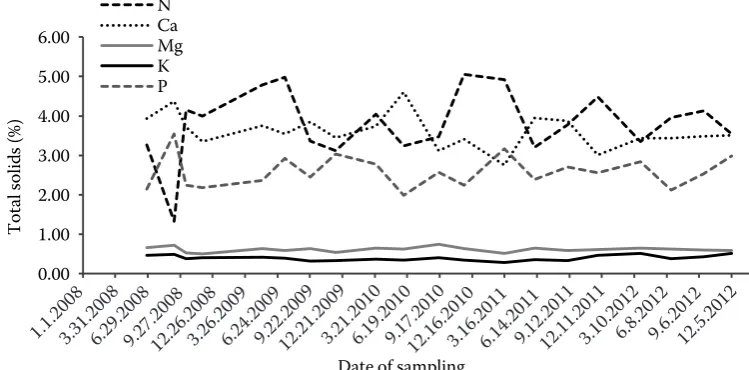
[image:7.595.64.291.139.304.2]The agrochemical characteristics of analysed sludge samples from waste water treatment plant Tišnov are following: average value of nitrogen content is 3.81% of dry matter, phosphorus 2.59% of dry matter, kalium 0.40 % of dry matter, calcium 3.62% of dry matter and magnesium 0.62% of dry matter. The agrochemical characteristics are pre-sented in Fig. 4.
[image:7.595.100.475.552.737.2]Fig. 4. Agrochemical characteristics of sludge samples from waste water treatment plant Tišnov Table 4. Concentration (CFU/g TS) of chosen hazardous
materials and elements in sludge samples from waste water treatment plant Tišnov
Type of hazardous
material or element Average value Maximal value Limit value
Arsenic 1.48 5.0 30
Cadmium 0.93 1.8 5
Chromium 37.21 62.0 200
Copper 179.00 257 500
Mercury 1.85 3.4 4
Nickel 28.55 41.0 100
Lead 53.22 72.0 200
Zinc 1,169.65 1,443 2,500
AOX 371.00 391 500
PCB(sum of 6 congeners) 0.06 0.20 0.6
1.00E+001.00E+01 1.00E+02 1.00E+03 1.00E+04 1.00E+05 1.00E+06 1.00E+07 1.00E+08 1.00E+09
To
ta
l soli
ds
(C
FU
/g
)
Date of sampling Enterococci - activated sludge
Termostable coliform bacteria - activated sludge Enterococci - hygienized sludge
Termostable coliform bacteria - hygienized sludge
0.00 1.00 2.00 3.00 4.00 5.00 6.00
To
ta
l soli
ds
(%
)
Date of sampling N
Ca Mg K P
1.1.20083.31.20086.29.20089.27.200812.26.20083.26.20096.24.20099.22.200912.21.20093.21.2010 6.14.20119.12.201112.11.20113.10.20126.8.20129.6.201212.5.2012 12.16.20103.16.2011
9.17.2010 6.19.2010
CONCLUSION
Sludge from waste water treatment plants can be defined as concentrated mixture of mineral and or-ganic materials removed from sewerage water by waste water treatment process. Sludge is character-ized by large variability of physical, chemical and microbial properties. These properties depend on origin and way of waste water and sludge treatment. Results of this experimental study confirm that sewage sludge treated by both assessed hygienisa-tion technologies meets legislahygienisa-tion requirements for application to agricultural soil (technology of pasteurization – sludge category I and technology of autothermic aerobic thermophilic stabilisation and hygienisation process – category II).
References
Arthurson V. (2008): Proper sanitization of sewage sludge: a critical issue for a sustainable society. Applied Environment Microbiology, 74: 5267–5275.
Benešová J. (2004): Technické řešení hygienizace. Odpadové fórum, 5: 17–18.
Bonjoch X., Blanch A.R. (2009): Resistance of faecal coliforms and enterococci populations in sludge and biosolids to different hygienisation treatments. Microbial Ecology, 57: 478–483.
Fukushi K., Babel S., Burakrai S. (2003): Survival of Salmo-nella spp in a simulated acid-phase anaerobic digester treat-ing sewage sludge. Bioresource Technology, 87: 177–181. Horan N.J., Fletcher L., Betmal S.M., Wilks S.A., Keevil C.W.
(2004): Die off of enteric bacterial pathogens during meso-philic anaerobic digestion. Water Research, 38: 1113–1120. Lang N.L., Smith S.R. (2008): Time and temperature inactiva-tion kinetics of enteric bacteria relevant to sewage sludge treatment processes for agricultural use. Water Research, 42: 2229–2241.
Lapara T.M., Alleman J.E. (1999): Thermophilic aerobic biological wastewater treatment. Water Research, 33: 895–908.
Lee S.H., Kang H.J., Park H.D. (2015): Influence of influent wastewater communities on temporal variation of activated sludge communities. Water Research, 73: 132–144. Liu Z.W., Lee D.J. (2000): Boiling of biological sludges.
In-ternational Communications in Heat and Mass Transfer, 27: 221–228.
Maier R.M., Pepper I.L., Gerba C.P. (2006): Environmental Microbiology. Elsevier Publishers, USA: 505–520. Metcalf And Eddy, Inc. (2003): Wastewater Engineering:
Treatment and Reuse, 4th Ed., McGraw Hill, USA. Sahlström L., Aspana A., Baggea E., Danielsson-Thamb M.L.,
Albihna A. (2004): Bacterial pathogen incidences in sludge from Swedish sewage treatment plants. Water Research, 38: 1989–1994.
Salsali H.R., Parker W.J., Sattar S.A. (2006): Impact of concen-tration, temperature and pH on inactivation of Salmonella
spp. by volatile fatty acids in anaerobic digestion. Canadian Journal of Microbiology, 52: 279–288.
Sinton L.W., Finlay R.K., Hannah D.J., 1998. Distinguishing human from animal faecal contamination in water: A rewiew. New Zealand Journal of Marine and Freshwater Research, 32: 323–348.
Stone R.J., Ekwue E.I, Clarke R.O. (1998): Engineering proper-ties of sewage sludge in Trinidad. Journal of Agricultural Engineering Research,70: 221–230.
Strauch D. (1998): Pathogenic microorganisms in sludge: Anaerobic digestion and disinfection methods to make sludge usable as a fertilizer. European Water Management, 1: 12–26.
Trávníček P., Junga P. (2014): Thixotropic behaviour of thickened sewage sludge. Journal of Environmental Health Science and Engineering, 72: 1–6.
Zwiefelhofer H.P. (1985): Aerobic-thermophilic/anaerobic-mesophilic two-stage sewage sludge treatment: Practical experiences in Switzerland. Conservation & Recycling, 8: 285–301.