Commonly, potato is grown under the conven-tional system, but more often the integrated and organic systems are met. Global trends are going in the direction of environmentally friendly sys-tems. However, in these systems, especially in the organic ones, there are certain restrictions that limit the level of yields. There are limits on the use of pesticides and in some soils deficit of nutrients appears as a result of non-mineral fertilizers. These limitations affect plant growth and, consequently, the tuber yield and its structure. Plants growing on the organic plantation are characterized by lower aboveground weight and smaller leaf green-ness (Zarzyńska and Szutkowska 2012, Zarzyńska and Pietraszko 2015). It can be assumed that their photosynthetic activity is also lower compared to the conventional system.
Potato is one of the most efficient plants in converting solar energy into human food, both quantitatively and qualitatively. According to Milthrope and Moorby (1997) the rate of tuber mass increase is determined by the time of tu-berization and the state of photosynthetically active leaves. Photosynthesis is one of the basic physiological processes of plants with internal and external conditions. Any reduction of the intensity of this process causes a decrease in the amount and quality of crop plants. One of the indicators for early prediction of potato yielding can be the measurement of chlorophyll fluorescence. It is an informative tool for studying the effects of dif-ferent environmental stresses on photosynthesis (Strasser et al. 2000). In the research work, the chlorophyll fluorescence techniques are used for
Possibility to predict the yield of potatoes grown under
two crop production systems on the basis of selected
morphological and physiological plant indicators
Krystyna ZARZYŃSKA*, Milena PIETRASZKO
Plant Breeding and Acclimatization Institute, Potato Agronomy Department, Jadwisin, Serock
*Corresponding author: [email protected]ABSTRACT
Zarzyńska K., Pietraszko M. (2017): Possibility to predict the yield of potatoes grown under two crop production systems on the basis of selected morphological and physiological plant indicators. Plant Soil Environ., 63: 165–170.
In the study conducted in the years 2014–2016 at the Institute of Plant Breeding and Acclimatization in Poland, the effect was tested of such indicators of plant productivity as: leaf area index (LAI), leaf greenery index (SPAD) and chlorophyll a fluorescence on the yield of potato tubers grown in two production systems, i.e. organic and conven-tional. It was found that in the organic production system the values of all tested indicators were significantly lower than in the conventional system and the decrease in chlorophyll content in the leaves, as well as the decrease in chlorophyll a fluorescence over time followed faster in the organic than in conventional system. The lower surface of the leaves, smaller greenery index and lower activity of photosynthesis contributed to a significant reduction in tuber yield in the organic system. The tuber yield in this system was about 30% lower than in the conventional one. The positive correlations between the value of the tested indicators and yield of tubers was obtained. The highest correlation was between the LAI index, the smallest between the performance index of photosystem II. In the con-ventional system the correlation coefficients were slightly higher than in organic, which indicates that in this system the possibility of predicting the final yield is simpler.
assessment of potato genotypes tolerant and sen-sitive to environmental stresses (Jefferies 1992, Mauromicale et al. 2006, Ierna 2007).
The aim of the study was to evaluate differences in the selected indicators of some morphological-physiological traits of potato plants grown in two production systems, i.e. organic and conventional, and to assess which of these indicators is the most correlated with the yield and whether it is possible to predict the final yield on this basis.
MATERIAL AND METHODS
A study was conducted in 2014–2016 at the Plant Breeding and Acclimatization Institute, in central Poland on a light loamy sand. Potatoes were grown in the two systems, i.e. organic and conventional. In the organic system the following crop rotation was used: potatoes → field peas → oat
→ rye with serradella undersown → buckwheat + white mustard as catch crops.
In the conventional system the crop rotation was: potatoes → spring wheat → winter wheat →
lupines. The two systems also differed in fertiliza-tion, weed control and insect control practices. Late blight control consisted of 2 to 3 foliar applications of copper fungicides in the organic system, and
3 to 5 applications of chemical fungicides in the conventional system (Table 1).
Weather conditions during three years of the trial were varied. In the years 2014 and 2016, both the amount and distribution of rainfall and air temperature were favourable for the growth and development of potato plants, while in 2015 there was an shortage of rainfall, especially in June and August, so the irrigation making up the water shortages in both systems was done. The meteorological data for 3 years of investigations are presented in Table 2.
Four Polish potato table cultivars were chosen for this study based on maturity class and resistance to late blight (Table 3). All cultivars were planted at the same time i.e. about the 20th April. Plot size
was 84 m2 in three replications. Plants were grown
with the spacing of 75 × 33.3 cm.
At the end of June (for the early cultivars) and 2 weeks later (for the mid-early ones) total above-ground biomass, and leaf area index were assessed. The assimilation area of leaves was measured by using the Li-3100 area meter (Lincoln, USA). The LAI was calculated as a ratio of assimilation area of one plant to the area of ground occupied per one plant. The measurements were conducted on four plants from each of the three replicates. In addition, six measurements of chlorophyll content and
chlo-Table 1. Agronomic inputs in organic and conventional systems
Crop production practice Organic system Conventional system
Fertilization manure – 28 t/ha + catch crop 4–5 t ploughed rye straw + 1 kg mineral nitrogen per 100 kg straw + catch crop.
(100 kg N/ha; 53 kg P/ha; 150 kg K/ha)
Weed control only mechanical tillage mechanical tillage + herbicides 2–3 times per season
Colorado potato beetle control
biological insecticide (Bacillus thuringiensis)
2–3 times per season
chemical insecticides 2–3 times per season
[image:2.595.60.532.112.242.2]Late blight control 2–3 copper fungicides 3–5 chemical fungicides
Table 2. Total monthly rainfall (R, mm) and mean monthly temperatures (T, °C) during the vegetative growth period in the years 2014–2016 for Jadwisin
Year May June July August September
R T R T R T R T R T
2014 41.3 14 69.8 15.8 23.5 21.4 79.2 18.3 11.1 14.8
2015 39.5 12.9 15.4 17.5 62.6 19.7 8.6 22.5 36.6 15.1
[image:2.595.63.532.671.756.2]rophyll a fluorescence were made at 10-day intervals starting from about 45 days after planting (DAP). Evaluation of total chlorophyll content was based on a leaf greenness index (SPAD) measured by SPAD 502- Soil-Plant Analyses Development (Minolta, Japan) chlorophyll meter, measured on apex leaf.
Chlorophyll a fluorescence measurements were performed on the plants with a Pocket PEA (plant efficiency analyser, Hansatech, UK). The young-est fully expanded leaves were kept in darkness for at least 20 min in specially provided clips. Determined parameters were: Fv/Fm – the ratio of variable to maximal chlorophyll fluorescence (the photochemical efficiency of photosystem II) and PI – the performance index of photosystem II (Strasser et al. 2000). Measurements were made on weekdays from 7:30–9:00 a.m. with the saturation irradiance up to 3500 μmol/m2/s.
Final harvest was performed after full maturity of plants, between August 5 and 12.
RESULTS
The significance of the studied factors
dif-ferentiation. The analysis of variance showed the
importance of the diversity of all studied factors depending on the production system except of the ratio Fv/Fm. Significant varietal differences were observed only in the leaf greenness index and the performance index of photosystem II. Years of research did not significantly differentiate any of the studied parameters (Table 4). There was a significant interaction of the years of research and production system.
Diversity of morphological and physiologi-cal plant parameters depending on the tested
factors. In the conventional system, the values
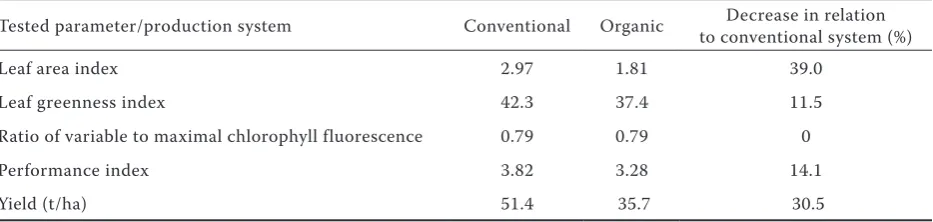
[image:3.595.305.532.112.244.2]of all studied parameters were higher than in the organic system. The only exception was the rate of Fv/Fm that did not differ in both systems. The biggest differences were related to LAI index; in the conventional system, its value was almost 40% higher than in the organic. Much less variation was observed in the case of leaf greenness index and the performance index of photosystem II) pa-rameters. The average value of SPAD was by 11.5 and PI by 14.1% higher in the conventional system. This diversity contributed to the tuber yield. The yield obtained in the conventional system was by 30.5% higher than in the organic one (Table 5).
Table 3. Characteristics of four potato cultivars evalu-ated in organic and conventional production systems during 2014–2016
Cultivar Maturity Phytophthora infestansResistance to
Ignacy early 3
Michalina early 3
Malaga mid early 3.5
Oberon mid early 3.5
1 – no resistance; 9 – full resistance
Table 4. Significance of the tested parameters
Tested parameter
Crop production
system Cultivar Year
Leaf area index ** ns ns
Leaf greenness index ** * ns
Ratio of variable to maximal
chlorophyll fluorescence ns ns ns
Performance index ** * ns
Total yield ** ns ns
[image:3.595.64.292.139.234.2]**α ≤ 0.01; *α ≤ 0.05; ns – non significant
Table 5. Differences of plant morphological and physiological parameters depending on the crop production system
Tested parameter/production system Conventional Organic to conventional system (%)Decrease in relation
Leaf area index 2.97 1.81 39.0
Leaf greenness index 42.3 37.4 11.5
Ratio of variable to maximal chlorophyll fluorescence 0.79 0.79 0
Performance index 3.82 3.28 14.1
[image:3.595.65.532.644.755.2]The cultivars significantly differed in the amount of the two indicators, i.e. SPAD and PI.
The biggest value of leaf greenness was recorded in cv. Oberon, the lowest in cv. Malaga. The high-est rate of PI was also noted for cv. Oberon and the lowest for cv. Malaga (Table 6).
Although the significant differences of years did not prove concerning in tuber yield, significant differences were found in yielding of potatoes grown in both production systems in subsequent years. In 2015, the highest yield was obtained in the conventional system but the lowest in the organic one.
Changes of SPAD index values in conventional
and organic systems over time. Performed every
10 days, the measurement of leaf greenness and the chlorophyll a fluorescence showed a variation of these parameters depending on the production system. At the beginning of the plant develop-ment, the chlorophyll content in the leaves of both systems was similar. Differentiation followed with the development of plants. The highest content of chlorophyll was observed in both systems at the
beginning of the measurements. In the organic system the chlorophyll content was generally lower and declined more rapidly over time than in the conventional system (Figure 1).
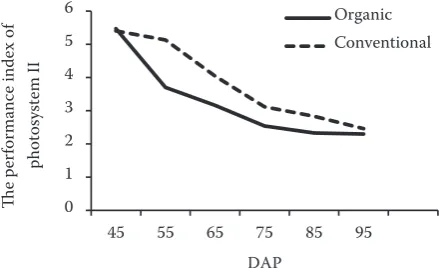
Similar situation is related to the chlorophyll a fluorescence. Photosynthetic activity of leaves determined by PI index was the highest in the ini-tial period of plant growth and decreased as they developed. In the organic system, the chlorophyll a fluorescence was lower than in the conventional system and falling faster than in the conventional system. In the early stages of plant growth the photosynthesis intensity in both production sys-tems was at a similar level (Figure 2).
The relationships between the value of mor-phological-physiological parameters and
tu-ber yield. The calculated correlation coefficients
between the value of the studied parameters and yield of tubers obtained in both production sys-tems showed the highest relationship between LAI, then between SPAD index and the lowest between PI ratio and tuber yield. The correlation coefficients were, respectively, as follow: in the conventional system: 0.702, 0.570 and 0. 381; in the organic system, they were slightly lower and amounted to: 0.687, 0.520 and 0.323 (Table 7).
DISCUSSION
[image:4.595.65.290.127.212.2]Prohibition or major restrictions in the use of chemical and fertilizer inputs in the organic pro-duction system resulted in weaker plant growth, and consequently reduced tuber yield and smaller tuber size. Development of the aboveground plant
Table 6. Cultivar differences of plant morphological and physiological parameters
Cultivar Leaf greenness index Performance index
Ignacy 39.7b 3.54b
Michalina 38.8b 3.68b
Malaga 37.1a 3.05a
Oberon 43.9c 3.94c
a,b,cMean values indicated by the same letters are not
sta-tistically significant at the 0.05 level by the Tukey’s test
0 10 20 30 40 50
45 55 65 75 85 90
Lea
f g
reen
er
y
in
dex
DAP Organic Conventional
Figure 1. Effect of production system (conventional and organic) on leaf chlorophyll content (SPAD index) from 45 to 95 days after planting (DAP). Values are means of 4 cultivars and three years
0 1 2 3 4 5 6
45 55 65 75 85 95
Th
e
pe
rf
orm
an
ce
in
de
x
of
ph
oto
sy
st
em
II
DAP
[image:4.595.308.528.572.706.2] [image:4.595.67.284.573.706.2]Organic Conventional
parts was largely determined by supply and avail-ability of nitrogen in the first weeks after emergence (Van der Zaag 1992, Marscher 1995, Vos 1995, Goffart et al. 2008) and the time of flowering, when the tuberization process begins. For maximum tu-berization, it is necessary to achieve a certain level of development of the aboveground plant parts, i.e. LAI ranging from 2.5 to 3 (Marschner 1995, Van Delen 2001). In our study, the average LAI in organic production system was only 1.8 and in the conventional system around 3. This difference in plant development was reflected in tuber yield that was 30% lower in organic system, although it should be emphasized that the resulting yields were as high as in organic system. In this study, it was found that at the beginning of the growing season the leaf chlorophyll content was similar in both production systems. Leaf chlorophyll content is closely related to nitrogen status of the plants (Tremblay 2004, Goffart et al. 2008, Ramirez at al. 2014). A decline in leaf chlorophyll content in the organic production system occurred starting about 50 DAP. This could have been related to a decline in available nitrogen from organic fertilizer sources. In conventional system, it started later. Cultivars generally differed in chlorophyll leaf content. With many years of research conducted in our institute, it is clear that for most cultivars, SPAD readings gave 43 result in optimum yield (Trawczyński 2012). Chlorophyll fluorescence is a measure of the efficiency of photosynthetic apparatus. The maximum efficiency of photosynthesis occurs when the surface of the lamina has already reached the minimum size, then decreases with the increase of the lamina surface (Pula et al. 1999, Michalek and Sawicka 2005); they found that the operation of photosystem PS II is the most sensitive indicator of various stressors on plants. Also Rykaczewska and Mańkowski (2015) stated that chlorophyll fluorescence is a very sensitive probe of the physi-ological status of leaves, which can provide a very
rapid assessment of plant performance in a wide range of situations. Our study also confirmed the highest activity of the photosynthetic apparatus in the early stages of plant development in both production systems. In the organic system, the activity of the photosynthesis was smaller and just as in the case of chlorophyll content it fell faster than in the conventional system. The obtained relationship between the studied indicators and yield of tubers showed the highest correlation between the leaf area index and the final yield. This indicator seems to be the key, because good development of plants proves their good nourish-ment, and thus life processes running properly. The slightly higher correlation in the conventional system provides for greater stability of the plant growth in this production system. In the organic system, plants are exposed to a stronger adverse fac-tors. Weather factors play a huge role in this case. In the years of unfavourable weather conditions, more significant losses in yield can be expected in the organic than conventional production systems (Zarzyńska and Pietraszko 2015, Zarzyńska and Goliszewki 2015).
To summarize, it is possible to predict the tu-ber yield based on physiological-morphological plant parameters; in the conventional system, it is simpler to eliminate the effects of factors inde-pendent of farmer.
REFERENCES
Goffart J.P., Olivier M., Frankinet M. (2008): Potato crop nitrogen status assessment to improve N fertilization management and efficiency: Past-present-future. Potato Research, 51: 355–383. Ierna A. (2007): Characterization of potato genotypes by chlo-rophyll fluorescence during plant aging in Mediterranean environment. Photosynthetica, 45: 568–575.
[image:5.595.63.531.128.196.2]Jefferies R.A. (1992): Effects of drought on chlorophyll fluores-cence in potato (Solanum tuberosum L.). I. Plant water status
Table 7. Correlation coefficients between the chosen morphological-physiological parameters and tuber yield. Values are means of 4 cultivars and three years
Production system
Leaf area index Leaf greenness index Performance index
P r2 P r2 P r2
Conventional 0.006 0.702 0.022 0.570 0.032 0.381
Organic 0.007 0.687 0.028 0.520 0.030 0.323
and the kinetics of chlorophyll fluorescence. Potato Research, 35: 25–34.
Marscher H. (1995): Mineral Nutrition for Higher Plants. 2nd Ed. London, Academic Press.
Mauromicale G., Ierna A., Marchese M. (2006): Chlorophyll fluorescence and chlorophyll content in field-grown potato as affected by nitrogen supply, genotype, and plant age. Pho-tosynthetica, 44: 76–82.
Michałek W., Sawicka B. (2005): Chlorophyll content and pho-tosynthetic activity of medium-late varieties of potato in the conditions of cropland in east-central Poland. Acta Agrophysica, 6: 183–195.
Milthrope F.L., Moorby J. (1997): Introduction to Physiology Plant Yielding. Warszawa, Agriculture and Forest Publishing. Pula J., Skrzypek E., Łabza T., Dubert T. (1999): Chlorophyll fluo-rescence as one of the indicators of potato yielding. Potatoes for trade and processing – Agronomic and storage conditions guaranteeing a quality. Radzików, 23–25: 110–122.
Ramírez D.A., Yactayo W., Gutiérrez R., Mares V., De Mendiburu F., Posadas A., Quiroz R. (2014): Chlorophyll concentration in leaves is an indicator of potatotuber yield in water-shortage conditions. Scienta Horticulturae, 168: 202–209.
Rykaczewska K., Mańkowski D. (2015): The effect of physiologi-cal age of potato plants on chosen chlorophyll fluorescence parameters. Plant, Soil and Environment, 61: 462–467. StatSoft, Inc. (2014): Statistica (data analysis software system),
version 12. Available at www.statsoft.com
Strasser R.J., Srivastava A., Tsimilli-Michael M. (2000): The fluorescence transient as a tool to characterize and screen photosynthetic samples. In: Yunus M., Pathre U., Mohanty P.
(eds.): Probing Photosynthesis: Mechanisms, Regulation and Adaptation. London, Taylor and Francis, 445–483.
Trawczyński C. (2012): Preparation of field and fertilization of potato. In: Chotkowski J. (ed.): Production and Market of Potato, Warsaw, 182–197. (In Polish)
Tremblay N. (2004): Determining nitrogen requirements from crop characteristics. Recent Research Development in Agronomy Horticulture, 1: 157–182.
Van Delen A. (2001): Yield and growth components of potato and wheat under organic nitrogen management. Agronomy Journal, 93: 1370–1385.
Van der Zaag D.E. (1992): Potatoes and their cultivation in the Netherlands. Hague, Netherlands Potato Consultative Institute. Vos J. (1995): Nitrogen and the growth of potato crops. In: Haver-kort A.J., MacKerron D.K.L. (eds): Potato Ecology and Mod-eling of Crops under Conditions Limiting Growth. Dordrecht, Kluwer, 115–128.
Zarzyńska K., Szutkowska M. (2012): Development differences, yield and late blight development (Phytophthora infestans) infection of potato plants grown under organic and conven-tional systems. Journal of Agriculture Science and Technology A, 3/4: 281–290.
Zarzyńska K., Goliszewski W. (2015): Cultivar – Environmental determinants of potato yielding under organic system. Journal of Research and Applications in Agricultural Engineering, 60: 135–139.
Zarzyńska K., Pietraszko M. (2015): Influence of climatic condi-tions on development and yield of potato plants growing under organic and conventional systems in Poland. American Journal of Potato Research, 92: 511–517.