Agents for the Grid: a Comparison with Web Services
(Part I: Transport Layer)
Luc Moreau
Department of Electronics and Computer Science
University of Southampton
SO17 1BJ Southampton UK
[email protected]
Abstract
The notion of agent has of late become popular in the Grid community, as exemplified by several workshops on the use of agents in the Grid.What are agents for the Grid? What is the difference between agents and Web-services? These are questions that we address by describing a port of theSoFARagent framework to Web services in the context of a bioinformatics Grid. In thisfirst paper, we focus our dis-cussion solely on issues at the transport layer. Through an agent communication language (ACL) and an abstract com-munication model, we have been able to define a generic API to communications, and are able to support multiple protocols, including theXMLprotocol, the transport
mech-anism of Web services. This approach facilitates the de-velopment of applications, makes our environment future-proof, and promotes the open-ness of our Grid architecture to third-party developers.
1. Introduction
MYGRID[35] is a Grid [18] pilot project funded by the
UK e-Science initiative [43]. Its purpose is to provide a collaborative and supportive environment that enables geo-graphically distributed biologists to achieve research goals more effectively, while enabling their results to be used in developments elsewhere in the community. TheMYGRID
project aims to build a personalised problem-solving envi-ronment for the e-Scientist.
A key requirement ofMYGRID is the design of an en-vironment in which collaborative distributed bioinformatics applications may be developed. Our methodology for future proofing the environment is to design ageneric architecture able to support multiple existing protocols, languages and standards, and which hopefully will be able to accommo-date future developments.
The biological community has been particularly active in defining customised APIs for commonly used program-ming languages such as BioJava [4] and Bioperl [5], and for distributed computing technologies such as BioCORBA [3]. XMLprotocol and Web Services [46] are also becom-ing widely adopted in this community. It is the purpose of
MYGRID to support all these technologies. Furthermore, MYGRID services will support and will be integrated with Grid middleware, e.g. Globus [17], to maintain links with development in the Grid community.
Our goal is to design anabstract communication archi-tecturethat we can map onto concrete communication tech-nologies. Open-ness and ease of development are two driv-ing forces of our undertakdriv-ing: (i)For open-ness, we will specify protocols on the wire, i.e. the message format for each protocol supported, so that third-party developers may elect to use MYGRID services or make theirs available to
MYGRID. (ii)For ease of development, we will provide programming APIs, which the programmer can use to de-velop new tools and applications in MYGRID. A specific
aim of the programming API is to provide an abstraction layer that hides the specific implementation details of each communication protocol.
meta-information. The third reason, i.e the agent commu-nication language, is the key principle underlying our ab-stract communication architecture. The other two reasons are long term motivations for using the agent paradigm, but we do not discuss them here; we refer the reader to publica-tions such as [26, 27].
We have prototyped these ideas into SoFAR, the Southampton Framework for Agent Research [33], an agent-based communication infrastructure, initially tar-geted for distributed information management applications; it now serves as the foundation of theMYGRID
communi-cation infrastructure. TheSoFARcommunication layer was already successfully mapped onto several implementations of RMI (including a UDP based one) and SSL; we fore-see no problem in porting it to CORBA. We have recently completed the mapping of theSoFARagent communication layer ontoXMLprotocol [46]. This paper discusses the dif-ferences between agents and Web Services from an imple-mentation perspective.
Web Services generally refer to a three-layer system composed of: (i)a transport layer based onXML mes-saging (XMLprotocol, formerly known as Soap [46]); (ii)a
registry mechanism allowing the advertising and discovery of services based on UDDI [42] and described by languages such as WSDL [45] or DAML-S [13]; (iii)Some workflow system such as XLANG [41] or WSFL [30].
It is frequent to hear questions such as “Why use agents and not Web Services?”, “What is the difference between Agents and Web Services?”. The purpose of this paper is to answer such questions from our practical experience of mapping SoFAR to Web services. This paper is the first step of our investigation, and focuses solely on the trans-port layer; in a second paper, we will discuss registry mech-anisms.
This paper is organised as follows. First, we describe our abstract communication architecture based on an agent communication language (ACL) (Section 2). Then, we
ex-plain our implementation mapping theACLontoXML Pro-tocol (Section 3). We then compare our system with related work (Section 4) and conclude the paper with a discussion on the differences between agents and Web services.
2. Abstract Communication Architecture
Our primary motivation for adopting the agent paradigm for the MYGRID environment is the notion of an “agent communication language” (ACL), an abstract
communica-tion language that can be mapped onto concrete communi-cation protocols, hence supporting our desire of an open and future-proof environment.
In combination with anACL, we also support an abstract
communication model, inspired by Nexus “virtual commu-nication links” composed of startpoint and endpoint pairs
[19]. AnACLand virtual links have allowed us to design a generic API, which facilitates the development of complex distributed applications.
In this Section, we present ourACL and its integration in our communication model in order to provide a generic API.
2.1. Agent Communication Language (ACL)
The idea of an “agent communication language” dates back from the DARPA knowledge sharing effort, which led to the design of KQML(Knowledge Query and Manipula-tion Language) [15], and was followed later byFIPA (Foun-dation for Intelligent Physical Agents)ACL[16]. Three el-ements compose anACL, which we describe below.
Performatives In agent systems, it is common practice to separate intention from content in communicative acts, ab-stracting and classifying the former according to Searle’s speech act theory [39]. An agent’s communications are thereby structured and classified according to a predefined set of “message categorisations”, usually referred to as per-formatives.
The number of different performatives varies between differentACLs. The most simple, such as Shoham’s Agent-0 [4Agent-0], have less than half a dozen, while the more com-plex, such as KQML or FIPAhave more than twenty. We carefully chose performatives that would allow our agents to interact in as complex ways as if they were using a more complex agent communication language. In partic-ular,FIPAandKQMLcontain specialised performatives for tasks such as forwarding messages or issuing calls for pro-posals which we respectively see as functions of the com-munication layer, or as terms to be defined in an application ontology. At the other extreme, Agent-0 relies on the com-position of basic acts to perform more complex messages, whichFIPAandKQMLconsider as primitive.
Our minimal set of performatives support common prim-itive interactions such as querying, notifying, requesting, subscribing, and advertising. They are a compromise be-tween extremes, being chosen in order to avoid the com-plexity and communication cost that composition would en-tail in the most common scenarios.
Adopting a rigid set of performatives also offers addi-tional benefits. Implementations may be able to offer effi -cient dispatch on messages, avoiding a further interpretation layer that would be required by a non-existing or unlimited message categorisation. Additionally, they allow us to pro-vide a generic programming API, as we discuss in Section 2.3.
problem domain, and so the content of the messages must be a representation of their world. AnACLrequires agents
to adopt an agreed vocabulary with ashared understanding of some domain that they can use in their communication [24]. Such a vocabulary is usually referred to as an ontol-ogy, and in this context can be seen as a message content schema.
At the communication level, we are only concerned with defining the vocabulary used in messages. Terms of such a vocabulary would typically refer (through a URI) to their semantic definition, which in turn could be used internally by agents to reason about such terms. Practically, terms of a vocabulary can be defined by a CORBA IDL or anXML
schema; in Section 2.4, we will present the definition lan-guage for specifying terms of our vocabulary. On the other hand, semantic definitions could be written in more expres-sive ontology languages such as frames or DAML+OIL [2]. The dynamic and evolving nature of a Grid environment requires the support of multiple ontologies, designed, re-vised and published by independent developers, at different times. It is a requirement of anACLto be able to accommo-date these.
Meta-Information Performatives and ontologies as de-scribed above are only a slight abstraction above a remote procedure call. However, as opposed to method calls in object-oriented programming, communication acts arenot considered as irresistible requests in agent-based systems. Agents must be able to discriminate between messages ac-cording to their internal state and the context of the mes-sage.
Thiscommunication contextincludes information about the act of communication itself such as the sender, receiver, sent time, message identifier and conversation thread. An agent may use this to reject a message or to discriminate between senders. In complex interaction protocols, agents need to be able to determine what conversation a message belongs to; a conversation may be regarded as a generalisa-tion of a peer-to-peer session to agents. This information is usually not available in object systems, but should defi -nitely be made available in an agent system.
Such a communication context is defined by a notion of
Envelope, which is specified in Figure 1.
2.2. Abstract Communication Model
An agent communication language can be mapped onto several communication layers, and therefore satisfies our need for open-ness: for each protocol, we may easily derive a specification of messages, which may be used by third-party developers to program applications interacting with
MYGRID.
<term name="Envelope" extends="Term"> <field type="AgentTerm" name="sender"/> <field type="AgentTerm" name="receiver"/> <field type="Time" name="timestamp"/> <field type="Integer" name="identifier"/> <field type="Integer" name="reference"/> <field type="Conversation" name="conversation"/> </term>
Figure 1. Meta Information of a Message
However, an agent communication language alone does not provide a generic API to communications, because e.g. performing a CORBA method call differs substantially from invoking a service through the Apache Soap implementa-tion.
Therefore, we have adapted a key concept of the Nexus communication layer [19] to the world of agents. Nexus has been shown to be a generic mode of communication, which is efficient and scalable. It provides programmers with two key ideas: startpoint/endpoint pairsto refer to remote ob-jects and a form of method activation to start computations on remote objects.
Communications between agents take place over a vir-tual communication link, identified by astartpointand an endpoint. Anendpointidentifies an agent’s ability to re-ceive messages using a specific communication protocol. An endpoint extracts messages from the communication link and passes them onto the agent. A startpoint is the other end of the communication link, from which messages get sent to an endpoint. Communications are initiated by calling one of the performatives on a startpoint; this results in the transfer of the data to the remote endpoint, which passes the message to the agent.
There may be several startpoints for a given agent, each acting as a representative of the agent at remote locations. Each startpoint is associated with an endpoint by a virtual link, and encapsulates a specific communication protocol.
Usually, a startpoint is attached to a single endpoint, and communication is point-to-point. If a startpoint is attached to several endpoints, a multicast mode of communication becomes possible. Such mode of communication is only permitted for performatives accepting this semantics (typi-cally those that do not return results).
2.3. Generic API
be-yond the scope of this paper, but may rely on the use of a lookup service.)
The details of the API are of course dependent on its embedding in a specific programming language. If we adopt an object-oriented methodology (specifically the language Java), we obtain the following.
A same interface defines the client and server side of the communication act. A startpoint supports a method for each performative defined in theACL. A communication is
ini-tiated by performing a method call on a startpoint, passing as argument the message content and the envelope. Figure 2 contains the interfaceAgentboth supported by a startpoint and an agent object.
interface Agent {
boolean query_if(Predicate p, Envelope e); Predicate[] query_ref(Predicate p, Envelope e); void inform(Predicate p, Envelope e);
void uninform(Predicate p, Envelope e); Contract register(Action a, Envelope e); void unregister(Contract c, Envelope e); Contract subscribe(Predicate p, Envelope e); void unsubscribe(Contract c, Envelope e); void request(Action a, Envelope e); }
Figure 2. Agent Interface
The effect of invoking a performative method on a start-point is to package the method call up as a message and to transmit it to the endpoint, which deserialises it and passes it onto the agent. Startpoints and endpoints have a crucial role: startpoints define the different components of the com-munication context, such as time or sender; endpoints re-construct the communication context and make it available to the agent.
Performatives such as queries are intended to return a result. The result is transmitted back to the sender agent using the communication link that carried the query; it is then returned as a result of the method invocation on the startpoint.
2.4. Ontology Support
SoFARontologies are defined in anXMLsyntax, as illus-trated by Figure 1. Concepts are composed of a number of fields, and may extend other concepts based on a principle of single inheritance. The root of the hierarchy is referred to as aTerm.SoFARalso provides primitive concepts cor-responding to programming languages primitive types such asInteger,Float, . . . . A concept of “polymorphic vec-tor” is also supported to describe collections of concepts. An “ontology compiler” takesXMLdefininitions of
ontolo-gies and generates their representation as Java classes. Ad-ditionally, it generates a “visitor pattern” [22] for these data
structures, which we use for defining customisable and ex-tensible pretty printers to text,HTMLorXML.
We have also defined notions of equality, matching and subsumption (i.e. reasoning over hierarchies) on ontologi-cal terms. These are implemented as Java methods that are available for use on Java representations of ontology defi -nitions. Matching and subsumption have turned out to be a powerful feature of the system, because they provide the foundation of an ontology-based query language.
We do not anticipate any problem compiling our onto-logical definitions to CORBA IDL, and we have experi-mented with their translation into Jini templates [36].
3. Mapping to the XML Protocol
In this Section, we describe how we used the Apache Soap [1] implementation as a transport layer for SoFAR. Such an experience enables us to compare the agent model of communication with the Web services transport layer.
3.1. Architectural Design
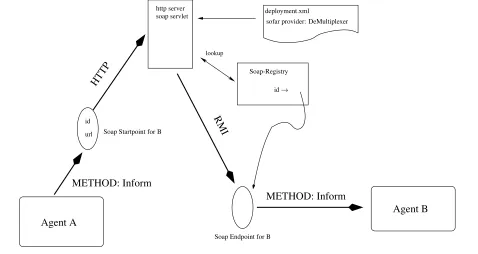
Figure 3 presents the architecture of our implementation ofSoFARoverXMLprotocol. At the top center of the pic-ture, wefind anHTTPserver, hosting a Soap servlet able to handle incomingXMLmessages as prescribed byXML pro-tocol. An agent will be seen as a Web service supporting a method for each performative.
Figure 3 also shows the path taken by aninform mes-sage sent by an agent to an agent . As explained in Section 2.2, communications between two agents take place over a virtual communication link, identified by a startpoint and an endpoint. Different communication links may be available between a pair of agents; thefigure only shows a Soap-based communication link.
In order to send an inform message, agent calls methodinformon a Soap startpoint representing agent . The startpoint contains the URLdenoting theHTTPserver acting as a Web-service provider for agent . The start-point establishes a connection overHTTP, which is handled by the Soap servlet. As a same HTTPserver may be used to serve several agents, a local naming scheme is used by theHTTPserver to designate the agent . In the picture,id
denotes agent ; such anidis contained in the startpoint and passed to theHTTPserver, where a “demultiplexer” dis-patches the request to the appropriate receiving agent. To this end, the demultiplexer makes use of a “Soap-registry” mapping ids onto agent endpoints. The configuration of the Soap server is defined in a “deployment.xml”file, which specifies the Java class (here DeMultiplexer) handling in-coming requests.
Agent B HTTP
RMI
Agent A
METHOD: Inform
METHOD: Inform lookup
Soap-Registry
id http server
soap servlet deployment.xml
Soap Endpoint for B
sofar provider: DeMultiplexer
Soap Startpoint for B id
[image:5.595.52.530.70.324.2]url
Figure 3. Communications of two Agents over SOAP
registered in a “Soap-registry”. The system is configurable in multiple ways. A same agent may be used as a back-end for several HTTP-servers, and vice-versa an HTTP-server may act as the Web-service front-end to several agents. An agent registered as a Web service can also support other forms of communication. For instance, outside an enter-prise the agent may be seen as a Web service, whereas it is used withRMIinside the enterprise.
3.2. Technical Challenges
Various technical challenges had to be addressed while portingSoFARto Apache Soap. Their understanding is use-ful for grasping the differences between the agent model of communication and the Soap approach.
Startpoints The envelope of a communication act (cf. Figure 1) contains a representation of the message sender, called anAgentTerm, which includes the startpoints the sender supports. In practice, we useRMIand Soap commu-nications on a regular basis. AnRMIstartpoint encapsulates anRMI stub, which allows communication with a remote object usingRMI. While the package JavaRMI is able to
serialiseRMI stubs overRMI, it is currently unable to gen-erate a serialisation of such a stub toXML. Furthermore, we
cannot program their serialisation and deserialisation our-selves, because constructors for such objects are not public.
We therefore decided that only Soap startpoints would be serialised over theXMLprotocol transport layer. Their serialisation contains theURLrepresenting theHTTPserver and a unique identifier associated with an agent.
<SoapStartpoint url="http://..." id="..."/>
SoFAR is designed in such a way that constructors for startpoints and endpoints are not made public. The rationale is that a communication received from an agent running on a platform that is both authenticated and trusted to run the
SoFAR system properly will correctly identify the sender. Such a rationale is no longer valid in the presence of Web services because the sender may simply open a socket and sendXMLdata no longer guaranteeing any property. We are currently investigating the possibility of using digital signa-tures to authenticate message senders.
Besides the problem of security, transporting stubs over
XMLprotocol breaks other properties such as liveness and distributed reference counting, which we discuss in the fol-lowing paragraph.
Registration is the action by which an agent declares to an agent Registry its ability to handle some messages. If the registry answers positively to a registration act, it com-mits itself to advertise the registered capability and to re-turn it to agents that ask matching queries. As a proof of its commitment, the registry issues acontractas a result of the registration act (as shown for performativeregisterin Figure 2). As long as the contract remains live, the registry will retain the advertised capability. Conversely, if the agent that registered the capability desires to stop its advertising, it just has to terminate the associated contract.
Contracts are similar to leases as they need to be renewed on a regular basis by “keep-alive” messages to be sent to the registry. If the agent that registered or its host crash, “keep-alive” messages will no longer be sent, the lease will not be renewed, and the registry entry will be cleared. Fur-thermore, contracts may be shared and communicated by agents, which means that they need to be reference counted: a registry entry is cleared if no remote reference of the as-sociated contract remains live in the system.
The SoFAR implementation of contracts relied on RMI
stubs, for which the JavaRMIimplementation maintains ref-erence counters and leases. Porting this aspect ofSoFARto Soap brings new challenging problems, because Soap (like Corba) opens the system to clients that may not be run-ning Java. Hence, there is a burden on a client implementor to implement the lease and reference counting algorithms. Therefore, an application making use of these features, and involving a service not written in Java will have to trust the implementation of the algorithm supporting these features. This becomes particularly difficult when services are dy-namically discovered and orchestrated. We may have to re-fer to some form of certification authority that certifies the validity of a given implementation.
In our implementation, a Soap Endpoint converts con-tracts into a representation that is suitable forXML seriali-sation. It is also its role to maintain the reference counter and lease associated with the contract; in addition, the
HTTP server has to be ready to receive messages related to these. We are currently studying which distributed ref-erence counting algorithm is the most suitable for a port overXMLprotocol. The issues to consider are the number of messages to be exchanged when contracts are communi-cated between agents, and the directions of these messages [32].
Class Loading Java RMI [25] extends Network Objects
[6] by its ability to load code dynamically. Such facility is used bySoFARto load the code of ontology terms
dynam-ically, when received by agents. Let us remind the reader that this code is generated by the “ontology compiler” and provides important methods for matching terms and for vis-itor patterns used in a range of pretty printers.
The ability of loading this code dynamically is a funda-mental property of a long-running multi-agent system. For instance, a registry agent may run permanently on a well-known host. As new agents and associated ontologies get developed, these agents will register their service in the reg-istry. The registry will not be restarted with a new “class path”, or recompiled with the new ontology; instead, it will have to load code dynamically.
On the other hand,XMLprotocol provides an RPC mech-anism without a built-in dynamic code loading capability. It means that our port ofSoFARtoXMLprotocol currently behaves properly for agents run with the knowledge of the ontologies supported by the agents they interact with. This is an unsatisfactory short term solution.
We are currently investigating a mechanism by which code could be loaded dynamically, based on the URI refer-ring to the definition of an ontology. Since each ontology is required to be identified by a URI, the idea is to dele-gate to a third-party service the task of accessing ontologies definition from their URI, recompiling them on-the-fly and caching them. This third-party service could actually be the one hosting the definition of the ontology as specified by its URI. This scheme is however centralised and may not scale well in a Grid environment. Instead, we foresee several of these services replicated in the Grid, which would ensure that agents have the ability to load classes dynamically from a suitably-local and trusted service.
We have developed a very simple benchmark to evaluate the performance ofSoFARover Web services. An agent discovers an agent and sends 100 notifications using the
inform performative. The SoFAR framework uses Java 1.3.1; we ran the benchmark with the Java nativeRMI im-plementation and with the Apache Soap 1.1 implementa-tion (using Tomcat 3.2 servlets). We observed that the Soap communication layer was only 1.7 slower.
This result is positively surprising. Our implementation over Soap is still under development, and performs a Soap-registry lookup tofind out the Soap endpoint and uses an
RMIcommunication from theHTTPserver to the Soap
end-point (cf. Figure 3). Our implementation could easily be optimised, for instance, if the Soap-registry was run in the servlet directly.
4. Related Work
agent paradigm to integrate multiple information sources in problem solving environments. Busettaet al.[8] describe a Belief-Desire-Intention BDI agent architecture to simulate query optimisations in the Data Grid; in the long term, their goal is to provide advanced and adaptable Grid services (of which query optimisation is one) based on agent technolo-gies. Rana and Moreau [37] review how agents techniques may be used to implement services at the computational Grid layer.
The DARPA CoABS (Control of Agent Based Systems) Grid [11] integrates heterogeneous agent-based systems, mobile agent systems, object-based and legacy systems. The CoABS Grid is based on Jini [36] for its lookup service and JavaRMIfor inter-agent communications. As such, it is less open thanSoFAR, because it supports only one mode of communication. The CoABS Grid likeSoFARbenefits from Jini leases to clear obsolete entries in registries. Test of scal-ability of the registration mechanism have been undertaken in [28].
While not mentioning agents explicitly, Furmento, New-house and Darlington [21] discuss another Jini-based tech-nique for federating resources. Their long-term goal is the building of a computational economy for the Grid. Sev-eral other projects investigate this idea of a computational economy, according to which an economics framework reg-ulates the supply and demand of resources. In particular, Nimrod/G [9] is a resource broker able of “budget-based” scheduling, giving users incentive to trade off execution time for economic cost.
The agent community is very active in devising high-level interaction protocols able to coordinate the activities of suppliers and consumers. Agents may interact using co-operation(cooperative problem solving), which is the pro-cess by which a group of agents choose to work together to achieve a common goal [44]. Multi-agent cooperation techniques are capable of adaptive behaviour. An alterna-tive approach to this cooperation paradigm is the market-based model, where agents act as self-interested entities competing on a market, where goods such as computational resources are traded. Systems built around this paradigm have been shown to reach an overall equilibrium, in which resources are fairly allocated [10, 29, 31]. In particular, the market-based approach gives particularly good results when resources are becoming scarce [23]. The market-based ap-proach is a specific case of a more general type of inter-action among self-interested agents:negotiation[27]. The key characteristics of negotiation are: the presence of some form of conflict that must be resolved in a decentralised manner, by self-interested rational agents with incomplete information. Negotiation is the paradigm case of persua-sion: it is a process by which agents come to a mutually acceptable decision on some matter. To the best of our knowledge, none of these techniques have yet been applied
to the context of the Grid, though experience in resource al-location in communication networks, for instance, may be a good starting point for studying the techniques in the con-text of the Grid.
Tomarchio and Vita present a mobile agent architecture for monitoring services in a Grid environment. Our abstract communication architecture supports transparent communi-cation with mobile agents, through the migration of end-points [34]. We have not tested our Web service communi-cation layer in this context yet.
The paradigm of agents has been used in the context of bioinformatics, but without specific concern for Grid envi-ronments. For instance, both [14] and [7] use agent systems to federate data sources and tools in bioinformatics applica-tions.
5. Discussion and Conclusion
Both Web Services and agent-based computing are high-level models of distributed computing. Our port ofSoFAR
toXMLprotocols shows that: (i)Agents may be seen as Web services, and (ii)XMLprotocol is expressive enough to
support an Agent Communication Language. Our port has also shown that an ACLis more abstract than XML
proto-col and can be mapped onto several concrete transport pro-tocols. We note that XMLprotocol also supports different delivery mechanism (for instanceHTTPand mail delivery),
but message contents remains in anXMLsyntax, which is not directly in the philosophy of object-oriented systems such as CORBA. Additionally, afixed set of performatives combined with an abstract communication model based on startpoint/endpoint pairs offers us a uniform API to pro-gramming communications. Importantly, this allows sev-eral transport protocols to be used simultaneously according to the delivery requirements of the application; for instance, we could conceive ourSoFARframework to be ported to a
reliable group multicast system.
The choice of anACL is also a move away from
stan-dard RPC because of the existence of the Envelope. From a service viewpoint, a client is no longer seen as an anony-mous entity (or at most identified by an IP address), but as an identifiable agent with which communications are possi-ble. Identifying service clients is an essential requirement for applications that need to trace provenance of data, or for applications required to provide services to entities be-longing to a specific (virtual) organisation. The idea of a “current conversation” generalises peer-to-peer sessions to multiple-agent sessions.
(Universal Description, Discovery and Integration of Busi-ness of the Web) [42] and WSDL (Web Service Description Language) [45].
In the introduction, we discussed several motivations for using agents. We see two applications of agents’ complex interactions for the Grid. (i)A computational economy may be a mechanism able to allocate resources in a fair and efficient manner in a Grid environment. This requires building a marketplace where rules enforce such a fairness property. We are currently designing such a marketplace approach for the dynamic selection of information in a rec-ommender system; this system is built on SoFAR and we
hope that some of these results will be applicable to a Grid context. (ii)The dynamic discovery, creation, manage-ment and disbanding of virtual organisations [20] require complex agent-based interactions; new scalable algorithms need to be devised in order to be applied to the Grid.
6. Acknowledgements
This research is funded in part by EPSRC myGrid project (reference GR/R67743/01) and QinetiQ and EP-SRC Magnitude project (reference GR/N35816). The au-thor thanks Carole Goble and Sean Bechhofer for a useful discussion on this topic.
References
[1] Apache SOAP. http://xml.appache.org/soap/, 2001.
[2] S. Bechhofer, C. Goble, and I. Horrocks. DAML+OIL is not enough. InSemantic Web Working Symposium (SWWS-1), Stanford (CA), July 2001.
[3] BioCORBA project. http://biocorba.org/, 2001. [4] BioJava. http://biojava.org/, 2001.
[5] Bioperl. http://bioperl.org/, 2001.
[6] A. Birrell, G. Nelson, S. Owicki, and E. Wobber. Network Objects. Technical Report 115, Digital Systems Research Center, Feb. 1994.
[7] K. Bryson, M. Luck, M. Joy, and D. Jones. Agent Interac-tion for Bioinformatics Data Management.Applied Artificial Intelligence, 2002.
[8] P. Busetta, M. Carman, L. Serafini, K. Stockinger, and F. Zini. Grid Query Optimisation in the Data Grid. Technical Report IRST 0109-01, Istituto Trentino di Cultura, Septem-ber 2001.
[9] R. Buyya, J. Giddy, and D. Abramson. An economy grid ar-chitecture for service-oriented grid computing. In10th IEEE International Heterogeneous Computing Workshop (HCW
2001), In conjunction with IPDPS 2001, San Francisco,
USA, Apr. 2001.
[10] S. H. Clearwater, editor.Market-Based Control. A Paradigm for Distributed Resource Allocation. World Scientifid Pub-lishing, 1996.
[11] The DARPA CoABS Project: “Control of Agent Based Systems”. http://coabs.globalinfotek.com/, 2000.
[12] S. J. Cox, M. J. Fairman, G. Xue, J. L. Wason, and A. J. Keane. The Grid: Computational and Data Resource Shar-ing in EngineerShar-ing Optimisation and Design Search. In
IEEE Proceedings of the 2001 ICPP Workshops, pages 207–
212, Valencia, Spain, Sept. 2001.
[13] DAML-S. http://www.daml.org/services/daml-s/2001/05, 2001.
[14] K. Decker, X. Zheng, and C. Schmidt. A Multi-Agent Sys-tem for Automated Genetic Annotation. InThefifth ACM
International Conference on Autonomous Agents, Montreal,
Canada, May 2001.
[15] T. Finin, Y. Labrou, and J. Mayfield. Software Agents, J.
Bradshaw, Ed., chapter KQML as an Agent Communication
Language. MIT Press, 1997.
[16] FIPA: Foundation for Intelligent Physical Agents.
http://drogo.cselt.stet.it/fipa/.
[17] I. Foster and C. Kesselman. Globus: A Metacomputing Infrastructure Toolkit. Intl J. Supercomputer Applications, 11(2):115–128, 1997.
[18] I. Foster and C. Kesselman, editors.The Grid: Blueprint for
a New Computing Infrastructure. Morgan Kaufman
Pub-lishers, 1998.
[19] I. Foster, C. Kesselman, and S. Tuecke. The Nexus Ap-proach to Integrating Multithreading and Communication.
Journal of Parallel and Distributed Computing, 37:70–82,
1996.
[20] I. Foster, C. Kesselman, and S. Tuecke. The Anatomy of the Grid. Enabling Scalable Virtual Organizations. Interna-tional Journal of Supercomputer Applications, 2001. [21] N. Furmento, S. Newhouse, and J. Darlington. Building
Computational Communities from Federated Resources. In
Proceedings of the 7th International Euro-Par Conference
(Euro-Par 2001), pages 855–863, Manchester, UK, Aug.
2001.
[22] E. Gamma, R. Helm, R. Johnson, and J. Vlissides. Design
Patterns: Elements of Reusable Object-Oriented Software.
Addison-Wesley, 1995.
[23] M. A. Gibney and N. R. Jennings. Dynamic resource allo-cation by market-based routing in telecommuniallo-cations net-works. In2nd Int. Workshop on Multi-Agent Systems and
Telecommunications, pages 102–117, 1998.
[24] T. R. Gruber. Toward principles for the design of ontologies used for knowledge sharing. Technical Report KSL-93-04, Knowledge Systems Laboratory, Stanford University, Aug. 1993.
[25] Java Remote Method Invocation Specification, Nov. 1996. [26] N. R. Jennings. On agent-based software engineering.
Arti-ficial Intelligence, 2000.
[27] N. R. Jennings, K. Sycara, and M. Wooldridge. A roadmap of agent research and development. Int Journal
of Autonomous Agents and Multi-Agent Systems, 1(1):7–38,
1998.
[28] M. L. Kahn and C. D. T. Cicalese. CoABS Grid Scalability Experiments. InSecond International Workshop on Infras-tructure for Scalable Multi-Agent systems at Autonomous
[29] K. Kuwabara, T. Ishida, Y. Nishibe, and T. Suda. An Equi-libratory Market-Based Approach for Distributed Resource Allocation and Its Applications to Communication Network Control. In Market-Based Control. A Paradigm for Dis-tributed Resource Allocation, pages 53–73. World Scientific, 1996.
[30] F. Leyman. Web Services Flow Language (WSFL). Techni-cal report, IBM, May 2001.
[31] M. Miller, D. Krieger, N. Hardy, C. Hibbert, and E. Trib-ble. An Automated Auction in ATM Network Bandwidth.
InMarket-Based Control. A Paradigm for Distributed
Re-source Allocation, pages 96–125. World Scientific, 1996. [32] L. Moreau. Tree Rerooting in Distributed Garbage
Collection: Implementation and Performance Eval-uation. Higher-Order and Symbolic Computa-tion, 14(4), 2002. (Coloured figures can be found in http://www.ecs.soton.ac.uk/ lavm/papers/hosc01-colour.tar.gz).
[33] L. Moreau, N. Gibbins, D. DeRoure, S. El-Beltagy, W. Hall, G. Hughes, D. Joyce, S. Kim, D. Michaelides, D. Millard, S. Reich, R. Tansley, and M. Weal. SoFAR with DIM Agents: An Agent Framework for Distributed Information Management. InThe Fifth International Conference and Ex-hibition on The Practical Application of Intelligent Agents
and Multi-Agents, pages 369–388, Manchester, UK, Apr.
2000.
[34] L. Moreau and D. Ribbens. Mobile Objects in Java. Sci-entific Programming, 2002. Special issue of the Interna-tional Workshop on Performance-oriented Application De-velopment for Distributed Architectures (PADDA’2001). [35] mygrid. http://www.mygrid.org.uk/, 2001.
[36] S. Oaks and H. Wong. Jini In a Nutshell. O’Reilly, 2000. [37] O. F. Rana and L. Moreau. Issues in Building Agent based
Computational Grids. InThird Workshop of the UK Special
Interest Group on Multi-Agent Systems (UKMAS’2000),
Ox-ford, UK, Dec. 2000.
[38] O. F. Rana and D. W. Walker. ‘The Agent Grid’: Agent-Based Resource Integration in PSEs. InProceedings of the 16th IMACS World Congress on Scientific Computation,
Ap-plied Mathematics and Simulation, Lausanne, Switzerland,
July 2000.
[39] J. Searle. Speech Acts: An Essay in the Philosophy of Lan-guage. Cambridge University Press, 1969.
[40] Y. Shoham. Agent-oriented Programming. Artificial Intelli-gence, 60:51–92, 1993.
[41] S. Thatte. XLANG: Web Services for Business Process De-sign Author. Technical report, Microsoft, 2001.
[42] Universal Description, Discovery and Integration of Busi-ness of the Web.www.uddi.org, 2001.
[43] The UK Research Councils e-Science Core Programme. http://www.research-councils.ac.uk/escience/, 2001. [44] M. J. Wooldridge and N. R. Jennings. Cooperative problem
solving. Journal of Logic and Computation, 9(4):563–592, 1999.
[45] Web Services Description Language (WSDL).
http://www.w3.org/TR/wsdl, 2001.
[46] XML Protocol Activity.