Aine N. O’Toole,
1Laurence D. Hurst,*
, 2and Aoife McLysaght*
, 1 1Department of Genetics, Smurfit Institute of Genetics, Trinity College Dublin, Dublin, Ireland 2
The Milner Centre for Evolution, Department of Biology and Biochemistry, University of Bath, Bath, Somerset, United Kingdom
*Corresponding authors:E-mails: [email protected]; [email protected].
Associate editor:Jeffrey Thorne
Abstract
An attractive and long-standing hypothesis regarding the evolution of genes after duplication posits that the duplication event creates new evolutionary possibilities by releasing a copy of the gene from constraint. Apparent support was found in numerous analyses, particularly, the observation of higher rates of evolution in duplicated as compared with singleton genes. Could it, instead, be that more duplicable genes (owing to mutation, fixation, or retention biases) are intrinsically faster evolving? To uncouple the measurement of rates of evolution from the determination of duplicate or singleton status, we measure the rates of evolution in singleton genes in outgroup primate lineages but classify these genes as to whether they have duplicated or not in a crown group of great apes. We find that rates of evolution are higher in duplicable genes prior to the duplication event. In part this is owing to a negative correlation between coding sequence length and rate of evolution, coupled with a bias toward smaller genes being more duplicable. The effect is masked by difference in expression rate between duplicable genes and singletons. Additionally, in contradiction to the classical assumption, we find no convincing evidence for an increase indN=dSafter duplication, nor for rate asymmetry between
duplicates. We conclude that high rates of evolution of duplicated genes are not solely a consequence of the duplication event, but are rather a predictor of duplicability. These results are consistent with a model in which successful gene duplication events in mammals are skewed toward events of minimal phenotypic impact.
Key words: gene duplication, evolutionary rates, duplicability, primates, evolutionary constraint.
Introduction
It is commonly reported that recently duplicated genes have higher rates of evolution than singleton genes (Lynch and Conery 2000;Van de Peer et al. 2001;Pegueroles et al. 2013). This is often interpreted as evidence that a period of genetic redundancy following gene duplication creates a temporary relaxation of functional constraint, thus permitting faster evolution (Lynch and Conery 2000; Jordan et al. 2004). However, it is not obvious that genetic redundancy causes a relaxation of constraint on coding sequences—particularly, when one considers the likelihood of nonsynonymous sub-stitutions having a dominant negative effect—and cases of accelerated evolution may reflect positive selection rather than a relaxation of purifying selection (Hughes 1994). Indeed, positive selection after gene duplication has been associated with functional innovation in many instances. One clear example is seen in adaptation to a new diet where a new digestive enzyme arose by duplication and divergence from its paralog with all amino acid changes occurring in one copy of the pair (Zhang et al. 2002). Specific amino acid changes after gene duplication have also been associated with changes in ligand specificity of corticosteroids (Arterbery et al. 2011). An alternative scenario, involving positive selection after gene duplication, arises when there is conflict between separate functions of a singleton gene such that neither function can be improved without
compromising the other. This restriction of the singleton gene to be a “jack of all trades, master of none” is released by gene duplication which provides an escape from adaptive conflict, as seen in an anthocyanin pathway gene in morning glory plants (Des Marais and Rausher 2008). The latter is an example of a phenomenon first proposed by Hughes and now known as “subfunctionalization,” where functions of a multi-functional ancestral singleton gene get shared out between the daughter paralogs (Hughes 1994). Subfunctionalization may also occur as a passive process in-volving degenerative mutations, but this is considered more likely for regulatory sequence evolution as opposed to coding sequence evolution (Hughes 1994;Force et al. 1999).
Both the relaxation of selective constraint model and adaptive evolution model assume that the higher rate of se-quence evolution of duplicate genes postdates the duplica-tion event and was enabled by the duplicaduplica-tion event. There is, however, a rarely considered alternative possibility to explain the correlation between rates of coding sequence evolution and gene copy number. The alternative postulates that the causal arrow runs in the opposite direction and that genes that are intrinsically fast-evolving are more prone to success-ful duplication. That is to say, if genes with lower sequence constraint (and thus faster rates of evolution) are also under lower copy number constraint, this would explain the differ-ences in rates of evolution between duplicated and nondu-plicated genes without invoking a period of relaxed sequence
Article
ßThe Author 2017. Published by Oxford University Press on behalf of the Society for Molecular Biology and Evolution.
This is an Open Access article distributed under the terms of the Creative Commons Attribution License (http://creativecommons. org/licenses/by/4.0/), which permits unrestricted reuse, distribution, and reproduction in any medium, provided the original work is
constraint or adaptive evolution. We are concerned with small-scale duplication (SSD) as opposed to whole genome duplication (WGD), which are different in many significant ways. Nonetheless, it is interesting to note that ancestral evo-lutionary rates influence expression evolution and retention of paralogs following WGD events in teleost fish and in Xenopus(Brunet et al. 2006;Se´mon and Wolfe 2008).
Under this alternative model, gene duplication is often a symptom of lack of constraint, and we further expect that such weakly constrained genes are easily gained and lost. In this scenario, the greatest chance to observe a duplicate is shortly after it has been created, before it has been lost again. Consistent with this, ancestrally faster-evolving Xenopus genes were more likely to be found with one of the WGD-duplicated pair exhibiting reduced expression, (Se´mon and Wolfe 2008) possiblyen routeto being lost again. Thus, we predict that such weakly constrained, fast-evolving genes are mostly observed as young duplicates, and that, by contrast, long-term retention of SSD paralogs will be a rarer event perhaps associated with an initial burst of positive selection and ultimately associated with purifying selection.
In this context, being more prone to duplication (higher duplicability) could have several, not mutually exclusive, com-ponents. It could mean that the gene in question is more likely to undergo the mutational event generating a copy number change (mutation bias) or that any such mutational event might be more likely to reach fixation (fixation bias). Additionally, it could mean that any fixed event might be more likely to persist over long evolutionary times and so be detected as a duplicated gene (retention bias). Note that these first two biases can only refer to SSD events and not WGD: by definition, WGD includes all genes and there is no fixation step—if the WGD event is successful that implies fixation of all duplicates. Indeed, SSD and WGD are generally not comparable to the extent that the genes commonly du-plicated by SSD are usually not ultimately retained following WGD, leading to almost nonoverlapping sets of paralogs gen-erated by the two mechanisms (Guan et al. 2007;Hakes et al. 2007; Makino and McLysaght 2010; Makino et al. 2013). Notably, asymmetric sequence evolution is an observable phenomenon in a sizeable fraction of post-WGD paralogs (that is, one paralog evolves faster than the other) and is consistent with relaxation of sequence constraints for many paralogs (Brunet et al. 2006;Fares et al. 2006;Byrne and Wolfe 2007). However, asymmetric expression evolution, where one WGD paralog has low or no expression in all tissues, is more prevalent in genes with ancestrally higher rates of sequence evolution (Se´mon and Wolfe 2008), which may indicate con-sistently low evolutionary constraints, rather than a change induced by the duplication status.
In the case of SSD, mutational biases are quite possible. For example, if recombination is mechanistically coupled to the generation of new copies, then genes in genomic domains with higher recombination rates might be more prone to the mutational gain of an extra copy (Woods et al. 2013). Indeed, nonessential genes inCaenorhabditistend to reside in geno-mic domains with higher recombination rates (Woods et al. 2013), and hotspots of segmental duplication exist in the
human genome (Mefford and Eichler 2009). Similarly, genes that are highly expressed in germline are more likely to un-dergo a transmissible retrocopying event (Vinckenbosch et al. 2006). For genes that are highly dosage sensitive, one can similarly envisage that any change of dosage via a new dupli-cation event might be opposed by purifying selection (Rice and McLysaght 2017). This may explain why members of protein complexes tend to be resilient to SSD (Papp et al. 2003). Hence there may well exist a filter enabling faster rates of copy number evolution of genes that are not dosage sen-sitive (Woods et al. 2013). Assuming dosage insensitive genes to be faster evolving (Hurst and Smith 1999), a relationship between duplicability and faster sequence evolution can be expected. However, if a gene is more easily gained it might also be more easily lost, so the interplay of fixation bias and retention bias may be complex (for review see Zhang and Yang 2015).
The duplicability hypothesis requires that faster sequence evolution is correlated with faster copy number changes. Consistent with this, in yeast, less essential genes are more duplicable (He and Zhang 2006), and inCaenorhabditis non-essential genes are more duplicable, more easily lost again, have low expression levels and faster evolution (Woods et al. 2013). However, this Woods et al. analysis did not uncouple rates of sequence evolution from the duplication process it-self. To investigate the alternative hypothesis properly, we need to know about intrinsic rates of evolution of genes in-dependent of the duplication event in question.
In order to determine whether observed faster rates of evolution in duplicated genes reflect a postduplication accel-eration or instead a persistently higher rate of evolution in-dependent of gene duplication, we seek to measure rates of evolution prior to and independent of any duplication event. Primates were an ideal choice for study organisms due to the high-quality genome sequence and gene annotation available for many species and their inclusion in EnsemblCompara (Vilella et al. 2008). The study organisms selected were gibbon (Nomascus leucogenys) and macaque (Macaca mulatta). From these two species, we identified genes that are single-tons (and were ancestrally singlesingle-tons). We estimated the rate of evolution of these singletons alone in a pairwise mode. We assume the rate of evolution in this outgroup pair is a defen-sible proxy for the ancestral rate. Duplicability was assessed based on whether or not orthologs of these singleton genes had duplicated in any of four closely related crown primate species (human,Homo sapiens; chimpanzee,Pan troglodytes; gorilla,Gorilla gorilla; and orangutan,Pongo abelii). We then partitioned the data into genes that have or have not dupli-cated and compared their rates of evolution in the singleton ancestors, thus uncoupling the estimation of the rate of se-quence evolution from the process of duplication itself.
biases. We conclude that, at least in primates, faster sequence evolution is correlated with faster rates of copy number al-teration. We examine possible covariates that might underpin this result. We find no evidence for a systematic acceleration of sequence evolution postduplication, nor for rate asymme-try between paralogs.
Results
Identification of Primate Singleton and Duplicate
Genes
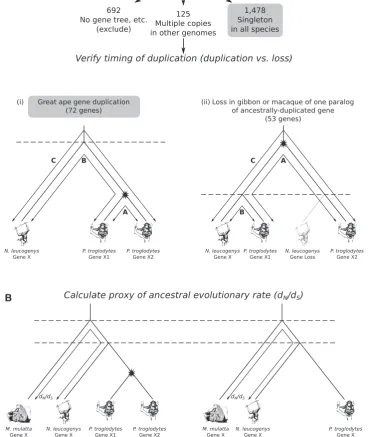
Previous studies have applied various different approaches to the detection of duplicate genes, each of which has its caveats. One popular approach is based on all-against-all BLAST searches (Lynch and Conery 2000; Davis and Petrov 2004; Jordan et al. 2004;He and Zhang 2006;Woods et al. 2013). Additionally, gene families—from which duplicate genes may be inferred—can be constructed using gene sequence clus-tering methods or distance-matrices (Lan and Pritchard 2016). Alternatively, gene family trees can be used to confirm paralogy (Pegueroles et al. 2013;Li et al. 2016). Phylogenetic tree based methods are the gold standard, being integral to the distinction between orthologs and paralogs (Fitch 1970, 2000) but might not be implemented for reasons of compu-tational tractability, though in many cases precomputed gene trees are available (such as from Ensembl;Vilella et al. 2008). We performed a systematic search for genes that were sin-gletons at the base of the primate tree and remain sinsin-gletons in macaque and gibbon, and then classified these as either single-ton or duplicable based on their duplication status in the great apes inferred from gene tree analysis (fig. 1a). Any ancestral singleton gene that was duplicated in at least one of the great apes was considered as “duplicable.” We employed several stringent quality control steps to account for ancestral dupli-cation and loss, as described in methods, and excluded cases where appropriate. We identified 1,550 genes where we could be confident that they were singletons at the base of the pri-mate tree and remain singletons in macaque and gibbon; of these 1,478 are also singletons in all the great apes examined, and 72 are duplicated in at least one great ape genome (here-after “singleton” and “duplicable” genes, respectively).
Duplicable Genes Evolve at Faster Rates than
Singletons
The entire set of retained gene trees, whether singleton or duplicable in the great apes, share the status of macaque, gibbon, and the ancestral node as singletons. First, to confirm the previously reported (Lynch and Conery 2000) higher evo-lutionary rate in duplicated genes (i.e., postduplication) we measured the rate of evolution of the 1,478 singletons and 72 duplicates. We find that the rate of protein evolution of singletons (dN=dS between the human and macaque
se-quence) is lower than for duplicates (average ofdN=dS
be-tween the each of the paralogs and the macaque sequence), with medians of 0.25 and 0.38, respectively (Mann–Whitney UtestdN=dS,W¼42,468,Pvalue¼0.0037;supplementary
fig. S2,Supplementary Materialonline). This is consistent with the findings of previous studies (Lynch and Conery 2000;
Van de Peer et al. 2001;Pegueroles et al. 2013) but does not reveal the cause-and-effect relationship. Does dupli-cation cause higher rates of evolution, as predicted by the classic model, or rather, is a faster rate of evolution char-acteristic of duplicable genes?
As we are interested in investigating the evolutionary rate of singletons and duplicates independently of the potential effects of the duplication event, we measured the amount of evolution (dN,dS, and their ratio,dN=dS) in the macaque and
gibbon lineages and use this as a proxy for the ancestral evolutionary rate. We are aware of only one prior analysis which tests for an evolutionary-rate bias in SSD gene duplic-ability and which considers the rate of sequence evolution of genes in one lineage (D. melanogasterandA. gambiae) while defining duplicability by reference to events in a different lineage (S. cerevisiae and C. elegans). The authors report that duplicable genes evolve slower, not faster, than those that had not duplicated (Davis and Petrov 2004). However, this analysis was not ideal in that it did not control for du-plication in the lineage in which evolutionary rates were cal-culated and the two lineages were very distant (and so gene function need not be conserved and there might be an as-certainment bias toward more essential genes).
Any sequences with values ofdS < 0:01 ordN=dS>10
were excluded from our analysis as they can potentially reflect inflated and inaccuratedN=dSvalues (Yang 2007;
Villanueva-Ca~nas et al. 2013). We confirmed that this exclusion does not significantly affect the results (supplementary table S1, Supplementary Materialonline). This left 1,543 alignments in total: 70 in the duplicable set and 1,473 in the singleton set. All alignments with dS>0:3 (n¼62) were visually
inspected and were found to have well-aligned codons, thus we concluded that the alignments were reliable.
There are significant differences between singletons and duplicable genes indN,dS, anddN=dSvalues (Mann–Whitney
Utest;W¼40,210, 42,662, 43,521;P¼0.002, 0.015, and 0.027, respectively). The duplicable genes consistently show higher rates of synonymous and nonsynonymous substitution even though these measurements are based on macaque-gibbon sequence comparison where the genes have not experienced duplication (fig. 2). Median values fordN,dS, anddN=dSare
0.04 and 0.02; 0.1 and 0.08; and 0.36 and 0.27, for duplicable and singleton gene trees, respectively. In other words, at least a component of the elevated rates of sequence evolution of duplicated genes is independent of their duplication status. This is suggestive of generalized lower constraints on dupli-cable genes, observed both as greater duplicability and faster sequence evolution. This is consistent with previous studies that found greater duplicability of less essential genes (He and Zhang 2006;Woods et al. 2013).
One version of the model of evolution after gene duplica-tion posits that purifying selecduplica-tion should be initially relaxed due to redundancy, but then re-established once the dupli-cate acquires a new function.Lynch and Conery (2000) com-pared dN and dS in pairs of paralogous genes (i.e., postduplication) and found that whereasdNdSwhendS
is low,dN<dSwhendSis high. This was interpreted as a signal
duplicates (dN=dS1), followed later by purifying selection
and presumed functionality (dN=dS < 1).
With our data, we have the opportunity to comparedN
and dS in a similar way, but for all genes independent of
duplication events. We find that the slope ofdNpredicted
bydSis<1 (fig. 3). Hence the difference betweendNanddS
increases with higherdS, even though in this casedSis not a
surrogate for time as all of the genes compared here should have the same divergence time (the macaque-gibbon speci-ation). Instead, in our analysis, variation indSpredominantly A
B
FIG. 1.Project strategy.We are interested in identifying genes that are singletons in gibbon and macaque, and sorting those into great ape singleton and duplicable genes according to their status in great ape genomes.(a)Compile list of putative singleton gibbon genes (via an all-against-all BLASTp). For each singleton gene, obtain the corresponding Ensembl gene tree. Confirm the singleton status of gibbon and macaque within the trees. Assess their condition (singleton or nonsingleton) in each of the four related primate species human, chimpanzee, gorilla, and orangutan. This restriction to within the primate lineage minimizes the effects of young versus old duplications. The nonsingleton set of gene trees can arise through gene duplication or gene loss events. The two alternative scenarios are illustrated using chimpanzee (panelsa—i and ii). If a duplication has occurred in the chimpanzee lineage, the distance,A, between the two sister genes will be less than each of the distances to the orthologous gibbon gene (BandC). However, this relationship will not hold if the nonsingleton arose from a prespeciation duplication event, with a subsequent gene loss in gibbon. This method has been adapted from a similar protocol inHe and Zhang (2006).(b)The rate of evolution (dN=dS)
[image:4.595.113.482.100.538.2]P value = 0.002
0.00 0.05 0.10 0.15
Duplicable Singleton
dN A
P value = 0.015
0.00 0.05 0.10 0.15 0.20 0.25
Duplicable Singleton
dS B
P value = 0.027
0.0 0.3 0.6 0.9 1.2
Duplicable Singleton
dN /dS C
FIG. 2.Boxplots showing.dN,dS, anddN=dSvalues for duplicable and singleton gene sets.All genes have singleton status in macaque and
gibbon, and the evolutionary rates were calculated by comparison of macaque-gibbon orthologs. The data are separated into singleton and duplicable genes according to their status in the great apes, with the latter having at least one duplication event in the great apes. Values were compared using the Mann–WhitneyUtest andPvalues are shown above each pair of boxplots.
−2 −1.5 −1 −0.5 0
−2 −1.5 −1 −0.5 0
log10dS
log
10
dN
Duplicable Singleton
FIG. 3.Greater difference betweendNanddSat higherdSfor both duplicable and singleton genes.An xy-scatterplot oflog10dNversuslog10dSvalues
indicates variation in mutation or fixation rates. That is, we find a similar pattern toLynch and Conery (2000) indepen-dent of duplication status and time. This argues against the prior interpretation supposing that this pattern is a conse-quence of (and evidence for) duplication-induced alteration of constraints.
Why Might Singleton Genes Evolve Slower than
Duplicable Genes?
Expression Level Differences Mask the Difference indN=dS
Why might genes that subsequently duplicate have higher rates of protein evolution and higherdN=dS. Gene expression
level has been shown to be a strong and universal predictor of evolutionary rate such that expression levels of slowly evolv-ing genes are significantly higher than of fast evolvevolv-ing genes in yeast (Pal et al. 2001;Drummond et al. 2005) and mammals (Wang et al. 2011). Should genes prone to duplication have lower expression levels, then their faster evolution may in part be explained by such an effect. Thus we investigated whether the differences in evolutionary rates between duplicable and singleton genes are explained by differences in expression levels. We sourced expression level data in macaque from Brawand et al. (2011). We confirmed that the rate of evolu-tion negatively correlates with expression level (Spearman’s q¼ 0:35,Pvalue¼<0.0001, for entire data set). We find no significant difference in expression level between duplica-ble and singleton genes (fig. 4a: Mann–Whitney U, W¼47,246, P value¼0.237), although duplicable genes have if anything slightly higher expression levels: mean of
log10 (expressionþ1) for duplicables: 0.6660.065 SEM,
mean for singletons¼0.5660.01 SEM.
That duplicates have if anything a higher expression level suggests that the underlying difference between singletons and duplicates in rates of evolution is in part being masked. To address this possibility we fitted a LOWESS regression for dN=dSon the log10of macaque expression data (fig. 4b). When
we examine the residuals of this regression line, we find that the higherdN=dS in duplicates than singletons becomes more
significant (Mann–WhitneyUtest of the LOWESS expression residuals: W¼41,909, P value¼0.008, previously P val-ue¼0.027), consistent with expression level differences mask-ing the rate differences between smask-ingletons and duplicates. To ask whether the reduction inPvalue after residuals correction is itself significant, we performed a nonparametric Monte Carlo simulation in which the expression values were random-ized, the LOWESS and subsequent residuals recalculated and the difference between duplicate and singleton genes in resid-uals recalculated. In 10,000 simulants we find no simulant with as low aPvalue as the actual residuals, strongly supporting the view that the slightly raised expression level of the duplicate genes masks a more profound difference between duplicable and singleton genes in theirdN=dSvalues.
CDS Size Differences Explain Some of the Difference indN=dS
A priori we might expect that gene length might also be an important parameter to examine, not because the correlation between gene length and dN=dS is especially strong
P value 0.237
0.0 0.5 1.0 1.5 2.0 2.5
Duplicable Singleton
log
10
Expression Le
v
el+1
A B E
P value 0.001
2.5 3.0 3.5 4.0 4.5
Duplicable Singleton
log
10
CDS Length
C
0.0 0.5 1.0 1.5 2.0 2.5
0.0 0.5 1.0 1.5 2.0
log10Expression level+1 dN
dS
0.0 0.5 1.0 1.5 2.0 2.5
2.5 3.0 3.5 4.0
log10CDS Length dN
dS D
−0.5 0.0 0.5 1.0 1.5 2.0
0.0 0.5 1.0 1.5 2.0
Residuals on CDS Length
Residuals on Expression Le
v
e
l
FIG. 4.Rate differences between singleton and duplicable genes are explained by CDS length and expression level differences.Analysis of 1,473 singletons (blue) and 70 duplicable genes (orange). Boxplot of (a)log10of expression levelsþ1 (log2-transformed RPKM gene expression data) and (c) log10of CDS lengths of duplicable and singleton genes.Pvalues for the test of difference between the means is shown above the boxplots (Pvalues 0.237 and 0.001, respectively, MWU). LOWESS regression fitted fordN=dSon the log10of (b) expression levelsþ1 and (d) CDS
length. The regression lines for singletons are shown in black and, for duplicates in orange. (e)dN=dSresidual space is graphed by plotting the
(Nembaware et al. 2002), but length differences between duplicable and singleton genes might be expected for many reasons: retroposition might favor shorter genes to duplicate; and longer genes might be more costly to duplicate if there are translation costs. Larger proteins (hence longer genes) do indeed tend to be more deleterious upon overexpression (Ma et al. 2010).
Similar to a prior report (Nembaware et al. 2002), we find a negative correlation between dN=dS and coding sequence
(CDS) length, more modest that the expression level effect (Spearman’sq¼ 0:1,Pvalue<0.0001). In addition, we find that singletons are longer than duplicable genes (fig. 4c: Mann–WhitneyUtest, W¼63,530,Pvalue¼0.001, mean log10CDS length in bp of duplicates: 3.0660.04 SEM, mean
for singletons¼3.260.008 SEM).
To determine whether this length difference significantly explains some of the difference between duplicable and sin-gleton genes in their rates of evolution, comparable to the above, we fitted a LOWESS regression fordN=dS onto the
log10 of CDS length (fig. 4d). Comparing the residuals for
regression of CDS-length suggests that some of the difference between the duplicable and singleton gene tree values has been accounted for as thePvalue has increased from 0.027 to 0.046 (Mann–Whitney U, W¼44,272). To determine whether the increase inPvalue is itself significant we again perform a nonparametric Monte Carlo simulation, generating residuals from the plot ofdN=dS against randomized log10
CDS length, and again compare residuals for the duplicable and singleton genes via a Mann–WhitneyUtest. In 10,000 simulations only 43 had aPvalue from this Mann–WhitneyU test as high or higher than that observed with the real data, indicating that some significant (Pvalue¼0.004) fraction of the difference between duplicates and singletons indN=dSis
explained by the fact that singletons are longer and longer genes tend to evolve slower.
For completeness, we also considered genomic length. While the correlation between genomic length anddN=dS
is even weaker than that for CDS length (Pearson’sr¼ 0.06, Pvalue¼0.02), we observe no difference in genomic length between singleton and duplicable genes (Mann–WhitneyU, W¼35,118,Pvalue¼0.0848). As above, we fitted a LOWESS regression fordN=dSon log10of genomic length and find that,
upon comparing residuals from this LOWESS regression be-tween singleton and duplicable genes, theP value has in-creased from 0.027 to 0.031. After simulation testing as described earlier we find that this increase inPvalue is not significant and genomic length does not explain a significant portion of the variation (randomization test,Pvalue¼0.097). We can consider the combined impact of expression and CDS length differences ondN=dSby comparing the residuals
from the above analyses (fig. 4e). A Kernel Density Estimation of the 2D spread of residual values for duplicate and singleton genes indicates the difference indN=dShas been accounted
for by the two covariates (Pvalue¼0.32). The difference in dN=dSvalues between duplicable and singleton genes is thus
accounted for in some part by the differences in CDS length and expression level.
A further possible cause of the difference in dN=dS
be-tween duplicable and singletons is a potential difference in G and C content affecting codon usage bias, mutagenicity, anddN=dS. To address this we have compared GC3 (mean of
the macaque and gibbon value for each gene) between dupli-cable and singleton genes. WhiledN=dScorrelates with GC3
content (q¼0.18,P<0.001), GC3 is not different between duplicable and singleton genes: Mann–Whitney U test, P
value¼0.495, mean GC3 percentage for
duplicables¼57.561.84, for singletons¼56.2,60.41. TheP value for Mann–WhitneyU test on the residuals ofdN=dS
predicted by GC3 is very close to that observed prior to the residuals test (fordN=dSbefore residuals testP¼0.027, after
P¼0.0263). This is not significantly different from the null expectation (randomization test,P¼0.31). We conclude that differences in GC3 do not explain differences indN=dS
be-tween duplicable and singleton genes.
No Evidence for Relaxation of Evolutionary
Constraints following Duplication
Even if faster evolving genes are more duplicable than slowly evolving genes, it is still possible that duplication causes a period of relaxed functional constraint or positive selection. A common hallmark of adaptive evolution or relaxed purify-ing selection is taken to be rate asymmetry between the paralogs. To test for rate asymmetry, we considered a likeli-hood framework considering a model in which paralogs are forced to have the same rate compared with a comparable model where they are permitted to have different rates. Given that the duplications within the primate lineage are recent, so as not to bias against cases where one of two duplicates has an especially low rate of evolution, in consideration of asym-metry, we remove the requirement for dS>0.01. Prior to
multitest correction, in only 6 cases out of 52 gene trees does the alternative model permitting asymmetric evolution of paralogs perform better than the null model, and following FDR correction we find no evidence that a model permitting duplicates to have different rates performs significantly better than a model in which duplicate genes are forced to have the same rate (supplementary table S2,Supplementary Material online). We also applied Fisher’s method for combining P values and observed no evidence that duplicates evolve at asymmetric rates postduplication when considereden masse (v2 statistic¼82.9, d.f.¼104,P¼0.94).
The key signature of relaxed selection or positive selection of duplicates is an increase indN=dSpostduplication. Given
acceleration, to be generous to the acceleration model, we considereden massethe 25 instances of faster rates. Applying Fisher’s method, we combined thePvalues from our likeli-hood analysis and observe no convincing evidence of signif-icant net rate acceleration postduplication (v2 statistic¼63.37, d.f.¼50,P¼0.097). That this is true even when excluding all examples thatprima facieargue against the model, we conclude that we see no evidence for increased dN=dSin any given gene or when considereden masse.
Discussion
Gene duplication is a common occurrence in eukaryotic evo-lution. Many models invoke a period of relaxed selection due to redundancy following duplication as the context for the evolution of novel functions in paralogs. Alternatively adap-tive evolution may be enabled by gene duplication. In both cases the supposition is that the faster evolution of duplicated genes is evidence for such effects and, by assumption, must occur post the duplication event. However, we find no evi-dence that paralogs evolve at different rates postduplication nor for asymmetrical rates of evolution of the duplicates. Rather, our results support an alternative model wherein genes with faster rates of evolution, presumably reflecting lower functional constraints, are inherently more duplicable. These results are consistent with a model in which the set of duplicable genes is less constrained in terms of both sequence evolution and copy number evolution. The underlying cause of the increased duplicability, whether it be owing to muta-tion bias, fixamuta-tion bias or retenmuta-tion bias, remains to be dis-cerned. Given the short amount of time we are examining in this study (i.e., great-ape-specific duplication events), in our opinion retention biases are less important than in other studies examining longer periods of evolutionary time (Davis and Petrov 2004). To ascertain the magnitude of any effect would require forward simulations.
These results provide a consistent framework for consid-ering several previous findings: that less essential genes are more duplicable in yeasts (He and Zhang 2006); that young genes are less essential than older genes (Chen et al. 2012); that young duplicates are short-lived and are less essential than older duplicates (Woods et al. 2013); and that duplic-ability is a consistent characteristic of a subset of genes, even across vast evolutionary distances (Li et al. 2016). All of these results make sense under the model where a subset of the genome is only weakly constrained in terms of both sequence evolution and copy number. Duplicable genes are fast evolv-ing and have “easy come, easy go” paralogs, frequently fixed and lost again (presumably by drift in both instances).
In this context, the generalizability of our results invites scrutiny. That small genes evolve faster and are more dupli-cable explains some of the trend for duplidupli-cable genes to be faster evolving. Given this, the trend that we have identified need not apply to all modes of duplication. We have exam-ined duplicates that are not the result of whole genome du-plication events. While we do not know why small genes are overrepresented in the set of genes that successfully dupli-cated, many possible causes of the size effect on duplicability
are unlikely to apply equally to WGD events. For example, genes with a small CDS might be more duplicable because they are more likely to fully integrate as retrocopied genes or be less costly when overexpressed. If so, then WGD and SSD will have different dynamics.
Furthermore, it is unclear whether our results are expected to extend to small scale duplicates in other lineages. Indeed, one might conjecture that in the large-bodied primates that we considered, with small effective population sizes, the dy-namics are more likely to be dominated by neutral and nearly neutral forces. Whether the same trend for faster evolution to be coupled with duplicability exists in lineages with more efficient selection owing to larger effective population sizes, is worthy of scrutiny. One prior analysis (Davis and Petrov 2004) did examine the coupling of evolutionary rate and duplicability in invertebrates and yeasts and reported a result opposite to ours, that is, that duplicable genes evolve slower, not faster, than those that had not duplicated. How might we understand the difference in conclusions?
One possibility is, as we conjecture above, a difference in the strength of selection. Before accepting this possibility, we sought to replicate the prior analysis using updated data. The bulk of the evolutionary sequence rate analysis in the Davis and Petrov study was reported for all sequences without considering only those that are singletons in the outgroup. The authors do parenthetically mention this control but do not elaborate on it. We have attempted to replicate the analysis using only singletons in the relevant lineage (see Supplementary Material online). However, we find that no genes meet the criteria of being singletons in the outgroup and duplicate in the ingroup, thus we could proceed no fur-ther. This could possibly be explained if a subset of genes is inherently duplicable, and thus unlikely to be duplicated in one lineage while remaining unduplicated over the large evolution-ary times encapsulated by this study setup (Li et al. 2016). Our analysis additionally estimates evolutionary rates in lineages in close phylogenetic proximity to the duplication event. Owing to this our analysis probably has a reduced filter of any reten-tion bias, as the time for gene loss is much more restricted than in the prior study. It would be valuable to repeat our mode of analysis on closely related species with large population sizes (e.g., yeast, flies). It would be similarly valuable to see if dupli-cates from whole genome duplication events behave differ-ently to those resulting from small scale duplication events.
Our data support the view that duplicable genes are less important, and their loss is less consequential, whether or not they are duplicated (He and Zhang 2006;Woods et al. 2013). Our study tests the model that duplicable genes are a less constrained subset of the genome ab initio, and shows, at the very least, that the observed faster rates of evolution of du-plicate genes is not necessarily a consequence of events that occur after the duplication event.
Materials and Methods
Data
nucleotide sequences for all primate study species (human, chimp, gorilla, orangutan, gibbon, and macaque) were col-lected using the Ensembl REST API (Cock et al. 2009;Yates et al. 2015, version 4.6).
Macaque log2-transformed reads per kilobase per million (RPKM) gene expression data were obtained from the RNA Seq transcriptome data inBrawand et al. (2011). The median expression level across all six available tissues for each gene was obtained and matched to the genes in our analysis using Ensembl Gene IDs. CDS-length values from macaque are used in all cases with the data sourced from Ensembl. Genomic length information was calculated from genomic start and stop positions downloaded from Ensembl BioMart (Kinsella et al. 2011).
Definition of Singleton and Duplicable Genes
We defined singleton and duplicable genes within the great apes as individual ancestral genes that had either remained unduplicated or been duplicated at least once, respectively. In order to uncouple duplication status from evolutionary rate measurement we also required that all genes in this study remain singletons in gibbon and macaque, where evolution-ary rates will be measured. An initial list of 2,961 candidate singleton gibbon genes was defined as genes with only self-hits in an intraspecific all-against-all BLASTp (Evalue thresh-old¼0.1) using the longest protein for each gene. Gene trees were obtained from Ensembl Compara, the generation of which is described in Vilella et al. (2008), and these were pruned using ETE3, a python framework for phylogenetic analysis (Huerta-Cepas et al. 2016), to include only species of interest (Gibbon, macaque, orangutan, gorilla, human, and chimp). We employed several quality control filters using Python to verify the singleton status at the base of this pruned tree and to exclude ancestral duplication followed by loss in gibbon or macaque (graphical summary insupplementary fig. S1, Supplementary Material online). Of the 2,961 putative singleton gibbon genes, 692 were excluded because they ei-ther lacked a gene tree, a macaque ortholog, or lacked any identifiable orthologs in any other genome (these could be annotation artifacts, novel genes, or very rapidly evolving genes); 1,926 gene trees had a single gibbon and a single macaque gene; and 343 trees had more than one homolog in gibbon and/or macaque (potentially ancestrally duplicated).
The 343 gene trees with multiple macaque or gibbon homologs need further examination to assess whether or not they can be included in this analysis. Where the tree topology indicated that the duplication predated the primate lineage such that there were subtrees being made up of a single macaque and single gibbon gene with orthologs in the great apes, these were split and retained as distinct gene family trees (supplementary fig. S1,Supplementary Material online).
We identified 1,478 gene trees containing a single macaque and gibbon gene and also a single homolog in orangutan, gorilla, chimp, and human and were thus considered single-ton gene trees. In the set of gene trees where at least one of the four great ape species had more than one gene within the
gene tree, the observed gene counts could have arisen via a gene duplication event in the great apes, or gene loss events in macaque and gibbon. As this study is specifically interested in identifying great-ape-specific gene duplications, it was nec-essary to rule out gene loss as an explanation for the gene counts. For the set of 125 gene trees of the nonsingletons (more than one copy in at least one of the great apes) we evaluated whether the gene copy number was due to a recent great-ape-specific duplication or to an ancestral duplication with loss in some lineages. We used genetic distance between paralogs to distinguish ancestral and recent duplication events in a protocol similar toHe and Zhang (2006)where the paralogs are considered to be created by a recent dupli-cation event when the genetic distance between the paralogs is less than the genetic distance from either one to the gibbon gene. If the distance between, say, two chimpanzee paralogs (A) is less than the distance between the gibbon ortholog and each of the sister chimpanzee genes (denoted BandC, re-spectively), we rule out ancestral duplication with lineage-specific loss and infer that the duplication event occurred more recently than the speciation event (that is, within the time period of interest here; illustrated in fig. 1a). Genetic distances were obtained from the Ensembl gene trees (Vilella et al. 2008). If more than two paralogs per species were present, the two most closely related paralogs were considered. The method is potentially confounded by inter-paralog gene conversion. However, we do not think this is a substantial issue and moreover, under these circumstances, the macaque-gibbon distance would appear as a very obvious outlier and we see no evidence for this.
Of the 125 gene trees with only one ortholog in macaque and gibbon and multiple orthologs in some great ape genomes, we cannot rule out ancestral duplication followed by gene loss in macaque and gibbon for 53 gene trees. The remaining 72 gene trees include great ape gene duplication events.
Test for Differing Rates of Evolution between
Singleton and Duplicate Genes
For each of the 1,478 singleton gene trees and the 72 dupli-cate gene trees, the protein sequences of the gibbon, ma-caque, orangutan, gorilla, chimpanzee, and human genes were aligned using MUSCLE (Edgar 2004) and then converted to nucleotide alignments using Translator-x (Abascal et al. 2010). Lists of duplicate and singleton families are provided asSupplementary Materialonline. To test whether duplicate genes and singleton genes evolve at different rates, as has been described previously (Lynch and Conery 2000;Van de Peer et al. 2001; Pegueroles et al. 2013), we extracted the human and macaque sequences from the multiple sequence alignments and estimateddN=dSusing the codeml module of
Measurement of Proxy-Ancestral Evolutionary Rate
To calculate proxy ancestral rates of evolution (fig. 1band supplementary fig. S3, Supplementary Material online), we extracted the aligned singleton gibbon and macaque sequen-ces from the multiple sequence alignment and used them in the calculation ofdN=dS. By extracting the alignment of just
these genes, we prevent PAML from allowing evolutionary rate calculations dependent on the evolution of the genes after duplication to interfere with or otherwise affect the inference of the rate when they are singletons. Any effects of gene conversion postduplication, for example, cannot then interfere with ancestral rate estimation. We estimateddN,dS,
anddN=dSas above. Gene trees withdN=dSvalues>10 ordS
values<0.01 were excluded from further analysis (as per Villanueva-Ca~nas et al. 2013), as lowdSvalues may artificially
inflatedN=dS.
Model Selection
In order to investigate whether the regression lines of dN
versusdSinfigure 3are significantly different between
single-ton and duplicable measurements, model selection was per-formed using Akaike information criterion (AIC) values, which are a measure of the relative quality of a given statistical model taking into account the goodness-of-fit and complex-ity of a given model. We compared a null model ofdNdS
and an alternative model incorporating an interaction term for dS and duplication status. The AIC values suggest that
incorporating this interaction term fordS and duplication
status does not produce a superior model (dNdS,
AIC¼ 6,614.2; dNdS,þstatusþdS: status,
AIC¼ 6,612.3. ANOVA comparing the two models, F¼1.0876, Pvalue¼0.34). This suggests that this trend is true for both singletons and duplicable genes.
Examination of Possible Explanatory Variables
In order to determine whether a possible covariate of both duplicate/singleton classification and evolutionary rate might mask or explain differences in evolutionary rate, we employed a nonparametric regression approach, with significance de-termined by nonparametric Monte Carlo simulations. Briefly, for the variable in question (we consider log10expressionþ1,
gene length measured as log10CDS length, genomic length,
and GþC content at the third position of codons, GC3), we construct the LOWESS regression of thisx variable against dN=dS. We employed thelowessfunction in R with f¼0.3,
with the fit established via theapproxfunfunction. From the best fit regression line we calculate the deviation of each data point indN=dSfrom the expected value given the regression
line and the value of the x variable (values above the line having positive residuals, those below having negative resid-uals). These residual values we then compare between the duplicable and singleton genes via Mann–WhitneyUtest. We checked the resilience of results to employing the alternative loessfunction in R and found no qualitative differences in results.
We evaluate the significance in the change inPvalue be-tween the residual corrected and the uncorrected values (i.e., thePvalue of the Mann–WhitneyUtest comparingdN=dS
between duplicated and singleton genes), via randomization. Here, we randomly reassign the values of thexvariable with-out replacement and recalculate the LOWESS regression and the residuals in the same manner as above, using the randomizedxvariable as the predictor. We then recalculate the difference between duplicated and singleton genes as before, extracting the reportedPvalue. Repeating this process 10,000 times we ask how often we observe aPvalue as ex-treme or more exex-treme as that observed when the LOWESS is performed with unrandomized data. ThePvalue for this test is the number of observations as extreme or more extreme divided by the number of simulations. The median value of thePvalue in the simulants should be very nearly the same as thePvalue of Mann–WhitneyUtest comparing singletons and duplicates with no covariate correction, as the regression against random data should have an average slope of zero. With a slope of zero, the rank order of the residual values would be the same as the rank order of the observed values and hence the partitioning into duplicated and singleton genes should give the same pairs of rank orderings and hence the samePvalue. We confirmed that medianPvalue of the simulants was indeed very similar to that of the uncorrected analysis.
Testing for Asymmetric Evolution of Paralogs
In order to test whether there was significant asymmetric evolution between paralogs postduplication we ran the branch-model of codeml (runmode¼0, model¼2, See sup-plementary fig. S3,Supplementary Materialonline) for each gene tree for each duplicated species, comparing two models: first with paralogs forced to have the samedN=dSvalue and
second an alternative model with the paralogs allowed to have distinct evolutionary rates. The first, null model allowed a background rate (x0) and then all paralogs for a given
species were given a rate x1 (two parameter model). The
alternative model allowed each paralog to have a distinct rate. In the case of two paralogs in a species, the model allows a background rate (x0), as before, and two postduplication
rates (x1andx2). If more than two paralogs exist for a given
species per gene tree, additional rates are allowed (x3, etc.).
We excluded gene trees withdN=dS>10, leaving 52
duplica-tion events. The Log-likelihood values and numbers of param-eters were extracted from the PAML output files for each model and the LRT test statistic, the number of degrees of freedom (DOF) between the two models andPvalues were calculated using Python and R. Supplementary table S2, Supplementary Material online, gives details of DOF andP values, pre- and postfalse discovery rate (FDR) correction. We also implemented Fisher’s method for combining Pvalues using the metap package for R (Dewey 2017).
Testing for Accelerated Evolution Postduplication
Akin to the asymmetry analysis, we compared two codeml models to test for rate acceleration (supplementary fig. S2, Supplementary Materialonline). The first null model imple-mented a single evolutionary rate (x0) for all branches in the
background ratex0and a distinct postduplication ratex1for
duplicated genes within a species (runmode¼0, model¼2). We excluded gene trees withdS<0.01 anddN=dS>10 (as
recommended inVillanueva-Ca~nas et al. 2013). Due to the recency of many duplications, after applying this filter 39 duplication events remained in the analysis. As before, the log-likelihood from the PAML output was used to calculate LRT test statistics andPvalues (Seesupplementary table S3, Supplementary Material online, for details). We identified cases where the postduplication rate of evolution was higher than the background rate and, as above, implemented Fisher’s method for combiningPvalues (Dewey 2017).
Data Handling
Unless otherwise stated, statistical tests and plots were per-formed and created using R, sm, and ggplot2 (Bowman and Azzalini 2014;Wickham 2016). The kernel density estimation (KDE) test is a nonparametric test for testing whether two 2D sets of data are the same. It was run using theks (kernel-smoothing) package for R (Duong 2017).
Supplementary Material
Supplementary dataare available at Molecular Biology and Evolutiononline.
Acknowledgments
The research leading to these results has received funding from the European Research Council (ERC) under the European Union’s Seventh Framework Programme (FP7/ 2007–2013)/ERC Grant Agreement 30983 to A.McL. and ERC-2014-ADG 669207 to L.D.H.
References
Abascal F, Zardoya R, Telford MJ. 2010. TranslatorX: multiple alignment of nucleotide sequences guided by amino acid translations.Nucleic Acids Res.38(Web Server issue):W7–13.
Arterbery AS, Fergus DJ, Fogarty EA, Mayberry J, Deitcher DL, Lee Kraus W, Bass AH. 2011. Evolution of ligand specificity in vertebrate cor-ticosteroid receptors.BMC Evol Biol. 11(1):14.
Bowman AW, Azzalini A. 2014. R package sm: nonparametric smoothing methods (version 2.2-5.4). R package.
Brawand D, Soumillon M, Necsulea A, Julien P, Csardi G, Harrigan P, Weier M, Liechti A, Aximu-Petri A, Kircher M, et al. (18 co-authors). 2011. The evolution of gene expression levels in mammalian organs.
Nature478(7369):343–348.
Brunet FG, Crollius HR, Paris M, Aury JM. 2006. Gene loss and evolu-tionary rates following whole-genome duplication in teleost fishes.
Mol Biol Evol. 23(9):1808–1816.
Byrne KP, Wolfe KH. 2007. Consistent patterns of rate asymmetry and gene loss indicate widespread neofunctionalization of yeast genes after whole-genome duplication.Genetics175(3):1341–1350. Chen WH, Trachana K, Lercher MJ, Bork P. 2012. Younger genes are less
likely to be essential than older genes, and duplicates are less likely to be essential than singletons of the same age. Mol Biol Evol. 29(7):1703–1706.
Cock PJA, Antao T, Chang JT, Chapman BA, Cox CJ, Dalke A, Friedberg I, Hamelryck T, Kauff F, Wilczynski B, et al. (11 co-authors). 2009. Biopython: freely available Python tools for computational molecu-lar biology and bioinformatics.Bioinformatics25(11):1422–1423. Davis JC, Petrov DA. 2004. Preferential duplication of conserved proteins
in eukaryotic genomes.PLoS Biol. 2(3):E55.
Des Marais DL, Rausher MD. 2008. Escape from adaptive conflict after du-plication in an anthocyanin pathway gene.Nature454(7205):762–765. Dewey M. 2017. metap: meta-analysis of significance values. R package
version 0.8.
Drummond DA, Bloom JD, Adami C, Wilke CO, Arnold FH. 2005. Why highly expressed proteins evolve slowly.Proc Natl Acad Sci U S A. 102(40):14338–14343.
Duong T. 2017. ks (kernel smoothing package) for R.
Edgar RC. 2004. MUSCLE: multiple sequence alignment with high accu-racy and high throughput.Nucleic Acids Res. 32(5):1792–1797. Fares MA, Byrne KP, Wolfe KH. 2006. Rate asymmetry after genome
duplication causes substantial long-branch attraction artifacts in the phylogeny of Saccharomyces species.Mol Biol Evol. 23(2):245–253. Fitch WM. 1970. Distinguishing homologous from analogous proteins.
Syst Biol. 19(2):99–113.
Fitch WM. 2000. Homology: a personal view on some of the problems.
Trends Genet. 16(5):227–231.
Force A, Lynch M, Pickett FB, Amores A, Yan YL, Postlethwait J. 1999. Preservation of duplicate genes by complementary, degenerative mutations.Genetics151(4):1531–1545.
Guan Y, Dunham MJ, Troyanskaya OG. 2007. Functional analysis of gene duplications inSaccharomyces cerevisiae.Genetics175(2):933–943. Hakes L, Pinney JW, Lovell SC, Oliver SG, Robertson DL. 2007. All
dupli-cates are not equal: the difference between small-scale and genome duplication.Genome Biol. 8(10):R209.
He X, Zhang J. 2006. Higher duplicability of less important genes in yeast genomes.Mol Biol Evol. 23(1):144–151.
Huerta-Cepas J, Serra F, Bork P. 2016. ETE 3: reconstruction, analysis, and visualization of phylogenomic data.Mol Biol Evol. 33(6):1635–1638. Hughes AL. 1994. The evolution of functionally novel proteins after gene
duplication.Proc Biol Sci.256(1346):119–124.
Hurst LD, Smith NG. 1999. Do essential genes evolve slowly?Curr Biol. 9(14):747–750.
Jordan IK, Wolf YI, Koonin EV. 2004. Duplicated genes evolve slower than singletons despite the initial rate increase.BMC Evol Biol. 4:22. Kinsella RJ, Kahari A, Haider S, Zamora J, Proctor G, Spudich G,
Almeida-King J, Staines D, Derwent P, Kerhornou A, et al. (12 co-authors). 2011. Ensembl BioMart: a hub for data retrieval across taxonomic space.Database2011(0):bar030.
Lan X, Pritchard JK. 2016. Coregulation of tandem duplicate genes slows evolution of subfunctionalization in mammals.Science352(6288): 1009–1013.
Li Z, Defoort J, Tasdighian S, Maere S, Van de Peer Y, De Smet R. 2016. Gene duplicability of core genes is highly consistent across all angio-sperms.Plant Cell28(2):326–344.
Lynch M, Conery JS. 2000. The evolutionary fate and consequences of duplicate genes.Science290(5494):1151–1155.
Ma L, Pang C, Li SS, Wilkins MR. 2010. Proteins deleterious on over-expression are associated with high intrinsic disorder, specific inter-action domains, and low abundance. J Proteome Res. 9(3): 1218–1225.
Makino T, McLysaght A. 2010. Ohnologs in the human genome are dosage balanced and frequently associated with disease.Proc Natl Acad Sci U S A. 107(20):9270–9274.
Makino T, McLysaght A, Kawata M. 2013. Genome-wide deserts for copy number variation in vertebrates.Nat Commun. 4:2283.
Mefford HC, Eichler EE. 2009. Duplication hotspots, rare genomic disor-ders, and common disease.Curr Opin Genet Dev. 19(3):196–204. Nembaware V, Crum K, Kelso J, Seoighe C. 2002. Impact of the presence
of paralogs on sequence divergence in a set of mouse-human ortho-logs.Genome Res. 12(9):1370–1376.
Pal C, Papp B, Hurst LD. 2001. Highly expressed genes in yeast evolve slowly.Genetics158(2):927–931.
Papp B, Pal C, Hurst LD. 2003. Dosage sensitivity and the evolution of gene families in yeast.Nature424(6945):194–197.
Rice AM, McLysaght A. 2017. Dosage sensitivity is a major determinant of human copy number variant pathogenicity.Nat Commun. 8:14366. Se´mon M, Wolfe KH. 2008. Preferential subfunctionalization of
slow-evolving genes after allopolyploidization in Xenopus laevis.Proc Natl Acad Sci U S A. 105(24):8333–8338.
Van de Peer Y, Taylor JS, Braasch I, Meyer A. 2001. The ghost of selection past: rates of evolution and functional divergence of anciently du-plicated genes.J Mol Evol. 53(4–5):436–446.
Vilella AJ, Severin J, Ureta-Vidal A, Heng L, Durbin R, Birney E. 2008. EnsemblCompara GeneTrees: complete, duplication-aware phyloge-netic trees in vertebrates.Genome Res. 19(2):327–335.
Villanueva-Canas JL, Laurie S, Alb~ a MM. 2013. Improving genome-wide scans of positive selection by using protein isoforms of similar length.
Genome Biol Evol. 5(2):457–467.
Vinckenbosch N, Dupanloup I, Kaessmann H, Kaessmann H. 2006. Evolutionary fate of retroposed gene copies in the human genome.
Proc Natl Acad Sci U S A. 103(9):3220–3225.
Wang D, Liu F, Wang L, Huang S, Yu J. 2011. Nonsynonymous sub-stitution rate (Ka) is a relatively consistent parameter for
defining fast-evolving and slow-evolving protein-coding genes.
Biol Direct6:13.
Wickham H. 2016. Getting Started with ggplot2. Cham: Springer International Publishing. p. 11–31.
Woods S, Coghlan A, Rivers D, Warnecke T, Jeffries SJ, Kwon T, Rogers A, Hurst LD, Ahringer J. 2013. Duplication and retention biases of es-sential and non-eses-sential genes revealed by systematic knockdown analyses.PLoS Genet. 9(5):e1003330.
Yang Z. 2007. PAML 4: phylogenetic analysis by maximum likelihood.
Mol Biol Evol. 24(8):1586–1591.
Yates A, Beal K, Keenan S, McLaren W, Pignatelli M, Ritchie GRS, Ruffier M, Taylor K, Vullo A, Flicek P. 2015. The Ensembl REST API: Ensembl data for any language. Bioinformatics 31(1): 143–145.
Zhang J, Yang JR. 2015. Determinants of the rate of protein sequence evolution.Nat Rev Genet.16(7):409–420.