Power Plant Maintenance Scheduling using
Dependency Structure Matrix and Evolutionary
Optimization
Magnus Thor Jonsson
Abstract—With the growth of demand for electrical energy, it is a common practice in the power industry to shorten the maintenance duration and often to postpone maintenance tasks. Maintenance or overhaul of generating units is one of the crucial factors in delivering reliable electrical energy. A large part of the overhaul work is to examine the condition of the mechanical and the electrical elements. This examination can highlight faults in some components requiring management of new activities. This paper presents a method using a dependency structure matrix for managing schedules within uncertain conditions of information dependency. The matrix is optimized using an evolutionary algorithm for scheduling overhaul and planned outages at hydro power plants. The dependency between tasks or the information flow between activities is formulated in a structural matrix with the objective to minimize the total completion time. The method is used to examine the staff scheduling of a twelve years overhaul at one of Landsvirkjun’s hydro power units. Staff scheduling or rostering is a large scale constrained optimization problem. Using the Dependency Structure Matrix (DSM) and evolutionary methods (GA) to optimize the order of activities shows improvements in the overhaul operational plan.
Index Terms—Maintenance, optimization, outage, staff scheduling, dependency structure matrix.
I. INTRODUCTION
I
CELAND as the world’s largest electricity producer per capita, generates 99% of its energy from hydroelectric and geothermal sources. Landsvirkjun, the largest power company in Iceland, operates 16 power stations all over the country. Installed capacity is 2.1 GW produced by 38 hydro turbines and 5 steam turbines. At Landsvirkjun, preventive maintenance is planned as a comprehensive overhaul every 12 years. The outages process is both costly and time consuming due to its number of activities, equipment, spare parts, teams or staff with different skills and experience, and the dependency relationship between tasks and activities.This paper describes a hybrid method using an evolu-tionary algorithm for optimizing a Dependency Structure Matrix (DSM) that includes activities or tasks for a 12 years overhaul of a hydro turbine at Hrauneyjarfoss power station. Conventional project management tools like Gantt charts, CPM and PERT are often used for planning overhaul projects by graphic representations of task flows. These tools can model both dependent and independent tasks in time but are not used to analyze the dependency between tasks or the information flow between activities. In this paper, the
Manuscript received July 10th, 2015; revised July 22nd, 2015. This work was supported in part by the University of Iceland
M.T. Jonsson is with the Department of Industrial Engineering, Me-chanical Engineering and of Computer Science, University of Iceland, 101 Reykjavik, Iceland, e-mail: [email protected]
dependency of activities and the information flow is used to schedule jobs with the objective to minimize the total com-pletion time and the total cost. A large part of the overhaul work is to examine the condition of the mechanical and the electrical elements. This examination can highlight faults in some components requiring management of new activities. Due to dependences and relations between activities, the approach discussed in this paper uses a Dependency Structure Matrix (DSM) in order to minimize the total outages time and the overhaul cost.
Maintenance management has been the subject of many articles during the last decades, where thorough discussion on maintenance optimization models, maintenance techniques, scheduling, performance models, information systems and policies can be found [1]. The maintenance techniques can be classified as preventive maintenance, condition based, total productivity (TPM), reliability centered (RCM), com-puterized management systems (CMMS), predictive mainte-nance, outsourcing, effectiveness centered maintemainte-nance, and strategic and risk based maintenance [2]. Many different ap-proaches for measuring maintenance performance have also been discussed in various papers [3]. Maintenance scheduling is another interesting area that needs more investigation [4]. The stochastic nature of the maintenance work makes it a challenging problem and distinguishes it from many production scheduling.
The Design or Dependency Structure Matrix (DSM) methodology is widely known and has been used to handle dependences and relations between activities for large design projects. It’s a compact, matrix representation of a project and it has been used for representing and analyzing informa-tion flow as well as to analyze development projects modeled at the task level. The method was originally developed by Donald V. Steward in 1981 [5] but it was not until in the 1990s that it received wide spread attention, due to MIT’s research in the design process modeling arena [6].
Evolutionary algorithms are population based metaheuris-tic optimization algorithms which use principles of biological evolution, such as reproduction, mutation, recombination and natural selection, to search for optimal solutions. It has been shown, by many authors, that a GA is an efficient and a robust technique that can be applied to both continuous and discrete optimization problems. The main advantages of a GA in the present study are their efficiency and robustness and their ability to operate on mixed integer-order based problems.
explained and the results are presented in section V. The paper concludes with a general discussion and a summary.
II. DEPENDENCY STRUCTURE MATRIX
Managing hydro turbine overhauls involves a determina-tion of many interdependent activities which together define a project plan. The precedence order of the tasks and the information flow between these activities require coupling because some of the tasks can not be determined unless information from other tasks are first known or assumed.
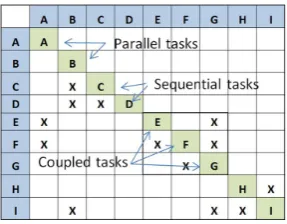
Conventional planning techniques do not handle the cir-cuits inherent in the project planning but the Dependnecy Structure Matrix (DSM) is a useful tool to develop an effec-tive project plan showing how these iterations are handled, where estimates are to be used as well as showing the information flow during the work. The matrix contains a list of all constituent activities and the corresponding information exchange patterns. In a DSM model, each project task is defined by a row of a matrix and a corresponding identically ordered column. The task’s dependencies are represented by placing marks in that particular row in the corresponding columns to indicate the other tasks (columns) on which it depends. Therefore, reading across a row for a specific task reveals all of the tasks whose output is required to perform the task corresponding to that row. Similarily, reading down a column reveals which tasks receive information from the task in that column. Fig. 1 shows an example of a DSM with sequential, parallel and coupled tasks.
The design structure matrix in Fig. 1 shows two marks in row D; in column B and column C. Thus, according to the matrix the output or information from tasks B and C is required to perform task D. Then, task A transfers information to tasks E and F since column A has marks in those rows.
[image:2.595.308.546.56.162.2]The matrix in Fig. 2 , shows three basic building blocks for describing the relationship among the tasks: parallel (or concurrent), sequential (or dependent) and coupled (or inter-dependent). In order to improve the maintenance process, the activities in the matrix are reordered and the same reordering is made of the rows and columns. The objective is to reorder the activities so that the matrix is lower triangular, i.e., all marks are either on or below the diagonal. Then, proceeding in this order, the acivities could be determined one at a time. As each activity is determined, all its required predecessors would be to the left of the diagonal and thus already known. The following algorithm can be used to sequence the tasks [6]:
[image:2.595.306.549.609.762.2]Fig. 1. Dependency structure matrix with sequential, parallel and coupled tasks.
Fig. 2. Basic building blocks descriping the relationship among tasks.
1) All empty rows are moved to the top. 2) All empty columns are moved to the end. 3) All loops are collapsed and scheduled as above. 4) Steps 1)-3) are repeated until all tasks and loops are
sequenced.
This kind of reordering is unfortunately rarely possible due to the coupling of activities. However, the tasks can be reordered by a process known as partitioning, so as to confine the marks in the matrix to appear either below the diagonal or within square blocks on the diagonal. All the tasks that occur in a circuit will then be found in the same block and the blocks represent all the smallest sets of tasks that must be determined jointly.
Once the blocks are found, they are sequenced by the following algorithm [7]:
1) A block which no variable has a predecessor in another unnumbered block is found.
2) The block is assigned the next number.
3) Points 1) and 2) are repeated until all blocks are numbered.
This process is used to order the blocks but the relative ordering of the variables within each block is arbitrary. The order of the activities affects the marks, which are above the diagonal and show where estimates are required to start an iteration. A process known as tearing can be used to choose a set of marks representing where estimates might be made, to obtain an ordering so that the marks represent reasonable estimates. Then, when having made these estimates, no additional estimates should need to be made [8]. Thus, when marks that have been chosen from the block have been removed and the block has been reordered
[image:2.595.98.242.647.759.2]by partitioning, no marks should appear above the diagonal. Fig. 3 shows an example of tearing. The square with tasks A, G and E in Fig. 3 shows a block with circuits where task A requires information from task E, task G requires information from tasks A and E, and task E needs output from task G. There are two circuits, one between G and E, and another one between A, G and E. In order to break both of the circuits, tearing is performed between G and E, which results in a lower triangular matrix. The block that is reordered without the marks removed is called the reduced block and the removed marks are called tears. The block with the tear marks restored is called the torn block, and if the reduced block is lower triangular, the torn block has only tear marks above the diagonal. Thus, every circuit contains a mark that is torn and the reduced matrix has no circuit. When tearing, the first choice of marks to tear are the predecessors that already have been well estimated or can be poorly estimated without significantly affecting the variables they precede. The choices are given numbers where high numbers indicate the better places to tear and lower numbers indicate where estimates are harder to make. The marks with the highest level number are torn first, then the variables are reordered in the block by partitioning, and then the marks with the next higher level numbers are torn [9]. Once the estimates are made of how many times each block is to be iterated and how long the tasks are to take in each iteration, a critical path schedule can be developed [10].
Numerical DSMs contains an attributes that provide infor-mation on the relationships between the different elements of the system such as the overlapping ratio of the duration time [11]. The duration of each activity is also included as the diagonal cell of the matrix. The dependency structure ma-trix methodology provides therefore a representation of the schedule that can be optimized using evolutionary methods.
III. EVOLUTIONARY ALGORITHM
It has been shown, by many authors, that a GA is an efficient and a robust technique that can be applied to both continuous and discrete optimization problems. The main advantages of a GA in the present study are their efficiency and robustness and the ability to operate on mixed integer-order based problems. Genetic algorithms have been widely used to solve or optimize scheduling problems. These GA methods vary in their representation or encoding schemes, the genetic operators, and methods for solution evaluation. The method, maintain a population of encoded tentative solutions that are manipulated by applying some variation operators in the search of global optimum. A general GA goes as follows,
1) Initial generation chosen randomly
2) Individuals in the initial generation evaluated 3) For number of generations
(a) The fittest individuals chosen (b) Crossover
(c) Mutation
(d) All individuals in the generation evaluated 4) Results
GA individuals store the decision variables in a coded representation. The decision variables coded as integer are the order of tasks and the assignment of staff to tasks. The
tournament selection is a widely used selection method for GA where a number of n-individuals is chosen randomly from the population and the best individual from the group is copied to the intermediate population. This is repeated as often as the number of individuals in a generation. The size n is called the tournament size. Increasing the tournament size results in loss of diversity and increasing selection intensity [6]. Genetic Algorithms implicitly maintain statistics about the search space through the population. It has been proposed to use this implicit statistics to explicitly enhance GA’s performance. Inspired by this idea a statistics based non-uniform crossover method has been proposed
In order to get a good coverage of the search space random bits in the resulting individuals from the crossover are mutated with a probability of pm. Low mutation rate speeds up convergence but increases the risk of the algorithm getting stuck in a local minimum, whereas high mutation rate works in the opposite direction.
IV. HYDRO TURBINES OVERHAULS AND OUTAGES
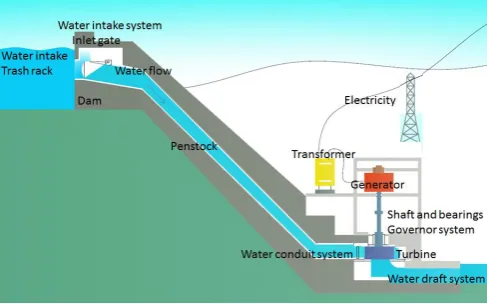
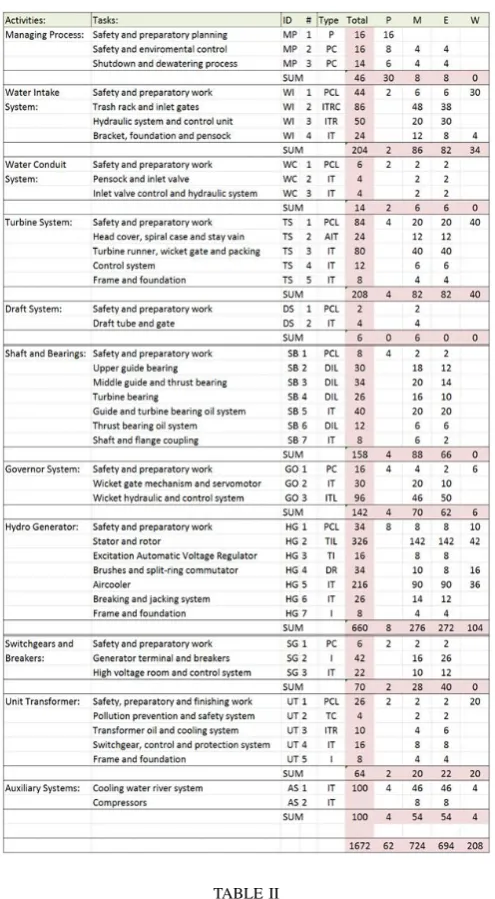
[image:3.595.305.549.613.765.2]The first step in the overhauls and outages of hydro turbines is the management process. The outage is planned and each activity is scheduled. Here the DSM is used as a managing tool for preliminary analysis. In this formulation the maintenance supervisor (P) is also a planner and a sched-uler. The supervisor manages a group of staff and contractors with different skills and experiences. The group consists of mechanics (M), electricians (E), and workmen (W). The type of work that is performed can be defined as, Planning (P), Controlling (C), Dismantling (D), Inspection (I), Cleaning (L), Testing (T), Repairing (R) and Reassembling (A) as shown in Table II. After the planning, scheduling and staffing process, the safety and environmental issues are considered. The planned overhaul usually begins with a visual inspec-tion before the shutdown. First, the condiinspec-tion of the foun-dation, anchor bolts, piping, flanges and valves is examined. Also, before the dewatering process the leakage is checked at accessible areas, for example at the main valve, the penstock and the turbine. Then, the safety and environmental programs and standards are listed for each maintenance unit. The main units are shown in Fig. 4 and listed in Table I. For each unit, there are a number of tasks to perform and each task has a resource requirement as shown in Table II.
At the water intake for the power plant there is a trash rack and an inlet gate. The gate is used for cutting off the water supply to the turbine when the unit is shut-down and dewatering is required to permit access for maintenance of the connecting penstocks. The intake has a motor lifted, gravity lowered gate and valve, with an automatic release operated by an excess flow device if a burst occurs in a pipe line. Main inlet valves at the turbine are opened by an oil servomotor. The penstock and the inlet valve system are defined as the water conduit system. From the inlet valve the water flows in Francis turbines through the spiral case, stay vain and wicket gates to the runner. The governor is the speed/load control of the turbine and the main controller in which it adjusts, by guide vanes and wicket gate, the flow of water through the turbine to balance the input power with the load. From the runner, the water flows through the water draft system. The turbine is connected to the generator with a shaft that has one thrust bearing, two guide bearings on each side of the generator and the turbine bearing. The main parts of the generator are the stator, rotor and excitation system. From the generator, the electricity is transmitted through the generator terminal and breakers to the unit transformer.
V. RESULTS
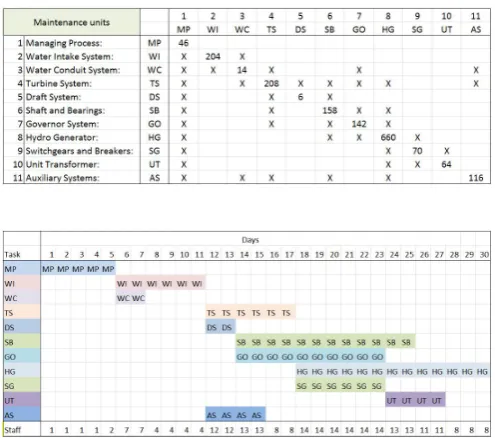
The case studied here is the Hrauneyjarfoss power plant unit 1 and the total workload for this overhaul project is estimated as 1672 man-hours, as shown in Table I. The planner or supervisor uses 8 to complete his part, based on an eight hour work day, but a team of mechanics, electricians and workmen are assigned to each task as shown in Table II. Allowable resources are one planner that is assigned to all tasks, seven mechanics, seven electrician and three workmen. The order of activities and the dependencies between activities for main maintenance units are shown in Table III. This permutation is based on best practice and is the same as the order of the work previously performed and Fig. 5 shows Gantt charts with couplings between activities. The make span is 30 days and the staff includes 6 mechanics, 6 electrician and 2 workmen. The outages are planned from day 5 and will last for 25 days.
The dependencies rules are used as discussed in chapter II, to sequence the tasks and the activities. The activities are reordered by the following partitioning process:
1) All empty rows are moved to the top. 2) All empty columns are moved to the end. 3) All loops are collapsed and scheduled as above. 4) Steps 1)-3) are repeated until all tasks and loops are
[image:4.595.303.551.83.533.2]sequenced.
Table IV, shows the dependency structure matrix after the partitioning process. At least four blocks need to be considered. The first block is the switchgear and the trans-former system, the next one is the draft and the turbine system and then it is the water intake and the conduit system. The last block is the auxiliary, the hydro generator and the shaft bearings system. The blocks are are sequenced by the following algorithm:
1) A block which no variable has a predecessor in another unnumbered block is found.
2) The block is assigned the next number.
3) Points 1) and 2) are repeated until all blocks are numbered.
TABLE I
TASKS ASSIGNED TO EACH ACTIVITY, TYPE OF WORK AND ESTIMATED WORKLOAD ON DIFFERENT SKILLS
TABLE II
MAINTENANCE UNITS AND ESTIMATED MAN-HOURS
[image:4.595.303.551.550.656.2]TABLE III
DEPENDENCY STRUCTURE MATRIX PRIOR TO SEQUENCING AND PARTITIONING PROCESS.
[image:5.595.46.294.367.632.2]Fig. 5. Gantt chart for schedule based on dependency structure matrix in Table III.
TABLE IV
DEPENDENCY STRUCTURE MATRIX AFTER SEQUENCING AND PARTITIONING PROCESS.
Fig. 6. Gantt chart for schedule based on dependency structure matrix in Table IV.
is reduced. When the blocks are coupled, the efficiency of the maintenance team can be increased, reducing the total makespan of the work outages and shortening the outages as shown in Fig. . By using these blocks and adding one workman to the staff the make span reduce to 24 days as shown in Fig. . The outages last for 19 days and the total period of the 12 years overhaul has been reduced without increasing the cost.
VI. CONCLUSION
This paper introduces a novel approach for designing a planning and a scheduling methodology using a Dependency Structure Matrix (DSM). The method was successfully tested by scheduling a 12 years overhaul and outages for a hydro turbine at Landsvirkjun power plant in Iceland. One of the premises for a successful use of the DSM methodology is that the data used is of high quality, i.e. the task breakdown has a reasonable granularity and that the relationships of these tasks is known with a high level of certainty. The data used to create the matrix for this project did not fully meet these requirements. Although a large part of the tasks have sufficient granularity and their relationships with other tasks is known, other tasks lack these important properties.
ACKNOWLEDGMENT
The author wishes to thank Landsvirkjun and Thrandur Rognvaldsson maintenance specialist for their contribution to this work.
REFERENCES
[1] H. Wang, “A survey of maintenance policies of deteriorating systems,”
European Journal of Operational Research, vol. 139, no. 3, pp. 469– 489, 2002.
[2] A. Garg and S. G. Deshmukh, “Maintenance management: literature review and directions,”Journal of Quality in Maintenance Engineer-ing, vol. 12, no. 3, pp. 205–238, 2006.
[3] C. F. G. J. M. Simes and M. M. Yasin, “A literature review of mainte-nance performance measurement,”Journal of Quality in Maintenance Engineering, vol. 17, no. 2, pp. 116–137, 2011.
[4] D. Sherwin, “A review of overall models for maintenance manage-ment,”Journal of Quality in Maintenance Engineering, vol. 6, no. 3, pp. 138–164, 2000.
[5] D. V. Steward, “The design structure system: A method for managing the design of complex systems,”IEEE Transactions on Engineering Management, vol. 28, no. 3, 1981.
[6] K. T. Ulrich and S. D. Eppinger,Product design and development, 5th ed. Mc Graw Hill, 2012.
[7] R. P. S. S. D. Eppinger, D. E. Whitney and D. A. Gebala, “A model-based method for organizing tasks in product development,”Research in Engineering Design, vol. 6, pp. 1–13, 1994, springer-Verlag London Limited.
[8] E. F. T. R. Browning and H. Negele, “Key concepts in modeling product development processes,” Syst. Eng., vol. 9, no. 2, pp. 104– 128, 2006.
[9] S. F. L. C. H. Chen and W. Chen, “Project scheduling for collaborative product development using dsm,”Int. J. Proj. Manag., vol. 21, no. 4, pp. 291–299, May 2003.